
Lumon Definition and Meaning: The Complete Guide to Its Origin, Uses & Surprising Meanings
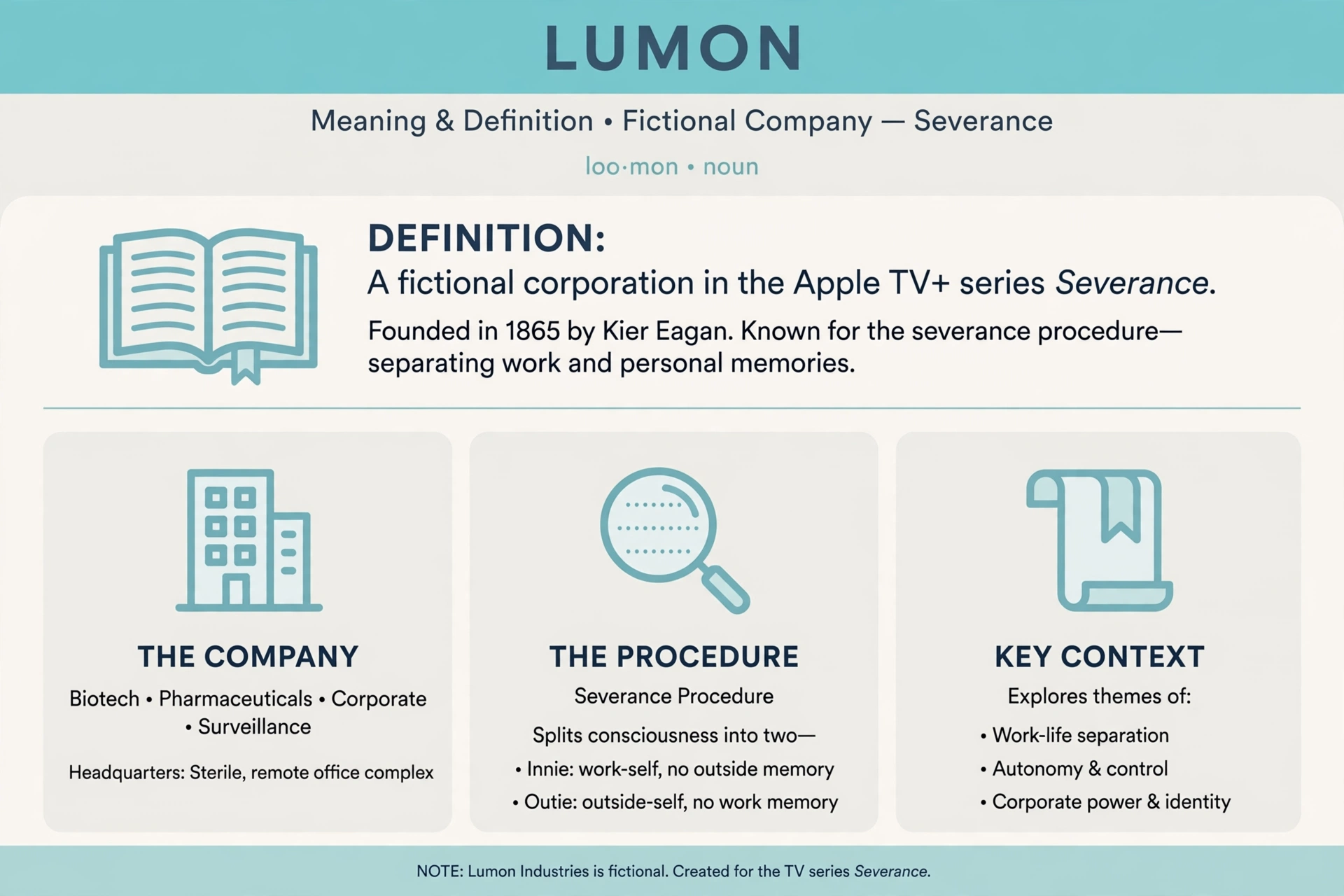
Lumon definition and meaning: The word lumon carries several meanings depending on context. Most famously, Lumon refers to Lumon Industries, the fictional biotech corporation from the hit Apple TV+ series Severance. As a standalone word, “lumon” comes from the Latin lumen (meaning “light”) and suggests illumination, clarity, or brightness. In Tagalog, lumón is a medicinal moss that grows on coconut trees. In modern slang, calling a workplace “Lumon” means it feels controlling, secretive, or dystopian.
Lumon Definition and Meaning: Meaning & Definition
If you searched for the lumon definition and meaning, you are in the right place. Unlike ordinary dictionary words, “lumon” does not have one single, settled definition — its meaning changes with the conversation you are in. Here is the complete breakdown:
- Primary meaning (pop culture): Lumon is the name of the mysterious biotech company — Lumon Industries — at the center of the television series Severance. It is a proper noun, always capitalized.
- Linguistic meaning: “Lumon” is closely related to the Latin word lumen, which means “light.” As a result, the word carries associations with illumination, brightness, clarity, and knowledge.
- Slang meaning: In online conversations, “Lumon” (or “Lumon-like”) is used as shorthand for any controlling, secretive, or dehumanizing workplace or organization.
- Tagalog meaning: In Filipino, lumón is a noun meaning a kind of medicinal moss that grows on coconut trees (root word: lumot).
Pronunciation: loo-MUN (rhymes with “moon”). Part of speech: Proper noun (the company), common noun in Tagalog (the moss), and informal adjective/noun in slang usage.
Because “lumon” is not yet listed in most standard English dictionaries, people often get confused when they first hear it. Some mix it up with lumen (the scientific unit of light), while others assume it is a misspelling. This guide clears up every version of the word so you can use it confidently. Like every pop-culture slang term born from a hit show, “lumon” carries layers of meaning worth unpacking.
Introduction
You have probably seen the word Lumon pop up somewhere recently — maybe in a Severance fan thread, in a meme about someone’s nightmare office job, or even in a word game like the NYT Connections puzzle. It is one of those words that feels familiar but is hard to pin down, and that is exactly why the lumon definition and meaning is such a popular search.
Here is the short version of the story: “lumon” is a made-up-sounding word with very real roots. It borrows from Latin, grew famous through one of the most talked-about TV shows of the decade, picked up a second life as internet slang for toxic workplaces, and — in a completely separate corner of the world — it has existed for generations as an ordinary Filipino word for moss. One word, four different lives.
In this article, we will walk through all of them. You will learn where “lumon” came from, why it exploded in popularity, how people actually use it in everyday conversation (with friendly, professional, and funny examples), what it is commonly confused with, and the mistakes to avoid when using it. Whether you are a Severance fan, a language lover, or just someone who saw the word and got curious, this is the only guide you need.
Origin
The origin of “lumon” is actually three separate origin stories woven into one word. Understanding each one explains why the lumon definition and meaning feels so layered.
The Latin Root: Lumen (Light)
The oldest root of “lumon” is the Latin word lumen, which means “light” — specifically a source of light, an opening that lets light through, or brightness itself. Latin lumen gave English a whole family of words you already know: luminous (glowing), illuminate (to light up), luminary (a person who inspires or guides others), and luminescence (the emission of light).
Science kept the root alive, too. The lumen is the SI unit of luminous flux — the standard measure of how much visible light a source produces (one lumen is roughly the light of a single candle at one meter). In biology and anatomy, a lumen is the inside space of a tubular structure, like a blood vessel — an “opening” through which something passes. The creators behind the fictional name clearly tapped into this rich word family: “lumon” sounds like “luminous” with the “i” dimmed out, which fans have noted feels perfectly on-theme for a company built on secrets and shadows.
The Severance Origin: A Deliberate Invention
The modern fame of the word comes from Severance, the psychological thriller series created by Dan Erickson. In interviews, the show’s creators have discussed choosing the name Lumon Industries deliberately: it evokes light, clarity, and progress — everything a futuristic wellness-and-science company wants to project — while the show itself reveals the darkness underneath that polished image. The name is a piece of storytelling: illumination twisted by control.
Fans have also noticed the wordplay. Pronounced “loo-MUN,” it rhymes with lemon — a sour little joke hiding inside a sinister corporate name. Online fan communities, including widely discussed Reddit threads, have dissected the name as “lumen, inverted”: light that does not quite shine, fitting for a company whose employees work under fluorescent lights with their memories divided in two.
The Tagalog Origin: An Entirely Separate Word
Completely independent of Latin and television, lumón exists in Tagalog (Filipino), where it means a kind of medicinal moss that grows on coconut trees. It comes from the root lumot (moss). This is a coincidence of language, not a borrowing — a reminder that similar-sounding words can evolve in totally different parts of the world with totally different meanings. It belongs to a fascinating family of words with surprising Latin roots and double lives in different languages.
Popularity
The word “lumon” went from obscure to everywhere in a remarkably short time, and the lumon definition and meaning is now one of the more searched pop-culture term queries online. Here is how that happened:
- 2022 — The Severance boom: When Severance premiered, Lumon Industries became one of television’s most discussed fictional companies. The show’s eerie corporate aesthetic — endless white hallways, retro computers, cryptic company slogans — turned “Lumon” into instant cultural shorthand for creepy corporate control.
- Fan communities and memes: Viewers began comparing their own workplaces to Lumon. Posts like “my office just installed keystroke tracking, welcome to Lumon” spread across social media, cementing the word’s second life as workplace slang.
- Dictionary and glossary entries: Because standard English dictionaries did not list “lumon” before the show, fan wikis, slang glossaries, and meaning-blogs (like this one) filled the gap — each offering their own take on the lumon definition and meaning.
- 2025 — Season 2 and the puzzle moment: The show’s second season expanded Lumon’s fictional history and global reach, sparking a fresh wave of searches. Around the same time, “LUMON” appeared in the NYT Connections puzzle (#635, March 2025) as part of a group of fruit names with their second letter changed — lumon standing in for lemon — introducing the word to thousands of puzzle fans who had never seen the show.
- Ongoing slang usage: Today, “Lumon” functions as a ready-made adjective for anything that feels overly monitored, cult-like, or secretive at work — from aggressive return-to-office mandates to companies with mysterious “culture” rituals.
Unlike flash-in-the-pan slang, “lumon” has staying power because it is anchored to a beloved show and to a genuinely useful concept. As long as people work in strange offices, they will need a word for it — and “Lumon” fits perfectly.
How It Is Used
So how do people actually use the word in real life? The lumon definition and meaning in practice depends on who is talking and where. Here are the four main usage patterns:
- As a proper noun (the company): “Have you watched the new episode? Lumon is hiding something huge.” — Used exactly like any company name, always capitalized.
- As workplace slang (adjective or noun): “This new badge-tracking policy is so Lumon.” / “I swear I work at Lumon now.” — Used informally to criticize controlling or secretive work environments. Usually lowercase in casual texting, though many writers keep the capital L.
- As a creative or poetic word (light symbolism): Writers and poets occasionally use “lumon” as a coined word for a source of light or clarity — “a lumon in the dark.” This usage is rare and artistic rather than standard.
- As a Tagalog noun (the moss): In Filipino contexts, lumón refers to the medicinal coconut-tree moss. This usage has nothing to do with the TV show and appears in botanical or traditional-medicine discussions.
| Context | How “Lumon” Is Used | Example |
|---|---|---|
| TV discussion | Proper noun — the fictional company | “Lumon just dropped a terrifying new training video.” |
| Workplace chat | Slang — controlling employer | “Three meetings about ‘culture’ today. Peak Lumon.” |
| Creative writing | Symbolic — light, clarity | “Her words were a lumon in his confusion.” |
| Filipino/botanical | Noun — medicinal moss | “Lumón is traditionally gathered from coconut trunks.” |
Tone note: In slang use, “Lumon” is almost always critical or joking-never-complimentary. Nobody calls their workplace “Lumon” as praise. The tone ranges from playful eye-roll (“lol, very Lumon of them”) to genuinely bitter (“this place is Lumon, I’m quitting”). If you enjoy this kind of vocabulary, explore our guides to other workplace slang terms and internet vocabulary.
Examples
Examples make the lumon definition and meaning click instantly. Here is how the word sounds in friendly chats, professional settings, and funny contexts.
Friendly Examples
- Texting a friend about a show:
A: “Finally started Severance!!”
B: “Yesss, wait till you meet Lumon — that company is NOT normal” - Casual group chat:
“Guys my new job makes us do morning chants… am I joining Lumon or what” - Recommending the series:
“If you like mind-bending shows, watch Severance. Lumon Industries will live in your head rent-free.” - Reacting to office news:
“They’re putting cameras in the break room now?? Okay, Lumon behavior”
Professional Examples
- In a media-studies discussion: “Lumon Industries functions as a critique of modern corporate paternalism — the show uses the company’s wellness rhetoric to mask its coercive practices.”
- In a branding case study: “The name ‘Lumon’ is a masterclass in corporate naming: it borrows the positive associations of ‘lumen’ (light, clarity) while the narrative subverts them.”
- In a workplace-culture article: “Employees increasingly describe surveillance-heavy employers as ‘Lumon-like,’ signaling a cultural anxiety about the blurring of work and identity.”
- In a linguistics context: “Unlike lumen, which is an established scientific term, lumon remains a proper noun in English outside of its Tagalog homonym.”
Funny Examples
- “My cat stares at me while I work from home. She’s my personal Lumon supervisor.”
- “Day 47 of corporate life: they replaced the coffee machine with ‘hydration optimization stations.’ Lumon arc complete.”
- “POV: you asked for a raise and HR scheduled a ‘wellness session’ instead. Welcome to Lumon.”
- “My phone’s screen-time report judging me every Monday morning is the most Lumon thing in my life.”
Notice the pattern: in jokes, “Lumon” is the punchline for anything that feels monitored, corporate-mandated, or absurdly “optimized.” The humor works because everyone instantly pictures those endless white hallways.

Comparison with Similar Terms
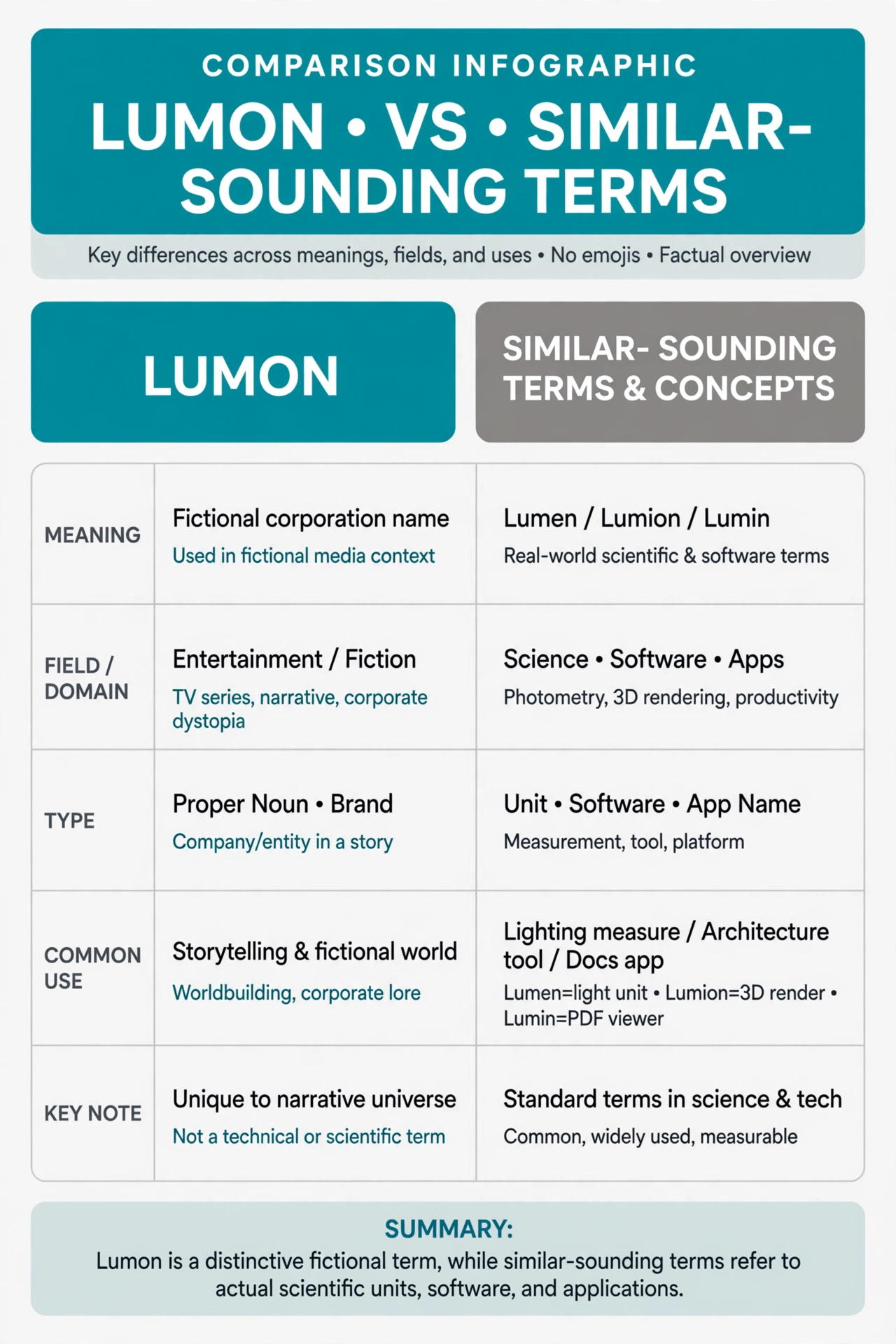
Part of nailing the lumon definition and meaning is knowing what it is not. These look-alike and related terms get mixed up constantly:
| Term | Meaning | How It Differs from “Lumon” |
|---|---|---|
| Lumon | Fictional company from Severance; slang for a controlling workplace | The word in question — a proper noun / slang term |
| Lumen | SI unit of light; also an anatomical term for a cavity/opening | A real scientific word; “lumon” is often a misspelling of this |
| Luminous | Adjective meaning glowing or radiant | A standard English adjective; “lumon” is not an adjective in standard English |
| Luminary | A person who inspires others; a notable figure | Refers to people, not companies or light itself |
| Illuminate | Verb meaning to light up or clarify | An action word; “lumon” names a thing, not an action |
| Lumón (Tagalog) | Medicinal moss on coconut trees | Same spelling, different language, different meaning entirely |
| Big Brother | Slang for oppressive surveillance (from 1984) | Older literary reference; “Lumon” is the modern workplace-specific version |
Quick rule of thumb: if you are talking about science or measurements, you want lumen. If you are talking about the TV show or a creepy office, you want Lumon. If you are talking about moss in the Philippines, you want lumón.
Alternate Meanings
Beyond the headline definitions, “lumon” has a few lesser-known alternate meanings worth knowing:
- The Tagalog botanical meaning: As covered above, lumón (from lumot) is a medicinal moss gathered from coconut trees in the Philippines. This is the word’s only “official” dictionary definition in any language.
- The NYT Connections “lemon”: In the March 2025 NYT Connections puzzle (#635), LUMON appeared as one of four words formed by changing the second letter of a fruit name — “lumon” was simply “lemon” with a twist. It has no meaning there beyond the wordplay, but it shows how recognizable the letter pattern has become.
- A poetic coinage for “a light”: Some writers use “lumon” the way they might use “beacon” — a small, invented noun meaning a source of illumination or insight. This is creative license, not standard usage.
- Surnames and brand names: “Lumon” occasionally appears as a surname or small-business name in various countries. These are independent coinages, usually chosen for the pleasant “light” sound.
- Misspelling of “lumen”: Honestly, a large share of “lumon” sightings online are just typos for lumen — especially in discussions of light bulbs, projectors, and phone brightness (“how many lumons does this flashlight have?” should be lumens).
When you encounter “lumon” in the wild, context is everything. A botany forum, a TV subreddit, and a product review for LED bulbs are talking about three completely different things that happen to share six letters.
Professional or Polite Alternatives
The slang use of “Lumon” is fun with friends, but calling your actual employer “Lumon” in a professional setting is a fast way to sound insubordinate. Here are polished alternatives for each sense of the word:
- Instead of “my company is so Lumon” (critical slang), try:
- “a highly structured organization”
- “a process-driven workplace”
- “a hierarchical corporate culture”
- “a compliance-heavy environment”
- “an organization with intensive oversight”
- Instead of “lumon” as “a light” (poetic use), try standard English:
- luminous — “a luminous idea”
- illuminating — “an illuminating explanation”
- radiant — “a radiant personality”
- beacon — “a beacon of clarity”
- For the scientific sense, always use lumen (plural: lumens), never “lumon” — e.g., “a 1,600-lumen bulb,” not “a 1,600-lumon bulb.”
When “Lumon” is fine as-is: discussing Severance, writing fan content, joking with friends about work, or writing about the Tagalog word lumón. In all of those, no alternative is needed — the word is exactly right.
Common Mistakes
These are the errors people make most often with the lumon definition and meaning — avoid them and you will already sound more knowledgeable than most of the internet:
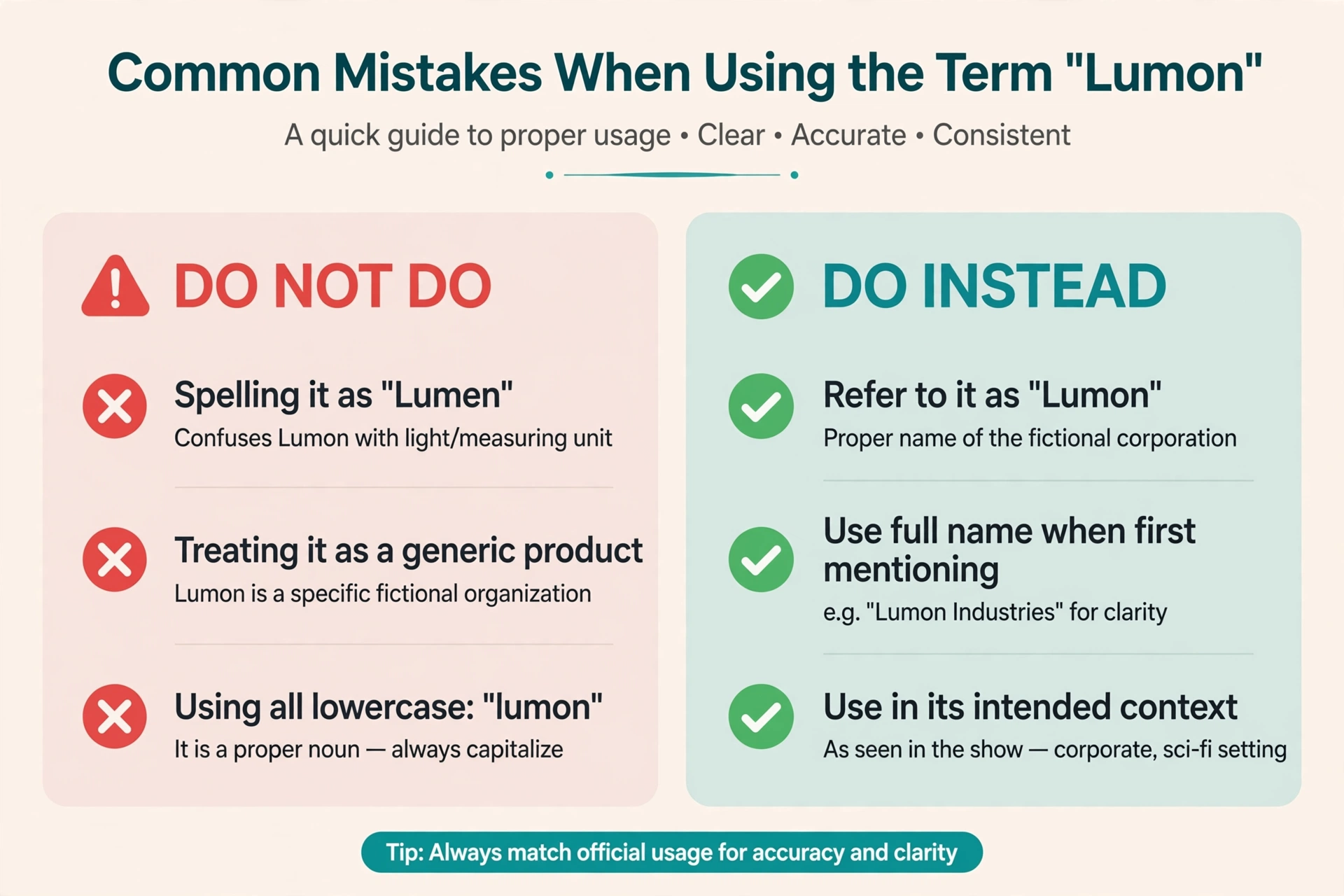
- Confusing “lumon” with “lumen”: The single most common mistake. Lumen is the scientific unit of light; lumon is the fictional company (or the moss, or the slang). Double-check which one you mean before you hit send.
- Treating it as a standard English dictionary word: Outside of Severance fandom and slang, “lumon” is not established English vocabulary. Do not use it in formal writing to mean “light” — use luminous or illumination instead.
- Wrong capitalization: The company is Lumon (capital L). Writing “lumon industries” in lowercase looks sloppy in any serious discussion of the show.
- Mispronunciation: It is “loo-MUN,” not “LOO-mon” or “luh-MON.” Getting this right instantly marks you as someone who knows the reference.
- Using the slang at work: Calling your boss’s new policy “very Lumon” in a team meeting might get a laugh — or a meeting with HR. Keep the slang in casual channels.
- Forgetting the Tagalog meaning exists: If a Filipino reader mentions lumón, they are talking about moss, not television. Context-check before you reply with a Severance meme.
- Overusing it until it loses meaning: Like all slang, “Lumon” hits hardest sparingly. If everything is “Lumon,” nothing is.
Quick Tips
- Memory trick: Think “Lumon = the company with the lights always on” — the Latin lumen (light) connection makes the spelling stick.
- Spell-check survival: Most spell-checkers will flag “lumon” and suggest “lumen” or “lemon.” Add it to your dictionary if you write about the show often — or you will “correct” it into an error.
- Capitalize the company: Lumon Industries always takes capitals; the slang can go either way, but capital L reads more intentional.
- Use it as social shorthand: “That’s so Lumon” is the fastest way to say “this workplace policy feels dystopian” — your audience will get it instantly if they know the show.
- Pair it with specifics: The slang lands harder with an example: “Mandatory fun Fridays? Very Lumon.” beats a bare “this is Lumon.”
- Know your audience: With Severance fans, go deep on the lore. With everyone else, a one-line gloss (“the creepy company from Severance“) keeps the conversation moving.
- When in doubt, clarify: A quick “Lumon — the fictional company, not the light unit” prevents 90% of confusion in mixed audiences.

FAQ
1. What does “lumon” mean?
“Lumon” most commonly refers to Lumon Industries, the fictional biotech company from the Apple TV+ series Severance. The word derives from the Latin lumen (light), and in modern slang it describes a controlling or secretive workplace. In Tagalog, lumón separately means a medicinal moss.
2. Is “lumon” a real English word?
Not in the traditional sense — it does not appear in most standard English dictionaries. It is a proper noun (the fictional company), an internet slang term, and a coined word with Latin roots. Its only established dictionary definition is the Tagalog lumón (moss).
3. What is Lumon Industries in Severance?
Lumon Industries is the mysterious biotechnology corporation at the center of Severance. In the show’s story, it developed the “severance” procedure that surgically divides employees’ work and personal memories. The company is portrayed as secretive, cult-like, and controlling — which is why its name became slang for dystopian workplaces.
4. What is the origin of the word “lumon”?
“Lumon” comes from the Latin lumen, meaning “light.” The show’s creators chose it to evoke illumination, clarity, and progress — then subverted those associations with the company’s dark behavior. Separately, the Tagalog lumón (moss) evolved independently from the root lumot.
5. What does “lumon” mean in Tagalog?
In Tagalog, lumón means a kind of medicinal moss that grows on coconut trees. It comes from the root word lumot (moss). This meaning has no connection to the TV show — it is a coincidence of language.
6. How do you pronounce “lumon”?
It is pronounced “loo-MUN” — rhyming with “moon.” Note that it coincidentally rhymes with “lemon,” a bit of wordplay fans love to point out (and one that even showed up in an NYT Connections puzzle).
7. Why do people compare their jobs to Lumon?
Because Lumon Industries in Severance represents the ultimate controlling employer: constant surveillance, enforced positivity, blurred boundaries between work and self, and mysterious corporate rituals. When real workplaces introduce invasive monitoring or cult-like “culture” initiatives, calling them “Lumon” is shorthand for “this feels dystopian.”
8. What is the difference between “lumon” and “lumen”?
Lumen is a real scientific word — the SI unit measuring light output (plural: lumens) — and an anatomical term for a bodily cavity. Lumon is the fictional company name and slang term. They share the Latin root but are different words; mixing them up is the most common mistake people make.
Want to keep decoding trending words? Browse our more pop-culture term meanings for other slang explained.
Conclusion
The lumon definition and meaning turns out to be richer than a single dictionary line. It is a Latin-rooted word for light, reborn as television’s most unsettling fictional company, repurposed by the internet as the perfect insult for a controlling boss — and, in an entirely different language, the everyday name for a humble moss on a coconut tree.
The practical takeaways are simple: capitalize it when you mean the company, do not confuse it with the scientific lumen, pronounce it “loo-MUN,” and save the slang version for casual conversation rather than the performance review. Use it precisely, and “Lumon” does something rare for internet vocabulary — it carries a whole critique of modern work culture inside six letters.
Now that you know the full story, you will never stare blankly at the word again — whether it shows up in a finale recap, a group chat rant about your office, or a puzzle grid. And if someone asks you what it means, you have got the complete answer.
