If you’ve seen the word pop up in a text, a tweet, or a dating app bio and paused to figure out what the person actually meant, you’re not alone. The phrase kink meaning slang gets searched thousands of times a month because the word carries two completely different meanings depending on where you encounter it — and most guides online blur the two together instead of separating them clearly.
This article breaks down both meanings, where the word came from, how to tell which one someone is using, and the real terminology behind it — without the vague filler you’ll find on most “meaning” sites.
What Does Kink Mean in Slang? Two Distinct Meanings
Before anything else, understand this: when people search for kink meaning slang, they’re usually trying to figure out one of two things.
- The casual, everyday meaning — a quirky personal habit or preference someone jokes about (“organizing my bookshelf by color is my kink”)
- The sexual/community meaning — an unconventional sexual interest, tied to the broader kink and BDSM community, where the word has specific, well-established terminology attached to it
Both are correct. Neither is “the real one.” The confusion happens because the same word slides between an innocent joke and a genuinely sexual topic depending entirely on context, tone, and who’s talking.
Here’s the fastest way to separate them:
| Signal | Casual/Joke Meaning | Sexual/Community Meaning |
|---|---|---|
| Topic of conversation | Habits, hobbies, food, routines | Dating, attraction, relationships, identity |
| Tone | Exaggerated, funny, self-deprecating | Direct, personal, sometimes serious |
| Where it appears | TikTok captions, group chats, memes | Dating apps, kink forums, relationship talk |
| Follow-up question | “Wait, what’s yours?” (as a joke) | “Are you into anything specific?” |
| Explicit detail given | Rarely — the whole joke is vagueness | Sometimes, in trusted or explicit spaces |
Understanding this split is the entire key to decoding kink meaning slang correctly in any conversation you come across it in.
Where the Word Kink Comes From
The word didn’t start as slang at all. It’s a genuinely old English word with a boring original definition: a twist, bend, or kink in a rope, wire, or piece of hair.
- Original meaning (centuries old): a physical twist or knot, like “there’s a kink in the garden hose”
- Early 1900s expansion: the word started being used for a “twist” in someone’s personality or character — a quirk or unusual trait
- Mid-20th century: psychology and sexology writers began using “kink” specifically to describe unconventional sexual interests, treating it as a lighter, less clinical alternative to “paraphilia” or “deviance”
- Internet era (2000s–today): online communities adopted the word openly, and it split into the two branches — the joke version and the identity/community version — that coexist today
So when you ask what the kink meaning slang actually is, you’re really asking about the tail end of a hundred-year-old linguistic drift from “twisted rope” to “twisted preference” to “personal identity term.”
The Casual, Everyday Use of Kink
This is the version most people encounter first, usually in a group chat or on social media, and it has almost nothing to do with sex.
How it works: someone frames an ordinary, sometimes oddly specific habit as a “kink” for comedic effect. The humor comes from borrowing the intensity of the sexual term and applying it to something mundane.
Typical examples:
- “Rewatching the same show five times is apparently my kink.”
- “Color-coding my closet? That’s a kink at this point.”
- “Hard mode on every game — it’s a gaming kink, honestly.”
Where you’ll see this version:
| Platform | How It Shows Up |
|---|---|
| TikTok | Captions joking about a weirdly specific habit |
| Twitter/X | Self-deprecating one-liners about routines |
| Group texts | Friends teasing each other about quirks |
| Instagram captions | Lighthearted admissions about odd preferences |
In this context, the kink meaning slang carries zero sexual weight. It’s a stylistic exaggeration — the word is doing comedic work, not literal work.
The Sexual and Community Meaning of Kink
The second branch is the one most people are actually curious about, and it’s also the one most “meaning” websites tiptoe around without ever explaining properly.
In this sense, kink refers to an unconventional sexual interest or preference — something outside what’s considered “standard” sexual behavior. This is the meaning tied to the kink community: a broad, organized subculture built around exploring these interests safely and with mutual consent.
This isn’t a vague online trend — it has real structure, real vocabulary, and real norms that have existed for decades, long before social media existed.
Core ideas within the kink community:
- Interests are personal and vary enormously from person to person
- Consent and communication are treated as non-negotiable foundations, not optional extras
- Many terms exist specifically to help partners communicate boundaries clearly before anything happens
Here’s where a real, useful kink meaning slang glossary matters — because these terms show up constantly in dating profiles, kink forums, and relationship conversations, and almost no competing article explains them properly.
Kink and BDSM Glossary
| Term | Meaning |
|---|---|
| Vanilla | Sex or preferences considered conventional, without kink elements |
| Fetish | A specific object, body part, or scenario that is a strong or necessary source of arousal |
| BDSM | An umbrella term combining Bondage/Discipline, Dominance/Submission, and Sadism/Masochism |
| Dom / Sub | Short for Dominant and Submissive — the two roles in a power-exchange dynamic |
| Switch | Someone who moves between dominant and submissive roles depending on the partner or situation |
| Hard limit | An activity someone is completely unwilling to do, no exceptions |
| Soft limit | An activity someone is hesitant about but might try under the right conditions |
| Safe word | A pre-agreed word used to pause or stop an activity immediately |
| Aftercare | Comfort and check-in time partners give each other after an intense scene |
| Munch | A casual, non-sexual social meetup for people in the kink community to meet in public |
| Kink-friendly | A term used on dating profiles or by therapists/venues signaling openness to kink topics without judgment |
Knowing this vocabulary is what actually separates a shallow explainer from a genuinely useful one — and it’s the biggest gap in almost every article currently ranking for kink meaning slang.
Kink vs. Fetish vs. Quirk vs. Paraphilia
People use these four words interchangeably, but they’re not the same thing, and mixing them up causes real confusion in conversations.
| Term | What It Really Means | Sexual by Definition? |
|---|---|---|
| Kink | A general, unconventional preference or interest, often but not always sexual | Sometimes |
| Fetish | A specific, often necessary trigger for arousal (an object, material, or body part) | Almost always |
| Quirk | A harmless personality trait or habit | No |
| Paraphilia | A clinical/psychological term for atypical sexual interest, sometimes used in a medical context | Yes, by definition |
A simple way to remember it: a quirk is a personality trait, a kink is a preference, a fetish is a specific and often intense requirement, and a paraphilia is the clinical label sexology uses for the same territory kink covers casually.
How to Tell Which Meaning Someone Is Using
Since the same word covers both a joke and a genuine topic, context clues matter more than the word itself. Ask yourself these questions when you’re unsure:
- What’s the surrounding conversation about? Habits and hobbies point to the joke version. Dating, attraction, or relationships point to the real one.
- Is the tone exaggerated or sincere? Over-the-top humor usually signals the casual meaning.
- Where is it being said? A group chat meme is different from a dating app conversation.
- Are other kink/BDSM terms nearby? If someone mentions “hard limits” or “aftercare” in the same message, they’re using the sexual meaning.
- Is there follow-up detail? The joke version stays vague on purpose. The genuine version sometimes gets specific if the setting is appropriate.
Getting comfortable reading these signals is really the whole skill behind understanding zesty meaning slang in real conversations — it’s rarely about the dictionary definition and almost always about context.
When to Use the Word and When to Avoid It
Fine to use:
- Joking with friends about a harmless habit
- Dating conversations where both people are comfortable discussing preferences
- Kink community spaces, forums, or events built around this exact topic
Better to avoid:
- Professional or workplace settings
- Conversations with people you don’t know well, since interpretation varies a lot by age and culture
- Public posts aimed at a broad, mixed audience
Safer alternatives if you want to soften it:
- “Preference” instead of kink, in general conversation
- “Interest” or “thing I’m into,” in vague social contexts
- “Kink-friendly,” specifically when signaling openness without detail (common on dating profiles)
Common Misunderstandings About Kink
“Kink always means something explicit.”
Not true. The joke version is used constantly for completely non-sexual habits, and most people who use the word this way never mean anything sexual at all.
“Kink and fetish are the same thing.”
They overlap but aren’t identical — a fetish is typically narrower and more specific, while kink covers a much wider range of preferences.
“Talking about kink means something is wrong with you.”
This is an outdated assumption. Sexology has treated kink as a normal variation in human sexuality for decades, not a disorder, as long as it’s consensual.
“The kink community is one single thing.”
It’s actually a wide, varied space covering everything from mild interests to structured lifestyles, with its own etiquette, events, and social norms — not a single monolithic group.
Clearing up these misconceptions is honestly the most useful part of understanding kink meaning slang, because most of the confusion people have isn’t about the word — it’s about assumptions attached to it.
Kink Meaning Slang: Quick Reference Table
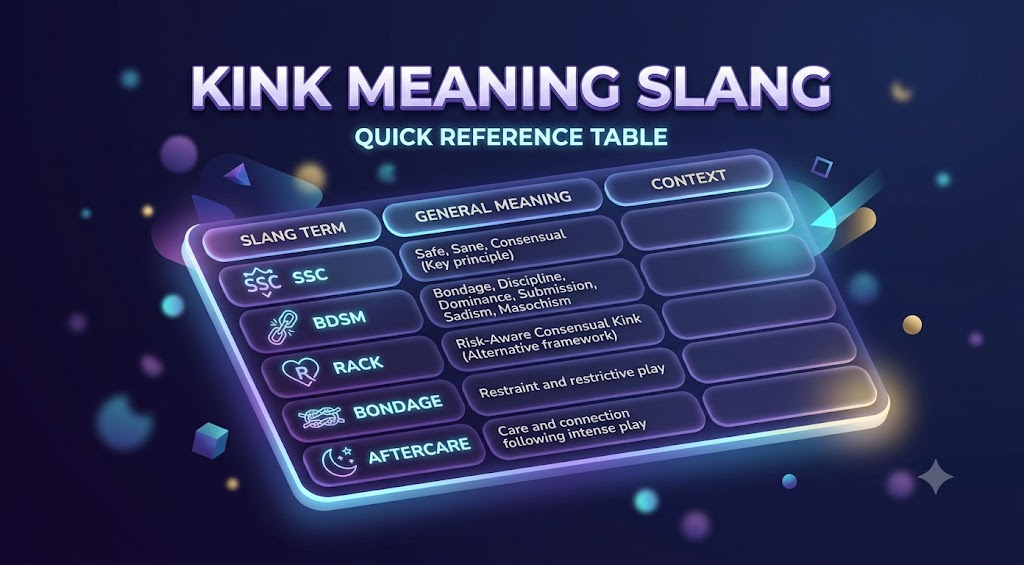
| Question | Short Answer |
|---|---|
| Does kink always mean sexual? | No — it’s often just a joke about a habit |
| Is kink the same as fetish? | No — fetish is more specific and intense |
| Is it appropriate at work? | Generally no, avoid it in professional settings |
| What does “kink-friendly” mean? | Openness to kink topics, common on dating profiles |
| What’s a safe word? | A word used to pause or stop an activity immediately |
| Is kink a new internet term? | No — the sexual usage dates back to mid-20th century writing |
Frequently Asked Questions
Does kink always mean something sexual?
No. It’s frequently used as a joke to describe an odd but harmless personal habit, with no sexual meaning intended at all.
What’s the difference between kink and fetish?
Kink is a broad, general preference, while a fetish is usually a specific object or scenario that plays a strong, sometimes necessary role in arousal.
Is it okay to use the word kink casually with friends?
Yes, among people who know the joking tone, it’s a normal and common way to tease about a quirky habit.
What does “kink-friendly” mean on a dating profile?
It signals that someone is open to discussing kink-related topics or preferences without judgment, without necessarily detailing what those are.
Why do people use kink terminology like “hard limits” or “safe words”?
These terms exist to help partners communicate boundaries clearly and ensure consent stays central to anything explored within the kink community.
Is kink considered a normal part of sexuality?
Yes. Modern sexology generally treats kink as a natural variation in sexual interest, not something inherently problematic, as long as it’s consensual.
Can kink refer to something completely non-sexual?
Yes — in casual slang, it very often does, referring instead to a quirky personality trait or an unusual but harmless preference.
