Quick definition: The omw meaning in text is “on my way.” It is a short, casual way to tell someone you have already left — or are just about to leave — and are heading toward them. When a friend texts “OMW,” they are saying, “I’m coming, hang tight.”
OMW Meaning in Text: Meaning & Definition
OMW is an acronym that stands for “on my way.” In texting, it works as a real-time status update: it tells the other person that your arrival is already in motion, not just planned. It is one of the most practical abbreviations in modern messaging because it answers the two questions every waiting person has — “Are you coming?” and “Where are you?” — in just three letters.
Unlike a vague promise such as “coming soon,” OMW carries a specific claim: you are moving. That is why it feels reassuring. A friend waiting outside a café, a parent waiting for a pickup, or a coworker waiting for a meeting all relax a little when they see it, because it signals action rather than intention.
Here is the meaning in its simplest form:
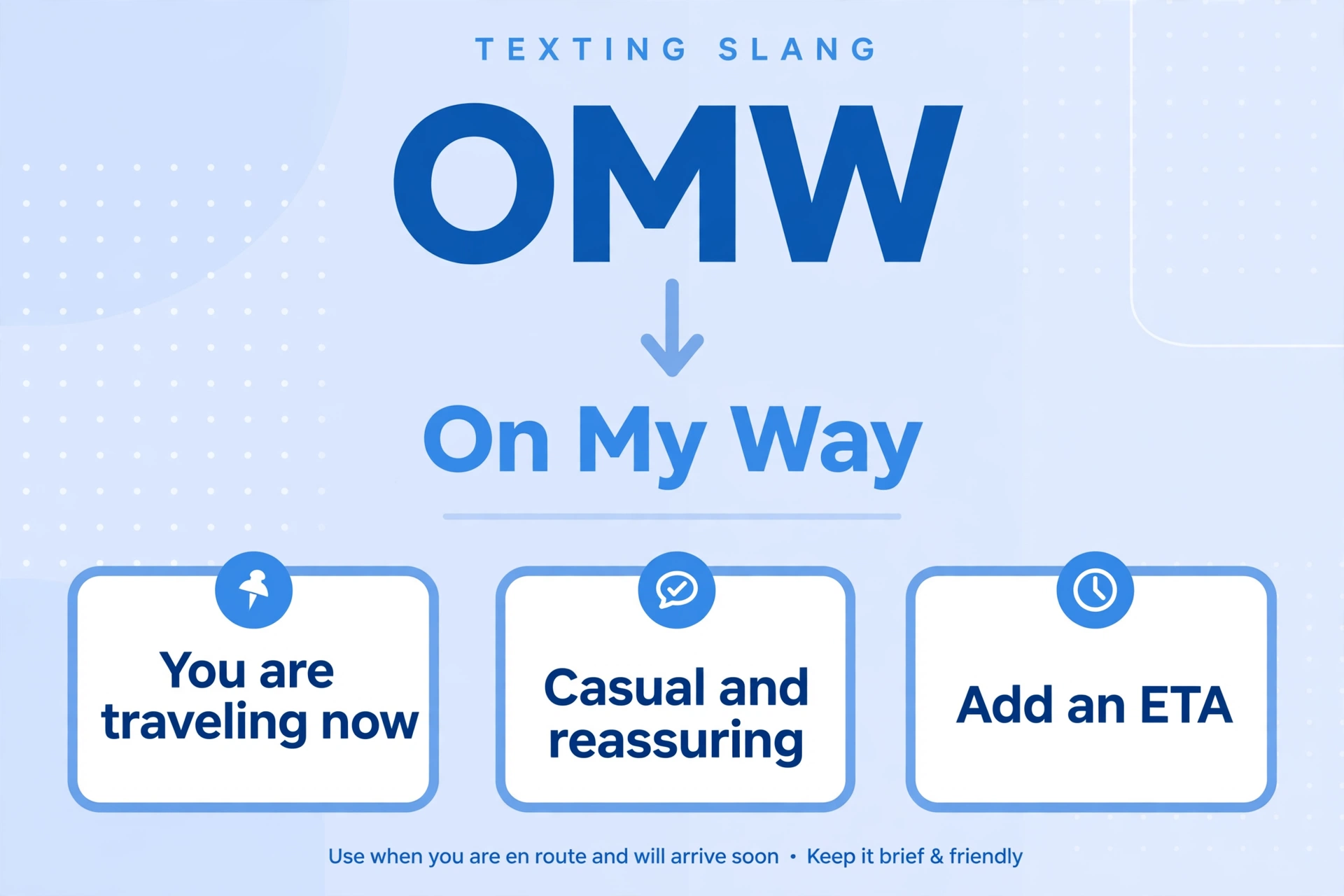
| Element | What It Means |
|---|---|
| OMW | On My Way |
| Core message | I am traveling toward you right now |
| Tone | Casual, friendly, reassuring |
| Where it appears | Texts, DMs, group chats, Snapchat, WhatsApp, Slack |
| Best paired with | An ETA, e.g. “OMW, 10 mins away” |
OMW is almost always written in capital letters, but lowercase “omw” carries the same meaning. Capitals can feel a bit more energetic or urgent, while lowercase reads as relaxed or typed in a hurry. Punctuation matters too: “OMW!” sounds excited, “OMW.” can sound flat or annoyed, and a bare “omw” is neutral.
Introduction
Picture this: you are standing outside a restaurant, checking your phone for the third time, when a message lands — “OMW!” Instantly, the waiting feels easier. You know your friend is on the road, and you can stop wondering whether they forgot. That tiny burst of relief is exactly why OMW has survived decades of texting trends while hundreds of other abbreviations faded away.
The omw meaning in text is simple, but the way people use it is surprisingly rich. It can be a promise, an apology, a joke, or a meme caption. It shows up in flirty chats, family group threads, gaming lobbies, and even quick work messages. And like all good slang, it has unwritten rules: use it honestly, pair it with a time estimate, and never send it from your couch while claiming you are already on the road.
In this guide, you will learn the full OMW meaning in text, where it came from, how to use it in every kind of conversation, how it compares to similar terms like OTW and ETA, the mistakes to avoid, and polite alternatives for formal settings. Whether you are decoding a message you just received or deciding whether OMW fits your next reply, this is everything you need to know. If you have ever wondered what to say when someone asks where you are, the wya meaning in text guide pairs naturally with this one — WYA asks the question, and OMW answers it.
Origin
OMW was born in the era of SMS texting in the late 1990s and early 2000s, when every character cost effort — and often money. Early mobile phones had tiny keypads, small screens, and strict character limits, so people compressed everyday phrases into acronyms. “On my way” became OMW, just as “be right back” became BRB and “laughing out loud” became LOL.
The abbreviation spread through the same channels as other early internet slang: chat rooms, instant messaging apps like AIM and MSN Messenger, and then SMS. By the mid-2000s, OMW was a standard part of texting vocabulary in the United States and beyond. It did not need a viral moment or a celebrity endorsement — it simply solved a daily problem. Everyone, at some point, needs to tell someone they are coming, and OMW said it faster than anything else.
Smartphones gave OMW a second life. Messaging apps, group chats, and social media made it even more common, and it picked up new jobs along the way: a meme caption (“OMW to ruin my sleep schedule again”), a flirty line (“OMW to steal your heart”), and a gaming callout (“OMW mid”). The core meaning never changed, though — movement, in progress, right now.
Popularity
OMW remains one of the most widely used texting abbreviations in English. It ranks among the top text acronyms people search for, and it appears across every age group, though Gen Z and Millennials use it most heavily. Its staying power comes from usefulness: unlike trend-driven slang that burns out in a season, OMW describes a situation that happens every single day.
Several forces keep OMW popular:
- It is universal. Everyone travels, everyone waits, and everyone texts. OMW fits all three.
- It is platform-proof. It works in iMessage, WhatsApp, Instagram DMs, Snapchat, TikTok captions, Discord, and Slack.
- It reduces anxiety. Waiting is stressful; a three-letter update genuinely calms people down.
- It is meme-friendly. The “OMW to…” format is one of the internet’s most durable joke templates.
- It is honest shorthand. Unlike many slang terms, OMW means exactly what it says — there is little room for confusion.
Search interest in OMW meaning has stayed steady for years, spiking whenever memes or TikTok trends revive it. It is the kind of abbreviation that new texters learn within weeks of getting their first phone, and it rarely leaves their vocabulary.
How It Is Used
OMW is used to announce that you are en route. The most common pattern is a reply to a “where are you?” message, but it also works as a proactive update — sent before anyone asks — to show you are on top of your plans.
Here are the everyday situations where OMW fits perfectly:
- Meeting friends: “OMW, see you in 10!”
- Answering a check-in: “Where are you?” → “OMW!”
- Family pickups: “OMW to pick you up from practice.”
- Work and meetings: “Running a few minutes late — OMW to the meeting room.”
- Group chats: “Pizza just arrived?” → “OMW!!! Save me a slice!”
- Gaming: “OMW mid, hold the lane.”
- Dates and meetups: “OMW, just parked down the street.”
- Travel updates: “Flight landed, OMW to the hotel.”
Notice the pattern: OMW almost always comes with context. On its own, it says you are moving. With an ETA, a location, or a reason, it becomes a complete update. The best OMW messages answer three questions at once: Are you coming? (Yes.) Where are you in the journey? (On the road.) When will you arrive? (In about X minutes.) Adding that third detail is what separates a helpful OMW from a lazy one.
Tone also shapes the message. “OMW!” with an exclamation mark reads as enthusiastic. “OMW, sorry, traffic is terrible” reads as apologetic. “omw” in lowercase reads as casual or rushed. And “OMW…” with an ellipsis can read as sarcastic — as if the sender is moving but not happy about it. When in doubt, add a few words or an emoji so your tone lands the way you intend.
Examples
The best way to understand OMW is to see it in real conversations. The examples below cover friendly, professional, and funny uses, so you can match the tone to your situation.
Friendly Examples
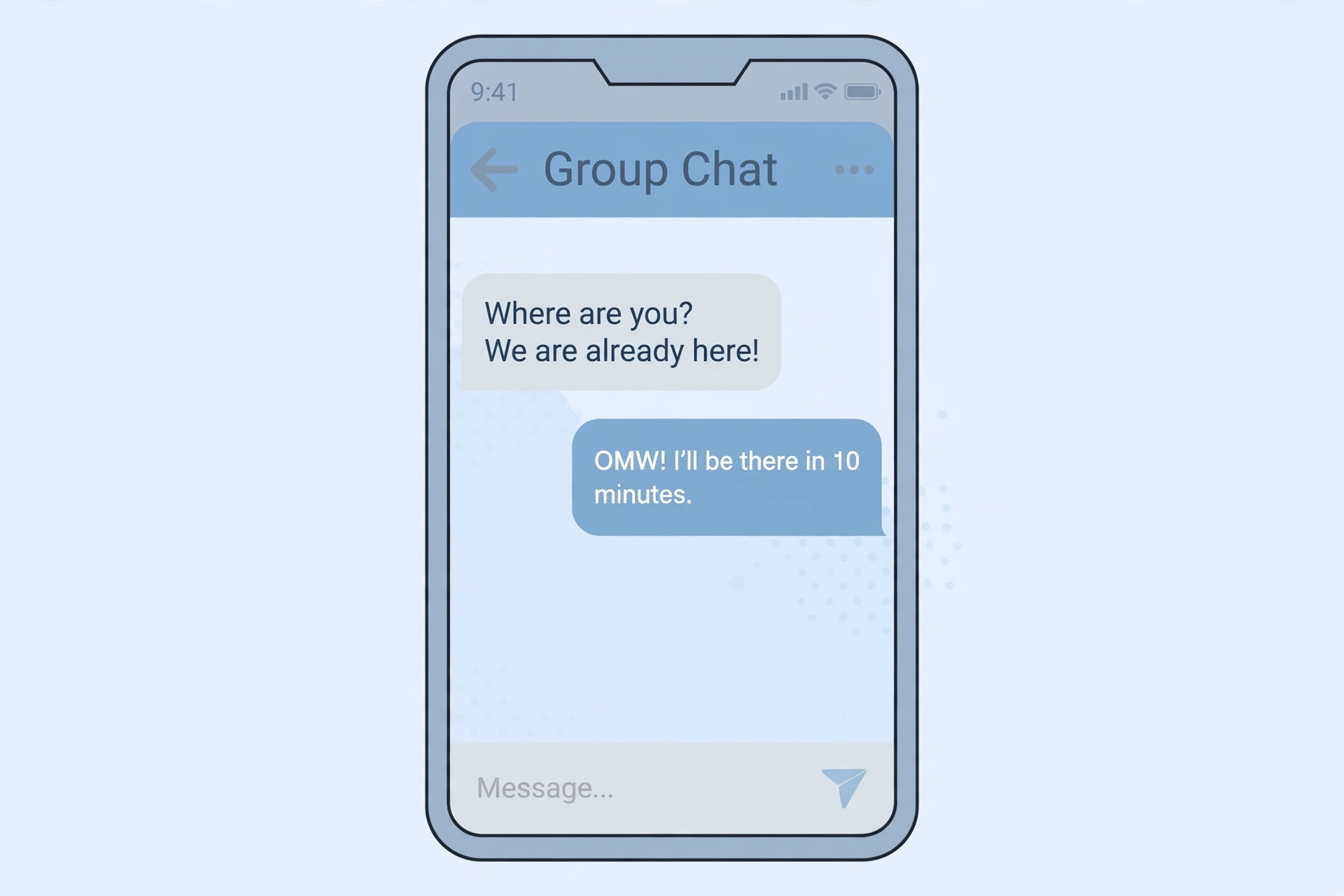
- Friend: “Where are you?? We’re already here!”
You: “OMW! I’ll be there in 10 minutes.” - Mom: “Did you leave for school yet?”
You: “Yes, OMW now.” - Friend: “Movie starts at 7!”
You: “OMW, don’t start without me!” - Sibling: “Can you pick me up?”
You: “OMW 👍” - Group chat: “We’re waiting outside.”
You: “OMW! Traffic is bad though.” - Friend: “Dinner’s ready, hurry!”
You: “OMW, just grabbed my keys.”
Professional Examples
- Coworker: “Are you joining the standup?”
You: “OMW to the conference room.” - Boss (casual chat): “Client call in 5.”
You: “OMW, joining now.” - Delivery context: “Your driver is OMW with your order.”
- Team Slack: “Running late, OMW — start without me if needed.”
Professional use works only in informal channels — a quick Slack message or a text to a colleague you know well. Never use OMW in a formal email, a client proposal, or a message to someone senior you do not know well. In those settings, write it out: “I’m on my way.”
Funny Examples
- “OMW to ruin my sleep schedule again 😂”
- “OMW to my third cup of coffee today ☕”
- “OMW to overthink a text I sent 3 seconds ago.”
- “OMW to check the fridge for the fifth time, like something new appeared.”
- “POV: You said OMW 30 minutes ago and you’re still at home.”
The joke format works because everyone recognizes the gap between saying OMW and actually moving. Used with self-awareness, it is one of the most relatable captions on TikTok and Instagram.
Comparison with Similar Terms
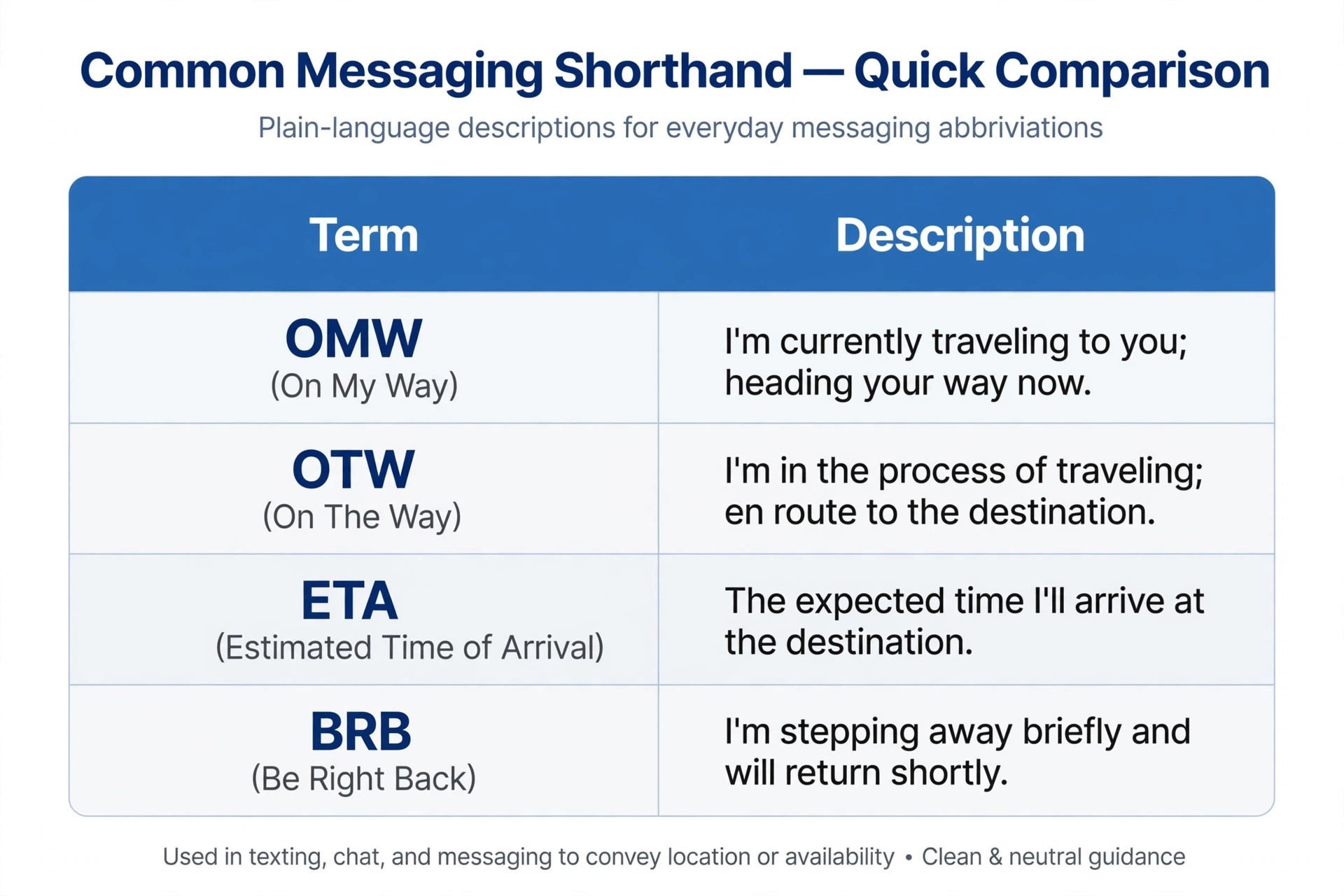
OMW has several close cousins, and choosing the right one depends on what you want to emphasize — movement, timing, or return. The table below breaks down the differences.
| Term | Stands For | What It Emphasizes | When to Use It |
|---|---|---|---|
| OMW | On My Way | You are traveling now | Replying to “where are you?” |
| OTW | On The Way | Same as OMW, slightly more neutral | Interchangeable with OMW |
| ETA | Estimated Time of Arrival | Exact timing | When someone needs a precise arrival time |
| BRB | Be Right Back | Short absence, then return | Stepping away from a chat, not traveling |
| OTW vs OMW | — | Nearly identical | OMW feels more personal; OTW more factual |
| TTYL | Talk To You Later | Ending a conversation | Leaving a chat, not heading anywhere |
OMW vs OTW: These two are true synonyms. OMW (“on my way”) centers the speaker — my way — while OTW (“on the way”) centers the journey. In practice, nobody distinguishes them strictly. OMW is slightly more common in American texting, and OTW shows up a bit more in British and gaming contexts, but either one will be understood everywhere.
OMW vs ETA: OMW tells someone you are moving; ETA tells them when you will arrive. They are best used together: “OMW, ETA 15 mins” is the gold standard of arrival updates. If you can only send one, choose ETA when the other person is planning around your arrival (a reservation, a pickup), and OMW when they just need reassurance that you are coming.
OMW vs BRB: BRB means you are stepping away briefly and will return to the same conversation — for example, grabbing water during a gaming session. OMW means you are physically traveling somewhere. Mixing them up can confuse people: “BRB” to a friend waiting outside would suggest you are not coming at all.
Alternate Meanings
In texting and social media, OMW means “on my way” more than 99% of the time. But like many abbreviations, it has a few niche alternate meanings in specialized contexts:
- “Oh My Word” — a rare, mild exclamation of surprise, similar to “oh my god” but softer. You might see it in older chat logs, but it is almost never used this way today, and it risks confusion — most readers will read it as “on my way.” Avoid this usage.
- Gaming callouts — in team games, OMW keeps its “on my way” meaning but functions as a tactical signal: help or backup is coming to a specific lane or objective.
- Logistics and delivery — dispatchers and drivers use OMW informally to confirm a pickup or delivery is in progress.
- “One Man’s World” / brand names — a handful of businesses, podcasts, and products use OMW as initials, but these have nothing to do with texting slang.
The practical rule is simple: unless the context clearly points elsewhere, always read OMW as “on my way.” If someone texts you “OMW” after you asked a question, they are telling you they are coming — not exclaiming surprise.
Professional or Polite Alternatives
OMW is informal by nature. In formal or professional settings, swap it for a full phrase that matches the tone of the conversation:
| Situation | Instead of OMW, Say |
|---|---|
| Formal email | “I’m on my way and expect to arrive by 3:00.” |
| Client message | “I’m heading over now — see you shortly.” |
| Job interview / meeting | “I’m en route and will be there in about ten minutes.” |
| Apologetic / running late | “I’m on my way — apologies for the delay.” |
| Polite and warm | “I’m on my way! Looking forward to seeing you.” |
| Quick but professional (Slack) | “On my way — joining in a moment.” |
The pattern is consistent: spell it out, add a time estimate, and keep the tone warm. You get all the reassurance of OMW with none of the casualness that can look careless in a professional context.
Common Mistakes
OMW is simple, but people still use it in ways that backfire. Avoid these common mistakes:
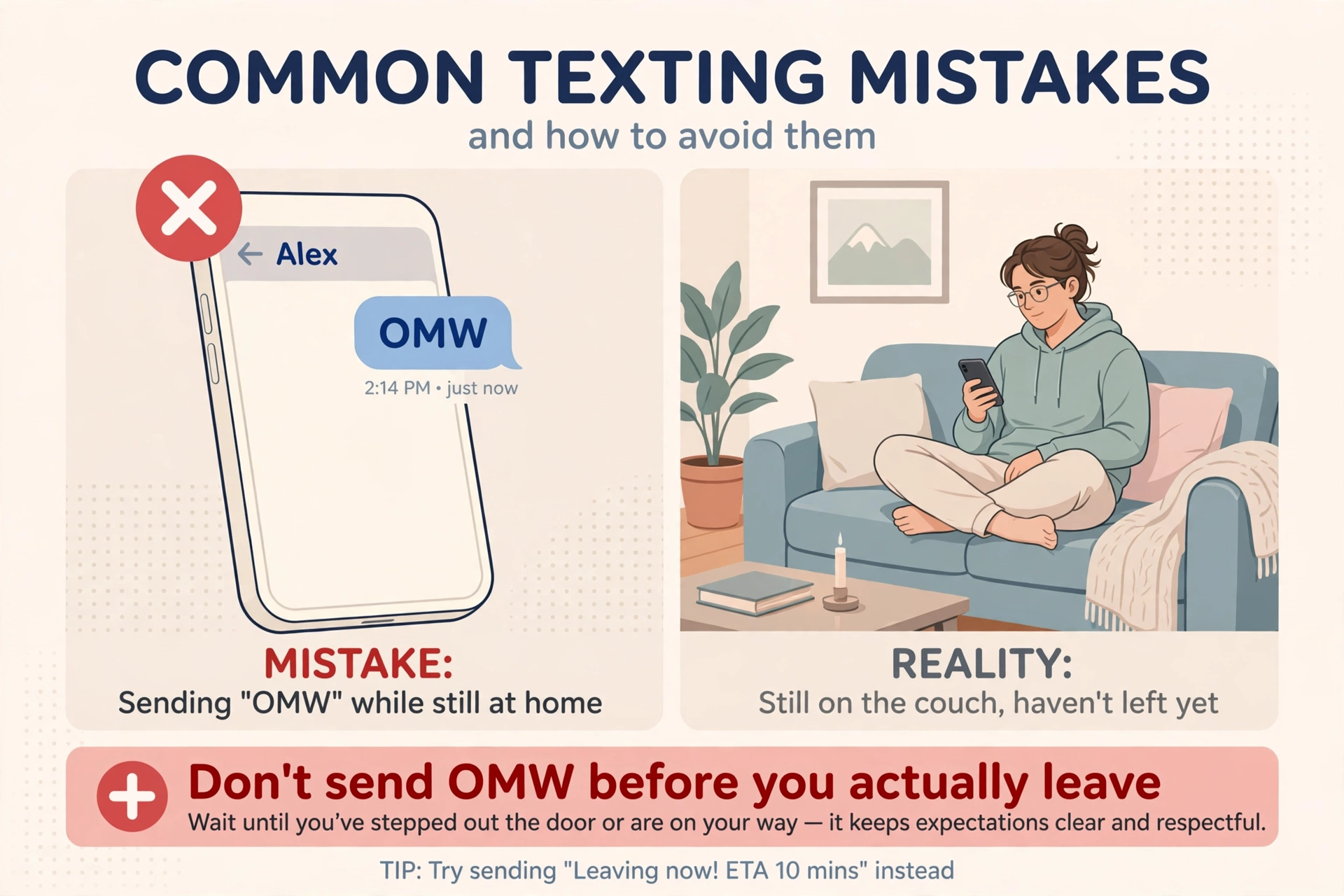
- Sending OMW while still at home. This is the number-one OMW sin. The moment you send it, the other person starts counting down. If you are still on the couch, say “Leaving in 5” instead — it is honest, and it sets a real expectation.
- Sending OMW with no ETA. A bare “OMW” leaves the other person guessing. Add a time: “OMW, 15 mins away.” It takes two seconds and prevents three follow-up texts.
- Using OMW in formal messages. In a job email or a first message to a client, OMW reads as sloppy. Write the full phrase.
- Confusing OMW with BRB. OMW means traveling; BRB means stepping away briefly. Swapping them confuses the other person about whether you are coming at all.
- Using “Oh My Word” as OMW. Almost nobody reads OMW that way anymore. If you mean “oh my word,” type it out.
- Overusing OMW as a stall tactic. Sending “OMW” repeatedly while not moving trains people to stop believing you. One honest update beats three empty ones.
- Texting OMW while driving. Never type while driving. If you must update someone, use voice-to-text or a hands-free assistant — or send the update before you start the car.
Quick Tips
Use these tips to make every OMW message land well:
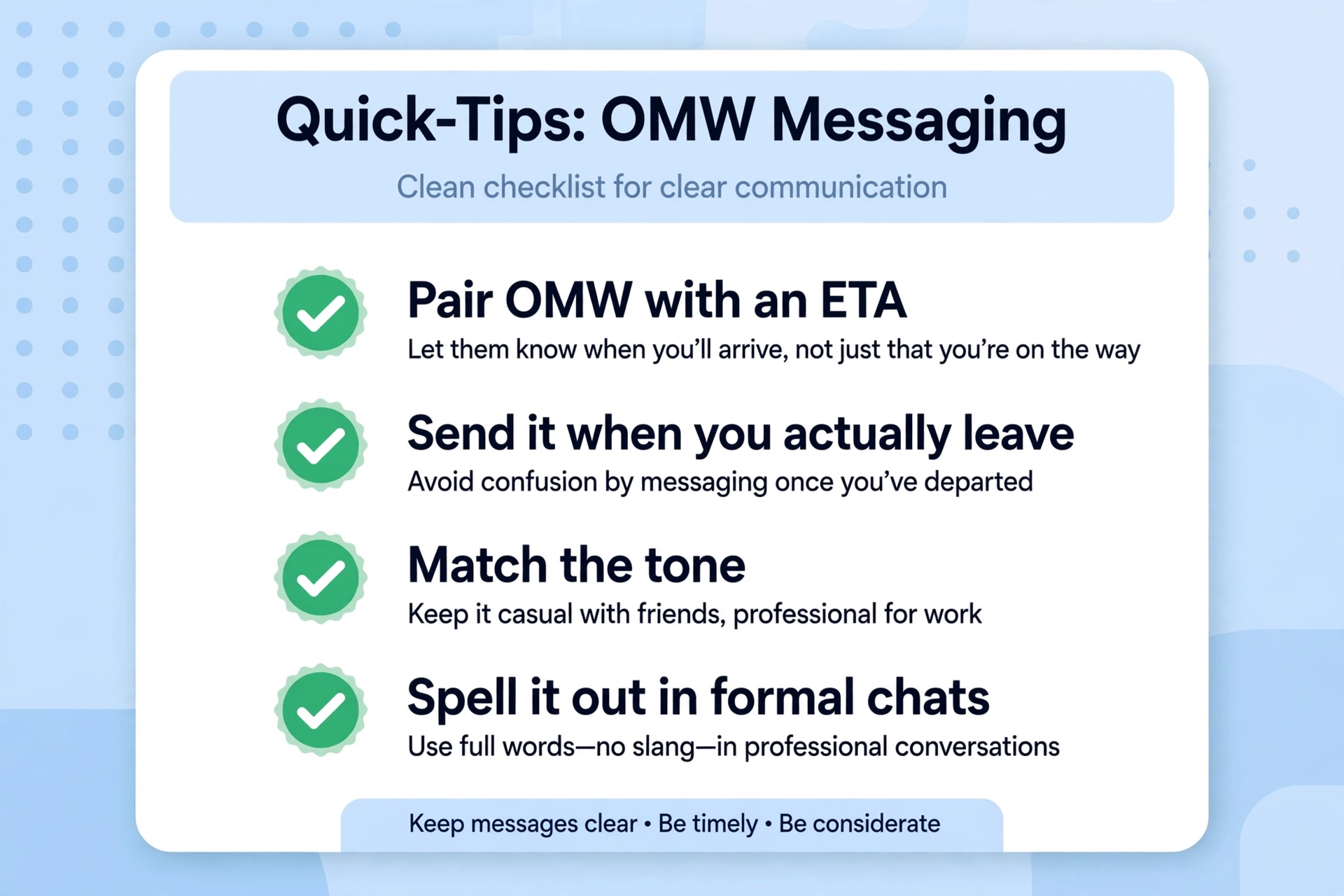
- Pair OMW with an ETA. “OMW, 10 mins” is the most helpful version of the message.
- Send it the moment you actually leave. Timing is what makes OMW trustworthy.
- Add context when plans changed. “OMW, had to stop for gas — add 5 mins” prevents confusion.
- Match the tone. Exclamation marks for excitement, a short apology when you are late, and a plain “OMW” when things are on schedule.
- Use location sharing for close friends. If someone is waiting, a live location pin plus “OMW” removes all guesswork.
- Reply when you receive it. A simple “See you soon!” or “Drive safe” confirms you got the message and keeps the plan smooth.
- Know when to spell it out. Formal settings, older relatives, and professional contacts usually deserve the full “I’m on my way.”
- Do not fake it. OMW is a mini promise. Keeping it honest keeps your word worth something — and keeps your friends from waiting in the rain.
FAQ
1. What does OMW mean in text?
OMW means “on my way.” It tells the other person you are already traveling toward them or about to leave, and it is used as a quick, casual arrival update.
2. Is OMW the same as OTW?
Yes. OMW stands for “on my way” and OTW stands for “on the way.” They mean the same thing and can be used interchangeably, though OMW is slightly more common in American texting.
3. Is OMW rude or polite?
OMW is polite and friendly when used honestly. It reassures the other person that you are coming. It only feels rude when it is used as a stall — sent while you have not actually left yet.
4. Can I use OMW in professional messages?
Only in informal work chats, like a quick Slack message to a coworker you know well. For formal emails or messages to clients, write it out: “I’m on my way.”
5. What is the difference between OMW and ETA?
OMW says you are moving; ETA says when you will arrive. They work best together — “OMW, ETA 15 mins” — because the combination answers both “Are you coming?” and “When?”
6. What does “OMW” mean on Snapchat or TikTok?
On Snapchat, OMW usually appears in location snaps and travel updates. On TikTok, it is often a meme caption — “OMW to…” followed by something funny or relatable. In both cases, the core meaning is still “on my way.”
7. What should I reply when someone texts OMW?
A short acknowledgment works best: “See you soon!”, “Drive safe!”, “Take your time”, or “OK, I’ll be outside.” If they gave an ETA, you can simply react or say “Perfect.”
8. Does OMW mean “oh my word”?
Very rarely, and almost never in modern texting. OMW almost always means “on my way.” If you mean “oh my word,” type the full phrase to avoid confusion.
Conclusion
Now you know the full omw meaning in text: “on my way” — a three-letter promise that you are already moving. It is one of texting’s most useful abbreviations because it does real work: it calms waiting, coordinates plans, and keeps conversations moving with zero friction.
The key takeaways are simple. Use OMW when you are genuinely on the road, pair it with an ETA, match your tone to the situation, and spell it out in formal settings. Avoid the classic trap of sending it from the couch, and never type it while driving. Master those habits, and OMW becomes a small act of reliability — proof that when you say you are coming, you mean it.
Texting slang is a whole language of its own, and every abbreviation has its own story. If you found this guide useful, you might also enjoy the wyfd meaning in text breakdown or the ngl meaning in text guide — and for a deeper look at how abbreviations get cataloged, Dictionary.com is a solid reference for standard definitions behind the slang.
