
Quick definition: Bricked up slang is a joking, crude Gen Z phrase that most often means having an erection. The joke is the image: a brick is hard, solid, and stacked up, so “bricked up” turns an awkward physical reaction into an exaggerated punchline. Online, though, people also use it more loosely to mean wildly excited or hyped up about something, which is why the same two words can sound crude in one chat and harmless in another. Context, tone, and audience decide which meaning lands, and getting that wrong is the whole risk of using it.
Bricked Up Slang Meaning & Definition
In modern internet slang, bricked up is a humorous way to describe male sexual arousal, specifically an erection. It is not a medical term, it is not formal English, and it is not polite. It belongs to the same family of exaggerated body jokes as “pitching a tent” and “standing at attention”: the meaning is clear, the delivery is meant to be funny, and the humor comes from how over the top the image is. If someone texts “I got bricked up in class,” they are almost always telling a self-deprecating joke about an embarrassing moment, not making a serious confession.
The phrase works because of a simple word picture. A brick is hard. A wall is built brick by brick, stacked higher and higher. Put those two ideas together and you get a visual metaphor that needs no further explanation, which is exactly why it spread so fast in memes and short videos. Nobody had to define it in a comment thread. The image did the work. That instant readability is also why the phrase escaped its original, narrow meaning and started showing up in places that have nothing to do with arousal at all.
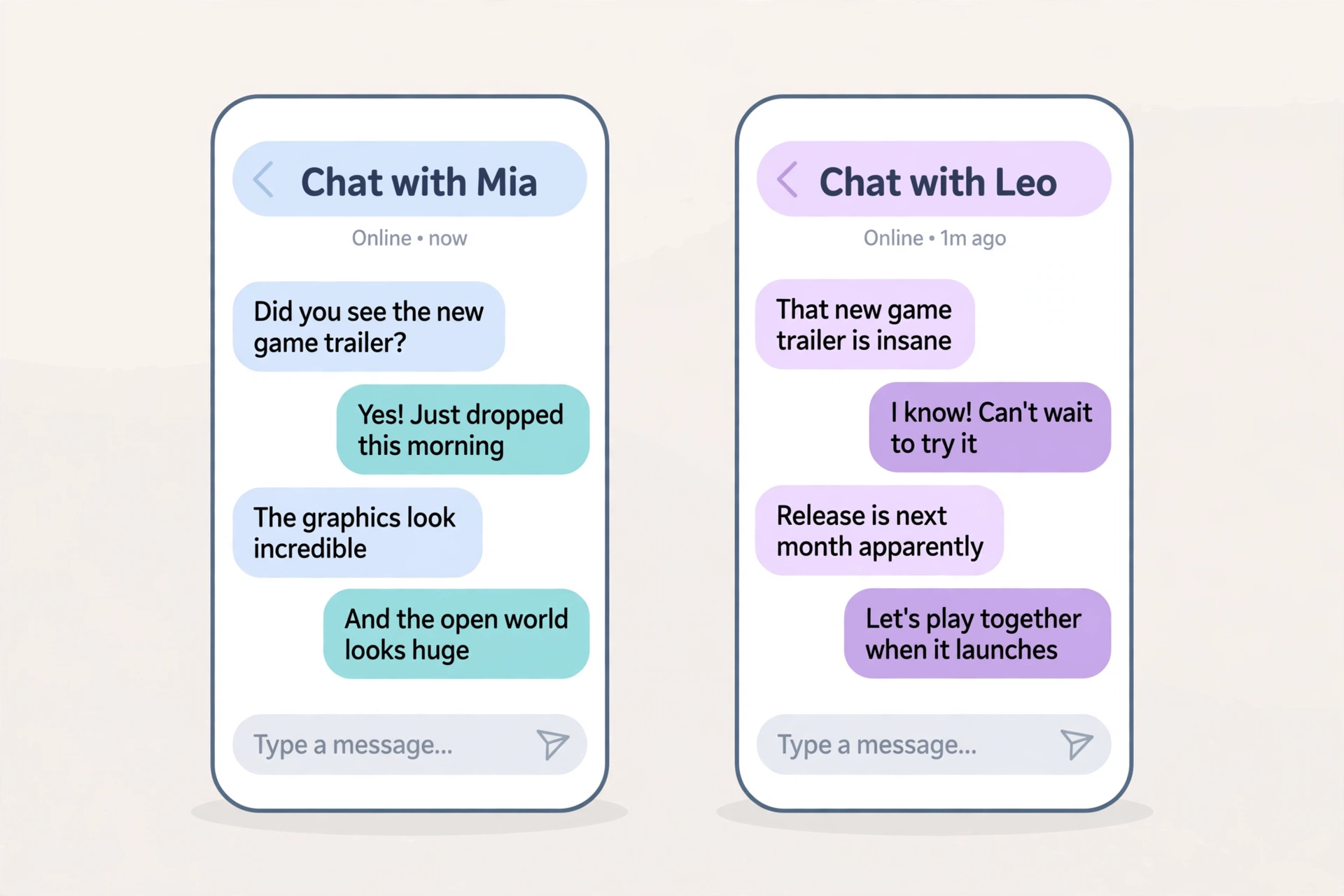
That second, looser meaning is now just as common on TikTok and in group chats. When someone says they are “bricked up” for a new album, a sneaker drop, a game trailer, or a sports result, they usually mean they are extremely excited, locked in, or hyped beyond normal levels. The arousal joke is still hovering in the background, which is part of what makes it funny to the people using it, but the literal meaning is not the point. Think of it as excitement turned up so loud that it becomes a joke about itself. If the sentence is about a thing, an event, or a piece of media rather than a person, the hype meaning is usually the right read.
There is one more thing to settle right away, because it causes most of the confusion around this phrase. Bricked up is not the same as bricked. “Bricked” is older tech slang: a phone or console that has been bricked is dead, frozen, and about as useful as a literal brick. “Bricked up” in slang is a different expression with a different history, even though both phrases borrow the same image of a brick. Mixing them up will confuse everyone reading your message, so keep them separate. The comparison section below lays out the difference in full.
| Use of “bricked up” | What it usually means | How it usually sounds |
|---|---|---|
| Bricked up (slang, main meaning) | Having an erection; male arousal | Crude, joking, exaggerated |
| Bricked up (hype sense) | Extremely excited or hyped about something | Playful, hyperbolic, meme-like |
| Bricked up (literal) | Sealed off with bricks, like a doorway or window | Neutral, construction language |
| Bricked (tech slang) | A device that is broken or dead | Frustrated, technical, not sexual |
Like most slang that travels through memes, bricked up slang is a word you understand by watching how it is used, not by memorizing a dictionary entry. The rest of this guide follows that rule: the origin story, the places it shows up, the tones it can carry, the lookalike terms it gets confused with, and the situations where it should stay firmly in the group chat and nowhere else.
Introduction
You have probably seen it in a comment section and done a double take. A TikTok about a movie trailer. A meme about a celebrity photo shoot. A group chat reacting to a game announcement. Someone drops “bricked up” into the replies, everyone laughs or reacts with a brick emoji, and you are left wondering whether you just read something rude, something funny, or something completely different from what you assumed. The honest answer is that it can be all three, and the difference is rarely in the words themselves. It is in who said it, where they said it, and what they were reacting to.
This guide explains bricked up slang the way a friend who lives online would: the plain meaning first, then the origin, then the many ways it gets used, then the lines it crosses. You will get real examples for friendly chats, funny moments, and the professional settings where it does not belong, a comparison with similar terms like “bricked,” “brick,” and “fully torqued,” and a clear list of polite alternatives for when you want the joke without the crudeness. By the end, you will know why a brick became a punchline, why a 2020 rap interview made it famous, why TikTok made it unavoidable, and why the smartest way to use it is usually not to use it at all outside your closest circle. If you enjoy decoding how fast internet language moves, this is one of the clearest examples of the whole process: a joke, a meme, a moment of fame, and then a word that means three things at once.

Origin
The slang meaning of “bricked up” did not appear out of nowhere, but it did have a very visible breakout moment. The phrase had been circulating in hip-hop lyrics, online forums, and Urban Dictionary entries since the mid-2010s, always with the same joke at its center: hardness, stacked up, taken to a ridiculous extreme. Rappers used it as a boastful, deliberately over-the-top way to talk about attraction, and meme makers picked it up for the same reason. It was vivid, it was funny, and it was short enough to fit in a caption. What it did not yet have was a single clip that everyone had seen.
That clip arrived on February 11, 2020. In a Genius “Verified” video, rapper Jack Harlow broke down the lyrics to his breakout song “WHATS POPPIN” and, explaining a line about a dark-haired woman who looked like Shego from the cartoon Kim Possible, said that certain cartoon characters from his childhood got him “bricked up.” The video racked up millions of views, the line became a clip, and the phrase became a punchline that people outside hip-hop and meme circles had suddenly heard. Urban Dictionary gained a definition for the term that same day. Know Your Meme’s “Bricked Up” entry traces exactly this path, from the Harlow interview through the wave of memes that followed, and it remains the clearest single record of how the term went from niche joke to mainstream internet vocabulary.
From there, the spread followed the usual route for Gen Z slang. TikTok creators turned it into a format: reaction videos, “POV: you’re bricked up at the worst possible time” jokes, and confession-style clips about embarrassing school moments. Discord servers and gaming chats adopted it as a shorthand reaction, the way an earlier generation used a single emoji or a reaction image. In late 2022, TikToker @itsjp69 built a whole comedy series around the phrase, watching viewer-suggested viral videos until he got “bricked up,” which pushed the term even further into TikTok’s mainstream feed. Each new format stretched the meaning a little further. The arousal joke stayed, but the hype meaning grew alongside it, because a phrase that means “I am extremely, embarrassingly into this” turns out to be useful for almost any strong reaction.
It helps to remember that the literal phrase is much older than the slang. In construction, “bricked up” has always meant sealing an opening, a doorway, a window, or a passage, with bricks and mortar. Old buildings all over Britain still show bricked-up windows, many of them sealed during the era of the window tax, when owners blocked windows to avoid paying for them. The slang borrowed the words but flipped the image: instead of something being closed off, something is built up, stacked, and impossible to ignore. That flip is the whole joke, and it is why the phrase feels instantly understandable even the first time you hear it. The older, literal meaning has not gone away, by the way. In a news article about a renovation or a history book about old houses, “bricked up” still means exactly what it meant a hundred years ago. Only online does it mean something else entirely.
Popularity
Bricked up slang is popular for a reason that has little to do with the joke itself. It is popular because it is useful. One short phrase can carry a joke, a reaction, an exaggeration, and a confession at the same time, and it works in a comment, a caption, a text, or a video title. On TikTok, where the entire point is a fast reaction to something you just watched, that efficiency matters. A comment that says “bricked up” under a trailer does more work than a paragraph explaining that you are excited. It says you are excited, it says you know the joke, and it says you belong to the group that gets it. Slang is often a membership badge as much as a message, and this phrase is a very clear badge.
The popularity also follows a pattern that shows up again and again with internet slang. People do not usually search for a term like this because it is trending in the abstract. They search because they heard it somewhere specific, a video, a lyric, a friend’s text, and they want a fast answer before they reply or repeat it. That is why the term keeps spiking around new content: a viral video here, a rap lyric there, a meme format that runs for a month and then fades. The word itself is not the trend. The moments that carry it are. This is the same cycle that made terms like mewing and zesty into household words among younger users: a niche joke, a viral carrier, and then a word that everyone under twenty-five seems to know and nobody over forty has ever heard.
There is a generational split worth naming honestly. For Gen Z and younger millennials, “bricked up” is familiar background noise, a joke they have heard a hundred times, usually in a context where nobody takes it literally. For older readers, it can land as genuinely shocking, because the literal meaning is sexual and the delivery is deliberately crude. Neither reaction is wrong. The phrase was built to be a little shocking; that is part of the humor. The split matters because it decides how the phrase lands in mixed company. In a group chat of friends your own age, it is a throwaway joke. In a family chat, a workplace channel, or a message to someone you do not know well, the same words can read as vulgar, confusing, or simply inappropriate. Popularity online is not the same as acceptability everywhere, and this term is one of the clearest examples of that gap.
The phrase has also stuck around longer than most meme slang, and that staying power is worth noting. Many TikTok words burn bright for a month and vanish. “Bricked up” has been circulating since 2020, with new waves of use in 2022 and beyond, because it keeps finding new jobs: a reaction to a celebrity, a joke about a game release, a caption on a gym photo, a punchline in a rap lyric. A word that can do that many jobs does not fade quickly. It becomes part of the furniture of internet English, the kind of term that new users keep encountering and keep having to look up, which is exactly why a clear, complete explanation is more useful than the one-line definitions most pages offer.
How It Is Used
In practice, bricked up slang shows up in three main patterns, and learning to tell them apart is the key to understanding it. The first is the embarrassment joke. Someone describes an awkward moment, usually in school, in class, or in public, where a physical reaction showed up at the worst possible time. The tone is self-deprecating, the audience is friends, and the point is that everyone has had an embarrassing body moment and survived it. The second is the hype reaction. Someone is reacting to media, a trailer, a song, a photo, a game, and uses “bricked up” to mean they are overwhelmingly excited. The tone is celebratory and exaggerated, and the literal meaning is mostly background noise. The third is the boast. Someone, usually in a rap lyric or a deliberately crude joke, uses it to brag about attraction or desire. The tone is cocky, the audience is in on the joke, and the crudeness is the point.
Three features of the usage are worth learning. First, it is almost always a reaction, not a description. People rarely announce it out of nowhere. They say it in response to something: a picture, a video, a person walking into a room, a piece of news. Second, it is almost always exaggerated. Nobody says “slightly bricked up.” The humor depends on the scale being absurd, a skyscraper, a wall, a fortress. Third, it travels with other Gen Z markers. You will see it next to “no cap,” “fr,” “deadass,” and the brick emoji, in sentences that are short, lowercase, and built for speed. If a message looks like a meme caption, the hype reading is more likely. If it looks like a confession to a close friend, the embarrassment reading is more likely. And if it is a lyric or a roast, the boast reading is more likely.
Platform changes the tone too. On TikTok and in Discord servers, the phrase is casual, fast, and usually funny. On X (Twitter), it shows up in quote-posts and replies, often as a one-word reaction. In text messages between friends, it is private, joking, and safe in a way it never is in public. In gaming chats, it often means pure hype, the equivalent of “I am so ready for this.” In a comment under a celebrity’s post, it is usually a thirst joke, and the person posting it knows exactly how it reads. The same two words, five platforms, five slightly different risks. The table below is the fastest way to read the room before you reply.
| Situation | Most likely meaning | Safe to repeat? |
|---|---|---|
| Friend jokes about an awkward school moment | Embarrassment joke, arousal sense | With close friends only |
| Comment under a trailer, album, or game announcement | Hype, excitement | Usually, if the thread is already joking |
| Group chat reacting to a celebrity photo | Attraction, thirst joke | With friends, never at work |
| Rap lyric or meme caption | Boast, deliberate crudeness | Quoting is fine; directing it at someone is not |
| Work chat, school message, or message to a stranger | Will read as crude and confusing | No, use a polite alternative |
| Talking about a building, renovation, or old house | Literal: sealed with bricks | Yes, it is ordinary English here |
One more usage note matters more than any other. The phrase is gendered in its literal meaning, but not in its online use. Literally, it describes a male body. Online, people of all genders use it, apply it to themselves, and apply it to things, because the hype meaning has detached from the anatomy. That does not make the literal meaning disappear. It means you will see sentences like “I am bricked up for this album” from people the literal meaning could never describe, and the intended meaning is excitement, full stop. If you are explaining the term to someone, both facts belong in the explanation: where it comes from, and how far it has travelled from there.
Examples
The best way to learn bricked up slang is to see it in real messages, with the situation attached. The same phrase can be a joke, a confession, or a celebration depending on where it lands. These examples cover the range: friendly chats, the rare professional-adjacent context where the word appears only as a warning, and the funny, exaggerated moments where the phrase does its best work. Notice how much of the meaning comes from what the person is reacting to, not from the words alone.
Friendly Examples
- “Bro, the new trailer just dropped and I’m bricked up, this game looks unreal.” — The hype sense. The person is excited about a game, not describing a body. This is the most common use in gaming and fandom chats.
- “I saw her walk in and I was bricked up instantly, it was so embarrassing.” — The embarrassment joke. A confession to a close friend, told for laughs, about an awkward moment.
- “POV: you’re bricked up at the worst possible time.” — A TikTok caption format. The joke is the timing, and the whole video exists to exaggerate that one awkward idea.
- “We waited two years for this album and I’m bricked up for every single track.” — Pure hype again. The word is doing the job of “I cannot wait” with a meme attached.
- “He got bricked up during algebra class and had to stand behind his desk.” — A retold school story, the classic setting for this joke. Embarrassing, universal, and told years later because it is funny in hindsight.
- “Don’t be weird about it, I just mean I’m hyped. I’m bricked up for the concert, that’s all.” — A clarification, and a useful one. The speaker knows the word has two readings and picks the hype reading out loud.
Professional Examples
Here is the honest truth about bricked up slang and professional settings: there are no good professional examples, and that is the example. The phrase is crude, sexual in origin, and built to be shocking. It does not belong in a work email, a Slack channel, a classroom discussion, a customer message, or any conversation with a boss, a teacher, a client, or a stranger. If it appears at work at all, it appears as a problem: someone used it in a chat, someone else was uncomfortable, and someone had to explain why it was not appropriate. If you are writing about the term for a school project or a presentation, quote it once, define it plainly, and move on. If you are tempted to use it to sound casual with colleagues, use one of the polite alternatives in the section below instead. “I’m really excited for this launch” says the same thing, reaches everyone, and costs you nothing. The professional version of this slang is not a toned-down version of the same words. It is different words entirely.
Funny Examples
- “I got bricked up like a skyscraper under construction.” — The classic exaggeration. The joke is the scale: not just a brick, a whole building project.
- “That plot twist had me bricked up, walled up, sealed up, the whole construction site.” — A joke that stacks the literal and slang meanings on top of each other until the whole sentence becomes a building.
- “Me: I’m a mature adult. Also me, one trailer later: bricked up.” — The gap between the self-image and the reaction is the joke. Most meme uses of the phrase work exactly this way.
- “He’s built like a brick wall and now he’s bricked up too, the man is a whole house.” — A gym and thirst joke in one, playing on the “built” meaning and the slang meaning at the same time.
- “I bricked up, then I bricked my phone trying to screenshot it. Worst day of my life.” — A joke that uses both “bricked up” and “bricked” in one sentence, and only works if you know they mean different things.
Comparison with Similar Terms
Bricked up slang sits in a crowded neighborhood of words that all borrow images of hardness, building, or being stuck. The differences between them are small on the surface and large in practice, and confusing them is the fastest way to send a message that means the opposite of what you intended. The most important distinction is the one already mentioned: “bricked” is about broken technology, “bricked up” is about arousal or hype, and “brick” on its own, in New York slang, means very cold weather. Three words, one root image, three unrelated meanings. The rest of the neighborhood is made of euphemisms and near-synonyms that vary in how crude, how funny, and how safe they are.
The comparison that matters most for everyday use is with the hype vocabulary. When someone says they are “locked in,” “hyped,” or “down bad” for something, they are in the same territory as the hype sense of “bricked up,” but without the sexual joke attached. “Down bad” is the closest cousin: it also started as a joke about desire and also stretched into general obsession and excitement. “Fully torqued” is a direct synonym for the arousal sense, just as crude, just less famous. “Pitching a tent” is the older, schoolyard version of the same visual joke. And “bricked up” for a girl, or said by a girl, belongs in the hype column, not the literal column, because the internet long ago detached the word from the body it originally described. The glazing guide covers another Gen Z word that stretched the same way, from a narrow, crude origin into a broad, everyday exaggeration, and the pattern is worth recognizing: internet slang rarely stays in the box it started in.
| Term | Meaning | How it differs from “bricked up” |
|---|---|---|
| Bricked | A device that is dead or unusable | Tech slang, not sexual; “I bricked my phone” |
| Brick (cold) | Very cold weather, New York slang | Weather only; “It’s brick outside” |
| Fully torqued | Aroused, joking and crude | Same meaning, different image; less widely known |
| Pitching a tent | Aroused, visual schoolyard joke | Older, softer, more familiar to older readers |
| Down bad | Obsessed, desperate, overly into something | Broader; covers crushes, fandom, and hype |
| Locked in / hyped | Excited, focused, ready | Same hype feeling, no sexual joke attached |
| Bricked up (built) | Muscled, solidly built, “built like a brick wall” | Emerging, rare; usually needs context to be clear |
| Walled off / shut down | Emotionally closed off, unreachable | Figurative and serious, not a joke |

Alternate Meanings
Beyond the slang, “bricked up” has a life in ordinary English that predates the internet by centuries, and a few newer figurative uses that are still finding their footing. Knowing these alternate meanings matters, because they are the reason the phrase can appear in a history book, a renovation blog, or a poem and mean nothing crude at all. If you only know the slang, you will misread those uses. If you only know the literal meaning, you will misread the slang. Both readings are real, and the setting tells you which one is in play.
The literal meaning is the oldest and the simplest. To brick something up is to fill or seal an opening with bricks and mortar: a doorway that is no longer used, a window that is no longer wanted, a passage that needs to be closed for good. Historic houses are full of bricked-up windows and fireplaces, and renovation shows talk about “bricking up” an opening as casually as they talk about knocking a wall down. This is the meaning you will find in dictionaries, in building guides, and in any article written before 2015 that uses the phrase. It is neutral, technical, and completely safe, and it has nothing to do with the slang except for sharing the same words.
The tech meaning belongs to “bricked,” not “bricked up,” but the two get tangled so often that it deserves a clear line here. A bricked phone, tablet, or console is one that will not turn on or respond, usually after a failed update or a bad modification. It is “as useful as a brick,” which is where the image comes from. Gamers and phone enthusiasts use it constantly, and it is the meaning you will meet in a tech forum or a repair shop. Nobody in that setting is making a joke about arousal. They are mourning a dead device. If someone says “I bricked my console,” the correct response is sympathy, not laughter.
Two newer figurative uses are still emerging, and both should be treated as context-dependent. The first is physical: “bricked up” to mean heavily muscled or solidly built, as in “he hit the gym all summer and now he’s bricked up.” This use borrows the “built like a brick wall” image and is still rare enough that most readers will default to the slang meaning unless the gym context is unmistakable. The second is emotional: “bricked up” to mean walled off, sealed, or closed to other people, as in “after the breakup he was bricked up, totally closed off.” This use is poetic and uncommon, and it works only when the surrounding sentences make the emotional meaning obvious. Both are real, both are minority uses, and neither should be your first guess when you see the phrase online. Online, the slang meaning, or the hype meaning, wins almost every time.
Professional or Polite Alternatives
Most of the time, what a person actually wants to say with “bricked up” is one of two simple things: “I am really excited” or “that was awkward and funny.” Both have clean, direct alternatives that work everywhere the slang does not. The trick is to match the alternative to the meaning you actually intended. If you meant hype, say hype. If you meant an embarrassing moment, describe the embarrassment without the crude punchline. The alternatives below are grouped by the meaning you want, because a good substitute for the hype sense is a terrible substitute for the arousal joke, and vice versa.
For excitement and hype, the safest options are also the most natural: “I’m so hyped for this,” “I cannot wait,” “I’m locked in,” “this has me obsessed,” or “I’m so ready for this.” Each one carries the energy without the baggage, and each one works in a group chat, a comment section, a classroom, or a work message. “Down bad” works too if the audience is young and online, though it carries its own joke about desire, so it is still a friends-only word. For a public comment or anything a stranger might read, “hyped” and “locked in” are the best choices. They are current, they are clear, and they offend nobody.
For the embarrassment joke, the alternatives are about the feeling, not the body. “That was so awkward,” “I wanted the ground to swallow me up,” “worst timing ever,” or “I was mortified” all tell the story without the crude detail. If you are retelling a school story to friends who already know the slang, you can quote the phrase once and move on. If you are telling it to a mixed audience, the feeling is the funny part anyway. Nobody in the story is laughing at the vocabulary. They are laughing at the timing, the panic, and the universal experience of a body doing something embarrassing in public. Lead with that.
| What you mean | Say instead | Where it works |
|---|---|---|
| Extremely excited, hyped | “I’m so hyped for this” | Everywhere: chats, comments, work, school |
| Obsessed, cannot wait | “I’m locked in” / “I’m obsessed” | Chats, comments, casual conversation |
| Attracted, joking with friends | “Okay, I’m down bad” (friends only) | Close friends, private chats |
| An embarrassing moment | “Worst timing ever, I was mortified” | Everywhere, including mixed company |
| Quoting the slang itself | Quote it once, then define it plainly | Essays, presentations, explanations |
Common Mistakes
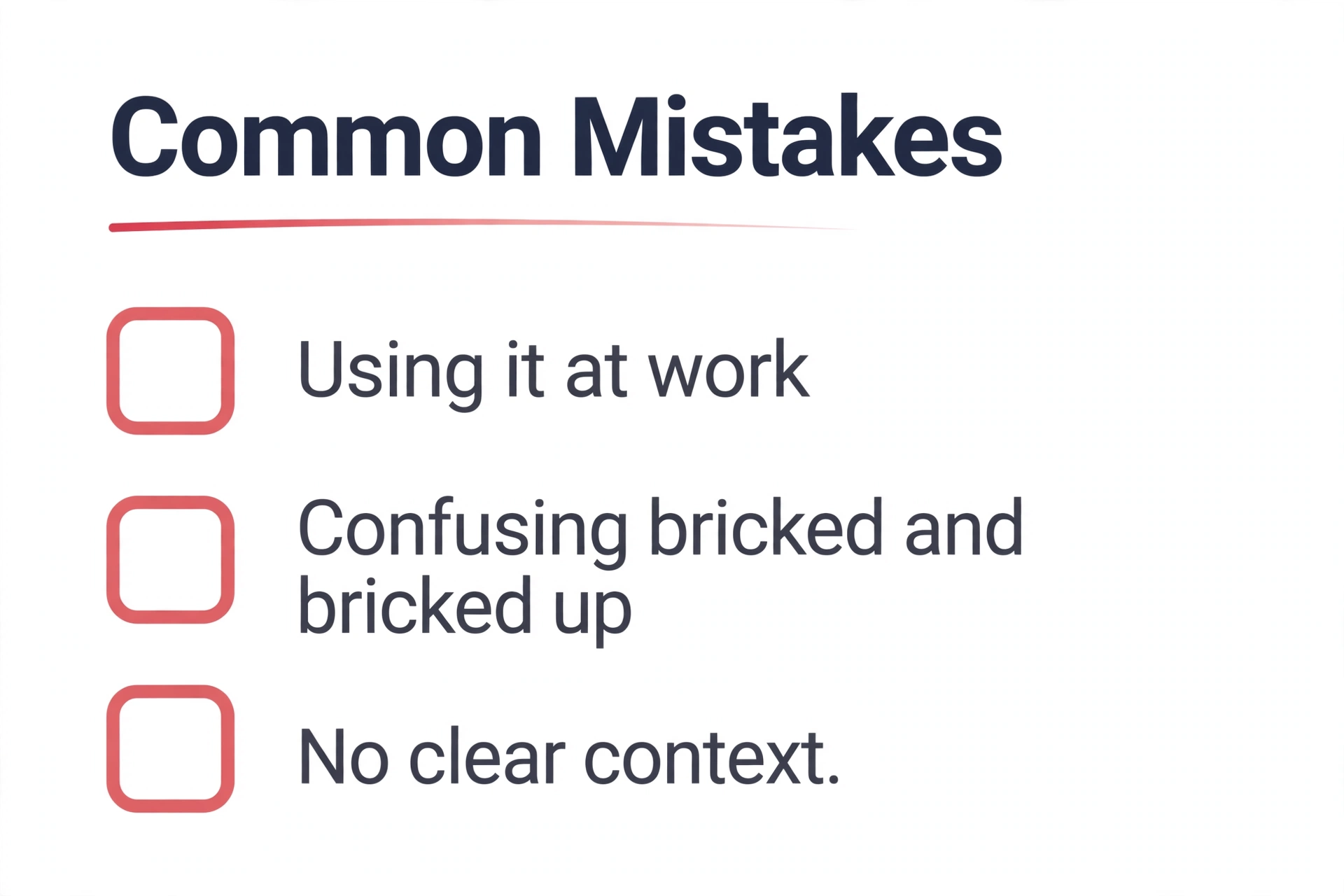
The most common mistake with bricked up slang is also the most predictable: using it where the audience does not share the joke. A word that is funny in a Discord server at midnight is not funny in a morning meeting, a family group chat, or a message to a teacher. The second most common mistake is confusing it with “bricked.” Texting a friend “I bricked up my phone” when you mean the phone died will get you laughter you did not ask for, and telling a tech support forum that your console is “bricked up” will get you confusion. The third mistake is assuming everyone knows the hype meaning. Many readers, especially older ones, know only the literal sexual meaning, so a hype comment under a public post can read as a crude comment about a person when you meant it about a trailer. If the audience is mixed or public, the hype meaning needs a clear object: “bricked up for this album” is much safer than a bare “bricked up” under a photo of a person.
Other mistakes are subtler. Using it about a real person you do not know well, especially in a public comment, reads as harassment, not humor, no matter how you intended it. Using it repeatedly in the same conversation wears the joke out fast; the humor is in the exaggeration, and exaggeration stops being funny on the fourth repetition. Using it to describe yourself in a formal or semi-formal setting, even as a joke, signals that you did not read the room. And using it with the “bricked up” spelling when you mean the cold-weather “brick” will confuse New Yorkers in particular, for whom “brick” is weather vocabulary with a long history of its own. When in doubt, the rule is simple: if you have to explain the joke, the setting, or the audience before you say it, say something else instead. The Ohio slang guide makes the same point about another word that means one thing online and something else entirely to everyone else: slang is a local language, and using it outside its home turf is where the misunderstandings live.
- Using it at work, school, or with strangers, where it reads as crude rather than funny.
- Confusing “bricked up” (slang) with “bricked” (a dead device) or “brick” (cold weather).
- Posting a bare “bricked up” under a person’s photo, where it reads as a comment about them, not about your excitement.
- Assuming everyone knows the hype meaning and will not take the literal meaning.
- Repeating it until the exaggeration stops being funny and starts being awkward.
- Using it to tease someone about an embarrassing moment they did not volunteer themselves.
Quick Tips
- Read the object first. If the sentence is about a thing, an event, or media, the hype meaning is likely. If it is about a person in an awkward moment, the literal joke is likely.
- Keep it in the group chat. Bricked up slang is a friends-only word. In public, mixed, or professional settings, use “hyped” or “locked in” instead.
- Never aim it at a stranger. A joke about a real person you do not know reads as crude or harassing, even if you meant it as a compliment.
- Say the object out loud. “Bricked up for this trailer” is clear. A bare “bricked up” under a photo is not.
- Do not confuse the cousins. Bricked is a dead phone. Brick is cold weather. Bricked up is the slang. Keep all three apart.
- One use is enough. The joke is the exaggeration. Use it once, let it land, and move on.
- When explaining it, define it once, plainly. Quote the phrase, give the meaning in one sentence, and then use the polite alternatives for the rest of the conversation.

FAQ
What does bricked up slang mean?
Bricked up slang most often means having an erection, said as a crude, exaggerated joke. The image is a brick: hard, solid, and stacked up. Online, it is also used more loosely to mean extremely excited or hyped about something, like a new album, trailer, or game. Which meaning applies depends on context: if the sentence is about a person in an awkward moment, it is usually the literal joke; if it is about media or an event, it is usually hype.
Where did bricked up come from?
The phrase circulated in hip-hop lyrics, forums, and Urban Dictionary entries in the late 2010s, and broke into the mainstream on February 11, 2020, when Jack Harlow said in a Genius “Verified” video for “WHATS POPPIN” that certain cartoon characters got him “bricked up.” The clip went viral, the term was defined on Urban Dictionary the same day, and TikTok creators turned it into reaction videos and captions over the following years, including a late-2022 series by TikToker @itsjp69. The literal construction meaning, sealing an opening with bricks, is centuries older.
Is bricked up a bad word?
It is crude, but it is not a traditional swear word. It is sexual slang, and it is meant to be a little shocking, which is part of the humor for the people who use it. That makes it inappropriate for work, school, family chats, and messages to strangers, even though it is common and joking in Gen Z group chats and meme comments. Treat it as a friends-only word: fine where everyone already knows the joke, wrong everywhere else.
What does it mean when a girl is bricked up, or says she is bricked up?
Literally, the phrase describes a male body, so it cannot describe a girl in the literal sense. Online, though, girls use it and have it applied to them in the hype sense all the time, meaning wildly excited or obsessed with something. When a girl says “I’m bricked up for this concert,” the meaning is excitement, full stop. The borrowed use works because the internet detached the phrase from its anatomy and kept the exaggeration. If the context is a joke about a person rather than excitement about a thing, the literal meaning is still hovering in the background, so read the sentence, not just the word.
What is the difference between bricked and bricked up?
“Bricked” is tech slang for a device that is dead or unusable, as in “I bricked my phone.” “Bricked up” is the slang for arousal or hype, as in “I’m bricked up for this trailer.” They share the brick image but mean different things, come from different communities, and are not interchangeable. “Brick” on its own is also New York slang for very cold weather. Keeping the three apart is the single most useful distinction in this whole guide.
Does bricked up always mean arousal?
No. The arousal meaning is the original and still the most widely recognized slang meaning, but the hype meaning is now extremely common, especially in comments about media, games, music, and sports. A good test is the object of the sentence. If someone is “bricked up” for a trailer, an album, or a match, they mean excitement. If the sentence describes a person in an embarrassing moment, the arousal joke is the point. When the object is missing, assume the literal meaning, because that is what most readers will assume too.
What does bricked up mean in texting and gaming?
In texting between friends, it is usually either an embarrassment joke or a hype reaction, and the surrounding messages make it clear which. In gaming chats, the hype meaning dominates: “bricked up” for a new release, a trailer, or a tournament is the equivalent of “I am so ready.” In both settings, it is informal, joking, and meant for people who already share the vocabulary. It should never appear in a message to a stranger, a teacher, or a colleague, where the same words will be read as crude.
What can I say instead of bricked up?
For excitement, say “I’m so hyped,” “I cannot wait,” “I’m locked in,” or “I’m obsessed.” For an embarrassing moment, say “worst timing ever” or “I was mortified.” For a crush or attraction joke with close friends, “I’m down bad” carries a similar energy. If you are explaining the term itself, quote it once, define it plainly, and then use the polite versions. The alternatives say the same thing, reach a wider audience, and never need an apology afterwards.
Conclusion
Bricked up slang is a small phrase with a large job. It started as a crude visual joke, got famous in a 2020 rap interview, spread through TikTok into a general word for excitement, and now means three or four things depending on where you meet it. The literal meaning, an erection, turned into an exaggeration. The exaggeration turned into a reaction. And the reaction is now useful for almost any strong feeling, from embarrassment to hype, which is why the phrase has lasted longer than most meme vocabulary. Understanding it is mostly a matter of reading the room: the object of the sentence, the platform, the audience, and the tone. Get those right and the meaning is usually obvious. Get them wrong and the same two words can be crude, confusing, or unwelcome.
The practical advice is short. Learn the meaning so you are never confused when you see it. Use it only with close friends, only once, and only with a clear object, so nobody has to guess whether you meant hype or something cruder. Keep “bricked,” “brick,” and “bricked up” apart, and keep the literal construction meaning in mind for the many places the phrase is still ordinary English. And when the audience is mixed, public, or professional, reach for the polite versions: hyped, locked in, obsessed, mortified. They carry the same energy without the risk. Slang like this rewards the same habit that unlocks every fast-moving vocabulary: listen for the meaning underneath the word, check who is speaking and who is listening, and you will understand far more than a list of definitions alone. For more of the same decoding, our guides to mewing and zesty slang follow the same journey, from a niche joke to a word everyone online seems to know, and the glazing guide shows how another crude exaggeration became everyday internet English along the way.
