lit meaning slang: What Does Lit Mean in Texts, TikTok & Parties?
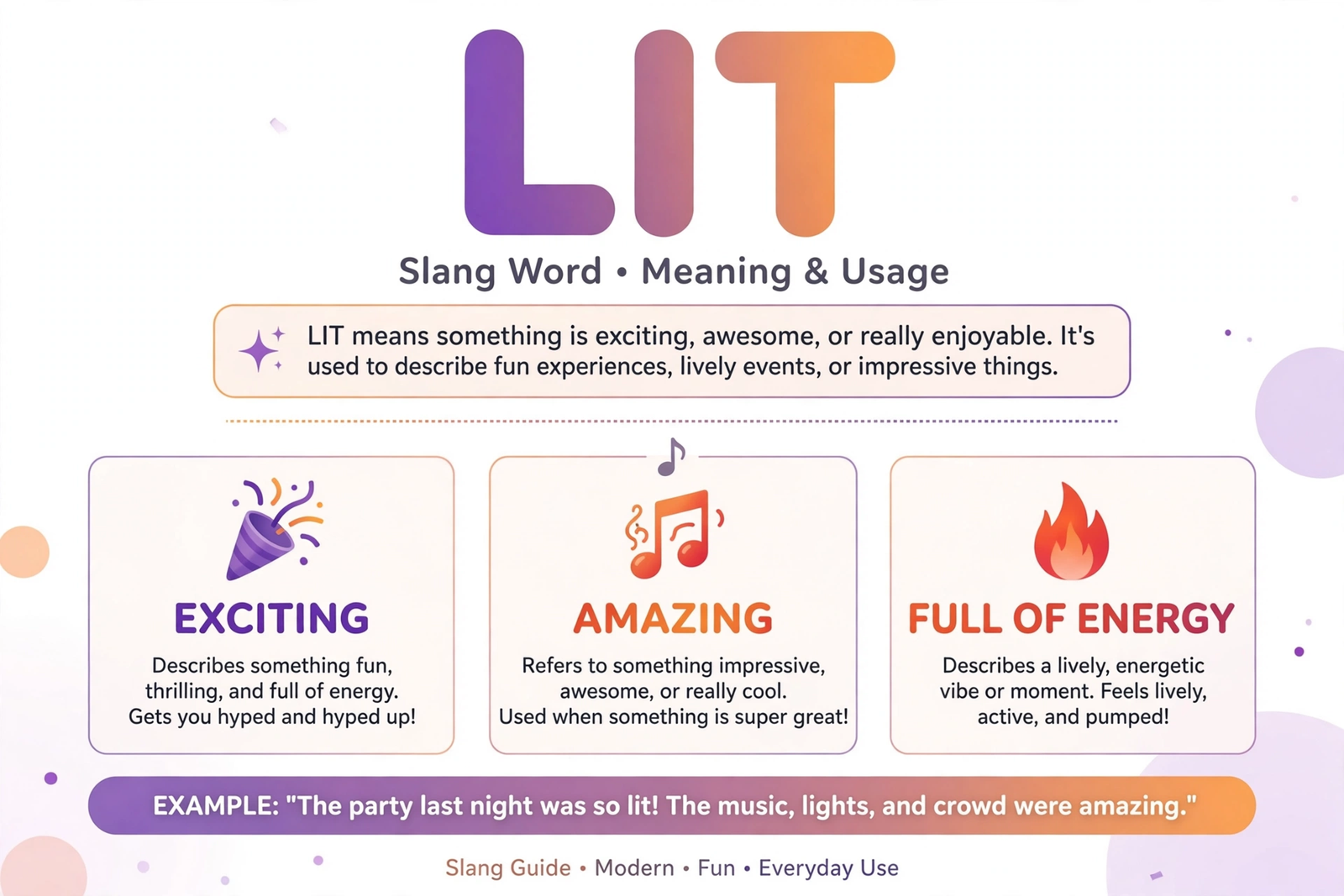
Quick answer: In modern slang, lit means exciting, amazing, fun, or full of energy. If someone says “that party was lit,” they mean it was incredible. If you have ever wondered about the lit meaning slang fans keep using in texts, TikTok captions, and song lyrics, this guide covers everything: the real definition, where it came from, how to use it naturally, and the mistakes to avoid.
lit meaning slang: Definition & Quick Answer
The lit meaning slang most people use today is simple: something is exciting, excellent, or wildly fun. It is a hype word. A concert can be lit, a playlist can be lit, a party can be lit, and even a plate of fries can be lit if it is surprisingly good.
Here is the fast version:
- Literal meaning: the past tense of “light” — as in “she lit a candle.”
- Older slang meaning: intoxicated or drunk — used this way for over a century.
- Modern slang meaning: exciting, amazing, excellent, or full of energy.
- Where you will see it: texts, TikTok, Instagram captions, Snapchat, Twitter/X, song lyrics, and everyday conversation.
- Tone: casual, positive, and high-energy. Never formal.
Context decides everything. “The room was lit by candles” is literal. “He looks lit” can mean he is drunk. “That concert was lit” means it was unforgettable. The same three letters, three very different messages — which is exactly why people search for the meaning so often.
Introduction
Scroll through TikTok for five minutes and you will see it. “This fit is lit.” “The function was lit.” “That goal was lit.” The word is everywhere, and it is one of the rare slang terms that jumped from street corners and rap lyrics into everyday group chats, classrooms, and even TV commentary without losing its punch.
But lit did not start as a party word. It has been in the English language for centuries as the past tense of “light,” and it has meant “drunk” in slang since the early 1900s. The exciting, excellent meaning that dominates today is the newest layer — and it arrived through hip-hop, Black American culture, and social media. Understanding all three layers is the difference between using the word correctly and using it awkwardly.
This guide explains the lit meaning slang in plain English, with real examples you can copy, a comparison with similar words like “fire,” “dope,” and “turnt,” and a clear list of situations where you should not use it. By the end, you will know exactly when “lit” makes you sound natural — and when it makes you sound like you are trying too hard.
Slang moves fast, and words like lit travel in packs. If you enjoy decoding internet language, you may also like our guide to glizzy meaning, another hip-hop word that went fully mainstream.
Origin of Lit
The story of “lit” starts long before smartphones. It is the past tense of the verb “light,” from Old English līhtan, and it has described things that are illuminated or set on fire for over a thousand years. “She lit the lamp” is the original, literal use, and it is still correct today.
The slang story begins in the early 20th century. By the 1910s, “lit” and “lit up” were already being used to mean drunk or intoxicated. A 1918 war diary, War Birds: Diary of an Unknown Aviator, contains the line “We all got lit and had a hell of a time.” The logic was visual: a person’s face “lights up” when they drink, and a lit person glows with energy, the same way a lit room glows with light.
For most of the 20th century, that was the main slang meaning. Then hip-hop changed it. In the 2000s and early 2010s, rappers started using “get lit” to describe the whole party atmosphere — the music, the crowd, the energy — not just the drinking. A$AP Rocky helped push the phrase with his 2011 track “Get Lit,” and the word kept spreading through rap lyrics and nightlife culture.
The real explosion came in the mid-2010s. Social media took “lit” from the club to the timeline. Travis Scott made “It’s lit!” a signature ad-lib, and suddenly the word described anything exciting: a game, a song, an outfit, a comeback. Merriam-Webster added the “exciting” and “excellent” meanings to its dictionary in 2021, which is the clearest sign a slang word has officially arrived. You can read the full history in Merriam-Webster’s breakdown of lit, which traces the same journey from “intoxicated” to “exciting.”
Popularity: How Lit Took Over the Internet
Few slang words have had a run like “lit.” It went from a niche party word to one of the most used hype words on the internet in less than a decade. Here is how that happened:
| Era | What happened |
|---|---|
| 1910s | “Lit” means drunk or intoxicated in American slang. |
| 2000s | Hip-hop adopts “get lit” for partying and nightlife. |
| 2011 | A$AP Rocky’s “Get Lit” pushes the phrase into mainstream rap. |
| 2015–2017 | Travis Scott’s “It’s lit!” ad-lib and social media make it a universal hype word. |
| 2021 | Merriam-Webster officially adds the “exciting / excellent” definitions. |
| Today | Used daily on TikTok, Instagram, Snapchat, and in texts worldwide. |
Why did it stick when so many slang words fade in a year? Three reasons. First, it is short — three letters, one syllable, easy to type and say. Second, it is flexible: it works as an adjective (“that was lit”), a verb phrase (“let’s get lit”), and an exclamation (“It’s lit!”). Third, it carries a feeling, not just a meaning. Saying something is “good” is flat. Saying it is “lit” says it had energy, it had a vibe, it was an experience.
It also benefited from perfect timing. As TikTok and short-form video grew, creators needed punchy words for captions and reactions. “Lit” fits in a caption, a comment, and a three-second clip. It is now used by teenagers, college students, athletes, gamers, and even brands — though brands using it often get teased for trying too hard, which tells you the word still belongs mostly to casual, young, internet-native speech.
How It Is Used
Most of the time, “lit” is an adjective that means exciting or excellent. The grammar is simple, and that simplicity is part of its charm. You do not need a complicated sentence — “lit” does the work.
The most common patterns:
- “That was lit.” — describing an event, party, or performance after it happened.
- “It’s lit!” — an exclamation in the moment, meaning “this is amazing right now.”
- “Let’s get lit.” — a plan to go out, party, or have a wild time (often implies drinking).
- “This song is lit.” — praising music, a video, a game, or any piece of content.
- “Your outfit is lit.” — a compliment meaning stylish or impressive.
It also shows up as “litty,” a playful variation that means the same thing with extra energy: “That party was litty.” You will see “litty” mostly in music and memes rather than everyday texting.
One important note: when “lit” describes a person rather than an event, the meaning can flip. “He’s lit” at a party might mean he is drunk, not that he is exciting. If you mean the positive sense about a person, attach it to what they did — “his performance was lit” — instead of to the person directly. That small change removes all confusion.
The word also pairs naturally with fire emojis and hype language in captions: “That drop was lit 🔥🔥.” On TikTok and Instagram, “lit” is often used to react to something impressive in the first three seconds of a video — a dunk, a dance, a reveal — before the viewer has even finished watching.
Examples
Real examples make the meaning stick. Here are ways “lit” actually shows up in daily conversation, sorted by tone.
Friendly Examples
- “Bro, last night’s party was lit! You should’ve been there.”
- “This playlist is lit — I’ve had it on repeat all day.”
- “Omg your birthday setup is lit 😍”
- “We won the game and the whole crowd went lit!”
- “That new taco spot? The food is lit, no joke.”
Professional Examples
“Lit” is casual, so it rarely belongs in formal writing — but it does appear in relaxed professional settings like creative teams, social media work, and entertainment:
- “The launch event was lit — great turnout and amazing energy from the crowd.”
- “Our latest campaign video is lit; the comments are full of love.”
- “The team’s presentation was lit. The client was genuinely impressed.”
A word of caution: do not use “lit” in a resume, a formal email, or a message to a client you do not know well. In those settings, “excellent,” “outstanding,” or “impressive” are safer. Save “lit” for colleagues you know and channels that are already casual.
Funny Examples
- “My grandma’s cooking is lit and I will not be taking questions.”
- “Tried to cook for the first time. The kitchen is lit. Literally. Send help.”
- “My Wi-Fi is lit today — two whole bars and zero buffering.”
- “Group project was lit… lit on fire, because nobody did their part.”
That last one shows how flexible the word is: the joke works because “lit” can mean both “exciting” and “literally on fire.” Slang that can do double duty like that tends to survive longer than one-trick words.
If you like collecting slang that started in music and went mainstream, check out our breakdown of fn meaning in text — another short word with a very different story.

Comparison with Similar Terms
“Lit” has plenty of cousins. They all mean something positive, but they are not interchangeable. Picking the right one depends on what you are describing.
| Term | Meaning | Best for | Example |
|---|---|---|---|
| Lit | Exciting, excellent, high-energy | Parties, events, music, moments | “That concert was lit.” |
| Fire (🔥) | Amazing quality, impressive | Songs, outfits, photos, skills | “That verse is fire.” |
| Dope | Cool, impressive, stylish | Style, music, ideas, things | “Those sneakers are dope.” |
| Turnt | Wild, hyped, often drunk | Parties and nightlife | “We got turnt last night.” |
| Hype | Exciting, full of energy | Events, announcements, energy | “The crowd was so hype.” |
| Slay | To do something flawlessly | Performances, looks, confidence | “She slayed that performance.” |
| GOAT | Greatest of all time | People and legends | “He’s the GOAT.” |
The closest match is “fire.” Both describe something excellent, but “fire” is mostly about quality while “lit” is mostly about energy. A slow, beautiful song can be fire without being lit. A chaotic, loud party can be lit without being fire. “Turnt” overlaps too, but it leans harder into wildness and drinking, while “lit” works for a family barbecue, a school pep rally, or a playlist.
Another useful comparison: “lit” describes the vibe of a moment, while “dope” describes the quality of a thing. You would call a party lit and a jacket dope. Swap them and people will still understand you, but the sentence loses a little of its natural feel — and in slang, natural feel is everything.
Curious about another word that describes a vibe rather than a thing? Our guide to drip meaning slang breaks down the style-focused cousin of “lit.”

Alternate Meanings
“Lit” is a busy little word. Beyond the slang meanings, it has several legitimate uses that still show up every day:
- Past tense of “light”: “She lit the candles before dinner.” This is the original meaning and the one your English teacher cares about.
- Illuminated: “The whole street was lit with fairy lights.” Here it simply means full of light.
- Intoxicated: “He got lit at the bar and needed a ride home.” The century-old slang meaning — still common, and the reason “He looks lit” can be a warning, not a compliment.
- Short for “literature”: “I have a lit class at 10 a.m.” Students shorten “literature” to “lit” all the time. Context makes it obvious: nobody says “my lit class was lit” unless they mean both.
- On fire (literal): “The grill is lit.” Simple, practical, and unrelated to slang.
- Sexually aroused: a rare, vulgar slang use that mostly appears in explicit lyrics. You will almost never need this meaning, and it is worth knowing only so you are not surprised by it in a song.
The rule is simple: read the sentence around the word. If the subject is a candle, a room, or a grill, “lit” is literal. If the subject is a person at a party, it may mean drunk. If the subject is an event, a song, or an experience, it almost always means exciting.
Professional or Polite Alternatives
“Lit” is fun, but it is not welcome everywhere. If you are writing to a teacher, a boss, a client, or anyone in a formal setting, swap it for one of these:
| Instead of | Say | When to use it |
|---|---|---|
| “That party was lit.” | “That party was fantastic.” | Formal recap or thank-you note |
| “The event was lit.” | “The event was a great success.” | Work email or report |
| “This song is lit.” | “This song is outstanding.” | Review or recommendation |
| “Your outfit is lit.” | “Your outfit looks amazing.” | Compliment to someone older |
| “The presentation was lit.” | “The presentation was impressive.” | Feedback to a colleague |
The meaning stays the same; only the register changes. Good communicators keep both versions ready: “lit” for friends and “excellent” for everyone else. That is not being fake — it is code-switching, and it is a skill.
Common Mistakes
Most people use “lit” correctly, but a few mistakes show up again and again:
- Using it for everything. If every meal, every song, and every Tuesday is “lit,” the word loses its power. Save it for things that genuinely have energy. Overuse is the fastest way to sound like you learned the word yesterday.
- Using it about a person when you mean drunk. “He’s lit” can mean he is intoxicated. If you mean he is fun or exciting, say “he’s a lot of fun” or “his set was lit” instead.
- Using it in formal writing. Resumes, cover letters, academic essays, and formal emails are not the place. It reads as careless, not cool.
- Confusing it with “lighted.” Both are past forms of “light,” but “lit” is the standard modern form for slang and most everyday use. “Lighted” survives mostly in formal or old-fashioned writing.
- Forcing it into sentences where it does not fit. “The meeting was lit” is only funny if the meeting genuinely had energy. Otherwise it sounds sarcastic — which can be the joke, but only if you mean it as one.
- Mixing up “lit” and “litty.” “Litty” is a playful intensifier, mostly in music and memes. Using it in a normal text (“Dinner was litty”) can sound forced. Stick with “lit” unless you are quoting a song.

Quick Tips
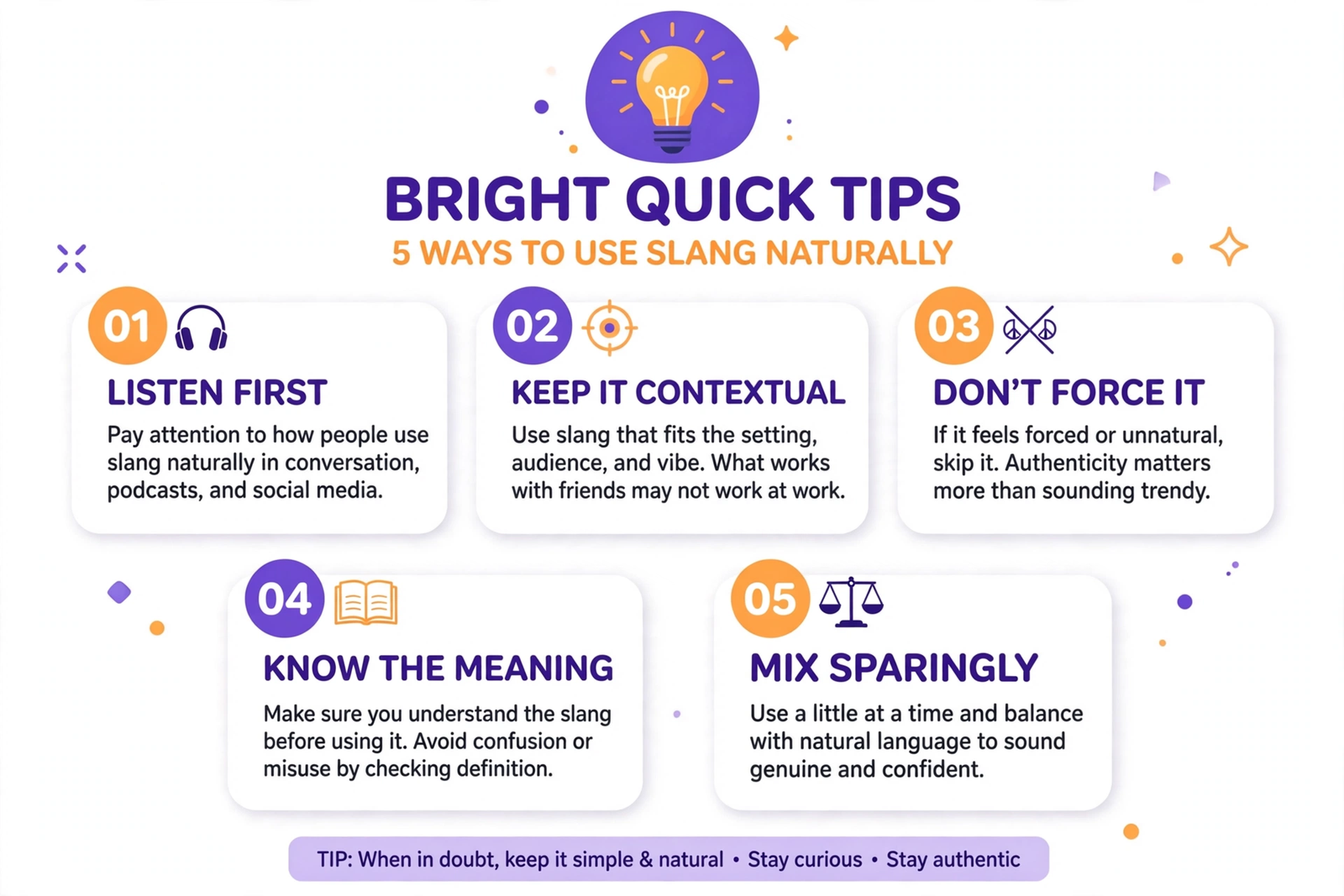
Want to use “lit” like a native? Keep these five tips in mind:
- Match the energy. Use “lit” for things that are genuinely exciting. A quiet dinner is “lovely,” not lit.
- Keep it casual. Friends, group chats, captions, and concerts — yes. Bosses, teachers, and formal emails — no.
- Attach it to events, not people. “The party was lit” is always safe. “He’s lit” can mean drunk.
- Pair it with specifics. “The concert was lit — the crowd sang every word” sounds real. “It was lit” alone sounds empty.
- Do not overuse it. One “lit” per conversation is plenty. Two is pushing it. Three and people stop believing you.
FAQ
What does lit mean in slang?
In modern slang, lit means exciting, amazing, excellent, or full of energy. “That party was lit” means the party was incredible. It is a positive hype word used for events, music, performances, and experiences.
What does “it’s lit” mean?
“It’s lit” means “this is amazing right now.” People say it during a great party, concert, or moment to express excitement. It is an exclamation, similar to “this is awesome!”
Does lit mean drunk?
Yes, it can. “Lit” has meant intoxicated or drunk in American slang since the early 1900s. When it describes a person — “he got lit last night” — it usually means drunk. When it describes an event — “the party was lit” — it usually means exciting. Context decides.
Where did lit come from?
“Lit” is the past tense of “light.” The drunk meaning dates to the 1910s, and the exciting meaning grew out of hip-hop and African American Vernacular English in the 2000s and 2010s, spreading through rap lyrics, Travis Scott’s “It’s lit!” ad-lib, and social media.
Is lit still popular in 2026?
Yes. It remains one of the most used slang words on TikTok, Instagram, and in texts. Merriam-Webster added the “exciting” and “excellent” definitions in 2021, and the word is still going strong in 2026, especially in captions, comments, and party talk.
Can I use lit at work?
Only in very casual workplaces and with colleagues you know well — for example, in a relaxed team chat about a successful event. Avoid it in formal emails, reports, meetings with clients, and any written communication that needs to sound professional.
What is the difference between lit and fire?
Both mean something is great, but “fire” is about quality and “lit” is about energy. A beautiful slow song can be fire without being lit, and a wild party can be lit without being fire. They overlap, but they are not identical.
What does lit mean in texting?
In texting, lit almost always means exciting or awesome. “That game was lit” means the game was amazing. It is shorthand for high praise, often paired with fire emojis. If someone texts “let’s get lit tonight,” they usually mean let’s go out and have a wild, fun night.
Conclusion
The lit meaning slang is simple once you see all the layers: literally, it is the past tense of “light”; historically, it meant drunk; today, it mostly means exciting, amazing, and full of energy. It traveled from 1910s slang to hip-hop lyrics to TikTok captions, and along the way it became one of the most useful hype words in English — short, flexible, and impossible to mistake for boring.
Use it for the moments that deserve it: the concert that gave you goosebumps, the party everyone is still talking about, the playlist that never misses. Attach it to events, keep it casual, and do not wear it out. Do that, and “lit” will always sound natural coming from you.
And the next time someone texts you “that was lit,” you will know exactly what they mean — and you will have the perfect reply ready. If you want to keep building your slang vocabulary, our guide to tysm meaning is a great next stop for the shorthand you see in every group chat.

9 thoughts on “lit meaning slang: What Does Lit Mean in Texts, TikTok & Parties?”