Quick definition: In slang, beans slang covers several playful meanings at once. It can mean a secret (as in “spill the beans”), something worthless (“not worth a hill of beans”), approval (“cool beans”), money, or even a pet’s paw pads (“toe beans”). The exact meaning always depends on context, so the same little word can dismiss a wild claim in one text and gush over a cat photo in the next.
Beans Slang Meaning & Definition
When someone asks what beans slang means, there is no single one-word answer — and that is exactly what makes it interesting. Unlike slang terms with one fixed definition, “beans” is a shape-shifter. In a group chat it can be a comeback, in a caption it can be a compliment, and in an old idiom it can be a secret waiting to escape.
The most common modern use of beans slang is as a short, playful way to call something nonsense. If a friend texts “I could totally beat you in a race blindfolded,” replying with a single word — “Beans.” — lands like a friendly eye-roll. It says “I do not believe you” without starting an argument. It is blunt, funny, and over in a second, which is why it works so well in fast-moving chats and comment sections.
But beans slang is bigger than one comeback. The word also lives inside some of the most familiar idioms in English. “Spill the beans” means to reveal a secret. “Cool beans” means something is great or approved. “Full of beans” describes someone bursting with energy. “Not worth a hill of beans” means something has almost no value at all. And in pet-loving corners of the internet, “toe beans” are the soft little pads on a cat’s or dog’s paws — probably the cutest use of the word ever invented.
Introduction
Imagine this: your friend sends a voice note claiming they once met a celebrity at a gas station, got their number, and turned down a date. You type one word back — “beans” — and the whole group chat erupts with laughing emojis. You did not write a paragraph. You did not need to. That single word did the job of a full sentence: nice try, but nobody believes that story.
That is the power of beans slang. It is tiny, it is funny, and it is flexible enough to fit a dozen different situations. Most slang words do one job. “Beans” does many. It can tease, dismiss, approve, describe, and melt hearts, depending on where it shows up. Few words in modern internet English cover that much ground.
In this guide, you will learn every major meaning of beans slang, where each one came from, and how to use each one without sounding confused. You will see real text examples for friendly, professional, and funny situations, a comparison table that separates “beans” from similar terms, the common mistakes people make, and quick tips for using it naturally. Whether you saw it in a TikTok comment, a tweet, or your group chat, by the end of this article you will know exactly what it means — and exactly when to use it yourself.

Origin
The slang life of “beans” began long before the internet. The word itself comes from Old English “bean,” and for centuries it simply meant the edible seed. But as early as the 1800s, English speakers started using beans to talk about things that were small, cheap, or worthless. That shift is the seed of almost every slang sense that followed.
The most famous early use is “not worth a hill of beans,” an American expression from the 19th century that means something has almost no value. A hill of beans was a tiny, unimpressive pile — so calling something worth less than that was a vivid way of saying it was worthless. The phrase stuck, and it carried the idea of beans-as-nothing into everyday speech. Green’s Dictionary of Slang records “beans” in this worthless sense and in the related phrase “not know beans,” meaning to know nothing at all.
“Spill the beans” followed a similar path. The idiom, meaning to reveal a secret, dates to at least the early 20th century. One popular story claims it comes from ancient Greek voting, where secret ballots were cast with beans in a jar and knocking the jar over revealed the vote — a charming origin story, though historians treat it as folk etymology rather than proven fact. What is certain is that by the 1900s, “spill the beans” was firmly established in American English, and it remains one of the most used bean idioms today.
Other senses grew out of different corners of life. In horse racing slang, a horse that was “full of beans” was lively and spirited, and the phrase jumped from the stable to everyday speech to describe energetic people. In American baseball in the early 1900s, a “beanball” was a pitch aimed at a batter’s head — because the head was slangily called the “bean” — and the verb “to bean” someone meant to hit them on the head. “Use your bean” (meaning “think!”) comes from the same head sense.
“Cool beans” is a newer arrival. It emerged in American college slang in the 1970s and 1980s as a cheerful way to say “great” or “awesome,” and it got a second life in the 1990s and 2000s through television and film. Meanwhile, “toe beans” is a pure internet-era invention: pet owners on Instagram and TikTok started calling their cats’ and dogs’ paw pads “toe beans” because of their shape, and the term went viral as part of cute-pet culture.
The newest sense — “beans” as a one-word dismissal meaning “nonsense” — grew out of comment-section culture. Short replies win online, and a single blunt word that swats away an exaggerated claim fits perfectly. Street slang glossaries now define it plainly: beans means an abrupt call of “nonsense,” a quick way to say someone is wrong, making stuff up, or talking big without proof. It is the latest chapter in a very long story, and it probably will not be the last.
Popularity
Beans slang is popular in a quiet, durable way. It is not the loudest word on TikTok, and it does not trend every week like a brand-new viral term. Instead, it survives because it keeps showing up in different places for different reasons — and that staying power is rarer than a viral moment.
On TikTok and Instagram, the cutest sense dominates: “toe beans” content — close-up photos and videos of cat and dog paws — regularly collects millions of views. The word “beans” in a caption signals warmth and affection, and pet accounts use it as a kind of password that tells followers they are part of the community. If you have ever liked a photo because the caption said “look at those beans,” you have felt this sense in action.
The idioms, meanwhile, never left mainstream English. “Spill the beans” appears in news headlines, TV dialogue, and office conversation. “Cool beans” still pops up as a deliberately retro, cheerful approval. “Full of beans” is still used by parents and teachers to describe energetic kids. These older uses keep the word familiar to every generation, which makes the newer slang senses easier to pick up — you already know the word, you just learn one more thing it can do.
How It Is Used
Beans slang changes its job with its surroundings, so the best way to learn it is to see each sense in its natural habitat. Here are the main uses you will actually encounter.
1. As a dismissal (“that’s nonsense”). This is the newest and most internet-native sense. One word, standing alone, usually as a reply. It means “I do not believe you,” “that is made up,” or “nice try.” It is playful rather than angry — a tease, not a fight. You will see it in comment sections, quote-tweets, and group chats, almost always in response to an exaggerated claim, a fake story, or a boast that nobody buys.
2. As a secret (“spill the beans”). This is the classic idiom use. “Spill the beans” means to reveal secret information, usually accidentally or under pressure. Someone might say “Come on, spill the beans — who is she dating?” or confess “I spilled the beans about the surprise party.” The beans here are the secret itself. This use is standard English, not just internet slang, so it works in almost any setting.
3. As approval (“cool beans”). “Cool beans” means “great,” “awesome,” or “that works for me.” It is cheerful, slightly old-fashioned, and often used with a smile. “We are meeting at seven?” — “Cool beans, see you then.” It sounds retro on purpose, which is part of its charm. Younger speakers sometimes use it ironically, but the meaning is always positive.
4. As energy (“full of beans”). Someone who is “full of beans” is lively, excited, and bursting with energy. Parents say it about children after a sugar rush; friends say it about someone who cannot sit still. It is warm and affectionate, never an insult. “The kids are full of beans this morning” is a compliment to their spirit, not a complaint.
5. As worthlessness (“not worth a hill of beans”). This use measures value — or the lack of it. “His promise is not worth a hill of beans” means the promise is worthless. It is a folksy, old-fashioned way of saying something does not matter, and it still appears in writing and speech today, especially when someone wants a colorful alternative to “worthless.”
6. As affection (“toe beans”). In pet culture, “toe beans” are the soft pads on a cat’s or dog’s paws. People post close-up photos with captions like “just look at those toe beans” and everyone understands: this is pure cute. The term is wholesome, gentle, and almost always paired with an animal photo. It has no negative sense at all.
The golden rule is simple: read the sentence, not just the word. “Beans” after a wild claim is disbelief. “Beans” under a cat photo is love. “Spill the beans” is a secret. The context always tells you which beans you are dealing with.
Examples
Seeing beans slang in real sentences is the fastest way to learn it. Here are examples grouped by tone, so you can see how the same word shifts its feeling.
Friendly Examples
Friendly uses are warm, teasing, and low-stakes — the kind of thing you say to people you like.
- A: “I finally finished my assignment at 3 a.m.” B: “Cool beans! Proud of you.”
- A: “Guess what? Maya said yes to the trip!” B: “No way — spill the beans, when are we leaving?”
- A: “Look at my cat’s paws.” B: “Those little toe beans! I cannot handle the cuteness.”
- A: “I made pancakes for everyone.” B: “Cool beans, you are the best.”
- A: “The puppy is running around like crazy.” B: “He is absolutely full of beans today.”
Professional Examples
In professional settings, only the idiom uses of beans slang are safe. The one-word dismissal and the pet sense stay in personal chats.
- “Let us not spill the beans about the launch date until marketing confirms it.”
- “The client asked for the full report — I will share the details, but please do not spill the beans to the other team yet.”
- “Our new intern is full of beans — she finished the onboarding tasks in half a day.”
- “That old software license is not worth a hill of beans now; we need the upgraded plan.”
- “Great news on the deadline extension — cool beans, that gives us room to polish the draft.” (Only in a very casual workplace; otherwise use “great news” instead.)
Funny Examples
Funny examples show beans slang at its most playful, especially the dismissal sense.
- A: “Bro, I bench-pressed a car yesterday.” B: “Beans.”
- A: “I am basically fluent in French now. I watched one movie.” B: “Beans. Absolute beans.”
- A: “My goldfish ran away from home.” B: “Beans?? Your goldfish lives in a bowl.”
- A: “I could eat fifty hot dogs, easy.” B: “Cool beans. I will bring the hot dogs and a camera.”
- A: “The cat knocked over the vase again.” B: “Those toe beans are trouble, but look at that face.”
The humor works because “beans” is such a small, silly word for such a firm verdict. Saying “beans” instead of “that is a lie” turns a correction into a joke, which is why friends prefer it — it keeps the conversation fun even when someone is clearly exaggerating.

Comparison with Similar Terms
Beans slang overlaps with several other words, but each one has its own flavor. This table makes the differences clear at a glance.
| Term | Meaning | Tone | Best Used When |
|---|---|---|---|
| Beans (dismissal) | That is nonsense / I do not believe you | Playful, teasing | Replying to an exaggerated claim in a chat |
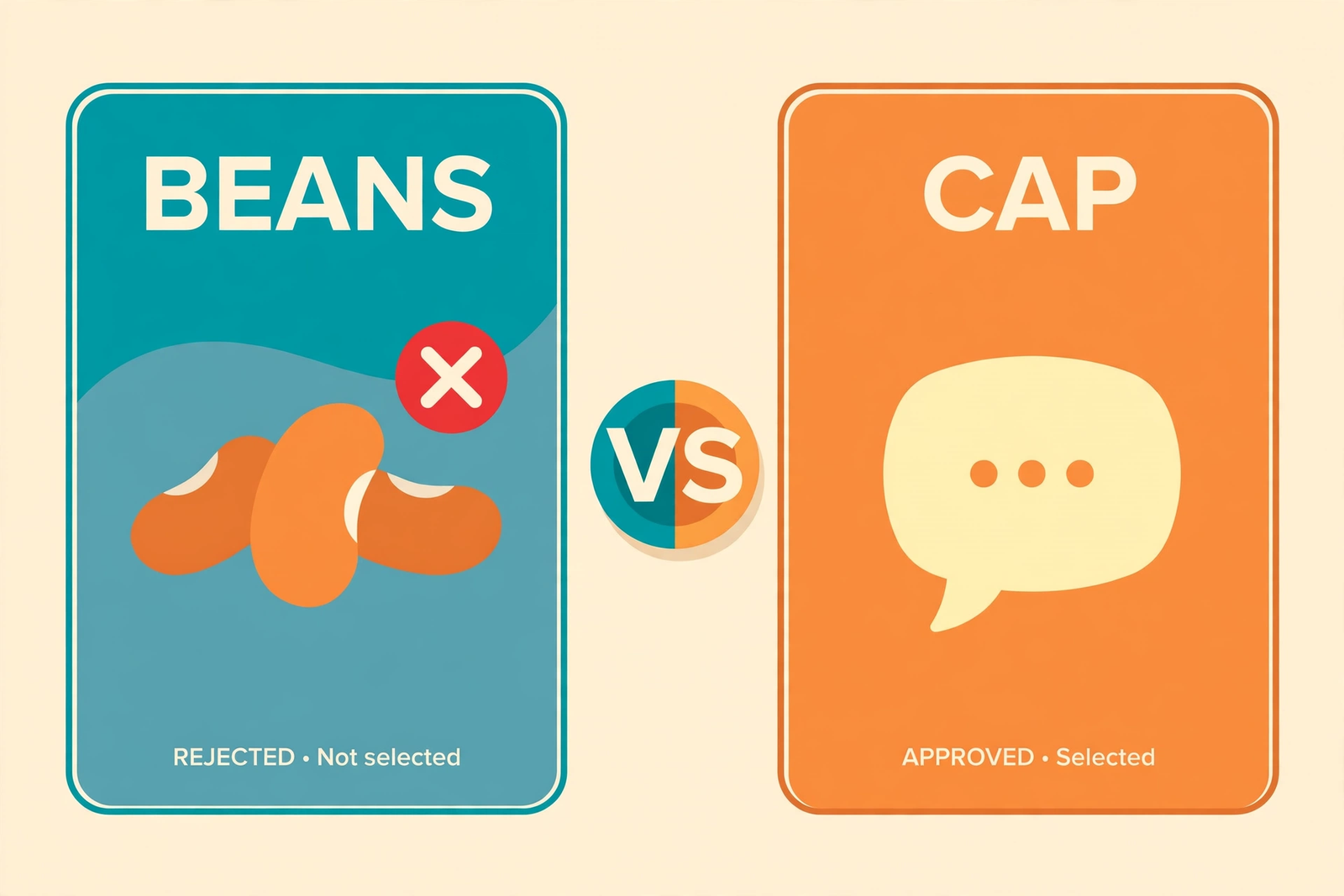
| Cap | That is a lie | Blunt, confident | Calling out a lie directly |
| Spill the beans | Reveal a secret | Neutral, idiomatic | Asking for or sharing hidden information |
| Spill the tea | Share the gossip | Gossipy, dramatic | Asking for juicy news or drama |
| Cool beans | Great / awesome / approved | Cheerful, retro | Agreeing happily to a plan |
| Fire | Excellent, outstanding | Energetic, hype | Praising music, style, or food |
| Full of beans | Bursting with energy | Warm, affectionate | Describing a lively person or child |
| Toe beans | Pet paw pads | Adorable, wholesome | Captioning a cute pet photo |
“Spill the beans” and “spill the tea” look like twins, but they ask for different things. “Spill the beans” asks for a secret — information someone was keeping hidden, like a surprise or a private decision. “Spill the tea” asks for gossip — the dramatic story, the drama, the thing everyone wants to hear. Use “beans” for secrets and “tea” for gossip, and you will always sound natural.
“Cool beans” and “fire” both mean something is good, but they live in different eras and energies. “Fire” is modern hype — loud, intense, and current. If you want to learn more about that word, check out our guide to fire and our breakdown of lit, two of the most used hype words today. “Cool beans” is retro cheer — softer, friendlier, and a little funny because it sounds like something from an old sitcom. Both work; the choice depends on whether you want hype or warmth. For more ways to say something is good, see our list of cool synonyms and the meaning of drip in modern slang.
Alternate Meanings
Beyond the main senses, “beans” and “bean” carry several alternate meanings worth knowing — partly so you recognize them, and partly so you do not mix them up.
Bean as the head. In older American slang, a “bean” is the head or brain. “Use your bean” means “think!” and “to bean someone” means to hit them on the head — a usage that survives in baseball, where a “beanball” is a pitch thrown at a batter’s head. You will still hear “use your bean” from older speakers, and it appears in books and films set in the early 20th century.
Bean as money. In British informal speech, “not have a bean” means to have no money at all — to be broke. Historically, “bean” could also mean a coin, a dollar, or a small amount of money. This sense is mostly idiomatic now rather than a unit of currency, so you will hear it inside phrases rather than as a standalone word for cash.
Beans as pills. In drug slang, “beans” has been used to mean pills, especially ecstasy tablets. This is a niche, dated sense, and it is the one most likely to cause confusion or discomfort. Unless you are sure of the context, assume “beans” does not mean this — and do not use it this way yourself.
Beans as nothing. “Not know beans” means to know nothing, and “not worth beans” means worthless. These are extensions of the old worthlessness sense, and they still appear in American speech, especially among older speakers. They are folksy rather than trendy, but they are part of the same family.
One alternate meaning deserves a warning: in some online communities, “beans” has been used as a coded reference to self-harm (the hypodermis layer). This is an obscure, harmful-context usage, not mainstream slang. If you ever see “beans” used in a context that worries you, take it seriously and check on the person. In everyday conversation, though, the meanings in this guide — secret, nonsense, approval, energy, and pet paws — are the ones you will meet.
Professional or Polite Alternatives
Beans slang is fun, but it is not always the right tool. Here are polished alternatives for each sense, so you can switch registers without losing the meaning.
| Instead of | Say this in formal settings | When to use it |
|---|---|---|
| “Beans.” (dismissal) | “I find that hard to believe.” | Questioning a claim politely at work or in a meeting |
| “Spill the beans” | “Please share the details.” | Asking for information in a professional email |
| “Cool beans” | “That sounds great.” | Agreeing to a plan with a colleague or client |
| “Full of beans” | “Full of energy” / “Very enthusiastic” | Describing someone’s energy in a report or review |
| “Not worth a hill of beans” | “Of little value” | Evaluating something in formal writing |
| “Toe beans” | “Paw pads” | Talking to a vet or writing formally about a pet |
The general rule is that idioms like “spill the beans” and “full of beans” are acceptable in most workplaces because they are established English phrases. The one-word dismissal “beans” and the playful “cool beans” and “toe beans” are casual — save them for friends, family, and social media. When in doubt, choose the plain version. Nobody ever got in trouble for saying “that sounds great” instead of “cool beans.”
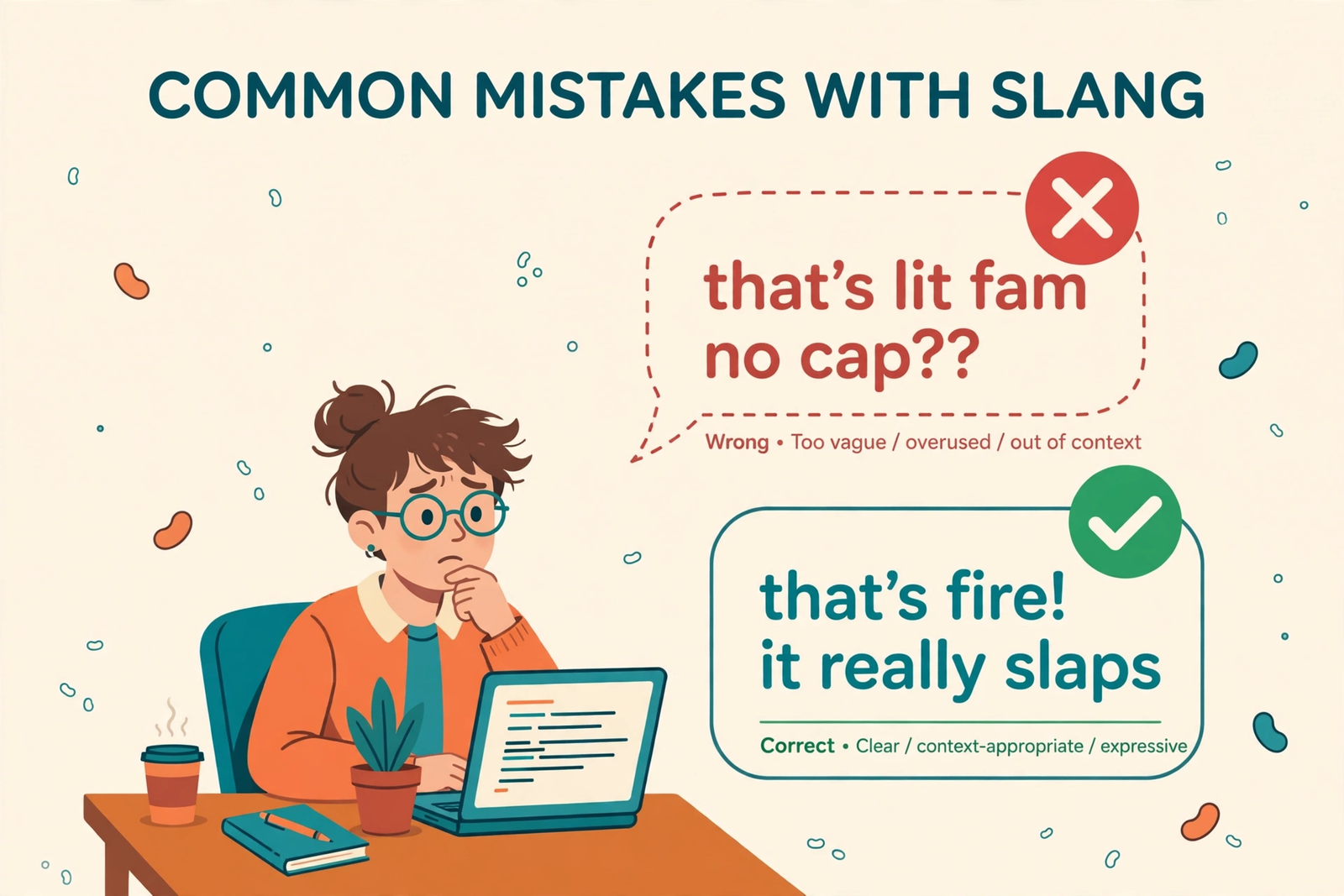
Common Mistakes
Beans slang is easy to use, but a few mistakes show up again and again. Avoid these and you will sound like a native speaker, not someone reading a dictionary.
1. Using the dismissal “beans” in serious situations. Replying “beans” to a coworker’s project update or a teacher’s announcement is not funny — it reads as rude and dismissive. The one-word dismissal is for friends and jokes only. In any situation where respect matters, use a real sentence instead.
2. Mixing up “spill the beans” and “spill the tea.” People often treat them as identical, but they are not. “Spill the beans” is about revealing a secret; “spill the tea” is about sharing gossip. Asking someone to “spill the beans” about celebrity drama sounds slightly off, and asking them to “spill the tea” about a surprise party sounds wrong. Match the phrase to the information.
3. Saying “cool beans” to sound current. “Cool beans” is deliberately retro. Using it to sound trendy usually backfires, because it signals the opposite — that you are being playfully old-fashioned. That is fine when it is intentional and funny, but if you want to sound current, words like “fire” or “lit” are the modern choices.
4. Using “beans” for money or pills. The money and pill senses are rare, dated, and confusing. If you say “I don’t have beans” to mean you are broke, most listeners under thirty will think you are talking about food — or they will simply be confused. Use “I am broke” instead, and leave the pill sense alone entirely.
5. Dropping “beans” without context. A lone “beans” in a conversation where nobody made an exaggerated claim will confuse people. The dismissal only works as a reaction to something unbelievable. If there is no claim to dismiss, the word has nothing to do — so make sure the setup is there before you deliver the punchline.
6. Overusing it. Like any joke word, “beans” loses its charm if you say it ten times a day. The humor comes from surprise and timing. Use it once, at the right moment, and it lands perfectly. Use it constantly and it becomes noise.
Quick Tips
- Read the room first. The dismissal sense is for friends and jokes. If the conversation is serious, professional, or emotional, skip it.
- Let context choose the meaning. Cat photo? Affection. Wild claim? Disbelief. Gossip thread? A secret. The sentence around the word always tells you which beans you are dealing with.
- Use “spill the beans” freely. It is the safest bean phrase — standard English, understood by every generation, and fine in most workplaces.
- Save “cool beans” for light moments. It works best when you are being deliberately cheerful or retro. A smile in your voice (or an emoji in your text) sells it.
- Pair “toe beans” with a photo. The term is at its best in a caption under a picture of paws. Without the photo, it loses half its charm.
- Do not force it. If “beans” does not fit naturally into your sentence, do not squeeze it in. Slang sounds best when it sounds effortless.

FAQ

What does beans slang mean?
Beans slang has several meanings depending on context. It can mean a secret (“spill the beans”), nonsense or disbelief (a one-word reply of “beans” to an exaggerated claim), approval (“cool beans”), energy (“full of beans”), worthlessness (“not worth a hill of beans”), or a pet’s paw pads (“toe beans”). The surrounding sentence tells you which meaning applies.
What does “spill the beans” mean?
“Spill the beans” means to reveal a secret, usually accidentally or under pressure. For example: “I accidentally spilled the beans about the surprise party.” The idiom dates to at least the early 20th century and is standard English, so it works in casual and professional settings alike.
What does “cool beans” mean?
“Cool beans” means “great,” “awesome,” or “that works for me.” It started in American college slang in the 1970s and 1980s and sounds cheerful and slightly retro today. Use it when you are happily agreeing to a plan: “Dinner at seven?” — “Cool beans, see you then.”
What are “toe beans”?
“Toe beans” are the soft pads on a cat’s or dog’s paws. Pet owners on Instagram and TikTok popularized the term because the pads look like little beans. It is a wholesome, affectionate word used almost always with a cute pet photo.
Is “beans” rude?
It depends on the sense. The one-word dismissal (“Beans.”) is mildly rude — it tells someone you do not believe them — but it is meant playfully among friends. The idioms “spill the beans,” “cool beans,” and “full of beans” are not rude at all. Never use the dismissal sense with a boss, a teacher, or a stranger.
What does “full of beans” mean?
“Full of beans” means bursting with energy and excitement. It comes from horse racing slang, where a lively horse was described as full of beans. Today it usually describes children or energetic people: “The kids are full of beans this morning.”
What does “not worth a hill of beans” mean?
It means something has almost no value. The phrase is a 19th-century American expression: a hill of beans is a tiny, unimpressive pile, so something worth less than that is worthless. Example: “His excuse was not worth a hill of beans.”
Can I use beans slang at work?
Only the idiom uses. “Spill the beans” and “full of beans” are established English phrases and are fine in most workplaces. The one-word dismissal, “cool beans,” and “toe beans” are casual — save them for friends, family, and social media. When in doubt, use a plain alternative like “please share the details” or “that sounds great.”
Conclusion
Beans slang is proof that the smallest words can carry the biggest personalities. In one little food word, English packed a secret, a dismissal, a compliment, an energy level, a measure of worth, and the cutest pet term on the internet. That range is exactly why the word has survived for more than a century while flashier slang came and went.
The key takeaway is simple: context is everything. “Beans” after a wild claim is disbelief. “Beans” under a cat photo is love. “Spill the beans” is a secret waiting to come out, “cool beans” is a happy yes, and “full of beans” is energy you can feel across the room. Learn the senses, watch the sentence around the word, and you will never misread it again.
Start with the safest uses — “spill the beans” in conversation, “cool beans” with friends — and try the one-word dismissal the next time someone in your group chat tells a story nobody believes. Use it once, at the right moment, and watch the laughing emojis roll in. And if you want to keep building your slang vocabulary, our guides to fire, lit, and drip are the perfect next stop — plus our list of cool synonyms for every time “good” feels too plain. For a deeper look at how slang itself works, the Merriam-Webster entry for bean is a great authoritative starting point. Now go enjoy your beans — in whatever sense you mean them.
