TYSM Meaning & Definition
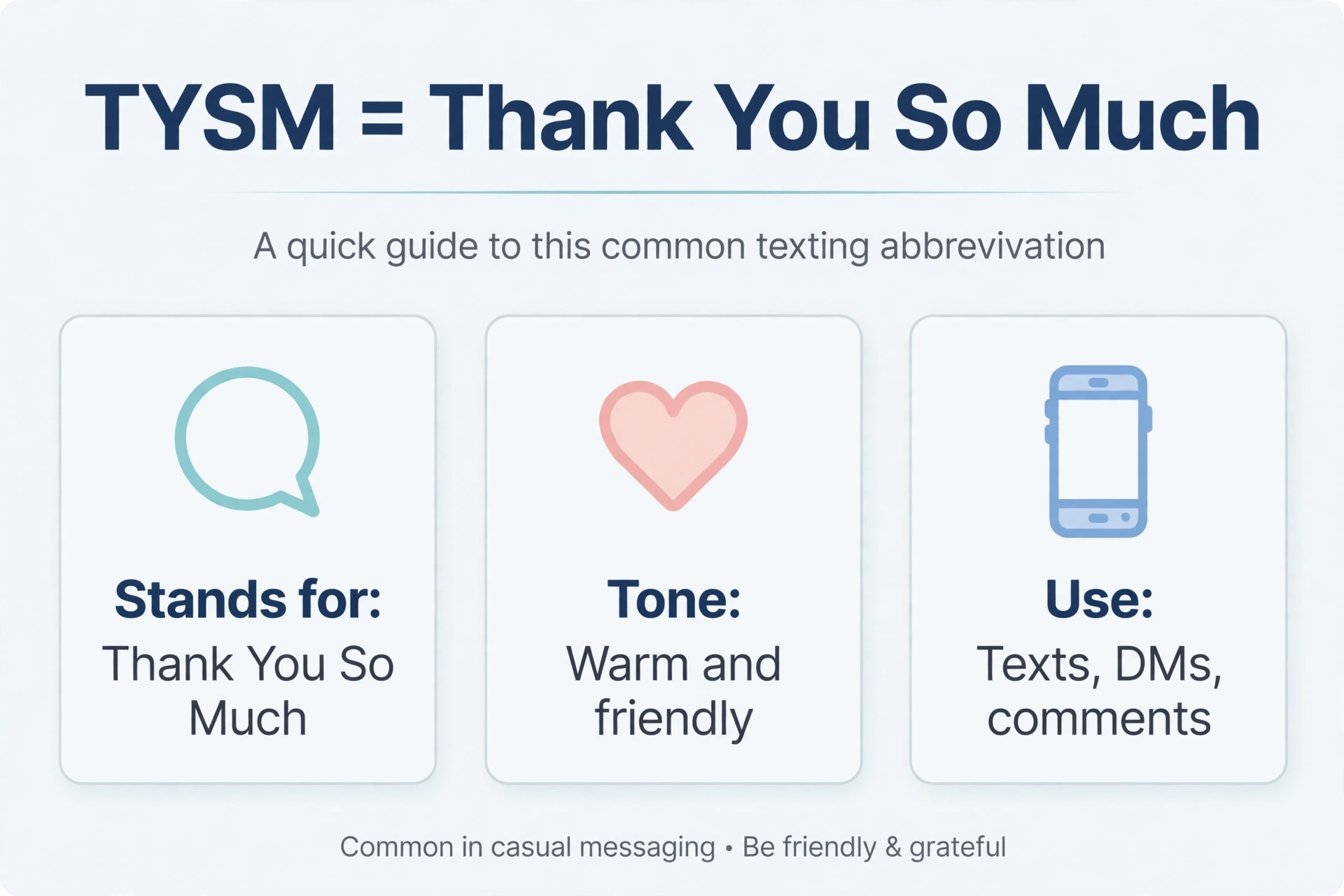
Quick Answer: In texting and on social media, TYSM stands for “Thank You So Much” — a fast, warm way to express gratitude in chats, DMs, and comment sections. When a friend sends you a helpful link and you reply “tysm!!”, you’re saying thanks with extra enthusiasm. The tone depends on context: it can be genuinely heartfelt or playfully sarcastic, as in “tysm for the spoiler” when someone ruins a show for you. It is casual by nature, so it belongs in texts and DMs, not in formal emails.
| Term | TYSM |
|---|---|
| Stands for | “Thank You So Much” |
| Category | Gratitude / appreciation abbreviation |
| Tone | Warm, friendly; occasionally sarcastic |
| Used where | Texts, WhatsApp, Instagram DMs, TikTok comments, Snapchat, Discord, gaming chats |
| Era | Early 2000s IM/SMS culture; mainstream by the 2010s |
| Formal use | No — keep it out of work emails and official messages |
Introduction
A friend drops the exact restaurant recommendation you needed. A creator replies to your comment with a shoutout. A stranger in a gaming lobby revives you at the last second. In each of those moments, typing out “thank you so much” feels right — but your thumbs have other plans, and four little letters do the job in half a second: TYSM.
If you’ve spent any time in text conversations or comment sections, you’ve seen TYSM everywhere. It’s one of the most common gratitude abbreviations on the internet, right up there with casual greetings like “sup” in everyday chat culture. But despite how often it appears, people still wonder about the exact TYSM meaning in text: Is it always sincere? Can you use it with your boss? What’s the difference between tysm, ty, and thx?
This guide answers all of it. You’ll learn what TYSM stands for, where it came from, how its tone changes with punctuation and capitalization, when it’s sincere versus sarcastic, how to reply when someone sends it to you, the mistakes to avoid, and the polite alternatives for situations where an abbreviation won’t cut it. By the end, you’ll use TYSM the way fluent texters do — naturally, and with exactly the right amount of warmth.
Origin
TYSM was born out of pure typing laziness — and that’s a compliment. In the early 2000s, the internet ran on instant messengers like AIM and MSN Messenger, and mobile phones ran on multi-tap T9 keypads where typing “thank you so much” meant pressing keys roughly thirty times. Abbreviating gratitude wasn’t just convenient; it was survival.
Early chat culture was an abbreviation factory — part of the broader Internet slang ecosystem documented on Wikipedia. Alongside LOL, BRB, OMG, and TTYL, gratitude got its own shortcuts: TY (“thank you”), THX (“thanks”), and eventually TYSM for the full-strength version. The logic was simple — the more letters, the warmer the thanks. A bare “ty” could feel flat; “tysm” carried genuine appreciation.
The abbreviation went mainstream in the 2010s as smartphones and social media took over. Twitter’s character limit rewarded every saved keystroke, and TYSM became a staple in replies and fan interactions. On Tumblr and Facebook, it showed up in reblogs and comments. By the time Instagram DMs, Snapchat, and TikTok comments became the center of online conversation, TYSM was fully embedded in the language — the default quick-thanks of the internet.
Unlike slang that flares up and fades (think of abbreviations that lived and died on a single platform), TYSM stuck around because it solves a permanent problem: gratitude is one of the most-typed emotions online, and people will always want a faster way to express it. In 2026, it remains one of the most recognized texting abbreviations in English — understood across generations, platforms, and countries.
Popularity
TYSM’s popularity has been remarkably stable — it never really had a “viral moment” because it was never really a meme. Instead, it became infrastructure: part of the invisible plumbing of online conversation. Here’s where it stands today:
- Texting and WhatsApp: The abbreviation’s natural habitat. Friends send “tysm” constantly — for favors, advice, memes, reminders, and rides. It’s often paired with emojis like 🙏, 💛, or 😭 to set the emotional temperature.
- Instagram and TikTok: Extremely common in DMs and comment replies. Creators use it to thank followers; followers use it to thank creators. On TikTok especially, “TYSM” appears in comment threads under helpful videos — recipes, tutorials, life advice.
- Snapchat: A quick “tysm” on a snap reply is standard etiquette when someone sends you something funny or useful.
- Gaming and Discord: After a teammate saves the match or shares loot, “tysm” flies through the chat. In fast-paced games, four letters is all you have time for.
- Customer chats and marketplaces: Buyers on platforms like Depop, Facebook Marketplace, and Etsy often close conversations with “tysm!” — it’s become the standard friendly sign-off for casual transactions.
Search interest for “TYSM meaning” has stayed consistent for years, which tells you something important: new texters keep arriving, and TYSM is one of the first abbreviations they need decoded. It’s not a trend — it’s vocabulary.
How It Is Used
TYSM is used the way spoken gratitude is used: to acknowledge something someone did for you, quickly and warmly. The key detail is that while the core TYSM meaning stays the same, small formatting choices change its tone — this is one abbreviation where capitalization and punctuation genuinely matter.
| Form | What it signals | Example |
|---|---|---|
| tysm (lowercase) | Casual, relaxed thanks between friends | “tysm for sending the notes” |
| TYSM (uppercase) | Enthusiastic, emphatic gratitude | “TYSM this made my day” |
| tysm!! (exclamation) | Extra warmth and excitement | “tysm!! you’re the best” |
| tysm. (period) | Can read as dry or flat — context decides | “tysm.” (after an argument) |
| tysm 🙄 (eye-roll) | Sarcastic — the opposite of thanks | “tysm for telling everyone 🙄” |
In practice, most TYSMs are sincere. Someone helps you, you thank them, done. The sarcastic version exists — and it’s common enough to know about — but it almost always comes with a tell: an eye-roll emoji, a complaint in the same message, or a situation where thanks would be absurd. “tysm for eating my fries” is not gratitude.
TYSM also works as a standalone message. Unlike some abbreviations that need a sentence around them, a lone “tysm 🙏” is a complete, polite response. That’s part of why it’s so popular: it lets you acknowledge someone without derailing the conversation.
Examples
The best way to understand TYSM is to see it in the wild. Here are real-world style examples across different tones and situations:
Friendly Examples
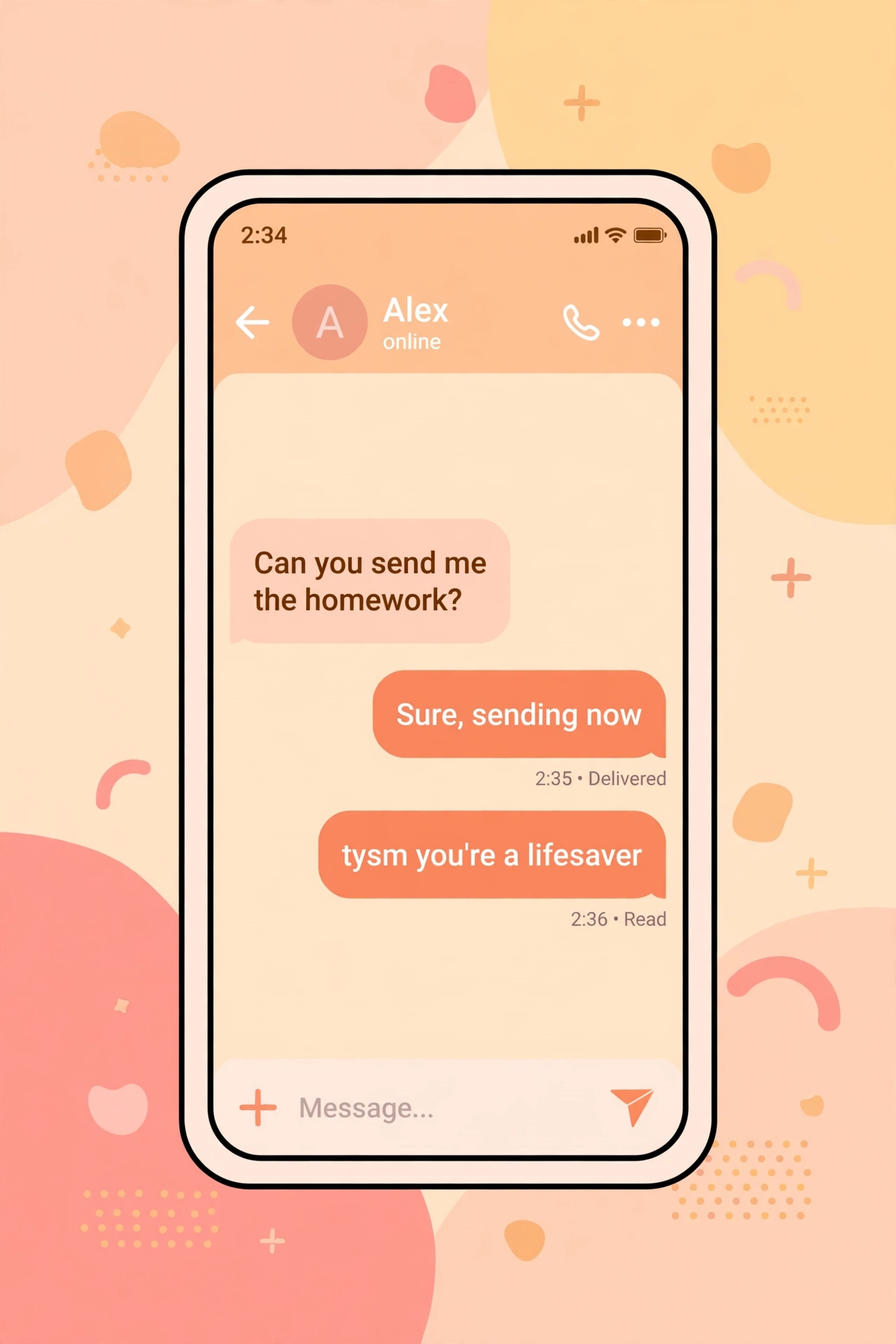
- Text: “Can you send me the homework questions?” → “Sure, sending now” → “tysm you’re a lifesaver 🙏”
- Instagram DM: “That filter you used is so pretty, which one is it?” → “It’s the Paris one!” → “TYSM!!”
- Group chat: “Reminder: party moved to Saturday” → “tysm for the heads up”
- Snapchat: (sends a funny meme) → “tysm I needed that laugh 😭”
- Gaming: (teammate drops a health pack) → “tysm!!”
Professional Examples
A quick note: TYSM is not for formal professional settings — never put it in a work email or a message to a client. But in casual workplace chats (Slack, Teams DMs with friendly coworkers), a light version can work:
- Slack: “Here’s the file you asked for” → “tysm! exactly what I needed”
- Teams: “I moved our meeting to 3 PM” → “tysm for letting me know”
Rule of thumb: if you’d sign the message with your full name, spell out the thanks. If it’s a quick DM with a coworker you’re friendly with, lowercase “tysm” is fine.
Funny Examples
- “tysm for the 47 notifications at 3 AM, truly blessed 🙏” — said to a friend who spammed the group chat
- “Wow tysm for finishing the pizza without me, so generous of you” — the classic roommate complaint
- “TYSM for the spoiler, I definitely wanted to find out that way” — the sarcastic show-ruiner response
- “tysm autocorrect, ‘ducking’ is exactly what I meant to say” — blaming the phone, as tradition demands
Comparison with Similar Terms
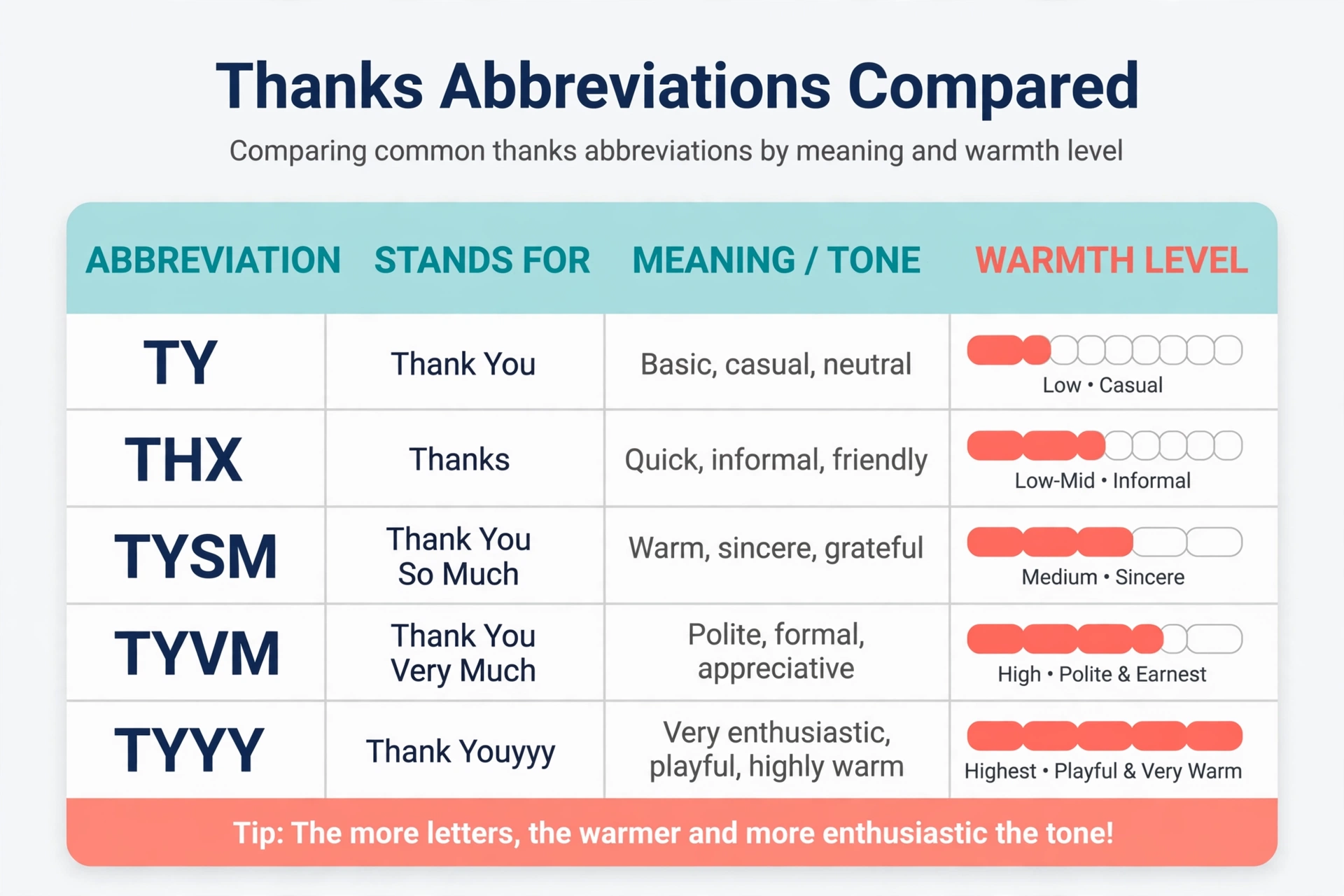
TYSM isn’t the only way to type thanks. The abbreviation you choose sets the emotional volume — here’s how the family compares:
| Abbreviation | Stands for | Warmth level | Best used when |
|---|---|---|---|
| ty | thank you | ⭐ Low — quick and neutral | A fast acknowledgment; can feel flat alone |
| thx | thanks | ⭐⭐ Medium-low — casual | Everyday small favors between friends |
| tysm | thank you so much | ⭐⭐⭐⭐ High — warm and genuine | Real gratitude: help, gifts, thoughtful gestures |
| tyvm | thank you very much | ⭐⭐⭐ Medium-high — slightly formal | A touch more polished; older internet style |
| tyyy / tyyyy | thank youuu | ⭐⭐⭐⭐⭐ Maximum — playful | Close friends, excited or affectionate thanks |
The pattern is simple: more letters (or repeated letters) = more warmth. “ty” is a nod; “tysm” is a hug. Choosing between them is mostly about how much the thing mattered to you. A meme gets a “thx”; someone driving you to the airport gets a “TYSM!!”
One more comparison worth knowing: TYSM vs. a plain “thanks”. In text, “thanks” with no emoji and a period — “Thanks.” — can read as cold or annoyed. TYSM almost never has that problem; the abbreviation itself carries warmth, which is why texters reach for it when they want to make sure the gratitude lands.
Like other texting shortcuts — the kind you’d find explained alongside terms like FN or CFS — TYSM earns its place by saving time without losing meaning. It compresses a full sentence of gratitude into four letters, and everyone on the receiving end decodes it instantly.
Alternate Meanings
Here’s the honest truth: TYSM has no widely used alternate meaning. Unlike abbreviations such as PTSO or ICL, which genuinely stand for different things in different contexts, TYSM is “Thank You So Much” essentially everywhere it appears.
That said, there are two tone-based “alternate readings” worth knowing:
- The sarcastic TYSM: As covered above, “tysm” can carry the exact opposite of gratitude when the situation is clearly negative — “tysm for the flat tire” nobody says sincerely. The sarcasm is always signaled by context or emojis, so it’s rarely confusing once you know to look for it.
- The dismissive TYSM: Occasionally, a bare “tysm” with no warmth — especially with a period — is used to end a conversation rather than express real thanks. “Yeah okay. tysm.” reads as “we’re done here.” Again, context makes it obvious.
If you see TYSM somewhere and neither of these readings fits, the default is always the sincere one. When in doubt, assume gratitude — you’ll be right the vast majority of the time.
Professional or Polite Alternatives
TYSM is perfect for friends and casual chats, but some situations demand the full, spelled-out version. Here’s how to scale your thanks to the setting:
| Situation | What to say instead |
|---|---|
| Work email | “Thank you so much for your help with this.” |
| Job interview follow-up | “I really appreciate you taking the time to speak with me.” |
| Message to a teacher/professor | “Thank you very much for the feedback.” |
| Texting someone older / formal | “Thank you so much!” (spelled out, with an exclamation mark) |
| Customer service (as the customer) | “Thanks so much for your help!” |
| Big favors | “I really appreciate it — thank you so much.” |
The principle: match the effort of your thanks to the effort of the favor. A four-letter abbreviation is perfect for everyday kindness; life’s bigger moments deserve the full sentence. And in any formal or professional context, abbreviations of any kind — not just TYSM — should stay out of the message.
Common Mistakes
TYSM is simple, but people still get it wrong. Here are the mistakes to avoid:
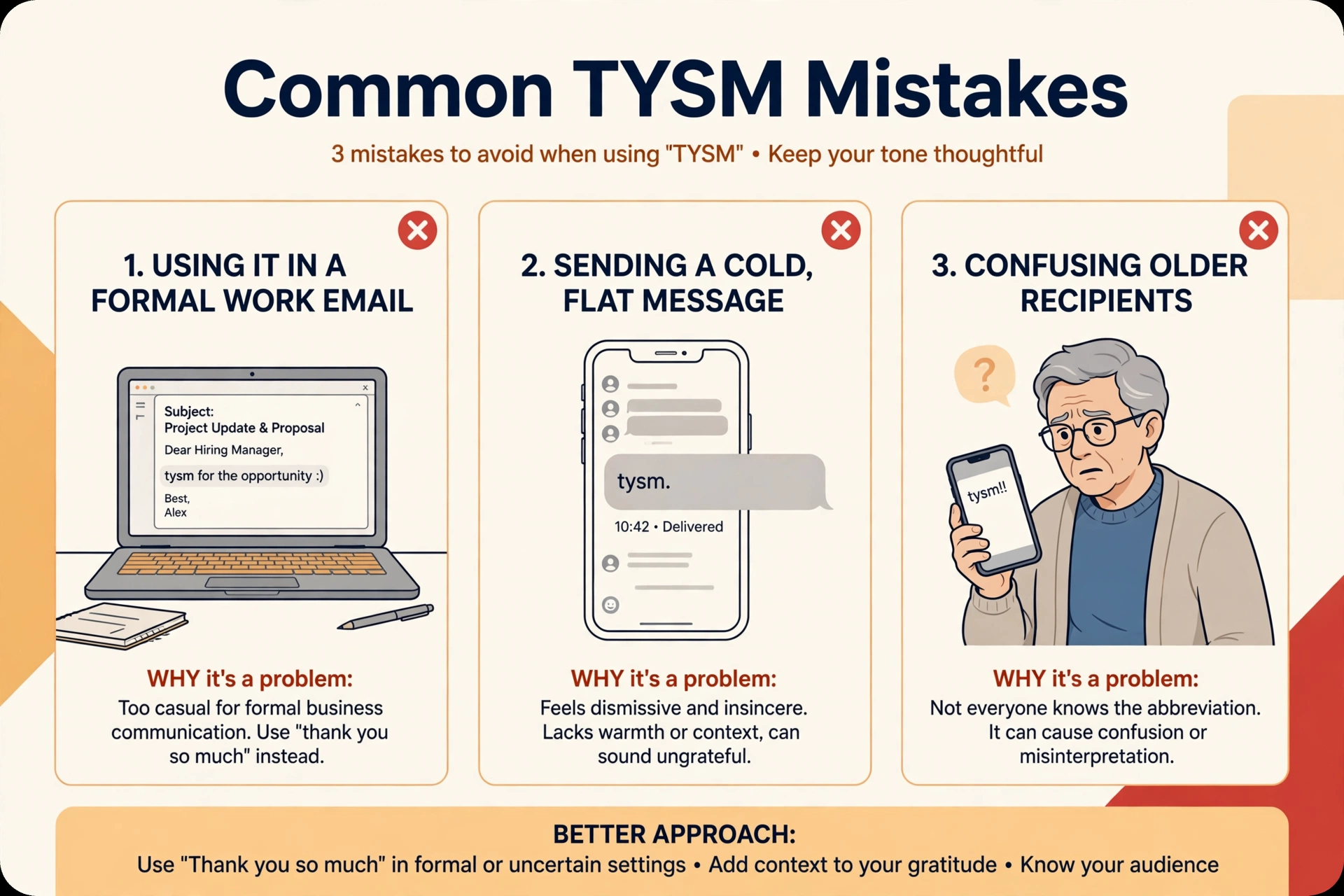
- Using it in formal emails. The number-one TYSM mistake. “TYSM for the interview opportunity” in a thank-you email reads as careless, not efficient. Spell it out.
- The lonely period. “tysm.” with a full stop can look passive-aggressive even when you mean it warmly. If you’re being sincere, skip the period or add an emoji.
- Sarcasm without a signal. A dry “tysm” after something annoying will confuse people who don’t know you well. If you’re joking, add 🙄 or 😅 so the tone is unmistakable.
- Overusing it in one conversation. Replying “tysm” to every single message makes each one mean less. Vary it: “tysm!”, “appreciate it 🙏”, “you’re the best”.
- Using it with people who won’t get it. Grandparents, formal acquaintances, and anyone not steeped in texting culture may read “TYSM” as a typo or a name. When in doubt, spell it out.
- Confusing warmth levels. Replying “ty” when someone went out of their way for you can feel dismissive. Match the abbreviation to the size of the favor — big help, big thanks.
- TYSM as a conversation ender. A bare “tysm” with nothing else can signal “I’m done talking.” If you want to keep chatting, add a follow-up: “tysm! so what did you think of the movie?”
Quick Tips
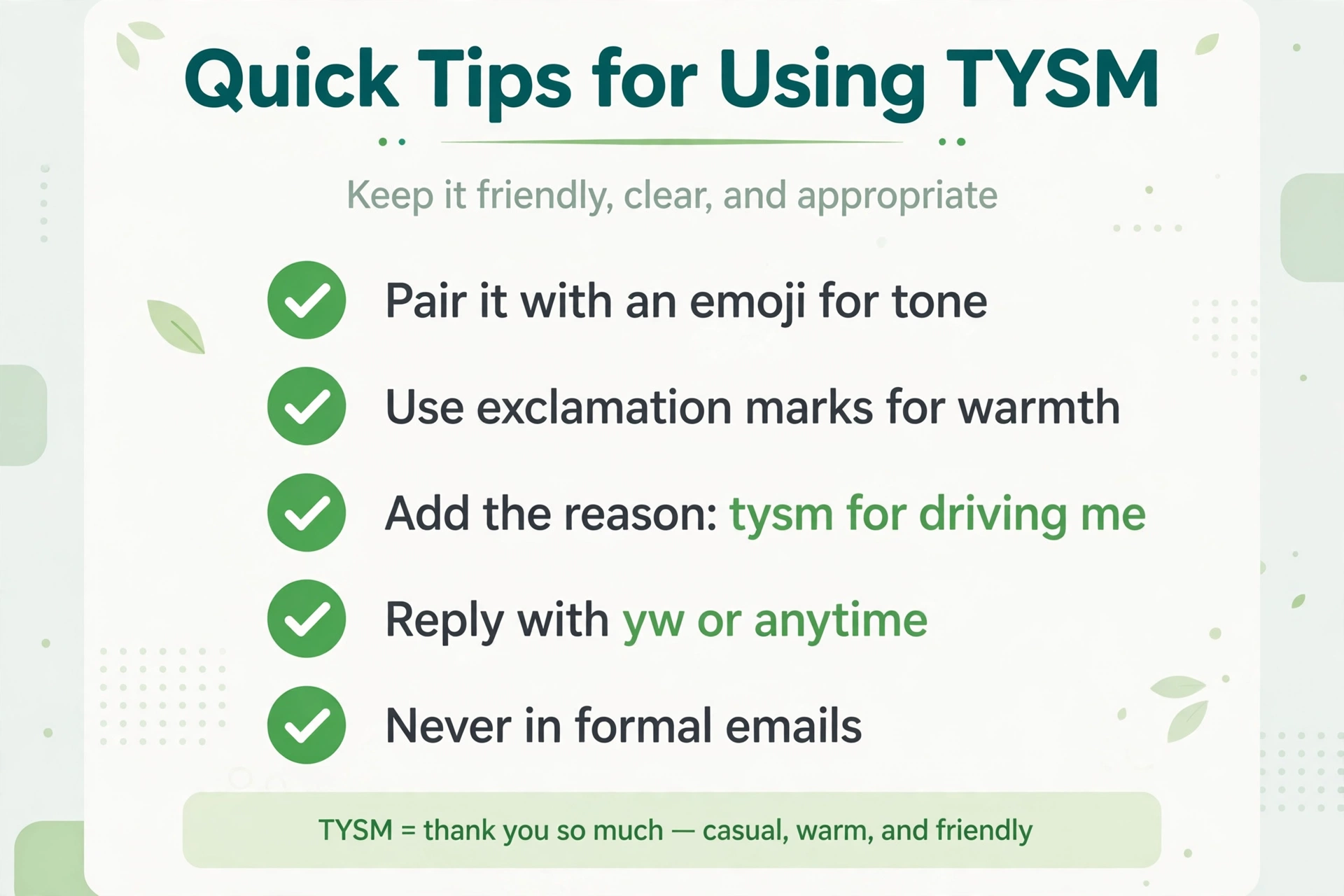
- Pair it with an emoji to lock in the tone: 🙏 for sincere, 💛 for warm, 😭 for overwhelmed-in-a-good-way.
- Use exclamation marks for extra warmth: “tysm!!” reads noticeably friendlier than “tysm”.
- Uppercase for emphasis: “TYSM” when you’re genuinely thrilled; lowercase “tysm” for everyday thanks.
- Add the reason when it matters: “tysm for driving me home” beats a bare “tysm” because it shows you noticed the specific effort.
- Reply to TYSM simply: “yw” (you’re welcome), “ofc” (of course), “anytime!”, or “np” (no problem) all work. For extra warmth: “anytime!! 💛”.
- In group chats, a quick “tysm” reaction to helpful messages keeps the vibe positive without cluttering the chat.
- Never in formal writing: resumes, cover letters, work emails, academic messages — always spell out “thank you so much.”
- When someone’s upset with you, don’t hide behind “tysm.” A real apology spelled out will always land better than four letters and a period.
FAQ
What does TYSM mean in text?
The TYSM meaning is simple: it stands for “Thank You So Much.” It’s a casual abbreviation used in texts, DMs, and comment sections to express gratitude quickly — the texting equivalent of saying thanks with extra warmth.
Is TYSM the same as TY?
They share a root, but the warmth differs. TY (“thank you”) is a quick, neutral acknowledgment, while TYSM (“thank you so much”) carries noticeably more gratitude. Think of TY as a nod and TYSM as a hug.
Can TYSM be sarcastic?
Yes. Like “thanks,” TYSM can be used sarcastically — “tysm for the spoiler 🙄” means the opposite of gratitude. Sarcastic use is almost always signaled by context (something bad happened) or emojis like 🙄, so it’s rarely confusing in practice.
Is it rude to say TYSM?
No — TYSM is friendly, not rude. The only way it reads badly is through formatting: a bare “tysm.” with a period can look flat or passive-aggressive, and using it in formal settings (work emails) comes across as careless. Among friends, it’s perfectly polite.
Can I use TYSM in a professional email?
No. Never use TYSM — or any texting abbreviation — in a professional email, cover letter, or formal message. Write “Thank you so much” in full. In casual workplace chats like Slack DMs with friendly coworkers, a lowercase “tysm” is generally fine.
How do you reply when someone says TYSM to you?
Keep it light: “yw” (you’re welcome), “ofc” (of course), “anytime!”, or “np” (no problem). If you want to match their warmth, try “anytime!! 💛” or “ofc, happy to help!”
What does TYSM mean on TikTok and Instagram?
The same thing: “Thank You So Much.” On TikTok and Instagram it appears constantly in comments and DMs — followers thanking creators, creators thanking followers, and friends reacting to helpful or funny content. It’s one of the most common gratitude expressions on both platforms.
What’s the difference between TYSM and TYVM?
Both express strong thanks: TYSM = “Thank You So Much,” TYVM = “Thank You Very Much.” TYSM feels warmer and more modern; TYVM feels slightly more formal and old-school internet. In everyday texting, TYSM is the more common choice.
Conclusion
The TYSM meaning — “Thank You So Much” — is one of those rare internet abbreviations that does exactly what it promises: it delivers genuine gratitude at the speed of texting. Born in the era of T9 keypads and instant messengers, it survived every platform shift since because the need it serves never goes away. People will always want a fast way to say thanks, and four warm letters beat a full sentence when your thumbs are busy.
The keys to using it well are simple: match the warmth to the favor (tysm for real help, ty for quick nods), mind your punctuation (exclamation marks add warmth, lone periods add frost), signal your sarcasm with an emoji when you’re joking, and keep it out of formal writing where the full “thank you so much” belongs.
Now that TYSM is decoded, you might enjoy learning the rest of texting’s greatest hits — from what PTSO means in text to the story behind TM in texting. The more of this vocabulary you know, the faster every conversation flows. And if this guide helped you out? Well — you know what to type. tysm for reading! 🙏

5 thoughts on “TYSM Meaning in Text: What It Really Means & How to Use It (2026)”