
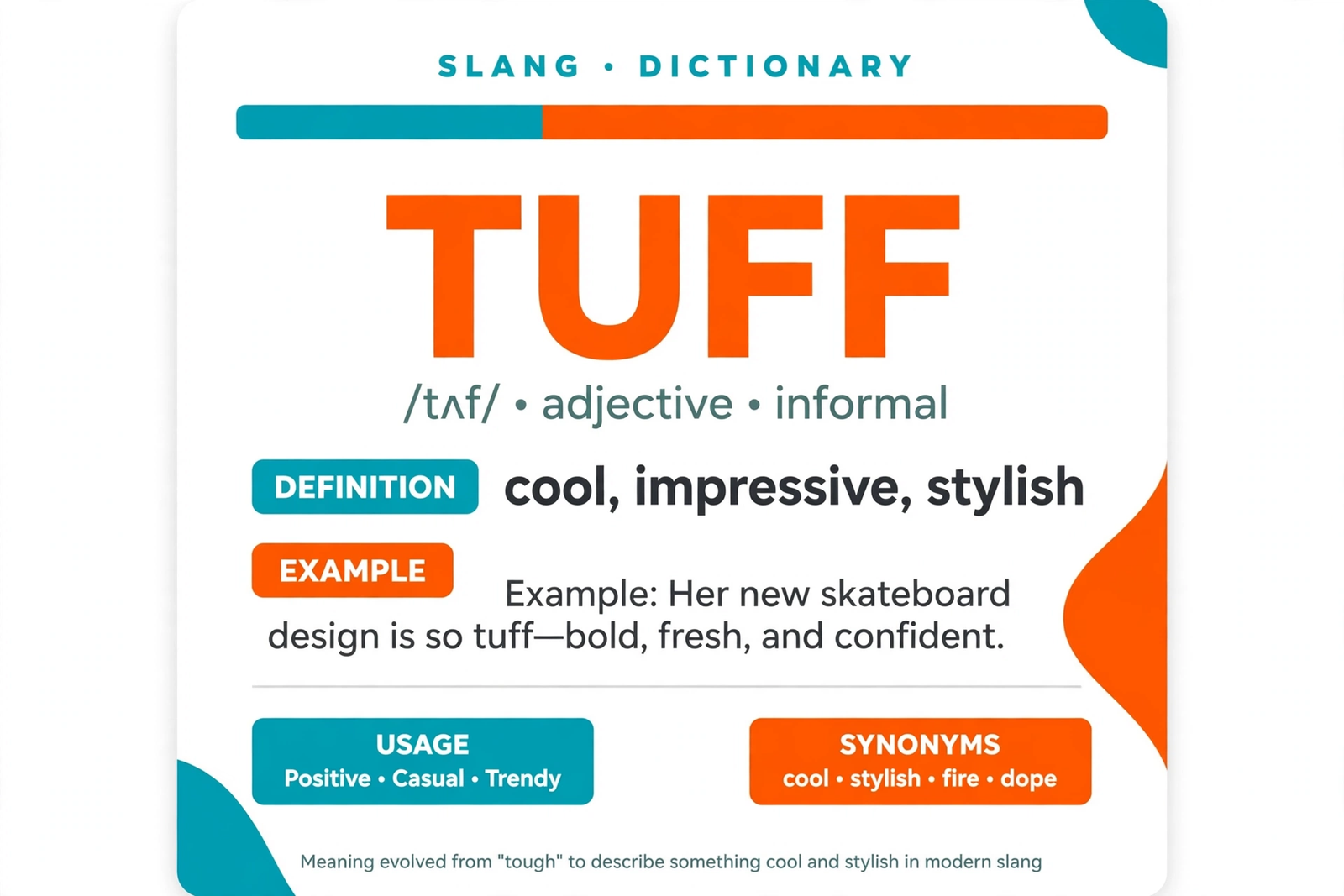
Quick definition: In slang, tuff means cool, impressive, or stylish. It is a playful respelling of the word “tough,” and when someone says “that fit is tuff” or “that edit was tuff,” they are giving a compliment. The tuff slang meaning is almost always positive — but context matters, because “that’s tuff” can also mean “that’s rough” when someone shares bad news.
Tuff Slang Meaning & Definition
The tuff slang meaning is simple: something that is cool, awesome, impressive, or hard in the best possible way. If a friend texts you “those sneakers are tuff,” they are not saying your shoes are difficult to wear. They are saying your shoes look great. If someone comments “that goal was tuff” under a football clip, they mean the goal was amazing.
Tuff is a deliberate respelling of tough. Both words are pronounced exactly the same way — “tuf” — but they live in different worlds. Tough is the standard English word for something difficult, strong, or durable. Tuff is the slang spelling that signals praise, style, and approval. The spelling itself is the message: when you see “tuff” with two f’s, you are reading internet culture, not a spelling mistake.
Here is the tuff slang meaning in one line:
- Tuff = cool, impressive, stylish, or hard-looking. Used as a compliment for people, outfits, music, videos, skills, cars, and almost anything worth admiring.
- “That’s tuff” after bad news = that’s rough. The same phrase flips meaning depending on the conversation, which is why the context around it matters so much.
- “Not tuff” = lame, cringe, or embarrassing. The opposite of the compliment, usually said as a joke or a light roast between friends.
Gen Z uses tuff the most, and Gen Alpha has pushed it even further. On TikTok, in group chats, in gaming lobbies, and in comment sections, tuff has become a quick, one-word way to say “I approve.” It sits in the same family as words like lit, drip, and gas — short hype words that do a lot of work in very few letters.
Introduction
Open TikTok, scroll through the comments on any impressive video — a wild basketball dunk, a perfectly edited fan video, a fresh haircut reveal — and you will see it. “Tuff.” “That’s tuff.” “Ts tuff.” Sometimes it is just the word on its own, dropped like a stamp of approval. No explanation, no emoji, no extra words needed. Everyone in the comments understands exactly what it means.
That is the power of the tuff slang meaning. It is short, it sounds confident, and it carries a very specific energy. Saying something is “cool” feels plain. Saying it is “tuff” feels like you actually mean it. The word has a weight to it — it sounds hard, solid, and unbothered, which is exactly the feeling it is meant to describe.
But tuff is also a word that trips people up. Parents see it in their kids’ texts and wonder if it is a typo. English learners hear it and think someone misspelled “tough.” And even native speakers can get confused, because “that’s tuff” can be a compliment in one conversation and a sympathetic “that sucks” in another. This guide clears all of that up: what tuff means, where it came from, how to use it, when not to use it, and how it compares to similar slang words.
Origin
The story of tuff starts long before TikTok. The word first became famous as slang in S.E. Hinton’s 1967 novel The Outsiders, where the narrator Ponyboy uses “tuff” to describe something cool or sharp. In the book, tuff was greaser slang — the language of cool, tough-looking teenagers in 1960s America. When Ponyboy called something tuff, he meant it looked good, it was impressive, it had style.
That 1960s usage never fully died. It lingered in American teen slang, in car culture, and in hip-hop, where “tough” and “tuff” blurred together for decades. Comedian Kevin Hart famously used “tuff” to describe something difficult in 2013, keeping the word in the public ear. But the real explosion came much later.
Tuff went viral on TikTok in late 2024. Short videos, fast comments, and a generation that loves one-word reactions turned it into a comment-section staple. Gen Z and especially Gen Alpha adopted it as a catch-all hype word — for shoes, goals, haircuts, Minecraft builds, edits, outfits, anything. By 2025 and into 2026, tuff had become one of the most common slang compliments on the internet, right alongside “fire,” “hard,” and “clean.”
The spelling is part of the appeal. Writing “tough” in a comment feels formal and old-fashioned. Writing “tuff” feels current, casual, and in on the joke. The double f gives the word a punchy, visual style that fits the fast, image-heavy world of TikTok and texting perfectly.
Popularity
Tuff is popular because it is useful. It works as a reaction, a compliment, a caption, and a reply all at once. You can drop it under a video, send it as a one-word text, or use it to hype up a friend — and it always lands.
Here is where you will see tuff the most in 2026:
- TikTok comments: The number one home of tuff. Any impressive video — sports highlights, outfit checks, edits, pranks, talents — collects “tuff” comments within minutes.
- Texting and group chats: Friends use it to react to photos, news, and wins. “Just got the new Jordans” gets a “tuff” back almost instantly.
- Gaming: A clean play, a rare skin, or a clutch win earns a “tuff” from teammates.
- Instagram and Snapchat: Captions and replies on fit pics, cars, and flex posts.
- Music and sports fandom: Fans call a new track, a jersey, or a highlight reel tuff.
The word is especially big with Gen Alpha — the younger crowd that lives on TikTok and in group chats. For them, tuff is not just slang; it is a default reaction word, the way “cool” was for earlier generations. Older Gen Z uses it too, but more selectively, usually for something genuinely impressive rather than as an everyday filler.
Search interest in the tuff slang meaning has grown steadily as parents, teachers, and curious readers try to keep up. It now appears in Gen Z slang dictionaries and listicles alongside rizz, delulu, and skibidi — a sign that it has moved from a niche comment word to a mainstream piece of internet vocabulary.
How It Is Used
Tuff is flexible. It can describe a thing, react to news, or stand alone as a complete reply. Here are the main ways people use it:
1. As a compliment for something cool
This is the most common use. Someone shows you something impressive, and tuff is your approval.
- “Your new haircut is tuff.”
- “That car is tuff, bro.”
- “Her fit is tuff today.”
2. As a one-word reaction
On TikTok and in chats, tuff often appears all by itself. No sentence, no extra words — just the verdict.
- “Tuff.”
- “Tuff 🔥” (sometimes paired with a fire emoji for extra emphasis)
- “Ts tuff” — short for “this is tuff” or “that’s tuff,” very common in comments.
3. As a reply to bad news — meaning “that’s rough”
This is the tricky one. When someone shares something unlucky or difficult, “that’s tuff” means “that sucks” or “that’s rough.” The exact same words, the opposite feeling.
- “I failed my driving test.” — “Ah, that’s tuff.”
- “My phone screen cracked again.” — “Tuff, man.”
The tone and the context tell you which meaning is in play. If the news is good, tuff is a compliment. If the news is bad, tuff is sympathy. When in doubt, look at what came right before it.
4. With “not” — the opposite
“Not tuff” means lame, embarrassing, or cringe. It is usually a joke or a light roast between friends, not a serious insult.
- “Bro really wore socks with sandals. Not tuff.”
- “That take was not tuff at all.”
5. To describe attitude or aura
Tuff can describe a person, not just a thing. A “tuff” person is confident, strong, stylish, and unbothered — someone with presence.
- “He walked in like he owned the place. Tuff.”
- “She’s got that tuff energy.”
Examples
Real examples make the tuff slang meaning click. Here are everyday uses, grouped by tone, so you can see exactly how it sounds in real conversations.
Friendly Examples
Between friends, tuff is warm, casual praise. It is the kind of thing you say without thinking twice.
- Friend 1: “Check out my new sneakers.” Friend 2: “Okay, those are tuff!”
- Friend 1: “I finally finished my art project.” Friend 2: “That’s tuff, I love the colors.”
- Friend 1: “Rate my fit.” Friend 2: “10/10, tuff.”
- Friend 1: “I got tickets to the concert!” Friend 2: “Tuff! You’re gonna have the best night.”
Professional Examples
Tuff is informal, so it rarely belongs in a workplace email — but in casual professional settings like creative teams, content creation, or social media work, it shows up as light praise.
- Teammate: “Here’s the new logo concept.” Designer: “That’s tuff, the color choice is really strong.”
- Creator: “Just dropped the new edit.” Comment: “Tuff edit, the transitions are clean.”
- Coach: “Great hustle today, team.” Player: “That comeback was tuff.”
Rule of thumb: if you would not say “cool” or “awesome” in that setting, do not say “tuff” either. Keep it for casual, friendly, or creative conversations.
Funny Examples
Because tuff is so short and confident, it also works as a joke — especially when something is obviously not cool at all.
- Friend: “I tripped in front of my crush.” Reply: “That’s tuff 😭”
- Friend: “My Wi-Fi died during the final boss fight.” Reply: “Tuff luck, bro.”
- Friend: “I wore my shirt inside out all day.” Reply: “Not tuff.”
- Friend: “I studied all night and still failed.” Reply: “Yeah, that’s tuff.”
Notice how the funny examples mostly use the “that’s rough” meaning. That is the humor of tuff: one tiny word can flip from hype to sympathy, and everyone in the chat knows which one it is.

Comparison with Similar Terms
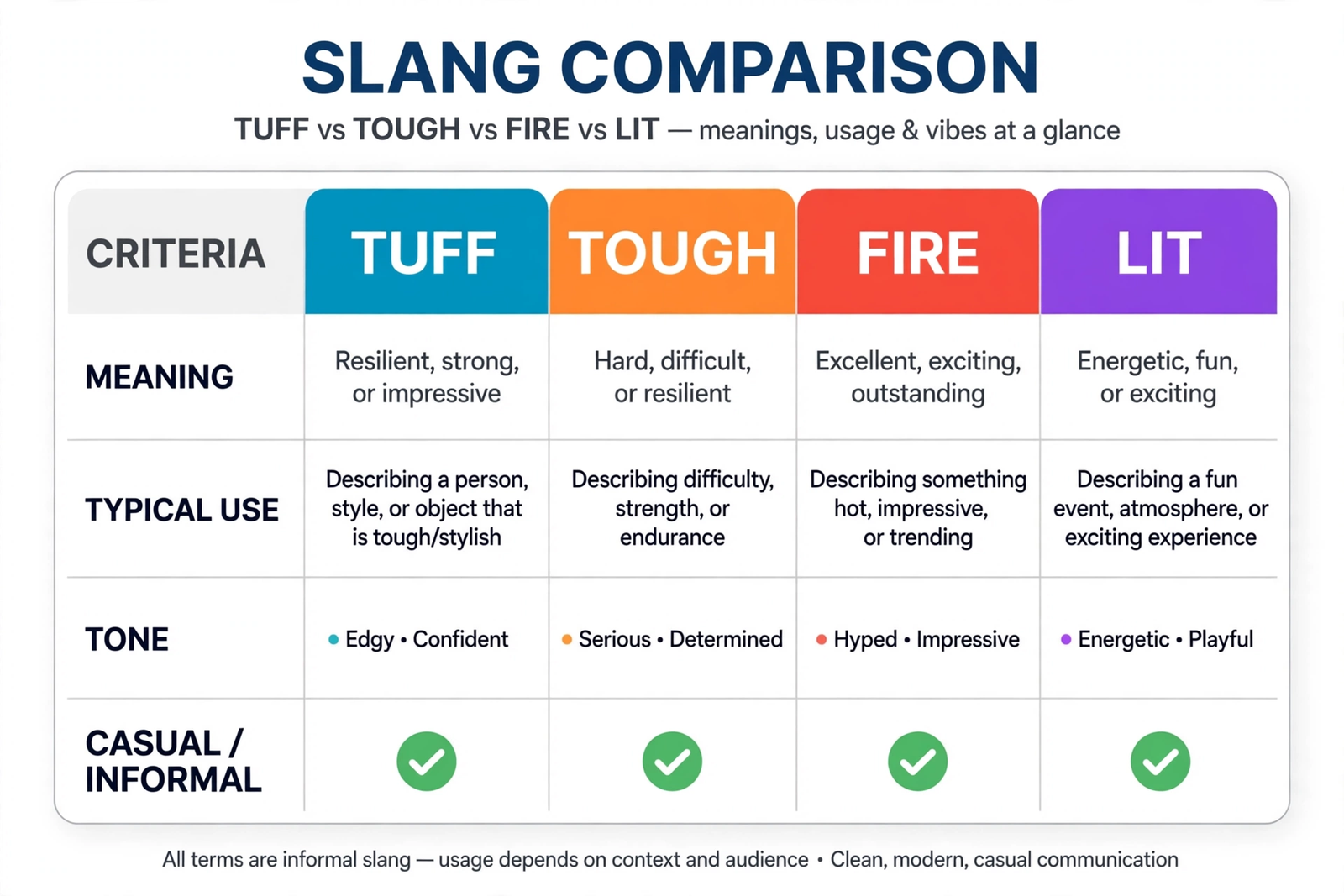
Tuff is not the only one-word compliment in slang. Here is how it stacks up against the words people confuse it with — including its own twin, tough.
| Word | Meaning | Vibe | Example |
|---|---|---|---|
| Tuff | Cool, impressive, stylish | Positive, confident | “That fit is tuff.” |
| Tough | Difficult, strong, durable | Neutral, standard English | “That exam was tough.” |
| Fire | Amazing, excellent | Positive, high energy | “That song is fire.” |
| Lit | Exciting, fun, amazing | Positive, party energy | “The party was lit.” |
| Hard | Impressive, goes hard | Positive, intense | “That beat goes hard.” |
| Dope | Cool, awesome | Positive, classic slang | “Those shoes are dope.” |
| Clean | Sharp, neat, well done | Positive, stylish | “That haircut is clean.” |
| Gas | Amazing, excellent | Positive, hype | “That track is gas.” |
The closest cousins of tuff are fire, hard, and dope — all one-word compliments for something impressive. Tuff feels slightly harder and more understated than fire, which is loud and excited. It is close to “hard” in energy, but tuff is used more for style and looks, while “hard” is used more for music and performance. Dope is the older classic; tuff is its Gen Z and Gen Alpha replacement.
And the tuff vs tough difference is worth repeating, because it is the number one source of confusion. Tough is the dictionary word: hard, strong, difficult. You can find it in the Merriam-Webster definition of tough, where it means something that is not easily broken or that requires great effort. Tuff is the slang respelling that usually means cool or impressive. Same sound, different spelling, different job.
Another useful comparison: tuff vs lit. Lit describes an experience — a party, a night out, a vibe. Tuff describes a thing or a look — an outfit, a car, a video, a skill. You would say “the concert was lit” but “his outfit was tuff.” Knowing that difference keeps your slang sounding natural.
Alternate Meanings
Tuff has a few meanings beyond the slang compliment, and knowing them helps you avoid confusion.
1. “That’s rough” — the sympathetic meaning
As covered above, “that’s tuff” after bad news means “that’s rough” or “that sucks.” It is sympathy, not praise. Context decides.
2. Volcanic rock — the geological meaning
In geology, tuff is a real, standard English noun: a rock formed from compacted volcanic ash and fragments. This is the original dictionary meaning, and it has nothing to do with slang. If you read a science article about a “layer of tuff,” it is talking about rock, not compliments. The slang spelling borrowed the same letters, but the two meanings live in completely different worlds.
3. Tough, strong, or resilient — the older slang sense
In older American slang, especially the 1950s and 60s greaser culture from The Outsiders, tuff could also mean tough in the sense of strong or hard-looking. That sense survives today when someone describes a person’s attitude: “tuff” can mean they look strong, confident, and unbothered.
4. “Tuff” as a name or brand
Because the word sounds strong, it shows up in brand names, usernames, and team names. In those cases it is just a name — the meaning comes from whatever the brand or person is known for.
| Meaning | When you will see it | Example |
|---|---|---|
| Cool / impressive | Texts, TikTok, comments | “That edit is tuff.” |
| That’s rough | Reply to bad news | “I lost my wallet.” — “Tuff.” |
| Volcanic rock | Geology, science | “The cliff is made of tuff.” |
| Strong / hard-looking | Describing attitude | “He’s got a tuff look.” |
Professional or Polite Alternatives
Tuff is slang, so it does not belong everywhere. In school essays, job applications, formal emails, or conversations with people who do not use internet slang, use one of these alternatives instead:
- Impressive — “That presentation was impressive.” (safe everywhere)
- Excellent — “Excellent work on the project.” (professional and warm)
- Stylish — “That outfit is very stylish.” (for fashion and looks)
- Outstanding — “An outstanding performance.” (formal praise)
- Remarkable — “A remarkable achievement.” (serious, respectful)
- Cool — “That’s cool.” (casual but universally understood)
- Awesome — “That’s awesome!” (friendly, works almost anywhere)
- Great — “Great job.” (the simplest safe option)
If you are texting a friend, tuff is perfect. If you are emailing a teacher or a boss, pick one of the words above. The compliment is the same — only the packaging changes.
Common Mistakes
Most mistakes with tuff come from using it in the wrong place or the wrong way. Here are the ones to avoid:
- Using it in formal writing: In a school essay, a cover letter, or a work email, “tuff” will be marked as a spelling mistake. The correct word there is “tough” or “impressive,” depending on what you mean.
- Mixing up the two meanings: Saying “that’s tuff” after someone’s good news is a compliment. Saying it after bad news is sympathy. Getting the context wrong can make you sound like you are celebrating someone’s bad luck.
- Spelling it “tough” when you mean the slang: “That fit is tough” reads as if the outfit is difficult or uncomfortable. If you mean “cool,” spell it “tuff.”
- Overusing it: Tuff works because it is short and punchy. If every single thing is tuff, the word loses its power. Save it for things that genuinely impress you.
- Using it with older people who do not know slang: Your grandma may read “tuff” as a typo. With people outside internet culture, “cool” or “awesome” communicates the same thing without confusion.
- Forgetting the “not tuff” joke can sting: “Not tuff” is usually playful, but said to the wrong person at the wrong time, it can feel like a real insult. Keep it for close friends who know you are joking.

Quick Tips
Want to use tuff like a native? These quick tips will keep you sounding natural:
- Keep it short. Tuff works best as a one-word reaction or a short sentence. “Tuff.” “That’s tuff.” “Ts tuff.” That is the whole style.
- Match the moment. Use it for things that are genuinely cool — a great outfit, a skill, a win, a clean edit. The compliment lands harder when you do not hand it out for everything.
- Read the room first. Before you reply “that’s tuff,” check whether the news is good or bad. Good news: compliment. Bad news: sympathy. Same words, opposite feelings.
- Pair it with fire or a clean emoji if you want extra hype. “Tuff 🔥” hits harder than “tuff” alone, but use it sparingly.
- Try the short forms. “Ts tuff” (this is tuff / that’s tuff) is the fastest version and the most common one in TikTok comments.
- Do not force it. If tuff does not feel natural to you yet, “cool,” “fire,” or “dope” say the same thing. Slang only works when it sounds like you.
- Remember the spelling. T-U-F-F. Two f’s. That is what makes it slang instead of a typo of “tough.”

FAQ

What does tuff mean in slang?
Tuff means cool, impressive, or stylish. It is a slang respelling of “tough,” used mostly by Gen Z and Gen Alpha as a compliment for outfits, music, videos, skills, cars, and anything worth admiring. “That fit is tuff” means “that outfit looks great.”
Is tuff a compliment?
Yes, most of the time tuff is a compliment. It means something is cool or impressive. The only exception is “that’s tuff” as a reply to bad news, where it means “that’s rough” — sympathy, not praise.
What does “that’s tuff” mean?
It depends on context. After good news, “that’s tuff” means “that’s amazing.” After bad news, it means “that sucks” or “that’s rough.” Look at what was said right before it to know which meaning is intended.
What is the difference between tuff and tough?
Tough is the standard English word meaning difficult, strong, or durable. Tuff is the slang respelling that usually means cool or impressive. They are pronounced the same way, but tough belongs in formal writing while tuff belongs in texts, TikTok comments, and casual chats.
What does “ts tuff” mean?
“Ts tuff” is short for “this is tuff” or “that’s tuff.” It is a fast, casual way to say something is cool or impressive, and it is one of the most common forms of the word in TikTok comments.
What does “not tuff” mean?
“Not tuff” means lame, cringe, or embarrassing. It is the opposite of the compliment, usually said as a joke or a light roast between friends — for example, “Bro wore socks with sandals. Not tuff.”
Where did tuff come from?
Tuff as slang for “cool” first became famous in S.E. Hinton’s 1967 novel The Outsiders, where it was greaser slang for something sharp or cool. It went viral on TikTok in late 2024 and became a mainstream Gen Z and Gen Alpha compliment in 2025 and 2026.
Is it okay to use tuff in formal writing?
No. In school essays, job applications, and formal emails, “tuff” will be read as a spelling mistake. Use “tough” if you mean difficult or strong, or “impressive,” “excellent,” or “stylish” if you mean cool. Save tuff for texts, social media, and casual conversation.
Conclusion
The tuff slang meaning is simple, but the word itself is doing a lot of work. In one short, punchy syllable it says “I see it, I like it, and I approve.” That is why it took over TikTok comments, group chats, and gaming lobbies — it is the fastest compliment on the internet.
Remember the two sides of it: most of the time tuff means cool, impressive, or stylish, and “that’s tuff” after bad news means “that’s rough.” Keep the spelling straight — tough is the dictionary word for difficult, tuff is the slang word for cool — and save it for casual settings where slang belongs.
So the next time a friend shows you a fresh fit, a clean edit, or a wild highlight, you know exactly what to say. Just drop a “tuff” and let the word do the talking. And if you want to keep building your slang vocabulary, check out related guides like drip slang meaning and tea slang meaning — because internet language moves fast, and the next word you need to know is already trending.

1 thought on “Tuff Slang Meaning: What Does Tuff Mean in Text, TikTok & Everyday Chat?”