
Quick Definition: In slang, ill means amazing, impressive, or exceptionally cool — the exact opposite of its standard meaning, “sick” or “unwell.” When someone says “that beat is ill” or “she’s the illest rapper alive,” they are giving the highest praise. The ill slang meaning comes from hip-hop culture, where flipping a negative word into a compliment became a signature move.
ill slang Meaning & Definition
The ill slang meaning is simple once you hear it in context: ill = incredible. It describes something so good it almost makes you feel sick — in the best possible way. A beat can be ill, a verse can be ill, a dunk can be ill, and a person can be the illest at what they do.
Here is the twist that confuses everyone: in standard English, “ill” means sick, unwell, or bad. In slang, it means the opposite — great, amazing, and skillful. Context is everything. “I’m feeling ill” means you need a doctor. “That freestyle was ill” means you just witnessed something special.
The word works as an adjective (“an ill performance”), a superlative (“the illest”), and even a verb form in the related term “illin'” (acting wild or showing off). It is one of the oldest and most respected praise words in hip-hop slang, and it still shows up in lyrics, captions, and comments today.
| Term | What It Means | Example |
|---|---|---|
| Ill | Amazing, impressive, exceptionally cool | “That guitar solo was ill.” |
| Illest | The absolute best; the most impressive | “She’s the illest dancer in the crew.” |
| Illin’ | Acting wild, showing off, or being crazy (in a fun way) | “He was illin’ at the party last night.” |
| Illmatic | Reference to Nas’s classic 1994 album; peak-level skill | “That album is straight Illmatic.” |
Introduction
Imagine you are scrolling through comments under a rap video and you see: “Bro went OFF, this is ILL 🔥.” Is the commenter saying the song is bad? Sick? Broken? None of those — they are saying it is fire. Welcome to one of slang’s most confusing flips, where a word that means “unwell” became one of the highest compliments in American English.
The ill slang meaning has been around for decades, but it still trips people up, especially English learners and anyone who did not grow up on hip-hop. That is because “ill” lives a double life. In a hospital, it is bad news. On a stage, it is the best news. The only way to tell the difference is context — and this guide will teach you exactly how to read it.
In this article, you will learn where “ill” came from, how hip-hop turned it into praise, how to use it in texts and conversations without sounding awkward, and the common mistakes that give away non-native speakers. You will also see how “ill” compares to similar slang words like dope, sick, and lit — so you always pick the right word for the moment.

Origin
The word “ill” is old — very old. It comes from the Old Norse word íllr, meaning evil or bad, and entered English in the 13th century. For hundreds of years, it meant exactly what you would expect: sick, unwell, harmful, or morally bad. Shakespeare used it that way. Your grandmother uses it that way. Dictionaries still list “sick” as the first definition, and Dictionary.com defines the slang sense of ill as “great; amazing” — a meaning that only exists because of hip-hop.
So how did a word for sickness become a compliment? The flip happened in 1980s New York hip-hop. MCs and DJs were masters of wordplay, and turning negative words into praise was part of the art. “Bad” already meant good (Michael Jackson’s “Bad” came out in 1987). “Sick” followed the same path. “Ill” — which literally means sick — was the natural next step. If something was so good it made you feel sick, it was ill.
Early hip-hop made the word famous. Run-DMC, LL Cool J, Big Daddy Kane, and Rakim all used “ill” in the 1980s to describe skills, rhymes, and beats that were beyond normal. The word’s biggest moment came in 1994, when Nas released his debut album Illmatic — a title that fused “ill” with “automatic” and instantly became one of the most respected album names in rap history. That same year, The Notorious B.I.G. rapped on “The What”: “I’m the illest.” The word was now permanent.
By the late 1990s and 2000s, “ill” had moved from rap lyrics into everyday youth slang in the United States. Skaters, gamers, athletes, and sneakerheads all used it. It peaked in the 2000s, faded a little as newer words like “lit” and “fire” took over, and then came back as a retro-cool throwback word on TikTok and in nostalgic hip-hop captions.
Popularity
“Ill” is not the trendiest slang word of 2026 — and that is exactly why it works. Unlike words that burn out in a year, “ill” has survived for four decades. It peaked in the 1990s and 2000s, when it was everywhere in rap, sports commentary, and street culture. Today, it is less common in everyday Gen Z speech, but it carries a weight that newer words do not. Saying something is “ill” sounds knowledgeable, old-school, and authentic — like you actually know hip-hop, not just TikTok trends.
Here is where you will still hear “ill” in 2026:
- Hip-hop and rap lyrics: Rappers still use “ill” and “illest” as high praise for skills and verses.
- Sports and skate culture: “That dunk was ill” or “an ill trick” is still common in highlight comments.
- TikTok and Instagram captions: Often used with a nostalgic or throwback tone — “throwback to when this fit was ill.”
- Gaming and esports: “Ill clutch” or “ill play” for an unbelievable move in a match.
- Music production: Producers call a beat “ill” when the sound design is exceptional.
The word’s staying power comes from its history. New slang words appear every month, but “ill” has a 40-year track record. It is the kind of word that makes you sound like you know the culture, not like you just learned it from a meme. That said, it is a niche word now — using it naturally matters more than using it often.
How It Is Used
“Ill” is almost always used as an adjective, placed before a noun or after a linking verb. The grammar is simple, but the tone matters a lot. It is casual, confident, and a little bit boastful — it is not a quiet compliment. When someone calls something “ill,” they are hyping it up.
| Pattern | Example | Meaning |
|---|---|---|
| ill + noun | “an ill beat” | an amazing beat |
| is/was + ill | “That goal was ill.” | That goal was incredible. |
| the illest | “He’s the illest MC alive.” | He’s the best MC alive. |
| illin’ (verb) | “Stop illin’.” | Stop acting wild / showing off. |
| ill + as… | “ill as hell” | extremely impressive (emphatic) |
Pay attention to tone. “Ill” is praise, but it is loud praise. You would say it about a performance, a skill, a beat, a move, or a piece of art — things that impress you. You would not usually call a sandwich “ill” (though some people do, jokingly). And you would almost never use it in a formal setting. Telling your boss “your presentation was ill” will get you a confused stare, not a promotion.
One more usage note: “illin'” is a separate beast. It usually means acting crazy, wild, or out of line — sometimes in a fun way, sometimes not. “He was illin’ at the club” could mean he was dancing amazingly, or it could mean he was acting foolish. The tone of the speaker decides. When in doubt, treat “illin'” as playful wildness, not a compliment about skill.
Examples
Real examples are the fastest way to learn “ill.” Notice how every example below uses “ill” to praise a skill, a performance, or a moment — never to describe an actual illness. That is the whole trick.
Friendly Examples
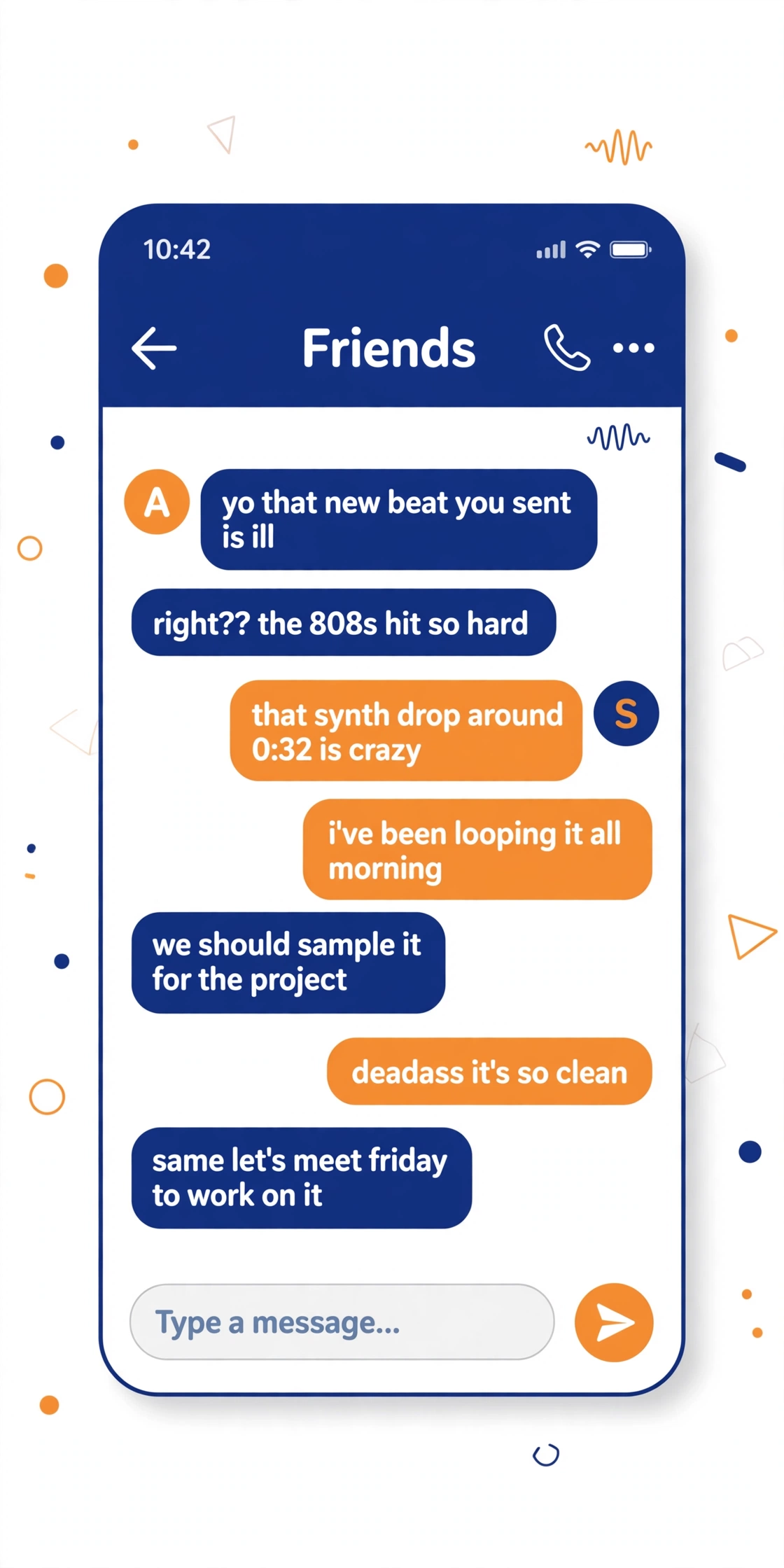
- “Bro, your new track is ill! When’s it dropping on Spotify?”
- “Did you see Maya’s dance video? She is absolutely the illest dancer I know.”
- “That comeback was ill — I was screaming at my screen the whole time.”
- “Your fit today is ill, where did you get that jacket?”
- “We were just chilling and he started freestyling — it was so ill.”
Professional Examples
Here is the honest truth: “ill” is almost never professional. It belongs in casual conversation, not in offices, emails, or meetings. But there are a few creative industries where it works:
- A music producer texting an artist: “That mix is ill, let’s ship it.”
- A sports commentator on social media: “Ill finish by the rookie to win the game!”
- A streetwear brand caption: “The illest drop of the season is live now.”
- A creative director in a brainstorm: “That concept is ill — let’s build on it.” (Only if the team culture is very casual.)
In any normal workplace, swap “ill” for “impressive,” “excellent,” or “outstanding.” The meaning stays the same, and nobody will wonder if you are feeling sick.
Funny Examples
- “My grandma tried to use slang and said my cooking was ‘ill.’ She meant it as a compliment. I am still not sure.”
- “He called his own mixtape ‘the illest ever’ and it had three listens. Confidence is a beautiful thing.”
- “I told my doctor I felt ill and he said ‘that’s not a compliment here.’ Fair enough.”
- “That cat video was ill — the cat did a backflip off the couch and landed it.”
Comparison with Similar Terms
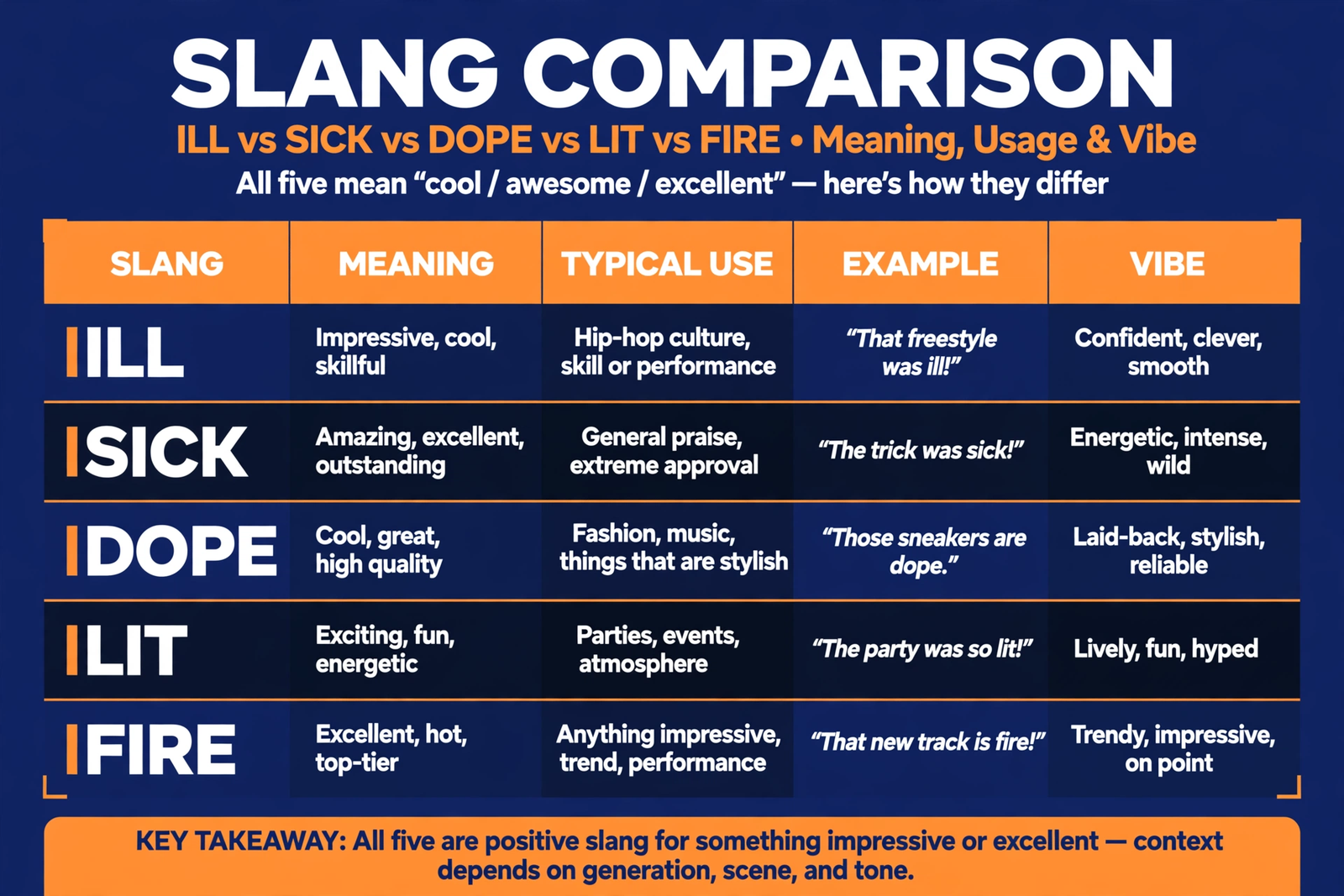
“Ill” has a lot of cousins in slang, and they are not interchangeable. Each one has its own flavor, its own era, and its own situations where it fits best. Picking the wrong one is the fastest way to sound out of touch.
| Word | Meaning | Vibe & Era | Best Used For |
|---|---|---|---|
| Ill | Amazing, impressive | Old-school hip-hop, 80s–2000s, still respected | Skills, beats, verses, performances |
| Sick | Amazing, cool | 90s–2010s, skater/surfer culture | Tricks, stunts, plays, moments |
| Dope | Cool, excellent | 90s hip-hop classic, still widely used | General praise — music, style, ideas |
| Lit | Exciting, amazing, fun | 2010s–now, party and social energy | Parties, nights out, hype moments |
| Fire | Excellent, hot, impressive | 2010s–now, very common | Music, outfits, food, anything great |
| Cool | Nice, good, agreeable | Timeless, safe everywhere | Almost anything, low intensity |
| Wack | Bad, lame, unimpressive | Old-school hip-hop | The opposite of ill — criticism |
The key difference: “ill” and “sick” both come from the same trick — flipping a word for unwellness into praise — but “ill” feels more lyrical and hip-hop, while “sick” feels more skater and extreme-sports. “Dope” is the safest all-purpose choice of the group. “Lit” is about energy and excitement, not just quality — a quiet acoustic performance can be ill but it is rarely lit. “Fire” is the modern default and works almost anywhere “ill” does, but it does not carry the same old-school credibility.
If you only remember one rule, remember this: use “ill” when you want to praise skill or craft with a hip-hop flavor. Use “fire” or “lit” when you want to sound current. Use “dope” when you want to play it safe. And never use “wack” unless you actually mean something is bad — it is the direct opposite of “ill.”
Alternate Meanings
“Ill” has several other meanings, and confusing them is the biggest source of mistakes. Here is the full map:
- Sick / unwell (standard English): “She stayed home because she was ill.” This is the original, formal meaning — and still the most common one worldwide.
- Bad, evil, or harmful (formal/literary): “Ill will,” “ill fortune,” “ill repute.” You will see this in books and formal writing, not in texts.
- Ill at ease: An idiom meaning uncomfortable or nervous. “He felt ill at ease at the fancy dinner.”
- Illin’ (acting wild): As covered above — acting crazy, showing off, or behaving badly. “Why are you illin’ right now?”
- Ill-advised / ill-informed: Compound adjectives meaning poorly advised or misinformed. These have nothing to do with slang praise.
- Illmatic (proper noun): Nas’s 1994 debut album, often used as shorthand for peak-level rap. “That verse is Illmatic-level.”
The practical takeaway: if the sentence is about health, feelings, or formal writing, “ill” means sick or bad. If the sentence is about music, skills, or performance in a casual setting, “ill” means amazing. When the context is unclear, assume the standard meaning — that is the safer default.
Professional or Polite Alternatives
You cannot say “ill” in a job interview — but you can say the same thing in a dozen professional ways. Here are the best swaps, ranked from closest in energy to most formal:
| Instead of “ill,” say… | When to use it |
|---|---|
| Amazing / incredible | Any casual or semi-formal situation |
| Impressive | Work, school, or formal praise |
| Outstanding / exceptional | Reviews, recommendations, formal feedback |
| Phenomenal | When you want extra emphasis without slang |
| Brilliant | British-friendly praise for ideas or work |
| Top-notch / first-class | Describing quality in a professional tone |
| Fire (still casual) | Only if the setting is casual but “ill” feels too old-school |
A quick test: if you would not say it to your boss, do not say it in an email. “Your presentation was impressive” works everywhere. “Your presentation was ill” works only if your boss is also your friend and you both love 90s hip-hop.
Common Mistakes
Most people misuse “ill” in one of these five ways. Avoid them and you will already sound more natural than most native speakers who force the word.
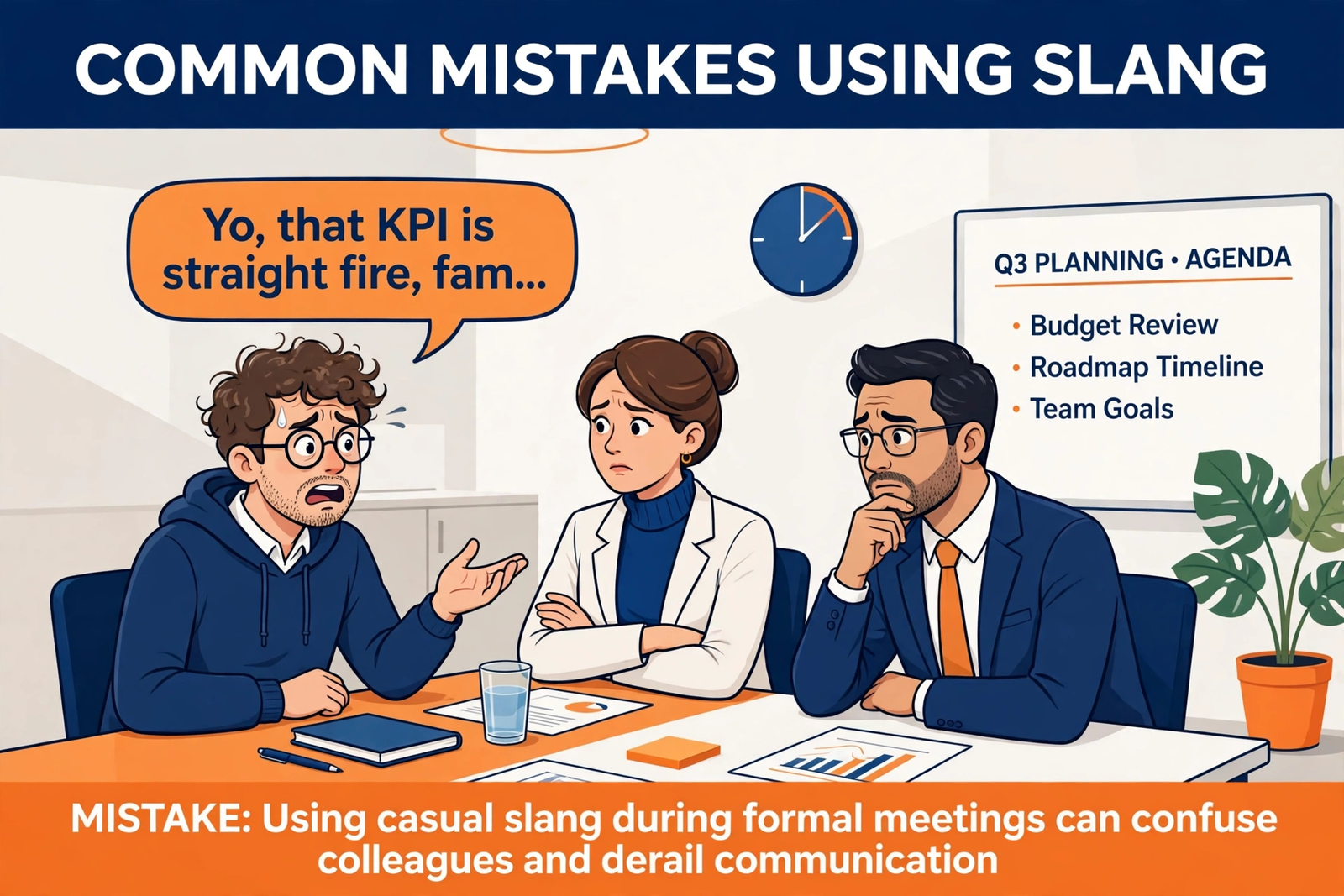
- Using it in formal settings: “Ill” is street and hip-hop slang. In a work email, a school essay, or a job interview, it will confuse people or make you sound unprofessional. Save it for friends, captions, and casual chats.
- Confusing it with actual sickness: “I’m feeling ill today” never means “I’m feeling amazing today.” If you are talking about health, “ill” always means sick. Do not flip the meaning in a medical context.
- Calling everything ill: The word loses its power if you use it for every sandwich and sunset. “Ill” is for things that genuinely impress you — a skill, a performance, a moment. Overuse makes you sound like you are trying too hard.
- Forcing “illest” into normal grammar: “Illest” is a slang superlative, not standard English. “She is the illest” works in casual speech. “The illest solution to our quarterly problem” does not — it sounds wrong in a meeting and silly in writing.
- Using “illin'” as a compliment: “Illin'” usually means acting wild or out of line, not being talented. Saying “she was illin’ on stage” could mean she was amazing — or that she was acting a fool. If you mean “amazing,” just say “ill.”
- Mixing it with Gen Z slang in the same sentence: “That fit is ill, no cap, it’s giving” mixes three different slang eras and sounds like a parody. Pick one era per sentence.
Quick Tips
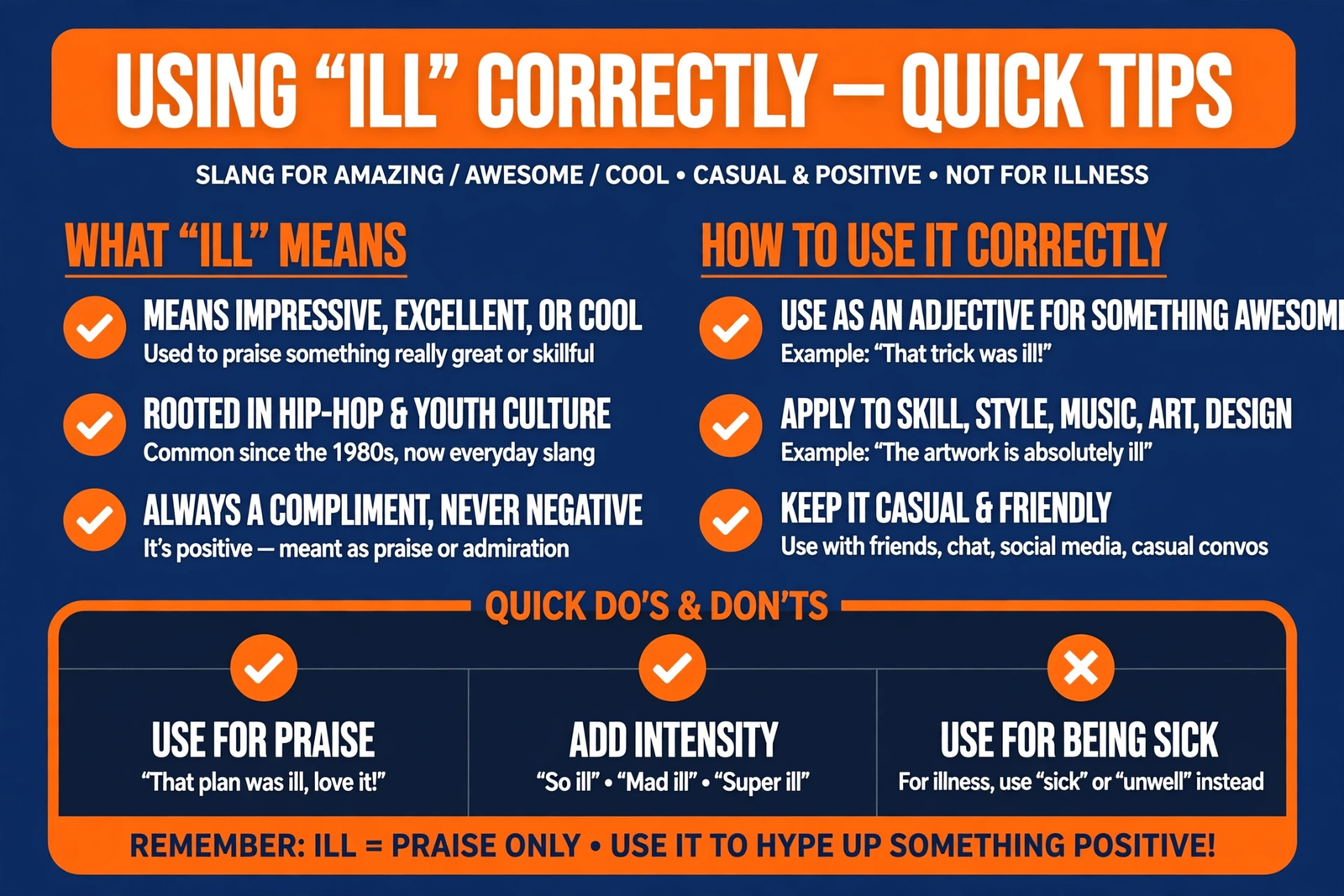
- Match the moment: Use “ill” for skills, performances, beats, verses, and big moments — not for ordinary things.
- Read the room: Friends, concerts, captions, gaming chats — yes. Work, school, doctors, grandparents — no.
- Pair it with hip-hop context: “Ill” sounds most natural when the topic is music, rap, sports, or street culture.
- Use “illest” sparingly: It is a superlative — save it for the actual best, or it means nothing.
- When unsure, use “fire” or “amazing”: Both are safer and understood by everyone. “Ill” is a style choice, not a necessity.
- Learn the opposite: If something is bad, the old-school opposite is “wack.” Knowing both words makes you sound fluent, not just trendy.
- Watch for “illin'”: If someone says “stop illin’,” they are telling you to calm down or stop acting wild — not complimenting you.
- Enjoy the history: Dropping an “Illmatic” reference in a hip-hop conversation is an instant credibility boost — it shows you know where the word comes from.
FAQ
1. What does ill mean in slang?
In slang, ill means amazing, impressive, or exceptionally cool. It comes from hip-hop culture, where “ill” was flipped from its standard meaning of “sick” into high praise. “That beat is ill” means the beat is incredible.
2. What does ill mean in texting?
In texting, “ill” means something is awesome or impressive — for example, “ur new song is ill 🔥.” It is casual praise, usually about music, skills, or a moment. It never means “sick” in a texting context unless the conversation is actually about health.
3. What does illest mean?
“Illest” is the superlative of “ill” — it means the absolute best or most impressive. “She’s the illest rapper in the game” means she is the best rapper. It was popularized by 90s hip-hop, including Biggie’s line “I’m the illest” in “The What” (1994).
4. Is ill a compliment or an insult?
Both — it depends on context. In slang, “ill” is a compliment meaning amazing. In standard English, “ill” means sick or bad, so it can be negative. In a casual conversation about music or skills, it is praise. In a conversation about health, it is not.
5. What does illin’ mean?
“Illin'” usually means acting wild, crazy, or out of line — sometimes playfully, sometimes not. “He was illin’ at the party” can mean he was showing off and having fun, or that he was behaving badly. The speaker’s tone decides which one it is.
6. Where did ill slang come from?
The ill slang meaning comes from 1980s New York hip-hop. MCs flipped the negative word “ill” (sick/bad) into praise for skills and beats. It spread through rap in the 1990s — helped by Nas’s album Illmatic (1994) — and then into mainstream youth culture in the 2000s.
7. Is ill still used in 2026, or is it outdated?
It is still used, but it is now a retro-cool word rather than a trendy one. You will hear it in hip-hop, sports, gaming, and nostalgic TikTok captions. It is less common in everyday Gen Z speech than “fire” or “lit,” but it carries old-school credibility that newer words do not have.
8. Can I use ill in professional or formal situations?
No — use “impressive,” “excellent,” or “outstanding” instead. “Ill” is casual slang, and in formal settings people will either misunderstand it or think you are unprofessional. Save it for friends, captions, and casual conversations about music, sports, or culture.
Conclusion
The ill slang meaning is one of hip-hop’s cleverest word flips: a word that means “sick” became the ultimate way to say “amazing.” From 1980s New York MCs to Nas’s Illmatic to today’s TikTok captions, “ill” has survived for four decades because it carries real cultural weight. When you call something ill, you are not just saying it is good — you are connecting with a whole history of music and style.
Remember the essentials: in slang, ill means impressive; the superlative is “illest”; “illin'” means acting wild; and in formal or medical contexts, ill still means sick. Use it for skills and performances, keep it casual, and do not overuse it — that is how you sound natural instead of forced.
Want to keep building your slang vocabulary? Check out dope meaning in slang for the closest cousin to “ill,” lit meaning in slang for the modern party-word version, and drip slang meaning for style-focused praise. And if you are curious about the opposite end of the spectrum, vanilla meaning in slang explains what it means when something is called basic. Now go listen to something ill — and you will know exactly why people say it.

1 thought on “Ill Slang Meaning: What Does Ill Mean in Text, TikTok & Hip-Hop?”