Quick definition: victorian slang is the colourful informal language of Britain during Queen Victoria’s reign (1837–1901) — the street talk, thieves’ cant, costermonger back slang, and drawing-room phrases recorded in the great slang dictionaries of the 1800s. From “got the morbs” (feeling melancholy) to “mutton shunter” (a policeman), these words open a window into how ordinary Victorians really spoke.
victorian slang Meaning & Definition
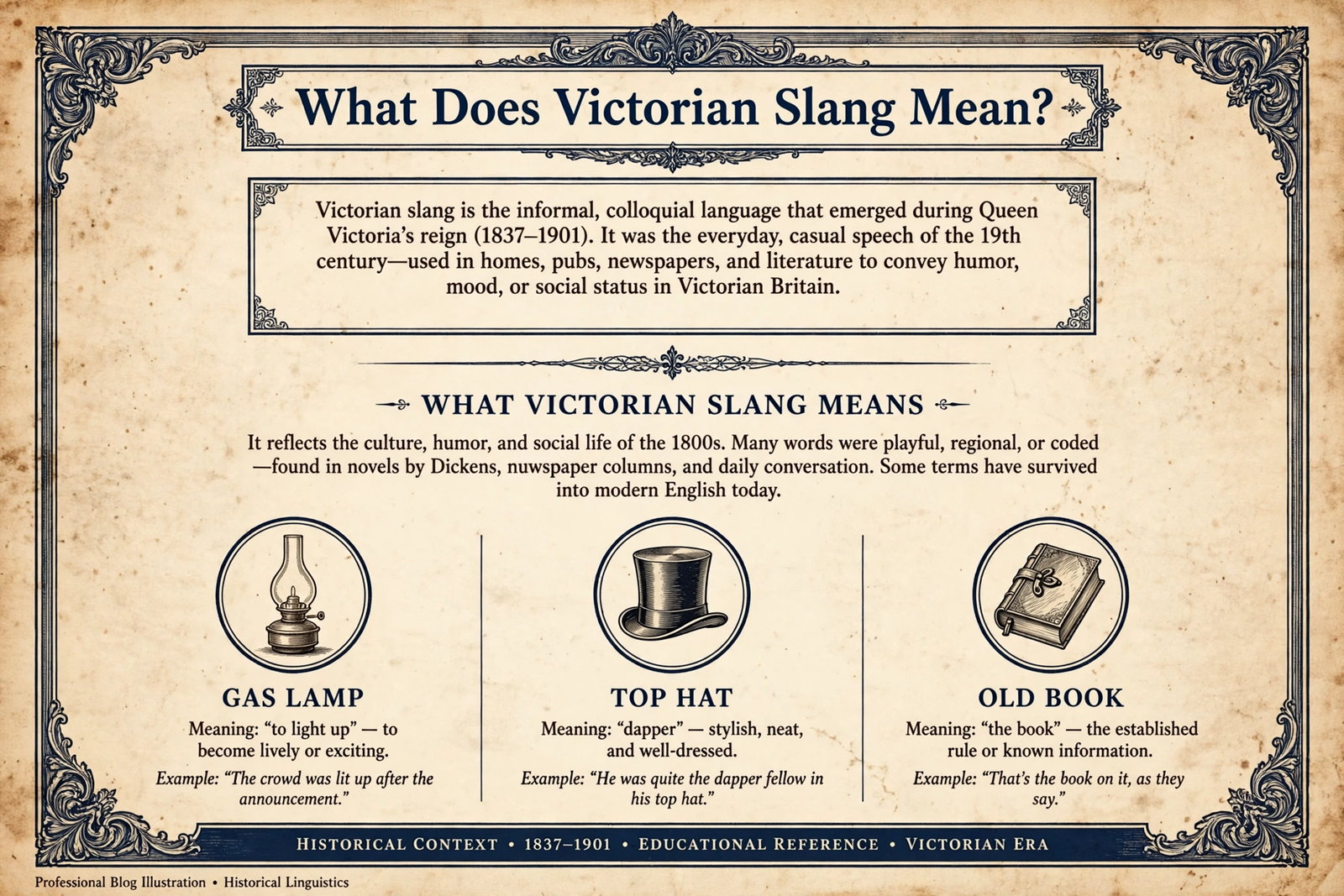
The victorian slang meaning is simple: it is the unofficial, everyday vocabulary of Victorian Britain — words and phrases that never made it into polite dictionaries but filled the streets, pubs, music halls, and marketplaces of 19th-century London. Unlike formal Victorian English, which sounds stiff and distant to modern ears, victorian slang was playful, rude, inventive, and very much alive.
When people search for victorian slang today, they usually want one of three things: a list of funny old words with their meanings, the stories behind them, or authentic phrases to use in historical fiction, costumes, or period drama. This guide covers all three — with 40+ real words, their exact meanings, where they came from, and how (and whether) you can still use them.
It helps to know that “Victorian” covers a long stretch — 64 years, from 1837 to 1901 — and slang changed a lot across it. Early Victorian slang owed much to the criminal underworld and the thieves’ cant of the 1700s, while late Victorian slang picked up music-hall jokes, Cockney rhyming slang, and the secret back slang of market traders. The dictionaries that captured it all are still available today: Francis Grose’s 1811 Dictionary of the Vulgar Tongue, John Camden Hotten’s Dictionary of Modern Slang, Cant and Vulgar Words (1860), and James Redding Ware’s Passing English of the Victorian Era, published in 1909 just after his death.
Introduction
Imagine walking through London in 1860. A costermonger shouts about his “war-rab” of apples. A policeman — a “mutton shunter” — strolls past. Someone who has had too much gin is “blotto”, and a friend who has gone quiet and sad has “got the morbs”. None of these words would appear in a school grammar book, but every Londoner on the street understood them instantly.
That is the magic of victorian slang. It was not one language but many: the coded talk of thieves, the reversed words of market traders, the jokes of the music hall, and the private phrases of soldiers, sailors, servants, and schoolboys. Some of it was crude, some of it was witty, and a surprising amount of it survives — you probably said “blimey” or “brolly” without realising you were speaking Victorian.
In this guide, you will find the most interesting victorian slang words grouped by theme, each with its real meaning and a real example of how it was used. You will also learn where Victorian slang came from, which words are still alive today, and the mistakes people make when they try to use it. Whether you are writing a novel, preparing a costume party, or just love language history, this is the most complete plain-English guide to the words of the 1800s.
Origin
Victorian slang did not appear out of nowhere. It grew out of three much older traditions that collided in 19th-century London.
1. Thieves’ cant. For centuries, criminals used a secret vocabulary — called cant — to talk about their work without being understood by outsiders or the police. Words like “bunk” (to run away) and “crack up” (to praise or talk up) came from this world. By the Victorian era, much of this criminal vocabulary had leaked into everyday street speech.
2. Costermonger back slang. London’s street sellers, the costermongers, invented a simple code: say words backwards. A boy became a “yob”, a penny became a “yennep”, beer became “reeb”, and a policeman became “esclop”. The idea was to talk about customers and police without being understood. Back slang was so effective that “yob” — from “boy” backwards — eventually entered standard English as a word for a hooligan.
3. Cockney rhyming slang. In the East End, speakers replaced a word with a rhyming phrase and then often dropped the rhyming part, leaving a puzzle for outsiders. This tradition began in the mid-1800s and is still alive in London today.
On top of these, the Victorian era added its own engines of slang: the music hall, where comedians spread catchphrases across the country; the railways and the penny post, which carried new words from London to every town; and the newspapers, which loved reporting the latest street phrases. Writers like Charles Dickens picked up slang and put it in novels, which spread it even further — Dickens’s London is full of slang-speaking characters, from the Artful Dodger to Sam Weller.
The great slang dictionaries of the era tried to keep up. Grose’s 1811 dictionary captured the vulgar tongue of the late Georgian period. Hotten’s 1860 dictionary was the first to treat slang seriously as a subject, recording the words of costermongers, thieves, students, and soldiers. And Ware’s 1909 Passing English of the Victorian Era looked back over the whole century, collecting thousands of words and phrases — from the witty to the unprintable — with dry, amused commentary. Together, these books are the reason we can still read victorian slang today instead of guessing at it.
Popularity
Victorian slang was wildly popular in its own time, and it is popular again now — for different reasons. In the 1800s, it was popular because it was useful: it let people speak quickly, joke sharply, and keep secrets. In the 2020s, it is popular because it is charming, funny, and perfect for period drama, historical novels, escape rooms, murder-mystery parties, and social media lists of “words we should bring back”.
Searches for victorian slang spike every time a period drama hits the screens — a new Dickens adaptation, a Sherlock Holmes film, or a series like The Gilded Age sends thousands of people looking up the words they just heard. Teachers use it to make history lessons vivid. Writers use it to make dialogue sound authentic. And word lovers share it because Victorian slang is genuinely funnier than most modern slang: where we say “I’m sad”, a Victorian said “I’ve got the morbs”. Where we say “the police”, they said “mutton shunter”.
Some victorian slang never died at all. “Blimey”, “crikey”, “brolly”, “blotto”, “chump”, “bunk”, and “brick” (meaning a good, reliable person) are all still in use, especially in Britain. Others, like “mafficking” (getting rowdy in the streets) or “nanty narking” (great fun), have vanished — but they are so good that people keep trying to bring them back.
How It Is Used
Victorian slang works differently from modern slang in one important way: it was deeply tied to social class and place. A word that was normal in a London market could be shocking in a drawing room. Here is how the main types were used:
- Street slang — short, punchy words for everyday things: money, drink, the police, the weather. Used by everyone from costermongers to clerks.
- Cant — coded criminal language. Used to discuss theft, escape, and the police without being understood.
- Back slang — reversed words. Used by market traders to talk about customers and money in front of them.
- Music-hall slang — catchphrases and jokes from the stage. Used by audiences who repeated them the next day.
- School and university slang — words like “chump” (a fool) that spread through public schools and universities into general use.
Tone matters. Most victorian slang was casual, comic, or deliberately rude. It was the language of jokes, gossip, and the pub — not of the pulpit or the courtroom. That is exactly why it is so useful for writers today: a character who says “cheese it!” sounds instantly like a Victorian street boy, while a character who says “please desist” sounds like a schoolmaster.
Context also decided meaning. The word “lit” is a good example of how slang shifts — in Victorian times, “lit” usually meant drunk (as in “lit up”), a sense that goes back to the early 1900s and earlier. If you want the full story of that word, see our guide to lit meaning slang. Many Victorian words had two or three meanings depending on who said them and where, which is why the old dictionaries often list a single word with a whole paragraph of uses.
Examples
Here are victorian slang words in real sentences, the way Victorians actually used them. They are grouped by tone so you can pick the right one for your purpose.
Friendly Examples
- “He’s a real brick — lent me a sovereign when I was skint.” (A brick was a good, dependable person.)
- “We had a nanty narking time at the music hall last night!” (Nanty narking meant great fun.)
- “Don’t look so down — you’ll get over the morbs by tomorrow.” (Got the morbs meant temporary melancholy.)
- “She’s the Cheshire, that one — nothing but smiles.” (Cheshire meant perfection, as in “she’s the Cheshire”.)
- “Pass the char, love — I’m parched.” (Char was tea, from the Hindustani word for tea.)
- “He’s afternoonified today — new coat and everything.” (Afternoonified meant smart and well-dressed.)
Professional Examples
- “The mutton shunter took our names and moved the crowd along.” (Mutton shunter was slang for a policeman.)
- “That job is pure church work — it will take all week.” (Church work meant any work that proceeds very slowly.)
- “He tried to crack up his new shop to every passer-by.” (To crack up meant to praise or talk something up.)
- “Mind the clap on the shoulder — he’s in debt up to his ears.” (A clap on the shoulder meant arrest for debt.)
- “The cads on castors nearly ran me down on the pavement.” (Cads on castors were bicyclists, unpopular with pedestrians.)
Funny Examples
- “I’m orf chump — I couldn’t eat another bite.” (Orf chump meant having no appetite.)
- “He got batty-fanged for stealing the apples.” (Batty-fang meant to thrash thoroughly.)
- “They were doing the bear in the garden all evening.” (Doing the bear meant courting that involves hugging.)
- “He was blotto by nine and asleep under the table by ten.” (Blotto meant very drunk.)
- “He came home balmy on the crumpet and tried to sing.” (Balmy on the crumpet meant crazy or insane.)
- “Cheese it! Here comes the schoolmaster!” (Cheese it meant stop it, or look out!)
- “I’ve got a boko like a lighthouse, and I don’t care.” (A boko was a huge nose.)

Comparison with Similar Terms
Victorian slang is often confused with other kinds of old English. Here is how it differs from the terms people mix it up with:
| Term | What it is | Time period | Example |
|---|---|---|---|
| victorian slang | Informal street and popular language of Victorian Britain | 1837–1901 | “He’s got the morbs.” |
| Thieves’ cant | Secret criminal code, much older than Victoria | 1500s–1800s | “Bunk” (run away) |
| Cockney rhyming slang | East London rhyming wordplay | 1840s–today | “Apples and pears” (stairs) |
| Back slang | Words spoken backwards by market traders | 1800s–today | “Yob” (boy) |
| Edwardian slang | The slang of the next generation, after Victoria | 1901–1914 | “Top-hole” (excellent) |
| Shakespearean slang | Early modern insults and jokes | 1500s–1600s | “You scullion!” |
The key point: victorian slang overlaps with cant, rhyming slang, and back slang, but it is bigger than any one of them. It is the whole informal vocabulary of the era — including words from the theatre, the army, the navy, the schools, and the streets. A word like “blotto” is victorian slang; a word like “yob” is back slang that became victorian slang; a word like “mutton shunter” is pure Victorian invention.
If you enjoy comparing slang across eras, you will also like our guide to Atlanta slang, which shows how a modern city builds its own vocabulary the same way Victorian London did.

Alternate Meanings
Many victorian slang words had more than one meaning, and some of them changed meaning completely over the century. Here are the most important ones to watch out for:
- Chump — originally meant the head (“use your chump”), but it also meant a young fool who had been cheated of his money by a young woman. Context decided which one was meant.
- Bunk — to tell someone angrily to go away (“bunk off!”), but also to dash away or escape (“he did the bunk”). Both senses survive in British English today.
- College — in Victorian slang, saying “I’ve been to college” could mean you had been to prison. The joke was that prison was the only college a thief ever attended.
- Brick — usually a compliment (a good, solid person), but in some contexts it described something heavy and dull. The compliment is the sense that survived.
- Char — tea, from Hindustani, but “char” also became the word for a cleaning woman (a “charwoman”) who came in to do the housework — the two senses share the same root.
- Blotto — drunk, but Victorians also used “blotto” for anything completely ruined or wiped out, as in “the plan went blotto”.
- Catch-penny — cheap ballads sold in the street, but the phrase also described anything cheap and showy made to catch a quick sale.
- Clap — a venereal disease, and also the sound of a hand on a shoulder: “the clap on the shoulder” was arrest for debt. Two very different misfortunes sharing one word.
The lesson is simple: never guess a Victorian word’s meaning from a single example. The old dictionaries often give three or four senses for one word, and using the wrong one can change a sentence completely.
Professional or Polite Alternatives
Victorian slang was, by design, impolite. If you are writing formal dialogue or explaining these words to a modern audience, here are polite ways to say the same things:
| Victorian slang | What it meant | Polite alternative |
|---|---|---|
| Got the morbs | Feeling sad or melancholy | Feeling a little low |
| Mutton shunter | Policeman | Police officer |
| Blotto | Very drunk | Had too much to drink |
| Balmy on the crumpet | Crazy, insane | Not quite himself |
| Orf chump | No appetite | Not hungry |
| Cheese it | Stop it / look out | Please stop / be careful |
| Batty-fang | To thrash thoroughly | To scold severely |
| Doing the bear | Courting with hugging | Spending time together |
| Boko | A huge nose | A prominent nose |
| Clap on the shoulder | Arrest for debt | Arrested over debts |
For modern writers, the polite version is useful in narration, while the slang version belongs in dialogue — that contrast is exactly how Dickens and his fellow novelists used it.
Common Mistakes
Victorian slang is easy to get wrong. These are the mistakes people make most often:
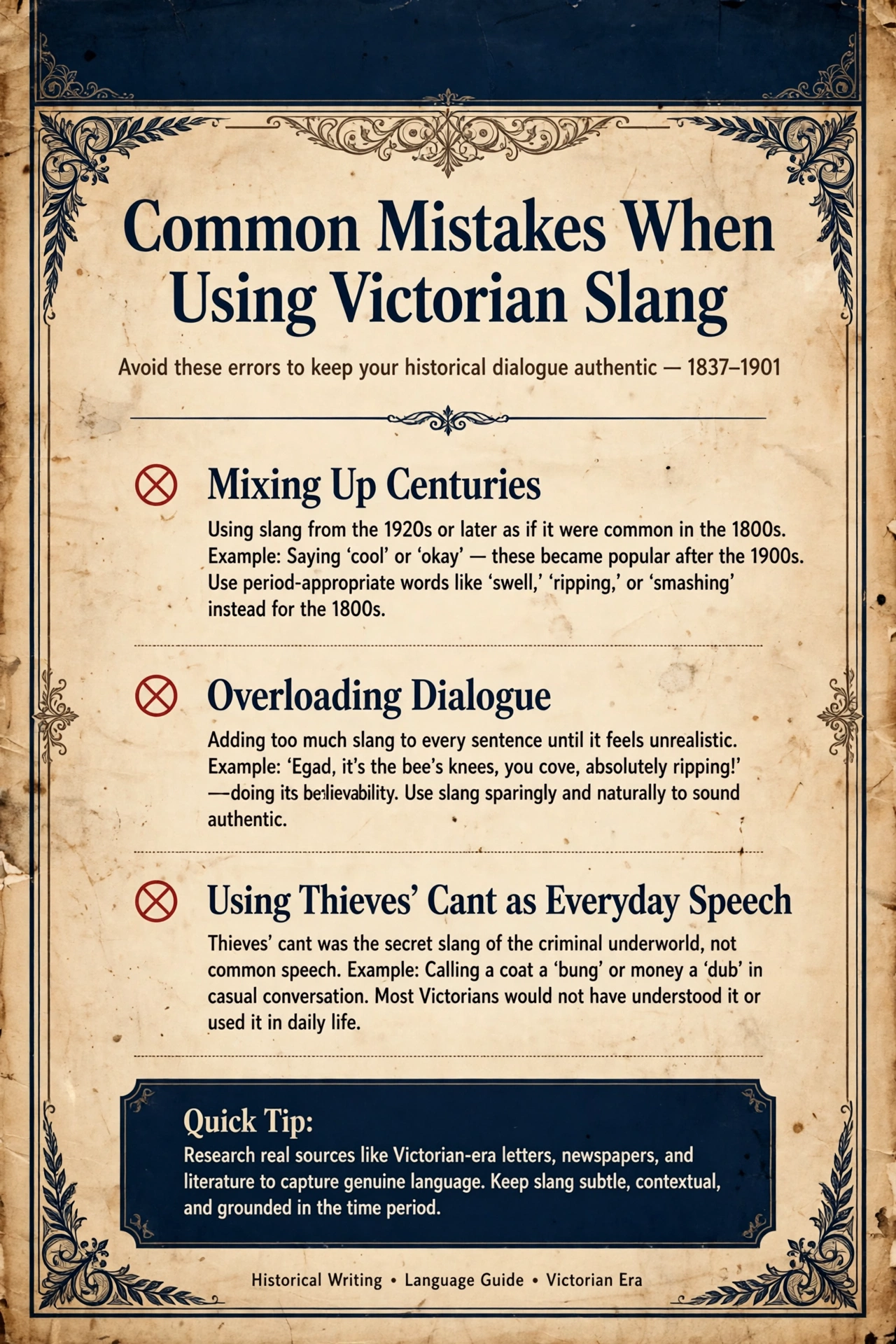
1. Mixing up the centuries. Not every old word is Victorian. “Thou” and “prithee” are Shakespearean, not Victorian. “Groovy” is 1960s, not 1860s. If a word does not appear in Grose, Hotten, or Ware, be suspicious of it.
2. Using thieves’ cant as everyday speech. Real Victorians did not talk in cant all day. Cant was a secret code used by criminals; an ordinary shopkeeper in 1860 would not have spoken it. Use street slang for ordinary characters and save cant for actual criminals.
3. Overloading dialogue. One or two slang words per sentence is plenty. A character who says “Cheese it, the mutton shunter’s coming, I’m orf chump and I’ve got the morbs” sounds like a costume, not a person. Dickens used slang sparingly, and that is why it worked.
4. Getting the meaning backwards. “Nanty narking” means great fun, not nonsense. “Afternoonified” means smart, not lazy. “Orf chump” means no appetite, not no brains. Always check a word in a real dictionary of the period before using it.
5. Treating back slang as a joke. Back slang was a working code, not a party trick. Costermongers used it to discuss prices and police in front of customers. The word “yob” survived precisely because the code was useful.
6. Assuming every Victorian word is dead. Words like “blimey”, “brolly”, “blotto”, “chump”, and “bunk” are still in everyday British use. Calling them “dead” words marks you out as someone who has never actually listened to a Londoner.
7. Forgetting class and place. A duke would not say “cheese it” and a costermonger would not say “I am afternoonified”. Slang belonged to specific groups, and using the wrong word for the wrong character breaks the illusion instantly.
Quick Tips
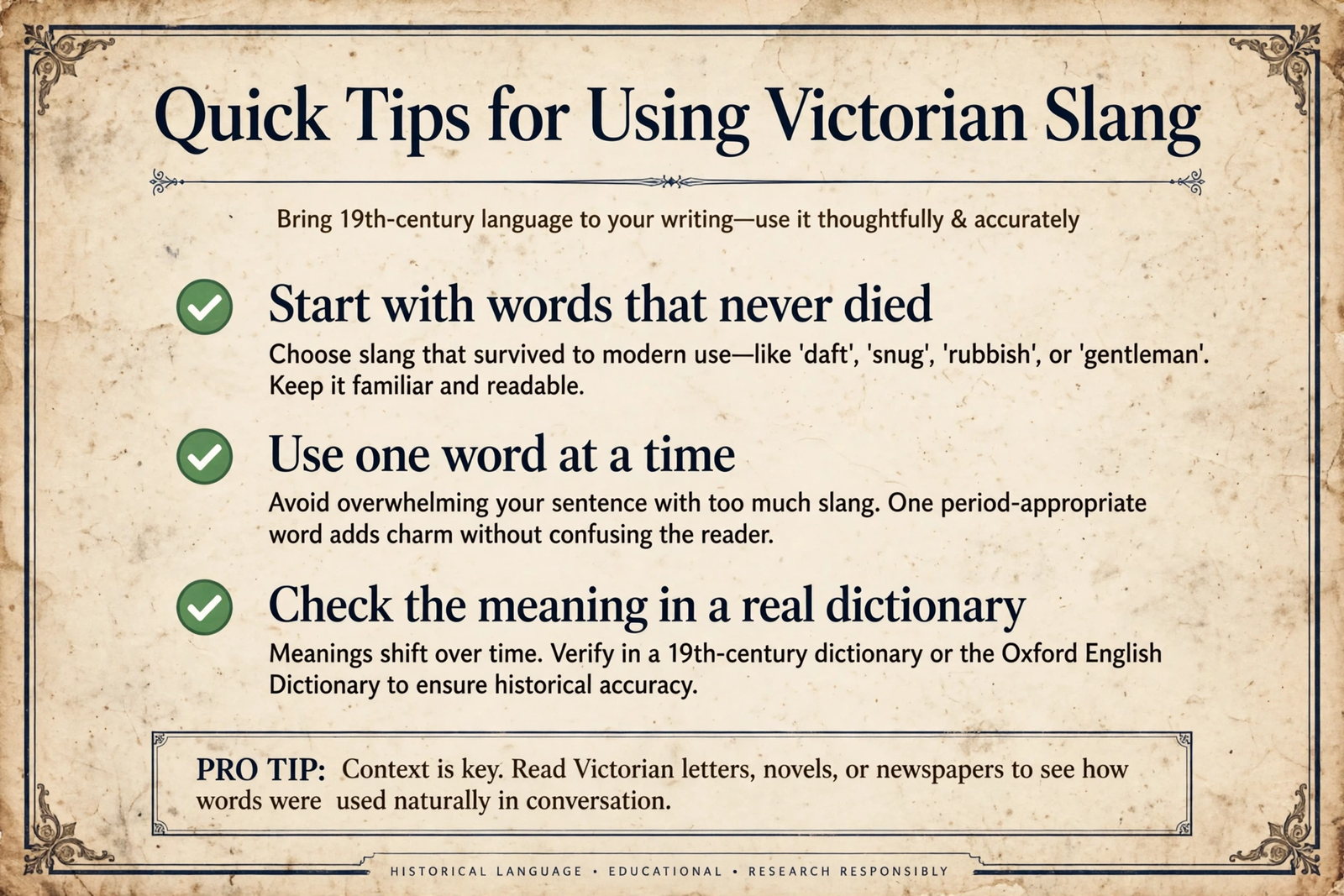
- Start with the survivors. If you want to use victorian slang in conversation today, start with words that never died: “blimey”, “crikey”, “brolly”, “blotto”, “chump”, “brick”. People will understand you, and you will sound charming rather than strange.
- Use one word at a time. Drop a single Victorian word into a modern sentence — “I’ve got the morbs today” — and it lands as a joke. Fill a whole paragraph with them and it lands as a lecture.
- Read the originals. The best way to learn the rhythm of victorian slang is to read Dickens, or browse Hotten’s 1860 dictionary and Ware’s 1909 Passing English. Both are available free online, and the Victorian Web’s guide to back slang is a good place to start.
- Check before you quote. Many “Victorian slang” lists on the internet are full of invented words. If a word does not appear in Grose (1811), Hotten (1860), or Ware (1909), treat it as unproven.
- Match the word to the character. Give street slang to street characters, music-hall jokes to performers, and school slang to schoolboys. Authenticity comes from who says the word, not just the word itself.
- Keep a glossary. If you are writing fiction, keep a list of every slang word you use and its exact meaning. Readers notice when a word changes meaning halfway through a book.
- Try “nanty narking” at your next party. It means great fun, it sounds wonderful, and nobody will have heard it before. That is the whole point of reviving victorian slang.
FAQ
What does victorian slang mean?
victorian slang is the informal, everyday language of Britain during Queen Victoria’s reign (1837–1901). It includes street talk, thieves’ cant, costermonger back slang, music-hall catchphrases, and the private vocabulary of soldiers, sailors, and schoolboys. In short, it is how ordinary Victorians actually spoke when they were not being formal.
What are some common victorian slang words?
Some of the most common victorian slang words are “got the morbs” (feeling melancholy), “mutton shunter” (policeman), “blotto” (drunk), “brolly” (umbrella), “brick” (a good, reliable person), “cheese it” (stop it or look out), “nanty narking” (great fun), “orf chump” (no appetite), “afternoonified” (smart and well-dressed), and “boko” (a huge nose). Many of these come from James Redding Ware’s 1909 dictionary Passing English of the Victorian Era.
When was the Victorian era?
The Victorian era ran from 1837, when Queen Victoria came to the throne, to 1901, when she died. Victorian slang changed a great deal across those 64 years, so a word that was common in 1840 might have been old-fashioned by 1890.
Is victorian slang still used today?
Yes — some of it. Words like “blimey”, “crikey”, “brolly”, “blotto”, “chump”, “bunk”, and “brick” are still in everyday British English. Others, like “mafficking” and “nanty narking”, have disappeared from daily speech but survive in books, period dramas, and lists of words people want to bring back.
What is back slang?
Back slang is a code invented by London costermongers (street sellers) in the 1800s: words spoken backwards so customers and police could not understand them. A boy became a “yob”, a penny became a “yennep”, beer became “reeb”, and a policeman became an “esclop”. The word “yob” survived and is now standard English for a hooligan.
What does “got the morbs” mean?
“Got the morbs” is victorian slang for temporary melancholy — feeling sad, low, or gloomy for a short time. It comes from James Redding Ware’s 1909 Passing English of the Victorian Era. A Victorian might say “She’s got the morbs today” the way we would say “She’s feeling down today”.
What does “mutton shunter” mean?
“Mutton shunter” is victorian slang for a policeman. It appears in Ware’s 1909 dictionary. The joke is in the image: a policeman who “shunts” (pushes or moves along) the crowd the way railway workers shunt wagons — with “mutton” adding a comic, slightly rude edge.
Where can I read real victorian slang?
The three best sources are all free online: Francis Grose’s 1811 Dictionary of the Vulgar Tongue, John Camden Hotten’s Dictionary of Modern Slang, Cant and Vulgar Words (1860), and James Redding Ware’s Passing English of the Victorian Era (1909). For fiction, Charles Dickens’s novels are full of authentic Victorian street speech, and the Victorian Web has a useful guide to back slang.
Conclusion
victorian slang is much more than a list of funny old words. It is a record of how ordinary people in the 1800s actually lived, joked, worked, and complained — from the costermonger’s back slang to the music hall’s catchphrases, from the policeman called a “mutton shunter” to the friend who had “got the morbs”. Each word carries a small piece of Victorian life with it, which is why these words still charm us more than a century later.
The best way to enjoy it is to start small. Pick one or two words — “nanty narking” for a great night out, “afternoonified” for a well-dressed friend, “blotto” for a night that went too far — and use them where they belong: in jokes, in stories, and in conversation with people who love language. Avoid them in formal writing, check the meaning before you use a new word, and remember that the Victorians themselves used slang sparingly and precisely.
Once you can drop a Victorian phrase into a modern conversation and make someone smile, you have understood what slang is really for. It is not about sounding old — it is about saying something ordinary in a way nobody has heard before. Keep exploring the language of the past, from the street talk in our guide to digs slang meaning to the regional colour of bullocks slang, and the 1800s will start to feel a lot closer than they look in a history book.
