Quick definition: Slang for good means the casual, trendy words and phrases people use instead of “good” to say something is excellent, cool, impressive, or enjoyable — words like fire, lit, dope, slaps, and bussin. You will hear them in texts, on TikTok, in music lyrics, and in everyday conversation, especially among younger speakers.
Slang for Good Meaning & Definition
When someone asks for slang for good, they usually want a fresher way to say that something is great. The word “good” works fine, but it can sound flat, formal, or boring — especially in a text message or a social media caption. Slang fills that gap. It adds energy, personality, and attitude to a compliment, and it signals that you are part of the conversation, not just watching it from the outside.
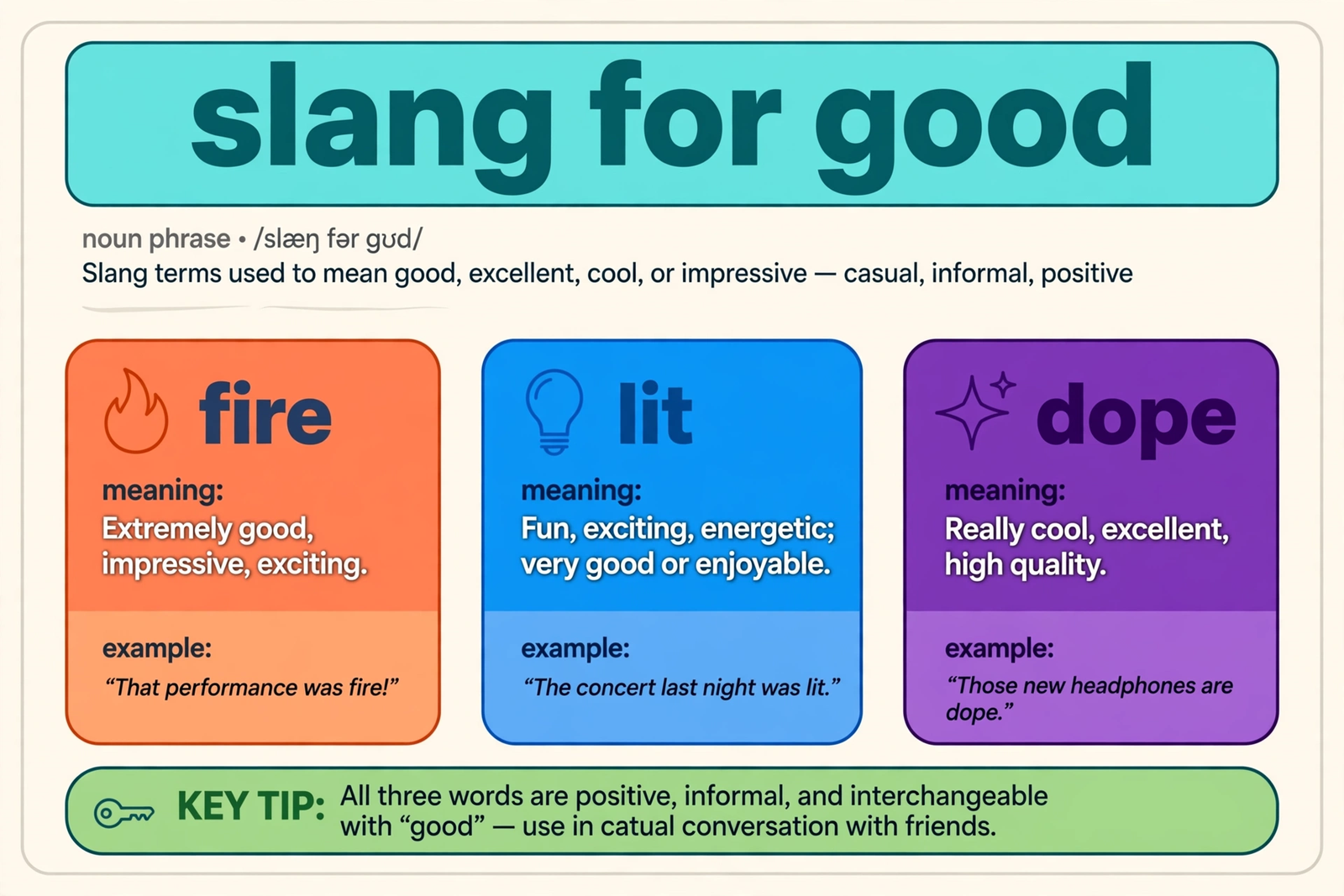
In simple terms, slang for good is any informal word or phrase that means “this is excellent” or “I really like this.” The exact word you pick depends on what you are describing. A song can slap. A meal can be bussin. An outfit can be fire. A movie can be lit. A person can be goated. Each term carries its own flavor, and that is exactly why people love using them.
These words change fast. A term that was everywhere last year can sound dated today, while a brand-new word can take over TikTok in a single weekend. That is part of the fun — and part of the challenge. If you want to sound natural instead of trying too hard, it helps to know which words are current, what they really mean, and when each one fits.
Introduction
Think about the last time you texted a friend about something you loved. Did you write “that was good”? Probably not. You probably wrote something like “that was fire” or “omg that slaps” or just sent a string of flame emojis. That is slang for good in action — and it is how millions of people talk every single day.
The reason is simple: “good” is vague. It tells someone you approve, but it does not tell them how much you approve or why. Slang does both. Saying a song “slaps” means it hits hard and you cannot stop playing it. Saying food is “bussin” means it tastes amazing, not just acceptable. Saying a fit is “fire” means it looks outstanding, not just fine. One word can carry a whole review.
Slang also works as social glue. Using the right word at the right moment shows you understand the culture around you — the music, the memes, the group chat energy. Using the wrong word, or using a trendy word in the wrong place, can do the opposite. That is why this guide does not just list words. It explains what each one means, where it came from, and how to use it without sounding forced.
In this article, you will find more than 25 slang words and phrases for “good,” grouped by what they describe: music, food, style, people, and general praise. You will see real examples in context, a comparison table so you can pick the right word fast, and a list of common mistakes to avoid. Whether you are texting a friend, writing a caption, or just trying to understand what your kids are saying, this guide has you covered.
Origin
Slang for “good” is as old as slang itself. Every generation invents its own words for approval because every generation wants to sound different from the one before it. In the 1920s, something great was “the bee’s knees” or “the cat’s pajamas.” In the 1950s, it was “cool” or “groovy.” In the 1980s, it was “rad” or “gnarly.” In the 1990s, hip-hop gave us “dope” and “phat.” Each era’s word for “good” is a small time capsule of its culture.
Many of today’s terms come from African American Vernacular English (AAVE) and hip-hop culture, which have shaped mainstream slang for decades. Words like lit, fire, dope, and goated all traveled from Black music, sports, and social media communities into everyday speech. That journey sped up enormously with the internet. A word that once took years to spread from one city to another can now go global in a week thanks to TikTok, Twitter, and Instagram.
Some terms have surprising roots. “Slaps” comes from the idea of a song hitting you physically, like a slap of sound. “Bussin” comes from “busting,” as in bursting with flavor. “Goated” is short for G.O.A.T., “greatest of all time,” a phrase popularized in sports debates. “Fire” is a metaphor as old as language itself — something so good it burns. Understanding where a word comes from helps you use it with more confidence and respect for the culture that created it.
Popularity
Slang for good is everywhere right now because short-form video made it so. TikTok, Instagram Reels, and YouTube Shorts reward punchy, emotional language, and a one-word reaction like “fire” or “this slaps” fits perfectly in a comment or caption. Creators use these words to hype products, songs, and moments, and their audiences copy them instantly.
Music drives a huge share of new slang. When a rapper calls a beat “hard” or a singer says a track “goes crazy,” fans adopt the phrase within days. Gaming and streaming culture add more: a great play is “insane,” “cracked,” or “clutch.” Sports commentary adds its own layer, with athletes described as “goated” or “him” after a standout performance.
Search interest in these terms spikes whenever a new one breaks through. People Google phrases like “what does bussin mean” or “what does slaps mean” after hearing them in a song or a video. That curiosity is exactly why knowing the current slang for good matters — it is not just about sounding cool, it is about understanding the conversation happening around you in real time.
How It Is Used
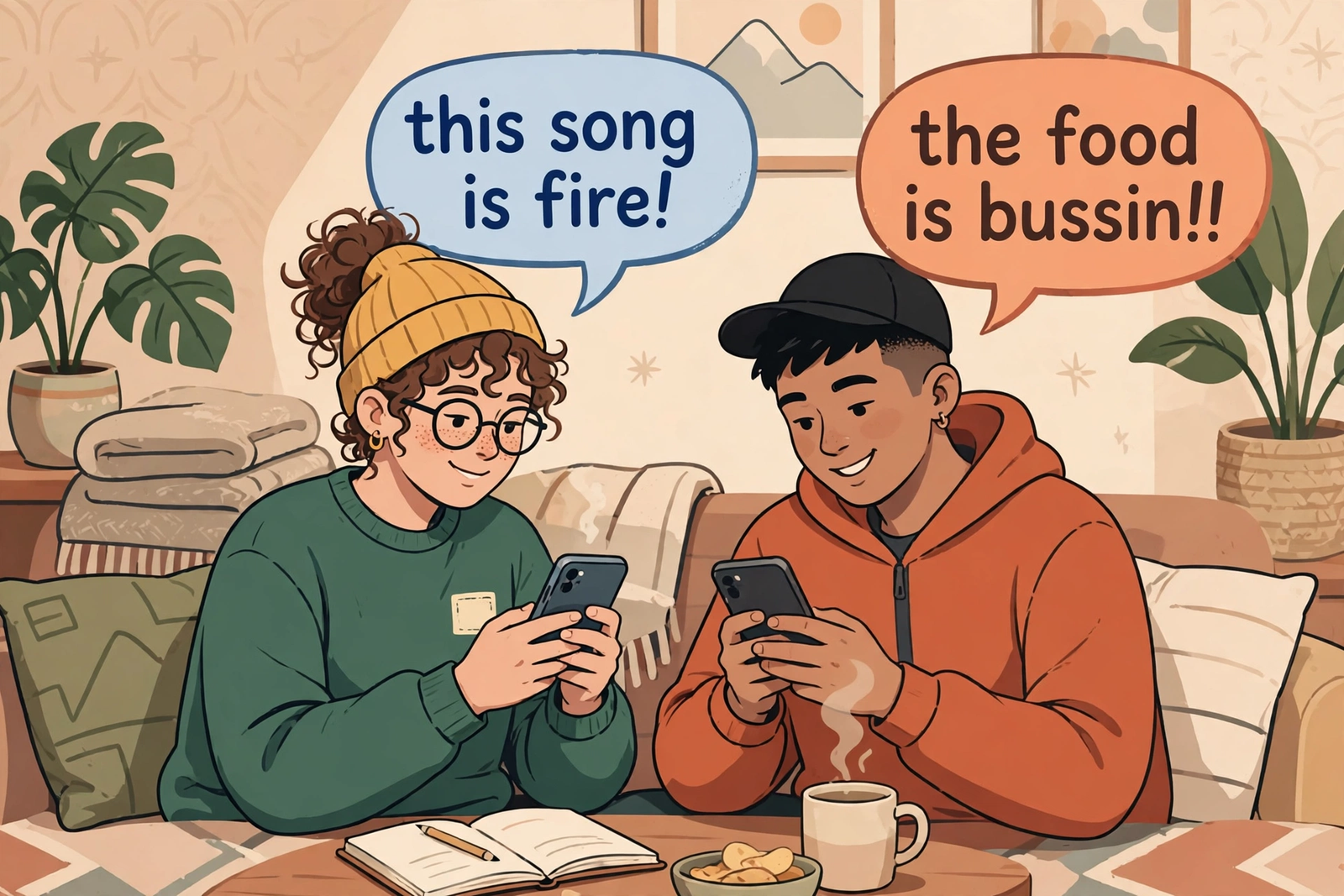
Slang for good shows up in almost every informal setting, but the rules change with the context. In a group chat with friends, anything goes — the more expressive, the better. On social media, these words work as captions, comments, and reactions: “this fit is fire,” “new album slaps,” “that goal was insane.” In spoken conversation, they add emphasis and energy: “Bro, that burger was bussin.”
The key is matching the word to the thing you are praising. Some words are general-purpose — fire, lit, dope, and awesome work for almost anything. Others are specific. Slaps and bangs are almost always about music. Bussin is almost always about food. Clean and drip are usually about style or appearance. Goated is reserved for people or performances at the very top. Using a specific word in the wrong category sounds off — nobody says a sandwich “slaps” (unless the sandwich has a beat).
Tone matters too. Most slang for good is enthusiastic and positive, but some terms carry a playful or exaggerated tone. Saying something is “insane” or “crazy good” is a compliment, even though the literal words sound negative. Saying something “goes hard” means it is intense in the best way. If you are unsure, watch how the people around you use a word before you try it yourself — context is the best teacher.
Examples
Here are real-world examples of slang for good in action, grouped by tone and situation. Notice how the same idea — “this is great” — sounds completely different depending on the word you choose.
Friendly Examples
- “This playlist is fire, I have had it on repeat all day.”
- “Your new haircut looks so clean, I love it.”
- “That movie was actually so good, the ending was insane.”
- “Bro, your cooking is bussin, you need to open a restaurant.”
- “This song slaps so hard, turn it up!”
- “Honestly, today was a vibe. Everything just felt right.”
- “That sunset was unreal, I had to take a picture.”
Professional Examples
Slang for good rarely belongs in a formal email or a job interview, but lighter versions show up in casual workplaces, creative industries, and friendly professional chats. The trick is choosing words that are upbeat without being too street or too young for the room.
- “The new design looks amazing — really clean work, team.”
- “That presentation was awesome, you nailed the pitch.”
- “The launch went great, the feedback has been excellent so far.”
- “Love the new branding, it feels fresh and modern.”
- “Your idea is solid — let’s run with it.”
- “The demo was impressive, the client loved it.”
In professional settings, words like amazing, excellent, solid, impressive, and fresh give you the same positive energy as slang without the risk. Save the heavier slang for friends and social media, where it belongs.
Funny Examples
- “This pizza is so bussin I might cry a little.”
- “My bed after a long day? Absolute peak comfort. 10/10, no notes.”
- “That comeback was so cold I need a jacket.”
- “His fit was so clean it should come with a warning label.”
- “This song slaps harder than my alarm clock on a Monday.”
- “The Wi-Fi finally working? A beautiful, rare, historic moment.”
- “That goal was so nasty the keeper is still looking for the ball.”
Comparison with Similar Terms
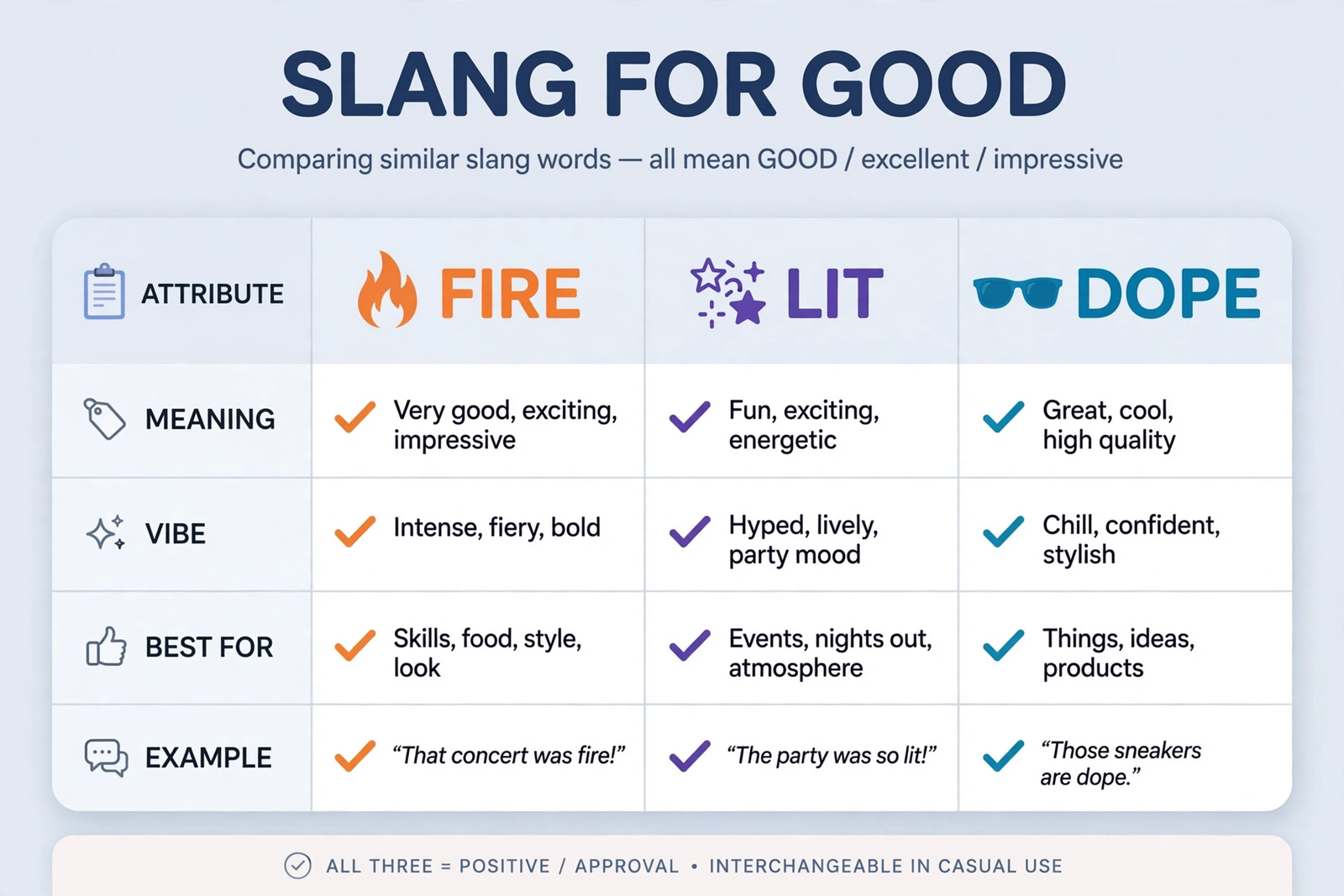
With so many words for “good,” choosing the right one can feel confusing. This table breaks down the most popular options so you can see at a glance what each word means, what it describes best, and how strong the praise is.
| Slang word | Meaning | Best for | Strength |
|---|---|---|---|
| Fire | Excellent, outstanding, very cool | Anything — music, style, food, moments | Very strong |
| Lit | Exciting, fun, full of energy | Parties, events, songs, nights out | Strong |
| Slaps | Sounds amazing, hits hard | Music and songs | Very strong |
| Bussin | Tastes incredibly good | Food and drinks | Very strong |
| Dope | Cool, impressive, excellent | General praise | Strong |
| Goated | The greatest of all time | People, athletes, legends | Highest |
| Clean | Stylish, neat, perfectly put together | Outfits, design, haircuts | Strong |
| Insane | Unbelievably good | Performances, plays, moments | Very strong |
| Vibe / vibes | A great feeling or atmosphere | Places, moods, experiences | Medium |
| Solid | Reliable, good, well done | Work, ideas, performances | Medium |
| Awesome | Amazing, impressive | General praise | Strong |
| Elite | Top-level, among the best | People, skills, quality | Very strong |
One quick way to remember the difference: fire and lit are your all-rounders, slaps is for your ears, bussin is for your taste buds, and goated is for the legends. When in doubt, pick the general word — it is always safer than forcing a specific one into the wrong sentence.
Alternate Meanings
Many slang words for “good” have other meanings, which is part of why they confuse people. Context is everything, so here are the most common double meanings to watch for.
Fire can also mean literal flames, or that someone was dismissed from a job (“he got fired”). In slang, though, “that’s fire” is always a compliment. Lit once meant drunk or intoxicated, and it still can in some contexts — “he was lit at the party” might mean drunk, not that the party was exciting. The surrounding words usually make the meaning clear.
Slaps literally means hitting something, so “this song slaps” could confuse a non-native speaker for a second — until they hear the song. Bussin can also describe something breaking or bursting, but in food talk it is pure praise. Dope famously also means drugs, which is why some people avoid it in formal settings even though the slang meaning is simply “cool.”
Bad is the trickiest of all: in slang, “bad” can mean very good, as in “that car is bad” said with admiration. Similarly, sick, nasty, crazy, and insane all sound negative on paper but work as high praise in conversation. The lesson is simple — never judge slang by its dictionary definition alone. Always look at how it is used in the sentence.
Professional or Polite Alternatives
There are times when slang is the wrong tool. A job interview, a formal email, a message to a teacher, or a conversation with a client all call for a different register. The good news is that you can keep the same positive energy with more polished words.
- Excellent — the safest all-purpose upgrade from “good.”
- Outstanding — for something that truly stands out.
- Impressive — great for work, skills, and performances.
- Wonderful — warm and polite, good for people and experiences.
- Fantastic — enthusiastic but still professional.
- Superb — a classy choice for quality, service, or food.
- Remarkable — for something genuinely unusual or noteworthy.
- Top-notch — casual-professional, perfect for praising work.
- First-rate — old-fashioned in a good way, ideal for formal praise.
- Delightful — best for experiences, meals, and hospitality.
A handy rule: if you would not say it to your boss or your grandmother, swap the slang for one of these. You will sound confident and polished, and the compliment will land just as well — maybe better.
Common Mistakes
Slang is forgiving, but a few mistakes will make you sound out of touch. Avoid these and you will already sound more natural than most people trying to keep up.
- Using a word in the wrong category: Saying food “slaps” or a song is “bussin” sounds wrong because each word belongs to its own world. Match the word to the thing.
- Overusing one word: Calling everything “fire” gets boring fast. Rotate between a few favorites so your praise actually means something.
- Forcing outdated slang: Words like “rad,” “gnarly,” and “phat” were once cool, but using them seriously today sounds like a throwback joke. Know which words are current.
- Using slang in formal settings: Telling a hiring manager their company is “lit” is a fast way to look unprofessional. Read the room first.
- Stacking too much slang in one sentence: “That fit is so fire, no cap, it slaps, on god” is exhausting. One strong slang word per sentence is enough.
- Copying slang you do not understand: If you are not sure what a word means, look it up before using it. Misusing a term — especially one rooted in another culture — can come across as disrespectful.
- Using “goated” for ordinary things: “Goated” means the greatest of all time. Calling your lunch “goated” is funny once, but it weakens the word if you do it every day.

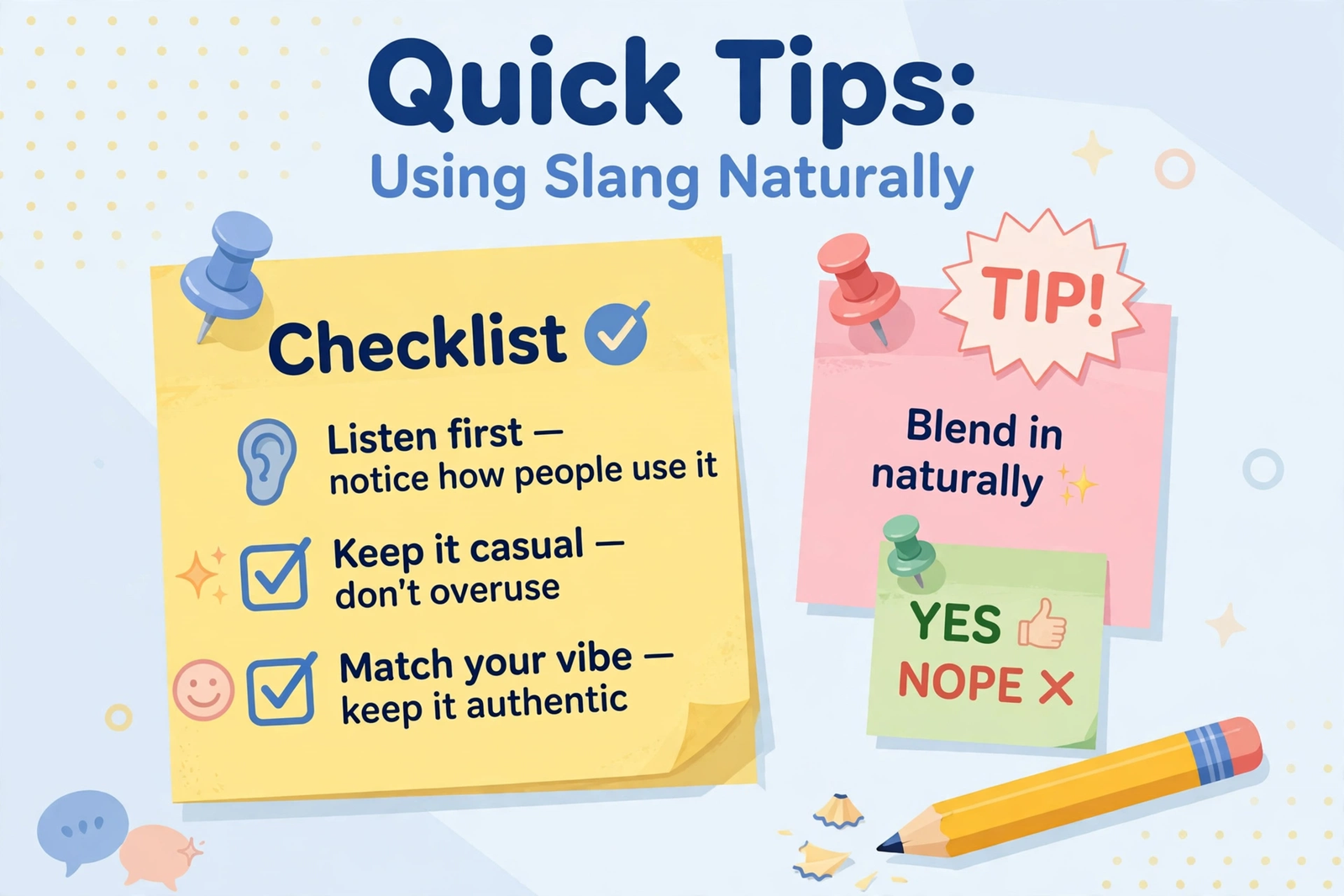
Quick Tips
- Start with the all-rounders: If you are new to slang, begin with fire, lit, and awesome. They fit almost any situation.
- Listen before you speak: Pay attention to how friends, creators, and musicians use a word. Copy the context, not just the word.
- Match the energy: A quiet “that’s nice” moment does not need “INSANE.” Save the strongest words for things that truly deserve them.
- Use slang in texts and captions: That is where it feels most natural. A caption like “this view is unreal” beats a stiff, formal sentence every time.
- Keep it short: Slang works best in quick reactions — “fire,” “this slaps,” “so clean.” Long slang-filled paragraphs lose their punch.
- Learn the new words as they arrive: Slang moves fast. When a new word shows up in your feed, check its meaning the same day so you are never behind.
- Know your audience: Friends, group chats, and social media love slang. Teachers, bosses, and formal emails do not. Switch codes without thinking twice.
- Do not fake it: If a word does not feel natural coming from you, skip it. A genuine “that was amazing” always beats a forced “that was bussin.”
FAQ
What is the most popular slang for good right now?
Right now, fire is the most versatile and widely used slang word for good, followed closely by lit and slaps for music. Bussin leads for food, and goated is the top choice for praising a person. Popularity shifts with trends, but these five have stayed strong for several years.
What does “slaps” mean in slang?
“Slaps” means a song sounds amazing and hits hard. It comes from the idea of music physically hitting you. You would say “this song slaps” about a track with a great beat, not about food or clothes. It is almost always used for music.
What does “bussin” mean?
“Bussin” means food or drink tastes incredibly good. It comes from “busting,” as in bursting with flavor. People usually say it about a meal, a snack, or a restaurant dish — “these tacos are bussin” is the classic example.
Is “dope” still used as slang for good?
Yes, “dope” is still used and understood everywhere, though it is less trendy than it was in the 1990s and 2000s. It means cool, excellent, or impressive. Some people avoid it in formal settings because it can also refer to drugs, but in casual conversation it is completely fine.
What is the difference between “fire” and “lit”?
“Fire” describes quality — something is outstanding, excellent, or very cool. “Lit” describes energy — a party, event, or night is exciting and fun. A song can be both fire and lit, but a quiet, beautiful painting is fire, not lit. Use “fire” for quality and “lit” for excitement.
What does “goated” mean?
“Goated” is short for G.O.A.T., which stands for “greatest of all time.” It is the highest praise you can give a person, athlete, or artist. Because it means the absolute best ever, save it for truly legendary performances — using it for everyday things weakens it.
Can I use slang for good in professional settings?
Light, widely understood words like “awesome,” “amazing,” or “solid” work in most casual workplaces. Heavier slang like “bussin,” “slaps,” or “no cap” should stay in personal chats and social media. When in doubt, choose a polished alternative like “excellent” or “impressive.”
How do I keep up with new slang words for good?
Follow music, TikTok, and streaming culture, where most new slang starts. When you hear a word you do not know, look it up the same day and watch how people use it in context. Slang changes fast, so the habit of checking matters more than memorizing any single list.
Conclusion
Slang for good is more than a list of trendy words — it is a living, fast-moving part of how people express excitement, admiration, and joy. From fire and lit to slaps, bussin, and goated, each term adds color and energy that plain old “good” simply cannot match. The trick is knowing which word fits which moment, and that is a skill anyone can learn.
Start with the all-rounders, listen to how people around you use the specific terms, and do not be afraid to try a new word in a low-stakes text with a friend. Avoid the common mistakes — wrong categories, outdated words, and formal settings — and your slang will sound natural instead of forced. And remember, the best compliment is an honest one. A genuine “that was amazing” will always beat a trendy word you do not really mean.
Want to keep building your slang vocabulary? Check out our guides to fire and lit — two of the most used slang words for good — plus our breakdown of cool synonyms and the meaning of drip. For a deeper look at how slang itself works, the Merriam-Webster definition of slang is a great authoritative starting point. Now go out there and describe the good things in life the way they deserve to be described.
