
Quick definition: russian slang is the informal, everyday vocabulary Russians actually use in chats, on TikTok, and in real-life conversation — from classics like davai (let’s go) and kruto (cool) to internet-born words like zhiza (relatable) and rofl (rolling on the floor laughing). It is fast, expressive, and often completely different from the formal Russian you learn in textbooks.
russian slang Meaning & Definition
So what exactly is russian slang? At its core, it is the casual layer of the Russian language — the words, phrases, and abbreviations that native speakers reach for when they are texting friends, joking around, gaming, or posting on social media. Formal Russian has strict grammar and polite forms. Russian slang throws most of that out the window and replaces it with short, punchy, emotional words that say a lot with very little effort.
The word “slang” itself translates to sleng (сленг) in Russian, and Russians also use the word zhargon (жаргон) for the special vocabulary of a group — gamers, students, soldiers, or musicians, for example. But when English speakers search for russian slang, they usually mean one of two things: the everyday informal words that make you sound like a real Russian instead of a textbook, and the internet slang that dominates Russian TikTok, Telegram, and gaming chats.
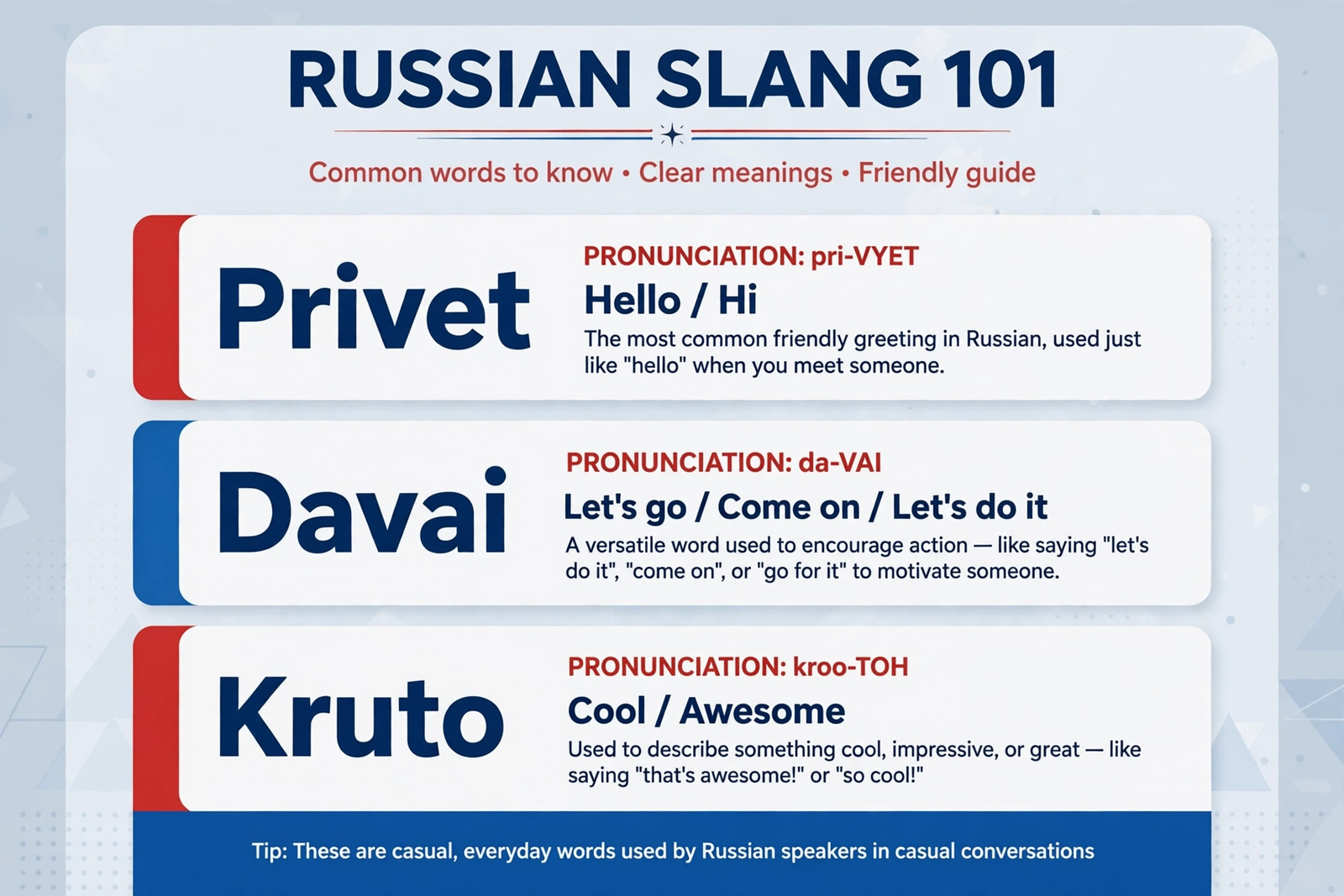
Here is the key thing to understand: Russian slang is not one single thing. It has layers. There is the friendly, universal slang everyone knows (privet for hi, poka for bye, kruto for cool). There is youth and internet slang that changes every year (kras for crush, vaib for vibe, khaip for hype). And there is mat (мат) — Russian profanity — which is extremely common in real life but off-limits in polite company. This guide covers all three layers honestly, with clear warnings about what is safe to use and what is not.
By the end of this article, you will know more than 40 real russian slang words, understand exactly when and how to use each one, and be able to read Russian chats, memes, and TikTok comments without feeling lost.
Introduction
Picture this: you open a Russian Telegram chat and see “Давай, это жесть, я ору 😂” — and you have no idea what any of it means. Your textbook taught you zdravstvuyte (hello) and spasibo (thank you), but nobody in a real Russian group chat talks like that. They say privet, davai, zhest, and oru — short, emotional, and very much alive.
That gap between textbook Russian and real Russian is exactly why russian slang matters. Russian is spoken by more than 250 million people, and it is one of the most-used languages on the internet. Russian speakers are everywhere on TikTok, YouTube, Twitch, and Telegram — and their slang travels fast. Words like blyat, davai, and privet have become recognizable even to people who have never studied a word of Russian, thanks to gaming streams, memes, and viral videos.
Learning russian slang is also the fastest way to sound natural. Formal Russian can sound stiff and distant in a casual chat. Drop in a well-placed kruto or klassno and suddenly you sound like someone who actually talks to Russians — not someone who only talks to a textbook. In this guide, we break down the most useful russian slang words by category, with real examples, pronunciation help, and the cultural context that makes each word click.
Origin
Russian slang has deep roots. Much of it comes from the Soviet era, when soldiers, prisoners, students, and workers all developed their own coded vocabularies. The criminal underworld’s slang, called fenya (феня), contributed words that eventually entered mainstream speech. Words like kruto (originally meaning “steep” or “tough”) and tusovka (a hangout or party scene) started in specific subcultures and spread to the whole country.
The 1990s brought a huge wave of English borrowings. As Russia opened up, words like cool, hype, and party were adapted into Russian spelling and pronunciation: kul became kruto‘s rival, khaip (хайп) took over from older words for excitement, and fleksit (флексить, to flex or show off) arrived straight from hip-hop culture. The Russian language has always absorbed foreign words, and slang is where that borrowing happens fastest.
The internet changed everything again. Russian social networks like VKontakte, messaging app Telegram, and TikTok created a new generation of slang almost overnight. Abbreviations like lol became лол, “laughing” became oru (ору — literally “I’m roaring”), and English words were Cyrillicized at lightning speed: vibe became vaib (вайб), crush became krash (краш), and relatable became zhiza (жиза — from zhizn, life). If you want to understand modern russian slang, you have to understand the internet — because that is where most of it is born now.
Popularity
Russian slang is more popular than ever, and not just in Russia. Russian is the second most-used language on the internet by website content, and Russian-speaking communities are massive on TikTok, YouTube, Twitch, and Discord. Gaming is a huge driver: Russian gamers popularized words like davai, blyat, and cyka (a vulgar insult) in international lobbies, and millions of non-Russian gamers now recognize them.
On TikTok, russian slang shows up in dance trends, comedy sketches, and “Russian phrases you need to know” videos that regularly get millions of views. Creators mix Russian slang with English to make content that feels edgy and international. Words like privet and davai have become so familiar that English speakers use them as jokes even without knowing Russian.
The slang also keeps evolving. Every year, new words enter the mainstream from memes, rap music, and viral videos, while older words fade. That is why a 2026 guide matters: the russian slang people actually use today is not the same list you would have found five years ago. This article focuses on words that are current, widely understood, and genuinely useful — not museum pieces.
How It Is Used
Russian slang shows up in almost every informal context. Here is where you will hear it most:
- Texting and messaging: Telegram, WhatsApp, and VK chats are full of slang abbreviations like lol, kk (okay), pzhl (please, short for pozhaluysta), and spasibo shortened to spas or spc.
- Social media: TikTok comments, Instagram captions, and YouTube chats use slang to sound casual and funny — zhiza, oru, khaip, and imbа are everywhere.
- Gaming: Russian gamers use a whole layer of slang in voice chat and text chat — davai to start a round, kruto for a great play, and plenty of mat when things go wrong.
- Everyday conversation: Friends greeting each other with privet and kak dela (how’s it going) will slip into slang within seconds — it is simply how Russians talk to people they are comfortable with.
- Music and memes: Russian rap and pop constantly introduce new slang, and memes spread it across the whole Russian-speaking internet within days.
One important rule: russian slang is for informal situations only. Using slang with a teacher, a boss, an older stranger, or in any official setting sounds disrespectful. The magic of slang is knowing when to use it — with friends, online, and in relaxed moments — and when to switch back to polite, standard Russian.
Examples
Here are the most useful russian slang words, grouped by how you will actually use them. Each entry includes the word in Cyrillic, a simple pronunciation guide, and a real example.
Friendly Examples
These are the warm, everyday words you can use with almost anyone in a casual setting:
| Slang word | Pronunciation | Meaning | Example |
|---|---|---|---|
| Privet (Привет) | pree-VYET | Hi / hello (informal) | “Privet! Kak dela?” — Hi! How’s it going? |
| Poka (Пока) | pa-KA | Bye / see you | “Poka, do zavtra!” — Bye, see you tomorrow! |
| Davai (Давай) | da-VAI | Let’s go / come on / okay, let’s do it | “Davai, poshli v kino!” — Come on, let’s go to the movies! |
| Spasibo (Спасибо) | spa-SEE-ba | Thank you (often shortened to “spas”) | “Spas za pomosh!” — Thanks for the help! |
| Kak dela? (Как дела?) | kak dye-LA | How’s it going? | “Privet! Kak dela, drug?” — Hi! How are you, friend? |
| Drug (Друг) | DROOK | Friend / buddy | “Eto moy luchshiy drug.” — He’s my best friend. |
Davai deserves special attention because it is probably the single most useful word in russian slang. It can mean “let’s go,” “come on,” “okay,” “let’s do it,” or even “goodbye” (as in “davai, poka” — alright, bye). Russians say it dozens of times a day, and once you start using it, you will wonder how you ever managed without it.
Professional Examples
Slang is casual by nature, but some russian slang words are mild enough to use in relaxed work chats, with colleagues you know well, or in friendly business messages:
- Khorosho (Хорошо) — “good” or “okay.” Perfect for agreeing to something: “Khorosho, sdelayu zavtra” (Okay, I’ll do it tomorrow).
- Dogovorilis (Договорились) — “Agreed” or “deal.” A friendly way to confirm plans: “Dogovorilis, vstrechaemsya v pyat” (Deal, we meet at five).
- Klassno (Классно) — “great” or “awesome.” Safe and positive: “Klassno, chto ty prishol” (Great that you came).
- Normalno (Нормально) — “fine” or “okay.” The standard answer to “kak dela?”: “Normalno, a u tebya?” (Fine, and you?).
- Super (Супер) — borrowed straight from English, means “super” or “great.” Works in almost any casual work chat.
A good rule of thumb: if a word would be fine in an English office group chat, its Russian equivalent is probably fine too. Klassno and super pass that test easily. Anything from the mat list does not — ever.
Funny Examples
Russian humor is dry, sarcastic, and self-deprecating, and its slang shows it:
- Oru (Ору) — literally “I’m roaring,” used the way English speakers say “I’m dying” or “I’m dead” from laughing. “Ya oru, eto ochen smeshno!” (I’m dying, that’s so funny!)
- Zhiza (Жиза) — “so relatable” or “that’s literally life.” From zhizn (life). “Kogda den’gi konchayutsya do zarplaty — zhiza.” (When the money runs out before payday — so relatable.)
- Zheat / Zhest (Жесть) — literally “tin,” used to mean “that’s brutal / intense / crazy.” “Ty videl etot match? Zhest!” (Did you see that match? Insane!)
- Rofl (Рофл) — borrowed from ROFL, means a joke or something hilarious. “Eto prosto rofl!” (That’s just hilarious!)
- Kek (Кек) — Russian internet laugh, similar to “lol” or “hehe.” Originally from gaming culture.
- Azaza (Азаза) — a playful, exaggerated laugh used in chats, like “ahahaha” with extra energy.
Russian speakers also love the word prikol (прикол) — a joke, a prank, or something funny. “Eto prikol?” means “Is this a joke?” and “bez prikola” means “no joke” or “seriously.” It is one of the most versatile funny words in russian slang.

Comparison with Similar Terms
Russian slang does not exist in a vacuum. Many words have close cousins in other languages, and comparing them helps you remember what each one really means. It also helps to see how russian slang stacks up against the slang of other big languages — if you already know Spanish or French slang, you will spot the patterns fast. For a wider tour, check out our guides to Spanish slang words and French slang — the borrowing patterns are surprisingly similar.
| Russian slang | Meaning | English equivalent | Closest in other slang |
|---|---|---|---|
| Kruto (Круто) | Cool, awesome | Cool / awesome | Chido (Mexican Spanish), genial (Spanish) |
| Davai (Давай) | Let’s go / come on | Let’s go | Vamos (Spanish), allez (French) |
| Zhiza (Жиза) | So relatable | Relatable / mood | Mood (English), same (English slang) |
| Oru (Ору) | I’m dying laughing | I’m dead 😂 | MDR (French, mort de rire) |
| Tusovka (Тусовка) | Party / hangout scene | Hangout / party | Fiesta (Spanish), soirée (French) |
| Krash (Краш) | Crush (romantic) | Crush | Crush (English, borrowed everywhere) |
| Vaib (Вайб) | Vibe / atmosphere | Vibe | Vibe (English), buena onda (Spanish) |
| Khaip (Хайп) | Hype / buzz | Hype | Hype (English, global) |
Notice how many modern russian slang words are just English words written in Cyrillic — krash, vaib, khaip, rofl, fleksit. This is one of the easiest things about learning russian slang: if you know English internet slang, you already know half the vocabulary. You just need to learn the Cyrillic spelling and the Russian pronunciation.
But the older, native words are the ones that give russian slang its real character. Davai has no perfect English translation because it does so many jobs at once. Zhest is not just “intense” — it carries a whole attitude of shock and amazement. And zhiza captures a feeling English needs a whole sentence to express. Those are the words worth memorizing first.
Alternate Meanings
Like all slang, russian slang words often have more than one meaning depending on context. Here are the most important ones to watch out for:
- Kruto — usually means “cool” or “awesome,” but it can also mean “tough” or “harsh” (from its original meaning, “steep”). “Krutoi paren” can mean a cool guy or a tough guy, depending on tone.
- Zhara (Жара) — literally “heat,” but in slang it means something amazing or on fire. “Eto zhara!” means “This is fire!” It can also just mean hot weather, so context decides.
- Normalno — usually “fine” or “okay,” but said with the right sarcastic tone it means “barely acceptable” or “meh.” Tone is everything.
- Prikol — a joke, a prank, or a funny situation, but “prikol” can also describe a weird or surprising thing: “Vot eto prikol!” (Now that’s something!)
- Blyat (Блядь) — the most famous Russian swear word. It is a mat word, extremely vulgar, and technically an insult — but in real life Russians use it constantly as an exclamation of surprise, frustration, or emphasis, the way English speakers use the f-word. You will hear it everywhere, but you should not use it in polite company, at work, or with strangers. Knowing what it means is useful; saying it is a choice with social consequences.
- Da (Да) — simply “yes,” but in slangy speech “da-a-a” stretched out can mean “yeah, right” or “sure…” with heavy sarcasm.
- Chyotko (Чётко) — literally “clearly,” used as slang for “exactly,” “precisely,” or “nicely done.” “Chyotko skazano” means “well said.”
The biggest alternate-meaning trap in russian slang is mat itself. Many mat words have become so common that they function as punctuation — filler words with almost no literal meaning left. That does not make them polite. A word can be extremely common and still be extremely rude. When in doubt, leave the mat words out of your own speech and just understand them when you hear them.
Professional or Polite Alternatives
Slang is fun, but sometimes you need the polite version. Here is how to say the same thing in standard, respectful Russian:
| Slang | Polite alternative | When to use the polite version |
|---|---|---|
| Privet | Zdravstvuyte (Здравствуйте) | Greeting anyone older, a stranger, or in formal settings |
| Poka | Do svidaniya (До свидания) | Saying goodbye formally |
| Spas / Spasibo | Bolshoe spasibo (Большое спасибо) | Thanking someone properly; “thank you very much” |
| Davai | Davayte (Давайте) | The polite plural form — use with strangers and elders |
| Kak dela? | Kak u vas dela? | Asking “how are you?” politely (formal “you”) |
| Kruto / Klassno | Zamechatelno / Prekrasno | “Wonderful” / “lovely” — safe in any setting |
| Normalno | Khorosho, spasibo | “Good, thank you” — the polite answer to “how are you?” |
| Chyotko | Tochno / Verno | “Exactly” / “correct” in formal speech |
The single most important polite switch is ty (ты, informal “you”) versus vy (вы, formal “you”). Almost all russian slang lives in the ty world — friends, peers, people your age or younger. The moment you are talking to someone older, a teacher, a boss, or a stranger, switch to vy forms and standard vocabulary. Russians notice this instantly, and getting it right earns you enormous respect.

Common Mistakes
Learning russian slang is exciting, but beginners make the same mistakes over and over. Here are the ones to avoid:
- Using mat too early. Words like blyat are everywhere in Russian media and gaming, so learners assume they are safe. They are not. Using mat with the wrong person can offend, embarrass, or even get you in trouble. Understand it, do not perform it.
- Mixing up ty and vy. Saying privet and davai to an older stranger sounds rude. Default to formal forms until someone invites you to switch to informal speech.
- Overusing slang to sound cool. A sentence packed with slang sounds forced, not fluent. Native speakers use one or two slang words per sentence at most. Sprinkle, do not drown.
- Wrong stress and pronunciation. Russian stress is unpredictable — privet is pree-VYET, not PREE-vet. Bad stress can make a familiar word unrecognizable, so listen to native speakers and copy their rhythm.
- Using internet slang out loud in formal settings. Saying zhiza or oru in a business meeting or a classroom will get you strange looks. These words live online and among friends.
- Translating word for word. Davai is not always “let’s go,” and zhest is not really “tin.” Slang meaning lives in context, so learn whole phrases and situations, not just dictionary definitions.
- Forgetting gender and case endings. Russian is a heavily inflected language. Krutoi paren (cool guy) and krutaya devushka (cool girl) use different endings. Slang words still follow Russian grammar — there is no shortcut around it.

Quick Tips
Want to start using russian slang today? These practical tips will get you sounding natural fast:
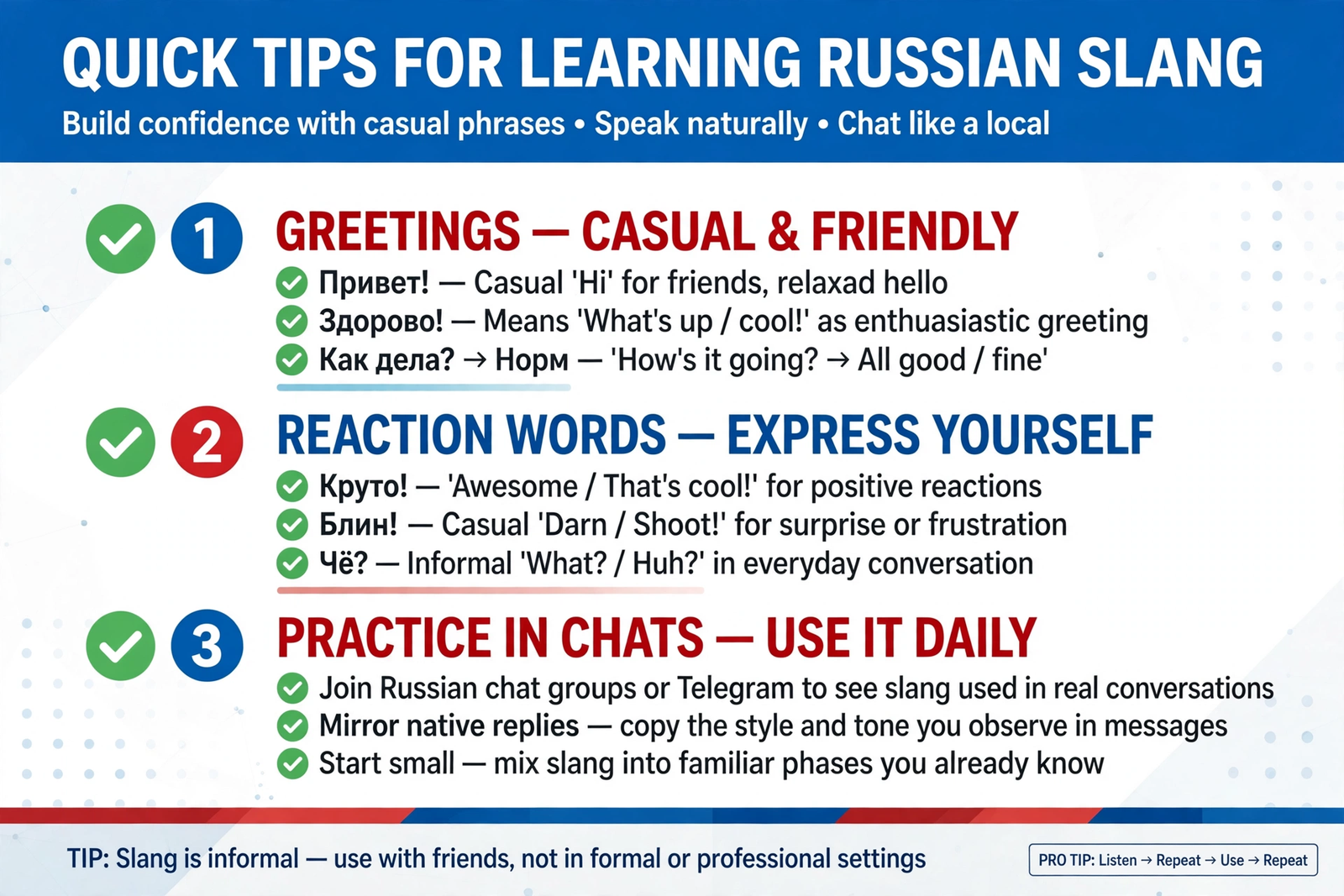
- Start with the big five: privet, poka, davai, spasibo, and kruto. These five words alone cover most casual conversations.
- Learn one word per situation. Greetings first, then reactions (zhest, klassno), then laughter (oru, zhiza). Build your slang the way you would build any vocabulary — in layers.
- Watch Russian TikTok and YouTube with subtitles. Hearing slang in real conversations is worth more than memorizing a hundred-word list. Pay attention to when speakers switch between formal and informal language.
- Practice in chats before speaking. Texting gives you time to think. Try dropping davai or klassno into a chat with a Russian-speaking friend and see how it feels.
- Copy the reaction words first. Reaction slang — zhest, kruto, klassno — is the easiest to use correctly because it works in almost any situation where you are surprised or impressed.
- Learn the Cyrillic spellings. Most russian slang online is written in Cyrillic. If you can read привет and давай, whole chats open up to you.
- Ask a native speaker to correct you. A Russian friend can tell you in seconds which words sound natural and which sound like you learned them from a meme. That feedback is gold.
- Keep a slang notebook. Every time you hear a new word in a video, stream, or chat, write it down with the sentence you heard it in. Context is what makes slang stick.

FAQ
What does russian slang mean?
Russian slang is the informal vocabulary Russians use in everyday conversation, texting, and social media. It includes friendly words like privet (hi) and davai (let’s go), internet slang like zhiza (relatable) and oru (dying laughing), and mat — Russian profanity — which is common but rude.
What is the most common russian slang word?
Davai (давай) is probably the most common russian slang word. It means “let’s go,” “come on,” “okay,” or “let’s do it,” and Russians use it dozens of times a day in almost any casual situation.
What does “blyat” mean in russian slang?
Blyat is a vulgar Russian swear word (part of mat) used as an exclamation of surprise, frustration, or emphasis — similar to the f-word in English. You will hear it constantly in Russian media and gaming, but you should not use it in polite company, at work, or with strangers.
How do you say “cool” in russian slang?
The most common ways to say “cool” in russian slang are kruto (круто) and klassno (классно). Both are safe, friendly, and widely used. Zhara (жара — literally “heat”) is a trendier option that means “fire” or “amazing.”
What does “privet” mean in Russian?
Privet (привет) means “hi” or “hello” in informal Russian. It is the casual greeting you use with friends, family, and people your own age. The formal version is zdravstvuyte (здравствуйте).
Is russian slang hard to learn?
Not really — it is one of the easiest parts of Russian to learn. Many modern slang words are borrowed from English (krash, vaib, khaip), and the most useful native words like davai and privet are short and simple. The hard part is knowing when slang is appropriate and when to switch to formal Russian.
What is “zhiza” in russian slang?
Zhiza (жиза) means “so relatable” or “that’s literally life.” It comes from zhizn (life) and is used the way English speakers say “mood” or “same” when something describes their own experience perfectly.
Where can I practice russian slang online?
Russian TikTok, Telegram channels, YouTube comments, and gaming communities on Discord and Twitch are the best places to see russian slang in action. Language-exchange apps and Russian-speaking friends are even better, because they can correct your usage in real time.
Conclusion
Russian slang is the living, breathing side of the Russian language — the part that textbooks skip and real people use every single day. From the universal privet and davai to internet favorites like zhiza, oru, and krash, these words are your shortcut to sounding natural, understanding Russian chats and memes, and connecting with Russian speakers on their own terms.
The key takeaways are simple. Start with the friendly basics, learn the reaction words that work everywhere, understand mat without using it carelessly, and always match your language to the situation — slang with friends, formal Russian with strangers and elders. If you do that, you will not just know russian slang, you will know how to use it like a native.
Language keeps moving, and russian slang moves faster than most. Keep listening, keep watching Russian creators, and keep a notebook of the new words you hear. The next time someone texts you “Davai, eto zhest, ya oru,” you will not need a dictionary — you will just laugh along. And if you enjoyed this guide, explore more of our slang guides, from Italian slang to Japanese slang — every language has its own hidden layer, and now you know how to find it.
