Quick definition: 1940s slang is the informal language Americans used during the 1940s — a colorful mix of World War II military talk, jazz-age expressions, and Hollywood movie dialogue. Words like snafu, hepcat, dreamboat, and cooking with gas defined the decade, and many of them are still understood — and even used — today.
1940s Slang Meaning & Definition
When people search for 1940s slang, they usually want one of two things: a list of the words themselves, or an understanding of what everyday Americans actually sounded like in the 1940s. The short answer is that 1940s slang was the casual, street-level English of a decade shaped by war, swing music, and the golden age of Hollywood.
Unlike the slang of today, which spreads through TikTok and texting, 1940s slang spread through radio broadcasts, newsreels, big-band dance halls, and letters sent home from soldiers overseas. A word could travel from a barracks in England to a kitchen table in Ohio in a matter of weeks, carried by a single letter or a popular song.
Some 1940s expressions were brand new. Others were older words that the decade made famous. Either way, the language of the forties has a rhythm all its own: short, punchy, playful, and full of personality. Below, you will find more than 60 of the most popular terms, what each one meant, how people used it, and which ones are still worth using today.
Introduction
Picture a smoky jazz club in 1944. A trumpet player finishes a solo, and someone at the bar turns to a friend and says, “That cat is solid — he is really cooking with gas tonight.” Nobody in the room needs a translation. In the 1940s, everybody knew the code.
The 1940s were one of the most dramatic decades in American history. The country entered World War II, millions of men and women joined the armed forces, women went to work in factories in huge numbers, and jazz and swing music became the soundtrack of daily life. Every one of those changes left fingerprints on the language.
Soldiers invented acronyms to describe the chaos of war. Jazz musicians invented words to describe the music and the scene around it. Hollywood stars turned street talk into movie dialogue, and movie dialogue turned back into street talk. The result was a slang vocabulary that was funny, tough, romantic, and endlessly creative.
Today, 1940s slang shows up in places you might not expect. Writers use it to give historical novels an authentic voice. Filmmakers use it to make period dramas feel real. Party planners build entire 1940s-themed events around it. And on social media, vintage slang has become a fun way to stand out — a dreamboat or a hepcat sounds a lot more interesting than the same old modern compliments. If you love synonyms for cool slang, you will recognize a few of these old favorites, because several 1940s words are still the coolest way to say something.

Origin
1940s slang did not come from one place. It came from at least four different worlds that collided during the decade: the military, the jazz scene, Hollywood, and the home front.
World War II and Military Slang
The single biggest source of 1940s slang was the war. More than 16 million Americans served in the armed forces, and they needed fast, funny shorthand for experiences that were often stressful or absurd. That is how the world got snafu (situation normal, all fouled up), fubar (fouled up beyond all recognition), and GI, short for “Government Issue,” which became the nickname for every American soldier.
Military slang was practical. AWOL meant absent without leave. Kilroy was here was the doodle-and-phrase soldiers scribbled on walls from Normandy to the Pacific. Boondocks described a remote, isolated place. Chow meant food, latrine talk aside, and a foxhole was home. Many of these words came home with the soldiers and never left the language — snafu is still in every dictionary today, and you can check its official definition on YourDictionary’s guide to 1940s slang for more examples of how the war shaped everyday speech.
Jazz, Swing, and the Hepcats
The second great source was jazz. Swing bands were the pop stars of the 1940s, and the musicians and fans around them — the hepcats — built a vocabulary of their own. A great musician was a cat. A great performance was solid. Something excellent was all reet (all right). If the band was playing well, they were cooking with gas. If you understood the scene, you were hip; if you did not, you were a square.
Jazz slang was also social slang. A jitterbug was an energetic swing dancer. Jive could mean jazz talk, or it could mean talk you should not believe. A dish or a dreamboat was an attractive person, and necking was the era’s polite word for kissing.
Hollywood and Radio
The third source was Hollywood. Gangster films, film noir, and screwball comedies pushed slang into millions of living rooms. Humphrey Bogart’s tough-guy dialogue, the fast-talking heroines of screwball comedy, and the wisecracking detectives of film noir all made slang sound glamorous. Radio did the same thing: comedy shows, dramas, and news programs carried the newest expressions into homes that had never seen a jazz club or a barracks.
The Home Front
Finally, ordinary life on the home front added its own words. Rationing, victory gardens, factory work, and scrap drives all produced new expressions, and so did the everyday business of dating, dancing, and going to the movies. A dime was ten cents but also an attractive woman; a nickel was five cents; moolah, clams, and greenbacks all meant money. When money was tight, something that cost almost nothing was peanuts.
Popularity
So why is 1940s slang still popular more than 80 years later? There are a few reasons, and they say a lot about why vintage language keeps coming back.
First, the words are fun. Modern slang can feel repetitive, but 1940s slang is full of surprises. Armored heifer meant canned milk. Chrome dome meant a bald man. Dead hoofer meant a bad dancer. Every term feels like a tiny joke, and people enjoy discovering them.
Second, the decade is everywhere in pop culture. World War II movies, swing-dance revivals, vintage fashion, and retro-themed parties all keep the language alive. When a hit show or film is set in the 1940s, millions of viewers hear the slang and start searching for what it means.
Third, writers and creators need it. Novelists, screenwriters, game designers, and history teachers all need to know how people in the 1940s actually talked. A story set in 1944 falls flat if the characters sound like they are texting in 2026.
Fourth, nostalgia is powerful. For many people, the 1940s represent a time of big-band music, classic movies, and family stories about grandparents who lived through the war. Learning the slang is a way of connecting with that generation — of hearing, just for a moment, how grandma and grandpa talked when they were young.
Search interest in 1940s slang spikes every year around Halloween (vintage costume parties), Veterans Day, and whenever a major World War II film or series is released. It is a topic with real staying power, not a passing trend.
How It Is Used
1940s slang is not just a museum piece. People use it today in several fun and practical ways:
- In writing and storytelling: Authors use terms like dame, hepcat, and snafu to give historical fiction and screenplays an authentic 1940s voice.
- At themed parties and events: A 1940s-themed party is not complete without the lingo. Guests greet each other as cats and dolls, call the music solid, and describe the night as a gas.
- In everyday conversation: Some 1940s words never really left. People still say cool, hip, dope, snafu, moxie, and cooking with gas without thinking of them as vintage at all.
- On social media: Vintage slang makes captions and comments stand out. Calling someone a dreamboat or describing a great night as all reet gets more smiles than the usual modern praise.
- In classrooms: Teachers use 1940s slang to make history lessons about World War II and the home front more vivid and memorable for students.
The key is context. Dropping a snafu into a work email is fine. Calling your boss a knucklehead is not — and it was not fine in 1944 either. The next sections break down exactly which words fit which situation.
Examples
Here is the big list: 60+ of the most popular 1940s slang words and phrases, each with its meaning and a real example of how people used it. The terms are grouped by theme so you can find the one you need fast.
People and Characters
| 1940s Slang | Meaning | Example |
|---|---|---|
| Ace | A top expert or skilled pilot | “He became an ace after five victories.” |
| Anchor clanker | A sailor | “The anchor clanker shipped out on Monday.” |
| Cat | A man, especially a jazz musician | “That cat can really play the trumpet.” |
| Chrome dome | A bald man | “The chrome dome at the bar laughed the loudest.” |
| Cookie | A cute girl | “She is one smart cookie.” |
| Dame | A woman (now sounds rude or dated) | “The film featured a mysterious dame.” |
| Dish | An attractive person | “The new singer is a real dish.” |
| Doll | A woman; a friendly form of address | “Thanks, doll, you are a lifesaver.” |
| Dreamboat | A very attractive person | “The new actor is a total dreamboat.” |
| GI | An American soldier | “Thousands of GIs came home in 1945.” |
| Hepcat | A stylish jazz fan who knows the scene | “Every hepcat in town was at the show.” |
| Hipster | Someone tuned in to the latest trends | “He was the biggest hipster on the block.” |
| Knucklehead | A foolish person | “Do not be such a knucklehead.” |
| Rookie | A new recruit or beginner | “The rookie scored on his first day.” |
| Square | Someone uncool or out of touch | “Do not be such a square — come dance.” |
Feelings, Actions, and Compliments
| 1940s Slang | Meaning | Example |
|---|---|---|
| All reet | All right, great, everything is fine | “Everything tonight is all reet.” |
| Cooking with gas | Doing great, making real progress | “Now you are cooking with gas!” |
| Dope | Information, gossip, or the latest news | “Give me the dope on what happened.” |
| Gas | Something hilarious or a great time | “The party was a real gas.” |
| Moxie | Courage, nerve, determination | “That kid has real moxie.” |
| Natch | Of course, naturally | “Will she come? Natch!” |
| Solid | Excellent, first-rate | “That trumpet solo was solid.” |
| Sweet | Excellent or outstanding | “That new car is sweet.” |
| Eager beaver | Someone very enthusiastic and hardworking | “The eager beaver finished first.” |
| Killer diller | Something or someone amazing | “That song is a real killer diller.” |
| On the ball | Alert, sharp, doing well | “She is really on the ball today.” |
| Swell | Wonderful, great | “We had a swell time at the dance.” |
War and Military Life
| 1940s Slang | Meaning | Example |
|---|---|---|
| Snafu | A confused, messed-up situation | “The mix-up was a complete snafu.” |
| Fubar | Messed up beyond recognition | “After the storm, the plan was fubar.” |
| AWOL | Absent without leave | “He went AWOL for two days.” |
| Blitz | A sudden, fierce attack | “Londoners endured the Blitz with courage.” |
| Ack-ack | Anti-aircraft fire | “Ack-ack lit up the harbor sky.” |
| Boondocks | A remote, isolated place | “They live way out in the boondocks.” |
| Chow | Food | “Time for chow, boys.” |
| Kilroy was here | Graffiti left by soldiers everywhere | “Kilroy was here — on every wall in town.” |
| On the lam | On the run from the law | “He has been on the lam for weeks.” |
| Buy the farm | To die (military origin) | “Sadly, he bought the farm in ’44.” |
| Jeep | A small, rugged military vehicle | “They loaded supplies into the jeep.” |
| Blockbuster | Something huge or hugely successful | “The new movie was a real blockbuster.” |
Money, Food, and Everyday Life
| 1940s Slang | Meaning | Example |
|---|---|---|
| Moolah | Money | “He saved his moolah for a car.” |
| Clams | Money | “That costs twenty clams.” |
| Greenbacks | Paper money | “He flashed a roll of greenbacks.” |
| Buck | One dollar | “A ticket cost less than a buck.” |
| Peanuts | A tiny amount, especially money | “He works for peanuts.” |
| Joe | Coffee | “Pour me a cup of joe.” |
| Grub / Chow | Food | “Let us grab some grub.” |
| Armored heifer | Canned milk | “We are out of fresh milk — use the armored heifer.” |
| Sauce | Liquor | “He has been hitting the sauce again.” |
| Bender | A drinking spree | “He went on a bender all weekend.” |
| Ameche | A telephone (to make a call) | “Ameche me when you get home.” |
| Duh | An expression of obviousness | “Duh, of course I remember.” |
| Gobbledygook | Confusing, jargon-filled talk | “That memo was pure gobbledygook.” |
| Jitterbug | An energetic swing dancer | “The jitterbugs owned the dance floor.” |
| Zoot suit | An oversized, flashy suit | “He showed up in a sharp zoot suit.” |
| Going steady | In a committed relationship | “They have been going steady for months.” |
| Necking | Kissing and cuddling | “They were caught necking at the movies.” |
| Above my pay grade | Not my responsibility or decision | “That call is above my pay grade.” |
| Belly up | Failed, finished, out of business | “The shop went belly up last year.” |
| Bum rap | An unfair accusation | “He got a bum rap from the boss.” |
Friendly Examples
Friendly 1940s slang is warm, playful, and easy to drop into conversation today:
- “Hiya, doll! You look swell tonight.” — a cheerful greeting at a dance.
- “That band is solid, cat. Pure gas!” — a compliment to a musician friend.
- “Everything is all reet — see you at the hop.” — a relaxed goodbye.
- “You are a real eager beaver, and I love it.” — praising a friend’s enthusiasm.
Professional Examples
Some 1940s expressions still work perfectly in professional settings, because they are clear and colorful without being rude:
- “There was a small snafu with the shipment, but it is fixed now.” — a polite way to describe a mix-up at work.
- “That decision is above my pay grade, so I will pass it to the manager.” — a classic, still-used deflection.
- “She has real moxie — she handled the whole project alone.” — praising courage and initiative.
- “Now we are cooking with gas — the launch is ahead of schedule.” — describing a project that is finally moving fast.
Funny Examples
The 1940s had a great sense of humor, and the slang proves it:
- “The chrome dome tried to jitterbug and nearly took out the whole dance floor.”
- “He spent all his moolah on a zoot suit and had peanuts left for dinner.”
- “Do not hand me that jive, knucklehead — I saw the whole thing.”
- “She called him a dreamboat, and he turned redder than a fire truck.”

Comparison with Similar Terms
Many 1940s words have modern twins. The ideas are the same — only the packaging changed. This table shows how the language evolved from the forties to today.
| 1940s Slang | Meaning | Modern Equivalent |
|---|---|---|
| Dreamboat | A very attractive person | Hottie, crush, snack |
| Hepcat | A stylish, in-the-know person | Trendsetter, influencer |
| All reet | Everything is great | All good, lit |
| Gas | A great time, hilarious | Lit, fire |
| Dope (information) | The latest news or gossip | The tea, the scoop |
| Square | Someone uncool | Basic, cringe |
| Going steady | In a committed relationship | Official, exclusive |
| Necking | Kissing and cuddling | Making out |
| Snafu | A confused mess | Fail, hot mess |
| Moolah / Clams | Money | Bread, cheddar, bag |
| Jive | Nonsense talk | Cap, BS |
| Cat | A cool guy, a musician | Dude, bro |
| Dame | A woman | Girl, lady (dame is now dated) |
| Cooking with gas | Doing great | On fire, killing it |
| Swell | Wonderful | Awesome, amazing |
Notice how many 1940s words survived almost unchanged. Snafu, cool, hip, dope, moxie, and blockbuster are still in everyday use, which tells you how strong the decade’s contribution to English really was. If you want to see how today’s words compare, our guide to lit meaning in slang shows how a single modern word picked up the same job that gas used to do.

Alternate Meanings
Some 1940s slang words had more than one meaning, and a few of them have changed completely since the decade ended. Knowing the alternate meanings helps you avoid embarrassing mix-ups.
- Dope: In the 1940s, dope usually meant information or gossip (“Give me the dope”). It could also mean a foolish person. Later, it picked up a drug-related meaning, and in modern slang it means excellent or cool. Context decides everything.
- Cool: In the forties, cool meant calm, stylish, and in control — a jazz word before it became a general word for “great.” It is one of the most successful slang exports of the decade.
- Gay: In 1940s slang, gay most often meant cheerful, carefree, or brightly colored (“a gay party”). Its modern meaning is entirely different, so be careful when reading old books and song lyrics.
- Cat: Beyond “jazz musician,” cat could simply mean a guy or a fellow. “That cat” was the 1940s version of “that dude.”
- Joint: In the 1940s, a joint was a place — a nightclub, a bar, or a hangout (“a jumping joint”). The drug-related meaning came later.
- Grass: In forties slang, grass could mean money in some contexts, long before its later associations.
- Tea: In the 1940s, tea was just the drink, sometimes served at a “tea dance.” Today it means gossip — a meaning the forties would have expressed with dope.
Professional or Polite Alternatives
Not every 1940s word is safe to use today. Some terms that were casual in 1944 are rude or offensive now. Here are polite modern alternatives for the trickiest ones:
| 1940s Term | Why to Avoid It | Polite Alternative |
|---|---|---|
| Dame / Broad | Sounds dismissive or sexist today | Woman, lady, person |
| Chick | Dated and often disrespectful | Woman, girl (if young), friend |
| Knucklehead | Insulting in formal settings | Silly, mistaken, confused |
| Fat head | Direct insult | Not thinking clearly |
| Yuck (person) | Calling someone foolish | Silly, goofy |
| Dead hoofer | Mocking someone’s dancing | Still learning the steps |
Words like snafu, moxie, cooking with gas, above my pay grade, and dreamboat (used playfully) are completely fine in modern conversation. The rule is simple: if the word describes a person in a way you would not want used on you, pick the modern alternative.
Common Mistakes
People make the same few mistakes when they try to use 1940s slang. Avoid these and you will sound charming instead of confused:
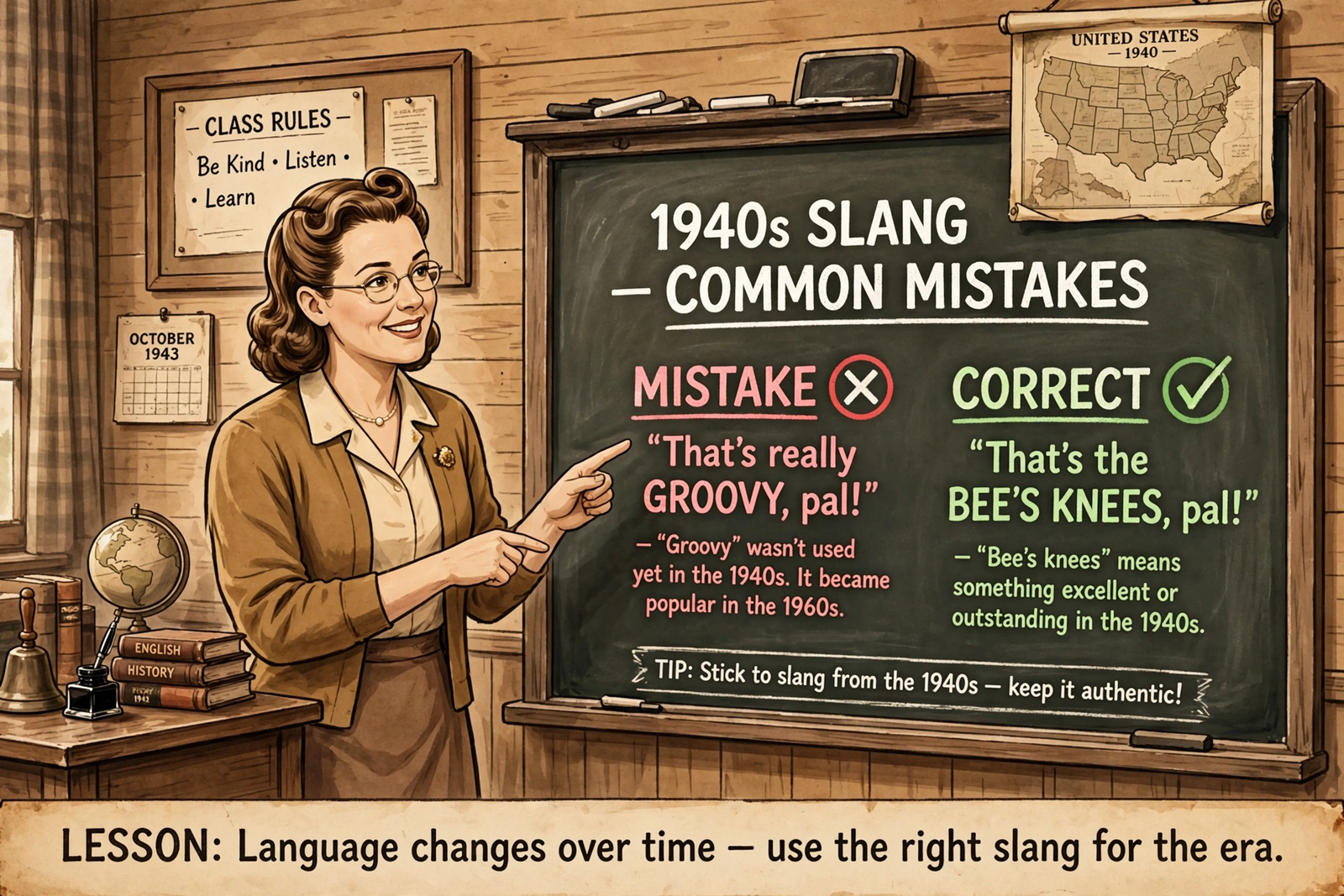
- Mixing decades: Not every “old-timey” word is from the 1940s. Groovy is 1960s. Rad is 1980s. Twenty-three skidoo is 1920s. If you want the forties, stick to this list.
- Overdoing it: Using one or two 1940s words is fun. Using ten in one sentence sounds like a costume, not a conversation. Sprinkle, do not pour.
- Using dated words for people: Calling a woman a dame or a broad at work will not land the way it did in a 1944 movie. Those words aged badly — leave them in the history books.
- Getting the meaning wrong: Jive does not mean “cool music” — it means talk you should not trust. Dope in a 1940s sentence means information, not drugs. Always check the meaning before you use a word.
- Forgetting the tone: 1940s slang was spoken fast, with confidence and a smile. Delivering it stiffly or sarcastically kills the charm. Say it like you mean it.
- Using military slang lightly: Words like snafu, fubar, and buy the farm come from real wartime experience. They are fine in casual use, but keep the context respectful — especially around veterans and military families.
Quick Tips
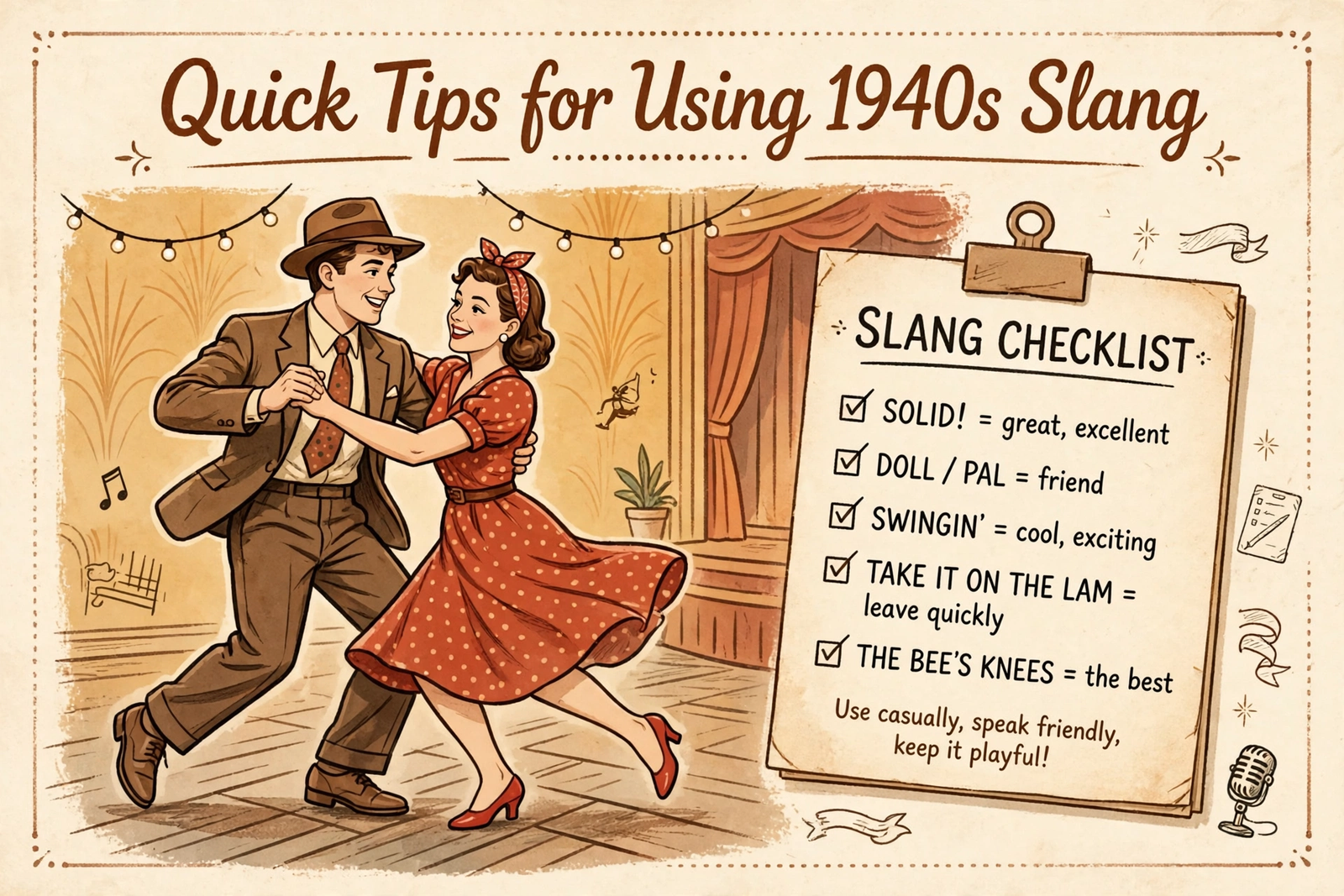
- Start with the survivors: Use snafu, moxie, cool, cooking with gas, and above my pay grade first. Everyone already understands them, so there is no risk.
- Learn five, not fifty: Pick five favorites — say dreamboat, hepcat, all reet, gas, and swell — and use them until they feel natural.
- Match the setting: A 1940s party, a history essay, a novel, or a retro social media post are perfect places. A formal business meeting is not.
- Watch the movies: Classic films like Casablanca, The Maltese Falcon, and His Girl Friday are the best teachers. Listen to how the actors deliver the lines.
- Listen to the music: Big-band and swing playlists are full of 1940s slang in its natural habitat — in song lyrics and between-song banter.
- Teach kids with it: Children love funny old words. Chrome dome, armored heifer, and eager beaver make history lessons memorable.
- Use it in writing: A blog post, a birthday card, or a wedding speech with one well-placed 1940s word gets remembered. Two or three is plenty.
FAQ
What does 1940s slang mean?
1940s slang is the informal language Americans used during the 1940s. It mixed World War II military terms like snafu and GI, jazz expressions like hepcat and all reet, and Hollywood dialogue like dreamboat and doll. It was the casual English of soldiers, swing dancers, and moviegoers.
What are some popular 1940s slang words?
Some of the most popular 1940s slang words are snafu, hepcat, dreamboat, cooking with gas, all reet, moxie, doll, dish, cat, solid, gas, swell, GI, jitterbug, and moolah. Many of them are still understood today.
What does “snafu” mean in 1940s slang?
Snafu stands for “situation normal, all fouled up.” Soldiers invented it during World War II to describe a plan that had gone wrong through confusion. Today it means any mix-up or mess, and it is still used in everyday English.
What does “hepcat” mean?
A hepcat was a stylish, knowledgeable jazz fan — someone who knew the music, the clubs, and the scene. If you were hip to the latest swing band and dressed the part, you were a hepcat. The word later shortened to hipster, which is still used today.
What did people call an attractive person in the 1940s?
An attractive person was a dreamboat, a dish, or a doll. A handsome man could also be a dreamboat, while a stylish woman might be called a dish. These compliments sound old-fashioned today, which is exactly why people still use them playfully.
Is 1940s slang still used today?
Yes. Words like snafu, cool, hip, moxie, blockbuster, cooking with gas, and above my pay grade never left the language. Others, like dreamboat and hepcat, survive in movies, books, themed parties, and social media as fun vintage expressions.
What is the difference between 1940s slang and 1920s slang?
1920s slang came from Prohibition, flappers, and jazz’s early days — words like twenty-three skidoo, the bee’s knees, and speakeasy. 1940s slang came from World War II, swing music, and Hollywood — words like snafu, GI, hepcat, and dreamboat. The forties were tougher and more military; the twenties were flashier and more rebellious.
How can I use 1940s slang without sounding silly?
Use one or two words at a time, in the right setting — a themed party, a story, a caption, or a casual chat. Start with words everyone knows, like snafu or moxie. Avoid dated terms for people, like dame or broad, and never stack five vintage words into one sentence. Confidence and a smile do the rest.
Conclusion
1940s slang is more than a list of funny old words. It is a time capsule from a decade when the whole world changed — when soldiers, jazz musicians, movie stars, and ordinary families all invented a new way of talking, almost without noticing. Words like snafu, hepcat, dreamboat, and cooking with gas carried people through a war, across dance floors, and into a new era.
The best part is that the language is still alive. Some of it never left. The rest is waiting for you to bring it back — at a party, in a story, in a caption, or just in a conversation with a friend who will smile when you call a great night a real gas.
So pick your five favorites, learn them well, and use them with confidence. And if you want to keep exploring how slang evolves, check out our guides to country slang and tuff slang meaning — the story of American slang did not stop in 1949, and neither should your vocabulary. As they would have said in 1944: everything is all reet, doll — now go out and be solid.
