
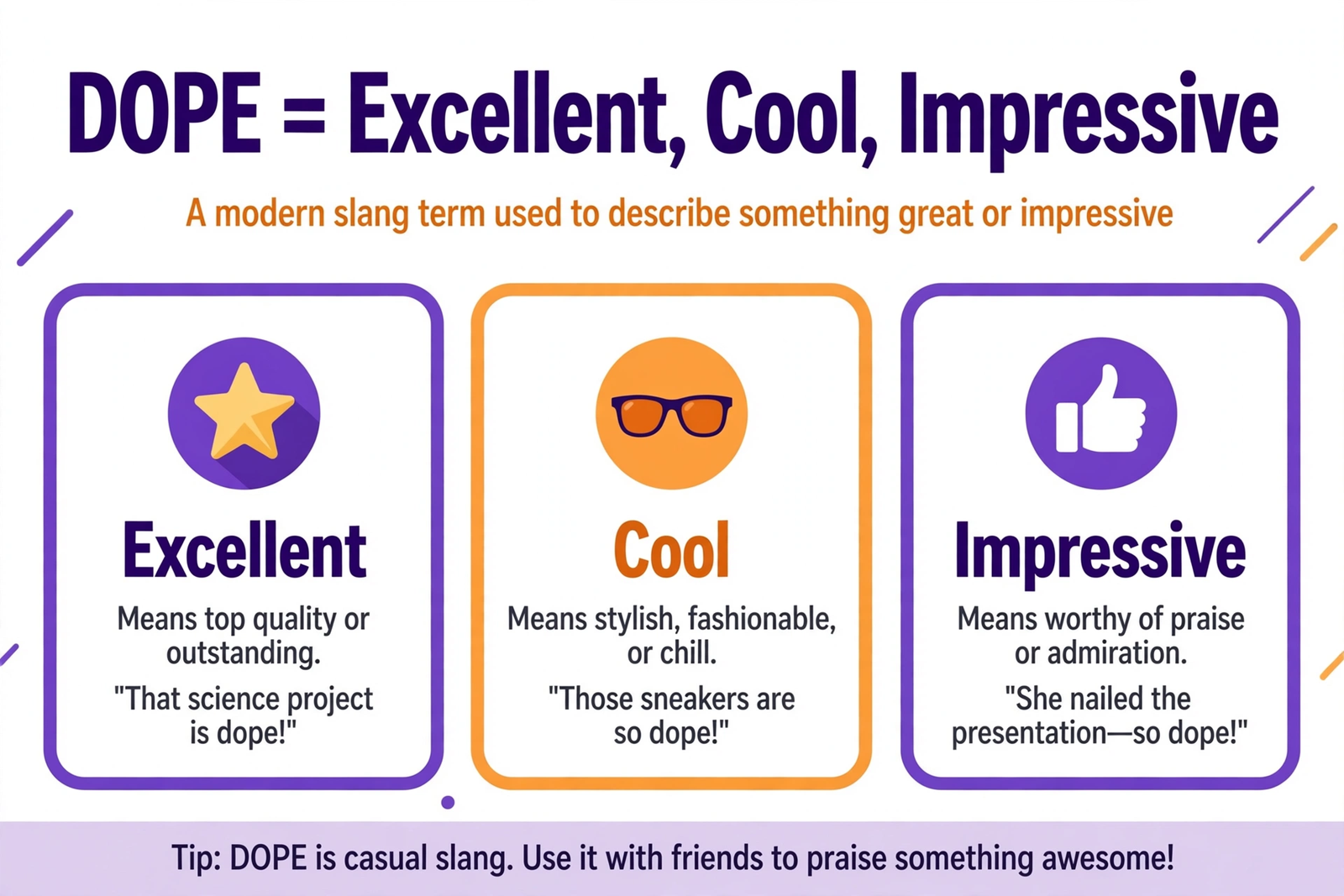
Quick definition: In slang, dope most often means excellent, cool, or impressive — as in “That beat is dope!” But the word has several other meanings depending on context: it can refer to illegal drugs (especially marijuana), to inside information (“What’s the dope on the new album?”), or, as an insult, to a foolish person. The positive “awesome” sense is the one you will hear most in texts, TikTok comments, and hip-hop lyrics today.
Dope Meaning Slang Meaning & Definition
Dope meaning slang is one of those phrases that confuses people because the word “dope” wears so many hats. Ask ten people what it means and you might get ten different answers — and most of them would be right. In modern slang, the most common meaning is simple: something is excellent, impressive, or really cool. If a friend texts you “That new song is dope,” they are not talking about drugs. They are saying the song is amazing.
But context is everything with this word. The same four letters can praise a sneaker drop, describe a drug, ask for gossip, or insult someone’s intelligence. That is exactly why “dope meaning slang” is searched so often — people hear the word in a song, a meme, or a group chat and need to figure out which meaning fits.
Here is the short version of every meaning you need to know:
- Excellent / awesome: “Your outfit is dope.” (the most common modern use)
- Drugs: “dope” as slang for marijuana, heroin, or illegal drugs in general.
- Inside information: “Give me the dope on what happened at the party.”
- A foolish person: “Don’t be such a dope.” (old-fashioned insult)
- Doping (sports): using banned performance-enhancing drugs.
In this guide, we break down each meaning with real examples, trace the word from a Dutch sauce to a hip-hop compliment, compare it with similar slang like “lit,” “fire,” and “sick,” and show you exactly when — and when not — to use it.
Introduction
Few slang words have lived as many lives as “dope.” It started as a word for thick sauce in the 1800s, became a name for opium and other drugs, turned into an insult for a foolish person, and then — in one of the great plot twists in English — flipped into one of the warmest compliments in hip-hop. Today, when someone says “that’s dope,” they usually mean the exact opposite of the word’s dark history: they mean something is brilliant.
That flip is what makes the word so interesting, and so easy to misunderstand. A parent reading a teenager’s texts might panic at the word “dope” and assume the worst. A non-native English speaker might hear it in a song and wonder why a rapper is praising drugs when he is actually praising a beat. And a Gen Z user might not even know the drug meaning exists — for them, “dope” has always meant “cool.”
Understanding dope meaning slang means understanding all of its layers, because the word never fully leaves any of them behind. The drug meaning still exists. The “inside information” meaning still shows up in phrases like “the straight dope.” The insult meaning still appears in old movies and books. But in everyday conversation in 2026, the positive meaning dominates — and that is the meaning this article focuses on, without hiding the rest.
Whether you heard it in a Drake lyric, saw it in a TikTok comment, or got it in a text from a friend, this guide will make sure you never have to guess again. You will learn where the word came from, how each meaning works, how to use it naturally, and the mistakes that make people sound awkward when they try.
Origin
The story of “dope” begins not in a recording studio or on a street corner, but in a Dutch kitchen. The word comes from the Dutch doop, meaning a thick sauce or dip, from the verb dopen, “to dip.” Early American writers, including Washington Irving in his satirical magazine Salmagundi in 1807, used “doup” to mean gravy or sauce. Nobody at the time could have guessed where the word was headed.
By the mid-1800s, “dope” had drifted into a general word for any thick liquid, paste, or glop — axle grease, varnish, the chemical on match heads, even the sugar added to canned sweetcorn. From there it took two important turns. First, in the 1850s, it became a mild insult for a stupid person — a “dope” was someone slow or foolish, a sense that survives in Disney’s Dopey from Snow White (1937) and in the phrase “dopey.” The logic seems to have been that a drugged, dulled person was a slow person.
The second turn was the drug sense. Opium, the drug of choice in 19th-century smoking dens, was a thick, treacle-like paste — exactly the kind of sticky substance the word already described. By the 1880s, “dope” was the standard slang for opium, and the term “dope-fiend” appeared for habitual users. Over the next few decades the word widened to cover morphine, cocaine, heroin, and eventually marijuana, becoming the generic slang term for illegal drugs that most people over forty still think of first.
A separate branch grew out of horse racing. Trainers who secretly drugged horses to change their performance gave us the verb “to dope,” and from the racing world came another meaning entirely: “the dope” as inside information. If you knew which horse had been doped, you had information nobody else had — so “What’s the dope?” came to mean “What’s the real story?” That meaning is still alive in the phrase “the straight dope,” meaning the honest facts.
Then came the flip. In the early days of hip-hop, around 1981, rappers began using “dope” to mean “excellent.” Early hip-hop artists like Busy Bee and Grandmaster Flash used it as praise, and the sense spread from Black American slang into mainstream youth culture through music, film, and fashion. A word that had spent a century describing drugs and foolishness now described the best beat, the freshest sneakers, and the coolest style. It is one of the most complete meaning reversals in modern English — and it is still going strong more than forty years later.
Popularity
So how popular is “dope” today? Extremely — but in a different way than it was in the 1980s and 1990s. In its hip-hop heyday, “dope” was everywhere: in lyrics, on album covers, in movies about street culture. It was the default compliment of the era, the way “lit” or “fire” functions for Gen Z today. Ask anyone who grew up in the 80s or 90s and they will tell you “dope” was the word.
Among younger users today, “dope” has settled into a comfortable second tier. It is no longer the trendiest compliment — words like “fire,” “lit,” “slay,” and “goated” have taken the spotlight in TikTok comments — but it has not faded away either. That is actually a sign of strength. Trendy words burn out fast; “dope” has survived for four decades because it feels natural, positive, and just retro enough to sound cool without trying too hard.
Millennials still use it constantly, and Gen Z uses it too, often with a slightly nostalgic, old-school flavour. You will see it in sneaker culture (“those kicks are dope”), in music discussions (“that album is dope front to back”), in gaming chats, and in everyday compliments between friends. It also shows up in brand names, podcast titles, and YouTube channels, which keeps it in front of new audiences.
Search interest tells the same story. People do not just search for the word — they search for its meaning, its origin, and how it compares to other slang. That is because “dope” is one of those words that everyone has heard but surprisingly few people can fully explain. It sits at the intersection of music history, drug culture, and everyday praise, and that mix keeps it interesting long after trendier words have come and gone.
One reason for its staying power is versatility. “Dope” works as an adjective (“a dope song”), a noun (“give me the dope”), and even a verb (“don’t dope the horse”). It fits in a text, a tweet, a song lyric, or a casual conversation. Few slang words are that flexible, and flexibility is what keeps a word alive.
How It Is Used
The most important rule for using “dope” is also the simplest: match the meaning to the moment. In 2026, if you use “dope” as a compliment, almost everyone will understand you. If you use one of its older meanings, you need the right context — or people will misunderstand you.
Here is how each meaning works in real life:
As a compliment (the main use)
This is the everyday meaning. “Dope” as an adjective means excellent, impressive, stylish, or cool. It describes things more often than people — a song, a movie, an outfit, a car, a meal, a trick, a design. You can say “That jacket is dope” or “The concert was so dope.” It is casual and warm, never formal, and it works best with friends, peers, and anyone you would joke around with.
You can also use it on its own as a reaction: someone shows you their new tattoo and you just say “Dope.” One word, full approval. That short, punchy use is very common in texts and comments.
As a noun for drugs
In this sense, “dope” usually means marijuana, though it can mean heroin or illegal drugs generally. This use is older and more common in certain regions and generations, and it appears in crime dramas, older rap lyrics, and news reports. Most younger speakers today would say “weed” instead — a shift worth knowing if you are trying to sound current. Our full guide to slang for weed covers the modern terms people actually use now.
As inside information
“What’s the dope?” and “Give me the straight dope” both ask for the real facts or the inside story. This use sounds a little old-fashioned and journalistic, like something from a 1940s newspaper movie, but it is still understood and it shows up in writing more than in speech. It is a fun phrase to know, even if you rarely need it.
As an insult
Calling someone “a dope” means calling them a fool. This use is dated — it sounds like something a grandparent would say — but it is still in dictionaries and still appears in books and films. Do not use it as a joke with strangers; the drug and compliment meanings are so much more common now that the insult can confuse people.
In sports: doping
The verb “to dope” and the noun “doping” belong to sports, where they mean using banned performance-enhancing drugs. This is a formal, newsroom use — “the athlete was caught doping” — and it is the one meaning of the word that has never been slang at all.
The golden rule: in casual conversation, “dope” means “awesome” unless the context clearly says otherwise. If someone says “That was dope” after a concert, they loved the concert. If a news anchor says “dope” on a crime report, they mean drugs. Context does all the work.
Examples
Examples are the fastest way to learn a slang word, because they show you the tone, the setting, and the reaction that goes with it. Here are real-feeling examples of “dope” across the situations where you are most likely to hear it.
Friendly Examples
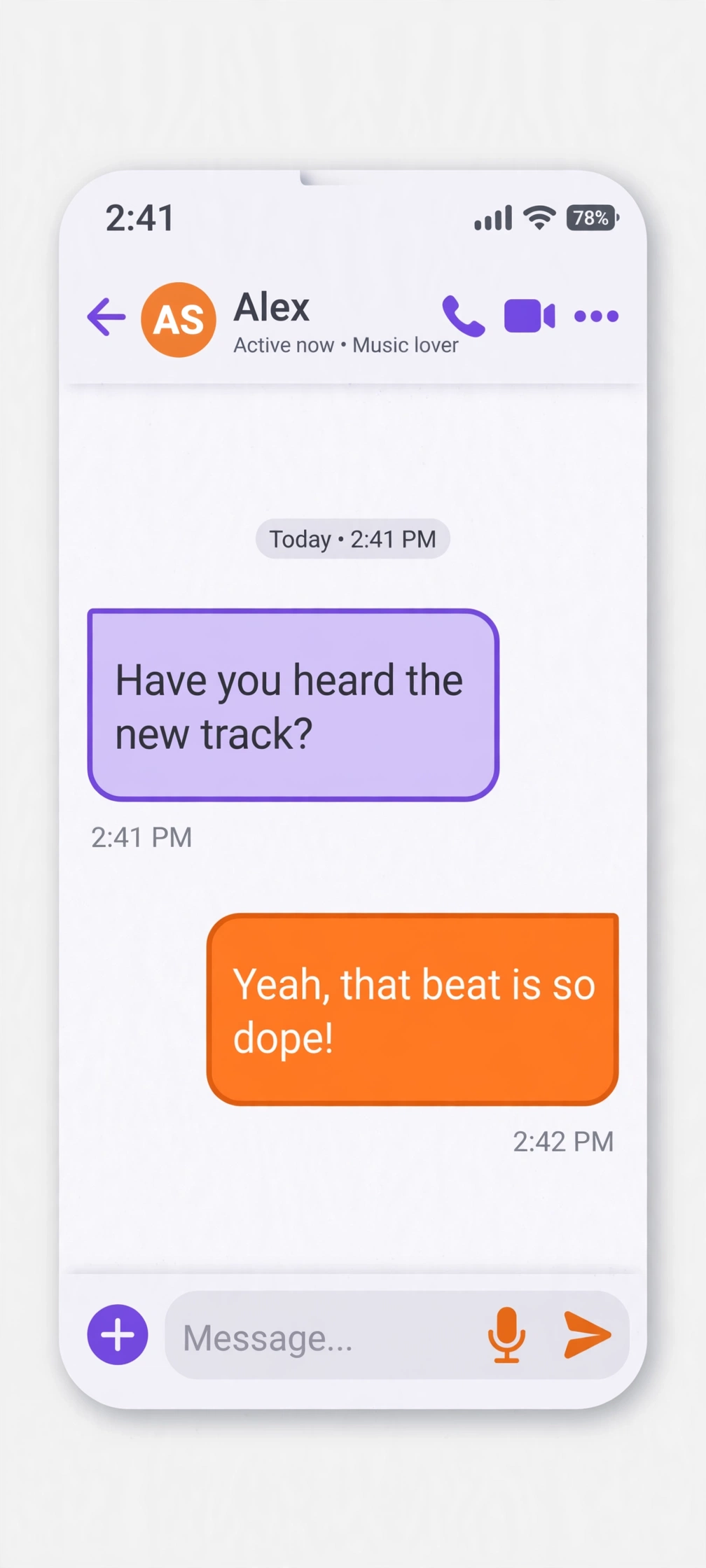
Texting a friend about music:
A: “Have you heard the new Kendrick track?”
B: “Yeah, that beat is so dope. I’ve had it on repeat all day.”
Complimenting a friend’s style:
A: “Just got these new sneakers.”
B: “Those are dope! Where did you get them?”
Reacting to a photo:
A: *sends a sunset photo from a road trip*
B: “Wow, that’s dope. The colours are unreal.”
Praising someone’s work:
A: “I finally finished my art project.”
B: “That’s dope, honestly. You should post it.”
In a group chat:
“Guys, the new café downtown is so dope. They have live music on Fridays and the coffee is actually good.”
Professional Examples
“Dope” is casual, so it rarely belongs in formal work emails or meetings — but it does appear in creative and informal professional settings. A designer might tell a client “That logo concept is dope” in a relaxed brainstorm. A music journalist might write “a dope new single” in a review. A social media manager might caption a product launch “Something dope is coming.”
The key is knowing your audience. With a creative team or a young audience, “dope” sounds natural and enthusiastic. With a formal client or a corporate boardroom, pick a safer word like “excellent” or “impressive.” Slang is a tool, and professionals choose the right tool for the room.
Example — creative workplace:
“That pitch deck is dope. The visuals are clean and the story actually lands. Let’s send it to the client.”
Example — music review:
“The album’s second half is the dopest stretch of songs the band has released in years.”
Funny Examples
Self-deprecating humour:
“My cooking is so dope that the smoke alarm gives it a standing ovation every time.”
Exaggerated praise:
“My grandma’s Wi-Fi password is dope. It’s literally ‘password123’ and she thinks she’s a hacker.”
Group chat banter:
A: “I just parallel parked perfectly on the first try.”
B: “Dope. Somebody get this man a trophy and a parade.”
Movie night:
“That plot twist was so dope I had to rewind it three times just to believe it.”
Comparison with Similar Terms
“Dope” does not live alone. English has a whole shelf of words that mean “excellent,” and picking the right one is partly about meaning and partly about vibe. Here is how “dope” stacks up against its closest cousins.
| Term | Meaning | Vibe & Era | Best For |
|---|---|---|---|
| Dope | Excellent, impressive, cool | Classic hip-hop, 1980s to now; relaxed and confident | Music, style, art, general praise |
| Lit | Exciting, amazing, high-energy | Gen Z party slang; loud and hype | Parties, concerts, wild nights out |
| Fire | Amazing, top quality, hot | Gen Z and millennial; short and punchy | Songs, outfits, photos, quick compliments |
| Sick | Awesome, impressive (opposite of ill) | Skater and surf culture; casual | Tricks, stunts, skills, sports moments |
| Cool | Good, agreeable, stylish | Timeless; works everywhere | Almost anything, including formal settings |
| Awesome | Excellent, impressive | Mainstream; safe and universal | Any audience, including work and family |
| Rad | Excellent, cool | 1980s surfer slang; retro and playful | Nostalgic praise, 80s throwbacks |
| Goated / GOAT | The greatest of all time | Gen Z and Gen Alpha; superlative praise | The absolute best of something |
The differences are subtle but real. “Lit” is about energy — a party is lit, a quiet painting usually is not. “Fire” is about heat and quality — a song can be fire, a meeting cannot. “Sick” belongs to skills and stunts. “Dope” is the most versatile of the slang options: it works for music, fashion, food, art, places, and ideas, and it carries a cool, laid-back confidence that the louder words do not.
Age matters too. If you say “dope” to someone over forty, they will almost certainly hear the compliment — they grew up with it. If you say “lit” to the same person, they might need a second to catch up. And if you say “dope” to a teenager, they will understand it perfectly, even if they would personally pick “fire” first. That cross-generational reach is rare in slang, and it is a big part of why “dope” has lasted.
One more cousin worth knowing is “dank,” which overlaps with “dope” in the drug world — “dank” originally described high-quality marijuana before becoming a general word for something excellent. The overlap is a reminder that a lot of modern praise-words started in drug slang and got cleaned up by music culture.

Alternate Meanings
Beyond the main slang senses, “dope” has a few more meanings that can surprise people. Knowing them saves you from confusion when the word shows up in an unexpected place.
- A thick liquid or paste: In old technical writing, “dope” was any sticky preparation — aircraft varnish, lubricant, the coating on photographic film. You will still see this in aviation history, where “dope” was the varnish brushed onto fabric-covered airplane wings.
- A soft drink: In parts of the southern United States, especially the Carolinas, “dope” was once a nickname for Coca-Cola and other sodas, because early cola was sold as a medicinal tonic. “Let’s get a dope” in a 1950s North Carolina diner meant ordering a Coke.
- To drug someone or something: “They doped the horse before the race” and “He was doped up on painkillers” use the verb form. This is the sense behind sports “doping” scandals.
- Inside information: “The straight dope” means the honest, complete facts. Journalists and political writers still use this phrase.
- A foolish person: The insult sense — “Don’t be a dope” — is old-fashioned but still listed first in some dictionaries.
- Computer and science uses: In electronics, “doping” means adding impurities to a semiconductor to change how it conducts electricity. In that world, “dope” is a technical term, not slang at all.
Most of these meanings are rare in everyday speech, but they explain why the word appears in such strange places — from chemistry textbooks to country songs. The word has simply been busy for two hundred years.
Professional or Polite Alternatives
“Dope” is a great word with friends, but it is not the right word everywhere. In a job interview, a formal email, a classroom presentation, or a conversation with someone you do not know well, a polite alternative lands better. Here are swaps that keep the meaning without the slang:
| Instead of | Say | When to use it |
|---|---|---|
| “That song is dope.” | “That song is excellent.” | Work, school, formal writing |
| “Your outfit is dope.” | “Your outfit looks great.” | Complimenting a colleague or client |
| “That’s a dope idea.” | “That’s an impressive idea.” | Meetings and brainstorms |
| “The food was dope.” | “The food was outstanding.” | Restaurant reviews, thank-you notes |
| “Dope design.” | “Stunning design.” | Professional feedback |
| “That’s so dope!” | “That’s wonderful!” | Talking with older relatives |
The trick is matching the energy, not just the meaning. “Dope” carries excitement, so a flat replacement like “good” can feel like a downgrade. “Excellent,” “outstanding,” “impressive,” “brilliant,” and “fantastic” keep the enthusiasm while sounding polished. Save “dope” for the group chat and the concert — and use its polished cousins everywhere else.
Common Mistakes
Even a simple word can go wrong. Here are the mistakes people make most often with “dope” — and how to avoid them.
1. Using it in formal settings. Saying “dope” in a job interview or a business presentation can make you sound unprofessional. It is not offensive, just too casual. Read the room first.
2. Using it when drugs are the topic. If the conversation is actually about drugs, “dope” as a compliment can create a genuinely confusing moment. “That dope is dope” is a sentence nobody should have to untangle. Pick a different compliment when drugs are on the table.
3. Overusing it. Calling everything dope — the sandwich, the weather, the bus, your socks — drains the word of its power. Slang works because it is selective. Save it for things that actually impress you.
4. Calling a person “dope” without context. “You’re dope” is a fine compliment between friends, but to a stranger it can sound odd, and in the wrong tone it can sound like the old insult. “You’re a dope person” is safer than a bare “You’re dope” with someone you barely know.
5. Using it with older relatives who know the drug meaning. Your grandmother may hear “dope” and think of the drug sense first, especially if she grew up in the era of anti-drug campaigns. A quick “I mean it’s really cool” clears it up — or just use “awesome” with grandma.
6. Forcing it to sound young. Nothing ages a sentence faster than slang used by someone trying too hard. If “dope” is not a word you naturally say, do not perform it. The most natural slang is the slang you actually use, and nobody is impressed by a word that sounds rehearsed. The same caution applies to other retro slang — if you want a broader tour, our 70s slang guide shows which old-school words still work and which ones sound like a costume.
7. Confusing it with “dope” the verb. “I doped the coffee” means you drugged it, not that you improved it. The verb form is almost never a compliment, so keep the praise in adjective form: “That coffee is dope,” never “I doped the coffee.”

Quick Tips
- Default to the compliment: In texts, TikTok, and casual talk, “dope” means “awesome” unless the context clearly points elsewhere.
- Use it for things, not just people: Songs, outfits, meals, movies, designs, and places are the most natural targets.
- One-word reactions work: A simple “Dope.” in reply to a photo or a song link is a complete, natural compliment.
- Pair it with specifics: “That chorus is dope” hits harder than a generic “That’s dope,” because it shows you actually noticed something.
- Keep it casual: Reserve “dope” for friends, peers, and informal settings; switch to “excellent” or “outstanding” at work.
- Don’t stack slang: “That’s so dope and lit and fire” sounds like a parody. Pick one praise word per sentence.
- Know the drug meaning exists: You do not need to use it, but knowing it stops you from being confused when it appears in older songs, films, and news stories.
- Try “dopest” for superlatives: “That’s the dopest track on the album” is the natural superlative, and it is widely used in music talk.


FAQ
What does dope mean in slang?
In modern slang, “dope” most commonly means excellent, cool, or impressive — as in “That song is dope.” It can also mean illegal drugs, inside information, or (as an old insult) a foolish person, but the compliment meaning is by far the most common in texts, TikTok, and everyday conversation today.
Is dope a compliment or an insult?
Almost always a compliment in modern use. Saying “That’s dope” means you think something is great. The insult sense — calling someone “a dope,” meaning a fool — is old-fashioned and rarely used now, so context usually makes the meaning obvious.
Where did the word dope come from?
“Dope” comes from the Dutch word doop, meaning a thick sauce or dip. It entered American English in the early 1800s for thick liquids and pastes, became slang for opium and other drugs by the 1880s, and then flipped into a compliment meaning “excellent” in hip-hop culture around 1981. For a deeper dive into the word’s history, Dictionary.com’s slang entry on dope traces the same journey from Dutch sauce to hip-hop praise.
Do people still say dope in 2026?
Yes. It is no longer the trendiest slang word — “fire,” “lit,” and “slay” get more attention from Gen Z — but “dope” is still widely used, especially by millennials and in music, sneaker, and art culture. Its cross-generational reach is exactly why it has survived for over forty years as a compliment.
What is the difference between dope and lit?
“Dope” means excellent or impressive and works for almost anything — a song, an outfit, a meal. “Lit” is specifically about energy and excitement, so it fits parties, concerts, and wild nights better than quiet things. A great album is dope; a wild party is lit. You can find more of these modern praise words in our Gen Z slang 2024 guide.
Can I say dope at work?
It depends on the workplace. In creative, casual, or youth-focused teams, “dope” sounds natural and enthusiastic. In formal or corporate settings, it is too casual — use “excellent,” “impressive,” or “outstanding” instead. When in doubt, pick the polished word.
Does dope always refer to drugs?
No — and in 2026 it usually does not. The drug meaning is real and still used, especially for marijuana and in older media, but in everyday conversation the compliment meaning dominates. Context tells you which one is meant: a comment on a song means “awesome,” a police report means drugs.
What is the straight dope?
“The straight dope” means the honest facts or the inside story about something. It comes from the horse-racing sense of “dope” as secret information. Asking “What’s the straight dope on the new policy?” means “Tell me the real story, no spin.”
Conclusion
“Dope” is a small word with a huge story. It travelled from a Dutch sauce to a drug den, from a racetrack to a recording studio, and from an insult to one of the warmest compliments in English. Few words have reinvented themselves so completely — and few have stayed useful for so long after doing it.
The key takeaways are simple. In 2026, dope meaning slang is, first and foremost, praise: excellent, cool, impressive. Use it for the music, movies, outfits, and ideas that genuinely impress you, keep it in casual settings, and pair it with specifics so the compliment lands. Remember that the older meanings — drugs, inside information, and the old insult — still exist, so let context do its job and you will never be misunderstood.
Slang is at its best when it connects people, and “dope” has been connecting them for decades — from 1980s hip-hop ciphers to today’s TikTok comments. Now that you know its full story, you can use it with confidence, and you will hear it differently the next time it shows up in a song or a text. And if you are curious about how other drug-adjacent slang went mainstream, our crack meaning slang guide tells a surprisingly similar story of a word that changed sides.

9 thoughts on “Dope Meaning Slang: What Does Dope Really Mean in Texts & on TikTok?”