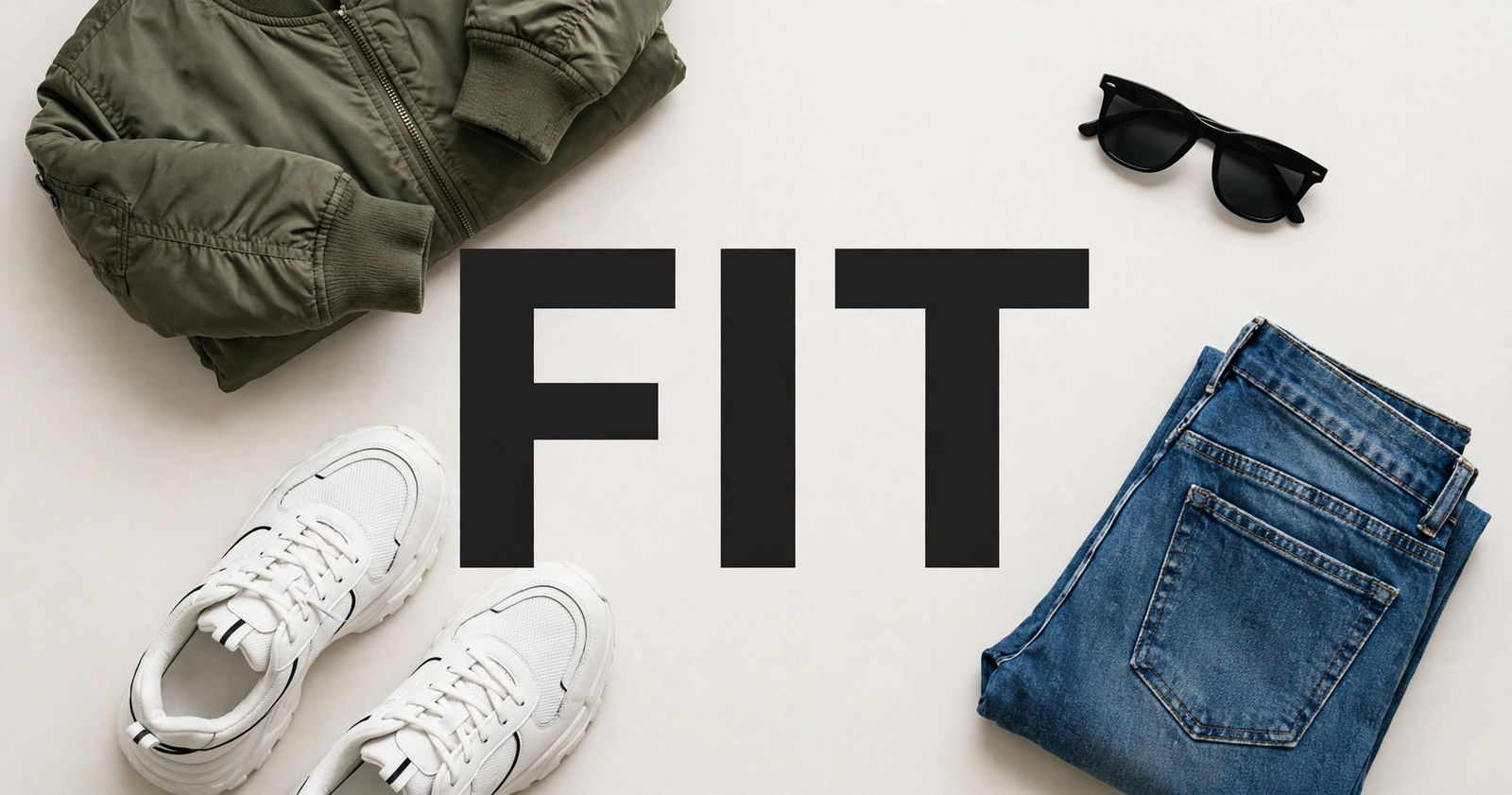
Quick definition: In slang, fit is short for “outfit.” When someone says “nice fit” or “that fit is fire,” they are complimenting what a person is wearing — the whole outfit, from head to toe. It is one of the most common fashion compliments in texts, on TikTok, and on Instagram, and it works for everything from streetwear to formal looks.
Fit Slang Meaning & Definition
The fit slang meaning is simple: fit = outfit. It is a clipped, casual version of the word “outfit” that took off in streetwear and sneaker culture before spreading to mainstream social media. Instead of saying “I love your outfit,” people now say “I love your fit” — shorter, cooler, and instantly understood by anyone who spends time online.
But “fit” in slang does a little more work than just replacing “outfit.” It usually refers to the complete look — how the clothes, shoes, and accessories work together as one styled package. A “fit” is not a single shirt or a pair of jeans; it is the entire combination. That is why you will hear phrases like:
- “Fit check” — a request (or invitation) to show off your outfit, usually in a photo or video.
- “Nice fit” — a simple compliment on someone’s outfit.
- “That fit is clean” — the outfit looks sharp, neat, and well put together.
- “Fit goes hard” — the outfit is impressive or bold.
- “Fit of the day” (FOTD) — the outfit someone chose to wear today.
The word also appears in sneaker and streetwear communities where “fit pics” (photos of an outfit) are a daily ritual. If you have ever scrolled TikTok and seen a creator spin slowly in front of a mirror while a caption reads “fit check,” you have seen the term in its natural habitat.
It is worth noting that “fit” has other meanings in English — it can mean physically healthy (“she stays fit”) or a sudden outburst (“he threw a fit”). In slang, though, when the conversation is about clothes, style, or a photo of someone dressed up, “fit” almost always means outfit. Context is everything, and the fashion meaning is now the dominant one among Gen Z and younger millennials.
Introduction
Scroll through TikTok, Instagram, or even a group chat, and you will run into the word “fit” sooner or later. Someone posts a mirror selfie and the comments flood in: “fit is fire,” “clean fit,” “where’d you get that fit?” If you are not fluent in internet slang, it can feel like everyone is speaking a slightly different language — because, in a way, they are.
Slang moves fast, and fashion slang moves fastest of all. Words like drip, fire, and clean all orbit the same idea: looking good. “Fit” sits at the center of that world because it names the thing itself — the outfit. Once you know the fit slang meaning, a whole corner of the internet suddenly makes sense, from “fit check” videos with millions of views to the simple “nice fit” your friend drops under your photo.
This guide breaks down everything you need to know: what “fit” means in slang, where it came from, how it spread, how to use it correctly in texts and on social media, and the mistakes that instantly mark someone as out of touch. By the end, you will not only understand the term — you will be able to use it naturally.

Origin
The slang use of “fit” as a shortened form of “outfit” traces back to Black American English and hip-hop culture, where clipping long words into punchy one-syllable forms has a long tradition. “Outfit” became “fit” in the same way “brother” became “bro” and “definitely” became “def.” The shorter form is faster to say, easier to type, and sounds more casual — exactly what slang is built for.
The term gained serious momentum in the 2010s alongside the explosion of streetwear and sneaker culture. Online forums, Reddit communities like r/streetwear, and Instagram fashion pages made “fit pics” a daily habit: users would post a photo of what they were wearing, and others would rate or compliment the “fit.” Sneakerheads were early adopters, because in that world the shoes make the outfit, and a “fit” was the full look built around a pair of kicks.
Hip-hop played a major role too. Rappers and artists used “fit” in lyrics and interviews throughout the 2010s, and as hip-hop became the dominant force in mainstream pop culture, its vocabulary traveled with it. By the late 2010s, “fit” had jumped from niche fashion circles into everyday teen and young-adult speech.
TikTok finished the job. The platform’s “fit check” trend — creators showing off an outfit, often with a spin or a transition — turned the word into a global phenomenon. A “fit check” video needs no explanation: the format is visual, the word is short, and the trend crossed language barriers with ease. Today, “fit” is understood by English speakers of all ages who spend any time on social media, and it has even started appearing in fashion journalism and brand marketing.
Popularity
“Fit” is one of the most widely used fashion slang terms in the English-speaking internet. A few numbers and signals tell the story:
- TikTok: “fit check” videos number in the millions, with the hashtag regularly appearing on the For You page across fashion, thrift, streetwear, and everyday lifestyle content.
- Instagram: “fit pic,” “fit of the day,” and “fit inspo” are standard captions, and dedicated fit-check accounts have hundreds of thousands of followers.
- Reddit: communities built around outfits — from streetwear to vintage fashion — use “fit” as their basic unit of discussion.
- Everyday speech: the term has moved beyond the internet. Teens compliment each other’s “fits” at school, and even adults use it casually when talking about clothes.
What makes “fit” so durable is that it fills a real gap. English had no short, casual word for “the complete outfit someone is wearing.” “Outfit” is fine but formal and clunky; “look” works but is vague. “Fit” is precise, quick, and stylish in itself — a rare case of slang that is also just good vocabulary.
The term is especially popular in the United States, the United Kingdom, Canada, and Australia, and it travels well because it is so short. Non-native English speakers pick it up quickly from social media, which is why “fit” now appears in fashion content from creators around the world.
How It Is Used
“Fit” is flexible. It works as a noun, and it shows up in a handful of fixed phrases. Here is how people actually use it:
As a Noun (the Outfit Itself)
- “Your fit is so clean today.”
- “I need a new fit for the party.”
- “That fit costs more than my rent.”
In the Phrase “Fit Check”
- “Fit check! Rate my outfit 1–10.”
- “Drop a fit check before you leave.”
- “Her fit check videos are always on point.”
As a Compliment
- “Nice fit 👌”
- “Fit goes hard 🔥”
- “Okay, fit ate. No crumbs left.”
With Adjectives
People pair “fit” with descriptive slang to grade an outfit: a clean fit is neat and sharp; a fire fit is outstanding; a trash fit is a bad one (usually said as a joke between friends, not to strangers). A casual fit is relaxed and everyday, while a formal fit is dressed up.
The word also appears in shopping and styling contexts: “fit inspo” means outfit inspiration, “fit ideas” are outfit ideas for a specific event, and “fit pics” are photos posted specifically to show off an outfit. If someone says “I thrifted this whole fit for $20,” they mean every piece of the outfit came from a thrift store.
Tone matters. “Fit” is casual and playful — perfect for friends, social media, and texting, but not the word to use in a formal email or a job interview. Saying “nice fit” to a coworker is friendly; writing it in a work report would be strange.
Examples
Real examples make the meaning stick. Here is how “fit” shows up in different kinds of conversations.
Friendly Examples
- Friend 1: “Yo, that fit is actually crazy. Where’d you get the jacket?”
Friend 2: “Thrifted it! Whole fit was like thirty bucks.” - Text: “Fit check before the concert?? I need to see what you’re wearing 👀”
- Comment: “Okay the fit?? The fit is fitting. 10/10 🔥”
- Group chat: “Everyone drop your fits for tonight, I need inspo ASAP.”
Professional Examples
“Fit” is informal, so professional uses are rare — but it does appear in fashion, retail, and content-creation workplaces:
- Stylist to client: “For the photoshoot, we’ll build the fit around the blazer so the look stays polished.”
- Retail associate: “That fit works great for the event — the trousers and the shoes tie it together.”
- Content creator: “Today’s fit is sponsored, so check the links below for every piece.”
Funny Examples
- “My fit today is just pajamas and confidence. Don’t judge.”
- “Bro really said ‘fit check’ and showed up in the same hoodie from yesterday 😭”
- “Me: spends an hour picking a fit. Also me: ends up wearing the first thing I tried on.”
- “His fit was so bad the group chat held a whole meeting about it.”
Notice how “fit” stays casual in every example. That is the point: the word signals that the conversation is relaxed, visual, and about style, not about formal dress codes.

Comparison with Similar Terms
“Fit” shares space with a whole family of fashion slang words. They overlap, but each one means something slightly different. The table below makes the distinctions clear.
| Term | What It Means | How It Differs from “Fit” | Example |
|---|---|---|---|
| Fit | The whole outfit | The outfit itself — the base word | “Nice fit!” |
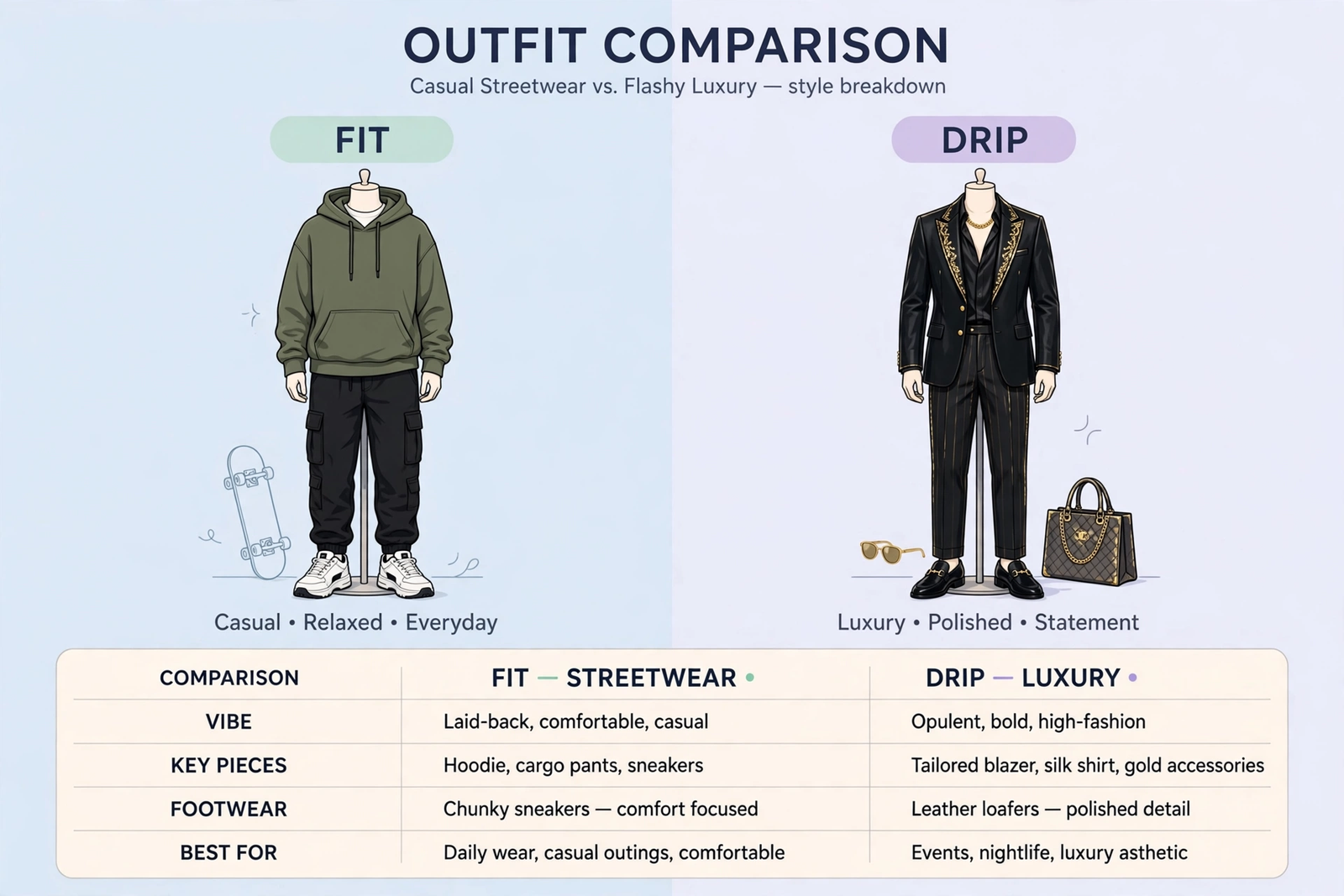
| Drip | Stylish, expensive-looking fashion sense | Describes the style level, not the outfit; see our guide to drip slang meaning | “His drip is unreal.” |
| Fire / Lit | Amazing, excellent | A general compliment, not clothing-specific | “That fit is fire.” |
| Clean | Neat, sharp, well put together | Describes how polished a fit looks | “Clean fit, bro.” |
| Slay | To look amazing, to dominate a look | A verb about the person, not the outfit | “She slayed that fit.” |
| Ate | Did something perfectly (slang) | Praises the performance of wearing it | “She ate that fit up.” |
| OOTD | Outfit of the day | A label/hashtag, while “fit” is the word itself | “OOTD: thrifted fit.” |
| Swag | Confidence and style | About the person’s vibe, not the clothes | “He’s got swag.” |
The key takeaway: “fit” is the noun for the outfit, while most of the other terms are adjectives or verbs that describe how good the fit is. You can say “that fit is fire,” but you would not say “that fire is fit” — the grammar only works one way. And if you want to understand the difference between a fit and a “wig” moment of surprise, our guide on what does wig mean slang breaks that term down the same way.
Alternate Meanings
“Fit” is a busy little word in English, and the slang meaning is only one of several. Here are the main alternate meanings you might run into:
- Physically healthy: “She works out every day — she’s really fit.” This is the standard British and general-English meaning, and it is the most common alternate use. Context makes it obvious: if nobody is talking about clothes, “fit” probably means healthy.
- Suitable or appropriate: “This jacket is a good fit” can mean it fits your body well (size) rather than referring to the whole outfit. In fashion talk, “the fit” can also describe how a garment sits on the body — “the fit of these jeans is perfect.”
- Attractive (British slang): In the UK, calling someone “fit” means they are good-looking: “He’s fit.” This is completely different from the outfit meaning and can cause confusion across the Atlantic.
- A sudden outburst: “He threw a fit” means he had a tantrum. This idiom has nothing to do with fashion.
- A seizure (medical): Historically, “fit” was used to describe a sudden seizure. This usage is now rare and mostly appears in older texts.
- To match or install: “Does this shirt fit me?” — the verb form, about size and comfort.
So how do you tell which meaning is in play? Look at the context. If the sentence mentions clothes, an outfit photo, or a “fit check,” it is the slang outfit meaning. If it mentions the gym, health, or exercise, it means physically fit. And if a British friend says someone is “fit” with no clothing in sight, they are talking about attractiveness. For a full dictionary definition of the standard meanings, see Merriam-Webster’s entry for “fit”.
Professional or Polite Alternatives
Because “fit” is slang, there are times when a more standard word works better. Here are polite alternatives for different situations:
| Situation | Instead of “Nice fit!” | Why |
|---|---|---|
| Workplace / formal event | “You look great today — that outfit really suits you.” | Professional and specific |
| Complimenting a colleague | “I like your outfit — the colors work really well together.” | Warm without being too casual |
| Writing / journalism | “The ensemble was sharply coordinated from head to toe.” | Descriptive, publication-ready |
| Talking to an older relative | “You look lovely — I love what you’re wearing.” | Friendly and universally understood |
| Customer service / retail | “That outfit looks wonderful on you.” | Polite and sales-appropriate |
That said, you do not need to avoid “fit” everywhere. With friends, on social media, and in any casual setting, it is the natural, expected word. The trick is code-switching: use “fit” where it fits (pun intended) and switch to “outfit” or “ensemble” when the setting calls for it.
Common Mistakes
Using “fit” wrong is easy if you only half-know the meaning. Here are the mistakes people make most often:
- Using it for a single item: “Nice fit” about a single shoe is wrong — a fit is the whole outfit. If you only mean the shoes, say “nice kicks” or “nice shoes.”
- Confusing it with “physically fit”: Telling someone “you look fit” in the UK means you think they are attractive, not that you like their outfit. Know your audience before you compliment.
- Saying “fit” in formal settings: “Your fit is clean” to a hiring manager will not land well. Save it for casual contexts.
- Overusing it: Calling everything a “fit” — your gym clothes, your pajamas, your work uniform — waters the word down. It works best when the outfit was actually chosen with some intention.
- Misspelling it as “fitt”: The correct slang spelling is “fit.” “Fitt” is not standard.
- Forcing it into sentences where it does not belong: “What fit are you?” does not make sense. A fit is something you wear, not something you are.
- Using it as a verb: “I fit really well today” is not slang — it sounds like you are talking about your size. The slang term is a noun.

Quick Tips
Want to use “fit” like a native? Keep these tips in mind:
- Compliment the whole look: “Fit” praises the complete outfit, so use it when the entire combination works — not for one accessory.
- Pair it with a rating: “Fit check — rate it 1 to 10” is the classic format for outfit posts and gets the most engagement.
- Add a descriptive word: “Clean fit,” “fire fit,” and “casual fit” all say more than “fit” alone. Pick the adjective that matches the vibe.
- Use it in captions: “Fit of the day” or “today’s fit” are perfect, low-effort captions for outfit photos.
- Read the room: With close friends, “fit goes hard” is perfect. With a stranger, a simple “nice fit” is safer and friendlier.
- Do not overthink it: The word is deliberately simple. If you are talking about an outfit and want to sound current, “fit” is almost always the right choice.
- Learn the companion terms: Knowing “drip,” “clean,” and “fire” alongside “fit” makes your fashion slang complete — and if you want to check how people react to surprising looks, the guide to dw slang meaning covers another reaction word you will see in the same comment sections.

FAQ

What does “fit” mean in slang?
In slang, “fit” is short for “outfit.” It means the complete set of clothes someone is wearing, from head to toe. Saying “nice fit” is a compliment on someone’s whole outfit.
What is a “fit check”?
A “fit check” is when someone shows off their outfit — usually in a photo or video — and asks others to rate or comment on it. It is a hugely popular format on TikTok and Instagram.
Is “fit” short for “outfit”?
Yes. “Fit” is a clipped form of “outfit” that started in streetwear and hip-hop culture and spread through social media. It means the same thing, just shorter and more casual.
What does “clean fit” mean?
A “clean fit” is an outfit that looks neat, sharp, and well put together — nothing messy or clashing. It is a compliment on both the clothes and how they are styled.
What does “fit goes hard” mean?
“Fit goes hard” means the outfit is impressive, bold, or exceptionally good. “Goes hard” is slang for something that is intense or excellent, so the phrase is a strong compliment.
Can “fit” mean something other than outfit?
Yes. “Fit” can also mean physically healthy (“she’s fit”), attractive (British slang: “he’s fit”), or a sudden outburst (“threw a fit”). The outfit meaning applies when the conversation is about clothes or style.
Is it okay to say “fit” at work?
It depends on the workplace. In casual, creative, or fashion-related jobs, “nice fit” is fine. In formal or corporate settings, “nice outfit” or “you look great” is a safer choice.
What is the difference between “fit” and “drip”?
A “fit” is the outfit itself, while “drip” describes how stylish or expensive-looking someone’s fashion sense is. You can have a fit with great drip — the fit is the clothes, and the drip is the style level. Our full guide explains the drip slang meaning in detail.
Conclusion
The fit slang meaning is refreshingly simple: a fit is an outfit — the whole look, worn with intention. What started as a clipped word in streetwear and hip-hop culture is now one of the most useful pieces of fashion slang in English, powering millions of “fit check” videos and everyday compliments alike. Whether you are rating a friend’s outfit, captioning your own mirror selfie, or just trying to keep up with the comments on TikTok, “fit” is a word worth knowing.
Remember the essentials: a fit is the complete outfit, not a single item; “fit check” is the invitation to show it off; and words like “clean,” “fire,” and “hard” tell you how good the fit is. Use it casually, pair it with a genuine compliment, and save the formal language for formal rooms. And if you ever want to throw back to a classic — the guide to tbt meaning slang covers another term you will see in the same feeds. Now go check your own fit — and if it is good, do not be shy about posting it.

1 thought on “Fit Slang Meaning: What Does Fit Mean in Slang, Texts & TikTok?”