
Quick Definition: In slang, fire means something is excellent, amazing, or extremely impressive. When someone says a song, outfit, meal, or idea is “fire,” they mean it is top-tier — often with the 🔥 emoji for emphasis. Fire slang grew out of hip-hop and African American Vernacular English (AAVE) and is now one of the most widely used compliments on the internet.
Fire Slang Meaning & Definition
Fire slang is the informal use of the word “fire” to describe anything outstanding. It works as both an adjective and a noun phrase: “That beat is fire,” “Her new album is straight fire,” or simply “🔥🔥🔥” under a photo. In every case, the message is the same — this is excellent, and I am impressed.
The power of fire slang is its simplicity. One short word carries a full compliment. It is stronger than “good” and cooler than “great,” and it works in almost any casual context: music, fashion, food, sports, gaming, memes, and everyday conversation. That flexibility is exactly why it spread from rap lyrics to group chats, comment sections, and captions around the world.
It is worth noting that fire slang almost always describes a thing or a performance rather than a person directly — although calling someone’s skills “fire” is common too. “Your freestyle was fire” praises the performance; “She is fire” usually means she looks amazing. Context decides the exact shade of meaning, which is true of most slang. If you want to see how another praise word made the same journey from the streets to the mainstream, our dope meaning slang guide tells a very similar story.
Introduction
Scroll through TikTok, Instagram, or YouTube comments for thirty seconds and you will see it: a wall of 🔥 emojis under a dance video, a new sneaker drop, or a plate of food. Somewhere in that wall, someone has written the words “this is fire” — and thousands of people instantly understand exactly what they mean.
Fire slang is one of those rare slang terms that crossed every boundary. It started in hip-hop, jumped to sports commentary, then to gaming chats, then to group texts between people who have never listened to a rap album in their lives. Today, grandparents use it, brands use it, and news anchors have said it on live television. It is praise in its purest, hottest form.
But like every slang word, fire has rules. Used at the right moment, it sounds natural and confident. Used in the wrong setting — a job interview, a formal email, a serious conversation — it can sound out of place or even confusing. This guide covers the full story: what fire slang means, where it came from, how it is used in texts and real life, how it compares with similar words like “lit” and “dope,” and the mistakes to avoid when you use it yourself.

Origin
The slang use of “fire” comes from African American Vernacular English (AAVE) and hip-hop culture of the 1990s and early 2000s. The logic was simple: “hot” already meant excellent, so “fire” — hotter than hot — was the next step up. A rapper calling a beat “fire” was saying it burned with energy, that it was impossible to ignore.
Early hip-hop had already built a whole vocabulary around heat. A track could be “hot,” a verse could be “heat,” and a performer could be “on fire.” The word “fire” took that idea and made it a standalone verdict. By the mid-2000s, it was all over rap lyrics: artists used it to praise beats, flows, outfits, cars, and entire albums.
From music, the word spread in three waves. First came sports, where commentators and fans started calling a player on a hot streak “fire” — a shooter who cannot miss is “on fire,” and a highlight reel is “straight fire.” Then came social media: Vine, Twitter, and Instagram turned the 🔥 emoji into a one-tap compliment, and “fire” became the word people typed under anything they loved. Finally came everyday speech, where it now sits comfortably next to “awesome” and “amazing” in the vocabulary of teenagers, young adults, and plenty of older people too.
The word also has older roots worth knowing. In the 1980s, “fire” was already cannabis slang for exceptionally high-quality weed — “that is fire” meant top-shelf quality. That usage still exists in cannabis culture, where fire sits alongside “gas,” “dank,” and “loud” as a quality label. The mainstream compliment and the cannabis sense share the same idea: the very best of its kind.
Popularity
Fire slang is popular because it is short, visual, and universal. It needs no explanation — even people who have never heard the term can guess the meaning from the 🔥 emoji sitting next to it. That visual link is a huge advantage in the age of comments, captions, and reaction buttons.
The 🔥 emoji itself is one of the most used emojis on the internet, and most of its uses are the slang meaning, not literal fire. It appears under music videos, sports highlights, outfit photos, food posts, and memes. For many people, typing three fire emojis is faster and more expressive than writing a sentence — and it is understood instantly across languages and cultures.
The term also stays popular because it never really goes out of style. Slang words often burn out in a year or two, but “fire” has been going strong for more than two decades. Part of that is its flexibility: it works as a compliment for almost anything, so it never gets trapped in one trend. Another part is that it keeps getting refreshed by new generations — Gen Z and Gen Alpha both use it heavily, which keeps it current rather than dated. Our 80s slang guide shows how slang from earlier decades faded or survived, and fire belongs firmly in the survivor category.
Brands and marketers have noticed too. Sneaker drops are “fire,” fast-food launches are “fire,” and movie trailers get called “fire” in their own comment sections. When brands use it, the word loses a little edge — but it also gains even more reach, which keeps it alive in the mainstream.
How It Is Used
Fire slang is used in three main ways: as an adjective, as a standalone reaction, and as part of a fixed phrase. The adjective form is the most common — “That song is fire,” “Your outfit is fire,” “This burger is fire.” The structure is simple: subject + “is” + “fire.”
The standalone reaction is even simpler. In a group chat or comment section, a single “🔥” or “Fire.” is a complete response. It says “I approve, I love this, this is excellent” without needing a full sentence. Replying “fire” to a photo of a friend’s new haircut is warm, quick, and perfectly natural.
The fixed phrases add intensity. “Straight fire” means unambiguously excellent — no debate, no qualification. “Absolute fire” and “pure fire” do the same job. “On fire” is slightly different: it describes a person performing brilliantly right now, as in “She is on fire tonight” — a hot streak rather than a permanent quality. And “fire” can also describe a person directly: “He is fire on the mic” means his rapping is outstanding.
The word also appears in combinations. “Fire track,” “fire fit” (a great outfit), “fire food,” “fire memes” — in each case, “fire” does the work of a superlative. It is almost always positive; there is no common negative use of fire slang, which makes it one of the safest slang compliments you can use.
Examples
Seeing fire slang in real sentences is the fastest way to learn it. The examples below cover friendly chats, professional settings, and funny moments — the three places you are most likely to meet the word.
Friendly Examples
- A: “Did you hear the new album?” B: “Yeah, every track is fire. 🔥”
- “Your new haircut is straight fire, honestly. Where did you get it done?”
- “This pizza is fire. We have to come back here every Friday.”
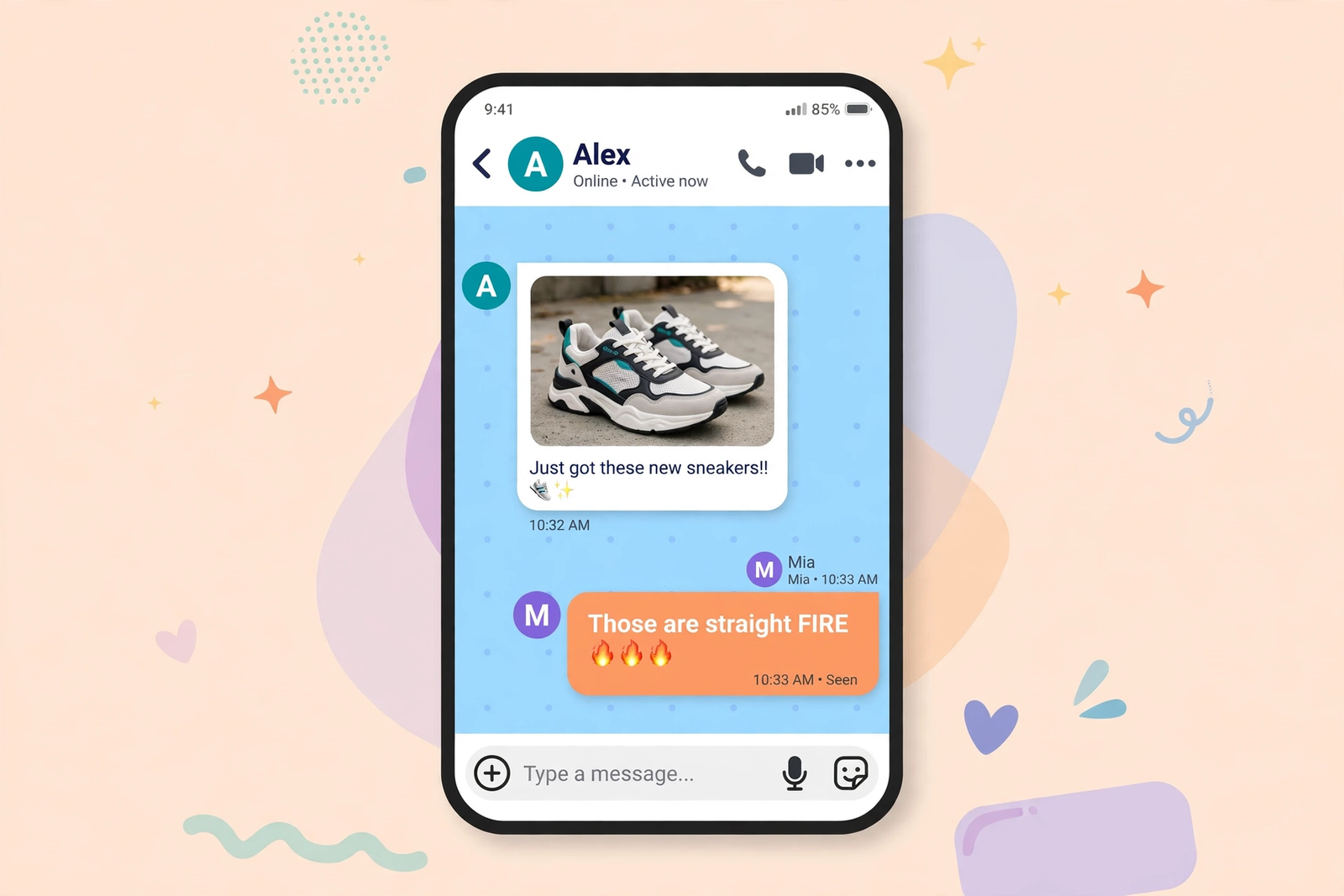
- A: “Check out my new sneakers.” B: “🔥🔥�🔥 Those are fire!”
- “That sunset photo you posted? Absolute fire.”
Professional Examples
Fire slang is casual, so it appears in professional settings only when the tone is already relaxed — creative teams, social media work, music and entertainment jobs, and friendly workplaces. Even then, it is best kept to informal moments:
- “The new campaign concept is fire — the client is going to love it.” (creative team chat)
- “Great work on the presentation, that opening slide was fire.” (after a team meeting)
- “Your demo was straight fire. The audience was hooked from the first minute.” (conference feedback)
In a formal email, a report, or a job interview, use “excellent,” “outstanding,” or “impressive” instead. Fire slang signals casual confidence; in formal settings, that signal can read as careless.
Funny Examples
- “My cooking tonight was fire. Well, the smoke alarm disagrees, but still.”
- “Bro thinks his playlist is fire. It is three songs and two of them are ringtones.”
- A: “Rate my outfit.” B: “Fire. The socks, though? The socks are a crime scene.”
- “I told my grandma her soup was fire and she said, ‘Then blow on it before you eat it.'”
Comparison with Similar Terms
Fire slang belongs to a big family of praise words, and the differences between them are small but real. Choosing the right one is mostly about tone, era, and what exactly you are praising.
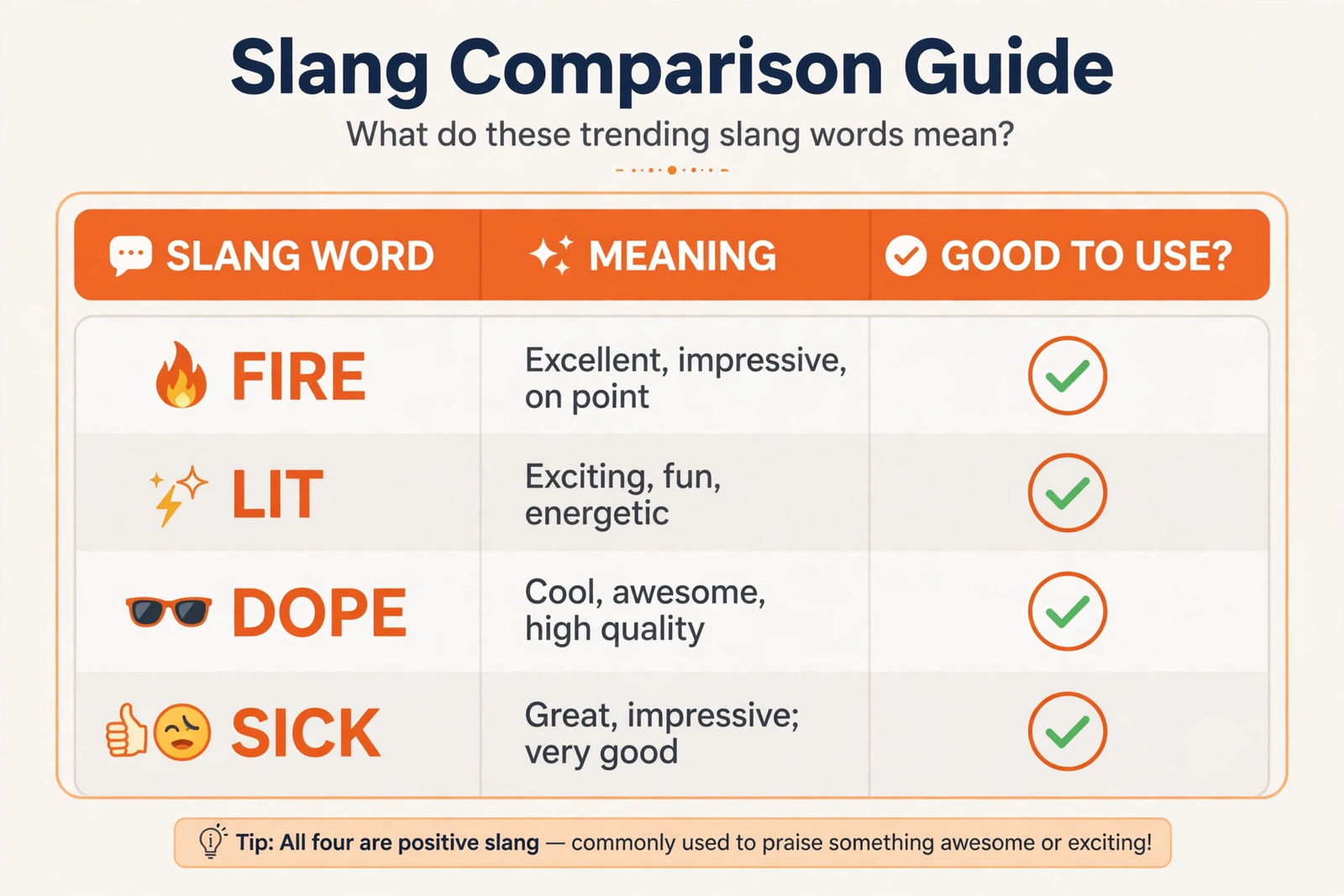
| Term | Meaning | Best For | Tone |
|---|---|---|---|
| Fire | Excellent, amazing, top-tier | Music, outfits, food, anything | Confident, timeless |
| Lit | Exciting, fun, high-energy | Parties, events, nights out | Energetic, slightly dated |
| Dope | Cool, impressive, excellent | Music, style, ideas | Classic, hip-hop rooted |
| Sick | Amazing, unbelievable | Skills, tricks, performances | Bold, informal |
| Slaps | Music that sounds amazing | Songs and beats only | Playful, music-specific |
| Heat | Outstanding quality, intensity | Music, sports performances | Street, hip-hop rooted |
| Awesome | Very good, impressive | Almost anything | Safe, universal |
The closest cousins are “lit” and “dope.” “Lit” describes excitement and energy — a party is lit, a night out is lit — while “fire” describes quality. A song can be both, but a quiet, beautiful song is fire without being lit. “Dope” and “fire” are nearly interchangeable for praise, but “dope” carries older drug-related baggage that “fire” mostly avoids, which makes fire the safer choice in mixed company.
“Slaps” is narrower: it only applies to music, as in “This song slaps.” “Sick” is for skills and stunts — a skateboard trick is sick, a meal is not. “Heat” is the most hip-hop of the group and still sounds like street slang, while “fire” has gone fully mainstream. If you are unsure which word to pick, “fire” is the safest bet: it works everywhere, offends nobody, and everyone understands it.
Alternate Meanings
Like most slang, “fire” did not start as slang at all — and its other meanings still matter, because they are the reason the slang works.
The literal meaning is combustion: flames, burning, heat. That is the image behind the slang — something so good it burns. “Fire” is also a verb: to fire a gun, to fire an employee (to dismiss them from a job), or to “fire away” with questions. None of these is slang, but they share the same word, so context is everything. “You are fired” is bad news; “That is fire” is a compliment.
In gaming, “fire” is a command and an action: “Fire!” means shoot, and “on fire” can describe a kill streak. In sports, a player who is “on fire” cannot miss. In cooking, “fire” is the order that tells the kitchen to start a dish. In cannabis culture, as noted above, “fire” means top-quality weed — the best of the batch.
There is also “fire” as an adjective for appearance: “She looked fire last night” means she looked stunning. And in the phrase “fire emoji” itself, the emoji has become a noun meaning praise. When someone says “Drop a fire emoji,” they mean “show your approval.” These alternate senses are all friendly to the main slang meaning, which is why confusion is rare — but if someone says “That is fire” about an actual stove, they are probably not complimenting it.
Professional or Polite Alternatives
Fire slang is perfect for friends, social media, and creative workplaces. In formal or professional settings, these alternatives carry the same praise without the casual tone:
- Excellent — the safest all-purpose replacement: “The presentation was excellent.”
- Outstanding — for work that clearly rises above the rest.
- Impressive — for skills, results, and performances.
- Exceptional — for formal praise in writing or speeches.
- Superb / first-rate — for quality, especially food, service, or craftsmanship.
- Brilliant — common in British English for ideas and performances.
A good rule is simple: if you would not use an emoji in the message, do not use “fire” either. A text to your best friend can say “That beat is fire 🔥” — an email to a client should say “The track is excellent.” Same feeling, different register, and the right choice shows social awareness.
Common Mistakes
Fire slang is easy to use, but a few mistakes make people sound awkward or out of touch. Avoid these and the word will always land well.
1. Using it in formal settings. Saying “fire” in a job interview, a business email, or a serious conversation can sound unprofessional. Save it for casual contexts.
2. Overusing it. If everything is fire, nothing is. Calling every song, outfit, and meal “fire” makes the word meaningless — and makes you sound like you have no other vocabulary. Reserve it for things that genuinely impress you.
3. Using it for people you barely know. Telling a stranger “You are fire” can come across as flirtatious or creepy rather than complimentary. Stick to praising things and performances with people you do not know well.
4. Confusing “fire” with “on fire.” “That song is fire” means the song is excellent. “That song is on fire” is not standard — “on fire” describes a person on a hot streak, not a thing. Keep the two separate.
5. Forcing it to sound young. Nothing ages a person faster than slang used self-consciously. If “fire” is not natural to you, a simple “That is amazing” sounds far better than a forced “Yo, that is so fire, bro.” Slang works when it is relaxed, not performed.
6. Using it sarcastically without a signal. “Yeah, that was fire” after a terrible performance can be funny among friends — but in text, without tone of voice, sarcasm is easily missed. Add an emoji or an obvious joke so people know you are kidding.

Quick Tips
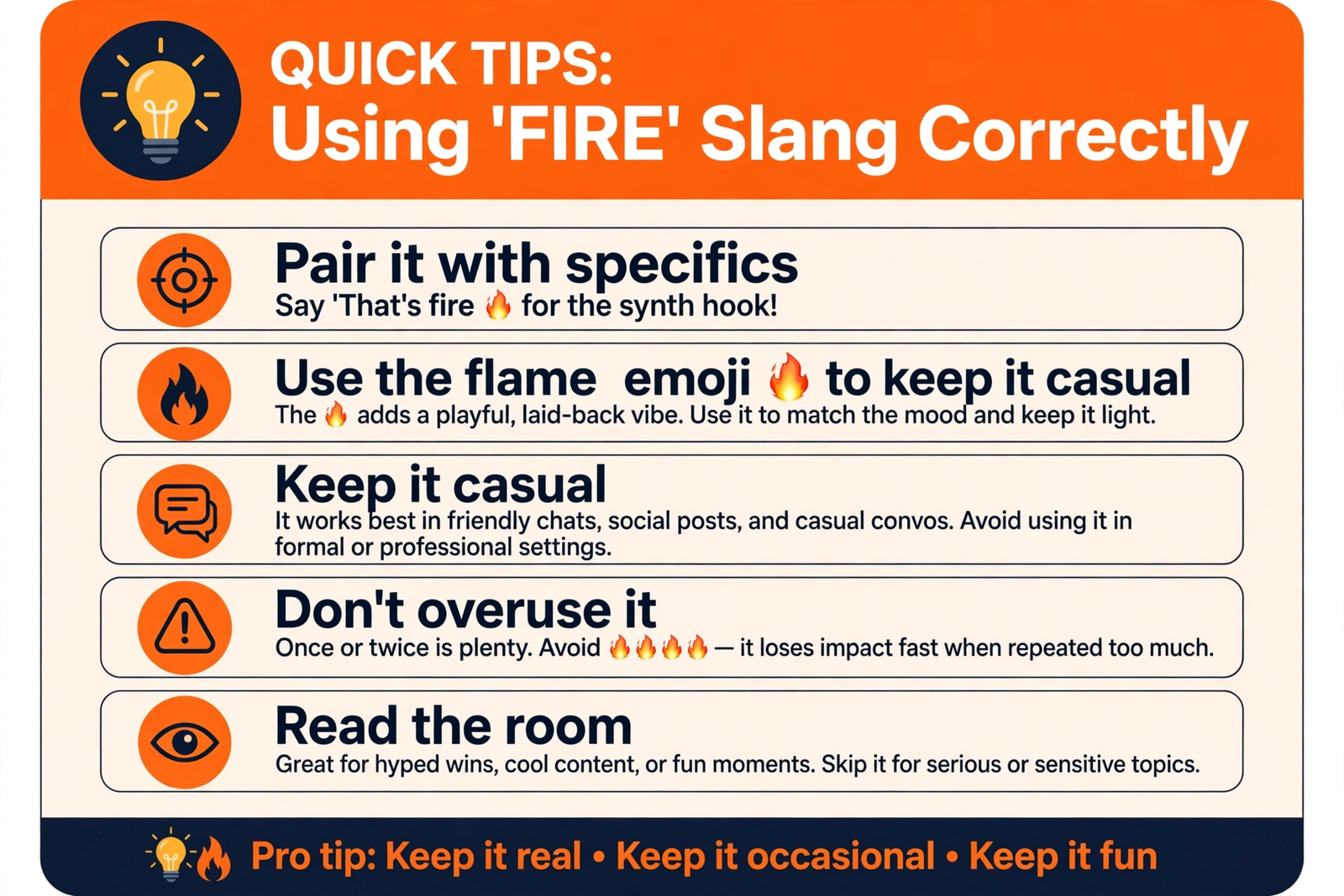
- Pair it with specifics: “The chorus is fire” is stronger than just “fire” — it shows you actually listened.
- Use the emoji, not a paragraph: A single 🔥 under a great photo says everything. Let the emoji do the work.
- Match the moment: Fire fits music drops, outfit posts, sports highlights, and great food. It does not fit sad news or serious topics.
- Try “straight fire” for emphasis: When something is not just good but unforgettable, “straight fire” adds the extra punch.
- Keep it casual: Fire belongs in texts, comments, captions, and friendly chats — not in formal writing.
- Do not stack it: One “fire” per compliment is enough. “Fire fire fire” reads like spam, not praise.
- Watch the audience: With close friends, go all in. With a boss or a client, switch to “excellent” or “outstanding.”
- Learn the emoji combos: 🔥 on its own is praise; 🔥🔥🔥 is excitement; 🔥 + 💯 is the highest compliment in the book.
FAQ
What does fire mean in slang?
In slang, fire means excellent, amazing, or extremely good. Saying something is “fire” is a strong compliment — it means the thing is top-tier quality, whether it is a song, an outfit, a meal, or an idea.
Where did fire slang come from?
Fire slang comes from hip-hop culture and African American Vernacular English (AAVE) in the 1990s and early 2000s. “Hot” already meant excellent, so “fire” was the next step up. It spread through music, sports, and social media, and the 🔥 emoji helped it go global.
What does “straight fire” mean?
“Straight fire” means something is unambiguously excellent — no debate, no qualification. The word “straight” adds emphasis, so “straight fire” is stronger than just “fire.” It is often used for songs, albums, and performances.
Is fire slang still popular in 2026?
Yes. Fire slang has stayed popular for more than two decades because it is short, visual, and works for almost anything. Gen Z and Gen Alpha both use it heavily, and the 🔥 emoji keeps it current on every social platform.
What is the difference between fire and lit?
Fire describes quality — something excellent. Lit describes excitement and energy — a party or a night out. A song can be both fire and lit, but a quiet, beautiful song is fire without being lit, and a wild party is lit without necessarily being fire.
Can you call a person fire?
Yes, but carefully. Calling someone’s skills or performance “fire” (“Your freestyle was fire”) is a normal compliment. Calling a person “fire” usually means they look amazing, which can sound flirtatious — so it is best used with people you know well.
Is it okay to use fire slang at work?
Only in casual, creative workplaces and informal chats. Saying “The new design is fire” in a relaxed team chat is fine. In a formal email, a report, or a job interview, use “excellent,” “outstanding,” or “impressive” instead.
What does the 🔥 emoji mean?
The 🔥 emoji usually carries the slang meaning of fire: excellent, exciting, or impressive. Under a photo or video, it is a quick compliment. It can also mean literal fire or that something is trending, so context decides — but in comments and captions, praise is the default meaning.
Conclusion
Fire slang is one of the simplest and most useful compliments in modern English. One word — or one emoji — says “this is excellent” with more energy than a whole sentence. It travelled from hip-hop lyrics to group chats, from sports highlights to sneaker drops, and it earned its staying power by being flexible, visual, and impossible to misunderstand.
The key takeaways are simple. In 2026, fire slang means excellent, amazing, or top-tier — use it for music, outfits, food, performances, and ideas that genuinely impress you. Keep it in casual settings, pair it with specifics so the compliment lands, and do not overuse it, or the word loses its heat. For a full picture of how slang praise works, you can also check our guide to fn meaning in text, and if you want more fun slang to explore, glizzy meaning is a great next read.
Now that you know the full story — the origin, the examples, the comparisons, and the mistakes to avoid — you can use “fire” with total confidence. The next time something truly impresses you, skip the long sentence. Just say it is fire, drop a 🔥, and let the word do the work. For a clear outside reference on how the term is used on social media, see Later’s social media glossary entry on fire.

2 thoughts on “Fire Slang: What Does Fire Mean in Slang? (2026 Guide)”