
Quick definition: Australian slang insults are informal, often humorous put-downs used in Australia — words like drongo, bogan, galah, and dag that tease, mock, or call someone out. Many sound harsh to outsiders but are often used affectionately between mates, so tone and context decide whether an Aussie insult is a joke or a real jab.
australian slang insults Meaning & Definition
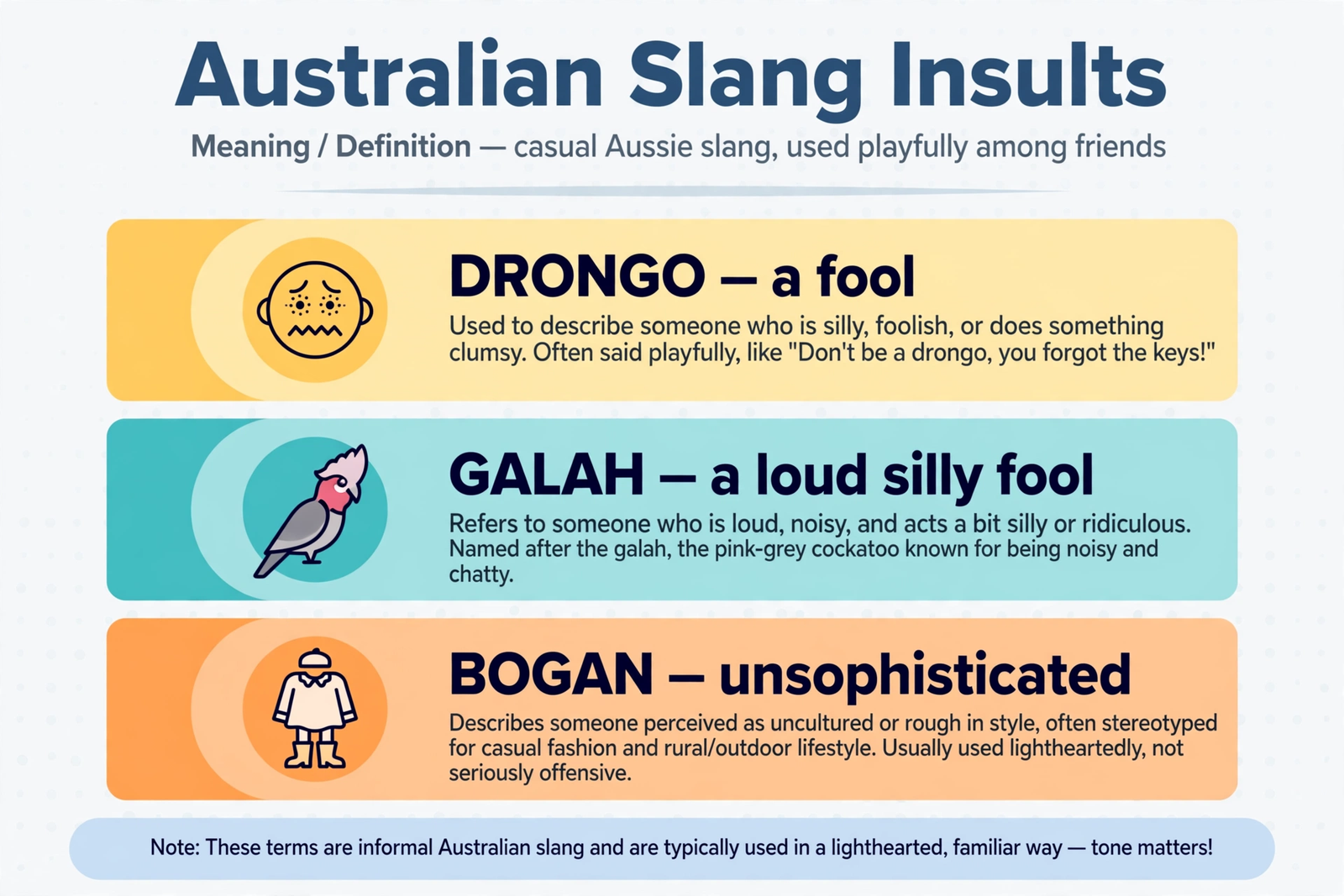
Australian slang insults are the colourful, cutting words Australians use to poke fun at someone, call out silly behaviour, or settle a score with humour instead of hostility. Unlike the blunt insults common in American or British English, Aussie insults are often wrapped in larrikin humour — a drongo is a fool, a galah is a loud idiot, and a bogan is someone seen as uncultured or unsophisticated. The same word can be an affectionate nickname among friends or a genuine insult among strangers, and Australians pride themselves on knowing the difference.
What makes australian slang insults so distinctive is their creativity. Australians love rhyming slang, playful exaggeration, and animal metaphors. A foolish person might be called a drongo (named after a racehorse that never won), a galah (after a noisy pink cockatoo), or a wombat (because a wombat “eats, roots, and leaves”). These insults rarely sound like textbook English, which is exactly why travellers, language learners, and TikTok viewers keep searching for them. If you have ever watched an Australian TV show and wondered why everyone was laughing after someone got called a dag, this guide explains every word, its real meaning, and when you should — and should not — use it.
The key thing to understand is that Australian insults sit on a sliding scale. At the gentle end are words like silly billy and dag, which are closer to teasing than insulting. In the middle sit drongo, galah, and dropkick — firm but often friendly. At the sharp end are words like bogan (when used cruelly), feral, and the classic bloody idiot. Context, tone, and relationship decide everything. Call your best mate a drongo over a beer and you will get a laugh; call a stranger the same word in an argument and you may get a very different reaction.
Introduction
Imagine landing in Sydney, ordering a coffee, and hearing someone say, “Don’t be a drongo, mate — the line starts back there.” You freeze. Were you just insulted? Probably not — you were just given a classic piece of Australian humour. Australian slang insults are one of the most searched corners of Aussie English, and for good reason: they are funny, confusing, and deeply woven into everyday conversation, from the pub to the footy field to the group chat.
Australians use insults differently from most English speakers. In many cultures, an insult is a weapon. In Australia, it is often a handshake. Calling a friend a dag or a galah can be a sign of closeness — proof that you are comfortable enough to tease each other. This tradition comes from the Australian value of “mateship” and the cultural habit of cutting down anyone who takes themselves too seriously, a habit known as the “tall poppy syndrome.” If you act like a know-it-all, someone will happily call you a wanker or a smartarse to bring you back to earth.
But the line between playful and offensive is real, and visitors cross it by accident all the time. Some australian slang insults are lighthearted, some are genuinely rude, and a few — like wog or abo — are offensive slurs that should never be used. This guide covers 25 of the most common Australian slang insults, explains exactly what each one means, shows you real examples, and tells you which ones are safe for a laugh and which ones to avoid completely. Whether you are visiting Australia, chatting with Aussie friends online, or just trying to understand your favourite Australian show, you will leave knowing exactly what a drongo is — and why you probably do not want to be one.
For the full picture of how Australians actually talk, start with our guide to Australian slang words — it covers 50+ everyday terms beyond the insults on this page.
Origin
Australian slang insults grew out of the country’s unique history. The first European settlers arrived in 1788, and the early colony was a rough mix of convicts, soldiers, and free settlers. In that environment, humour was a survival tool, and inventive put-downs became a form of social currency. Convict slang, Cockney rhyming slang from London, and Irish expressions blended together into something new, and the harsh landscape added its own flavour — many insults are named after Australian animals, from the galah to the drongo to the wombat.
The word drongo, for example, comes from a racehorse named Drongo that ran in the 1920s and never won a race. By the 1940s, calling someone a drongo meant calling them a hopeless fool. Galah took a similar path: the pink-and-grey cockatoo is famously noisy and silly-looking, so by the early 20th century, a loud, foolish person was a galah. Bogan is newer — it appeared in the 1980s to describe someone seen as unsophisticated, and it quickly became one of the most debated words in Australian English. Even the Macquarie Dictionary, Australia’s national dictionary, tracks these words carefully, and its editors have documented how terms like bogan and drongo shifted from niche slang into mainstream use. You can explore their work on Australian English at the Macquarie Dictionary, the authoritative record of how Australians really speak.
Another major influence was the Australian habit of shortening words and adding an “-o” or “-ie” ending — arvo for afternoon, brekkie for breakfast, mozzie for mosquito. Insults followed the same pattern: dropkick became a noun for a useless person, dipstick became a mild fool, and dag evolved from a farming term (a matted lump of wool on a sheep) into a word for a daggy, unfashionable person. The result is a set of insults that sound playful even when they sting — and that is exactly the point. An Australian insult is designed to make the room laugh, not just to wound the target.
Popularity
Australian slang insults have exploded in popularity online. TikTok creators, YouTube travel vloggers, and Australian comedy shows like Bluey for adults and Mr Inbetween have introduced words like drongo, bogan, and galah to millions of viewers worldwide. Searches for australian slang insults spike whenever a viral video features an Aussie calling someone a dropkick or a dag, and language-learning communities on Reddit and TikTok regularly debate which insults are friendly and which ones will get you in trouble.
The popularity is not just about entertainment. Australia receives millions of visitors every year, and many arrive wanting to understand the local lingo before they land. International students, working-holiday travellers, and new migrants all search for these words because Australian workplaces and friend groups use them constantly. A newcomer who understands that being called a dag by a colleague is usually a compliment-in-disguise will settle in far faster than one who takes every insult at face value.
Social media has also changed how these insults travel. A decade ago, bogan was mostly an Australian conversation; today it appears in memes, gaming chats, and comment sections around the world. The word drongo has even been adopted by English speakers in the UK and the US as a funny, old-fashioned-sounding insult. As Australian culture continues to punch above its weight online, these insults are becoming part of global internet slang — which makes knowing their real meanings more useful than ever.
How It Is Used
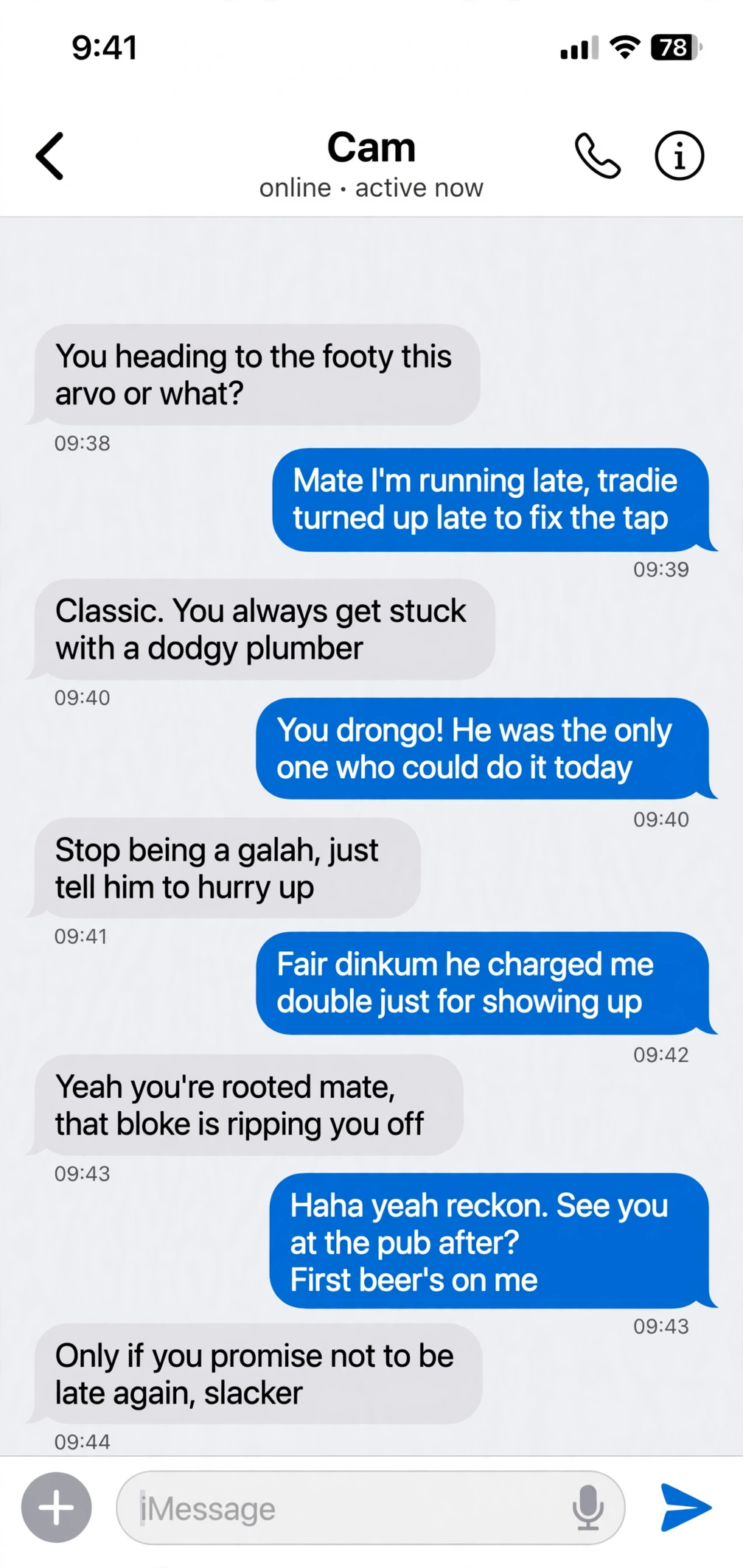
Australian slang insults are used in three main ways: as friendly teasing between mates, as a genuine put-down in an argument, and as self-deprecating humour. The same sentence can mean three different things depending on who says it and how. “You drongo!” said with a laugh after a friend drops a beer is teasing. “You bloody drongo” said through gritted teeth in traffic is not. Learning to read the tone is more important than memorising the words.
Here is how the usage breaks down in real life:
- Between friends: Insults are bonding tools. Mates call each other dag, galah, dropkick, and drongo as a sign of affection. If an Australian friend never teases you, they may not consider you a close mate yet.
- In arguments: The same words sharpen up. Adding bloody before an insult (“bloody idiot”, “bloody drongo”) makes it more serious, and words like wanker, tosser, and smartarse are almost always meant as real criticism.
- Self-deprecating humour: Australians often insult themselves first. “I’m such a dag, I wore thongs to a wedding” is a classic joke — calling yourself a dag before anyone else can.
- Online and in text: In group chats and gaming, australian slang insults fly fast. “Stop being a galah” in a Discord server usually means “stop mucking around,” not “I hate you.”
- At work: Light teasing is common in Australian workplaces, but formal settings still expect restraint. Calling your boss a drongo is a bad career move, even if everyone laughs.
One golden rule covers almost every situation: never use an Australian insult on someone you have just met, and never use one in a serious or formal context. Wait until you hear how the locals use them, match their tone, and when in doubt, laugh along instead of joining in. The insults are fun — but they are also a social test, and Australians notice when someone gets the tone wrong.
Examples
Here are real-world examples of australian slang insults in action, grouped by tone so you can see how the same words shift meaning.
Friendly Examples
- “You forgot the snags for the barbie again? You drongo!” — said laughing at a mate who forgot the sausages for the barbecue.
- “Look at this dag, wearing socks with sandals.” — affectionate teasing about a friend’s daggy fashion choices.
- “Stop being a galah and help me carry this esky.” — a mate telling a friend to stop mucking around and help with the cooler.
- “You’re such a dropkick, you locked your keys in the car again.” — gentle mockery after a silly mistake.
- “Don’t be a sook, it’s just a bit of rain.” — teasing someone for complaining about the weather (a sook is someone who whinges or sulks).
Professional Examples
- “Let’s not be dropkicks about this — read the brief before the meeting.” — a team leader using the word lightly to push colleagues to prepare.
- “He’s a bit of a smartarse in meetings, but his ideas are solid.” — describing a colleague who is clever but arrogant.
- “The new bloke’s a dag, but he’s the hardest worker on site.” — a compliment hidden inside an insult: daggy, but dependable.
- “Don’t be a galah on the client call — keep it professional.” — a manager warning someone not to act silly in front of a client.
Funny Examples (if applicable)
- “He tried to surf and got dumped by the first wave — what a drongo.”
- “She turned up to a black-tie event in thongs. Absolute dag energy.”
- “My GPS sent me to a sheep paddock. What a bloody dropkick I am.”
- “He reckons he’s a legend, but he’s just a wombat — eats, roots, leaves.”
- “Stop being a stickybeak and mind your own business!” — a stickybeak is a nosy person who pokes their nose into everything.
Notice how often the insult comes with a laugh, a shrug, or a story about a silly mistake. That is the Australian pattern: the insult is the punchline, not the whole joke. For more everyday Aussie vocabulary, our Australian slang guide lists 100+ terms with examples, including plenty of words that are not insults at all.
Comparison with Similar Terms
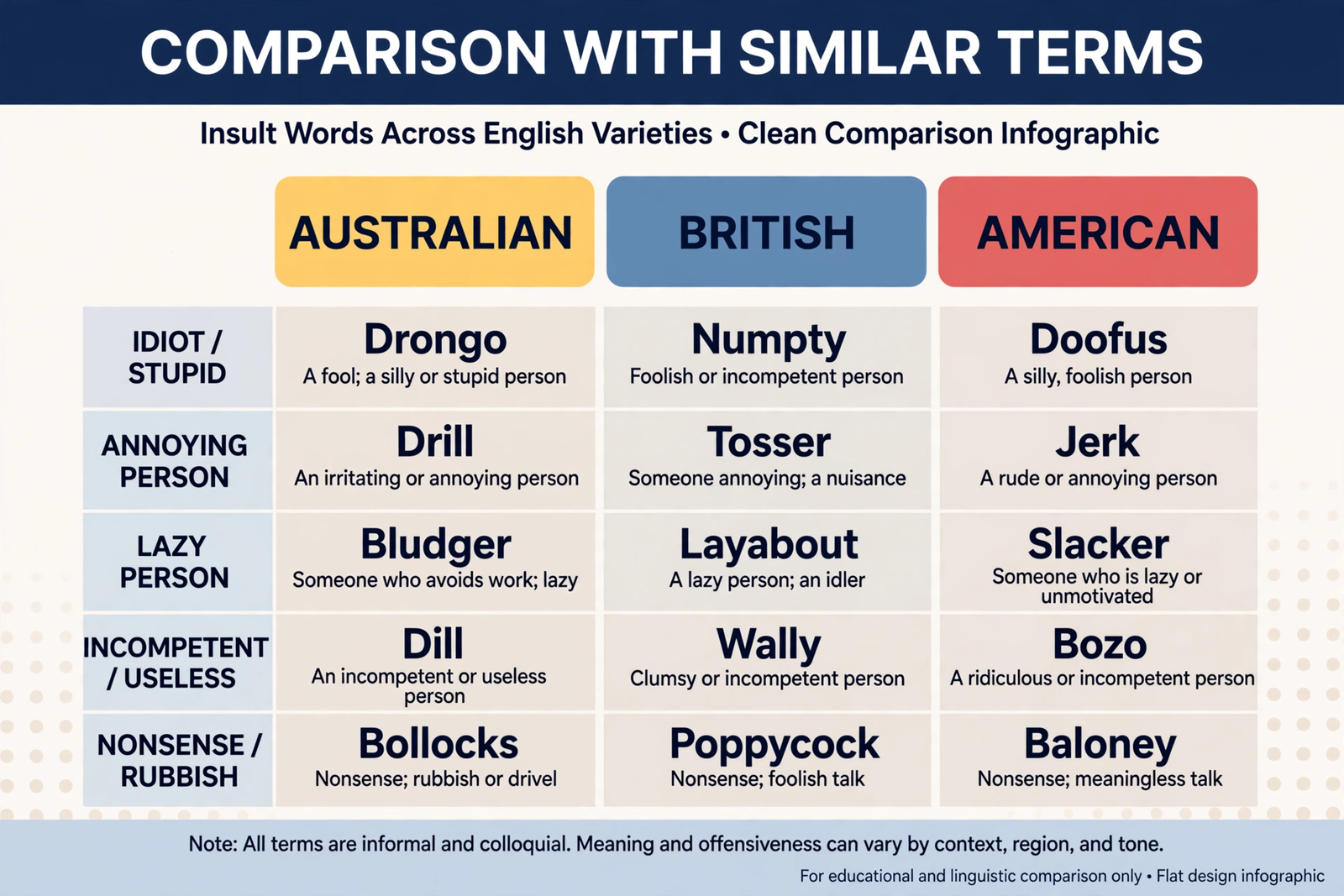
Australian slang insults overlap with British, American, and New Zealand slang, but the same idea often has a different word in each country. This table compares the most common Australian insults with their closest equivalents elsewhere, so you can see what makes the Aussie versions unique.
| Australian Insult | Meaning | British Equivalent | American Equivalent | Harshness (1–5) |
|---|---|---|---|---|
| Drongo | A fool; someone who makes silly mistakes | Plonker, numpty | Doofus, bonehead | 2 |
| Galah | A loud, silly fool | Twit, wally | Airhead, loudmouth | 2 |
| Bogan | Unsophisticated, uncultured person | Chav | Redneck, hillbilly | 3 |
| Dag | Unfashionable, daggy person | Saddo | Nerd, dork | 1 |
| Dropkick | A useless or hopeless person | Useless git | Loser, screw-up | 3 |
| Wanker | Arrogant, contemptible person | Wanker | Jerk, douchebag | 4 |
| Smartarse | A know-it-all | Smartarse | Smartass, know-it-all | 3 |
| Stickybeak | A nosy person | Nosy parker | Busybody | 2 |
| Sook | Someone who whinges or sulks | Moaner, crybaby | Whiner, crybaby | 2 |
| Bludger | A lazy person who avoids work | Skiver, layabout | Freeloader, slacker | 3 |
The biggest difference is tone. British and American insults are often direct and personal, while australian slang insults lean on humour and exaggeration. An Australian would rather call you a drongo and make the room laugh than call you an idiot and start a fight. New Zealand slang shares some of this flavour — Kiwi insults like tosser and muppet work the same way — and you can compare the two styles in our New Zealand slang guide, which covers 25+ Kiwi words and phrases.
Alternate Meanings
Several australian slang insults have alternate meanings, and context decides which one applies. The most important examples:
- Bogan: As an insult, it means unsophisticated or bogan — but many Australians now use it proudly. “Bogan pride” is a real thing, and bogan culture (flannelette shirts, utes, and VB beer) is celebrated at festivals and in comedy. Calling yourself a bogan is a badge of honour; being called one by a snob is an insult.
- Dag: Originally a farming word for a matted lump of wool on a sheep’s backside, dag now means an unfashionable person. But it also means a funny, lovable character — “he’s a real dag” can be a compliment about someone’s sense of humour. The 1990s film The Castle made “daggy” a national joke, and the word stuck.
- Dropkick: In rugby league and AFL, a dropkick is a type of kick. As slang, it means a useless person. The sporting meaning is neutral, so always check the context — “nice dropkick” on the footy field is praise, not an insult.
- Feral: Literally means a wild animal, but as slang it describes someone wild, rough, or out of control — “feral kids” or “he went feral at the party.” It can also describe something impressively wild, as in “that party was feral” (meaning amazingly chaotic).
- Root: Be careful with this one. In Australia, root is slang for sex, so calling someone a “root rat” is far ruder than it sounds to outsiders. A wombat joke (“eats, roots, leaves”) only works because of this double meaning.
- Git: Borrowed from British slang, a git is an unpleasant person. In Australia it also appears in phrases like “git slang” — and if you want to know what that word means on its own, our git slang guide explains its origins and uses in detail.
The lesson is simple: never assume an Australian insult has only one meaning. Listen to the sentence around it, watch the speaker’s face, and remember that Australians love using insults ironically. A word that sounds terrible in isolation can be a term of endearment in the right conversation.
Professional or Polite Alternatives
You do not need to insult anyone to sound Australian. In professional settings, or when talking to someone you do not know well, these polite alternatives say the same thing without the sting:
- Instead of drongo, say “he made a silly mistake” or “that was a bit of a mix-up.”
- Instead of galah, say “he’s a bit loud” or “she’s very excitable.”
- Instead of bogan, say “he’s a bit rough around the edges” or “she’s very down-to-earth.”
- Instead of dropkick, say “he’s not the most reliable” or “she struggles with the details.”
- Instead of wanker, say “he’s a bit full of himself” or “she comes across as arrogant.”
- Instead of smartarse, say “he’s a bit of a know-it-all” or “she always has an answer.”
- Instead of bludger, say “he’s not pulling his weight” or “she’s taking it easy.”
- Instead of sook, say “he’s having a tough day” or “she’s feeling a bit sensitive.”
- Instead of stickybeak, say “he’s very curious” or “she likes to know what’s going on.”
- Instead of dag, say “he’s a character” or “she has her own style.”
In formal writing, emails, and workplace feedback, always use the polite version. Save the slang for friends, family, and casual conversation — that is where australian slang insults belong, and where they are actually funny.
Common Mistakes
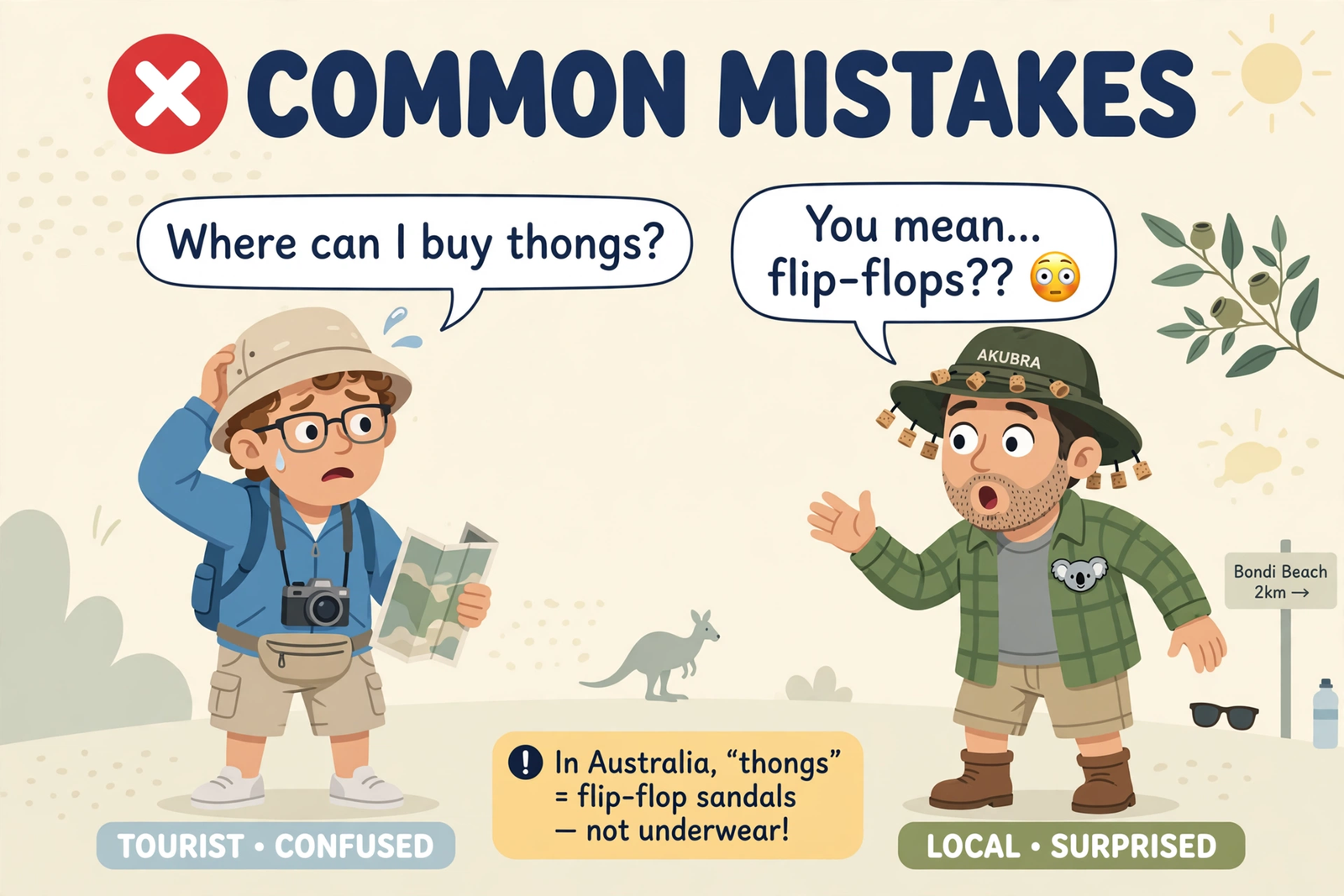
Visitors and learners make the same mistakes with australian slang insults over and over. Here are the biggest ones to avoid:
- Using insults with strangers. Calling a stranger a drongo is not friendly — it is rude. These words only work inside an existing relationship.
- Using slurs by accident. Some old Australian words are now recognised as offensive slurs and should never be used. If you are not sure a word is safe, do not use it.
- Getting the tone wrong. Saying “you drongo” with a flat, angry voice turns a joke into a fight. The humour lives in the delivery.
- Overusing bogan. Bogan is class-loaded and can sound snobbish or cruel. Many Australians reclaim it proudly, but using it to mock someone’s background is not funny — it is just mean.
- Mixing up dag and bogan. A dag is unfashionable but loveable; a bogan is a stereotype about class and taste. They are not interchangeable.
- Using insults in writing. In texts and emails, tone disappears. “You galah” in a message can read as hostile even when you meant it as a joke — add a laughing emoji or skip the insult entirely.
- Calling someone a wanker at work. This is one of the strongest australian slang insults. Even among friends it is sharp, and at work it can be a formal complaint waiting to happen.
- Assuming every insult is a joke. Australians do use insults affectionately, but they also use them angrily. If someone calls you a dropkick with no smile, take it seriously.
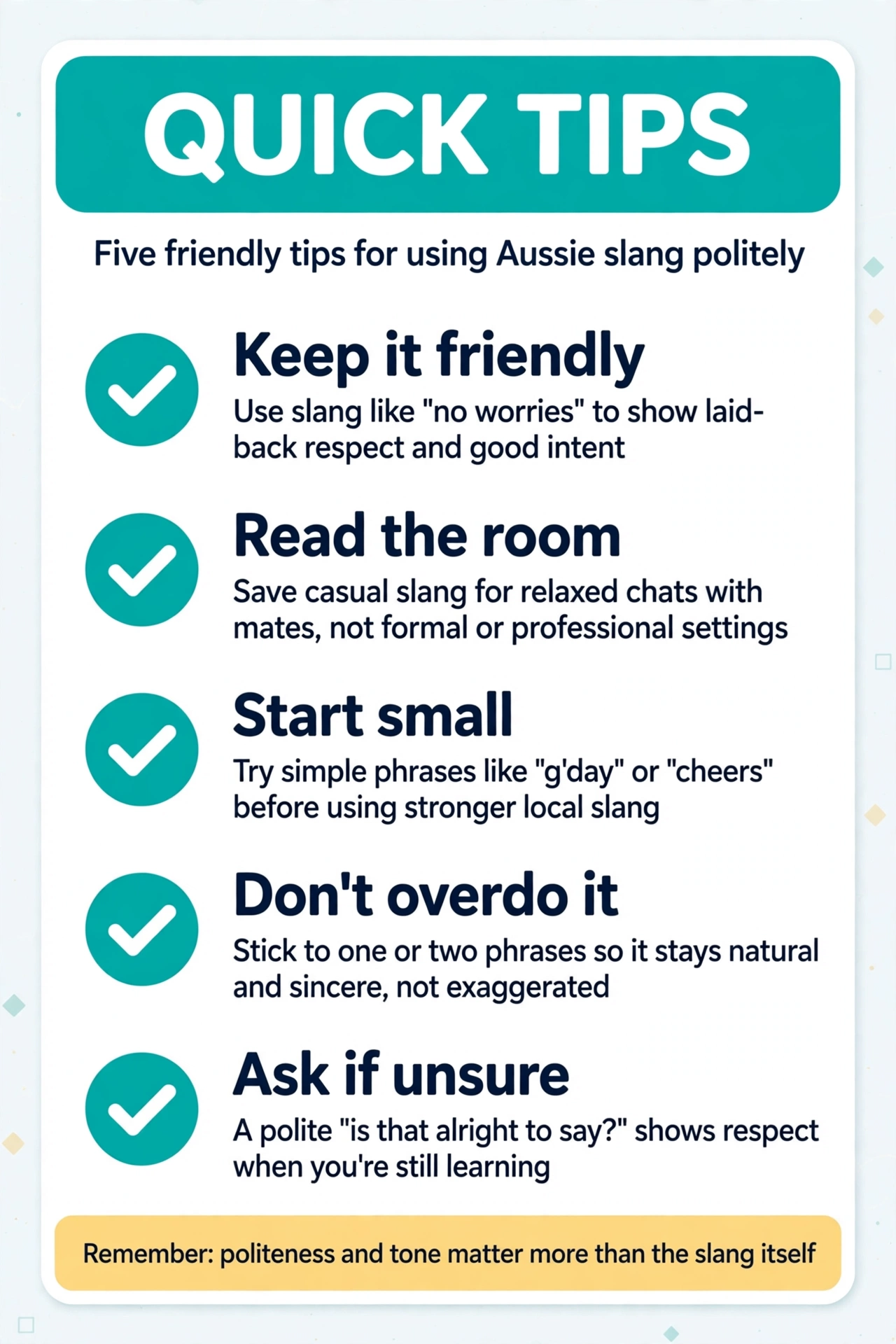
Quick Tips
Want to use australian slang insults without embarrassing yourself? Follow these practical tips:
- Listen first. Spend time hearing how Australians use these words before you try them yourself. Notice who says them, to whom, and in what tone.
- Start soft. Begin with gentle words like dag and drongo among friends. Save sharper words like wanker for when you are certain of the relationship.
- Match the room. A backyard barbecue is the right place for a galah joke; a job interview is not.
- Laugh at yourself first. Calling yourself a dag or a dropkick after a mistake is the fastest way to show you understand the humour.
- Never punch down. Insults aimed at someone’s background, appearance, or disability are not Australian humour — they are bullying.
- Learn the animals. Knowing that a galah is a cockatoo and a drongo is a racehorse makes the insults easier to remember — and funnier to use.
- Watch Australian TV. Shows like Bluey, Utopia, and Mr Inbetween are full of natural, well-delivered Aussie insults in context.
- When in doubt, leave it out. If you are not sure an insult will land well, just smile and skip it. Nobody ever got in trouble for not insulting someone.

FAQ
What does drongo mean in Australian slang?
Drongo means a fool or someone who keeps making silly mistakes. It comes from a racehorse named Drongo that never won a race. It is one of the mildest australian slang insults and is often used affectionately between friends, as in “Don’t be a drongo, mate.”
Is bogan an insult in Australia?
It depends on context. Bogan describes someone seen as unsophisticated, and it can be insulting when used to mock someone’s class or taste. But many Australians use it proudly to describe themselves, their culture, and their lifestyle — “bogan pride” is a genuine cultural identity.
What is the rudest Australian slang insult?
Wanker is one of the strongest everyday australian slang insults, and racial slurs are far worse and should never be used. Among common slang, dropkick, feral, and tosser are also sharp. The harshness depends heavily on tone and context.
Do Australians really call their friends insults?
Yes — friendly teasing is a big part of Australian culture. Calling a mate a dag, galah, or drongo is often a sign of closeness. If an Australian never teases you, you may not be close mates yet. The key is that the teasing goes both ways.
What does galah mean as an insult?
A galah is a noisy pink-and-grey cockatoo, so calling someone a galah means they are a loud, silly fool. It is a mild, funny insult, often used like “Stop being a galah and help me with this.”
What is a dag in Australian slang?
A dag is an unfashionable, daggy person — someone with questionable style who does not care. It comes from a farming term for matted wool on a sheep. It is usually affectionate: “he’s a real dag” often means he is funny and loveable.
Is it OK for a tourist to use Australian slang insults?
Only very carefully. Light words like dag or drongo are usually fine among new friends who are clearly joking with you, but never use insults with strangers, in formal settings, or before you understand the tone. When in doubt, just laugh along instead of joining in.
What does dropkick mean in Australia?
A dropkick is a useless or hopeless person — someone who keeps messing things up. It comes from the rugby and AFL kick of the same name. It is a mid-strength insult: funny among friends, but genuinely critical in an argument.
Conclusion
Australian slang insults are funny, creative, and deeply Australian — but they are also a social skill, not just a vocabulary list. Words like drongo, galah, dag, and bogan carry history, humour, and a whole set of unwritten rules about mateship and tone. Used well, they are the fastest way to sound like you belong; used badly, they are the fastest way to offend someone. The difference is almost always context: who you are talking to, how well you know them, and whether you are smiling when you say it.
The practical takeaway is simple. Learn the meanings, listen before you speak, start with the gentle words, and never use an insult to punch down. If you remember that a drongo is a loveable fool, a galah is a noisy one, and a dag is often a compliment in disguise, you will understand far more Australian conversation than most visitors ever do. And if you want to keep building your Aussie vocabulary, explore our Australian slang words guide and the wider collection of slang meanings on Means Today — from everyday terms to the sharpest words in the dictionary.
