
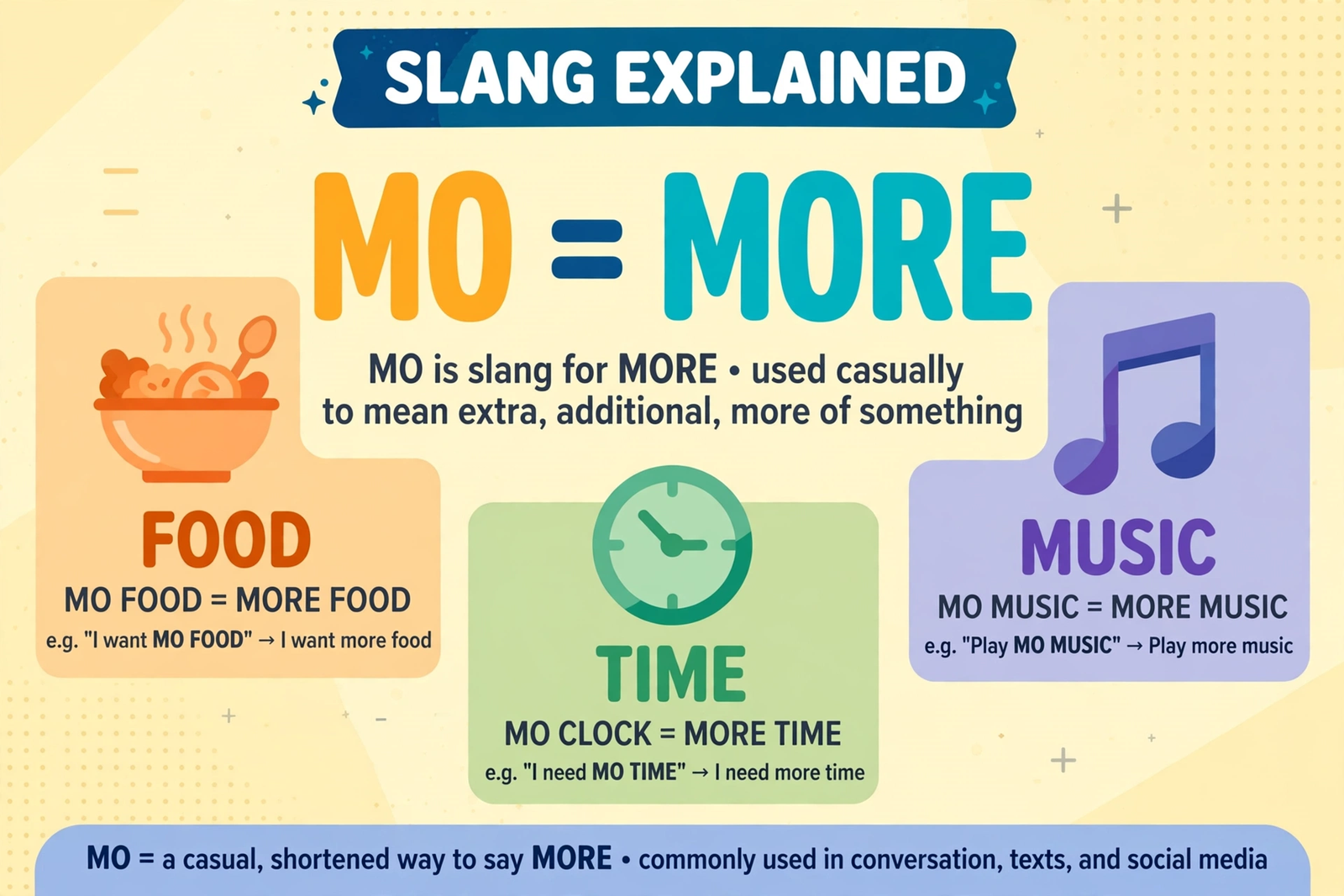
Quick definition: In slang, “mo” means “more.” It is a short, casual way of asking for extra of something — more food, more time, more attention, more fun. The word comes from African American Vernacular English and hip-hop culture, where “mo’ money, mo’ problems” made it famous around the world. In British slang, “mo” can also mean a “moment,” as in “hang on a mo.”
Mo Meaning Slang & Definition
The term mo meaning slang describes one of the shortest and most flexible words in modern casual English. At its core, “mo” is a clipped form of “more.” People drop the final “re” sound, keep the single syllable, and get a word that feels faster, cooler, and more relaxed than the full version. When someone texts “I want mo,” they are simply saying “I want more.”
That simplicity is exactly why the word has survived for decades. “Mo” does the job of “more” in fewer letters, and in texting, captions, lyrics, and casual speech, fewer letters often win. It shows up in group chats, TikTok comments, song lyrics, memes, and everyday conversation between friends. It is never formal, and it is never used in a business email or a school essay — but in casual settings, it is everywhere.
What makes “mo” interesting is that it is not a one-meaning word. The same two letters can mean “more” in a text from a teenager, “moment” in a message from someone in London, “modus operandi” when written as “M.O.” in a crime show, and even a moustache in Australia. Context decides everything, and this guide covers every meaning so you never have to guess.
| Meaning of “Mo” | What it stands for | Where you will hear it |
|---|---|---|
| More | A shortened form of “more” | Texts, TikTok, hip-hop lyrics, casual chat |
| Moment | A shortened form of “moment” | British and Commonwealth English |
| M.O. | Modus operandi — a person’s method of working | Crime shows, police talk, true crime |
| Missouri | Postal abbreviation for the US state | Addresses and US geography |
| Moustache | Clipping of “moustache” | Australian and New Zealand slang |
Introduction
You have probably seen “mo” in a comment section or a song lyric and wondered whether it was a typo. It is not. It is one of those tiny slang words that carries a surprising amount of history — from Black American speech to a Grammy-winning rap song, from British living rooms to Australian barbershops. Two letters, five or six meanings, and a different answer depending on who is talking and where they live.
The most common meaning is also the simplest: “mo” means “more.” Someone who writes “gimme mo” wants more of whatever is on the table — food, music, attention, drama, or laughs. Like other short slang words that pack attitude into a few letters — for example, our guide to dope meaning slang — “mo” sounds casual and confident, and that is a big part of its appeal.
This article breaks down the full mo meaning slang picture: the definition, the origin story, the hip-hop connection, real examples from texts and social media, a comparison with similar slang terms, the alternate meanings you need to know, and the mistakes to avoid. By the end, you will know exactly what someone means when they say “mo” — and exactly when to use it yourself.
Origin
The story of “mo” starts with the way English speakers have always shortened words in casual speech. “More” has been pronounced as “mo’” — with the final “r” dropped — in Black American English and Southern American English for well over a century. In non-rhotic speech, where a final “r” is not pronounced, “more” naturally comes out sounding like “mo.” The spelling simply caught up with the sound.
That pronunciation was already part of everyday speech long before the internet existed. What turned a regional pronunciation into a piece of global slang was music. Hip-hop artists in the 1980s and 1990s used “mo’” constantly in their lyrics, and the phrase that sealed it was “Mo Money Mo Problems,” the 1997 hit by The Notorious B.I.G. featuring Puff Daddy and Mase. The song was a number-one single, the phrase became a catchphrase, and “mo” went from a way of speaking to a word people wrote on purpose.
At the same time, a separate “mo” was developing in Britain. There, “mo” is a clipping of “moment” — “hang on a mo” has been standard informal British English since the late 1800s. The two words arrived at the same spelling from different directions, which is why the same two letters can mean “more” in New York and “a moment” in London.
The internet finished the job. Texting rewards short words, social media rewards punchy captions, and “mo” is both. By the 2010s, teenagers were typing “mo” in chats and comments without ever thinking about where it came from — which is usually the sign that a slang word has truly arrived.
Popularity
“Mo” is not a trending word that appeared last year and will vanish next year. It has been in steady use for decades, and its popularity comes in waves. Every time a new song, meme, or viral video uses it, a new generation discovers it. The Notorious B.I.G. song keeps it alive in music, British television keeps the “moment” meaning alive in the UK, and TikTok keeps the “more” meaning alive with teenagers.
Search interest in “mo meaning slang” is consistent rather than spiky, which tells you something important: people keep encountering the word in real life and looking it up. It appears in song titles, in captions like “need mo sleep,” in comments like “mo please,” and in memes about wanting more of everything from pizza to weekends. It is the kind of word that never fully leaves the conversation.
It also benefits from being useful. Unlike slang that exists only to sound cool, “mo” does real work — it replaces a common word with a shorter, more expressive one. Words like that tend to stick around. The same staying power explains why words such as “no cap” and “fire” have lasted for years, and you can see how they work in our guides to no cap meaning slang and fire slang.
How It Is Used
“Mo” is used in a few clear patterns, and once you know them, the meaning is almost always obvious from the sentence around it.
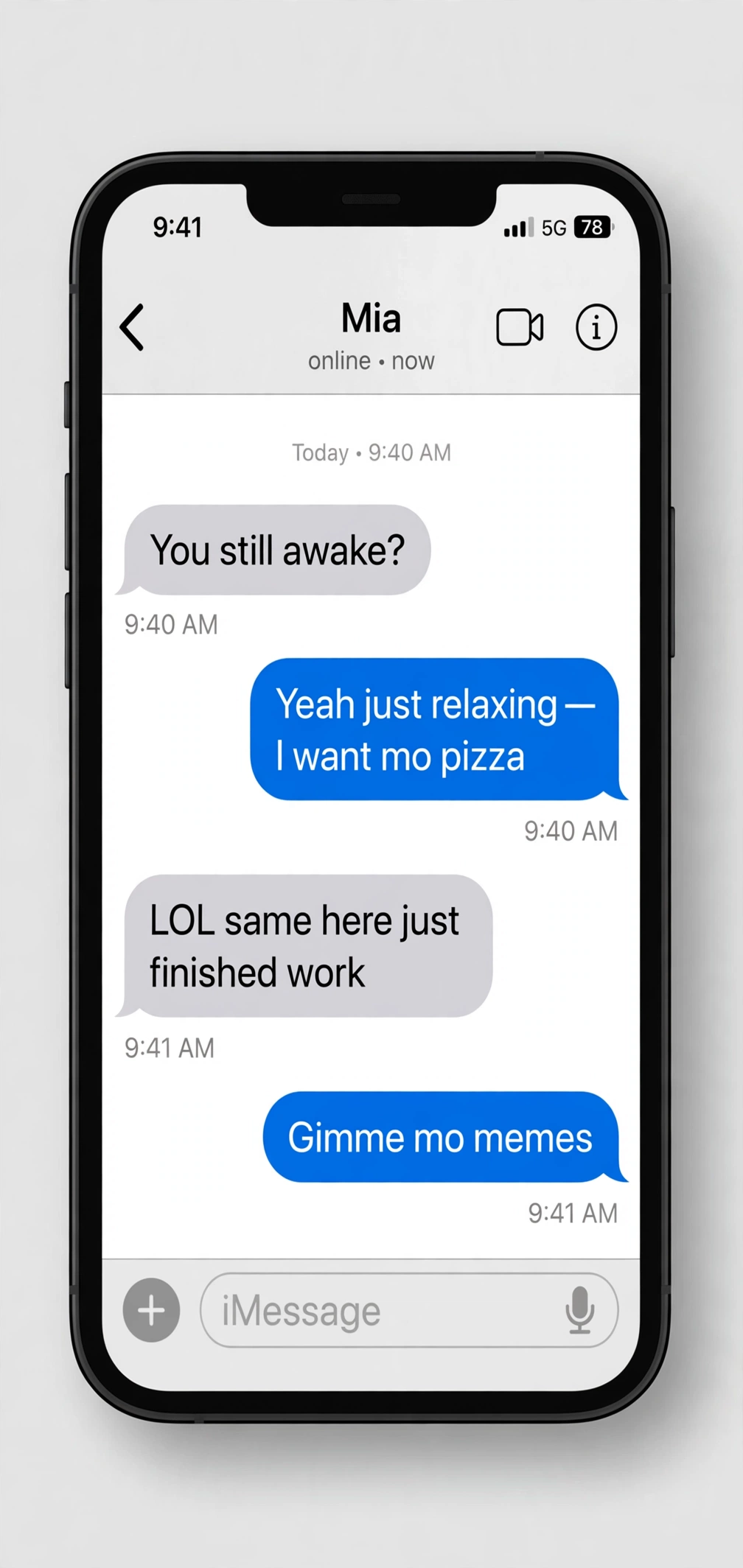
The most common pattern is a request: “gimme mo,” “I need mo,” “can I get mo?” Here “mo” is a direct stand-in for “more,” and the sentence is asking for an extra serving, another round, or more of something good. The tone is playful and a little demanding, but in a friendly way — the way a kid asks for a second helping of dessert.
The second pattern is emphasis: “mo money, mo problems,” “mo drama, mo fun,” “mo sleep, mo energy.” Here “mo” is repeated for rhythm and effect. It is a snowclone — a reusable formula where you swap in new words. It works because it sounds musical, and it is one of the reasons the word shows up so often in lyrics and captions.
The third pattern is the British “moment” use: “hang on a mo,” “give me a mo,” “back in a mo.” Here “mo” means a short period of time, and it is always about waiting. If someone says “just a mo,” they are asking you to wait a moment, not asking for more of something.
Finally, “M.O.” in capital letters is a different word entirely. When someone talks about a criminal’s “M.O.” or says “that’s his M.O.,” they mean modus operandi — the person’s usual method or pattern of behaviour. The capital letters and the periods are your clue.
- Requesting more: “Can I have mo fries?” — asking for extra food.
- Emphasis and rhythm: “Mo money, mo problems.” — repeating for effect.
- Asking someone to wait: “Hang on a mo!” — British use, meaning a moment.
- Describing a pattern: “His M.O. is to arrive late.” — a person’s usual method.
Examples of Mo Meaning Slang
Real examples make the meaning click. Here is how “mo” shows up in friendly chats, professional settings, and funny moments — and how the meaning changes with the context.
Friendly Examples
In friendly conversations, “mo” is warm, playful, and casual. Friends use it when they want more of a good thing, or when they are joking about wanting more.
- “This pasta is so good, I need mo!”
- “Gimme mo memes, I’m bored.”
- “Mo cake please, it’s my birthday!”
- “I want mo time with you before you leave.”
- “That song is a vibe — play it mo!”
Notice how none of these sentences need the full word “more.” The meaning is obvious, the tone is relaxed, and the word fits the rhythm of a quick text. That is the whole point of “mo” in friendly chat: it keeps things light.
Professional Examples
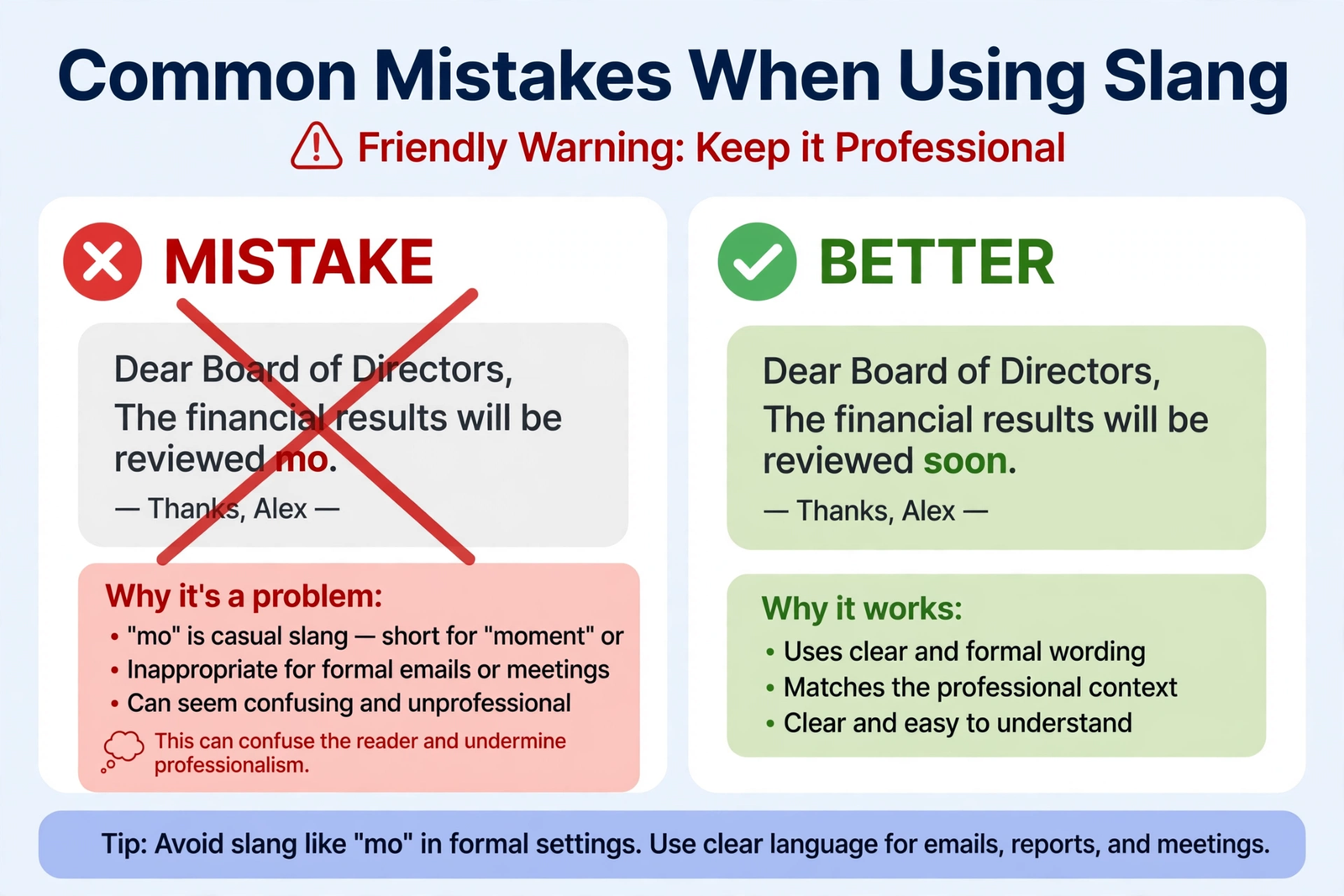
“Mo” does not belong in professional writing, and you will almost never see it in a work email or a formal report. But it does appear in casual workplace chat, in creative industries, and in social media marketing, where a relaxed voice is part of the job.
- “We need mo engagement on this post.” (social media team chat)
- “Clients want mo options before they decide.” (casual team message)
- “Mo reach, mo sales — that’s the goal.” (marketing slogan style)
The rule is simple: if the setting is formal, write “more.” If you are chatting with coworkers you know well, or writing a playful caption for a brand, “mo” can work. When in doubt, use the full word — nobody ever lost a client by writing “more.”
Funny Examples
Humour is where “mo” really shines, because the word itself sounds funny — short, punchy, and a little bit cheeky.
- “Mo money, mo problems… and I currently have no money, so no problems?”
- “I said I wanted mo sleep and my alarm said no.”
- “My bank account: no mo money. Me: mo shopping.”
- “Gimme mo pizza” — said by everyone, at every party, forever.
Memes love “mo” for the same reason songwriters do: it is short, it rhymes with itself, and it turns a complaint about wanting more into a joke. If you have ever laughed at a caption that said “mo coffee, mo problems,” you have seen the word doing exactly what it was built to do.
Comparison with Similar Terms
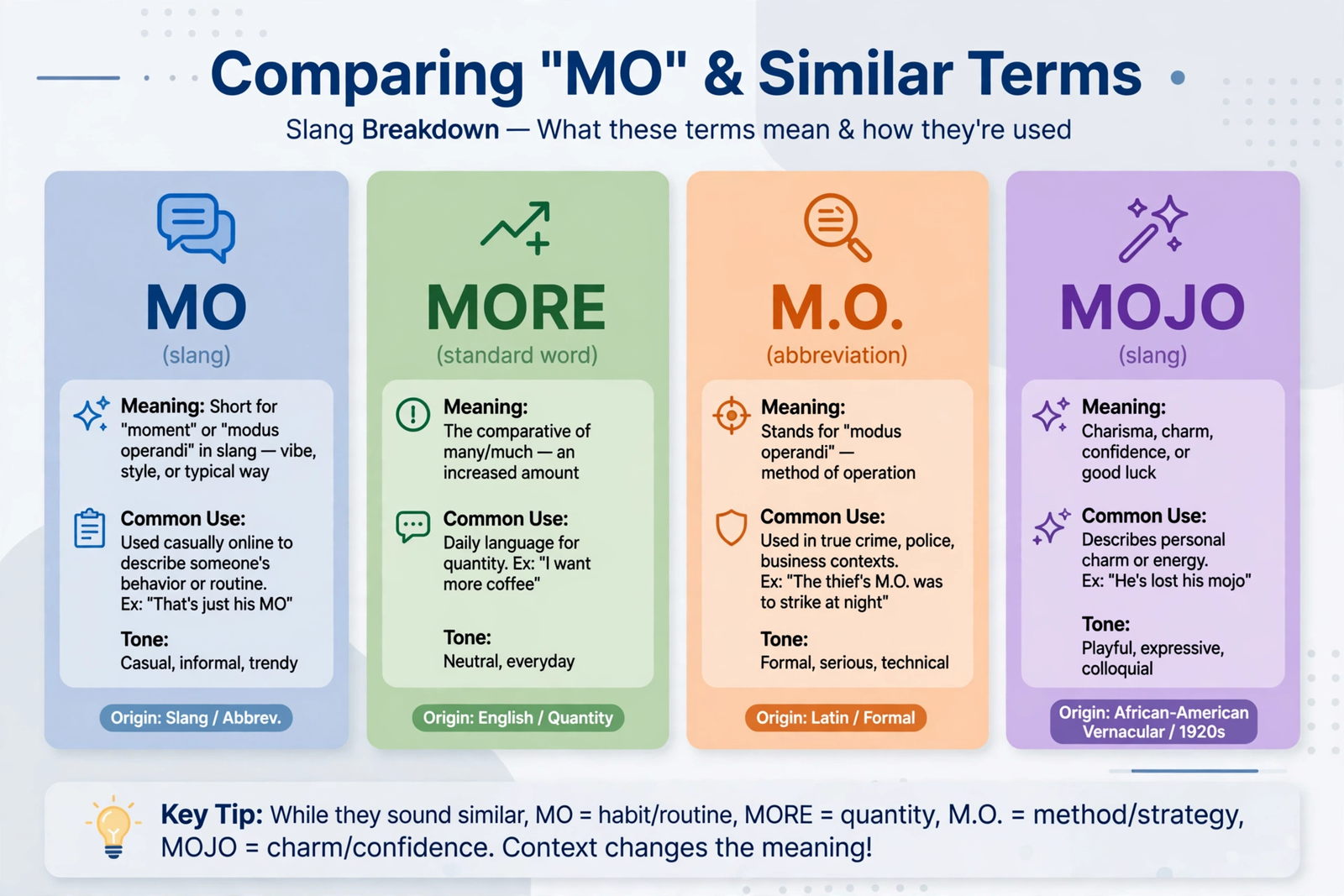
“Mo” has neighbours in slang that look similar but mean different things. Mixing them up is easy, so here is a side-by-side comparison.
| Term | Meaning | How it differs from “mo” |
|---|---|---|
| Mo | More; or a moment (UK) | The base word — a request for extra, or a short wait |
| Mo’ | More, with an apostrophe | Same meaning, older spelling that shows the dropped “r” |
| More | Greater amount or quantity | The full, standard word — correct everywhere, formal and informal |
| M.O. | Modus operandi | A person’s method or pattern, not a quantity at all |
| Mojo | Magic charm, confidence, sex appeal | A different word entirely — energy or luck, not “more” |
| Extra | Over the top, dramatic | Describes behaviour, while “mo” asks for quantity |
| Again | One more time | About repetition, while “mo” is about amount |
The closest confusion is between “mo” and “M.O.” — same letters, completely different meanings. The difference is the punctuation and the context. If the sentence is about a crime, a habit, or a pattern of behaviour, it is “M.O.” If the sentence is about food, money, time, or fun, it is “mo.”
“Mo” is also worth comparing with “mojo,” because people sometimes hear one and think the other. “Mojo” is about personal power or charm — “he lost his mojo” means he lost his confidence. “Mo” is about quantity — “I want mo” means “I want more.” They share two letters and nothing else.
Alternate Meanings
Because “mo” is so short, it has collected more meanings than most slang words. Here are the alternate meanings you are most likely to meet, with the clues that tell them apart.
1. A moment (British slang)
In the UK, Ireland, Australia, and New Zealand, “mo” is a clipping of “moment.” “Hang on a mo” means “wait a moment.” “I’ll be back in a mo” means “I’ll be back shortly.” This is the oldest use of the word, recorded in British English since the late 1800s. If the person speaking is British and the sentence is about waiting, this is the meaning.
2. Modus operandi (M.O.)
Written in capitals, often with periods, “M.O.” comes from the Latin “modus operandi,” meaning “mode of operating.” Police, journalists, and true-crime fans use it to describe how a criminal works, or how any person habitually behaves. “His M.O. is to target empty houses” is about a pattern, not a quantity. Dictionary.com lists modus operandi as one of the primary definitions of “MO”, which shows how established the abbreviation is in standard English.
3. Missouri (US postal abbreviation)
“MO” is the official two-letter postal abbreviation for Missouri. You will see it on envelopes, in addresses, and in databases. It has nothing to do with slang — it is simply the first and last sounds of the state name, standardised by the US Postal Service.
4. A moustache (Australian slang)
In Australia and New Zealand, a “mo” is a moustache. The word is a clipping of “moustache,” and it is best known from “Movember,” the annual charity event in which men grow a moustache during November to raise awareness of men’s health. If an Australian says “nice mo,” they are complimenting facial hair.
5. A name
“Mo” is also a common short form of names such as Mohammed, Muhammad, Maurice, Maureen, and Monica. The British-Somali runner Mo Farah is probably the most famous example. If “Mo” is capitalised and used as a name, it is a person, not a slang word.
6. Money (in some contexts)
In a few rap lyrics and street contexts, “mo” can be shorthand in phrases about money, almost always inside the “mo money” formula. It is not a standalone word for money the way “dough” or “bread” are — it only means money when it is part of that famous phrase.
The practical takeaway: when you see “mo,” look at the sentence around it. Food, fun, or feelings means “more.” Waiting means “moment.” Crime or habits means “M.O.” Facial hair means moustache. And a capital letter at the start of a sentence about a person usually means a name.
Professional or Polite Alternatives
“Mo” is a casual word, and there are plenty of situations where a fuller, more polished word works better. Here are polite alternatives for each use.
| Instead of | Say this | Best for |
|---|---|---|
| “I want mo.” | “I would like some more, please.” | Formal requests, restaurants, work |
| “Gimme mo.” | “Could I have a little more?” | Polite conversation with anyone |
| “Hang on a mo.” | “One moment, please.” | Phone calls, customer service, the office |
| “Mo money, mo problems.” | “Greater wealth often brings greater complications.” | Formal writing, essays, speeches |
| “Need mo time.” | “I need a little more time.” | Work messages, deadlines, school |
The safest rule is the usual one for slang: keep “mo” for friends, family, and casual online spaces. In any situation where you want to sound professional — a job application, a work email, a message to a teacher, a first meeting — use “more” or “a moment.” The full words cost you nothing and they always sound right.
Common Mistakes
“Mo” is a simple word, but people still use it wrong. These are the mistakes to avoid.
Mistake 1: Using it in formal writing. “Mo” in a work email, a school essay, or a job application looks careless. It signals that you did not take the setting seriously. Save it for texts and casual chat, where it belongs. If you want to see how other slang terms carry the same formal-versus-casual split, our guide to gas slang makes the same point.
Mistake 2: Confusing “mo” with “M.O.” Writing “what’s his mo?” when you mean “what’s his modus operandi?” will confuse people, because most readers will hear “what’s his more?” Capital letters and periods matter: “M.O.” is the crime and behaviour term, “mo” is the quantity word.
Mistake 3: Using it when “more” is clearer. In a sentence where the meaning could go either way, the full word is safer. “I need mo” in a text to a friend is fine; “I need mo” in a message to a landlord about a repair is not. Clarity beats style every time.
Mistake 4: Overusing it to sound cool. Dropping “mo” into every sentence does not make you sound like a rapper — it makes you sound like someone trying too hard. The word works because it is occasional. One “mo” in a conversation is natural; ten in a row is a performance.
Mistake 5: Forgetting the British meaning. If a British friend says “wait a mo,” they are not asking for more of something. They are asking you to wait a moment. Answering “mo of what?” will get you a laugh, but it will also mark you as someone who missed the meaning.
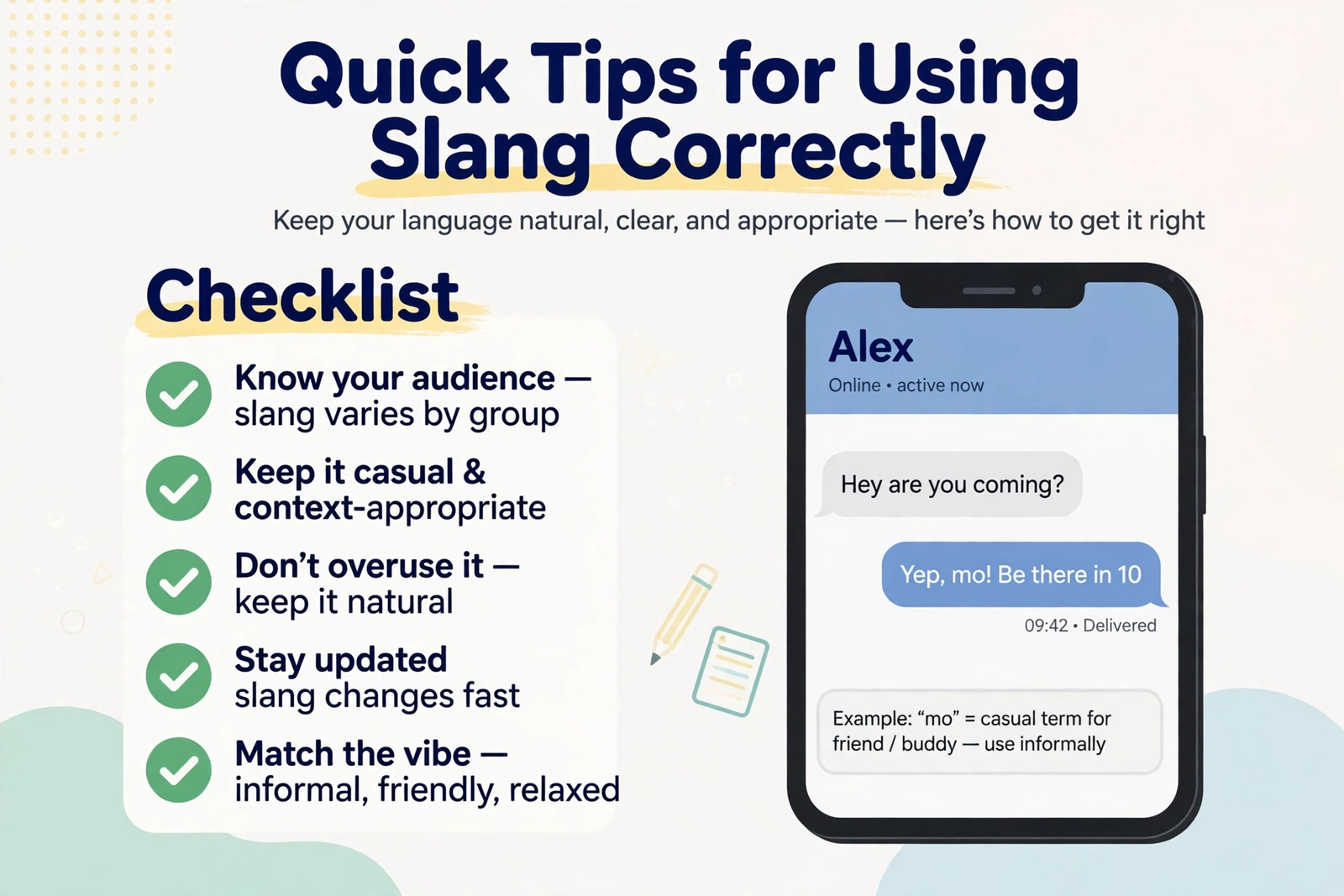
Quick Tips
Use these tips to get “mo” right every time, without thinking about it.
- Check the context first. Food, money, fun, or feelings means “more.” Waiting means “moment.” Crime or habits means “M.O.”
- Keep it casual. “Mo” belongs in texts, chats, captions, and conversations with friends — never in formal writing.
- Use it once, not ten times. A single “mo” sounds natural. Repeating it in every sentence sounds forced.
- Pair it with something specific. “Mo pizza” and “mo sleep” are clear. A bare “mo” on its own can be confusing.
- Remember the apostrophe version. “Mo’” with an apostrophe is the classic spelling in lyrics and older writing — same meaning, more old-school flavour.
- Watch the capitals. Lowercase “mo” is slang; capital “M.O.” with periods is modus operandi; capital “Mo” at the start of a sentence is often a name.
- When in doubt, say “more.” The full word is always correct, always clear, and never embarrassing.

FAQ
1. What does “mo” mean in slang?
In slang, “mo” means “more.” It is a shortened, casual form of the word “more,” used when someone wants extra of something — more food, more time, more fun, or more attention. It comes from African American Vernacular English and became famous through hip-hop, especially The Notorious B.I.G.’s song “Mo Money Mo Problems.”
2. What does “mo” mean in texting?
In texting, “mo” almost always means “more.” If someone texts “I want mo,” they want more of whatever you are talking about. It is a quick, casual shorthand that fits the fast pace of texting, and it is used the same way by teenagers and adults in informal chats.
3. Is “mo” short for “moment” or “more”?
It can be both, and the speaker’s location usually tells you which one. In American slang and texting, “mo” is short for “more.” In British, Irish, Australian, and New Zealand English, “mo” is short for “moment,” as in “hang on a mo.” The sentence around it makes the meaning clear.
4. What does “mo money mo problems” mean?
“Mo money mo problems” means that having more money often brings more complications, stress, and unwanted attention. It comes from The Notorious B.I.G.’s 1997 hit song of the same name. People now use the phrase as a joke or a warning whenever extra money — a raise, a win, a payout — comes with extra headaches.
5. What does “M.O.” stand for?
“M.O.” stands for “modus operandi,” a Latin phrase meaning “mode of operating.” It describes a person’s usual method or pattern of behaviour, and it is most often used to talk about how a criminal commits crimes. It is a completely different meaning from slang “mo,” and the capital letters and periods are the clue.
6. Is “mo” rude or offensive?
No, “mo” is not rude or offensive. It is informal, but it is not a swear word and it does not carry any insulting meaning. The only risk is using it in a formal setting, where it can sound careless. In casual conversation, it is perfectly polite.
7. Do people still say “mo” in 2026?
Yes. “Mo” has been in steady use for decades, and it is still common in texts, TikTok comments, song lyrics, and casual conversation. Its popularity rises whenever a new song or meme uses it, but it has never really gone away — because it does a simple job well. If you want more examples of slang with the same staying power, our guide to dope meaning slang covers another word that has lasted for years.
8. What is the difference between “mo,” “mo’,” and “mojo”?
“Mo” and “mo’” are the same word — “mo’” is simply the older spelling with an apostrophe showing the dropped “r” from “more.” “Mojo” is a different word entirely: it means personal power, charm, or luck, as in “he’s got his mojo back.” The three words share letters, but “mojo” has nothing to do with “more.”
Conclusion
Mo meaning slang is simple on the surface and richer underneath: in most cases, “mo” means “more” — a short, casual way to ask for extra of something good. It comes from Black American speech and hip-hop culture, it was carried around the world by “Mo Money Mo Problems,” and it is still going strong in texts, TikTok comments, and everyday conversation in 2026.
But the same two letters can mean a moment in London, a moustache in Melbourne, a method of working when written as “M.O.,” and a US state when written as “MO” on an envelope. The meaning always lives in the context, and now you know how to read it: look at who is speaking, where they are from, and what the sentence is about.
The practical advice is straightforward. Use “mo” with friends, in texts, and in captions — that is where it belongs and where it sounds natural. Use “more” or “a moment” in formal settings, where the full words always sound right. And when you see “mo” in a message, check the setting before you decide what it means: more food in a chat, a short wait in a British text, or a pattern of behaviour in a crime show.
Slang moves fast, but the words that last are the ones that say something no other word says quite as well. “Mo” packs a whole request into two letters, and that is why it is still here decades after a rap song made it famous. Now that you know exactly what it means, you will spot it everywhere — and you will know exactly how to use it.
