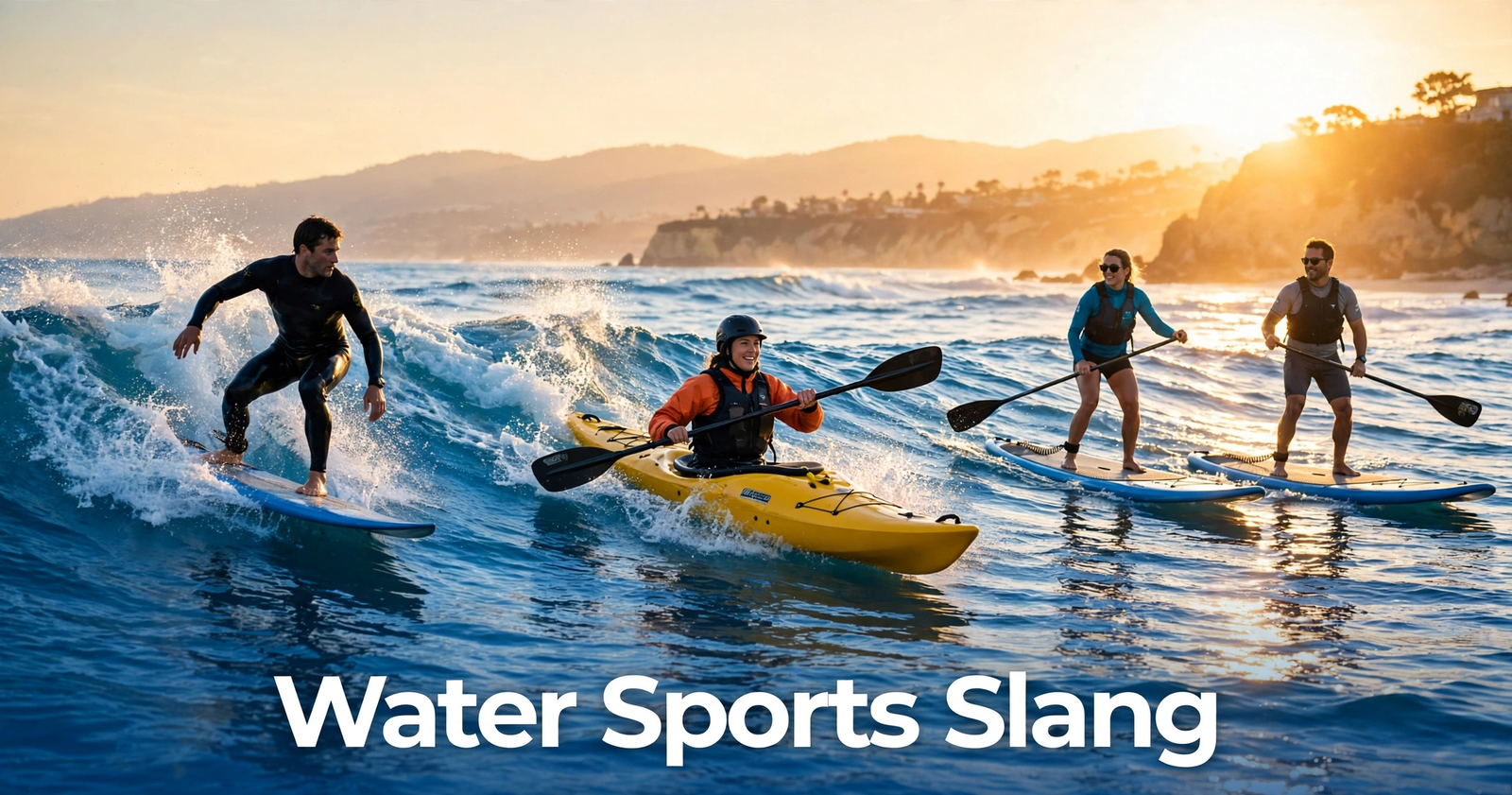
Quick definition: The water sports slang meaning is simple — it is the informal vocabulary used by surfers, kayakers, paddleboarders, wakeboarders, divers, and jet skiers to talk about waves, water, gear, and the feeling of being out on the water. Words like stoked, gnarly, wipeout, and shaka are not random beach talk; they are a shared language that grew out of surf culture in Hawaii and California and now shows up in texts, TikTok captions, and everyday conversation far from the ocean.
water sports slang Meaning & Definition
Water sports slang is the casual, expressive language of everyone who plays on the water. It covers everything an athlete needs to describe quickly while moving: the size and shape of a wave, the quality of a ride, the skill (or lack of it) of the person next to them, and the pure joy of a perfect session. The water sports slang meaning goes beyond a dictionary definition — it carries the laid-back, sun-soaked attitude of beach and lake culture itself.
Unlike formal sports terminology, water sports slang is playful and emotional. A wave is never just “large” — it is gnarly, heavy, or a bomb. A rider is never just “happy” — they are stoked, frothing, or amped. A fall is never just a fall — it is a wipeout, a yard sale, or getting rag-dolled. Each sport has its own corner of the vocabulary, but the words travel freely between surfing, kayaking, stand-up paddleboarding, wakeboarding, diving, and jet skiing, because the people who do one water sport usually try the others too.
This guide explains the water sports slang meaning in plain English, traces where the words came from, and breaks down 50+ of the most common water sports terms with real examples — so the next time someone says the swell is “pumping” and they are “frothing to get pitted,” you will know exactly what they mean.
Introduction
Picture this: you are standing on a beach at dawn, coffee in hand, when a stranger in a wetsuit walks past and says, “It is firing out there — clean six-footers, offshore wind, I got so barreled I was frothing.” If you have never spent time around water sports, that sentence might as well be another language. And in a way, it is. Water sports slang is one of the most borrowed vocabularies in English, and it shows up far beyond the beach — in group chats, Instagram captions, song lyrics, and even office small talk.
Why does it matter? Because water sports slang is no longer just for athletes. Terms like stoked, gnarly, and wipeout have gone fully mainstream, and new words keep arriving from TikTok surf clips, kayaking vlogs, and paddleboard influencers. If you text with friends who surf, kayak, or paddleboard — or if you are planning your first lesson — knowing this vocabulary saves you from confusion and from the classic beginner mistake of using a term in exactly the wrong situation.
If you already know the surfing side of this language, our guide to surfer slang meaning goes deeper on the 50+ terms that belong to surfing alone. This article is the bigger map: the shared slang of every sport that happens on the water, from the ocean to the river to the lake.
Origin
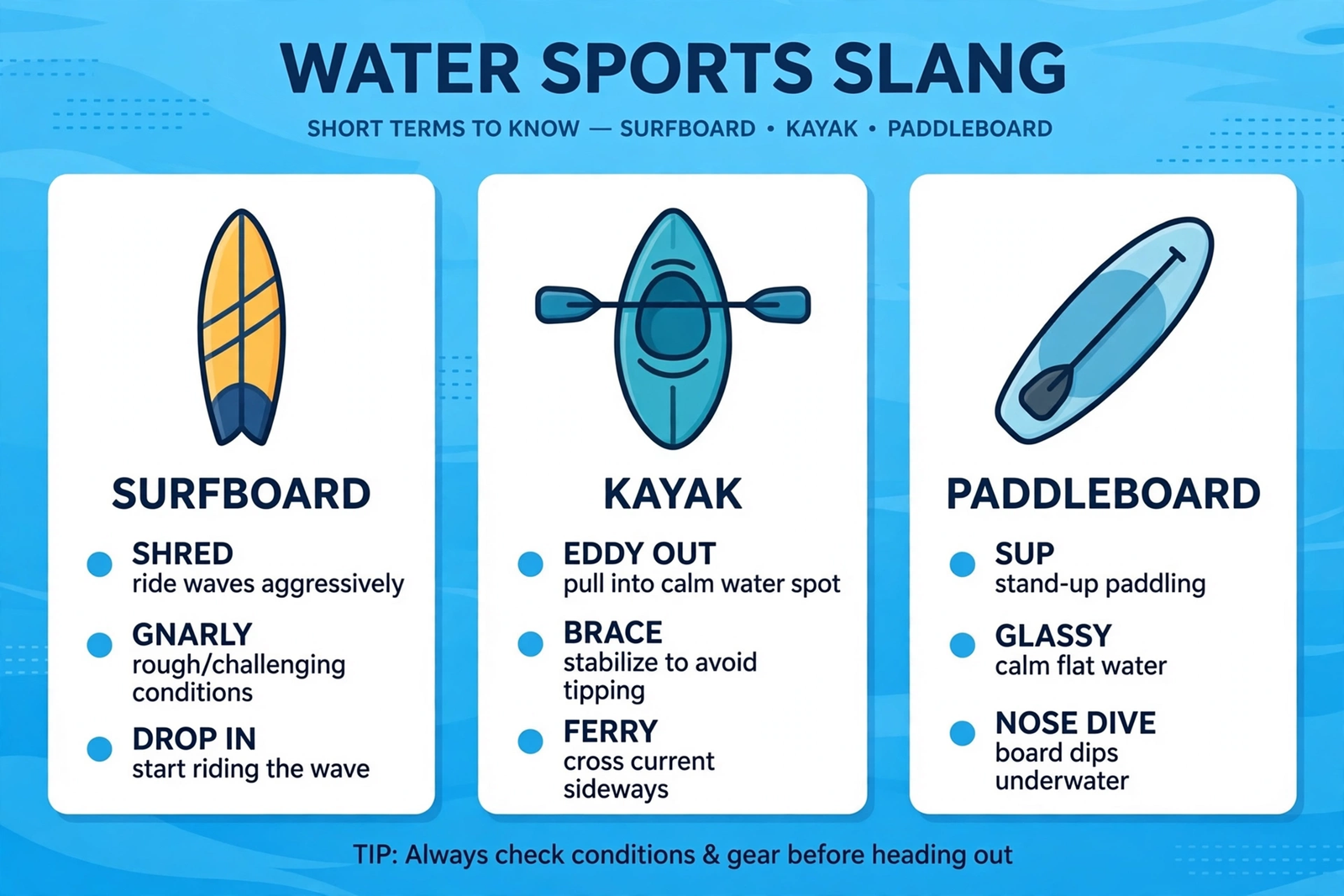
Water sports slang was born on the beaches of Hawaii, where modern surfing itself began. Ancient Hawaiians called the sport he’e nalu — “wave sliding” — and when surfing spread to the California coast in the early 1900s, a new beach culture grew around it. Duke Kahanamoku, the Hawaiian Olympic swimmer who popularized surfing worldwide in the 1910s and 1920s, carried the first wave of Hawaiian words — aloha, shaka, mahalo — into the global vocabulary.
The real explosion came in the 1950s and 1960s. Surf movies, surf rock bands like the Beach Boys, and the first surf magazines turned a small coastal subculture into a worldwide lifestyle. Words like gnarly and stoked, which now sound like ordinary English, were born in this era. They were then echoed in pop culture, skateboarding, and snowboarding, which only made them spread faster.
Other water sports added their own words along the way. Whitewater kayakers brought terms like eddy, boof, and yard sale from river culture. Wakeboarders contributed butter, stomp, and faceplant. Divers added narked and narced for nitrogen narcosis. Jet skiers and paddleboarders borrowed freely from all of them. The result is a single, messy, living vocabulary — and that is exactly what makes it fun to learn.
Popularity
Water sports slang has never been more popular than it is right now. A few forces are driving it:
- Social media: Short surf, kayak, and paddleboard clips on TikTok and Instagram Reels put slang in front of millions of people who have never touched a board. A single viral wipeout video can push a term like yard sale into group chats overnight.
- Surf culture in fashion and music: Streetwear brands, surf-inspired playlists, and beach aesthetics keep words like stoked and gnarly in daily circulation, even among people who live hundreds of miles from the sea.
- Adventure travel: Surf camps in Bali, kayaking trips in Costa Rica, and paddleboarding holidays in the Mediterranean mean more beginners than ever are hearing this vocabulary for the first time — and searching for what it means.
- Crossover sports: Skateboarders, snowboarders, and climbers borrow water sports slang constantly, so the words spread through every outdoor community at once.
Search interest in water sports slang spikes every summer in the United States, when beach season starts and beginners flood into surf schools and kayak rentals. It also spikes after big surf competitions and viral ocean videos. In short, this is a living language — and the words you learn today will still be useful next summer.
How It Is Used
Water sports slang is used in three main situations: on the water, in the parking lot after a session, and online. On the water, it is fast and practical — short words that carry a lot of meaning when you are paddling and cannot stop for a conversation. After a session, it becomes storytelling: every surfer retells their best wave, every kayaker retells their wildest rapid, and the slang makes the story better. Online, it is identity — using the right words in a caption or comment signals that you belong to the culture.
A few usage rules apply across all water sports:
- Tone is everything. The same word can be praise or an insult depending on context. Calling a wave gnarly is a compliment; calling a person a kook is not.
- Do not force it. Nothing marks a beginner faster than dropping five slang terms into one sentence. Use one or two naturally, and let the rest come with time.
- Respect the lineup. In surfing and kayaking, slang about priority and etiquette — drop in, snake, burn — describes real rules. Misusing those words can cause a real argument in the water.
- It travels. A term that starts in surfing, like stoked, will show up in a kayaker’s group chat the same week. The sports share the water, so they share the words.
Examples
Friendly Examples
- “I am so stoked — the swell is pumping and the wind just went offshore!”
- “You absolutely shredded that wave, that was the best ride of the day.”
- “Dawn patrol tomorrow? First light, glassy water, nobody else out there.”
- “That was a clean run — you stomped the landing perfectly.”
- “We were all frothing before we even got in the water.”
Professional Examples
- “The instructor explained that a barrel is the hollow part of a curling wave, and riding inside it is called getting pitted.”
- “In whitewater kayaking, an eddy is the calm water behind a rock where you can rest before the next rapid.”
- “The dive briefing covered nitrogen narcosis — if you feel narked at depth, signal your buddy and ascend slowly.”
- “For paddleboarding, a glassy morning means flat, calm water — the best conditions for beginners.”
- “The wakeboard coach said to keep your knees soft on landing so you do not faceplant on a big jump.”
Funny Examples
- “I tried to look cool and immediately took the biggest wipeout of my life in front of everyone on the beach.”
- “My kayak flipped, my paddle went one way, my hat went the other — total yard sale in the middle of the river.”
- “He calls himself a surfer but he has never stood up — certified kook behavior.”
- “I got rag-dolled by that wave so hard I found sand in places sand should never be.”
- “She said the water was ‘a little choppy’ — it was a washing machine with waves.”
Comparison with Similar Terms
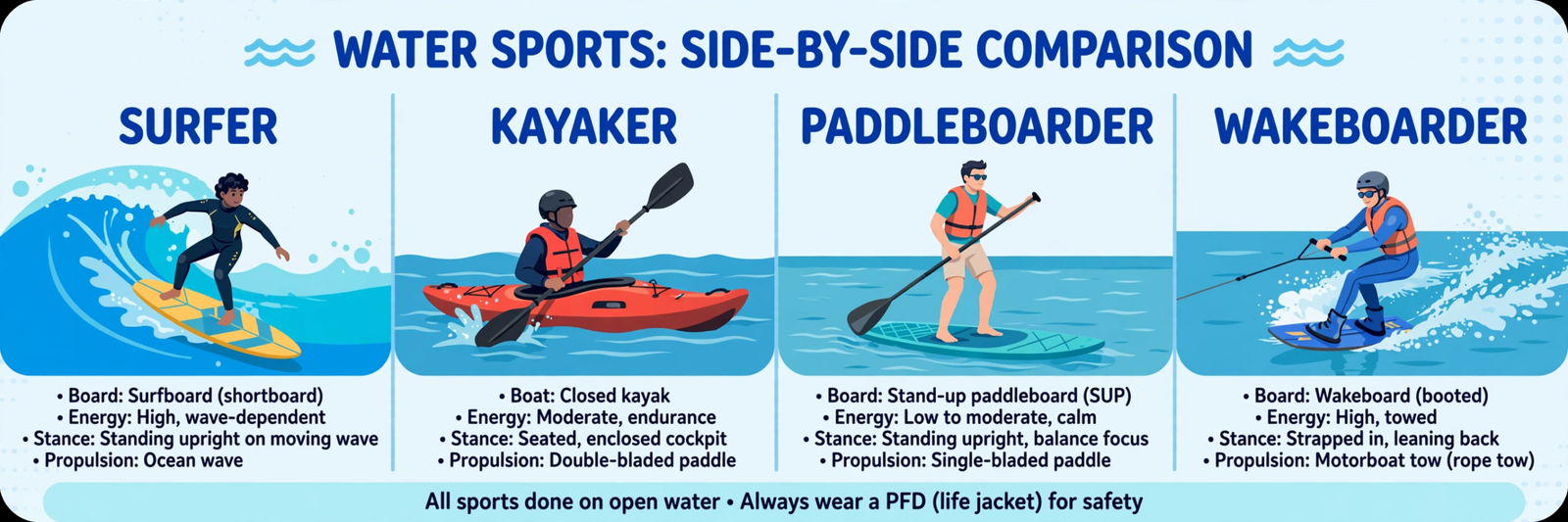
Water sports slang overlaps a lot between sports, but some terms belong mostly to one sport. Knowing which is which helps you sound like you actually do the sport you are talking about. Here is how the vocabulary splits across the main water sports:
| Term | Main Sport | Meaning | Example |
|---|---|---|---|
| Stoked | Surfing (all sports) | Extremely excited or happy | “I am so stoked for tomorrow’s swell.” |
| Gnarly | Surfing (all sports) | Amazing, intense, or difficult | “That wave was gnarly — double overhead!” |
| Barrel / Pitted | Surfing | Riding inside the hollow part of a wave | “He got barreled — best wave of the day.” |
| Boof | Whitewater kayaking | Launching the kayak off a drop so it lands flat | “Boof that ledge or you will get window-shaded.” |
| Yard sale | Kayaking / skiing | Gear scattered everywhere after a crash | “Total yard sale — paddle, helmet, everything.” |
| Stomp | Wakeboarding | Landing a trick cleanly | “She stomped the backflip on the first try.” |
| Glassy | Surfing / paddleboarding | Perfectly smooth, calm water | “Glassy morning — perfect for beginners.” |
| Narked | Scuba diving | Affected by nitrogen narcosis at depth | “He felt narked at 30 meters and ascended.” |
| Dawn patrol | Surfing (all sports) | An early morning session at first light | “Dawn patrol tomorrow — meet at 5:30.” |
| Shaka | Surfing (all sports) | The hang-loose hand gesture; means “all good” | “He threw a shaka as he paddled in.” |
And here is the quick-reference glossary — the 40 most useful water sports slang terms in one place:
| Term | Meaning | Example |
|---|---|---|
| Stoked | Extremely excited or happy | “I am so stoked for tomorrow’s swell.” |
| Gnarly | Amazing, intense, or difficult | “That wave was gnarly.” |
| Kook | An inexperienced or clueless rider who breaks etiquette | “That kook dropped in on everyone.” |
| Grom / Grommet | A young rider, usually a kid or teen | “The groms were ripping today.” |
| Shaka | Hang-loose gesture; also means “all good” | “He threw a shaka as he paddled in.” |
| Froth / Frothing | Being wildly excited about the water | “I am frothing — the forecast looks perfect.” |
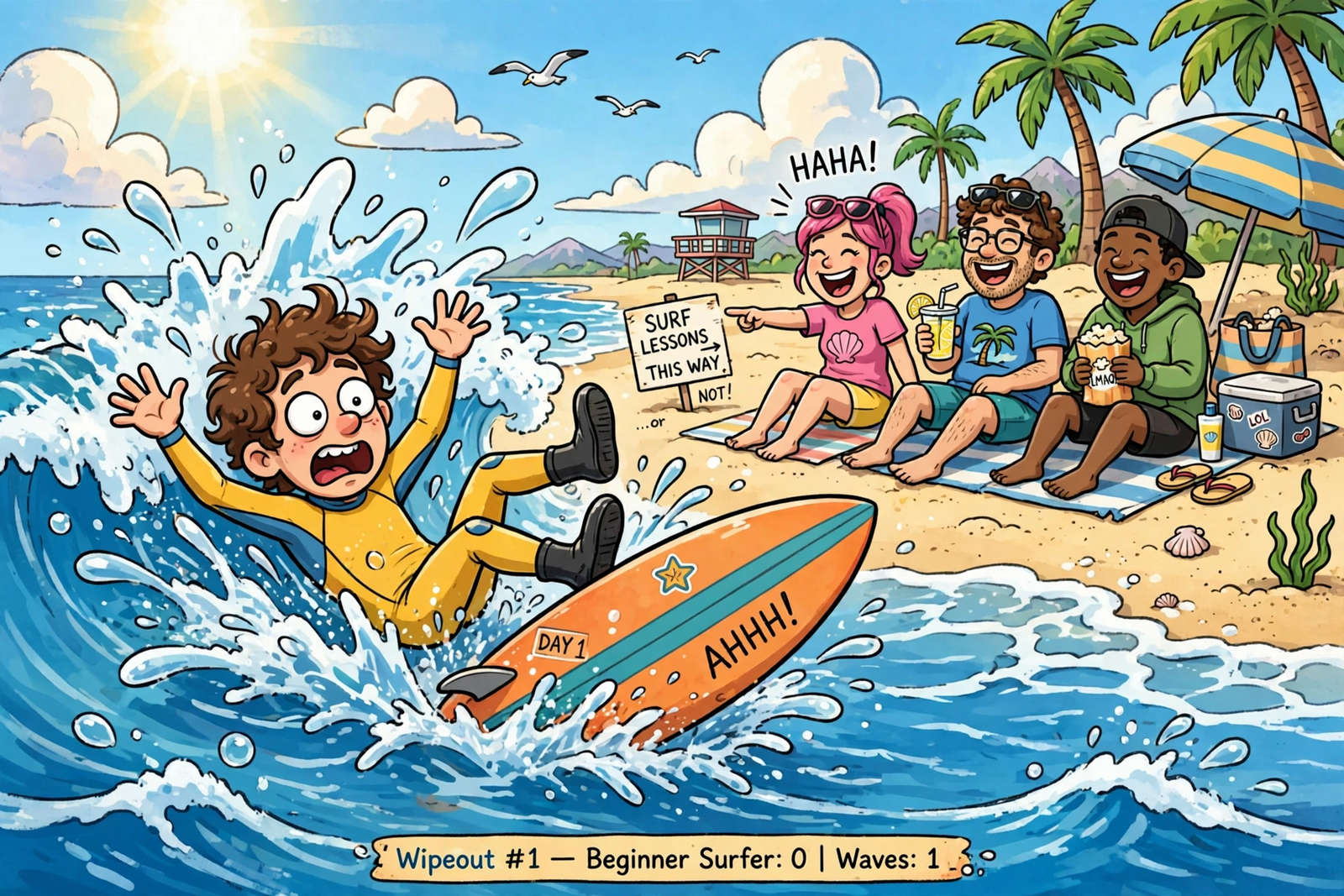
| Wipeout | Falling off your board | “Took a heavy wipeout on that set wave.” |
| Barrel / Tube | The hollow part of a curling wave | “He got barreled — best wave of the day.” |
| Hang ten | Riding with all ten toes over the nose | “He hung ten all the way to the beach.” |
| Drop in | Taking a wave someone else has priority on | “Do not drop in — that was his wave.” |
| Shred / Rip | Riding with great skill and aggression | “She was ripping all morning.” |
| Off the hook | The waves or conditions are perfect | “It is off the hook out there today.” |
| Dawn patrol | An early morning session | “Dawn patrol — first light, no crowd.” |
| Glassy | Perfectly smooth water | “Glassy conditions at sunrise.” |
| Choppy | Rough, uneven water surface | “It got choppy once the wind picked up.” |
| Set | A group of waves arriving together | “Wait for the next set — it looks bigger.” |
| Lineup | The area where riders wait for waves | “Meet me out in the lineup.” |
| Caught inside | Stuck shoreward of breaking waves | “I got caught inside for ten minutes.” |
| Snake | Paddling around someone to steal priority | “He snaked me on that wave.” |
| Burn | Taking someone else’s priority wave | “Getting burned twice in one session is rough.” |
| Boof | Launching a kayak off a drop | “Boof the ledge and land flat.” |
| Eddy | Calm water behind an obstacle in a river | “Catch the eddy and rest before the rapid.” |
| Yard sale | Gear scattered after a crash | “My paddle went everywhere — yard sale.” |
| Rag-dolled | Thrown around underwater by a wave | “Got rag-dolled and lost my board.” |
| Stomp | Land a trick cleanly | “Stomped the landing first try.” |
| Faceplant | Falling face-first into the water | “Tried a flip, total faceplant.” |
| Butter | Smooth, effortless style on a wakeboard | “His riding is pure butter.” |
| Whitewater / Soup | Foam from breaking waves | “Paddle through the soup to get out.” |
| Shorebreak / Shorey | A wave breaking right on the shore | “The shorey is brutal today.” |
| Narked | Affected by nitrogen narcosis | “He felt narked and signaled to ascend.” |
| Party wave | A wave shared by several riders | “We all took a party wave in.” |
| Point break | Waves breaking over a point of land | “The point break was firing all day.” |
| Hang loose | Relax, chill, be laid back | “Hang loose — the swell will come.” |
| Offshore | Wind blowing from land toward the sea | “Offshore wind is holding the waves up.” |
| Onshore | Wind blowing from sea toward land | “Onshore wind made it messy.” |
| Swell | A series of waves generated by distant wind | “A new swell is arriving on Friday.” |
| Flat / Flat spell | No waves at all | “It has been flat for a week.” |
| Log / Mal | A traditional longboard | “He rides a log — pure old-school style.” |
| Big gun | A board built for very large waves | “You need a big gun for waves that size.” |
| Wettie | Slang for wetsuit | “Grab your wettie, the water is cold.” |
Alternate Meanings
Many water sports slang terms have meanings outside the water, and some water words mean different things in different sports. That is where most confusion comes from:
- Gnarly — In surfing it means an amazing or intense wave. In everyday American English it can also mean disgusting or unpleasant (“that injury looks gnarly”), and in the 1980s it meant “cool.” Context decides.
- Stoked — In water sports it means thrilled about the conditions. Outside the beach it simply means very excited about anything, from a new job to a concert.
- Shred — On a board it means riding with skill. In the gym it means getting lean and muscular. In music it means playing a fast guitar solo.
- Drop in — In surfing it means stealing someone’s wave (rude). In everyday English it means visiting someone casually (“drop in anytime”). Opposite vibes — do not mix them up.
- Flat — In surfing it means no waves, which is bad news. In paddleboarding it can be good news, because flat water is perfect for beginners.
- Soup — In surfing it is the whitewater foam after a wave breaks. At a restaurant it is lunch. The surfer is not hungry — they are describing the water.
- Tube — In surfing it is the hollow of a wave. In the London Underground it is a train. In a hospital it is medical equipment. Same word, very different days.
Professional or Polite Alternatives
Water sports slang is perfect for the beach and the group chat, but in a professional or formal setting — a work email, a lesson booking, a safety briefing — plain language works better. Here are clean swaps:
| Slang | Professional Alternative |
|---|---|
| Stoked | Very excited / enthusiastic |
| Gnarly | Challenging / impressive / excellent |
| Wipeout | Fell off the board |
| Kook | Beginner / inexperienced rider |
| Shredding | Riding skillfully / performing well |
| Frothing | Very eager / enthusiastic |
| Yard sale | Lost control of my equipment |
| Hang loose | Relax / take it easy |
| Off the hook | Excellent conditions |
| Caught inside | Unable to get past the breaking waves |
A surf instructor talking to first-time students, for example, will say “the waves are excellent today” rather than “it is firing and totally off the hook” — same meaning, zero confusion. Save the slang for the water, where it belongs.
Common Mistakes
Beginners make the same few mistakes with water sports slang. Avoid these and you will sound like you belong much faster:
- Calling every wave “gnarly.” Gnarly means intense, big, or difficult — not just “nice.” A small, clean two-foot wave is fun, but it is not gnarly. Overusing the word is the fastest way to sound like a tourist. If you want the full story behind the word, see our guide to gnarly meaning slang.
- Calling yourself “stoked” about everything. Being stoked is a big feeling — the swell is perfect, the trip is booked, the wave of your life is coming. If you are stoked about your sandwich, the word loses its power.
- Using “kook” as a joke about yourself. Calling yourself a kook is fine and self-aware. Calling a stranger a kook in the water is an insult and can start a real confrontation. Use it carefully.
- Mixing up “drop in” and “snake.” A drop-in is taking off in front of someone on the same wave; a snake is paddling around someone to steal the priority spot before the wave even arrives. They are different mistakes with different levels of rudeness.
- Saying “shaka” while doing the wrong gesture. The shaka is thumb and pinky out, middle fingers folded. Do it wrong and you are just waving strangely at people.
- Using surf slang for a sport it does not belong to. “Getting barreled” is a surfing thing. A kayaker does not get barreled — they get window-shaded or maytagged. Use the right sport’s words.
- Forcing slang into every sentence. One or two natural terms beat a sentence stuffed with five. Real water people talk normally most of the time — the slang comes out when the moment deserves it. Words like dope and drip crossed over from other slang worlds into beach talk, but they still sound forced if you stack them all at once.
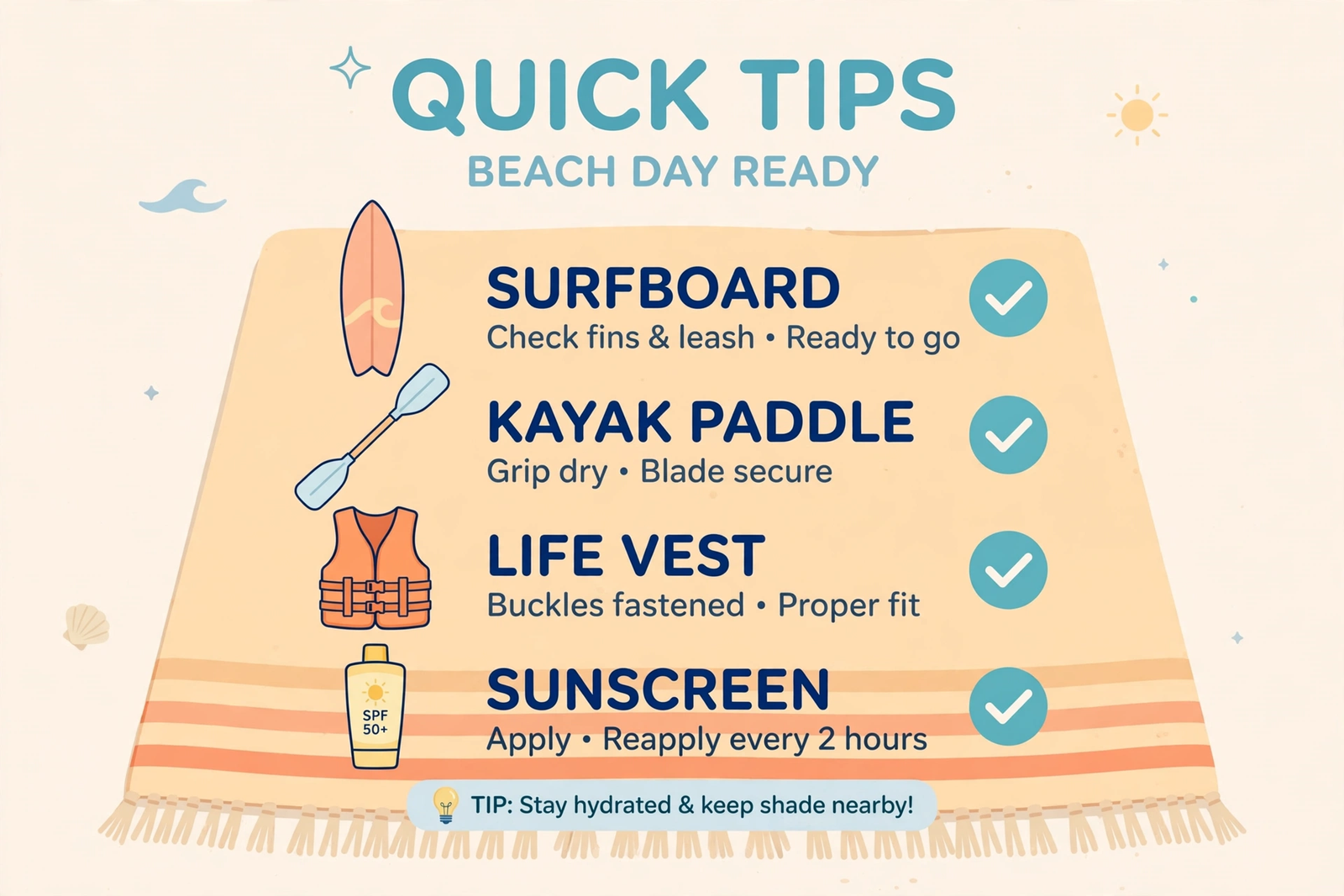
Quick Tips
- Learn five terms first: stoked, gnarly, wipeout, barrel, and shaka. Those five cover about 80% of what you will hear on your first day at the beach.
- Listen before you speak: Spend one session just listening to how locals use the words. You will learn the tone and timing faster than any list can teach you.
- Ask what a word means: Water people love explaining their vocabulary. Asking “what does that mean?” is never embarrassing — pretending you know is.
- Match the sport: Learn the slang of the sport you actually do. A paddleboarder needs glassy and chop; a kayaker needs eddy and boof; a surfer needs set and lineup.
- Watch the conditions words: Offshore, onshore, glassy, choppy, and swell are the most useful words in water sports slang — they describe the water itself, and everyone uses them.
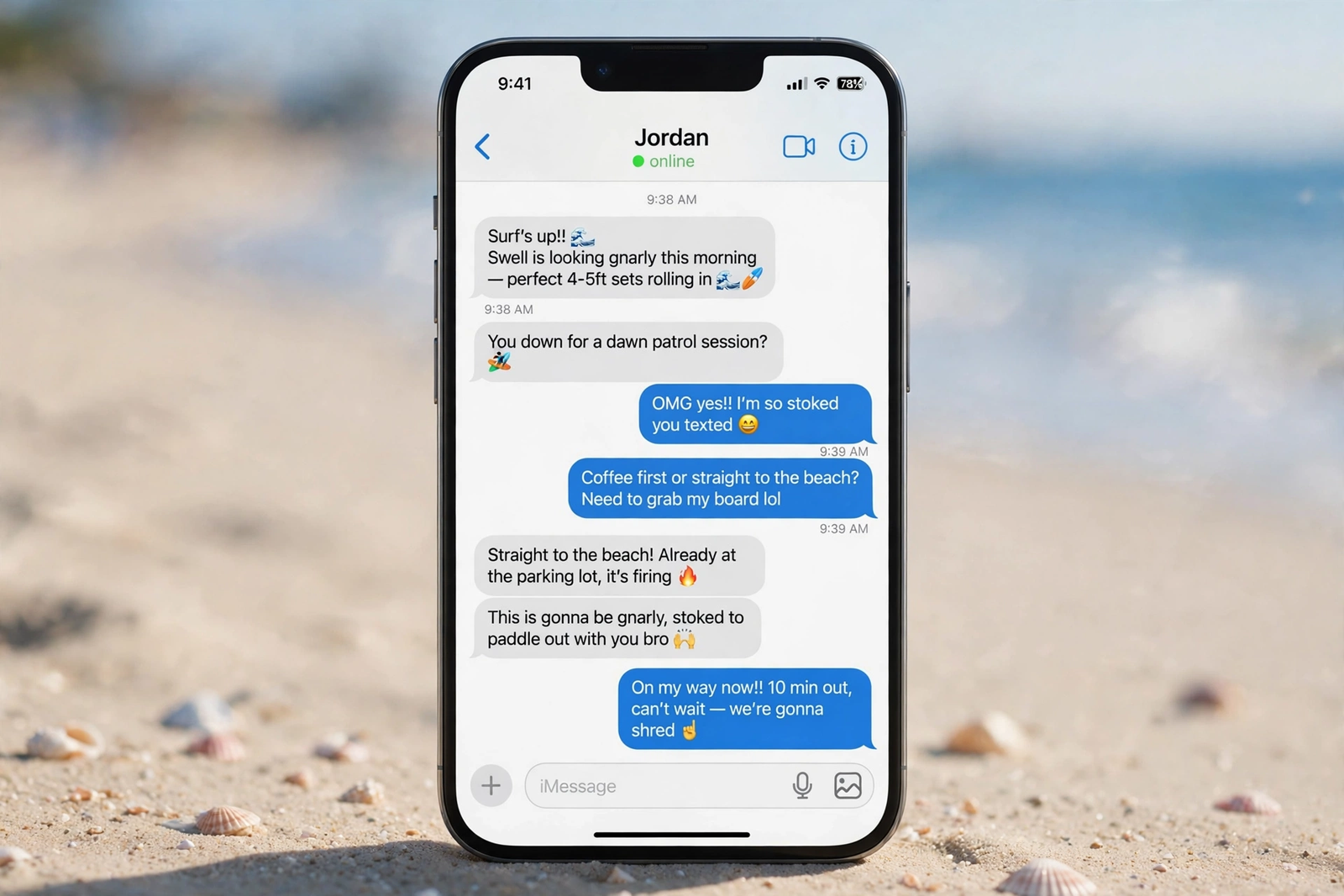
- Keep it natural in texts: “Swell is pumping, so stoked for dawn patrol” reads perfectly in a group chat. “I am frothing, it is gnarly, totally off the hook, shaka brah” reads like a parody.
- Learn the etiquette words early: Drop in, snake, burn, and priority are not just slang — they are the rules that keep everyone safe in the water.
FAQ
What does water sports slang mean?
Water sports slang is the informal vocabulary used by surfers, kayakers, paddleboarders, wakeboarders, divers, and jet skiers to describe waves, water conditions, gear, and the experience of being on the water. It includes words like stoked, gnarly, wipeout, and barrel that started in surf culture and spread to every water sport.
What is the most common water sports slang word?
Stoked is the most common — it means extremely excited or happy, and it is used by surfers, kayakers, paddleboarders, and wakeboarders alike. Gnarly is a close second, used to describe anything amazing, intense, or difficult.
What does “gnarly” mean in surfing?
In surfing, gnarly describes a wave that is big, powerful, difficult, or impressive. It can also describe an amazing ride. Outside surfing it can mean “cool” or, in other contexts, “disgusting” — so the meaning depends on the situation. See our full guide to gnarly meaning slang for the details.
What is a wipeout in water sports?
A wipeout is falling off your board — in surfing, paddleboarding, or wakeboarding. In kayaking the equivalent is capsizing or flipping. A wipeout can be funny, scary, or both, and every water athlete has had hundreds of them.
What does “shaka” mean?
The shaka is the Hawaiian “hang loose” hand gesture — thumb and pinky finger extended, middle fingers folded down. It means “all good,” “relax,” or “thank you,” and it is used by surfers and beach people all over the world.
What is dawn patrol in surfing?
Dawn patrol is an early morning surf session at first light. Surfers go out at dawn because the wind is usually calm, the water is glassy, and the lineup is empty before the crowds arrive.
Is water sports slang the same as surfer slang?
Not exactly. Surfer slang is one part of water sports slang — the surfing corner of it. Water sports slang is the bigger vocabulary that also covers kayaking, paddleboarding, wakeboarding, diving, and jet skiing. Many words overlap, but each sport has terms the others do not use.
How can I learn water sports slang quickly?
Start with five words — stoked, gnarly, wipeout, barrel, and shaka — then listen to how locals use them during one session. Watch surf and kayak videos with the sound on, read the captions, and use the words naturally in texts. Most people pick up the basics within a week at the beach.
Conclusion
Water sports slang is more than beach talk — it is the shared language of everyone who plays on the water, from Hawaiian surf pioneers to weekend paddleboarders on a lake. Learn the core words — stoked, gnarly, wipeout, barrel, shaka — and you will understand most of what you hear on your first day out. Learn the rest — boof, eddy, yard sale, glassy, dawn patrol — and you will sound like someone who belongs there.
The best way to learn is to get in the water. Listen first, ask questions, use one or two terms naturally, and let the rest come with time. The vocabulary is fun, the culture is welcoming, and the feeling it describes — that stoked, frothing joy of a perfect session — is the whole reason the words exist in the first place.
If you want to go deeper on the surfing side of this language, start with our guide to surfer slang meaning, and for the general background on the sports themselves, Wikipedia’s overview of water sports is a solid starting point. Now get out there — the swell is waiting, and you finally speak the language.
