Quick definition: In slang, “crack” most often means a joke, a witty remark, or a sarcastic comment — as in “he made a crack about my haircut.” But depending on the context, “crack” can also mean a drug (crack cocaine), to open something up (“crack open a cold one”), to solve something (“crack the code”), or to be funny, sharp, and quick-witted. The meaning changes completely with the sentence around it.
Crack Meaning & Definition
So, what does crack mean in slang? The short answer is: it depends on who is saying it, where they are saying it, and what they are talking about. “Crack” is one of those small English words that carries a surprising number of slang meanings, and most of them have been around for decades — some for centuries.
In everyday conversation, the most common slang meaning of “crack” is a joke or a witty remark. When someone says “that was a crack at me,” they mean someone made a sarcastic or teasing comment about them. This is the meaning you will hear most often in casual speech, in TV shows, and in group chats.
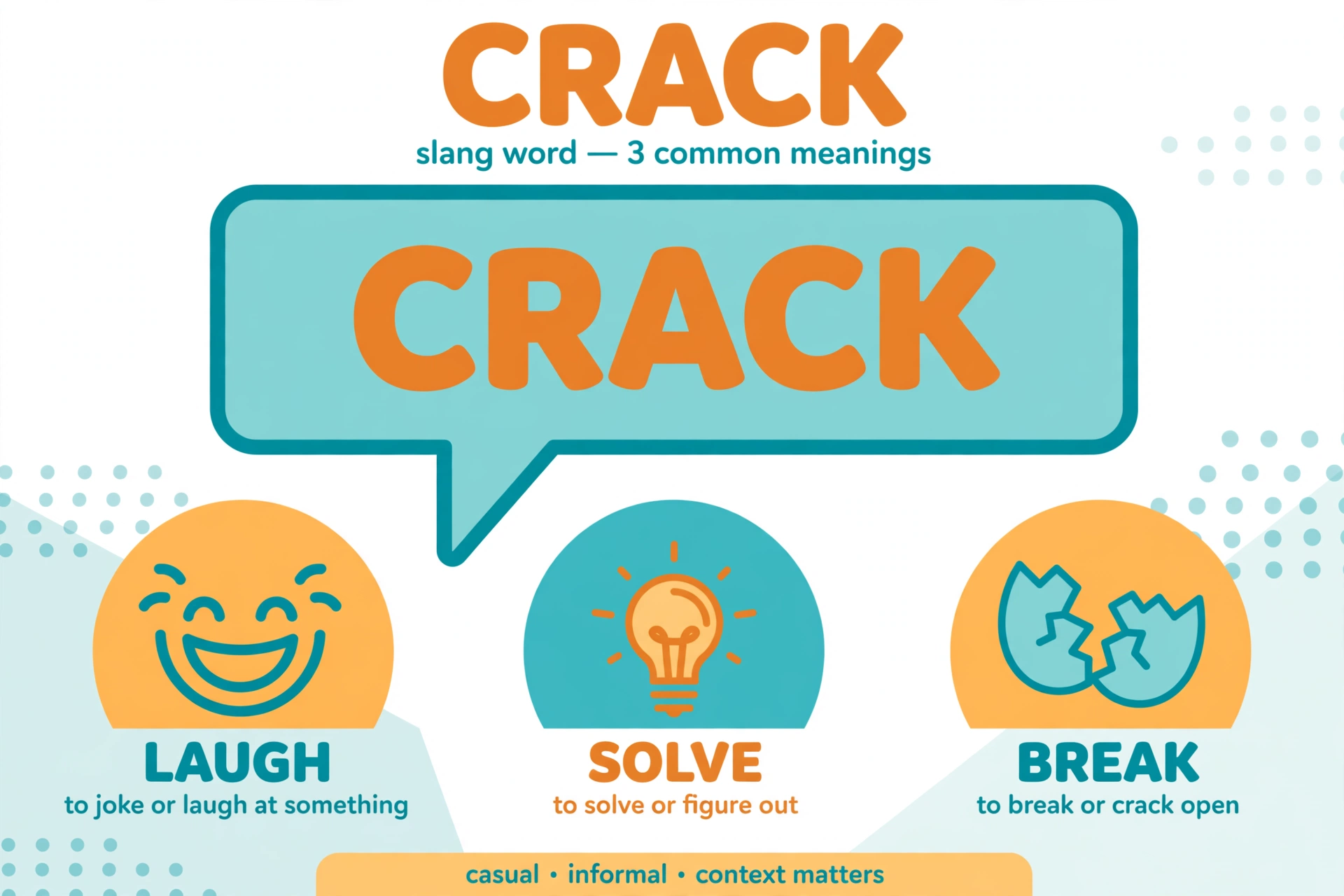
But “crack” also shows up in several other slang contexts:
- A joke or insult: “Don’t make cracks about her cooking.” — a crack is a sharp, funny, sometimes mean remark.
- Crack cocaine: In drug slang, “crack” is short for crack cocaine, a highly addictive form of cocaine. This is the serious, dangerous meaning, and it dominates news and crime reporting.
- To open or start: “Let’s crack open a cold one” means let’s open a beer and relax. “Crack a book” means to open a textbook and start studying.
- To solve or figure out: “She cracked the code” means she solved a puzzle, a password, or a difficult problem.
- A funny, sharp person: Someone who is “a crack” or “cracking” can be hilariously funny, especially in British and Irish slang, where “crack” (or “craic”) also means fun, gossip, and good conversation.
- To lose control or break down: “He cracked under pressure” means he could not handle the stress and broke down emotionally.
The key to understanding “crack” is context. The same four letters can be a harmless joke, a compliment about someone’s humour, or a reference to something dangerous. In this guide, we break down every major slang meaning of “crack,” where each one came from, and how to use the word without accidentally saying something you do not mean.
Introduction
You have probably heard “crack” used in a dozen different ways without ever stopping to think about it. A friend says “no cracks about my outfit, please.” A movie character says “crack open a cold one.” A gamer says “he’s cracked” — wait, that is a different word, but it is closely related, and we will get to that too.
Slang is messy. Words drift, split, and pick up new meanings every few years, and “crack” is a perfect example. It started as a word for a sharp noise — the crack of a whip, the crack of thunder — and over hundreds of years it stretched to cover jokes, drugs, solutions, and breakdowns. Today, if you search “crack meaning slang” on Google or TikTok, you will find people asking about all of these meanings at once, which is exactly why this guide exists.
Whether you saw “crack” in a text message, heard it in a song, or read it in a comment and felt unsure what it meant, this article gives you the full picture: the joke meaning, the drug meaning, the gaming connection, the British “craic” twist, and the polite alternatives you can use when you are not sure which meaning fits. By the end, you will know exactly what “crack” means in every context you are likely to meet.
Origin
The word “crack” has a long history in English, and its slang meanings grew out of its literal sense. Originally, “crack” described a sudden sharp sound — like a whip cracking or a branch snapping. From that sound, the word stretched in several directions at once.
The joke meaning came first. By the 1800s, a “crack” was already a witty remark in British and American English. The idea was simple: a good joke lands like a crack of a whip — sudden, sharp, and hard to ignore. Dictionaries from the 1840s list “crack” as a joke or a sarcastic comment, and the phrase “to crack a joke” — meaning to tell one — became standard English. That is why we still say someone “cracked a joke” or “made a crack” today.
The drug meaning arrived much later. “Crack” as shorthand for crack cocaine appeared in the 1980s, when the drug spread through American cities. The name comes from the crackling sound the drug makes when it is heated and smoked. This meaning is now so well known that it often overshadows the older, lighter meanings — which is one reason the word needs careful handling.
The “solve it” meaning — “crack the code,” “crack the case” — comes from the idea of breaking something open. A safe is cracked open; a code is cracked open; a mystery is cracked. The metaphor is physical: you break a hard shell to get at what is inside.
The Irish connection is a fun twist. In Ireland, “craic” (pronounced “crack”) means fun, entertainment, news, and good conversation. “What’s the crack?” means “what’s happening?” or “what’s the news?” This spelling — craic — was popularised in the 20th century, but the pronunciation and the spirit are the same word. When someone in Dublin says “the crack was mighty last night,” they mean the night was brilliant fun.
The gaming meaning is the newest. Around 2019, Fortnite players started calling exceptionally skilled players “cracked” — as in “that guy is cracked at Fortnite.” The term likely came from Apex Legends, where “cracked” meant an enemy’s shield was broken, and it was reinterpreted by Fortnite players to mean “unbelievably good.” That story is covered in detail in our guide to what “cracked” means in slang, and it shows how fast a word can pick up a brand-new life online.
Popularity
“Crack” is not a trendy new slang word — it is a durable one. Unlike TikTok slang that appears and vanishes in a month, “crack” has stayed in everyday English for over a century because it is useful. It is short, punchy, and flexible, and it fills gaps no other word fills quite as well.
That said, its popularity has shifted with culture:
- In comedy and casual speech, “crack” as a joke is as common as ever. “Don’t crack jokes at a funeral” is advice people still give, and “cracking up” (bursting into laughter) is a standard phrase in American English.
- In gaming and streaming, the related word “cracked” exploded in 2019 and is still everywhere on Twitch, TikTok, and YouTube. Gamers use it as the highest compliment for skill.
- In music and hip-hop, “crack” appears regularly — sometimes as drug slang, sometimes as a boast about being sharp or unbeatable. Lyrics use the word’s edge on purpose.
- On social media, “crack” shows up in memes, comments, and captions, usually in the joke sense (“the cracks in this group chat are unreal”) or the “crack open” sense (“crack open a cold one, it’s Friday”).
- In British and Irish English, “crack”/”craic” is a cultural staple. “What’s the crack?” is a standard greeting in Ireland, and “a good crack” means a great time.
Search data reflects this staying power. People search “crack meaning slang” because the word keeps appearing in new contexts — a song lyric, a game stream, a British TV show — and each context seems to mean something slightly different. The word’s popularity is not a spike; it is a plateau that has lasted for generations.
How It Is Used
“Crack” works as a noun, a verb, and part of dozens of fixed phrases. Here is how each form is used in real life:
As a noun (a joke or remark)
“That was a crack at my cooking, wasn’t it?” — a teasing or sarcastic remark. “He’s always making cracks about the boss.” This is the most common slang use, and it is usually playful, though it can turn mean.
As a verb (to tell a joke)
“He cracked a joke and the whole room laughed.” To “crack a joke” means to tell one. Similarly, “crack a smile” means to finally smile after trying not to, and “crack up” means to burst out laughing — “I cracked up when I saw the meme.”
As a verb (to open or start)
“Let’s crack open a bottle” means let’s open it and celebrate. “Crack a book” means to open a book and start studying — usually said with reluctance: “I haven’t cracked a book all semester.”
As a verb (to solve)
“She cracked the password in five minutes.” “Detectives finally cracked the case.” This use is about breaking through something difficult, and it sounds impressive because it suggests skill and persistence.
As a verb (to break down)
“He cracked under the pressure of the final exam.” This means someone could not cope and lost their composure. It is the emotional opposite of “cracking the code” — instead of breaking a problem open, the person breaks.
As drug slang (noun)
“He got caught selling crack.” This is the dangerous meaning, and it is almost always serious. In news, documentaries, and crime dramas, “crack” on its own usually means crack cocaine. If you hear it in this context, the conversation is not about jokes.
In British and Irish slang
“What’s the crack?” means “what’s going on?” or “what’s the news?” “The crack was great last night” means the party or night out was excellent fun. Spelled “craic” in Ireland, this is one of the friendliest uses of the word.
Examples
The best way to learn “crack” is to see it in real sentences. Here are examples grouped by tone, so you can feel how the word changes with context.
Friendly Examples
- “Stop making cracks about my driving — I got us here in one piece!”
- “He cracked a joke about the weather and everyone relaxed.”
- “Come on, crack open a cold one, it’s the weekend.”
- “What’s the crack? Anything fun happening tonight?”
- “I cracked up laughing at your last voice note.”
- “She’s such a crack — she had the whole table in stitches.”
Professional Examples
- “Our team finally cracked the client’s brief after three rounds of revisions.”
- “Please avoid making cracks about colleagues during meetings — keep it professional.”
- “She cracked the code on the new reporting system in a single afternoon.”
- “He cracked a smile when the CEO praised the project.”
- “Let’s not crack under pressure — we have a plan, and we stick to it.”
Funny Examples
- “My dad cracks the same joke every Thanksgiving and still laughs at it himself.”
- “I tried to crack a joke in the group chat and got left on read. Brutal.”
- “He cracked open the textbook, stared at page one, and immediately closed it again.”
- “The Wi-Fi cracked under the pressure of twelve people streaming at once.”
- “She made a crack about my haircut and now I can’t unsee it.”
Comparison with Similar Terms
“Crack” overlaps with several other slang words, but each one has its own flavour. This table makes the differences clear:
| Term | Meaning | How It Differs from “Crack” | Example |
|---|---|---|---|
| Crack | A joke, witty remark, or sarcastic comment | The original, most flexible term | “That was a crack at my expense.” |
| Cracked | Extremely skilled (gaming) or crazy | An adjective describing a person; “crack” is the remark itself | “He’s cracked at Fortnite.” |
| Roast | A harsh, funny insult aimed at someone | Stronger and more deliberate than a crack | “They roasted him for an hour straight.” |
| Diss | An insult, usually disrespectful | Always negative; a crack can be affectionate | “Don’t diss my favourite show.” |
| Banter | Playful back-and-forth teasing | A conversation, not a single remark | “Their banter is the best part of the podcast.” |
| Cooked | Done for, finished, in trouble | Describes a bad situation; “crack” describes a remark | “I’m so cooked for this exam.” |
| Craic | Fun, news, good conversation (Irish) | Same sound, different spelling and culture | “What’s the craic tonight?” |
| Wise crack | A clever, sarcastic joke | A specific type of crack — the witty one | “Save your wisecracks for later.” |
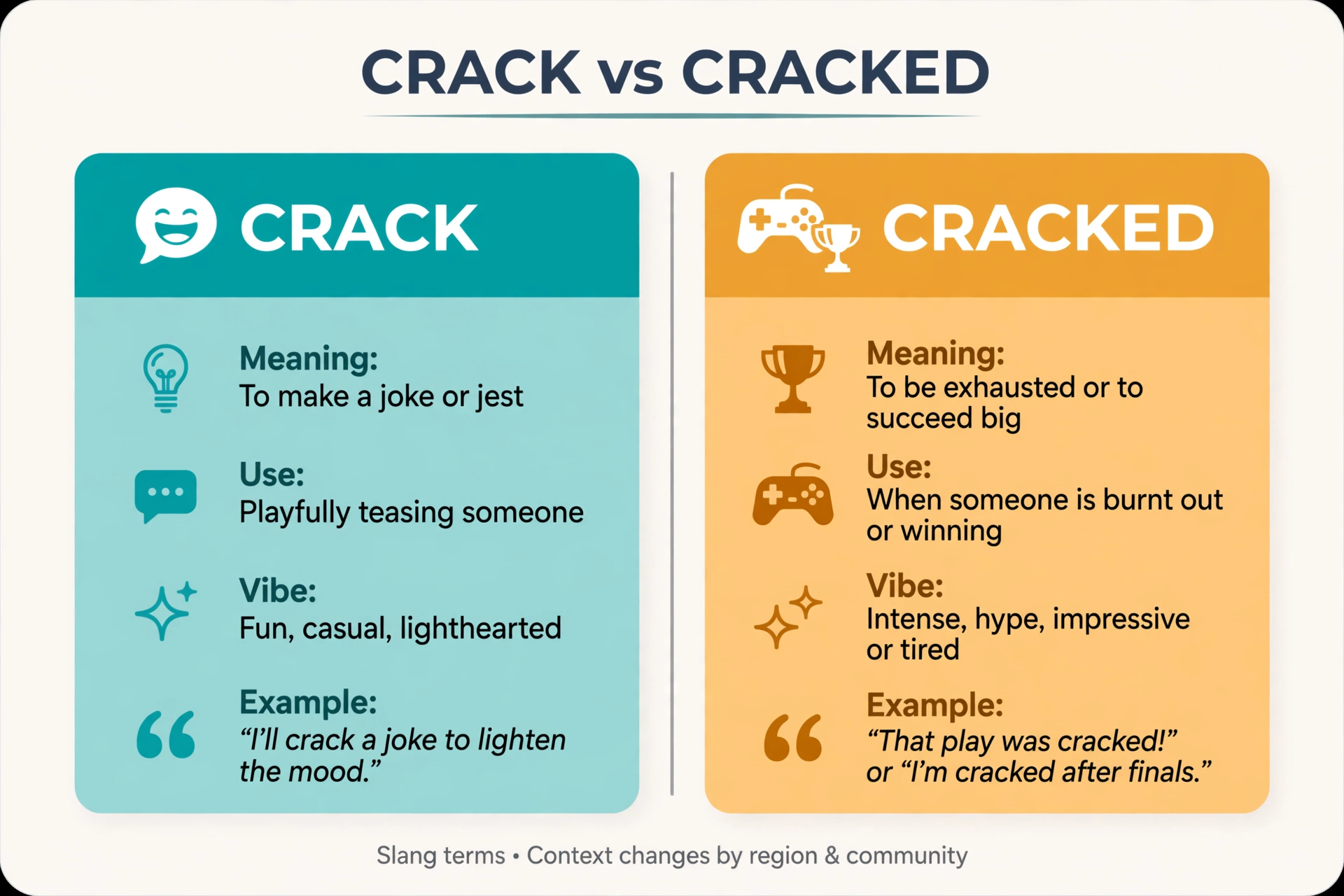
The closest cousin is “cracked,” and the two get confused constantly. Remember: a crack is something you say (a joke), while cracked is something you are (skilled, or crazy). If someone says “nice crack,” they liked your joke. If someone says “you’re cracked,” they think you are either insanely good at a game or a little bit mad — and the context will tell you which one. Our full guide to cracked breaks that word down in detail, and if you want to see how another gaming-era word works, check out what “cooked” means in slang — it is the word people reach for when a crack goes wrong.
Alternate Meanings
Beyond the slang uses, “crack” has several other meanings that are worth knowing, because they often appear in the same conversations:
- A physical split: The literal meaning — a crack in a phone screen, a wall, or a mirror. “I dropped my phone and now the screen is cracked.”
- A sharp sound: The crack of a whip, a bat hitting a ball, or thunder. This is where the word started.
- A small amount: “The crack of dawn” means the very first light of morning — the earliest moment of the day.
- An attempt: “Give it a crack” (British/Australian) means “give it a try.” “I’ll have a crack at fixing it” means I’ll attempt the repair.
- A top-quality thing: In British slang, a “crack” player or a “cracking” performance means an excellent one. “She gave a cracking performance” is high praise.
- To break into: “Crack a safe” means to break into it. In cybersecurity, “cracking” a password means breaking it by force.
- Drug slang: As covered above, “crack” alone very often means crack cocaine — the meaning you should assume in news, legal, or crime contexts unless the context clearly says otherwise.
- A sexual slang meaning: In some newer teen slang guides, “cracked” has also been listed as a crude term for having sex. This use is recent, uncommon, and mostly appears in parent guides warning about teen slang — not something you will hear in normal conversation, but worth knowing so the word does not surprise you.
Because the word has so many meanings, native speakers rely heavily on tone and situation. A sentence like “he’s on crack” is unambiguous — it is about drugs. A sentence like “nice crack” at a comedy show is unambiguous too — it is about a joke. The trouble only starts in text messages, where tone is invisible.
Professional or Polite Alternatives
Sometimes “crack” is too casual, too ambiguous, or too risky for the situation. Here are polished alternatives for each meaning:
| Instead of saying | Say this in formal settings |
|---|---|
| “He made a crack about the report.” | “He made a lighthearted comment about the report.” |
| “Don’t crack jokes in the meeting.” | “Let’s keep the discussion focused and professional.” |
| “She cracked the code.” | “She solved the problem” or “She found the solution.” |
| “I cracked up at his email.” | “His email made me laugh out loud.” |
| “Let’s crack open a cold one.” | “Let’s open a drink and relax.” |
| “He cracked under pressure.” | “He struggled to cope with the pressure.” |
| “What’s the crack?” | “What’s new?” or “How are things going?” |
| “Give it a crack.” | “Give it a try” or “Make an attempt.” |
The general rule: in work emails, formal writing, and conversations with people you do not know well, swap “crack” for the plain version. The meaning stays the same, but the risk of misunderstanding disappears — especially the risk that someone hears the drug meaning when you meant the joke meaning.
Common Mistakes
People get “crack” wrong in a few predictable ways. Avoid these and you will use the word like a native speaker:
- Using the drug meaning by accident: Saying “he’s on crack” as a joke about someone acting hyper is risky — it literally accuses them of drug use. If you mean “he’s acting wild,” say that instead.
- Confusing “crack” with “cracked”: “Nice crack” praises a joke. “You’re cracked” says someone is insanely skilled or crazy. Mixing them up changes the compliment completely.
- Making cracks at the wrong moment: A crack is a joke with an edge. Making one during a serious meeting, a funeral, or an argument will land badly. Read the room first.
- Overusing it in writing: “Crack” is informal. In essays, reports, and formal emails, it looks out of place. Use the plain alternative instead.
- Assuming the Irish meaning everywhere: “What’s the crack?” is a friendly greeting in Ireland, but in the US it can sound like you are asking about drugs. Know your audience before you use it.
- Forgetting the tone: In text messages, “nice crack” without context can read as sarcastic or hostile. Add an emoji or a follow-up line if you mean it warmly.
- Using it to describe violence: “Crack” can describe breaking something (“crack a safe,” “crack a skull” in old crime slang). Do not use these phrases lightly — they sound threatening.
Quick Tips
- Check the context first: Before you react to “crack” in a message, read the whole sentence. The same word means a joke, a drug, or a solution depending on the words around it.
- In gaming, “cracked” is a compliment: If a teammate calls you cracked, take it as praise — you played brilliantly.
- In Ireland, “crack” means fun: If an Irish friend asks “what’s the crack?”, they are asking what’s happening, not offering you anything illegal.
- Keep cracks kind: A good crack makes everyone laugh, including the person it is about. If only you are laughing, it was not a crack — it was an insult.
- Use “crack a joke” instead of “make a crack” when in doubt: The first is clearly about humour; the second can sound sharper.
- Don’t use drug slang casually: Joking about crack cocaine can offend people who have been affected by addiction. Keep that meaning out of casual conversation.
- Learn the phrases, not just the word: “Crack up,” “crack open,” “crack the code,” and “crack a smile” are the phrases native speakers actually use. Memorise the phrases and the word takes care of itself.
FAQ
What does “crack” mean in slang?
In slang, “crack” most commonly means a joke, a witty remark, or a sarcastic comment — as in “he made a crack about my haircut.” It can also mean crack cocaine, to open something (“crack open a cold one”), or to solve something (“crack the code”). The exact meaning depends on the context.
What does “cracked” mean in gaming slang?
In gaming, “cracked” means extremely skilled — a player who is “cracked” at Fortnite or Valorant is playing at an elite, almost superhuman level. The term became popular in Fortnite culture around 2019 and is now one of the highest compliments in gaming.
Is “crack” a bad word?
“Crack” is not a swear word, but it can be offensive depending on the meaning. The joke sense is harmless, while the drug sense is serious. Joking about crack cocaine can offend people affected by addiction, so use the word carefully and keep the context clear.
What does “what’s the crack?” mean?
“What’s the crack?” is Irish slang for “what’s happening?” or “what’s the news?” — a friendly greeting. In Ireland it is spelled “craic” and means fun, gossip, and good conversation. Outside Ireland, the same phrase can be misunderstood, so use it with people who know the meaning.
What does “crack a joke” mean?
“To crack a joke” means to tell a joke. It comes from the idea of a joke landing suddenly and sharply, like the crack of a whip. It is standard, everyday English and has been in use since the 1800s.
What does “crack open a cold one” mean?
“Crack open a cold one” means to open a cold beer (or another cold drink) and relax, usually with friends. It is a casual, celebratory phrase that signals the start of downtime — the end of the workday, a barbecue, or a weekend hangout.
What is the difference between “crack” and “cracked”?
“Crack” is usually a noun meaning a joke or remark (“that was a crack at me”), while “cracked” is an adjective describing a person — either extremely skilled at a game or, in older slang, crazy. One is something you say; the other is something you are.
What does “crack the code” mean?
“To crack the code” means to solve a difficult problem, puzzle, or password — to figure out something that seemed impossible. It comes from the idea of breaking something open, like cracking a safe, and it is used for everything from detective work to debugging software.
Conclusion
“Crack” is a small word with a big range. At its friendliest, it is a joke that makes a room laugh. At its most useful, it is the verb for solving hard problems and opening cold drinks on a Friday evening. At its most serious, it is a drug that has caused real harm. And in Ireland, it is the word for a great night out.
The trick to using “crack” well is the same trick that works for all slang: read the context before you react, and choose your audience before you speak. In a group chat with friends, a crack is a joke. In a gaming lobby, being cracked is a compliment. In a work email, the plain version of the sentence is always the safer choice. And if you ever hear “what’s the crack?” from an Irish friend, smile — they are just asking how you are.
Slang keeps moving, and “crack” will keep picking up new shades of meaning as it moves from group chats to games to songs. The meanings in this guide cover everything you are likely to meet in 2026 — and if you want to keep building your slang vocabulary, our guides to what “GOAT” means in slang and what “aura” means in slang are the perfect next reads. Keep your cracks kind, your code cracked, and your cold ones ready — and you will never be caught out by this word again.
