
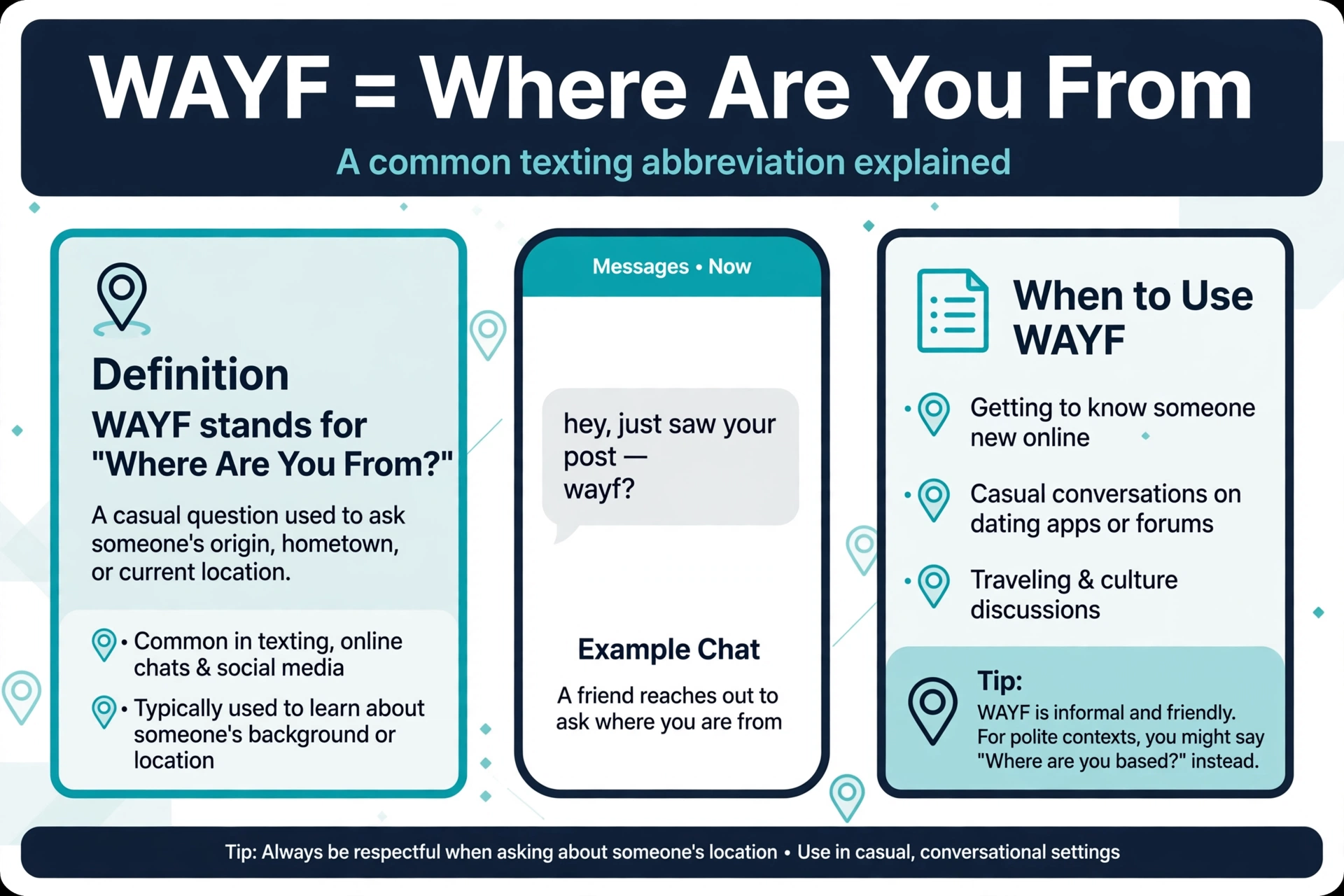
Quick definition: WAYF means “where are you from” — a casual texting abbreviation people use as a quick icebreaker in DMs, on Snapchat, and on dating apps. If a stranger opens a conversation with “hey, wayf?”, they are simply asking about your hometown or where you live, and they are hoping the answer sparks a real conversation.
WAYF Meaning & Definition
In texting and on social media, WAYF stands for “where are you from.” It is the four-letter cousin of the even shorter WYF (“where you from”), and both do exactly the same job: they ask about someone’s origins or current location in the fewest keystrokes possible.
WAYF almost always appears as a conversation opener. Unlike abbreviations that carry attitude or humor, WAYF is neutral and curious — it is the digital equivalent of small talk. Someone who sends “wayf” is usually trying to find common ground: maybe you are from the same city, maybe you live nearby, or maybe your answer gives them something interesting to ask about next.
The abbreviation is most at home in one-on-one chats rather than group conversations or public comments. You will see it in Snapchat DMs, Instagram message requests, Tinder and Hinge openers, Discord introductions, and plain old text messages when someone gets your number for the first time. It is short, low-pressure, and easy to answer — which is exactly why it became one of the default first questions of the texting era.
One thing worth knowing upfront: because WAYF asks for personal information, context and safety matter. Answering a close friend is very different from answering a stranger on a dating app, and this guide covers how to handle both — plus what to say when you would rather not answer at all.
Introduction
Every era of communication has its signature icebreaker. In person, it is “so, where are you from?” Online, where every character once cost effort and attention spans run short, that same question got compressed into four letters: WAYF. It is not flashy, it is not funny, and it will never go viral as a meme — but it might be one of the most useful abbreviations in all of texting slang, because it does the quiet work of starting conversations between strangers every single day.
Think about the last time you matched with someone on a dating app, got a Snapchat add from a friend of a friend, or joined a new Discord server. The first real question anyone asks is almost always about place — where you grew up, where you live now, what city shaped you. Location is the fastest shortcut to connection: shared hometowns create instant bond, and different ones create instant curiosity. WAYF exists because texting culture needed a frictionless way to ask that question, and “where are you from?” was simply too many words for a quick DM.
WAYF also belongs to a whole family of location-asking slang. Its closest relative is WYFF (“where you from, fam”), the friendlier three-letter version that pops up in the same DMs and dating-app openers. Learning the family helps you decode new variations the moment they appear — and it helps you answer with confidence instead of confusion.
In this complete guide, we break down the wayf meaning in text, where the abbreviation came from, how people actually use it across platforms, how it compares to similar terms, the mistakes that trip people up (including a real safety consideration), and — most practically — exactly what to reply when someone drops “wayf?” in your inbox.
Origin
WAYF was born in the world of early SMS shorthand culture, the era when texting on numeric keypads made every extra character a chore. Abbreviations like LOL, BRB, and OMG emerged from that constraint, and question-asking abbreviations followed close behind. “Where are you from?” — six syllables, eighteen characters — was an obvious candidate for compression.
The shorter form WYF (“where you from”) came first in most chat abbreviation lists, dropping the “are” entirely. WAYF kept the “A” for “are,” making it slightly more grammatical and, to some users, slightly clearer. Both spellings circulated in SMS glossaries and chat-room lingo through the 2000s, and both survived into the smartphone era — a testament to how sticky a good icebreaker can be.
The abbreviation got its second wind with Snapchat and dating apps in the 2010s. These platforms created a brand-new social situation: conversations with total strangers that needed to start fast. On Tinder, Hinge, and Bumble, “wayf” became a standard opener — short enough to send without overthinking, open-ended enough to keep the chat alive. Snapchat’s quick-add culture did the same thing: when you add someone you barely know, “hey wayf?” is the lowest-effort way to turn a contact into a conversation.
Unlike slang that burns bright and fades (remember when everyone said “on fleek”?), WAYF has stayed relevant because the need it serves never goes away. As long as strangers keep meeting online, they will keep asking where each other is from — and they will keep abbreviating it.
Popularity
WAYF’s popularity is quiet but enormous. It does not trend on TikTok or star in viral memes, because it is infrastructure slang — the unglamorous plumbing of digital conversation. But by that same token, it is everywhere:
- Dating apps — Tinder, Hinge, and Bumble openers. “Hey! wayf? 👀” is one of the most common first messages, especially when a profile gives few conversation hooks.
- Snapchat — DMs and quick-add chats. New snap friends use it to figure out whether you are local or long-distance.
- Instagram DMs — message requests from new followers, especially after meeting someone briefly in real life (“wait, we met at the concert — wayf?”).
- Discord and gaming — new server members introducing themselves; teammates figuring out time zones before a gaming session.
- Plain texting — when someone gets your number through a mutual friend and wants to place you geographically before suggesting plans.
The abbreviation skews young and casual — Gen Z and millennials are its core users — but the question it asks is universal. Parents texting their kids’ new friends, newcomers in group chats, and networking contacts all use some version of it; they just spell it out more often.
WAYF also benefits from being platform-agnostic. Slang tied to one app’s culture (like Snapchat streaks lingo) fades when the app does. WAYF works identically in a text message, a DM, a dating app, or a chat room, which is why it has outlasted flashier abbreviations that came and went.
How It Is Used
WAYF is used almost exclusively as a direct question, and it follows a few reliable patterns:
- As a cold opener: “hey, wayf?” — the classic. Short, friendly, and clearly a conversation starter rather than small talk.
- After an introduction: “I’m Jake btw, wayf?” — pairing the question with a name makes it feel warmer and more personal.
- As a follow-up: “oh nice, I’m in Chicago. wayf?” — answering first and then asking back is the polite, balanced way to use it.
- With an emoji softener: “wayf? 👀” or “wayf? 😊” — emojis signal friendly curiosity and take any interrogation edge off the question.
Grammatically, WAYF behaves like the full question it replaces. It can open a conversation, follow an answer, or stand alone as a complete message. It is virtually always written in lowercase (“wayf”) in casual chats — all-caps “WAYF” can read as shouting or oddly formal, so most people keep it chill.
Timing matters too. WAYF lands best early in a conversation, when two people are still placing each other. Dropping “wayf?” three weeks into a friendship feels strange — by then, you are supposed to know. And the expected answer is equally simple: a city, a state, or a country, usually followed by returning the question (“Austin, you?”).
Examples
Seeing WAYF in realistic conversations is the fastest way to understand its tone. Here is how it sounds across different contexts:
Friendly Examples
- Person A: “heyy, we matched! wayf? 😊”
Person B: “hey! I’m from Denver, you?”
Why it works: warm, mutual, and the emoji keeps it light — the gold standard WAYF exchange. - Person A: “oh you’re into hiking too?? wayf”
Person B: “Seattle! tons of trails here. u?”
Why it works: the question follows a shared interest, so it feels like curiosity rather than an interrogation. - Person A: “just moved here and know nobody lol. wayf?”
Person B: “born and raised here! happy to show you around”
Why it works: vulnerability first (“know nobody lol”) makes the question feel genuine instead of nosy.
Professional Examples
Here is the honest truth: WAYF itself is not professional language. You should not drop “wayf?” in a work email, a LinkedIn message, or a Slack thread with your manager. But the question behind it comes up constantly in professional settings — it just wears different clothes:
- Networking event follow-up: “Great meeting you today! Where are you based?”
- Remote work intro: “Welcome to the team! Which city are you working from?”
- Client small talk: “Before we dive in — where are you located these days?”
The pattern is the same as WAYF — place-based small talk that builds rapport — but the phrasing stays complete and polished. (More on professional alternatives below.)
Funny Examples
- Person A: “wayf?”
Person B: “mentally? the void. physically? Ohio 😭”
Why it is funny: dodges the literal question with self-deprecating humor — a classic Gen Z deflection. - Person A: “wayf”
Person B: “my mom’s house. I’m 27. please don’t ask follow-ups”
Why it is funny: oversharing as comedy; the fake boundary (“don’t ask follow-ups”) is the punchline. - Person A: “wayf? 👀”
Person B: “Earth. mostly.”
Why it is funny: technically true, maximally unhelpful — the dry humor lands because the question was so earnest.

Comparison with Similar Terms
WAYF sits in a crowded neighborhood of location-and-identity abbreviations. They look alike, but each asks a slightly different question — mixing them up is one of the most common texting mistakes:
| Term | Stands For | What It Really Asks | When to Use It |
|---|---|---|---|
| WAYF | Where are you from | Your hometown or home city | Meeting someone new; the classic icebreaker |
| WYF | Where you from | Same as WAYF, minus “are” | Interchangeable with WAYF — pick your spelling |
| WYFF | Where you from, fam | Same question, friendlier packaging | When you want the question to sound warm and casual |
| WYA | Where you at | Your current location | Coordinating meetups — NOT the same as WAYF |
| WYB | Where you been | Where you have been lately | Catching up with someone you already know |
| ASL | Age / sex / location | Three personal facts at once | Mostly retired — reads as dated or creepy now |
| HBU | How about you | Returns any question | The perfect follow-up after answering WAYF |
The most important distinction is WAYF vs. WYA. WAYF asks where you are from — your roots. WYA asks where you are — your current spot, usually because someone wants to meet up. Answering “where are you from?” with your live location (or vice versa) creates exactly the kind of confusion these abbreviations were supposed to prevent.
WAYF vs. WYB is the other easy mix-up. WYB (“where you been”) is for people you already know — it asks about their recent whereabouts, not their hometown. A stranger asking “wyb?” as an opener feels off; a friend asking it feels normal.
And then there is ASL, the grandparent of all these terms. In early chat rooms, “asl?” demanded age, sex, and location in one blunt question. It worked in 1999; today it reads as invasive. WAYF is essentially ASL’s polite modern descendant — it asks for just the location third, and only that.

Alternate Meanings
Let us be straightforward: WAYF has one dominant meaning — “where are you from” — and it covers the overwhelming majority of real-world uses. Unlike abbreviations with genuinely split personalities, WAYF is refreshingly unambiguous.
That said, a few edge cases exist:
- “Where are your friends?” — extremely rare, and only in contexts where friends were just mentioned. If someone asks “wayf?” right after talking about a group outing, this reading is possible, but the hometown meaning is still far more likely.
- Typo for “way” + “f” — occasionally “wayf” is just a typo or an intensifier fragment (“that’s wayf funny” is not a thing, but fat-fingered “way” happens). If the sentence makes no sense as a question, assume thumbs slipped.
- Confusion with “what are you feeling” — some newcomers guess this, but the standard abbreviation for that idea is different, and native texters do not use WAYF this way.
The practical rule: if “where are you from?” fits the sentence, that is the meaning. In the rare case it does not fit at all, just ask — “did you mean where I’m from?” takes two seconds and beats guessing wrong.
Professional or Polite Alternatives
WAYF is perfect for casual chats and completely wrong for professional ones. When the setting calls for polish, swap the abbreviation for the full question — or better, a warmer variant:
- “Where are you based?” — the professional gold standard. Neutral, modern, and works for remote workers and travelers alike.
- “Where are you located?” — slightly more formal; great for client emails and introductions.
- “Which city are you in?” — casual-professional; perfect for networking follow-ups and conference small talk.
- “Where do you call home?” — warm and personal without being nosy; ideal when you want the conversation to feel human.
- “Are you local to the area?” — useful when location matters practically, like planning an in-person meetup.
Notice what these alternatives share: they are complete sentences, they soften the directness with framing (“before we dive in,” “great meeting you”), and none of them is an abbreviation. In professional writing, spelling things out signals respect for the reader’s time and attention — the exact opposite of what abbreviations are for.
Common Mistakes
WAYF is simple, but people still get it wrong. Here are the mistakes to avoid:
- Oversharing with strangers. The biggest WAYF mistake is also a safety issue. “123 Maple Street, apartment 4B” is never the right answer to a stranger’s “wayf?” Start vague — city or region is plenty — and get specific only as trust builds.
- Confusing WAYF with WYA. As covered above: WAYF = where you are from, WYA = where you are. Giving your live location to someone who asked about your hometown (or vice versa) causes real confusion.
- Using it too late. Asking “wayf?” weeks into a friendship implies you have not been paying attention. It is an opener, not a mid-conversation question.
- One-word dead-end answers. Replying “Texas.” with no follow-up kills the conversation you just started. Add a hook: “Texas — born and raised. You?”
- Assuming romantic intent. WAYF is usually just curiosity, not flirting. Reading romance into a neutral icebreaker leads to awkward misreads (more on this in the FAQ).
- Using it professionally. “wayf?” in a LinkedIn message or work email reads as sloppy. Spell it out or use an alternative from the section above.
- Ignoring the question. If someone asks “wayf?” and you change the subject without answering, it reads as evasive. A light deflection (“haha, all over — you?”) keeps things smooth if you would rather not say.

Quick Tips
Want to handle WAYF like a texting native? These tips cover both asking and answering:
- Answer first, then ask back. “I’m from Austin — wayf?” feels generous; a bare “wayf?” can feel like an interview. Leading with your own answer sets a reciprocal tone.
- Start vague with strangers. City or state is enough for a new match or a fresh follow. (“Portland area, you?”) Save the neighborhood for people you trust.
- Add a conversation hook. The best WAYF answers include something to react to: “Chicago — deep-dish capital of the world 🍕” beats “Chicago.” every time.
- Mirror the energy. Casual “wayf? 👀” gets a casual answer. A longer, warmer introduction deserves a longer, warmer reply.
- Pair it with HBU. After answering any version of the location question, “hbu?” (how about you) keeps the rally going without repeating “wayf?” awkwardly.
- Watch for red flags. If a stranger pushes for specifics — exact address, “send your location,” workplace — after a vague answer, that is a boundary test. You do not owe precision to someone you just met.
- It is okay not to answer. Privacy is a complete reason. “I’d rather not say just yet — but I’m on the East Coast!” is friendly, honest, and boundary-respecting.
- Do not use it as your only opener. On dating apps, “hey wayf?” works, but “hey! I see you’re into climbing — wayf?” works better. One personal detail transforms a generic question into a real conversation starter.


FAQ
1. What does WAYF mean in texting?
WAYF stands for “where are you from.” It is a casual abbreviation used as a conversation starter in texts, DMs, and chats — the texter is asking about your hometown or where you live.
2. What is the wayf meaning in text on Snapchat and TikTok?
The meaning is the same on every platform: “where are you from.” On Snapchat it usually appears in DMs with new adds (“hey, wayf?”), and on TikTok it shows up in comments or message threads when creators and viewers start chatting. The platform does not change the definition — only the context around it.
3. What does WAYF mean from a guy or a girl — is it flirty?
Not inherently. WAYF is a neutral icebreaker, and most of the time it means exactly what it says: the person is curious where you are from. It can carry flirty energy if the surrounding conversation is flirty — compliments, late-night timing, sustained attention — but the abbreviation itself is not a signal. Read the whole conversation, not just the four letters.
4. What is the difference between WAYF and WYF?
Almost nothing. WAYF spells out “where are you from” (keeping the “are”), while WYF compresses it to “where you from.” They are interchangeable in practice — it is purely a spelling preference, like “gonna” vs. “going to.” Use whichever you like; everyone understands both.
5. How do you reply when someone asks “wayf?”
Give a short, friendly answer and return the question: “I’m from Austin, you?” Add a small hook if you want to keep the chat alive (“Chicago — deep-dish capital 🍕”). With strangers, keep it vague (city/state); with friends, be as specific as you like.
6. Is WAYF rude or offensive?
No — WAYF is neutral and polite as far as internet slang goes. It only becomes uncomfortable if someone uses it to pressure you for personal details you do not want to share. The question itself is fine; pushy follow-ups are not.
7. What does WAYF mean on dating apps like Tinder and Hinge?
Same meaning — “where are you from” — but the intent is often practical: people want to know if you live close enough to actually meet. On dating apps it frequently leads to logistics (“oh nice, I’m in Brooklyn too — ever been to…?”), so expect the conversation to move toward plans quickly.
8. Are there other meanings of WAYF?
Very rarely. In odd contexts it could be a typo or, extremely rarely, shorthand for “where are your friends” — but “where are you from” covers the vast majority of real uses. If that reading does not fit the conversation at all, just ask what they meant.
Conclusion
So, what does WAYF mean? Simply put: “where are you from” — the texting world’s favorite icebreaker. You now know where it came from (SMS shorthand culture, refined by Snapchat and dating apps), how to use it naturally, how it differs from lookalikes like WYA and WYB, the mistakes that trip people up, and exactly what to reply — including how to protect your privacy when a stranger asks.
The golden rule is simple: match your answer to your comfort level. A city and a returned question keep things friendly with someone new; details and stories are for people who have earned them. WAYF is an invitation to connect, not an obligation to disclose — treat it that way, and every “wayf?” becomes an easy win instead of an awkward moment.
Slang moves fast, and the location-asking family keeps growing — if this guide helped, check out our breakdown of WYGG, another texting acronym from the same curious family. Now go answer that DM with confidence — and do not forget to ask back. 😄

1 thought on “WAYF Meaning in Text: What It Really Means & How to Reply”