Quick definition: Old slang means the informal words and phrases people used in past decades — from the 1920s through the 1990s — that sound old-fashioned today. In text messages and online chats, people use old slang for humor, nostalgia, or retro style, like saying “that’s groovy” instead of “that’s cool” or “don’t have a cow” instead of “don’t overreact.”
Old Slang Meaning & Definition
Old slang refers to the casual, unofficial vocabulary of earlier generations. Every decade invents its own secret language, and when that decade ends, its slang becomes “old slang” — a time capsule of how people talked, joked, and showed attitude in the past.
When someone says a word is old slang, they usually mean one of two things. First, the word was popular slang in a past era but has mostly fallen out of everyday use — think “groovy” from the 1970s or “the bee’s knees” from the 1920s. Second, the word is still understood today but sounds deliberately vintage or funny when used now, like calling a great party “a gas” or telling someone to “scram.”
Old slang is not the same as formal old-fashioned English. Words like “thou” or “whence” belong to old formal English, while old slang was always informal, playful, and often a little rebellious. It came from jazz clubs, street corners, military bases, surfer beaches, disco floors, and high-school hallways — anywhere young people wanted a language of their own.
Today, old slang meaning in text is mostly about tone. Nobody texts “groovy” by accident in 2026. People use these words on purpose: to be funny, to sound retro-cool, to bond with older relatives, or to add personality to a meme, caption, or TikTok. Understanding old slang helps you decode movies, songs, grandparents’ stories, and the flood of “vintage slang” content all over social media.
Introduction
Picture this: your grandma texts you “that new jacket is the cat’s pajamas,” and you stare at your phone wondering why she is talking about a cat’s sleepwear. Or a friend captions a photo “feeling groovy today” and half the comments are laughing emojis while the other half are confused. Welcome to the world of old slang — words that were once the coolest thing anyone could say and now live on as charming, funny echoes of the past.
Slang never really dies. It just changes address. Some old slang words quietly retire, some get adopted by new generations with a wink, and some survive so well that people forget they were ever slang at all. “Cool” itself started as 1940s jazz slang, and look at it now — it never left. “Dude” began in the 1800s, survived the 1970s, and is still going strong in group chats today.
In this guide, you will learn exactly what old slang means, where it came from, and how to use it without sounding like you time-traveled by mistake. You will get 40+ vintage slang words and phrases with meanings and real examples, decade-by-decade, plus the mistakes to avoid and the modern words to use instead when you want to sound current. Whether you are decoding a retro movie, writing a nostalgic caption, or just trying to understand what your parents mean when they say “far out,” this is the complete guide.
Origin
Slang has been part of English for hundreds of years, but old slang as we know it really took off in the 20th century, when mass media started spreading youth language faster than ever before. Each decade had its own engine for creating slang.
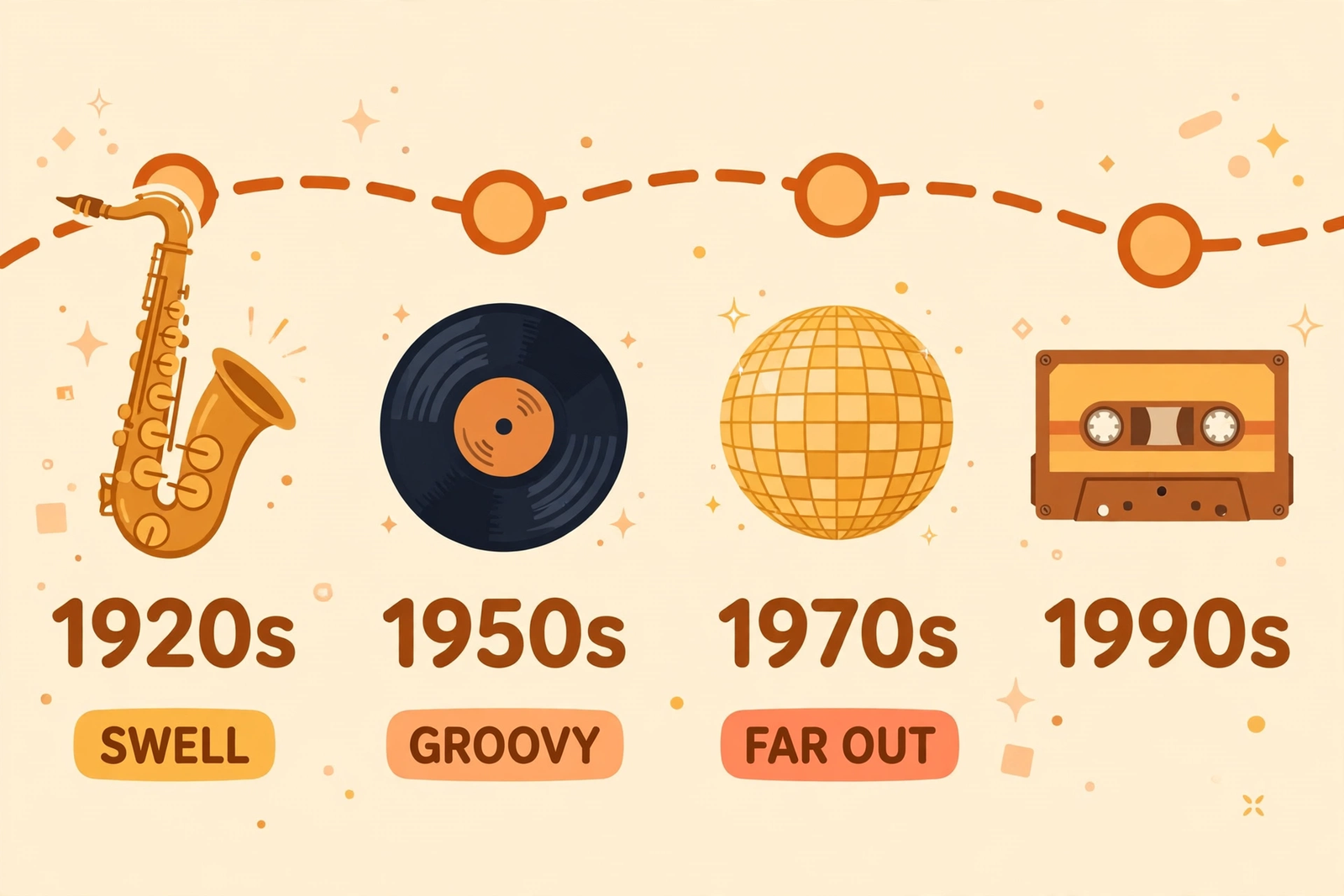
The 1920s gave us jazz-age slang. Prohibition-era speakeasies, jazz clubs, and flapper culture produced words like “the bee’s knees” (something excellent), “giggle water” (alcohol), “swell” (great), and “baloney” (nonsense). Much of it came from African American jazz musicians and then spread through radio and early Hollywood films.
The 1940s and 1950s added wartime and rock-and-roll slang. Soldiers brought home words like “snafu” and “fubar,” while teenagers adopted “cool cat,” “dig it” (understand it or like it), “daddy-o,” and “square” for anyone uncool. The word “cool” itself was jazz slang for calm, stylish, and in control — a meaning it has never lost.
The 1960s and 1970s were the golden age of slang. Hippie culture, the counterculture movement, disco, and funk gave us “groovy,” “far out,” “right on,” “peace out,” “boogie,” “outta sight,” “jive turkey,” and “catch you on the flip side.” These words were loud, joyful, and deliberately different from how parents talked — which was exactly the point.
The 1980s and 1990s rounded out the classic era. Valley Girl slang (“like, totally,” “gag me with a spoon”), hip-hop slang (“dope,” “fly,” “fresh”), and surfer and skater slang (“gnarly,” “rad,” “dude”) all piled in. Many of these words, like “awesome” and “rad,” are still understood by everyone, even if they now sound charmingly retro.
So where did all this slang come from? The same places slang always comes from: music, movies, the military, sports, street life, and young people inventing words faster than dictionaries could record them. Slang is born when a group wants to sound like itself and unlike everyone else — and it becomes “old slang” the moment the next generation invents its own version.
Popularity
Old slang is having a surprising second act. On TikTok and Instagram, “vintage slang” videos regularly go viral, with creators testing whether Gen Z can guess what “the bee’s knees” or “23 skidoo” means. Retro-themed parties, throwback playlists, and 70s and 90s nostalgia fashion have all pushed old words back into everyday conversation.
Movies and TV keep old slang alive too. Every time a period drama, a gangster film, or a retro comedy uses words like “scram,” “dame,” “swell,” or “groovy,” millions of viewers hear them again. Streaming has made old movies more accessible than ever, so slang from 50 or 80 years ago reaches new audiences every day.
There is also a practical reason old slang stays popular: it is fun. Modern texting slang is often short and cryptic — “lol,” “ngl,” “imo” — while old slang is colorful and descriptive. Saying “that party was a gas” paints a much better picture than “that party was lit,” and saying “don’t have a cow” is funnier than “calm down.” People reach for old slang when they want personality, not just efficiency.
That said, old slang is popular as a style choice, not as everyday speech. Nobody under 40 naturally says “groovy” in a work email. The charm is in the deliberate retro flavor — using it at the right moment, with the right audience, and with a smile.
How It Is Used
Old slang shows up in modern life in a few clear ways. Understanding the context helps you use it correctly — and spot it when someone else does.
- For humor: Dropping a word like “groovy” or “far out” into a normal text is a joke in itself. The contrast between the old word and the modern setting is what makes people laugh.
- For nostalgia: People use old slang to celebrate a past era — at a 70s-themed party, in a retro photo caption, or when talking about a favorite old movie or song.
- For emphasis: Some old slang words are just more expressive than modern ones. “Outta sight” feels bigger than “amazing.” “That’s the bee’s knees” feels more delighted than “that’s great.”
- For bonding across generations: Using your parents’ or grandparents’ slang is a warm way to connect. It says, “I know your world, and I like it.”
- For style and branding: Cafes, clothing brands, and content creators use old slang to create a vintage vibe — “groovy” on a T-shirt or “the cat’s pajamas” in a product name.
In text messages, old slang usually appears as a single word or short phrase, often with an emoji or an exclamation mark to signal that it is playful: “This playlist is groovy 🎶” or “Don’t have a cow, I’ll be there in five!” The emoji does important work — it tells the reader you are being fun, not confused about what decade it is.
One thing old slang is almost never used for today is serious communication. You would not write “scram” in a formal email or say “baloney” in a business meeting unless you were deliberately joking. Old slang is casual, warm, and playful by nature — that is its job, and that is why people love it.
Examples
The best way to learn old slang is to see it in action. Here are real-feeling examples of how these vintage words work in friendly chats, professional settings, and funny moments.
Friendly Examples
- “Your new haircut is groovy! Where did you get it done?”
- “We had a gas at the beach yesterday. You should have come!”
- “Don’t be such a square — come dance with us!”
- “That new cafe downtown is the bee’s knees. Best coffee ever.”
- “Catch you on the flip side, man. Have a great weekend!”
- “You dig what I’m saying? This song is outta sight.”
Professional Examples
Old slang rarely belongs in formal work messages, but in a relaxed office or creative workplace, a light touch can work — as long as everyone knows you are joking.
- “Great work on the presentation, team — that was swell!” (playful praise after a win)
- “Let’s not get bogged down in baloney. What’s the real timeline?” (only with close colleagues)
- “This vintage-themed campaign is going to be groovy. Clients will love the retro vibe.”
- “Don’t have a cow — the deadline moved, but we have a plan.”
Rule of thumb: if you would not say it to your boss’s boss, do not type it in a work chat. Keep old slang for friendly, creative, or informal work moments.
Funny Examples
- “I told my teenager to scram and he looked at me like I was speaking ancient Greek.”
- “Grandpa said my outfit was far out. I think that’s a compliment? I’m choosing to believe it’s a compliment.”
- “My mom still says ‘have a cow’ every time I leave dishes in the sink. She’s not wrong.”
- “Tried to sound cool at the 70s party. Said ‘right on’ to the DJ. He gave me a thumbs up. I peaked.”
- “Asked my dad what ’23 skidoo’ means. He said ‘scram, kid.’ So I guess I learned two slang words at once.”
Comparison with Similar Terms
Old slang is often confused with a few nearby ideas. Here is how they differ — and how old slang compares with the modern slang that replaced it.
| Term | What It Means | How It Differs from Old Slang |
|---|---|---|
| Old slang | Informal words from past decades (1920s–1990s) | The baseline: vintage, informal, playful |
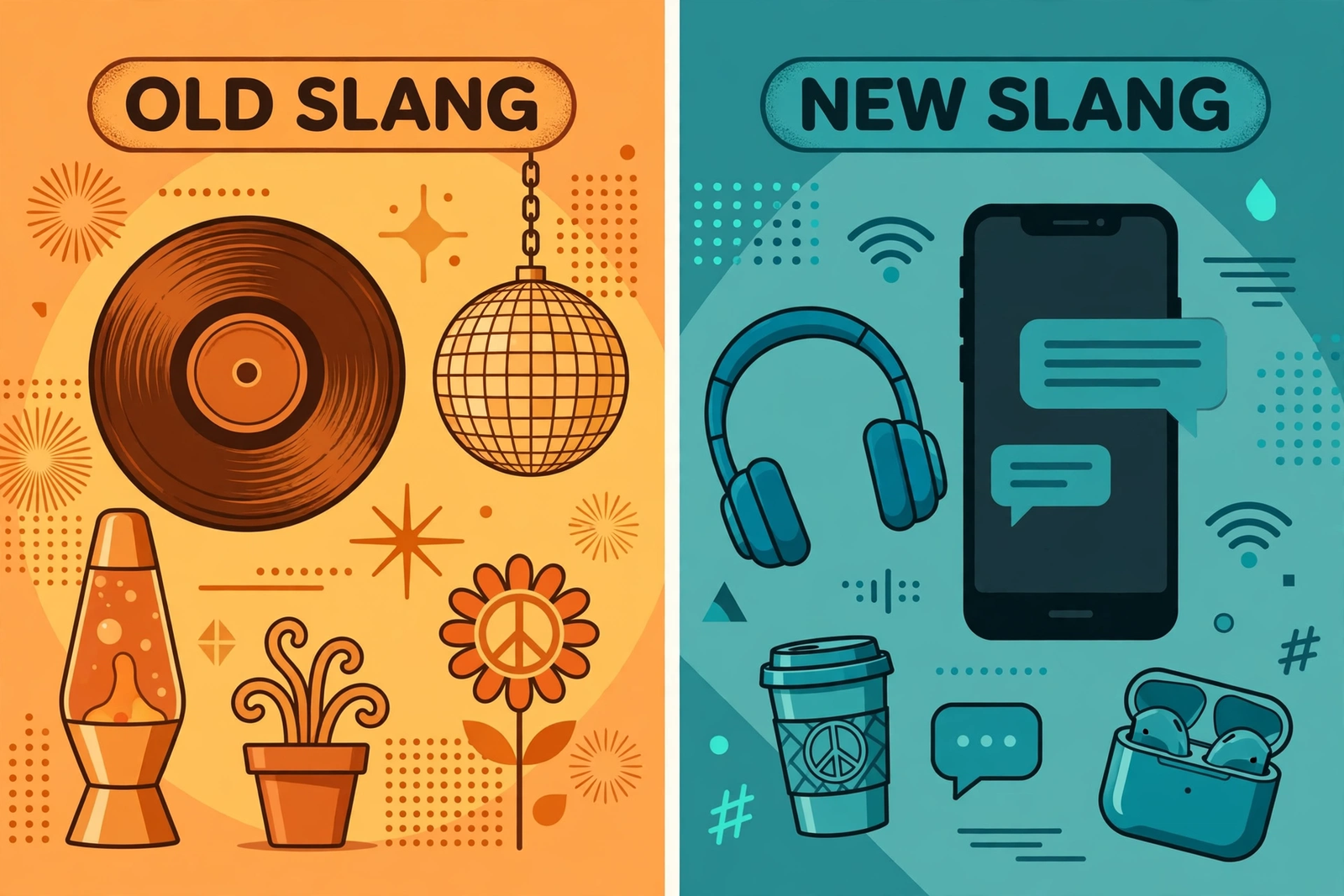
| Modern slang | Current informal words (lit, slay, no cap, rizz) | Same idea, different era — today’s slang becomes tomorrow’s old slang |
| Archaic English | Old formal words (thou, henceforth, whence) | Formal and literary, never casual or playful like slang |
| Retro / vintage | A style that imitates the past | Describes a look or vibe; old slang is the actual old language |
| Regional slang | Informal words tied to a place (NYC slang, Southern slang) | Tied to location, not time — NYC slang can be old or brand new |
It also helps to see old and new slang side by side, because people often reach for one when they mean the other:
| What You Want to Say | Old Slang Way | Modern Slang Way |
|---|---|---|
| That’s amazing | That’s groovy / far out / outta sight | That’s lit / fire / slay |
| I understand | I dig it | I feel you / facts |
| That’s nonsense | That’s baloney / malarkey | That’s cap |
| Leave quickly | Scram / 23 skidoo | Dip / bounce |
| That’s excellent | The bee’s knees / the cat’s pajamas | That’s goated / elite |
| Cool person | Cool cat / hep cat | They’re him / her (or “a vibe”) |
| Don’t overreact | Don’t have a cow | Chill / relax |
| Great, wonderful | Swell / peachy keen | Amazing / awesome |
Notice the pattern: old slang tends to be longer, more visual, and more playful, while modern slang is shorter and punchier. That is why old slang feels charming and modern slang feels efficient — they were built for different kinds of conversation. If you enjoy decoding slang across eras, you will also like our guides to fire slang and dope meaning in slang, which show how words shift meaning over time.
Alternate Meanings
“Old slang” itself has a few alternate shades of meaning depending on who says it and where.
- Old-fashioned slang: The most common alternate reading — simply any slang that sounds dated. People use “old slang,” “old-school slang,” and “vintage slang” almost interchangeably.
- Outdated insults: Sometimes “old slang” means the rude words of the past that nobody uses anymore, like calling someone a “square,” a “drip,” or a “wet blanket.” Many of these sound harmless now, which is part of their comedy.
- Generation-specific slang: What counts as “old” depends on your age. For a teenager, 90s slang like “talk to the hand” is old slang. For a 70-year-old, 90s slang is practically new.
- Historical slang: In linguistics, old slang can mean the documented slang of a specific historical period — 1920s jazz slang, 1940s military slang, 1960s counterculture slang — studied the way historians study any language.
Individual old slang words can also have alternate meanings. “Bad” in 80s slang meant “impressively good” (as in Michael Jackson’s “Bad”), “dope” meant excellent long before it meant anything else, and “cool” has meant calm, stylish, and good for over 80 years. Context is everything — a word’s meaning depends on the decade it came from and the sentence it sits in.
Professional or Polite Alternatives
Old slang is fun, but it is not always the right tool. Here are polite, professional ways to say the same thing when the setting calls for it.
| Old Slang | Polite / Professional Alternative |
|---|---|
| That’s groovy / far out | That’s wonderful / excellent / impressive |
| Don’t have a cow | Please don’t worry / let’s stay calm |
| That’s baloney | That’s not accurate / I disagree |
| Scram | Please excuse us / let’s move along |
| You’re a square | You have a more traditional style |
| That’s the bee’s knees | That’s outstanding / top-notch |
| Dig it? | Does that make sense? / Do you follow? |
| Have a gas | Have a wonderful time |
The trick is matching your words to your audience. Old slang with friends is warm and funny. The same words in a job interview would sound careless. Keep the vintage words for vintage moments.
Common Mistakes
Using old slang is easy to get wrong, and the mistakes are usually funny — but avoidable. Here are the most common ones.
- Using it seriously in formal settings: Saying “that’s baloney” in a board meeting or “scram” to a client will not land the way you want. Old slang is casual by definition.
- Mixing decades badly: Combining 1920s words (“the bee’s knees”) with 1970s words (“groovy, man”) in one sentence can sound like a costume, not a conversation. Pick one era’s vibe and stick with it.
- Getting the meaning wrong: “Bad” meaning good, “dope” meaning excellent, and “funky” meaning stylish are all traps for people who guess. If you are not sure what a word meant, check before you use it — otherwise the joke is on you.
- Overdoing it: One “groovy” in a text is charming. Five old slang words in one message sounds like a parody. Less is more.
- Using it with people who won’t get it: Old slang works best when your audience shares the reference. Texting “23 skidoo” to someone who has never heard it will just confuse them.
- Assuming every old word is slang: Words like “swell” were also normal English before they were slang. Context decides whether a word is slang or just old-fashioned.
- Forgetting the tone: Some old slang was rude in its day. “Scram,” “beat it,” and “buzz off” are dismissive — funny among friends, but not polite. Know the attitude behind the word, not just the definition.
Quick Tips
- Start with the famous ones: “Groovy,” “cool,” “far out,” “the bee’s knees,” and “don’t have a cow” are understood by almost everyone. They are the safest old slang to use first.
- Use one word at a time: Drop a single vintage word into a normal sentence instead of rewriting the whole sentence in old slang.
- Add a playful signal: An emoji, a laugh, or an exclamation mark tells people you are joking. “That concert was groovy 🎶” reads very differently from “That concert was groovy.” with a period.
- Match the era to the moment: 70s words fit disco and retro parties, 20s words fit Gatsby-style events, and 90s words fit throwback playlists.
- Learn the decade, not just the word: Knowing that “groovy” is 70s and “swell” is 30s helps you use them in the right context and avoid mixing eras.
- Use it to connect, not to show off: The best old slang moment is when it makes someone smile or feel remembered — not when it proves you know a trivia list.
- When in doubt, ask: If your grandma says something you don’t understand, ask her. Old slang is living history, and the people who used it are the best dictionaries.
FAQ
What does old slang mean?
Old slang means the informal words and phrases that were popular in past decades — roughly the 1920s through the 1990s — and now sound old-fashioned. Examples include “groovy” (cool), “the bee’s knees” (excellent), “scram” (leave quickly), and “baloney” (nonsense).
What are some examples of old slang words?
Some of the most famous old slang words are groovy, far out, swell, the bee’s knees, the cat’s pajamas, dig it, cool cat, right on, outta sight, scram, baloney, malarkey, have a cow, 23 skidoo, and catch you on the flip side. Each one comes from a different decade, from the jazz age to the disco era.
Is old slang still used today?
Yes, but mostly for humor, nostalgia, and style rather than everyday speech. People use old slang in memes, retro captions, themed parties, movies, and playful texts. A few words, like “cool” and “dude,” never actually left everyday language.
What is the difference between old slang and modern slang?
Old slang comes from past decades and sounds vintage today, while modern slang is what people use right now — words like “lit,” “slay,” and “no cap.” The main difference is time: today’s modern slang will become tomorrow’s old slang, just as “groovy” was once the newest word around.
What does “groovy” mean in old slang?
“Groovy” means cool, excellent, or fashionable. It comes from 1930s jazz culture (being “in the groove” of the music) and became hugely popular in the 1960s and 1970s. Today people use it playfully to describe something retro-cool.
What does “the bee’s knees” mean?
“The bee’s knees” means something excellent or outstanding — the best of its kind. It is 1920s slang from the era of nonsense animal phrases like “the cat’s pajamas” and “the snake’s hips.” Saying “that car is the bee’s knees” means the car is fantastic.
What does “don’t have a cow” mean?
“Don’t have a cow” means don’t overreact or don’t get upset. It was popularized in the 1980s (famously by Bart Simpson) and comes from older phrases like “having kittens” for being anxious. In a text it usually means “calm down, it’s not a big deal.”
Why do people still use old slang?
People use old slang because it is colorful, funny, and nostalgic. Old slang words paint vivid pictures, connect generations, and add personality to messages in a way that short modern abbreviations often don’t. They also keep cultural history alive — every old slang word is a small piece of the decade it came from.
Conclusion
Old slang is more than a list of funny words from the past — it is a record of how people lived, laughed, and talked in every decade of the last hundred years. From the jazz clubs of the 1920s to the disco floors of the 1970s to the malls of the 1990s, each generation invented words that fit its music, its movies, and its mood. When we use those words today, we are borrowing a little of that energy.
The key takeaways are simple. Old slang means the informal vocabulary of past decades, and it is still useful today — for humor, nostalgia, and connection. Use the famous words first, use one at a time, match the era to the moment, and always check your audience. Avoid formal settings, mixed decades, and words whose meaning you are guessing at.
Next time someone texts you “that’s groovy” or your grandma calls something “the bee’s knees,” you will know exactly what they mean — and you might even answer back in kind. After all, slang never really gets old. It just waits for someone to say it again with a smile. For more word-history fun, check out our guide to goon slang meaning and see how a single word can change across generations.
For a deeper look at how dictionaries track slang over time, see the Reader’s Digest guide to old-school slang words — a great starting point for exploring vintage vocabulary.

2 thoughts on “Old Slang Meaning in Text: 40+ Vintage Words and Phrases Explained Simply”