
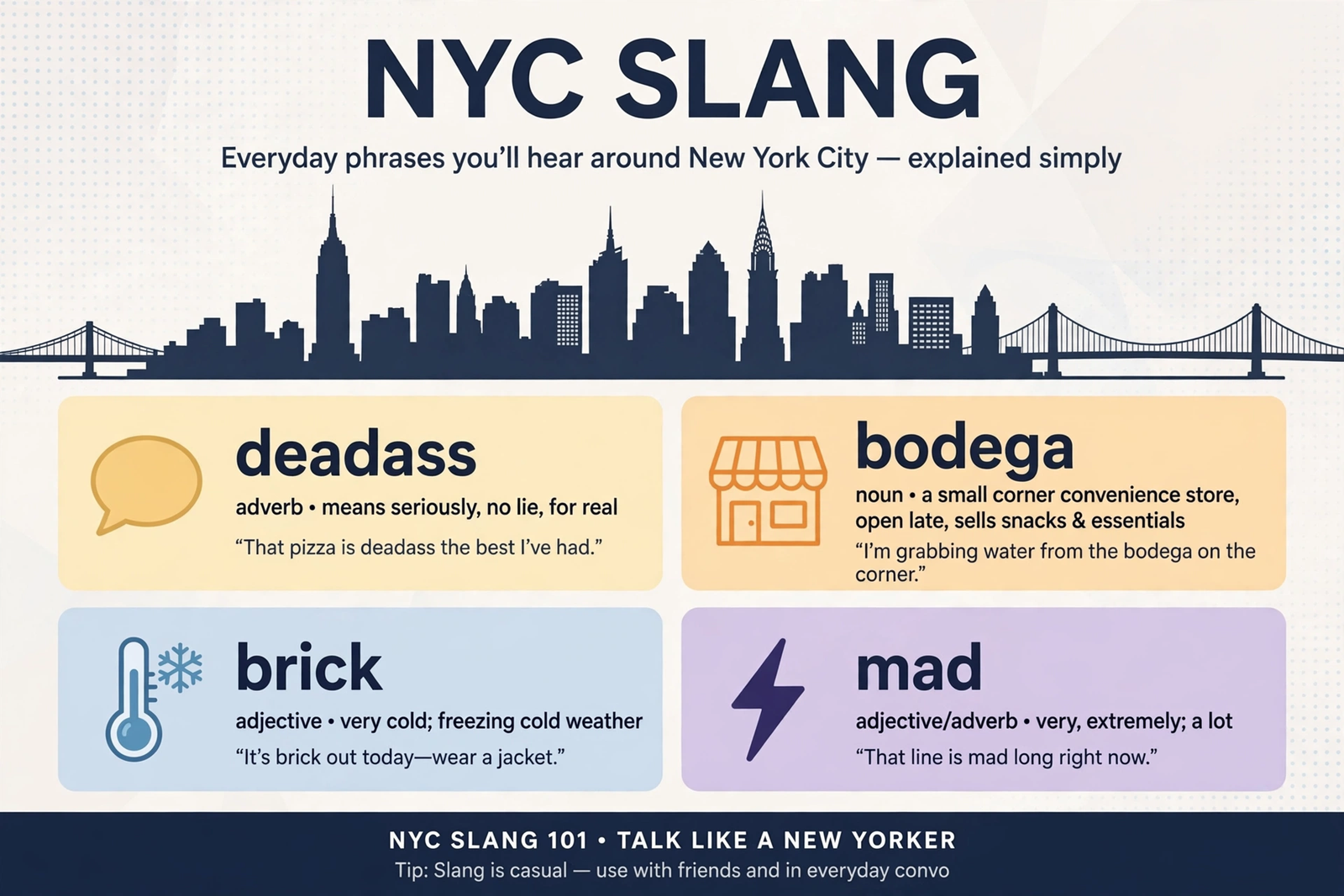
Quick Definition: NYC slang is the fast, blunt, and instantly recognisable way New Yorkers talk — a mix of street words, intensifiers, and food and neighbourhood terms shaped by hip-hop, immigrant communities, and five boroughs of attitude. When someone says “it’s brick outside, deadass,” they mean it is freezing cold, and they are completely serious about it.
NYC Slang Meaning & Definition
NYC slang means the informal vocabulary and phrases that people in New York City use every day — words like deadass, brick, bodega, and mad that sound strange to outsiders but are perfectly clear to anyone who lives in the five boroughs. It is not a separate language, and it is not only Gen Z slang. It is a city dialect built over decades by Black, Latino, Caribbean, Jewish, Italian, and immigrant communities, then spread worldwide by hip-hop, TV, and TikTok.
What makes NYC slang different from other American slang is its attitude. New Yorkers talk fast, cut words short, and use exaggeration as punctuation. A New Yorker does not say something is “very cold” — they say “it’s brick outside.” They do not say “I agree completely” — they say “facts.” The words are short, the delivery is confident, and the meaning is almost always obvious from context once you know the code.
NYC slang also works as an identity badge. Using the right word at the right moment tells people you belong — or at least that you understand the city. Using the wrong word, or forcing one, tells them the opposite just as quickly. That is why this guide covers not only meanings, but also tone, origin, and the mistakes that give visitors away.
Introduction
Picture this: you step out of Penn Station on a January morning, and a stranger tells their friend, “Yo, it’s brick out here, deadass.” You have just heard two of the most famous pieces of NYC slang in a single sentence — and if you are not from the city, you might have no idea what either word meant.
That is the everyday reality of New York City. With more than 8.3 million people and about 40 percent of them born outside the United States, the city has spent generations mixing languages and attitudes into something entirely its own. From the bodega on the corner to the stoop where neighbours gather, from a baconeggandcheese at 7 a.m. to a slice of pie at 2 a.m., the words New Yorkers use are as much a part of the city as the skyline.
This guide breaks down NYC slang properly: more than 40 essential words and phrases with meanings and real examples, where they came from, how they differ from slang in other American cities, the mistakes everyone makes, and answers to the questions people actually search for. Whether you are visiting the Big Apple, moving there, decoding a friend’s texts, or just curious, this is your complete New York slang cheat sheet.
Origin
NYC slang did not come from one place. It came from four overlapping sources, and most words can be traced to at least one of them.
African American Vernacular English (AAVE) and hip-hop. The biggest source by far. Hip-hop was born in the Bronx in the 1970s, and with it came a wave of words that travelled from block parties and rap lyrics into everyday speech: deadass, mad (as an intensifier), son, facts, frontin’, gully, and wylin’. Artists from Nas to Jay-Z to Cardi B carried these words worldwide, and streaming made them permanent. Understanding this history matters: these words carry culture, not just comedy, and using them respectfully means knowing they did not start as internet jokes. Hip-hop itself grew out of the Bronx’s Black and Latino communities, and its language remains one of New York’s greatest cultural exports — a history documented in detail by sources like Britannica’s guide to hip-hop.
Yiddish and Jewish New York. New York has one of the largest Jewish populations outside Israel, and Yiddish words slipped into everyday city speech generations ago: schlep (to haul something with effort), schvitz (to sweat), schmear (a thick spread of cream cheese), and chutzpah (nerve or boldness). Today, New Yorkers of every background use them without thinking twice.
Spanish and Caribbean influence. Puerto Rican and Dominican communities gave the city bodega (from the Spanish word for a small grocery or warehouse) and helped popularise greetings and rhythms that now feel universal in the city. Caribbean English added its own flavour, especially in Brooklyn and Queens.
Italian-American New York. The classic movie line “fuhgeddaboudit” (forget about it) comes from Italian-American speech, and so does the habit of turning whole phrases into single words — the same habit that produced baconeggandcheese as one breathless order at the deli counter.
Popularity
NYC slang is popular for three reasons: the city itself, the music, and the internet. New York is the most densely populated major city in the United States, and its slang spreads the way its people do — fast, loudly, and everywhere at once.
First, music made it global. From 1990s East Coast rap to today’s drill scene, New York artists have exported words like deadass and brick to listeners on every continent. When a chart-topping song repeats a word a hundred times, that word becomes part of the global vocabulary within weeks.
Second, TV and film keep it alive. Shows set in New York — from classic sitcoms to modern crime dramas — have taught the rest of the world how New Yorkers talk. Characters who say “fuhgeddaboudit” or order a “regular coffee” (cream and sugar, never black) do more for the slang than any dictionary ever could.
Third, TikTok and social media made it instant. A New York creator explaining “how New Yorkers really talk” can reach ten million viewers overnight. Words like yerrr (a greeting) and bop (a great song) now show up in comments from people who have never set foot in Manhattan — which is exactly why so many people search for a proper NYC slang guide before they visit.
How It Is Used
NYC slang shows up everywhere in the city: on the subway, in bodegas, in group chats, and in offices. The same word can shift meaning with tone, and context is everything.
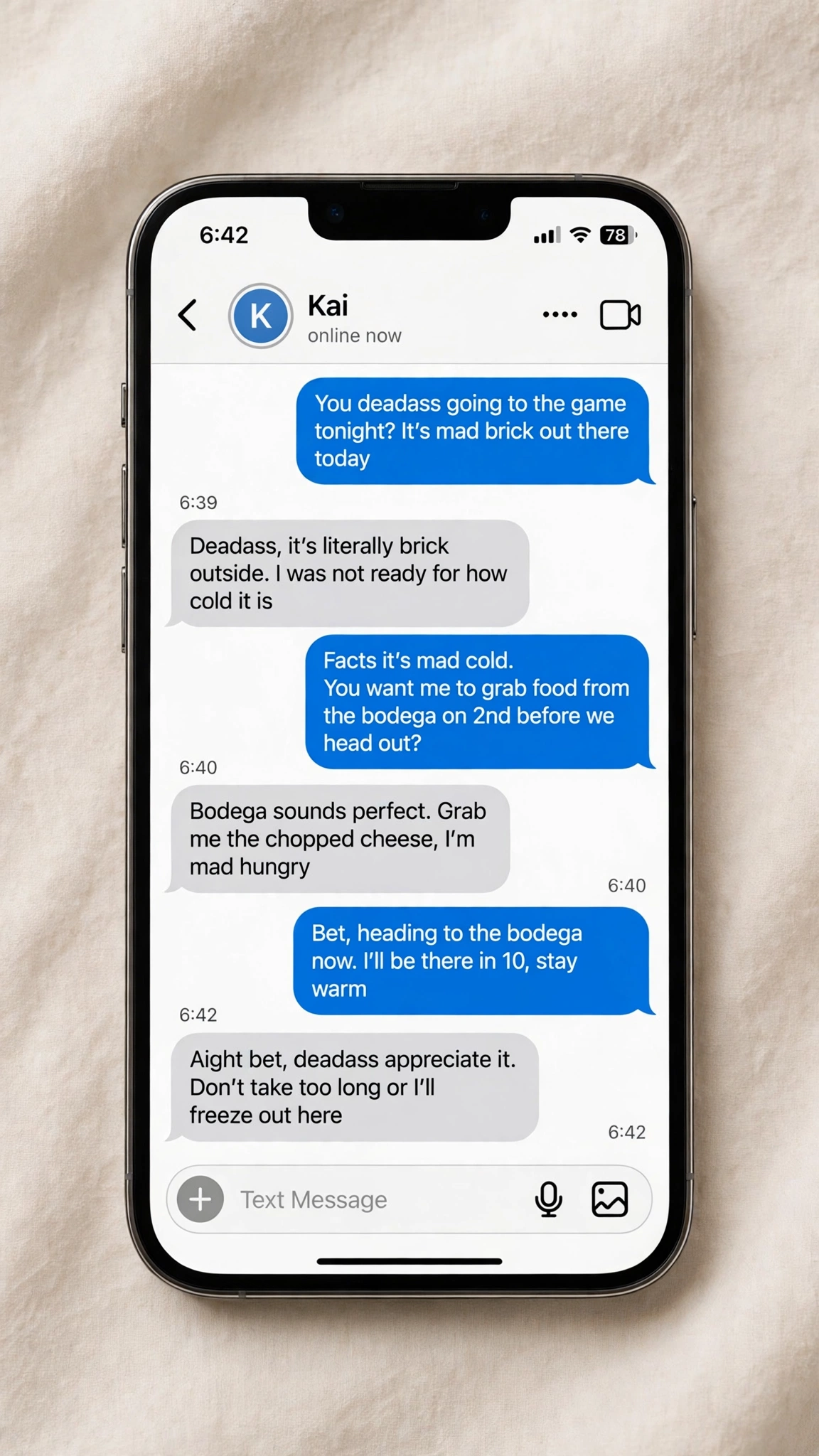
As intensifiers. New Yorkers love exaggeration. Mad and dumb both mean “very” (“That rent is mad expensive,” “It’s dumb cold out”). OD (short for “overdose”) means “way too much” (“He’s OD annoying”). These words turn ordinary sentences into strong opinions.
As agreement and emphasis. Deadass (“seriously, I’m not joking”) and facts (“that is absolutely true”) are the city’s favourite ways to back up a statement. “Deadass, that pizza was the best I ever had” is stronger than any five-star review.
As greetings and check-ins. “You good?” can mean hello, are you okay, or are we okay after an argument — the tone tells you which one. “Yerrr” is a casual hello between friends. “What’s good?” means what’s happening, or what’s up.
As neighbourhood vocabulary. Some words only make sense in the city: a stoop is the front steps of a brownstone where people sit and socialise; the City means Manhattan specifically, never the other boroughs; on line (not “in line”) is how New Yorkers say they are queuing; and a hero is the long sandwich other Americans call a sub or hoagie.
Examples
The fastest way to learn NYC slang is to see it in real sentences. Here are examples grouped by tone, so you can hear how the same city sounds in different situations.
Friendly Examples
- “Yo, yerrr! You coming to the cookout on Saturday?” — a warm greeting between friends.
- “Meet me at the bodega on the corner, I need a baconeggandcheese.” — the most New York breakfast order ever spoken.
- “That song is a bop, deadass. I’ve had it on repeat all week.” — high praise for music.
- “Bet, I’ll see you at 8.” — agreement, meaning “sounds good, it’s a plan.”
- “We were just chilling on the stoop all afternoon.” — hanging out on the front steps.
- “Son, you gotta try the pie from that spot on Bleecker.” — “son” here means close friend, not a child.
Professional Examples
- “Real talk, we need the report by Friday — no extensions.” — signalling that what follows is serious.
- “The client was grilling me in the meeting, asking question after question.” — being interrogated, not literally cooked.
- “I had to schlep three boxes up four flights of stairs to the office.” — carrying something with effort.
- “Let’s keep it moving — we’re mad behind schedule.” — very behind, said with urgency.
Funny Examples
- “It’s brick outside, I’m not leaving the apartment. Fuhgeddaboudit.” — it is freezing, and there is no discussion.
- “He was frontin’ like he knew the bouncer. He did not know the bouncer.” — pretending to be something he is not.
- “She ordered a regular coffee and got a black coffee. She was tight.” — upset, because a New York “regular coffee” always has milk and sugar.
- “Bro was wylin’ at the game last night, screaming at the ref.” — acting wild and out of control.
- “Nah, I’m deadass serious — I saw a rat carry a whole slice of pizza down the subway stairs.” — the most believable unbelievable New York story.
Comparison with Similar Terms
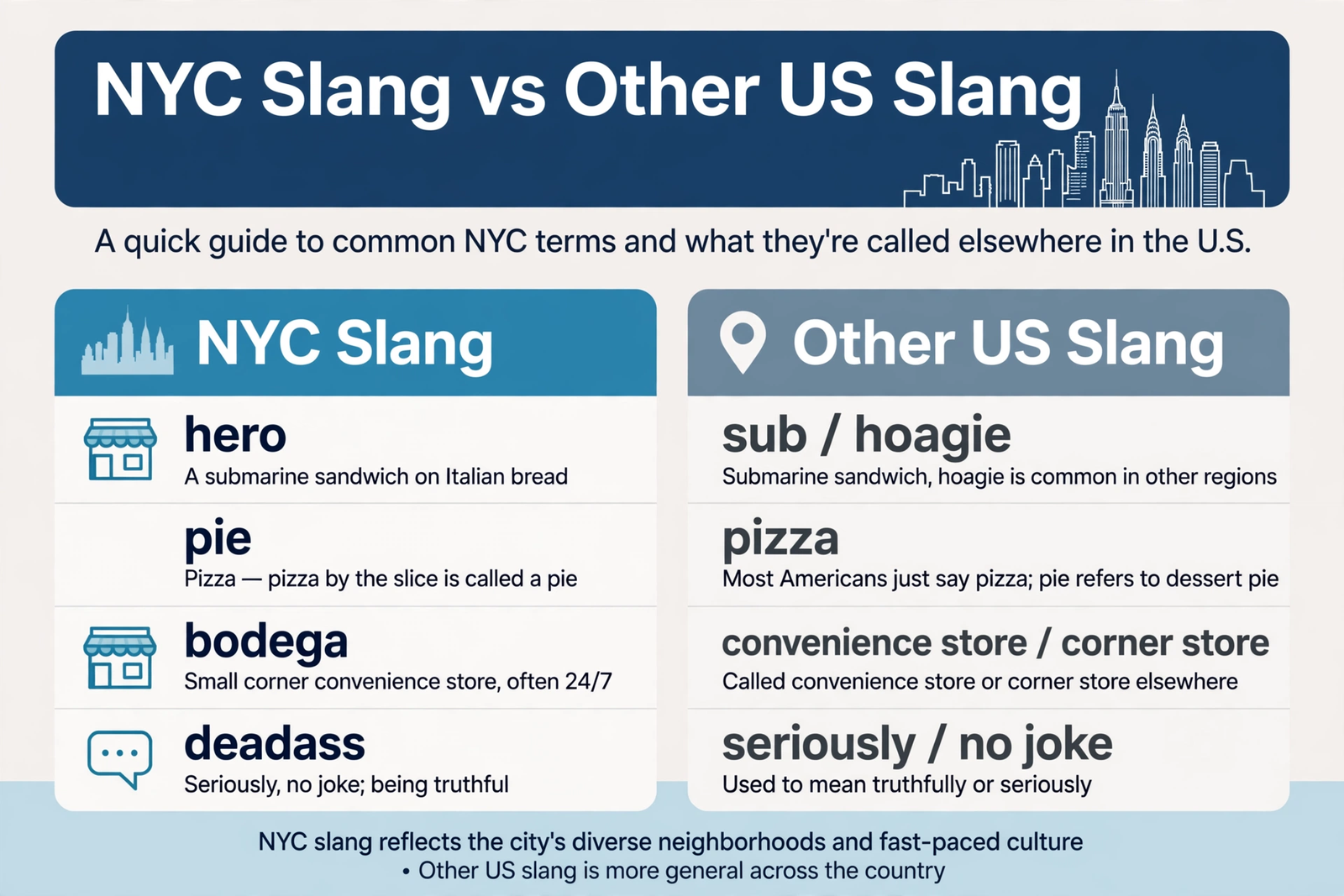
NYC slang is often confused with general American slang or with slang from other big cities. The table below shows how New York words differ from the alternatives people usually reach for.
| NYC Slang | What It Means | What Other Americans Say | Example |
|---|---|---|---|
| Deadass | Seriously; I’m not joking | “For real,” “no cap” | “Deadass, that was the best show ever.” |
| Bodega | Corner convenience store | “Corner store,” “7-Eleven” | “Run to the bodega for milk.” |
| Brick | Freezing cold | “Freezing,” “cold af” | “It’s brick outside today.” |
| Hero | Long sandwich on a roll | “Sub,” “hoagie,” “grinder” | “Get me a chicken parm hero.” |
| Pie | A whole pizza | “Pizza” | “Let’s order a pie for the group.” |
| Mad | Very; a lot | “Really,” “super,” “hella” (West Coast) | “That concert was mad good.” |
| The City | Manhattan specifically | “Downtown” | “I’m heading into the City tonight.” |
| On line | Waiting in a queue | “In line” | “We were on line for an hour.” |
| Stoop | Front steps of a building | “Porch,” “front steps” | “We sat on the stoop all evening.” |
| Schmear | A thick spread of cream cheese | “Cream cheese” | “Bagel with a schmear, please.” |
New York slang also differs from other regional slang in tone. Compared with the laid-back drawl of Southern slang or the surfy chill of California slang, NYC slang is faster, blunter, and more confrontational — even when it is friendly. Where a Californian says “hella cool,” a New Yorker says “mad dope.” Where a Southerner says “y’all,” a New Yorker says “yous” — or more often, just points and says “yo.” If you are comparing regional American slang, the same attitude shows up in guides to Ohio slang and Australian slang, where the local words reveal the local culture just as clearly.
Alternate Meanings
Many NYC slang words have more than one meaning, and the wrong guess can change a whole conversation. Here are the most important doubles:
- Brick: Usually means freezing cold weather (“It’s brick out”). In street and drug contexts it can also mean a kilogram-sized block of a substance — a meaning you will hear in rap lyrics but should not use casually.
- Mad: As slang it means “very” (“mad happy”). In standard English it still means angry — and a New Yorker can mean both at once (“I’m mad mad right now”).
- Whip: Most often a nice or expensive car (“That’s a clean whip”). As a verb it still means to hit or beat, and “whipped” in dating slang means controlled by a partner — three very different uses.
- Grill: To stare someone down angrily (“Stop grilling me”). But a “grill” can also mean decorative gold teeth, and of course the cooking appliance — context decides.
- Pie: A whole pizza in New York. Everywhere else, pie is dessert. Ordering “a pie” in a New York pizzeria will never get you apple pie.
- Son / Kid: A term of friendship and closeness (“What’s good, son?”). It has nothing to do with age or family when used this way — but never use it with a stranger, who may not take it as friendly.
- Tight: Means cool or well put together (“That fit is tight”). It can also mean angry or upset (“I’m tight about losing my wallet”) — near opposites, separated by tone.
- Dope: Means excellent or cool (“That party was dope”). In older slang it also meant drugs, a meaning that has mostly faded from everyday use.
- Facts: Means “that is absolutely true” (“Facts, no lie”). It is not a request for data — it is agreement.
- Gully: Means raw, real, or street-smart (“That’s a gully move”). It can praise toughness or warn that something is rough, depending on the sentence.
Professional or Polite Alternatives
NYC slang is perfect for friends, group chats, and the street — and a bad idea in a job interview, a client email, or a formal meeting. Here is how to translate the most common terms when the situation calls for standard English:
| NYC Slang | Polite / Professional Alternative |
|---|---|
| Deadass | “Seriously” / “I’m being completely honest” |
| Mad / Dumb (intensifiers) | “Very” / “Extremely” |
| You good? | “Are you alright?” / “Is everything okay?” |
| Real talk | “To be frank” / “Honestly” |
| Bet | “Agreed” / “Sounds good” |
| Frontin’ | “Being insincere” / “Putting on an act” |
| Wylin’ | “Behaving erratically” / “Acting out” |
| Grimy | “Unethical” / “Questionable behaviour” |
| Brick | “Freezing cold” |
| Schlep | “Carry” / “Transport with effort” |
| Fuhgeddaboudit | “Don’t worry about it” / “Never mind” |
| Son / Kid (to a colleague) | Use their name — never “son” at work |
The rule is simple: slang builds connection with people who share it, and creates distance with people who do not. In mixed company, default to the polite version — and save deadass for your friends.
Common Mistakes
Visitors and new arrivals make the same mistakes with NYC slang. Avoid these and you will sound far more natural:
- Calling all of New York “the City.” To a New Yorker, “the City” means Manhattan only. If you are in Brooklyn and say “I’m going to the City,” everyone understands you mean Manhattan. Saying you live “in the City” when you live in Queens will get you corrected fast.
- Ordering a “regular coffee” and expecting black coffee. A New York regular coffee comes with milk and sugar. If you want it black, say “black.” Getting this wrong is the fastest way to look like a tourist at a bodega counter.
- Using “son” or “kid” with strangers. Between friends it is warm. From a stranger it can sound confrontational or disrespectful. Earn the familiarity first.
- Saying “in line” and wondering why nobody corrects you. New Yorkers say “on line.” Both are understood, but “on line” is the local tell — and in a text it can confuse people, since “online” also means on the internet.
- Forcing “deadass” into every sentence. New Yorkers use it for emphasis, not as filler. Dropping it three times in one sentence does not make you sound local — it makes you sound like you learned the word yesterday.
- Mixing up NYC slang with general Gen Z slang. Words like “rizz,” “slay,” and “no cap” are used everywhere online. Words like “brick,” “bodega,” and “schmear” belong to New York. Knowing the difference is the whole point — our guide to Gen Z slang 2024 covers the internet-wide words, while this guide covers the city’s own vocabulary.
- Thinking “mad” always means angry. “I’m mad happy” means very happy. “I’m mad” alone usually means angry. The word after “mad” changes everything.
- Pronouncing it wrong. “Bodega” is boh-DAY-guh, “schmear” is shmeer, and “fuhgeddaboudit” is one fast blur, not four careful words. Listen before you imitate.

Quick Tips
- Learn the big five first: deadass, bodega, brick, mad, and the City. Those five words unlock most everyday New York conversations.
- Listen before you speak: Spend a day hearing how New Yorkers actually use these words — on the subway, in a deli, in a group chat — before trying them yourself.
- Match the tone: “You good?” can be friendly, concerned, or confrontational. Copy the speaker’s energy, not just their words.
- Use slang lightly: One well-placed “deadass” sounds natural. Five in one sentence sounds like a performance.
- Respect the roots: Many of these words come from AAVE and hip-hop culture. Use them with appreciation, not as a costume.
- When in doubt, ask: “What does that mean?” is always better than guessing — New Yorkers would rather explain a word than watch you misuse it.
- Learn the food words: Bodega, baconeggandcheese, schmear, hero, and pie will feed you well — literally. Food is the easiest way into NYC slang.
- Know the boroughs: Brooklyn, Queens, the Bronx, Harlem, and Staten Island each have their own flavour. A word that is huge in the Bronx might be rare on Staten Island.

FAQ
1. What does deadass mean in NYC slang?
Deadass means seriously, genuinely, or “I’m not joking.” New Yorkers use it to emphasise that a statement is completely true — “Deadass, I waited two hours for that train.” It comes from AAVE and hip-hop culture and is one of the most recognisable NYC slang words.
2. What is a bodega in New York?
A bodega is a small, usually family-owned corner convenience store found on nearly every block in New York City. Bodegas sell groceries, sandwiches, drinks, and household items, and many are open 24 hours. The word comes from Spanish, where it means a small grocery store or warehouse.
3. What does brick mean in NYC slang?
Brick means extremely cold, freezing weather — “It’s brick outside” means it is freezing. The word compares the cold to the feeling of being hit by a brick: hard, heavy, and impossible to ignore. New York winters make it one of the most-used words in the city from December to March.
4. Why do New Yorkers say “mad” instead of “very”?
In NYC slang, mad works as an intensifier meaning “very” or “a lot” — “mad good,” “mad people,” “mad expensive.” It comes from AAVE and hip-hop, where it has been used this way for decades. Context tells you whether “mad” means “very” or its standard meaning, “angry.”
5. What does “you good?” mean in NYC?
“You good?” is one of the most flexible phrases in NYC slang. It can mean hello, are you okay, do you need anything, or — with a harder tone — are we going to have a problem? The meaning depends entirely on tone and context, which is why listening matters more than memorising.
6. Is NYC slang the same as Gen Z slang?
No. Gen Z slang is internet-wide vocabulary used by young people everywhere, while NYC slang is city-specific vocabulary shaped by New York’s neighbourhoods, history, and cultures. They overlap — New Yorkers use Gen Z words too — but words like bodega, brick, and schmear belong to New York, not to a generation. If you are curious about the internet-wide side, see our guide to Gen Z slang 2024.
7. What does “the City” mean to New Yorkers?
To New Yorkers, “the City” means Manhattan — specifically the island of Manhattan, not the other four boroughs. Someone in Brooklyn who says “I’m going into the City” is heading to Manhattan. It is one of the oldest and most reliable tells of a real New Yorker.
8. How can I learn NYC slang without sounding fake?
Listen first and use words sparingly. Learn the meanings and the tone, then use one or two words naturally in the right context instead of forcing ten into one sentence. Spend time around New Yorkers, watch New York shows and creators, and remember that slang is about belonging — it works best when it comes from real exposure, not a memorised list.

Conclusion
NYC slang is more than a list of funny words — it is the sound of the city itself. Words like deadass, bodega, brick, and mad carry the history of the Bronx, the corner stores of Brooklyn, the delis of Manhattan, and the stoops of Queens. They tell you where a word came from, who made it popular, and how fast this city talks.
The key takeaways are simple. Learn the big five words first, use slang lightly and in the right context, respect where the words came from, and never force a term just to sound local. Slang is at its best when it builds connection — a shared laugh at a bodega counter, a quick “you good?” between friends, a deadass-serious recommendation for the best slice in the neighbourhood.
New York will keep inventing words, and today’s slang will be tomorrow’s nostalgia. But if you understand NYC slang, you understand something bigger: how a city of 8.3 million people, speaking hundreds of languages, still manages to sound like one place. Keep exploring — from Ohio slang to Australian slang — and you will never be lost in the conversation again.
Quick recap: NYC slang = deadass (seriously) · bodega (corner store) · brick (freezing) · mad (very) · the City (Manhattan) · stoop (front steps) · pie (pizza) · hero (long sandwich). When in doubt, listen first — and when a New Yorker says “deadass,” believe them.

2 thoughts on “NYC Slang: 40+ New York Slang Words, Meanings & Examples”