Quick Definition: Slang for clothes is the informal vocabulary people use instead of saying “outfit” or “clothing” — words like drip, fit, fire, fresh, fly, and threads. If someone says “your fit is fire” or “that drip is crazy,” they are complimenting what you are wearing. This guide explains the most popular slang for clothes, what each word means, where it came from, and how to use it without sounding out of place.
Slang for Clothes Meaning & Definition
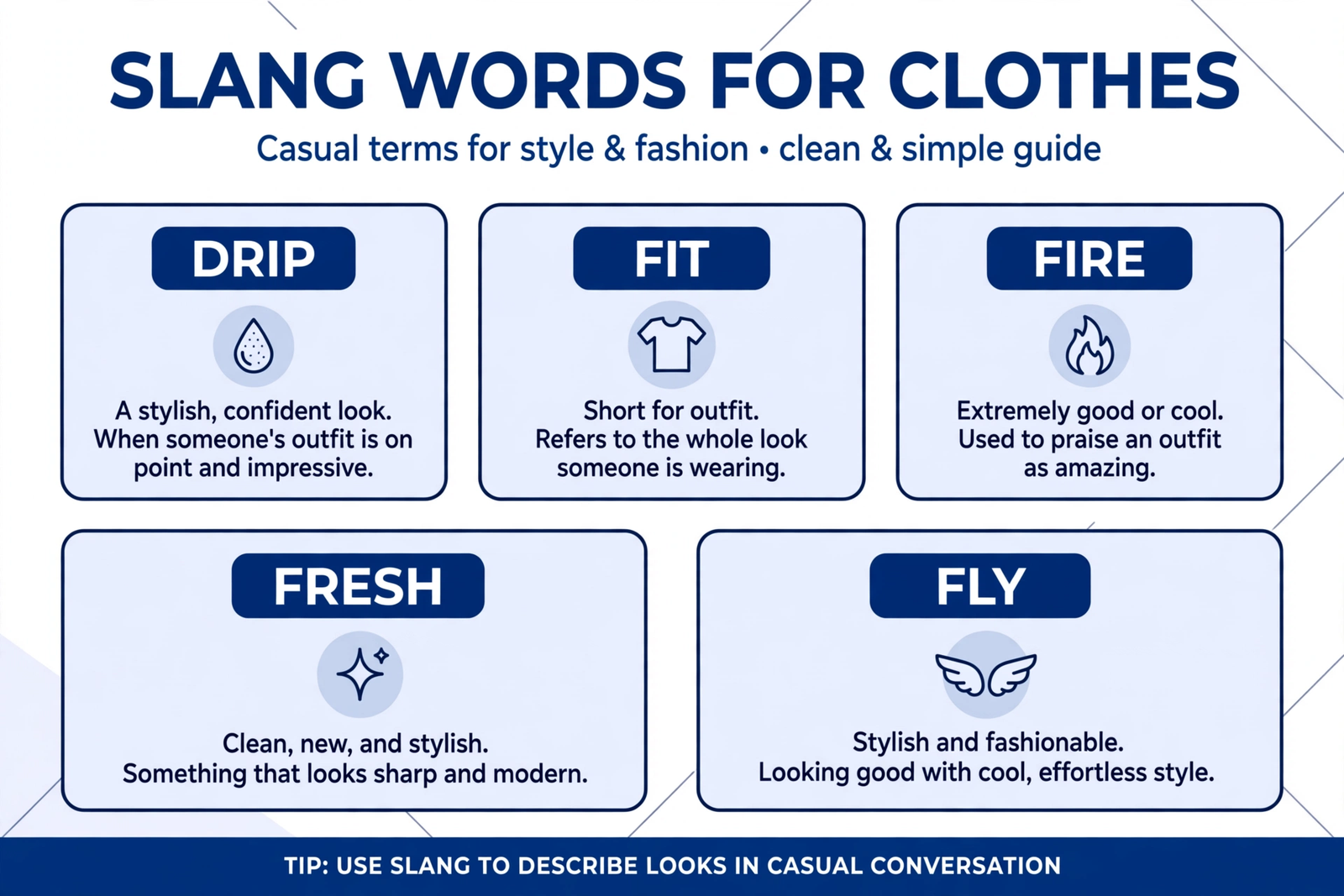
Slang for clothes means the casual, street-level words and phrases people use to talk about outfits, style, and fashion instead of formal words like “clothing,” “attire,” or “ensemble.” The most common examples are drip (stylish, expensive-looking clothes), fit (a complete outfit), fire (amazing-looking), fresh (clean and new-looking), fly (cool and fashionable), and threads (clothes in general). Instead of saying “I like your outfit,” someone using slang for clothes would say “your fit is fire,” “that drip goes hard,” or “you look fresh today.”
What makes slang for clothes interesting is that it changes fast. Ten years ago, “swag” was the word everyone used to describe a cool outfit. Today, Gen Z and Gen Alpha say “drip” or “aura” instead. The words travel from hip-hop lyrics, sneaker culture, and TikTok videos into everyday group chats, school hallways, and comment sections. Knowing the slang for clothes helps you understand compliments, memes, and conversations that would otherwise sound like a foreign language — and it helps you talk about fashion the way people actually talk about it in 2026.
Introduction
Imagine this: you walk into a party wearing a brand-new outfit, and someone looks at you and says, “Okay, the drip is insane.” Are they talking about water? Did you spill something? No — you just received one of the biggest compliments in modern slang. They are saying your clothes look incredible.
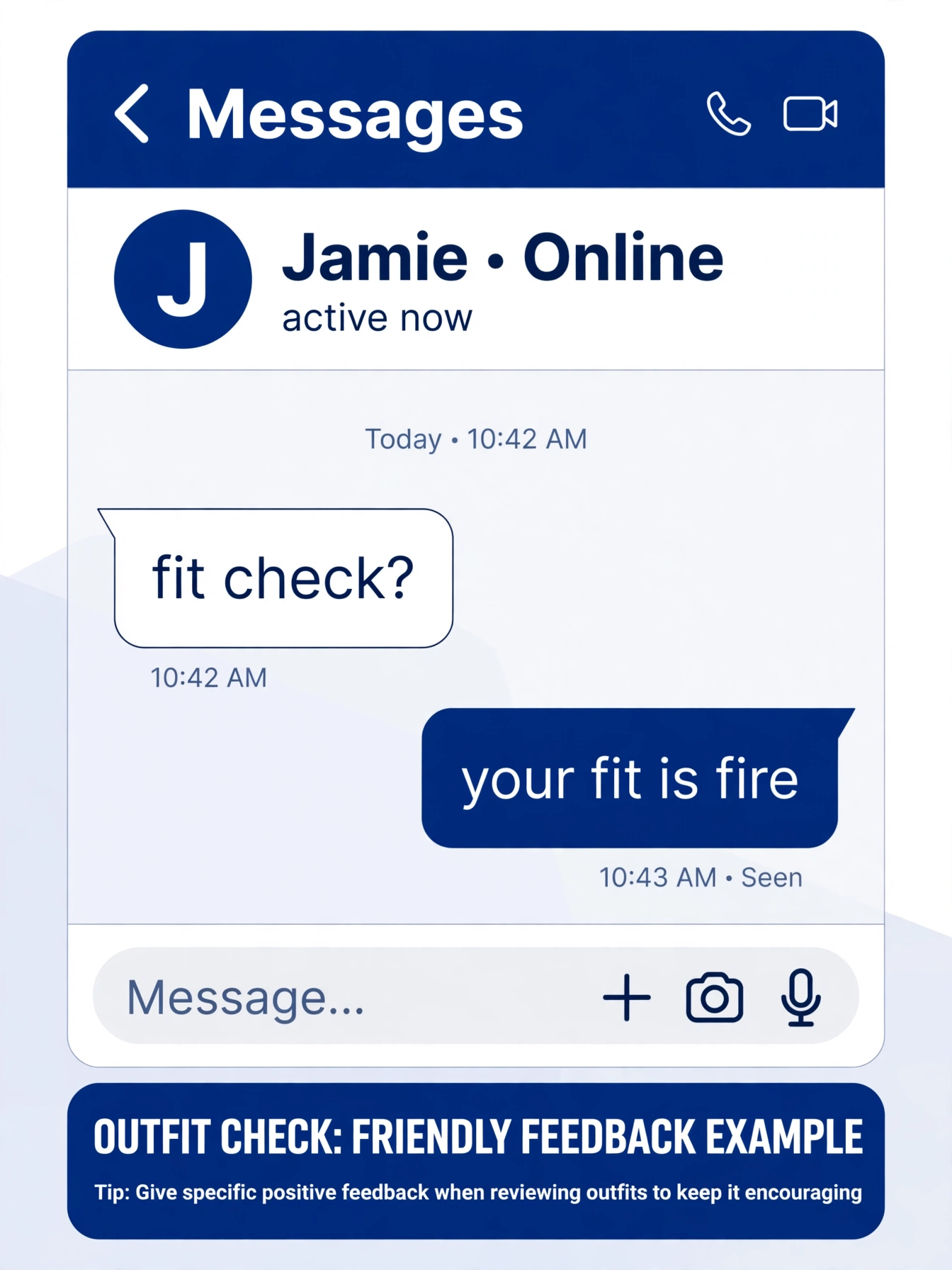
Or picture a text from your friend: “Fit check?” They are not asking about your gym routine. They want a photo of your outfit. And when your favorite influencer posts a mirror selfie captioned “fit is fire 🔥,” they are telling the world their outfit is amazing — no long description needed.
Clothes have always had slang. Every generation invents its own words for looking good: “sharp” in the 1950s, “groovy” in the 1960s, “fly” in the 1990s, “swag” in the 2010s, and “drip” today. The slang for clothes is more than just fun vocabulary — it is a social signal. The words you choose tell people which generation you belong to, which online communities you follow, and how plugged in you are to fashion culture.
In this complete guide, you will learn the 25 most popular slang words for clothes in 2026, what each one really means, where it came from, and exactly how to use it in texts, captions, and real conversations. You will also find a comparison table, common mistakes to avoid, polite alternatives for formal settings, and answers to the questions people search for most.
Origin
The slang for clothes has deep roots in African American Vernacular English (AAVE), hip-hop culture, and street fashion — and most of today’s popular terms started there before spreading to the mainstream. Merriam-Webster defines slang as informal, nonstandard vocabulary made up of newly coined words and figures of speech — and clothing slang is one of the fastest-changing parts of that vocabulary, because every generation reinvents how it talks about looking good.
The word fly is one of the oldest. It was already popular in the 1970s and 1980s, when hip-hop artists used it to describe someone who looked stylish and confident. The 1990s made it mainstream through rap lyrics, movies, and music videos. Around the same time, fresh became a staple word in hip-hop — LL Cool J and other artists used it to describe clean, new-looking clothes, and the phrase “fresh to death” meant dressed to perfection.
Threads is even older. It has been used to mean clothes since the early 1900s, and it appeared in jazz slang long before the internet existed. Gear followed a similar path, moving from military and sports language into streetwear talk in the 1980s and 1990s.
The modern wave started in the 2010s. Swag took over around 2010, spread by rappers and then by every brand on social media — and then, like most slang, it became overused and uncool. Drip replaced it. The word originally meant jewelry that “dripped” with diamonds, then expanded in the late 2010s to mean an entire stylish outfit. By 2020, “drip” was everywhere: in songs, on TikTok, and in everyday conversation. Fit, short for “outfit,” followed the same path — it started in fashion forums and sneaker communities, then became the standard word for an outfit on TikTok and Instagram, especially in the phrase “fit check.”
The newest additions, like aura (the vibe your outfit gives off) and clean (simple, sharp, well put-together), show how the slang for clothes keeps evolving. Every year, a few new words arrive, a few old ones fade, and the cycle continues.
Popularity
The slang for clothes is more popular than ever, and the numbers prove it. On TikTok, the hashtag #fitcheck has billions of views, with users posting daily outfit videos. #drip has hundreds of millions of views across TikTok and Instagram. Google searches for “drip meaning,” “fit check meaning,” and “what does drip mean in slang” have stayed strong for years, and new terms like “aura” spike every time a viral video uses them.
Why is this slang so popular? Three reasons stand out:
- Social media runs on outfits. Mirror selfies, “get ready with me” videos, and outfit-of-the-day posts are some of the most shared content online. Short slang words fit perfectly in captions and comments.
- Sneaker and streetwear culture went mainstream. Limited-edition sneakers, vintage clothes, and streetwear drops turned fashion into a hobby with its own language — and that language leaked into everyday talk.
- It is faster than formal language. “Your fit is fire” says in four words what “your outfit looks really fashionable today” says in seven. In texts and comments, speed wins.
The slang for clothes is most common among teenagers and people in their twenties, but it has spread far beyond that. Parents hear it from their kids, coworkers hear it in casual offices, and even fashion brands now use words like “drip” and “fit” in their marketing. It is no longer just street slang — it is part of how the internet talks about style.
How It Is Used
Slang for clothes shows up in three main situations: compliments, outfit posts, and shopping talk. Here is how the most common words work in real life:
- As a compliment: “Your fit is fire.” “That drip is crazy.” “You look so fresh today.” These are the modern versions of “you look great.”
- As a noun for the outfit itself: “Check out this fit.” “I need a new fit for the party.” “His drip is on another level.” Here, “fit” and “drip” replace the word “outfit.”
- As an adjective for style: “That jacket is so clean.” “Those shoes are hard.” “She always looks fly.” The slang word describes how good something looks.
- In questions: “Fit check?” means “show me your outfit.” “Where did you get that drip?” means “where did you buy those clothes?”
- In captions and hashtags: “Fit of the day 🔥” or “Sunday drip” — short, punchy, and instantly understood by anyone who follows fashion online.
The tone matters as much as the words. “Drip” and “fit” are casual and friendly — perfect for friends, social media, and texts. They are not the words to use in a job interview or a formal email. That is why this guide also includes polite alternatives for professional settings.
One more thing to know: slang for clothes is almost always positive. People rarely use “drip” or “fire” to insult an outfit. When someone wants to say an outfit looks bad, they usually just say nothing — or they use a different kind of slang entirely, like the kind you will find in our guide to ick meaning slang, which covers the feeling of being suddenly turned off by something someone does or wears.
Examples
The best way to learn slang for clothes is to see it in real conversations. Here are examples across different tones and situations, using the most popular words correctly.
Friendly Examples
- “Okay, that fit is actually fire. Where did you get those jeans?”
- “Bro, your drip today is on another level. Teach me your ways.”
- “Fit check before we leave — rate my outfit 1 to 10.”
- “You look so fresh in that jacket. New?”
- “Her outfit ate. The whole fit was perfect from head to toe.”
- “Love the threads! That color looks amazing on you.”
Professional Examples
In professional settings, people usually soften the slang or skip it entirely — but in creative industries, fashion, and casual workplaces, it still appears:
- “Great fit for the presentation today — clean and sharp.” (Here “clean” works because it also sounds like normal English.)
- “Your outfit is really on point for the client meeting.”
- “That blazer is a nice touch. Very polished look.”
- “Love the look — smart, modern, and professional.”
Notice that in work settings, people say “fit” less and “look” or “outfit” more. The slang still works when it overlaps with normal English words like “clean,” “sharp,” and “on point.”
Funny Examples
- “My fit is just pajamas and confidence today.”
- “His drip is so strong the rain asked him for style tips.”
- “Fit check: hoodie, sweatpants, and the audacity to go outside like this.”
- “She walked in with that aura and suddenly everyone’s outfit felt boring.”
- “My bank account said no drip today. It’s giving thrift store chic.”
- “Bro thinks his fit is fire but he looks like a walking clearance rack.”
Comparison with Similar Terms
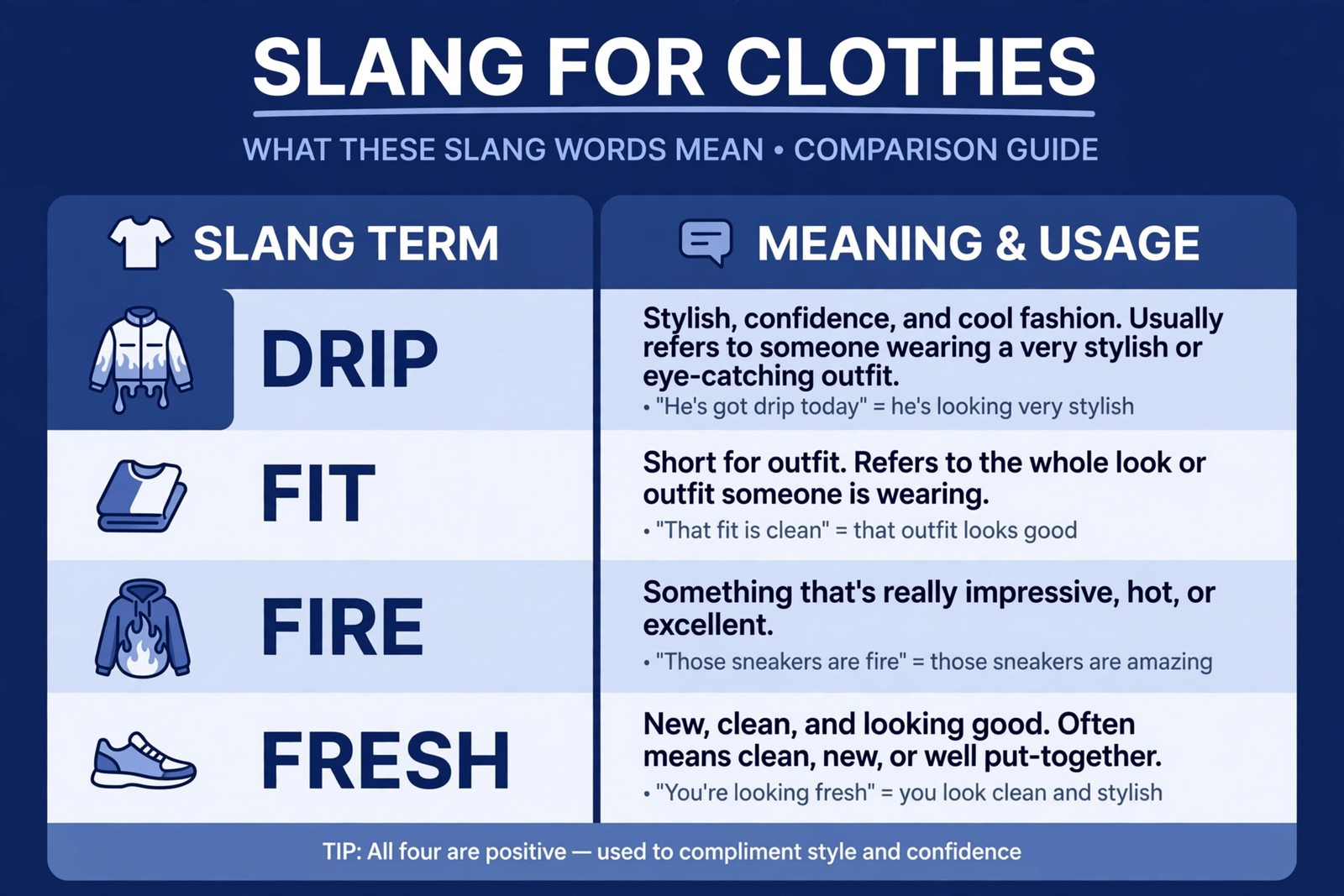
Many slang words for clothes sound similar but mean different things. This table clears up the confusion:
| Slang Word | What It Means | Example | Closest Formal Word |
|---|---|---|---|
| Drip | Expensive, flashy, head-turning style | “His drip is insane.” | Stylish / fashionable |
| Fit | A complete outfit | “Check out my fit.” | Outfit / ensemble |
| Fire | Amazing-looking, excellent | “That jacket is fire.” | Excellent / stunning |
| Fresh | Clean, new, sharp-looking | “You look fresh today.” | Neat / crisp |
| Fly | Cool and fashionable | “She always looks fly.” | Stylish / chic |
| Clean | Simple, sharp, well put-together | “That all-white fit is clean.” | Polished / neat |
| Swag | Confident style (now slightly dated) | “He’s got swag.” | Confidence / flair |
| Threads | Clothes in general | “Nice threads!” | Clothing / garments |
| Heat | Highly desirable sneakers or clothes | “Those are heat.” | Exclusive / coveted |
| Aura | The vibe your outfit gives off | “Her aura is unmatched.” | Presence / vibe |
The biggest difference to remember is between drip and fit. A “fit” is the outfit itself — the actual clothes you are wearing. “Drip” is the style level of that outfit — how impressive, expensive, or fashionable it looks. You can have a simple fit with great drip (a plain hoodie worn perfectly) or a complicated fit with no drip (expensive clothes that clash). They work together, but they are not the same word.
Similarly, fire and fresh are both compliments, but “fire” is stronger and more excited, while “fresh” is calmer and more about looking clean and new. “That outfit is fire” means it is amazing. “You look fresh” means you look clean and put-together. Both are good — just different energy levels.
Alternate Meanings
Many slang words for clothes have other meanings, and context is everything:
- Drip can also mean a slow leak of water, an IV drip in a hospital, or jewelry. In fashion slang, it means style — but if a plumber says “drip,” they mean a leak.
- Fit can mean physical fitness (“I need to get fit”), a tantrum (“she threw a fit”), or how well clothes match your body (“the fit of these jeans is perfect”). In slang for clothes, it means the outfit itself.
- Fire can mean actual flames, getting dismissed from a job (“he got fired”), or shooting a weapon. In slang, it means something is excellent.
- Fresh can mean recently made food, cool air, or being rude (“don’t get fresh with me”). In clothing slang, it means clean and sharp-looking.
- Fly can mean an insect, or the act of traveling by plane. In slang, it means stylish.
- Clean can mean washed or tidy, or a drug test result. In fashion slang, it means a simple, sharp outfit.
- Heat can mean temperature, or a gun in older slang. In sneaker culture, it means rare, desirable shoes or clothes.
- Threads can mean the strings in fabric, or a social media app. In old-school slang, it means clothes.
The rule is simple: if the conversation is about outfits, photos, or shopping, these words almost always carry their fashion meaning. If the conversation is about something else entirely, use the normal meaning.
Professional or Polite Alternatives
Slang for clothes is fun, but it does not belong everywhere. Here are polite, professional alternatives you can use in formal settings:
| Slang Word | Professional Alternative |
|---|---|
| “Your fit is fire.” | “Your outfit looks excellent today.” |
| “That drip is crazy.” | “That is a very stylish ensemble.” |
| “You look fresh.” | “You look very sharp and well put-together.” |
| “Nice threads.” | “I like your outfit — the colors work really well.” |
| “She’s got swag.” | “She has a confident, polished sense of style.” |
| “Fit check?” | “Could I see your outfit for today?” |
| “That jacket is clean.” | “That jacket is very smart and well-tailored.” |
| “Those shoes are heat.” | “Those are impressive — they must be a popular design.” |
In creative workplaces, fashion events, and casual offices, light slang like “clean” or “sharp” is usually fine. In job interviews, client meetings, and formal emails, stick to the professional versions. The goal is not to hide your personality — it is to match your words to the room you are in.
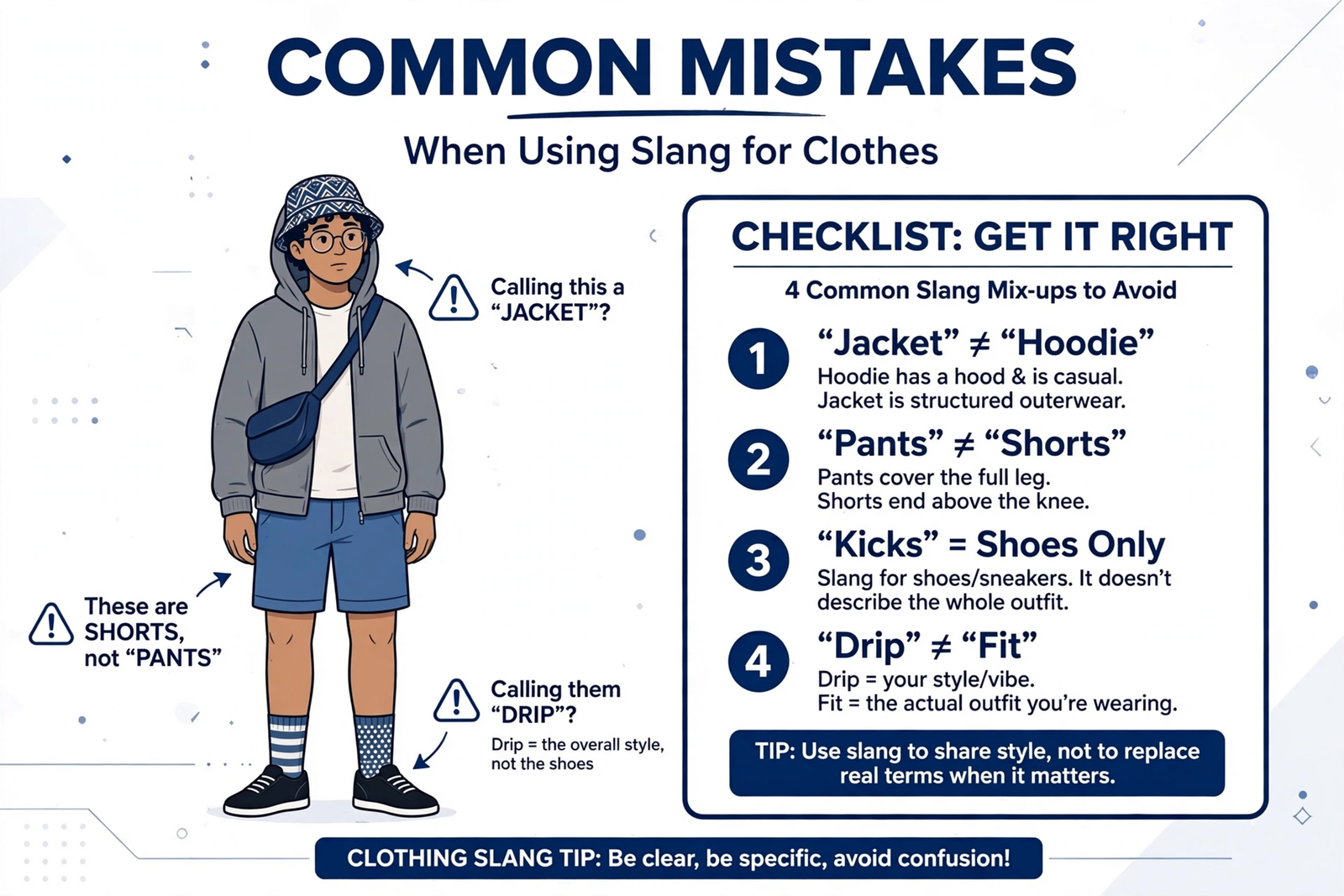
Common Mistakes
Even native speakers get slang for clothes wrong. Here are the most common mistakes to avoid:
- Calling everything “drip.” Drip means impressive, standout style — not just any clothes. A plain t-shirt and jeans is a fit, but it is only drip if it looks genuinely stylish. Overusing “drip” makes the compliment meaningless.
- Using “swag” in 2026. “Swag” was huge in the early 2010s, but today it sounds dated. Younger people may smile politely if you say it — the way they would if you said “groovy.” Use “drip,” “aura,” or “fit” instead.
- Mixing up “fit” and “fitness.” “Nice fit” means nice outfit. “Nice fitness” is not a thing anyone says. Keep the word short.
- Using slang in formal settings. Telling your boss “your drip is crazy” at a board meeting is a mistake you will only make once. Read the room first.
- Forcing slang you do not understand. If you have never heard “aura” used for clothes, do not drop it into a conversation to sound cool. People can tell when slang is forced, and it has the opposite effect. The same applies to other modern terms — for example, dope slang meaning explains a word that sounds positive today but had a very different history, so it pays to know what you are saying before you say it.
- Complimenting the wrong thing. “Your fit is fire” works when the whole outfit looks good. If only the shoes are great, say “those shoes are fire” instead — it is more specific and more believable.
- Using “fire” for everything. If every outfit is “fire,” none of them is. Save the strongest words for the outfits that really deserve them.
Quick Tips
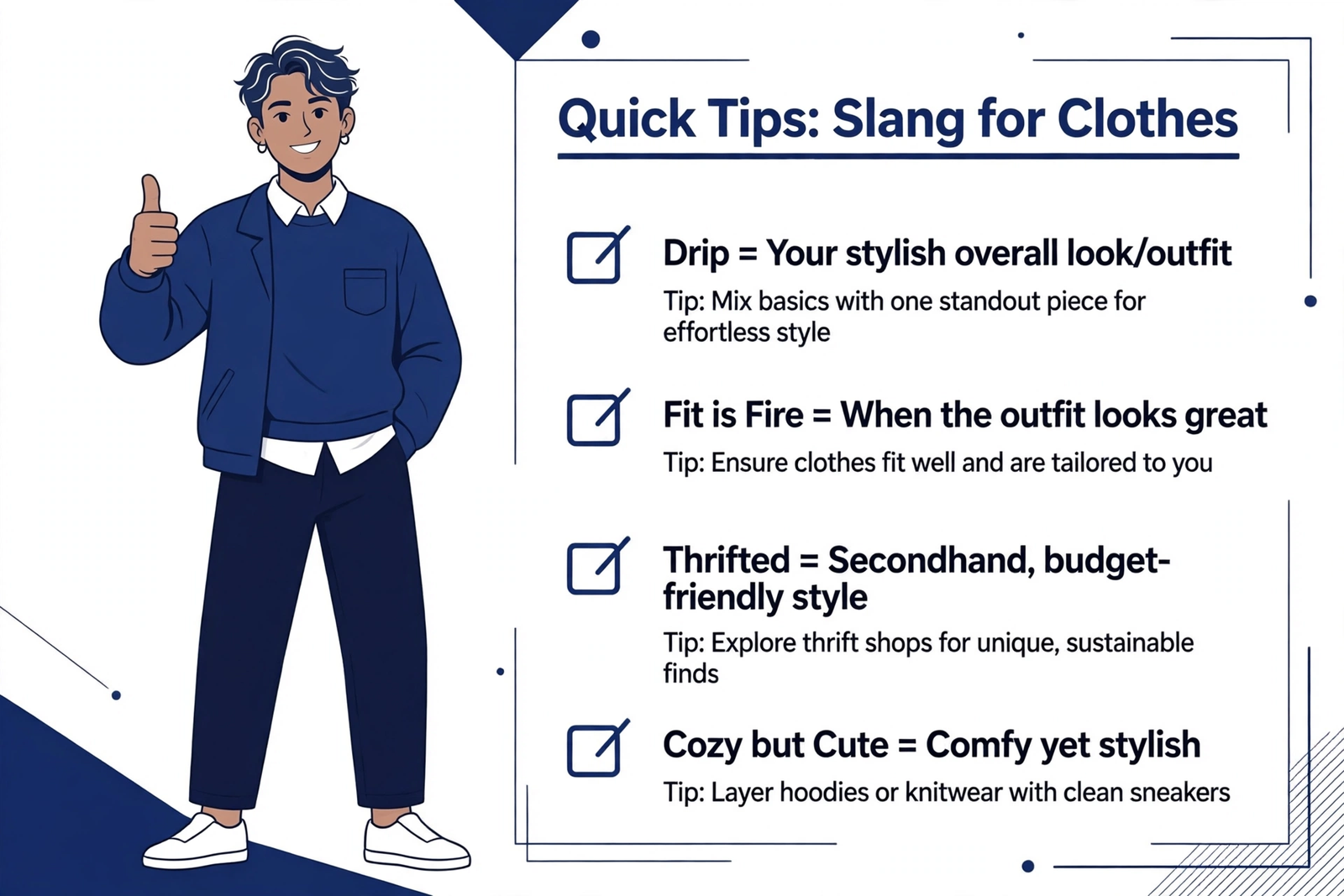
Want to use slang for clothes naturally? Follow these quick tips:
- Start with “fit” and “fire.” These two words are the safest and most widely understood. “Nice fit” and “that is fire” work in almost any casual situation.
- Listen before you speak. Pay attention to which words your friends actually use. If everyone around you says “drip,” use “drip.” If they say “clean,” use “clean.”
- Match the energy. A small compliment gets “nice fit.” A show-stopping outfit gets “that drip is insane.” Match your words to how good the outfit actually is.
- Use it in captions first. If you are nervous about saying slang out loud, try it in an Instagram caption or a text first. “Fit of the day” is an easy, low-risk start.
- Learn the new words slowly. “Aura” and “clean” are newer additions. Learn one or two at a time instead of trying to use all 25 words in one day.
- Do not overdo it. One slang word per sentence is plenty. “Your fit is fire and your drip is clean and your aura is unmatched” sounds like a parody, not a compliment.
- Know your audience. Slang for clothes is perfect for friends, social media, and casual settings. In formal settings, switch to the polite alternatives above.
- Stay updated. Slang changes every year. The words that are cool today may be dated in two years — just ask anyone who still says “swag.” If you want to keep up with how fast internet slang moves, our guide to fade slang meaning is a good example of a word that traveled from one community to the mainstream in record time.
FAQ
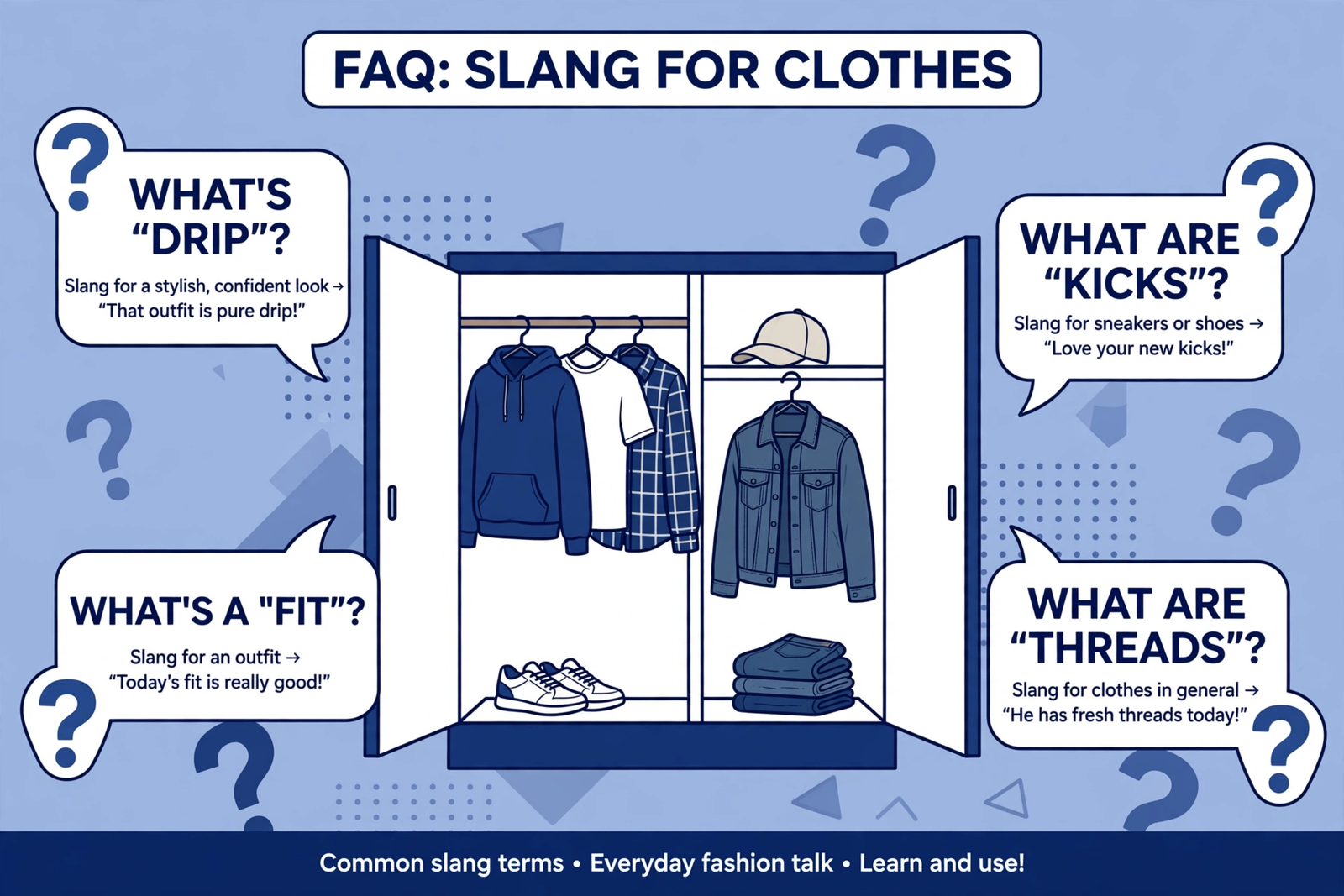
What is the slang for clothes?
The most popular slang for clothes in 2026 includes drip, fit, fire, fresh, fly, clean, threads, gear, heat, and aura. “Fit” means an outfit, “drip” means impressive style, “fire” means amazing-looking, and “fresh” means clean and sharp. These words come mostly from hip-hop culture, sneaker communities, and TikTok, and they are now used in everyday conversation and social media captions.
What does “drip” mean in slang for clothes?
In slang for clothes, “drip” means expensive, flashy, head-turning style. It originally referred to jewelry that “dripped” with diamonds, then expanded to describe an entire outfit that looks impressive. If someone says “your drip is crazy,” they mean your outfit looks incredible. It is one of the most popular fashion slang words of the 2020s.
What does “fit check” mean?
“Fit check” means “show me your outfit.” It is a request — usually in a text or on social media — to see what someone is wearing. People post “fit check” videos on TikTok showing their full outfit, often with a spin or a mirror selfie. It can also be a question between friends before going out: “Fit check?” means “let me see what you are wearing.”
What is the difference between “drip” and “fit”?
A “fit” is the outfit itself — the actual clothes you are wearing. “Drip” is the style level of that outfit — how impressive, fashionable, or expensive it looks. You can have a simple fit with great drip, or an expensive fit with no drip. “Fit” is a noun for the clothes; “drip” is a compliment about how good those clothes look.
Is “swag” still used as slang for clothes?
“Swag” is still understood, but it sounds dated in 2026. It was hugely popular in the early 2010s, then became overused and faded. Younger people now say “drip,” “aura,” or “fit” instead. You can still use “swag” with people your own age who grew up with it, but for the newest slang, “drip” and “aura” are the current words.
What does “clean” mean when talking about clothes?
When talking about clothes, “clean” means a simple, sharp, well put-together outfit — usually minimal, neat, and perfectly matched. An all-white outfit, a well-fitted suit, or a plain hoodie with the right jeans can all be described as “clean.” It is a calmer compliment than “fire” and works even in semi-formal settings because it overlaps with normal English.
What are some other slang words for clothes?
Beyond the most popular ones, other slang for clothes includes threads (clothes), gear (clothes or equipment), getup (an outfit, often unusual), heat (rare or desirable items), sauce (style or confidence), icy (covered in diamonds or jewelry), and bussin (amazing — mostly for food, but sometimes for outfits). Each has its own history, and new words appear every year through music and social media.
Can I use slang for clothes at work?
It depends on your workplace. In casual offices, creative industries, and fashion jobs, light slang like “clean,” “sharp,” or “nice fit” is usually fine. In formal offices, client meetings, and job interviews, use professional alternatives like “stylish,” “well put-together,” or “polished” instead. When in doubt, match the language of the people around you.
Conclusion
Slang for clothes is the fun, fast-moving vocabulary of fashion — and in 2026, it is led by words like drip, fit, fire, fresh, and aura. These words started in hip-hop, sneaker culture, and street fashion, then spread through TikTok and Instagram into everyday conversation. They let people compliment an outfit in two words instead of ten, and they signal that you understand the culture around you.
The key takeaways are simple. Use “fit” for the outfit itself and “drip” for how impressive it looks. Save “fire” for the outfits that truly deserve it, and “fresh” and “clean” for sharp, put-together looks. Leave “swag” in the past, avoid forcing words you do not understand, and switch to professional alternatives in formal settings. And remember that slang changes every year — the words that are cool today may be dated tomorrow, so keep listening and keep learning.
Now you know the slang for clothes, the next time someone asks for a “fit check” or says “your drip is crazy,” you will know exactly what they mean — and exactly what to say back. Keep exploring the language around you, from everyday words like cop slang to the latest internet expressions, and the next slang word you meet will feel a little less mysterious.
