
Quick definition: LA slang means the informal words and phrases people use in Los Angeles, California — from “hella” and “the 405” to “no cap,” “bussin,” and “deadass.” It is the casual street-and-group-chat language shaped by the city’s mix of cultures, its music scene, and its freeway-and-beach lifestyle. If someone says a sentence sounds “very LA,” they usually mean it is relaxed, a little dramatic, and full of words you would hear in a Venice coffee shop or a TikTok filmed on Melrose.
LA Slang Meaning & Definition
LA slang is the everyday informal vocabulary of Los Angeles. It is not one single dialect — it is a blend. Chicano English, African American Vernacular English (AAVE), surfer talk, Valley Girl speech, hip-hop lyrics, and Spanglish all feed into it, and the result is a style of speaking that sounds laid-back, expressive, and unmistakably Californian.
When people search for “la slang,” they usually want one of two things: either the meaning of a specific word they heard someone from LA say, or a list of the most common Los Angeles slang terms so they can understand TikToks, song lyrics, and group chats. This guide covers both — the definition, the history, the most-used words, and real examples of how Angelenos actually talk.
The most important thing to know is that LA slang is always moving. A word that was everywhere in 2020 can sound dated by 2026, and a brand-new phrase can jump from one viral video to every group chat in the city within a week. That is part of the fun — and part of why the city’s slang never really stops changing.
Introduction
Picture this: you are scrolling TikTok and a creator says, “Bro, the 405 was deadass packed, but the tacos were bussin, no cap.” If you are not from Los Angeles, half of that sentence might sound like another language. If you are from LA, you understood every word without thinking — the freeway was jammed, the tacos were amazing, and none of it is an exaggeration.
That is the power of LA slang. Los Angeles is the entertainment capital of the world, so its slang does not stay in the city. It travels through movies, music, YouTube, and TikTok until people in Ohio, London, and Sydney are saying words that started on a street corner in South Central or a beach in Malibu. LA slang shapes how the whole internet talks.
In this guide, you will learn the full la slang breakdown: what it means, where it came from, the words everyone in LA actually uses, how it compares to slang from New York and the Bay Area, and the mistakes that instantly mark someone as a tourist. By the end, you will understand the language of Los Angeles — and you will know exactly what to say (and what not to say) the next time you visit.

Origin
Los Angeles slang has never had a single origin point, because Los Angeles has never had a single culture. The city grew up as a meeting point: Mexican and Chicano communities in East LA, Black communities in South LA, surfers along the coast, and the entertainment industry in Hollywood all developed their own ways of talking — and then those ways of talking collided.
The earliest wave most people recognize is surfer slang from the 1960s. Words like “gnarly,” “rad,” “dude,” and “stoked” came from beach culture and spread through movies like Fast Times at Ridgemont High. A decade later, Valley Girl speech from the San Fernando Valley added “like,” “totally,” “for sure,” and “oh my God” to the national vocabulary — so thoroughly that most Americans now use these words without realizing they came from LA.
Hip-hop changed everything in the 1980s and 1990s. West Coast rap — N.W.A., Ice Cube, Snoop Dogg, Tupac, and later Kendrick Lamar — turned LA street language into global language. Words like “homie,” “dawg,” “fo’ sho,” and “trippin'” left the neighborhood and entered the mainstream through lyrics, and they never left. In the 2010s and 2020s, social media finished the job: LA slang now spreads through TikTok sounds, Instagram captions, and YouTube vlogs faster than any radio station ever could.
Spanglish is the other huge ingredient. With such a large Latino population, LA slang is full of Spanish borrowings — “órale,” “no mames,” “chale,” “ese,” “vato,” and “firme” are all part of everyday conversation for millions of Angelenos, and many of them have crossed over into general LA slang even among people who do not speak Spanish.
Popularity
LA slang is popular for a simple reason: Los Angeles is where American pop culture is made. When a movie star, a rapper, or a TikTok creator with ten million followers uses a word, that word becomes famous overnight. LA slang is not just local color — it is the raw material of global internet language.
The numbers tell the story. LA-based creators dominate TikTok, YouTube, and Instagram, and the words they use in a single viral video can generate millions of searches within days. Terms like “bussin,” “no cap,” and “slay” all had LA roots or LA boosters before they became worldwide slang. Even the way people talk about freeways — “the 405,” “the 101,” “the 10” — is now a recognizable LA signature that shows up in comedy sketches everywhere.
Music keeps the cycle going. Every new wave of LA rap, R&B, and pop brings a fresh batch of words. Kendrick Lamar’s music alone has introduced or popularized dozens of LA phrases, and the city’s streetwear and skate scenes do the same. If you want to know what American teenagers will be saying next year, listen to what LA teenagers are saying today.
How It Is Used
LA slang is used in texts, in person, in song lyrics, in captions, and in comments — basically everywhere casual language lives. It works as emphasis (“deadass,” “for real”), as approval (“bussin,” “fire,” “firme”), as dismissal (“chale,” “trippin'”), and as a way of claiming identity. Saying “I’m from LA” with the right slang in your voice is a fast way of telling people where you belong.
The tone is usually relaxed and confident. LA slang rarely sounds stiff or formal — it is the language of hanging out, hyping a friend up, or reacting to something wild. It is also highly contextual: the same word can be a compliment, a joke, or an insult depending on who says it and how. “You trippin'” can be a gentle tease between friends or a serious warning, and only the tone tells you which one it is.
One famous LA habit is putting “the” before freeway numbers — “take the 405 to the 10” — which no other American city really does. Another is the heavy use of “like” as a filler and “literally” as an intensifier. These small habits are part of what makes LA speech instantly recognizable, even when no obvious slang word is in the sentence at all.
Examples
The best way to learn LA slang is to see it in real sentences. Here are examples of how Angelenos actually use these words in everyday conversation — in friendly chats, at work, and in jokes.
Friendly Examples
“Yo, that taco truck on Sunset is bussin — we gotta go back this weekend.” (The tacos are amazing.)
“She’s hella cool, fr. We been friends since high school.” (She is genuinely cool, for real.)
“I’m finna hit the beach after work, you down?” (I’m going to go to the beach — are you coming?)
“Órale, let’s go — the show starts in twenty minutes.” (Alright, let’s go.)
Professional Examples
LA slang shows up at work too, just softened. “That pitch was fire, honestly — the client loved it.” “Let’s keep it chill and circle back on Monday.” “The traffic on the 405 was unreal, I was twenty minutes late.” In creative industries — entertainment, music, fashion, social media — a little LA slang in the office is completely normal, and sounding too formal can actually feel out of place.
Funny Examples
“Bro said the party was gonna be lit and it was just him, his cousin, and a bag of chips.” “My GPS said take the 405 and I aged five years in traffic.” “She said ‘no cap’ and then immediately capped.” The humor in LA slang usually comes from exaggeration — everything is “literally the best,” “deadass the worst,” or “so fire” that it needs a whole sentence to recover.

Comparison with Similar Terms
LA slang is often confused with general American slang, but it has its own flavor. The biggest comparisons are with New York slang and Bay Area (NorCal) slang — and the differences are real. LA is laid-back and drawn-out; New York is fast and sharp; the Bay Area has its own separate vocabulary that LA people sometimes tease. Here is how they stack up.
| Word or Feature | LA Slang | New York Slang | Bay Area Slang |
|---|---|---|---|
| Very / a lot | Hella (borrowed, but common) | Mad (“mad cool”) | Hella (original home) |
| Amazing food | Bussin | Bussin (shared now) | Slaps |
| For real | Deadass, fo’ sho | Deadass, word | Fo’ real |
| Freeway talk | “The 405,” “the 10” | Highway numbers, no “the” | “The 101,” “the 880” |
| Friend | Homie, dawg, bruh | Son, bro, my guy | Cuz, bruh |
| Crazy / unbelievable | Trippin’ | Buggin’ | Trippin’ (shared) |
| Cool / solid | Firme, fire | Fire, valid | Hyphy (older) |
One thing the table shows clearly: a lot of slang is shared now. The internet has blurred the lines, and words like “bussin” and “deadass” belong to everyone. What stays uniquely LA is the mix — the Spanglish, the surfer words, the freeway habit, and the entertainment-industry energy that no other city quite copies. If you want to keep decoding internet language, our guide to sigma is a good next stop, since it is another term LA creators helped make famous.

Alternate Meanings
“LA” does not always mean Los Angeles, and “la slang” searches sometimes come from people looking for something else entirely. Here are the main alternate meanings to know.
LA as Louisiana: LA is also the official postal abbreviation for Louisiana. “Louisiana slang” is a totally different world — Cajun and Creole French influences, words like “lagniappe” (a little something extra), “cher” (dear), and “making groceries” (going grocery shopping). If the context is the South, LA probably means Louisiana, not Los Angeles.
La in Spanish: In Spanish, “la” is simply the feminine definite article — “the.” So “la slang” could be a fragment of a Spanish sentence, and Spanish-language slang (“la jerga”) is its own rich topic. In LA itself, the two meanings overlap constantly, since so much LA slang is Spanglish.
La as a musical note: In solfège, “la” is the sixth note of the scale (A). It shows up in music slang and in the phrase “la la la,” but it has nothing to do with Los Angeles slang.
LA as a place name elsewhere: There are other places abbreviated LA, and “LA” is also used as shorthand in gaming and fandom communities. Context is everything — if the sentence mentions freeways, tacos, or TikTok, it is Los Angeles.
Professional or Polite Alternatives
LA slang is perfect for friends, social media, and casual conversation, but it does not belong everywhere. In a job interview, a formal email, or a meeting with a client, the same ideas sound better in plain, professional English.
Instead of “that’s bussin,” say “that’s excellent” or “that was really good.” Instead of “deadass,” say “seriously” or “honestly.” Instead of “you trippin’,” say “I think there’s been a misunderstanding.” Instead of “hella cool,” say “really great.” The trick is not to lose your personality — just to translate it. You can still be warm and enthusiastic without slang, and in formal settings, clear language is what people remember.
One exception: in creative industries in LA itself, a little slang is often expected. A casting director, a music manager, or a social media team will not mind “fire” or “no cap” in a brainstorm. Read the room first, and match the energy of the people you are talking to.
Common Mistakes
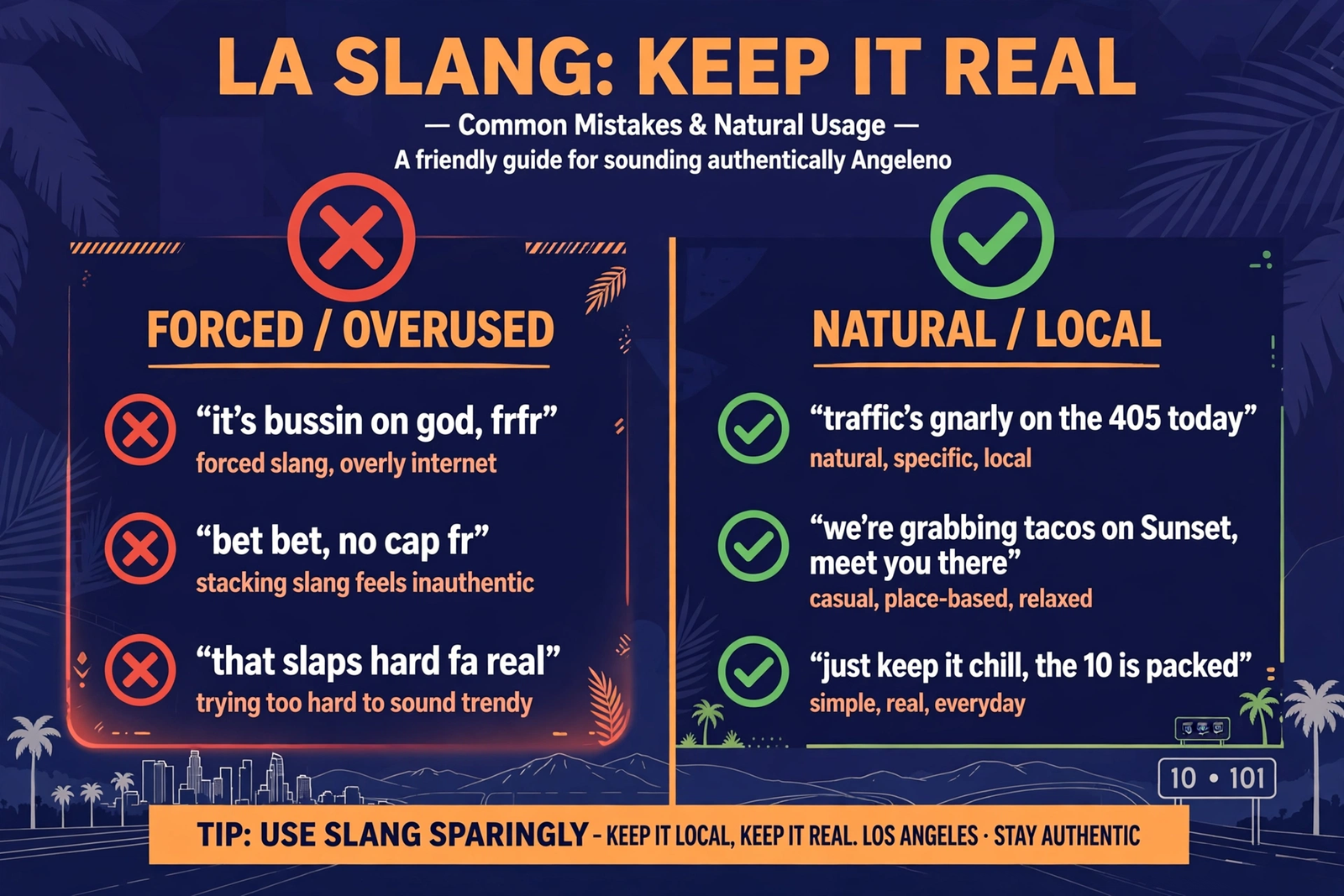
The biggest mistake people make with LA slang is forcing it. Nothing sounds more out of place than someone dropping “deadass” and “bussin” into every sentence when they have never lived in California. LA slang works because it sounds effortless — the moment it sounds rehearsed, it stops working.
Another common mistake is using words from the wrong region. “Hella” is originally Bay Area, and while LA people use it, calling everything “hella” is a fast way to sound like you learned slang from a list instead of from people. Similarly, mixing LA words with New York words (“mad hella cool”) just sounds confused.
People also misuse “the” with freeways — or forget it entirely. Saying “take 405” instead of “take the 405” is the single easiest way for an Angeleno to spot a visitor. And do not overuse “like” in formal writing; in speech it is natural, but in a work email it reads as unsure.
Finally, be careful with borrowed words from other cultures. Some LA slang comes from AAVE and Chicano communities, and using it mockingly — or to sound “street” — can come across as disrespectful. Use the words naturally, in the right context, and with respect for where they came from.
Quick Tips
- Listen first: Spend time around LA creators, music, and shows before you start using the slang yourself. You will pick up the rhythm naturally.
- Start small: Learn three or four words well — “bussin,” “no cap,” “deadass,” “for real” — instead of memorizing a list of fifty you will never use.
- Match the moment: LA slang is for casual settings. Keep it out of job interviews, formal emails, and serious conversations.
- Use “the” with freeways: It is “the 405,” “the 101,” “the 10.” Always. This one detail makes you sound instantly more LA.
- Do not overdo it: One slang word per sentence is plenty. Two or three in a row sounds like a parody.
- Stay current: LA slang changes fast. A word that was hot last year might sound dated now — check TikTok and new music to keep up.
- Respect the source: Remember that much of LA slang comes from Black and Latino communities. Use it, enjoy it, and do not mock it.

FAQ
What does LA slang mean?
LA slang means the informal words and phrases used in Los Angeles, California — terms like “bussin,” “deadass,” “hella,” “trippin’,” and “no cap” that come from the city’s mix of surf culture, hip-hop, Chicano culture, and entertainment. It is the casual language of Angelenos in texts, on TikTok, and in everyday conversation.
What is the most famous LA slang word?
“Dude” is probably the most famous LA word of all time, thanks to surfer and Valley culture. In modern LA slang, “bussin” and “no cap” are the most widely used, while “deadass” and “hella” are close behind. For a deeper look at one of the most popular modern terms, see our guide to FRFR, which LA creators use constantly.
Is LA slang the same as California slang?
Not exactly. LA slang is one regional style of California slang. The Bay Area (NorCal) has its own words, like “hyphy” and its own use of “hella,” and San Diego and the Central Valley have their own local flavor too. LA slang is the most famous version because Hollywood and the music industry spread it worldwide.
Why do people from LA say “the” before freeway numbers?
Angelenos say “the 405” and “the 10” because LA’s freeways were originally named — the San Diego Freeway, the Santa Monica Freeway — and “the” stuck when the numbers took over. It is one of the most reliable signs that someone is from LA, and people from other cities almost never do it.
What does “bussin” mean in LA slang?
“Bussin” means really, really good — almost always about food. “These tacos are bussin” means the tacos are amazing. It started in AAVE and spread through LA hip-hop and TikTok until it became one of the most popular slang words in America. If you want another word that works the same way, check out our guide to slay, which is LA slang for doing something perfectly.
Is LA slang appropriate to use at work?
It depends on the workplace. In LA creative industries — entertainment, music, fashion, social media — light slang like “fire” or “no cap” is normal. In formal corporate, legal, or medical settings, it is better to use plain professional English. When in doubt, listen to how your coworkers talk and match their level.
How is LA slang different from New York slang?
LA slang is more laid-back and drawn-out, with heavy Spanglish and surfer influences. New York slang is faster and sharper, with words like “son,” “mad,” and “buggin’.” Both cities share some words now — “deadass” and “bussin” are used in both — but the overall sound and rhythm are very different.
How can I learn LA slang quickly?
Watch LA creators on TikTok and YouTube, listen to West Coast hip-hop, and pay attention to how words are used in context rather than memorizing definitions. Start with a few common words, use them naturally, and let the rest come with exposure. Our guides to terms like NPC can help too, since many of these words travel together in the same online spaces.
Conclusion
LA slang is more than a list of funny words — it is the sound of Los Angeles itself. It carries the city’s beaches, its freeways, its music, its movies, and its mix of cultures in every sentence. From surfer words like “gnarly” to hip-hop staples like “homie” and TikTok favorites like “bussin,” LA slang has shaped how the whole world talks, and it is still changing every single day.
The key takeaways are simple: LA slang is casual, expressive, and deeply tied to the city’s identity. Learn the most common words, use them naturally, and do not force them. Say “the 405,” call great food “bussin,” and save “deadass” for moments you really mean it. And remember where the words come from — the communities that created them deserve respect, not imitation.
Now that you know the full la slang story, the next time a TikTok caption or a song lyric throws an unfamiliar LA word at you, you will know exactly what it means — and you might even catch yourself saying it. Los Angeles does not just make movies and music; it makes the language the rest of us end up speaking. For the history of how internet slang spreads, see the California English page, which covers the dialects and slang that grew out of the state.
