
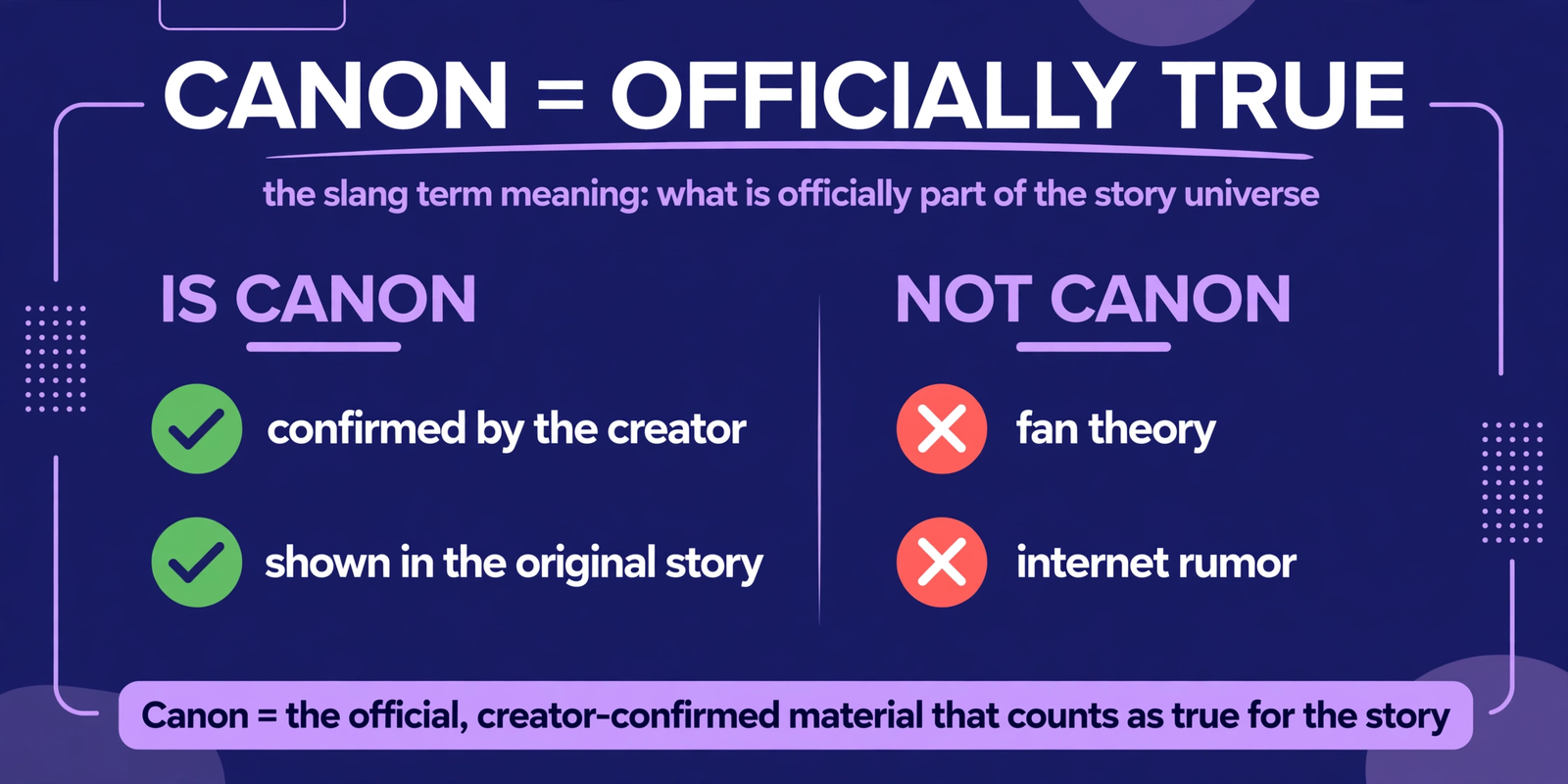
Quick definition: In slang, canon means something is officially true inside a fictional story, show, game, or universe. If a detail is “canon,” the creator confirmed it or it actually happened in the story — it is not a fan theory, a joke, or a made-up rumor. You will see it everywhere in fandom spaces: “Is that canon?” simply asks, “Did that really happen in the story?”
Canon Meaning & Definition
The canon meaning slang is simple once you hear it in context: canon is the official version of events. In a fandom, the canon is everything that truly counts — the plot points, relationships, backstories, and rules that the original creator, writer, or studio has established. Anything outside that official record is not canon, no matter how popular it is online.
Think of it like the rulebook of a fictional world. A TV show’s canon includes what happened on screen. A book series’ canon includes what is written in the books. A video game’s canon includes the events of the main storyline. Fan fiction, fan art, memes, and theories can be fun and wildly popular, but they do not become canon just because millions of people like them.
Here is the definition in one line: canon = officially true in the story, confirmed by the creator or shown in the original work.
| Term | What It Means | Example |
|---|---|---|
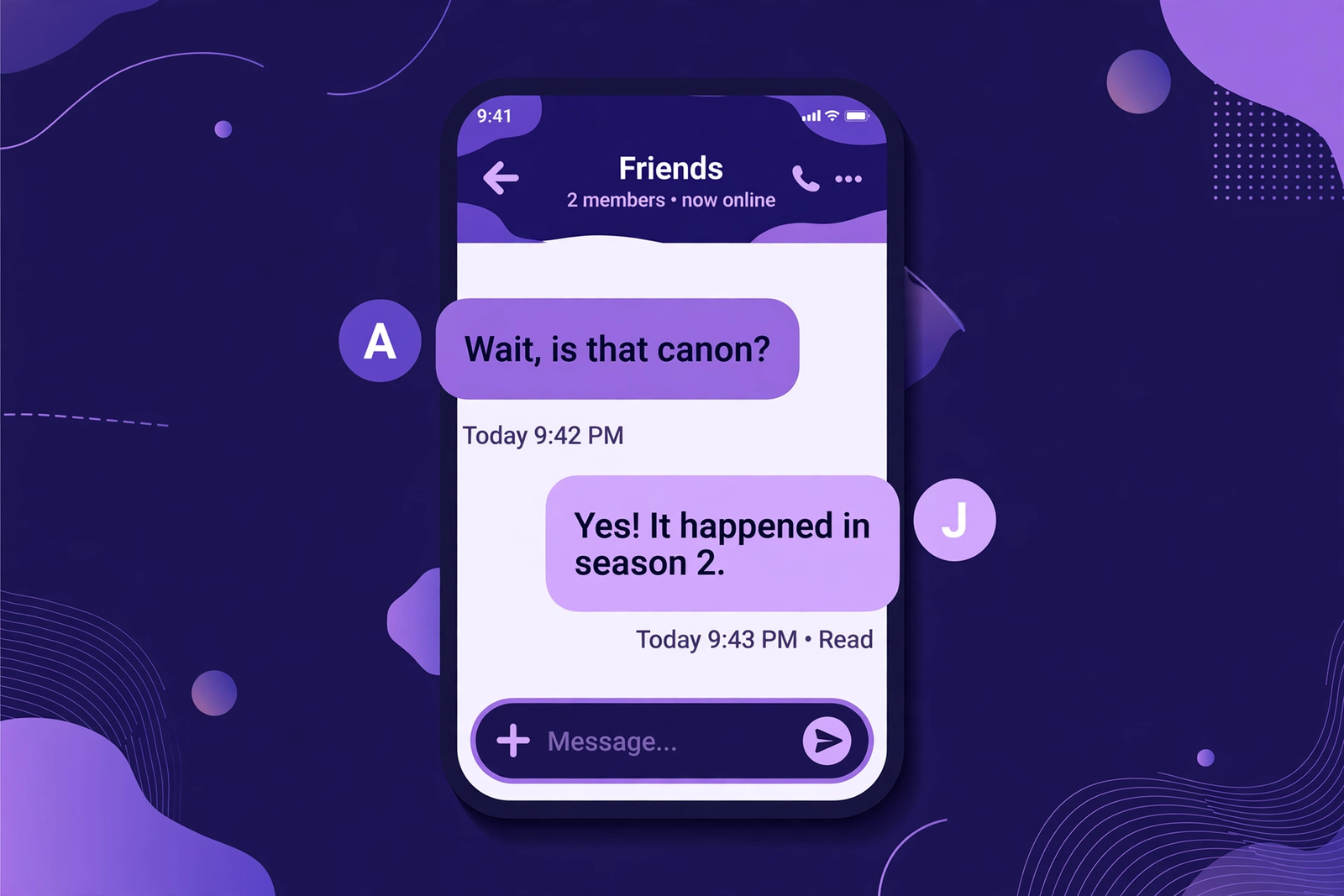
| Canon | Officially true in the story | “Their breakup is canon — it happened in season 2.” |
| Headcanon | A fan’s personal belief about the story | “My headcanon is that she secretly speaks three languages.” |
| Fanon | A fan idea so popular the whole fandom treats it as true | “That nickname is fanon, not canon — it started on Tumblr.” |
| Canon event | A key moment that must happen for the story to work | “Losing his mentor was a canon event — it shaped everything after.” |
| Retcon | When creators change or erase earlier canon | “The new movie retconned the old ending.” |
Introduction
Scroll through any fandom comment section on TikTok, X, Reddit, or Discord and you will run into the word canon within seconds. “Wait, is that canon?” “That is NOT canon, stop spreading it.” “Canon event incoming.” For anyone outside fandom culture, it can feel like a secret password — but the idea behind it is older than the internet itself.
The word comes from the world of books and religion, where a “canon” was the list of works officially accepted as genuine. Fans borrowed it to draw the same line: what counts as real in the story, and what is just something fans invented? As fandoms moved from forums to TikTok edits and X threads, the word escaped its niche and became everyday internet slang.
Today, canon is not only a fandom word. People use it to talk about real life, too — a “canon event” now describes any unavoidable life moment, from a bad breakup to a first job. Understanding the canon meaning slang helps you read fandom debates, enjoy the jokes, and avoid confidently repeating something that never actually happened in the story. If you want to decode more internet shorthand, our guides to hbu and imk cover the rest of the group-chat dictionary.
Origin
The word canon comes from the Greek word kanon, meaning a measuring rod or rule. In early Christianity, it described the list of books officially accepted as scripture — the genuine texts, as opposed to disputed ones. Literature borrowed the idea next: the “canon” of Sherlock Holmes, for example, means the original stories written by Arthur Conan Doyle, not the hundreds of pastiches and adaptations that came later.
Science fiction and fantasy fandoms adopted the term in the 20th century. Star Trek and Star Wars fans needed a way to separate the movies and TV episodes from the spin-off novels, comics, and games — so the films and shows became canon, and everything else was ranked below them. Online forums in the 1990s and 2000s made the word standard fandom vocabulary, and fanfiction sites like Archive of Our Own built entire tagging systems around it.
The slang explosion came later. Around 2020, “canon event” jumped from Spider-Man fandom into mainstream TikTok after Spider-Man: Across the Spider-Verse (2023) made the phrase a plot point: certain events must happen to every Spider-Person, or their universe collapses. TikTok users started calling their own painful life moments “canon events,” and suddenly a word that once belonged to Star Trek forums was on everyone’s For You page.
Popularity
Canon is popular because fandoms are popular. Every major franchise — Marvel, Harry Potter, anime like Jujutsu Kaisen and Demon Slayer, games like Genshin Impact and Elden Ring — has an active online community that argues about what is and is not canon. The word is the referee in those arguments.
Several things pushed canon into the mainstream:
- Canon events on TikTok: The “canon event” meme turned the word into a joke format — any awkward or painful moment became “my canon event.” Millions of views made the term familiar even to people who have never joined a fandom.
- Franchise debates: When a new movie or season changes the story, fans rush online to ask whether the change is canon. The word frames every debate.
- Shipping culture: Fans who want two characters together constantly ask whether a relationship is canon — an official couple — or just something they wish were true.
- Gaming: Games with multiple endings, DLC, and spin-offs need a clear canon, so players use the word constantly to sort out which ending “really” happened.
- Short-form video: Edits, theories, and lore videos on TikTok and YouTube Shorts use “canon” in titles and captions, teaching the word to new audiences every day.
Search interest in the phrase has stayed strong because every new season, movie, or game release starts the argument all over again. Canon is not a trend that fades — it is the permanent vocabulary of fandom.
How It Is Used
Canon works as a noun, an adjective, and sometimes a stamp of approval. Here are the main ways people use it:
- As an adjective — “canon”: “That scene is canon.” It means the scene officially happened in the story.
- As a question — “Is that canon?”: The most common use. Someone shares a fact or theory, and the reply asks whether it is officially true.
- As a denial — “That’s not canon”: A quick correction when someone treats fan fiction, a meme, or a rumor as fact.
- As a noun — “the canon”: “It contradicts the canon.” The whole body of official story material.
- As “canon event”: A moment that is unavoidable and shapes what comes next — in a story, or as a joke about real life.
- As “canonically”: The adverb form. “Canonically, she is 17 years old” means the official story says she is 17.
- As “canon-compliant”: Fan fiction that fits the official story without contradicting it.
Outside fandom, people also use canon loosely to mean “official” or “the real version.” A friend might say, “The canon story is that we met at a party,” meaning the agreed-upon official version of events. The tone is usually playful — canon is a fun word, not a formal one.
Examples
Canon shows up in chats, comment sections, and captions. Here is how it sounds in real conversations.
Friendly Examples
- “Wait, are they actually dating? Is that canon or just fan art?”
- “Her power level is canon — she literally destroyed a planet in episode 12.”
- “My canon event was getting rejected from my dream college. It built character, I guess.”
- “That line is canon now, the writer confirmed it on Twitter.”
- “Canonically, he hates coffee. The fandom just ignores it.”
Professional Examples
Canon is casual slang, so it rarely appears in formal writing — but it does show up in professional creative work:
- A game developer: “We need to confirm what is canon before the sequel’s script is finalized.”
- A film critic: “The reboot treats only the first two films as canon.”
- A publishing editor: “The new novel is canon-compliant with the original trilogy.”
- A marketing post: “The official canon timeline is now live on our website.”
Funny Examples
- “Getting food poisoning at a wedding is a canon event. You cannot avoid it.”
- “My canon event is saying ‘you too’ when the waiter says enjoy your meal.”
- “Bro thinks his fan theory is canon. It is not. It never was.”
- “That outfit is so iconic it should be canon.”
- “Canon event: tripping in front of your crush in slow motion.”
Comparison with Similar Terms
Canon is easy to confuse with the words around it. This table sorts them out.
| Term | Meaning | Official? | Example |
|---|---|---|---|
| Canon | Officially true in the story | Yes | “They got married in the final book — it is canon.” |
| Headcanon | A fan’s personal belief, not confirmed | No | “My headcanon is that he is secretly a prince.” |
| Fanon | A fan idea the whole fandom accepts as if true | No | “The fandom treats that nickname as fanon.” |
| Canon event | A key moment that must happen | Yes, in-story | “His mentor’s death was a canon event.” |
| Retcon | Creators retroactively changing canon | Yes, new canon | “The sequel retconned her backstory.” |
| Lore | All background facts of a fictional world | Partly | “The lore says dragons ruled the north.” |
| Ship | Wanting two characters in a relationship | No | “I ship them, but it is not canon.” |
The key difference is authority. Canon comes from the creator or the original work. Headcanon and fanon come from fans. Lore is broader — it includes canon facts plus legends and background that may or may not be confirmed. And a retcon is the only thing that can overwrite canon: when the creators themselves change the official story.

Alternate Meanings
Canon has several meanings outside slang. Knowing them helps you tell which one someone means.
- Canon (camera brand): Canon Inc. is the Japanese company famous for cameras, lenses, and printers. “I shoot on a Canon” has nothing to do with fandom.
- Pachelbel’s Canon: A famous piece of classical music — Canon in D by Johann Pachelbel — played at countless weddings. Here, canon is a musical form where a melody repeats with overlapping voices.
- Canon law: The official laws of the Catholic Church. This is the original “official rules” sense of the word.
- Literary canon: The set of books considered the most important in a culture or field — the “classics” that students are expected to read.
- Canon (religious): A list of saints officially recognized by the Church, or the official list of books in the Bible.
- Canon (art and design): A standard of proportion, like the “canon of proportions” for drawing the human body.
In a texting or fandom context, canon almost always means the slang definition — officially true in the story. If someone is talking about cameras or classical music, they mean one of the other definitions.
Professional or Polite Alternatives
Canon is casual internet slang. In formal or professional settings, use these alternatives instead:
| Instead of | Say | When to use it |
|---|---|---|
| “Is that canon?” | “Is that part of the official storyline?” | Work emails, articles, reviews |
| “That is not canon.” | “That is not part of the established story.” | Professional writing |
| “Canon event” | “A defining moment” or “a turning point” | Formal speech or writing |
| “Canonically, she is 17.” | “According to the official story, she is 17.” | Academic or journalistic writing |
| “Canon-compliant” | “Consistent with the original work” | Publishing and editing |
Among friends and in fandom spaces, canon is perfectly fine. Save the formal versions for work, school, or anything that will be read by people outside the fandom.
Common Mistakes
Even regular fans mix canon up. Avoid these mistakes:
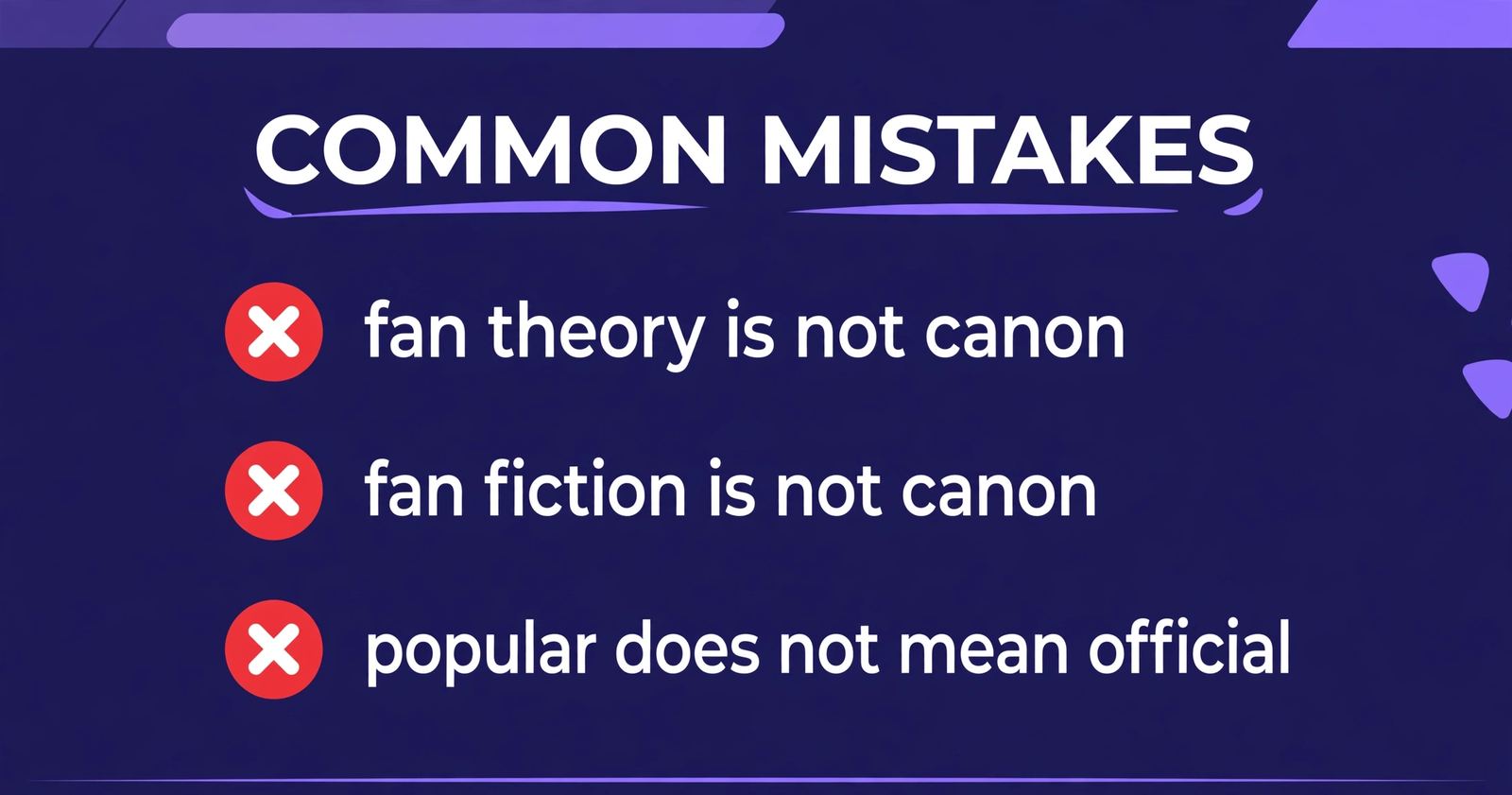
- Calling popular fan theories canon: A theory with a million likes is still a theory until the creator confirms it. Popularity does not make something canon.
- Treating fan fiction as canon: Fan fiction is written by fans, not the creator. It can be brilliant, but it is not part of the official story unless the creator adopts it.
- Confusing canon with fanon: Fanon is a fan idea everyone repeats so often it feels official. If you cannot find it in the original work or a creator statement, it is fanon, not canon.
- Assuming every adaptation is canon: Movie versions, spin-offs, and reboots often change the story. A detail from a film may not be canon in the books, and vice versa.
- Forgetting retcons: Creators sometimes rewrite earlier facts. The old version was canon once — but the new version is canon now.
- Using “canon event” for everything: The joke works because a canon event is unavoidable and life-changing. Calling a minor inconvenience a canon event makes the joke fall flat.
- Arguing without a source: “It is canon, trust me” settles nothing. Point to the episode, chapter, or interview where it was confirmed.
Quick Tips
- Check the source: Before claiming something is canon, check the episode, chapter, or official interview. The original work is the only real proof.
- Ask “is that canon?” politely: It is a genuine question, not an insult — use it when you are curious, not when you want to start a fight.
- Respect other people’s headcanons: A headcanon is personal. You can disagree without calling someone wrong — just say it is not canon.
- Keep timelines straight: In big franchises, note which version you mean — book canon, movie canon, or game canon can all differ.
- Use “canon event” sparingly: Save the joke for real turning points and it stays funny.
- Watch for retcons: If a new season contradicts an old fact, the new fact is the canon one now.
- Learn the fandom’s canon first: Before joining a debate, read the wiki or official timeline so your arguments land.

FAQ
What does canon mean in slang?
In slang, canon means something is officially true inside a fictional story. If a detail is canon, the creator confirmed it or it happened in the original work — it is not a fan theory or a rumor.
What is a canon event?
A canon event is a key moment that must happen for the story — or a person’s life — to unfold the way it does. The phrase comes from Spider-Man: Across the Spider-Verse (2023), where certain events must happen to every Spider-Person. On TikTok, people jokingly call their own unavoidable life moments canon events.
What is the difference between canon and headcanon?
Canon is officially confirmed by the creator or shown in the original work. Headcanon is a fan’s personal belief about the story that has never been confirmed. Headcanon can be fun, but it is not official.
Is fan fiction canon?
No. Fan fiction is written by fans, not the original creator, so it is not part of the official story — unless the creator later adopts an idea from it, which is rare.
Can something stop being canon?
Yes. When creators rewrite earlier facts, it is called a retcon. The new version becomes canon and the old version stops being official — even if fans preferred the original.
What does “canonically” mean?
Canonically is the adverb form of canon. “Canonically, she is 17” means that according to the official story, she is 17 years old.
Is canon only used in fandoms?
Mostly, but not entirely. People now use “canon event” as a joke about real life, and “canon” sometimes means “the official version” of any story — even a real-life one, like how two friends met.
How do I know if something is canon?
Check the original work — the book, episode, film, or game — or an official statement from the creator. Fan wikis usually label canon facts and cite their sources, which makes them a good place to check.
Conclusion
The canon meaning slang is one of the most useful words in internet culture: canon means officially true in the story, confirmed by the creator or shown in the original work. Everything else — headcanon, fanon, theories, and memes — lives outside that line, no matter how popular it gets. That single distinction is why the word matters so much in fandom debates, and why it spread from Star Trek forums to TikTok in the first place.
What makes canon fun is how far it has traveled. It started as a religious and literary term, became the referee of fandom arguments, and then — thanks to the “canon event” meme — turned into a joke about real life. A bad breakup, a failed exam, an embarrassing moment in front of a crush: all canon events now, because they are the unavoidable moments that shape who you become.
So the next time someone asks “is that canon?” you will know exactly what they are asking — and you will know how to answer. Check the source, respect the difference between canon and headcanon, and save your canon-event jokes for the moments that truly deserve them. And if you want to keep decoding the language of the internet, check out our guides to mhm and fn — the rest of the group-chat dictionary, explained one term at a time.
For the dictionary definition, see the Wiktionary entry for canon, which covers the word’s senses from official lists to fandom usage.
