
Goon Slang Meaning: What Does Goon Mean in Slang?
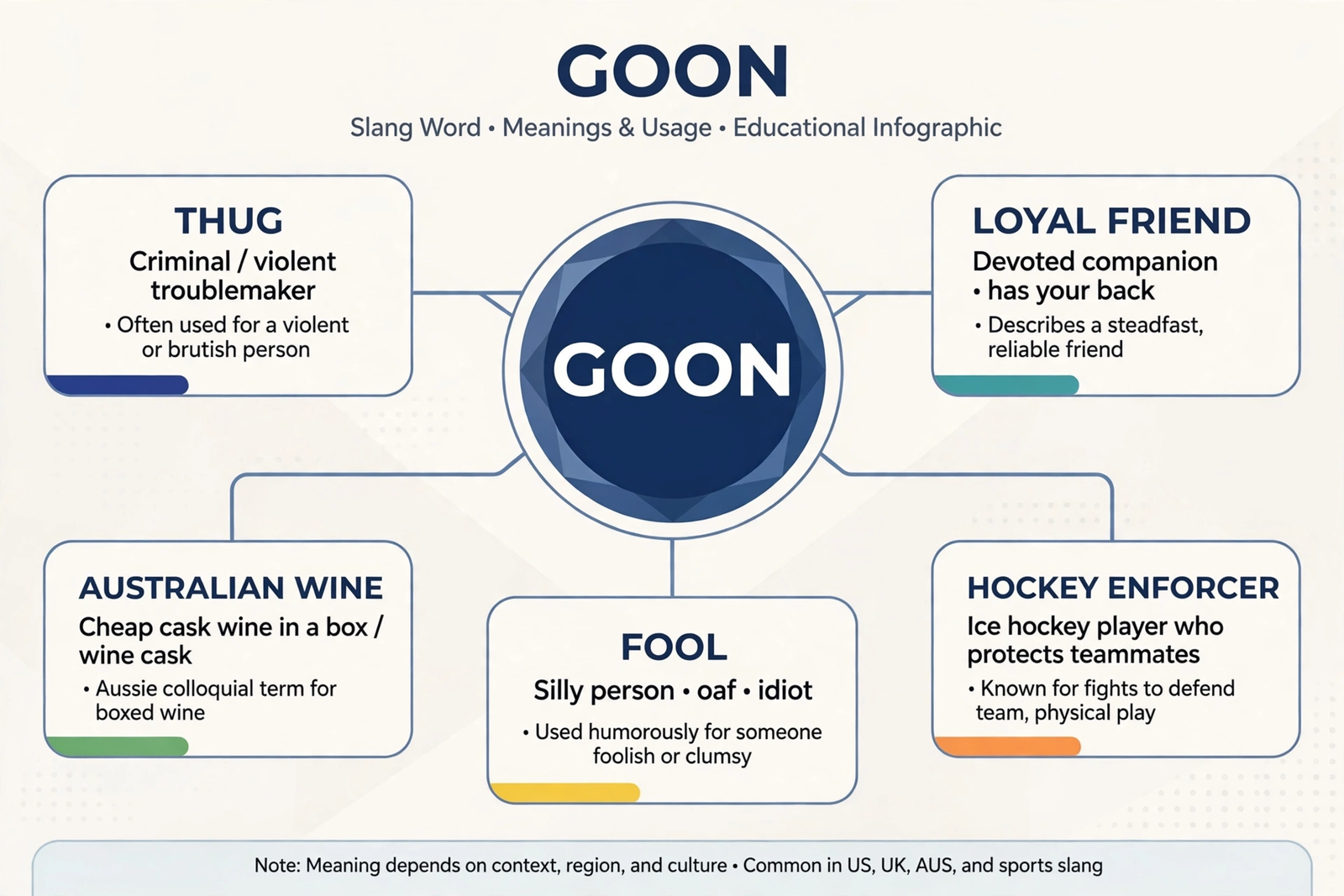
Quick Definition: In slang, goon most commonly means a tough, intimidating person hired to threaten or hurt others — a thug or henchman. But goon slang has grown far beyond that one meaning: depending on where you hear it, a goon can also be a silly fool, a loyal friend in your crew, a hockey enforcer, cheap boxed wine in Australia, or — in the newest internet usage — someone deep into the online trend called “gooning.” Context is everything, and this guide breaks down every meaning with real examples.
Goon Slang Meaning & Definition
Goon slang refers to all the informal meanings of the word goon — a word that has been reinvented by almost every generation since the 1920s. At its core, a goon is a heavy: a big, menacing person who does the dirty work for someone else. Think of the mobster’s muscle, the bouncer at the door, or the villain’s henchman in a movie. That is the original slang meaning, and it is still the first definition most dictionaries list.
But slang never sits still. Over a hundred years, goon has picked up a whole family of meanings. In casual conversation it can mean a fool or a clown — someone acting silly. In friend groups it can be an affectionate label for a loyal member of the crew. In Australia it means cheap wine in a box. In hockey it means the enforcer who protects the star players. And on TikTok and Twitter in the 2020s, it became tied to gooning, a very different internet subculture — one that gave the old word a brand-new, adult edge.
So what does goon mean in slang today? There is no single answer. The word is a chameleon: threatening in a crime movie, playful between friends, and confusing in a group chat. The meaning depends on who says it, where they say it, and what came before it. That is exactly why it is worth learning properly — because guessing wrong can mean missing a joke, or much worse, misunderstanding a warning.
Introduction
Imagine you are scrolling TikTok and a comment says, “bro is a certified goon.” Is that an insult? A compliment? A joke about wine? A decade ago the answer would have been obvious: a goon was a thug, full stop. Today, that same sentence could mean four different things — and the person who wrote it probably expects you to know which one.
Goon is one of those rare slang words that never died. It started in American street talk in the 1920s, showed up in cartoons and comic strips in the 1930s, became a staple of gangster movies, crossed into sports, jumped to Australia where it got a whole new life, and then exploded again on the internet. Very few slang terms survive a century. Goon did not just survive — it multiplied.
That long life is also what makes it tricky. A grandparent, a hockey fan, an Australian backpacker, and a teenager on Discord could all use the word goon in the same week and mean completely different things. This guide sorts out every major meaning of goon slang, from the classic thug definition to the newest TikTok usage, with real examples, a comparison table, common mistakes, and quick tips so you can use it confidently — and know exactly when not to.
Origin
The story of goon slang starts in the United States in the early 1920s. Language experts trace it to the word goony, meaning a stupid or awkward person, which itself may come from gooney — a name for the albatross, a clumsy seabird. The word got its big break in 1933, when cartoonist E. C. Segar introduced Alice the Goon in the Popeye comic strip: a huge, slow, dim-witted creature. Suddenly “goon” meant a big, dumb brute — and the word stuck.
By the late 1930s, American newspapers were using goon for hired muscle: the tough guys companies brought in to intimidate striking workers, and the enforcers who did a gangster’s dirty work. The “goon squad” became a famous phrase — a group of strongmen sent to scare, beat up, or silence someone. Hollywood sealed the meaning: in gangster films of the 1940s and 50s, the goon was the nameless heavy standing behind the boss.
From there the word branched out. In the 1980s and 90s, hip-hop and street culture kept the thug meaning alive while also softening it — a “goon” could be any loyal, tough member of your crew, not just a criminal. In Australia, a totally separate branch grew: goon became slang for cheap cask wine, short for “flagon,” and the silver bag inside the box became the legendary “goon bag.” And in the 2020s, internet culture gave the word its strangest twist yet, when gooning — derived from goon — became a viral term with an adult meaning all its own.
The result is a word with roughly a hundred years of history and at least six lives. Understanding the origin helps you see why goon slang feels so layered: every generation added a meaning instead of replacing the old one.
Popularity
Goon slang has never really left the spotlight, but its popularity has surged in waves. The first wave was the gangster era, when “goon squad” was headline language. The second came with sports — hockey fans have used goon for the team enforcer since the 1970s, and the 2011 film Goon, starring Seann William Scott as a hockey enforcer, pushed the word back into mainstream conversation.
The third wave is the internet one, and it is the biggest. On TikTok, Twitter/X, Reddit, and Discord, goon and gooning became meme vocabulary in the early 2020s. Memes like “goon cave” and “certified goon” spread the word to millions of people who had never watched a gangster film. Search interest in goon slang spiked alongside related internet terms — the same wave that made words like sigma and slay household names among Gen Z.
In Australia, meanwhile, goon never needed a revival: it has been everyday vocabulary for decades, and the “goon of fortune” drinking game is a rite of passage at parties and festivals. And in gaming, goon lives on as the generic name for enemy henchmen and hired muscle in countless video games.
What makes goon slang so durable is its flexibility. It can be threatening, funny, affectionate, or crude, depending on the room. That is also why it keeps trending: every new platform finds a new use for it, and every new use sends people searching for what it means.
How It Is Used
Goon slang changes its personality with the setting. Here are the main ways people use it today:
- As a thug or henchman: “The boss sent his goons to collect the money.” This is the classic meaning — a hired tough guy. It is common in crime dramas, news stories, and hip-hop lyrics.
- As a loyal crew member: “That’s my goon right there — he’s had my back since day one.” In street and hip-hop culture, calling someone your goon can be a badge of loyalty and toughness, almost a compliment.
- As a fool or clown: “Stop acting like a goon.” Here it means someone being silly, dumb, or embarrassing — closer to the original cartoon meaning than to the thug one.
- As a hockey enforcer: “Their goon is on the ice — someone’s getting checked into the boards.” In hockey, a goon is the player whose job is physical intimidation and protecting teammates.
- As cheap wine (Australia): “Grab a goon bag for the party.” In Australian slang, goon is cask wine, and the foil bag inside the box is famously used as a pillow, a water bomb, or a Hills Hoist decoration.
- As internet slang: “Bro is a certified goon” in a meme comment usually refers to the gooning subculture — an adult, online trend. This usage is jokey and ironic online, but it is crude, so it does not belong in polite conversation.
The tone matters as much as the words. “My goon” between friends is warm. “His goons” in a news report is menacing. “Stop being a goon” from a teacher is a scolding. Same word, three different energies — and the only way to tell them apart is context.
Examples
Real examples show how flexible goon slang is. Notice how the same word shifts meaning with the situation.
Friendly Examples
- “That’s my goon — we’ve been friends since middle school.” (loyal friend, affectionate)
- “My goons and I are hitting the gym later.” (my crew, playful pride)
- “You’re such a goon, I can’t take you anywhere 😂” (silly friend, teasing)
- “Shout out to my goons for helping me move all weekend.” (loyal helpers, warm)
Professional Examples
- “The film’s villain is backed by a squad of goons.” (movie review, henchmen)
- “The team’s goon spent twelve minutes in the penalty box.” (hockey commentary, enforcer)
- “The company was accused of hiring goons to intimidate workers.” (news report, hired muscle)
- “In the game, you fight waves of goons before reaching the boss.” (gaming, enemy henchmen)
Funny Examples (if applicable)
- “Me showing up to the party with a four-litre goon bag like it’s fine dining.” (Australian wine joke)
- “Bro called himself a goon and then tripped over his own shoelaces.” (fool, ironic)
- “POV: you’re the goon in a movie and the hero beats you in one punch.” (henchman meme)
- “Certified goon behaviour: wearing sunglasses indoors at 9pm.” (internet joke, playful)

Comparison with Similar Terms
Goon overlaps with several other slang words, but each one has its own flavour. This table makes the differences clear.
| Term | Core Meaning | How It Differs from Goon | Tone |
|---|---|---|---|
| Goon | Hired muscle, thug, or loyal crew member | The original; covers both threat and loyalty | Tough, sometimes funny |
| Thug | A violent criminal | More serious and criminal; rarely affectionate | Harsh, negative |
| Henchman | A villain’s loyal follower | More formal and old-fashioned; mostly in fiction | Neutral, dramatic |
| Goon (Aussie) | Cheap cask wine | Completely different meaning; only in Australia | Casual, humorous |
| Goof / Goofball | A silly, foolish person | Only the “fool” sense; never the thug sense | Light, playful |
| Day one / Dawg | A loyal, long-time friend | Only the loyalty sense; no toughness implied | Warm, friendly |
| Enforcer | The tough guy who protects the team | Sports-specific; the polite word for a hockey goon | Neutral, sporty |
| Sigma | A lone-wolf, self-reliant man | About independence, not muscle or loyalty to a crew | Cool, internet-native |
The closest cousins are thug and henchman, but neither one carries the playful, affectionate side of goon. And goof captures only the silly side. Goon is unusual because it holds both ends — menace and mateship — in a single word. For more on the internet slang wave that gave goon its latest revival, see our guide to TikTok slang, where many of these terms cross over.

Alternate Meanings
Beyond the main definitions, goon has several alternate meanings worth knowing:
- Gooning (internet): A viral online subculture and meme term derived from goon, with an adult meaning related to prolonged edging. It is the newest and crudest branch of goon slang — common in memes, but not appropriate in formal or mixed company. We cover it separately in our guide to gooning meaning in slang.
- Goon bag (Australia): The silver foil bladder inside a box of cask wine. At Australian parties, the empty goon bag becomes a pillow, a water balloon, or a decoration pegged to a Hills Hoist rotary clothesline — the famous “goon of fortune” game.
- Goon squad: A group of hired toughs sent to intimidate someone. The phrase dates to 1930s labour disputes and is still used in news and politics.
- Goon (gaming): A generic low-level enemy or henchman in video games — the faceless guard you fight before the boss level.
- Goon (hockey): The enforcer, as explained above. The 2011 film Goon made the term famous far beyond hockey fans.
- Goon (cartoon): Alice the Goon, the original Popeye character — a big, gentle, dim-witted creature. This is the root of the “fool” meaning.
Professional or Polite Alternatives
Goon is informal, and some of its meanings are crude or aggressive. In professional settings, use these alternatives instead:
| Instead of | Say | When to use it |
|---|---|---|
| “He’s a goon” (thug sense) | “He works as security / enforcement” | Workplace or formal writing |
| “My goon” (friend sense) | “My close friend / my teammate” | Professional introductions |
| “Stop being a goon” (fool sense) | “Let’s stay focused, please” | Meetings, classrooms, emails |
| “Goon” (hockey sense) | “Enforcer” | Sports journalism, broadcasts |
| “Goon” (wine sense) | “Cask wine / boxed wine” | Outside Australia |
| Internet “goon” jokes | Skip them entirely | Any professional or formal context |
The rule is simple: if you are not sure the room will get the joke, pick the plain word. Goon’s charm is its edge, and that edge is exactly what makes it risky at work or in formal writing.
Common Mistakes
- Confusing goon with gooning: Goon is the older, broader word (thug, fool, friend, wine). Gooning is a specific, adult internet trend. Using them interchangeably is the most common mistake — and the most embarrassing one.
- Using it as a compliment at work: Calling a colleague “my goon” might sound loyal to you, but to others it can sound like you are calling them a thug. Keep it for close friends.
- Assuming it is always an insult: Between friends, “you goon” is often pure teasing. Reading it as a threat misses the joke — check the tone and the relationship first.
- Using the Australian meaning abroad: Asking for “a goon” at a bar in the US or UK will get you confused looks, not wine. The wine meaning only works in Australia and New Zealand.
- Dropping the internet meaning in mixed company: The meme usage is crude. Using it around family, at work, or in a classroom can land very badly.
- Spelling it “gune” or “goone”: It is always G-O-O-N. The double O is the whole word.

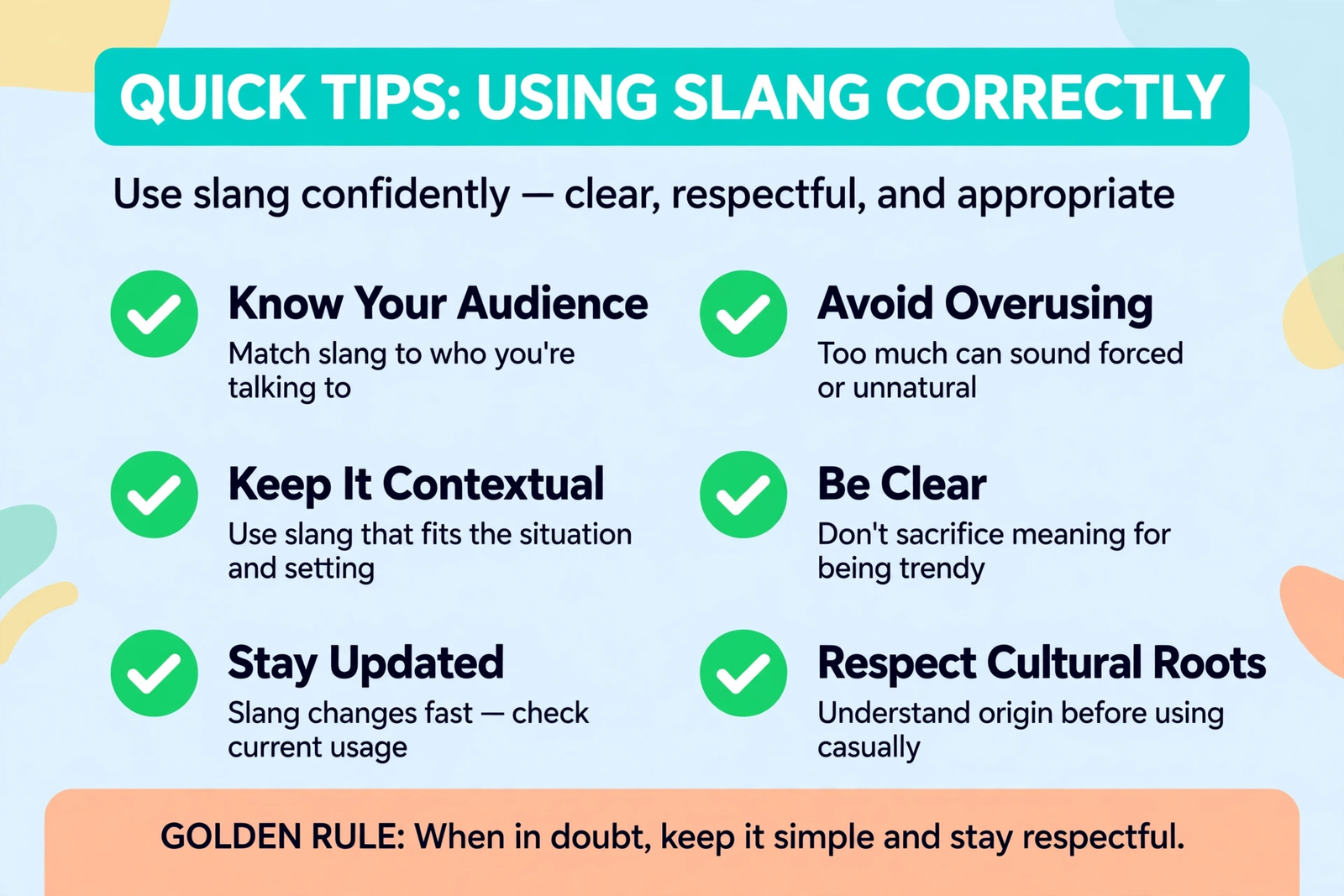
Quick Tips
- Read the room first: Goon can be warm, funny, or threatening. Match your usage to the people around you.
- Default to the classic meaning: When in doubt, assume goon means a thug or henchman — that is the meaning most people will hear first.
- Keep the internet meaning online: The gooning-adjacent jokes belong in meme spaces, not in real-life conversation.
- Use it for loyalty, not menace: “My goon” works best as praise for a friend who always shows up.
- In Australia, embrace it: Goon is everyday vocabulary there — a goon bag at a barbecue is a cultural institution, not an insult.
- Pair it with context: “Our team’s goon” (hockey), “the villain’s goons” (movies), “my goon” (friends) — a few extra words remove all doubt.
- Never use it to threaten: Joking that you will “send the goons” can be read as a real threat. Do not say it unless everyone knows you are joking.

FAQ
1. What does goon mean in slang?
In slang, goon most commonly means a tough, intimidating person hired to do dirty work — a thug or henchman. It can also mean a loyal friend, a silly fool, a hockey enforcer, or cheap boxed wine in Australia. The newest internet usage ties it to the adult meme trend called gooning.
2. Is calling someone a goon an insult or a compliment?
Both — it depends on context. Between friends, “my goon” is a compliment about loyalty. From a stranger or in a serious tone, “goon” is an insult meaning thug or fool. Tone and relationship decide the meaning.
3. What is the difference between goon and gooning?
Goon is the older, broader word with many meanings (thug, fool, friend, wine, hockey enforcer). Gooning is a specific modern internet subculture term derived from goon, with an adult meaning. They share a root but are not the same thing.
4. What does goon mean in Australia?
In Australia, goon is slang for cheap cask wine, and the silver bag inside the box is called a goon bag. It is one of Australia’s most famous slang words and a staple of parties and barbecues.
5. What does goon mean on TikTok?
On TikTok, goon usually appears in memes like “certified goon,” joking about the gooning subculture. It is ironic, crude humour — popular in comments, but not something to repeat in polite conversation.
6. What is a goon in hockey?
In hockey, a goon is the enforcer — the player whose job is physical play, fighting, and protecting star teammates. The 2011 film Goon popularised the term beyond hockey fans.
7. Where did the word goon come from?
Goon comes from early 1900s American slang, popularised by Alice the Goon in the Popeye comic strip in 1933. It went from meaning a big, dim-witted creature to meaning hired muscle, then picked up its many modern meanings over the next century. Dictionaries such as Merriam-Webster list the thug and fool senses as the primary definitions.
8. Can I use goon in professional settings?
Generally no. Use “enforcer” for hockey, “security” or “henchman” for the thug sense, and “close friend” for the loyalty sense. The internet meaning should never appear in professional settings.
Conclusion
Goon slang is a century-old word that refuses to retire. It started as a cartoon brute, became the hired muscle of gangster movies, softened into a word for a loyal friend, crossed the world to become Australia’s favourite cheap wine, and then exploded online as meme vocabulary. Few slang words carry that much history in four letters.
The key takeaway is simple: context decides the meaning. A goon in a crime film is a threat. A goon in your friend group is family. A goon at an Australian barbecue is a box of wine. And a goon in a TikTok comment is probably a joke you should not repeat at work. Learn the setting, and the word makes sense every time.
Now you know every major meaning of goon slang — the thug, the fool, the friend, the enforcer, the wine, and the meme. Use it with the right people, in the right place, and it is one of the most versatile words in slang. Use it in the wrong room, and it is one of the fastest ways to be misunderstood. Choose wisely, and your inner goon will always land right.
Quick recap: Goon slang = hired muscle or thug (classic) · loyal crew member · silly fool · hockey enforcer · cheap cask wine in Australia · internet meme tied to gooning. Context is the decoder — always check it first.

1 thought on “Goon Slang Meaning: What Does Goon Mean in Slang?”