
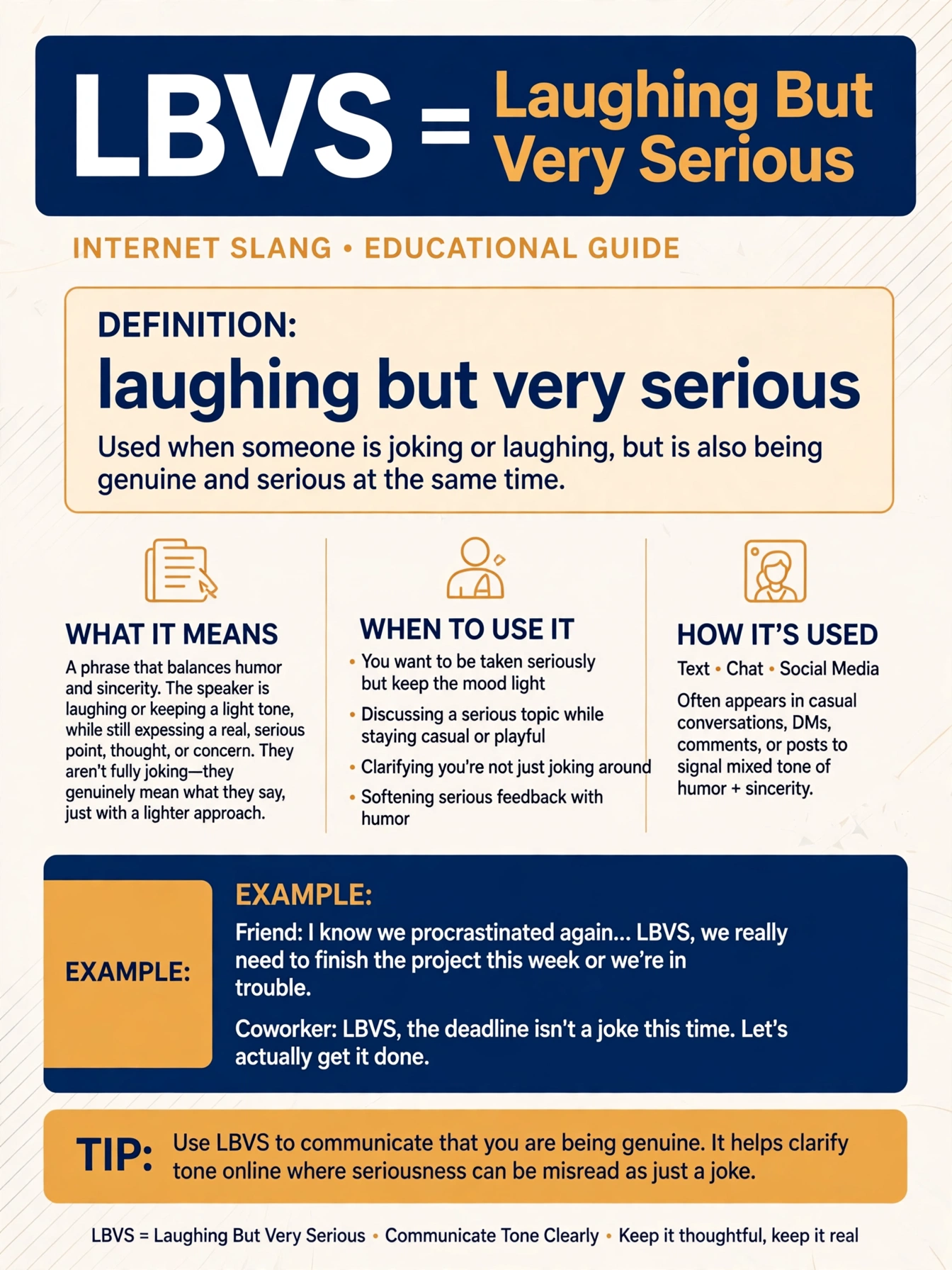
Quick definition: The lbvs meaning slang is simple — LBVS stands for “laughing but very serious.” People use it in texts and on social media when something is funny, but the point behind the joke is completely serious. It is the internet’s way of saying, “I am laughing, but I genuinely mean this.”
lbvs meaning slang & Definition
LBVS is an acronym that stands for “laughing but very serious.” It is a tone marker — a tiny label people attach to a message to tell the reader exactly how to feel about it. The laughter says “this is funny,” and the “very serious” part says “but do not dismiss what I just said.” When you understand the lbvs meaning slang, you understand one of the most useful dual-tone signals in modern texting.
Unlike LOL, which only signals laughter, LBVS carries two emotions at once. It tells your friend that you found something amusing and that you stand behind the message. That is why it shows up most often in messages about real life — awkward moments, honest opinions, and situations that are funny only because they are also a little painful.
| Detail | LBVS at a Glance |
|---|---|
| Stands for | Laughing But Very Serious |
| Type | Internet slang acronym / initialism |
| Tone | Humorous, sincere, playful, emphatic |
| Used on | Text messages, TikTok, Snapchat, Instagram, Discord, X |
| Formality | Casual only — never formal or professional |
| Shorter form | LBS (laughing but serious) |
Introduction
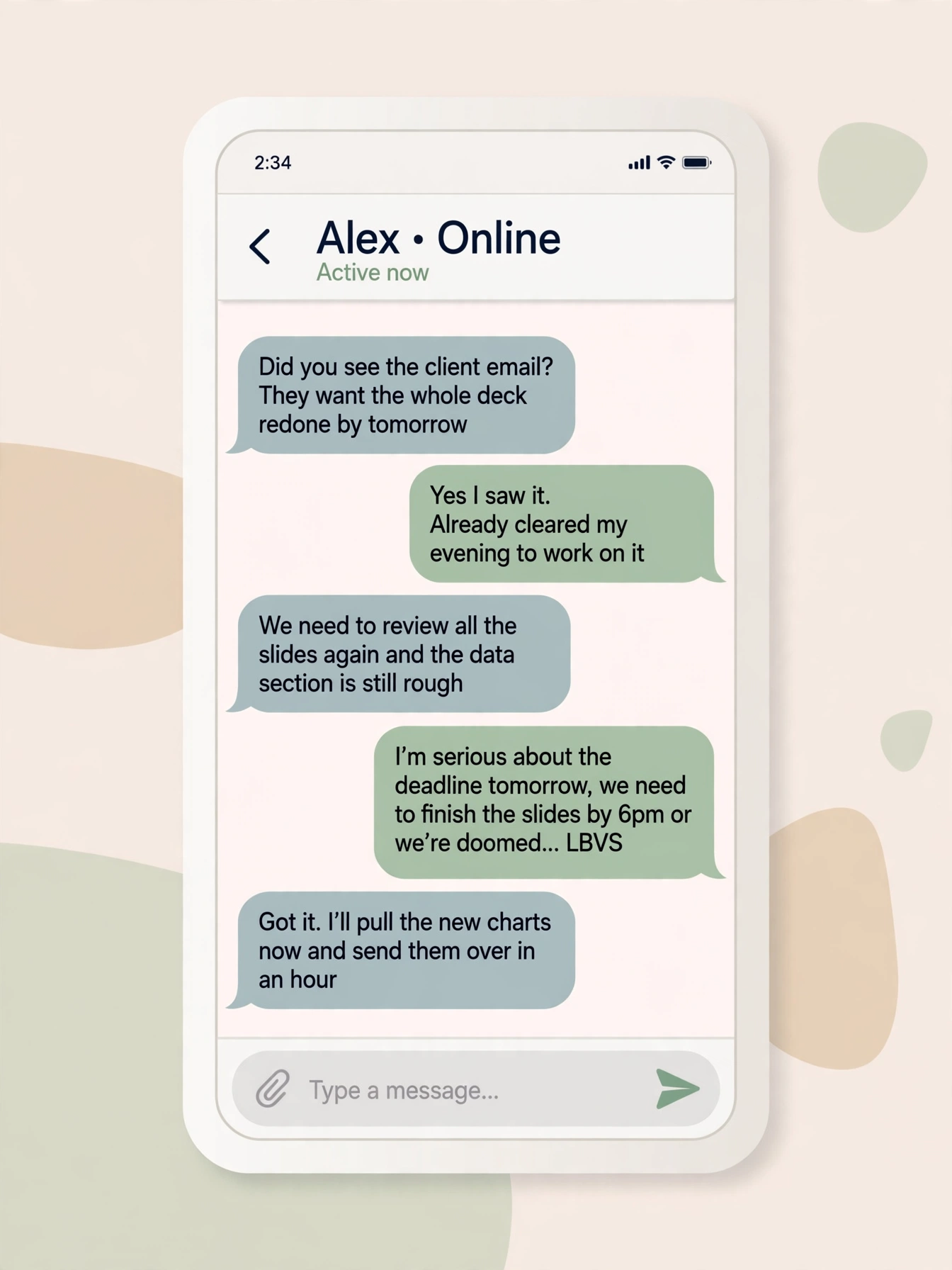
Imagine your friend texts you: “My boss just asked me to work the weekend again. I said yes before I even thought about it. LBVS.” You laugh — because the situation is painfully relatable — but you also know your friend is not joking. They really did say yes, and they really are annoyed about it. That single four-letter tag at the end of the message does the work of a whole paragraph: it sets the tone, delivers the joke, and keeps the honesty intact.
That is the power of LBVS. In a world where texting strips away facial expressions and voice tone, acronyms like this one fill the gap. They tell the reader how to take a message before it gets misunderstood. And LBVS is one of the cleverest of them all, because it holds two opposite feelings — laughter and seriousness — in the same breath.
In this guide, you will learn the full lbvs meaning slang, where it came from, how people use it on TikTok, Snapchat, and Instagram, and how it compares with similar slang like LOL, LMAO, and TBH. You will also see real examples, common mistakes, and polite alternatives, so you can use it confidently — and know exactly when not to.
Origin
The lbvs meaning slang traces back to the early days of internet shorthand, when people started compressing whole sentences into a few letters to type faster. According to Urban Dictionary’s LBVS entry, the term was first defined there in 2010 as “laughing but very serious.” That makes it one of the older texting acronyms still in circulation today — older than many of the slang terms that dominate TikTok in 2026.
LBVS was born from a real communication problem. Early texters had LOL for laughter and “seriously” or “no joke” for sincerity, but nothing that combined the two. People kept finding themselves in situations that were genuinely funny and genuinely serious at the same time — a friend tripping at a wedding, a sibling failing a test in a spectacular way, a coworker quitting with a dramatic one-liner. Laughing felt wrong, but staying silent felt worse. LBVS gave that awkward middle ground a name.
The acronym spread slowly at first, mostly through texting and early social platforms, because it was never as universal as LOL or OMG. It stayed a niche piece of internet vocabulary — the kind of term you learn from a friend, not from a trending page. Then short-form video changed everything. On TikTok, where captions are short and comments move fast, a four-letter tag that says “funny but true” fits perfectly. Creators started using LBVS in captions and comment replies, and a new generation of users picked it up without ever knowing its 2010 roots.
Popularity
LBVS is popular, but it is not mainstream in the way LOL or BRB are. Most people who use it learned it from a friend or from a TikTok comment, and many casual texters have never seen it at all. That is actually part of its charm: using LBVS signals that you are fluent in internet culture, not just repeating the three acronyms everyone knows.
Its popularity is strongest in a few specific places:
- TikTok: LBVS appears in video captions and comment threads, usually after a joke about something painfully true — a relatable rant, a failed plan, or a brutally honest observation.
- Snapchat: The acronym fits perfectly in snap captions and quick replies, where there is barely room to explain your tone.
- Instagram: People drop LBVS in comments and direct messages, often after a joke about real life, relationships, or work.
- Discord and group chats: In fast-moving group conversations, LBVS works like a tone flag that keeps a joke from landing the wrong way.
- Text messages: Between close friends and family, LBVS adds warmth and honesty to messages that could otherwise sound harsh.
Search interest in the term has stayed steady rather than exploding, which tells you something important: LBVS is not a passing trend. It is a durable piece of internet slang that survives because it solves a real problem — how to be funny and serious in the same sentence.
How It Is Used
LBVS is almost always used in writing, not speech. Nobody says “el-bee-vee-es” out loud in a normal conversation — it would sound strange. Instead, it appears at the end of a sentence, right where a punchline or a warning would go, like a piece of punctuation that carries emotion.
Here is how it works in practice:
- After a joke with a real point: “I love my job, said no teacher ever during exam week. LBVS.” The joke is clear, but so is the frustration behind it.
- After an awkward or embarrassing story: “I tripped in front of my crush and then waved like I meant to do it. LBVS.” Funny, but the embarrassment is real.
- After an honest opinion: “We need to stop pretending the group project is going fine. LBVS.” The laughter softens the message, but the message is serious.
- After a tragically funny situation: “My phone died right as I was about to show everyone the photos. LBVS.” It is funny in hindsight, painful in the moment.
The key rule is that LBVS changes how the sentence before it should be read. Without it, “I tripped in front of my crush” is just a sad story. With it, the story becomes a joke the sender is in on — while still admitting it genuinely happened and genuinely stung.
It is also worth noting what LBVS is not. It is not a replacement for LOL — LOL only means something was funny. It is not the same as “just kidding” — LBVS means the opposite of kidding. And it is not formal language. You would never put LBVS in a work email, a school essay, or a message to someone you do not know well, because the whole point of the term is casual, in-group honesty.
Examples
The best way to understand the lbvs meaning slang is to see it in real conversations. The examples below cover friendly chats, professional settings, and funny situations — so you can see exactly how the tone shifts in each one.
Friendly Examples
- “You looked so confident walking into the wrong classroom this morning. LBVS.”
- “I told Mom I was studying and then fell asleep on my textbook. LBVS.”
- “We spent an hour picking a movie and then watched nothing. LBVS, we need a better system.”
- “Your cooking is getting better, but we still need to work on those pancakes. LBVS!”
- “I said I would save money this month and then bought three pairs of shoes. LBVS.”
In friendly chats, LBVS works like a laugh shared between people who trust each other. The joke lands because both sides know the serious part is true — and that is exactly what makes it funny.
Professional Examples
LBVS is a casual term, so it rarely belongs in truly professional communication. But in relaxed work chats with colleagues you know well, it can appear in a light, self-aware way:
- “The meeting could have been an email. LBVS, but also we really do need to fix this process.”
- “I finished the report at 2 a.m. and then found a typo in the first line. LBVS.”
- “Our team lunch turned into a two-hour planning session. LBVS — at least the food was good.”
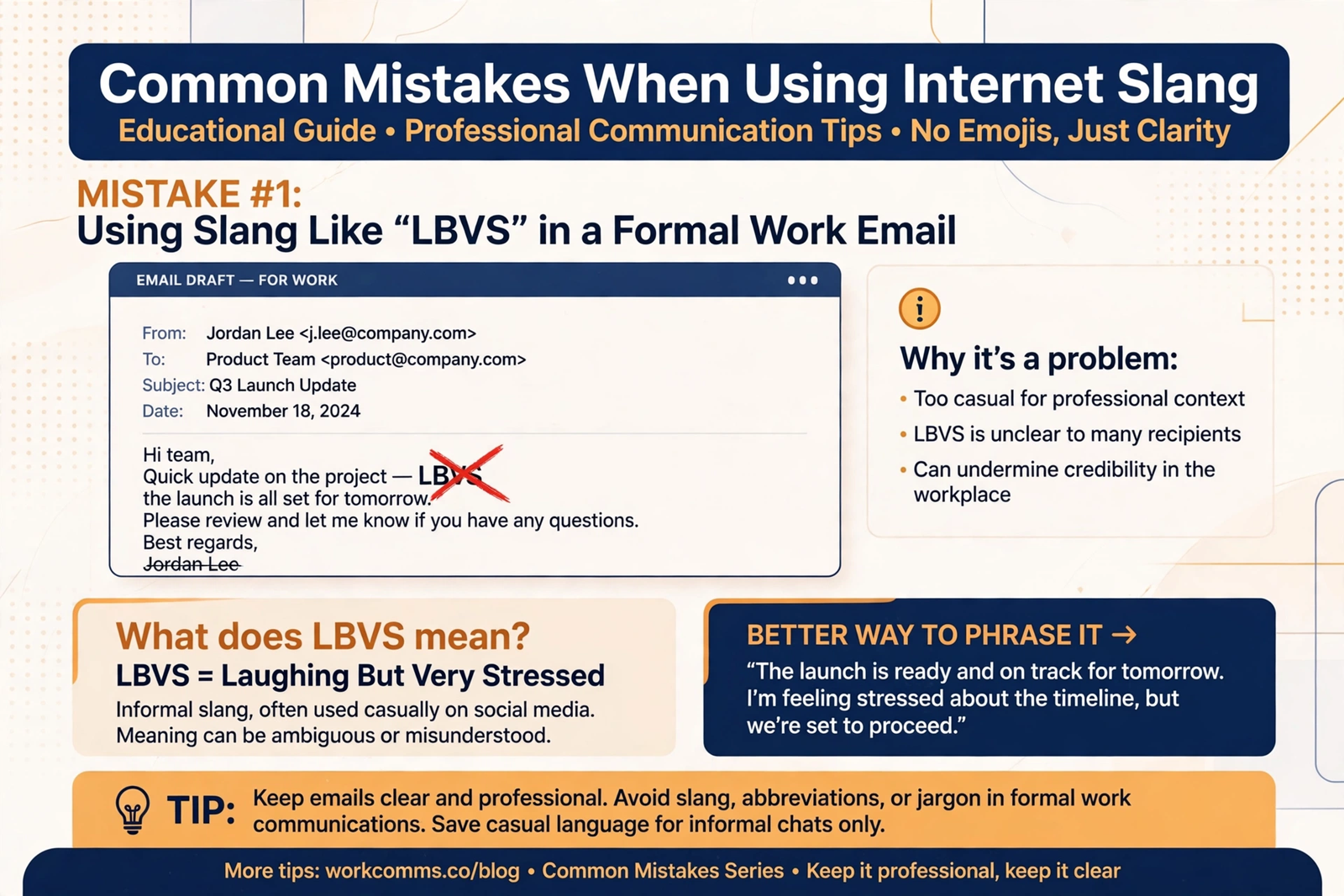
Even here, the rule is the same: only use LBVS with coworkers you know well, and never in a message to a client, a manager you barely know, or anyone in a formal setting. If you are unsure, leave it out — a plain, professional sentence is always safer.
Funny Examples
- “My alarm did not go off, so I blamed the alarm. LBVS, I forgot to set it.”
- “I went to the gym once and told everyone about it for a week. LBVS.”
- “I studied the wrong chapter for the whole night. LBVS, the exam was on the other one.”
- “Grandma dropped her phone in the sink and now it makes a weird buzzing sound. LBVS.”
- “I tried to look cool in front of my neighbors and walked straight into the fence. LBVS.”
Notice the pattern in every example: something goes wrong, it is funny enough to laugh about, and the sender still means every word. That combination — humor plus honesty — is the heart of LBVS.
Comparison with Similar Terms
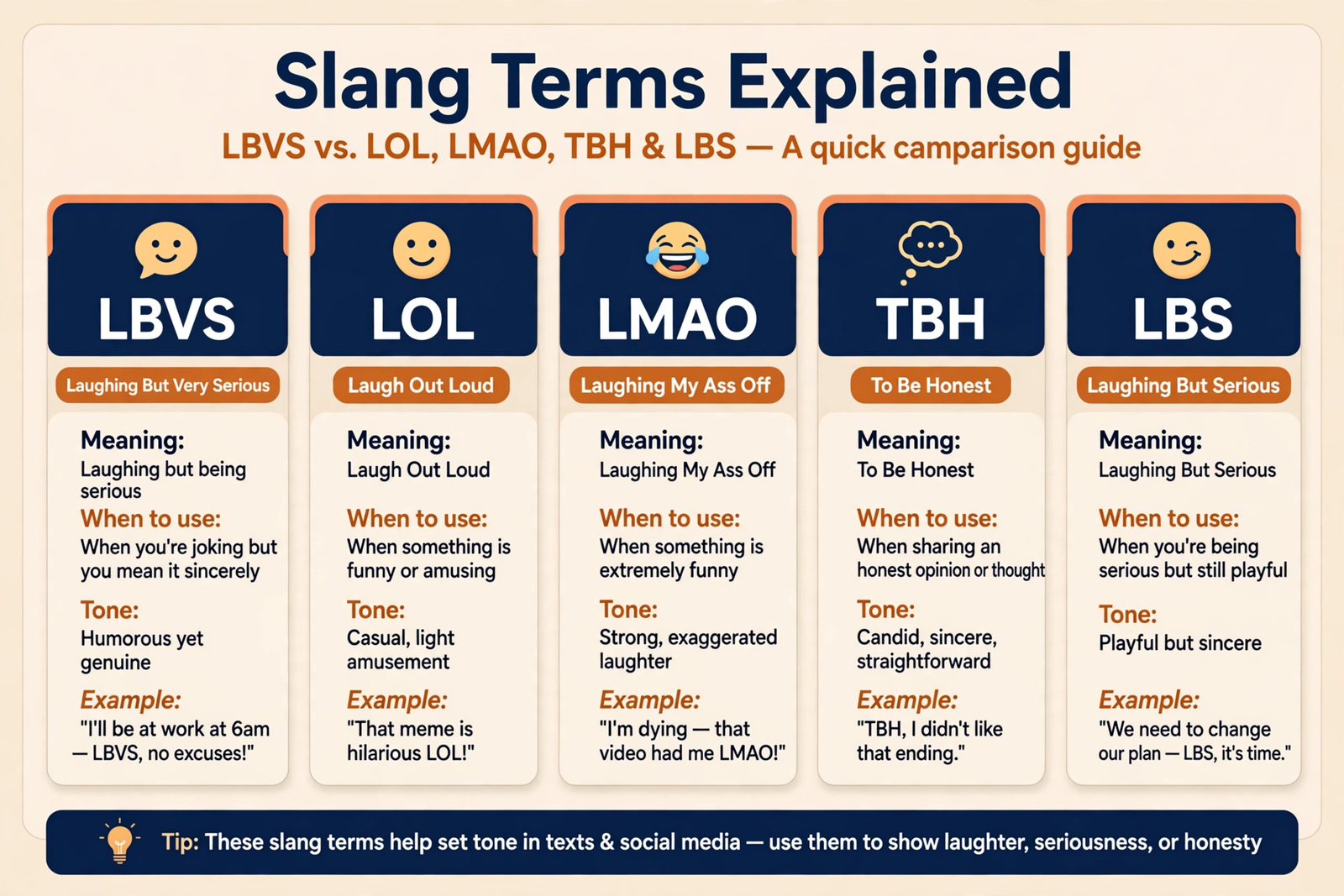
LBVS is easy to confuse with other laughing acronyms, but each one sends a different signal. The table below shows how LBVS compares with the terms people mix it up with most often.
| Term | Stands For | What It Signals | When to Use It |
|---|---|---|---|
| LBVS | Laughing But Very Serious | Funny, but I genuinely mean it | Jokes with a real point behind them |
| LBS | Laughing But Serious | Funny, but I mean it (lighter version) | Slightly less serious situations than LBVS |
| LOL | Laughing Out Loud | Something was funny | Any funny moment, no seriousness attached |
| LMAO | Laughing My Ass Off | Something was very funny | Strong laughter, casual friends only |
| TBH | To Be Honest | An honest opinion is coming | Sharing a real opinion, funny or not |
| JK | Just Kidding | I was not serious | Taking back a joke or tease |
| FR | For Real | I am completely serious | Emphasizing honesty, no humor |
| NGL | Not Gonna Lie | Honest admission ahead | Confessions and unpopular opinions |
The closest relative of LBVS is LBS — “laughing but serious.” The difference is a matter of degree: people tend to use LBS for lighter situations and save LBVS for moments that feel heavier or more genuinely serious. If the situation made you laugh but also genuinely worried you, LBVS is the stronger, more honest choice.
LBVS also pairs naturally with other slang you probably already use. If you know what fn means in text or you have looked up tysm meaning before, you already speak the same internet shorthand family that LBVS belongs to. And if you want to understand how tone markers like these shape modern texting, our guide to imk meaning in text is a good next read.
Alternate Meanings
In texting and on social media, LBVS almost always means “laughing but very serious.” But the same letters have completely different meanings in other fields — and knowing them can save you from an awkward mix-up.
| Field | LBVS Means | Context |
|---|---|---|
| Internet slang | Laughing But Very Serious | Texting, TikTok, Snapchat, Instagram |
| Astronomy | Luminous Blue Variables (LBVs) | Massive, unstable stars that change brightness |
| Wine | Late Bottled Vintage (LBV) | A style of port wine, usually written as LBV |
The astronomy meaning is the one most likely to cause confusion. In astrophysics, Luminous Blue Variables are rare, massive stars that go through dramatic changes in brightness — and scientists abbreviate them as LBVs. If you text “LBVS” to an astronomer, they might think you are talking about stars. In everyday conversation, though, context makes the meaning obvious: nobody discussing a funny text message is talking about variable stars.
There is also a small spelling trap to watch for. Some people write LVBS by mistake, swapping the B and the V. That is not a recognized abbreviation — it is just a typo. The correct order is L-B-V-S: Laughing But Very Serious.
Professional or Polite Alternatives
LBVS is informal by nature, so it has no place in formal writing. When you need the same idea — “this is funny, but I am serious” — in a professional or polite setting, use one of these alternatives instead:
- “Joking aside…” — “Joking aside, we really do need to fix this before Friday.” Clean, professional, and clear.
- “In all seriousness…” — “In all seriousness, the plan needs more time.” Works in meetings, emails, and presentations.
- “Funny, but true.” — “Funny, but true — the printer really did eat my report.” Casual enough for work chats, safe for mixed company.
- “I say this with a smile, but I mean it.” — Warm and honest, good for feedback conversations.
- “On a serious note…” — “On a serious note, the deadline is not moving.” Perfect for shifting a light conversation into a real one.
- “I am laughing, but I am not joking.” — The closest plain-English translation of LBVS, and it works anywhere.
The general rule is simple: if the message matters — a work email, a message to a teacher, a condolence, or anything involving someone you do not know well — spell the feeling out in full words. Acronyms are shortcuts, and shortcuts are for people who already know you well enough to read your tone.
Common Mistakes
LBVS is a small word with a big tone, so it is easy to use it wrong. These are the mistakes people make most often:
- Using it in serious or sad situations. LBVS admits you found something funny. Using it after genuinely bad news — an accident, a loss, a breakup — can sound heartless, even if you did not mean it that way. If nobody is laughing, do not use LBVS.
- Using it with strangers. The term assumes the reader knows your sense of humor. A stranger may read “laughing” and miss the “very serious” entirely, and take offense at the joke.
- Using it at work. In professional chats, LBVS reads as unprofessional. A manager or client who does not know the term will be confused — or worse, will think you are not taking the matter seriously.
- Using it when you are actually joking. LBVS means you are serious. If you add it to a message that is pure joke, you confuse the reader: are you serious or not? For pure jokes, LOL or JK is the right tool.
- Overusing it. Like any slang, LBVS loses its punch if it appears in every message. Save it for moments where the funny-serious mix is genuinely the point.
- Spelling it LVBS. The letters go L-B-V-S. Swapping the B and V turns a real acronym into a typo nobody recognizes.
- Using it with people who do not know internet slang. Older relatives, new acquaintances, or anyone outside internet culture may have no idea what LBVS means. With them, a full sentence always works better.
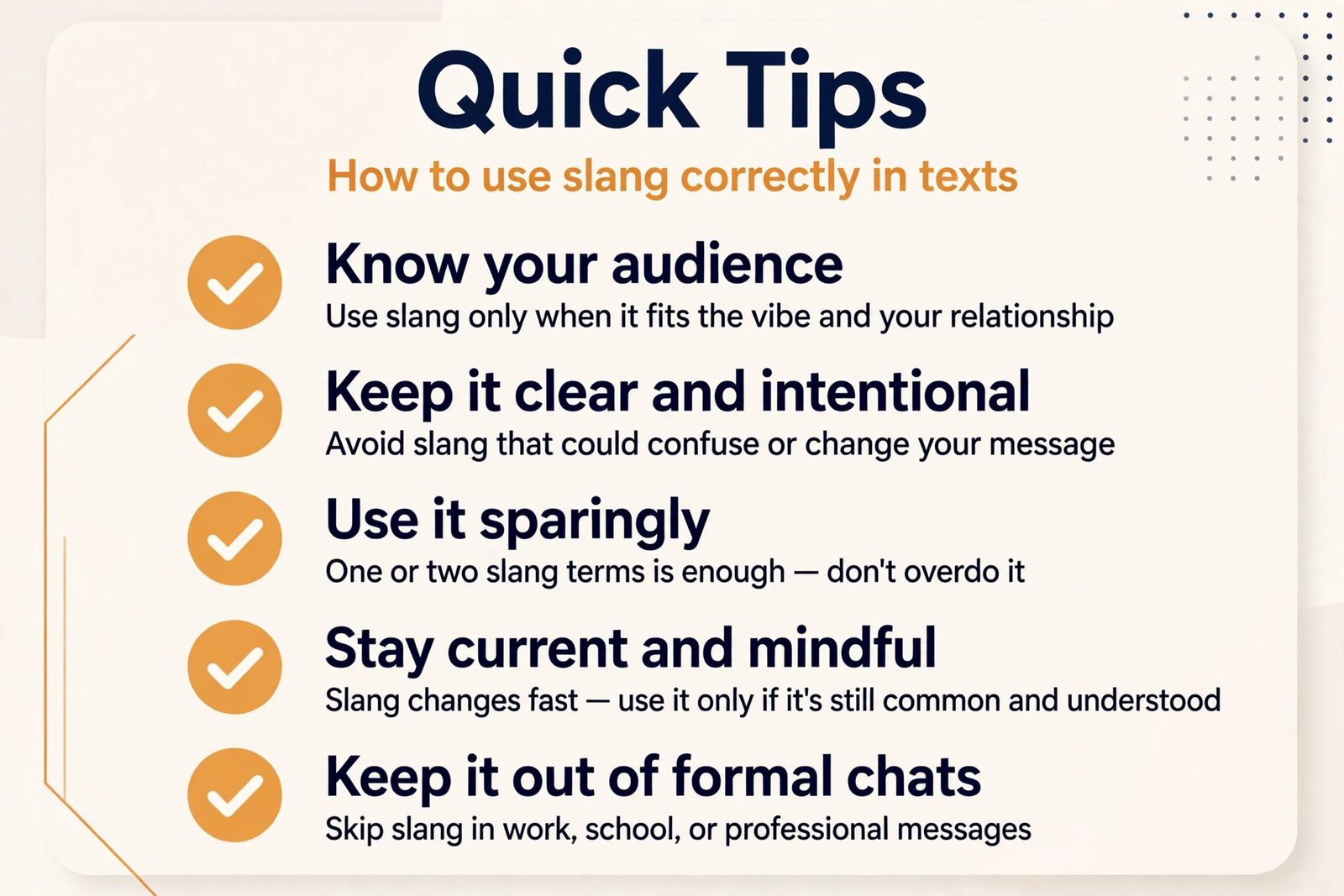
Quick Tips
- Place it at the end. LBVS works best as the last word of a sentence, where it colors everything that came before it.
- Use it with close friends first. People who know your humor will read the tone correctly. Strangers might not.
- Pair it with real honesty. The best LBVS messages are the ones where the serious part is genuinely true — that is what makes them funny.
- Keep it casual. TikTok comments, group chats, Snapchat replies, and texts to friends are LBVS territory. Emails and formal messages are not.
- Do not force it. If a message is only funny, use LOL. If it is only serious, say so plainly. LBVS is for the overlap — and only the overlap.
- Watch the room. If the situation involves someone’s feelings, ask yourself how the message reads without the laughter. If it stings, rephrase it.
- Learn the family. LBVS sits alongside terms like LBS, TBH, and NGL. Knowing the whole set makes your texting sharper — for example, our guide to hbu meaning in chat explains another tone marker you will see in the same conversations.
FAQ
What does LBVS mean in text?
LBVS means “laughing but very serious.” It is used in texting and on social media when something is funny, but the person also genuinely means what they are saying. The laughter does not cancel the seriousness of the message.
What does LBVS mean on TikTok?
On TikTok, LBVS usually appears in video captions and comment threads. Creators and viewers use it after a joke about something painfully true — a relatable rant, a failed plan, or a brutally honest observation. It signals “this is funny, but it is also real.”
What does LBVS mean on Snapchat?
On Snapchat, LBVS shows up in snap captions and quick replies. Because Snapchat messages are short and fast, the acronym works as a quick tone flag: it tells the reader the sender is laughing while still being serious about the message.
Is LBVS the same as LOL?
No. LOL only means something was funny. LBVS means something was funny and the sender is serious about it. If there is no serious point behind the joke, LOL is the better choice.
What is the difference between LBVS and LBS?
LBS stands for “laughing but serious,” while LBVS stands for “laughing but very serious.” The difference is intensity: LBVS is the stronger version, used when the situation feels heavier or more genuinely serious. LBS fits lighter moments.
When should I not use LBVS?
Do not use LBVS in formal or professional messages, in serious or sad situations where nobody is laughing, or with people who do not know internet slang. It is a casual, in-group term — save it for friends and relaxed social media conversations.
Is LBVS rude or offensive?
LBVS itself is not rude, but it can come across badly if used in the wrong moment. Because it admits you found something funny, using it about someone else’s misfortune — especially with people who do not know you well — can feel dismissive. Context and relationship matter more than the word itself.
Where did LBVS come from?
LBVS was first defined on Urban Dictionary in 2010 as “laughing but very serious.” It grew out of early texting culture, where people needed a short way to signal a mixed tone, and it later spread to TikTok, Snapchat, and Instagram as short-form video made quick tone markers more useful than ever.
Conclusion
The lbvs meaning slang is easy to remember once you hear it spelled out: laughing but very serious. It is a small acronym with a clever job — it lets you laugh at something and stand behind it at the same time. That is why it has survived since 2010 while countless other slang terms faded away: it solves a problem every texter knows, the problem of sounding funny and honest in the same sentence.
The key takeaways are simple. LBVS goes at the end of a message, it belongs in casual conversations with people who know your humor, and it should only appear when the funny part and the serious part are both real. Use it for relatable rants, awkward stories, and honest opinions with a laugh attached — and leave it out of work emails, formal messages, and genuinely sad moments.
Now that you know what LBVS means, you will start noticing it everywhere — in TikTok comments, group chats, and captions from friends who are laughing and meaning every word. And if you want to keep building your internet vocabulary, explore more guides like our breakdown of glizzy meaning and keep decoding the slang you see every day, one term at a time.
