
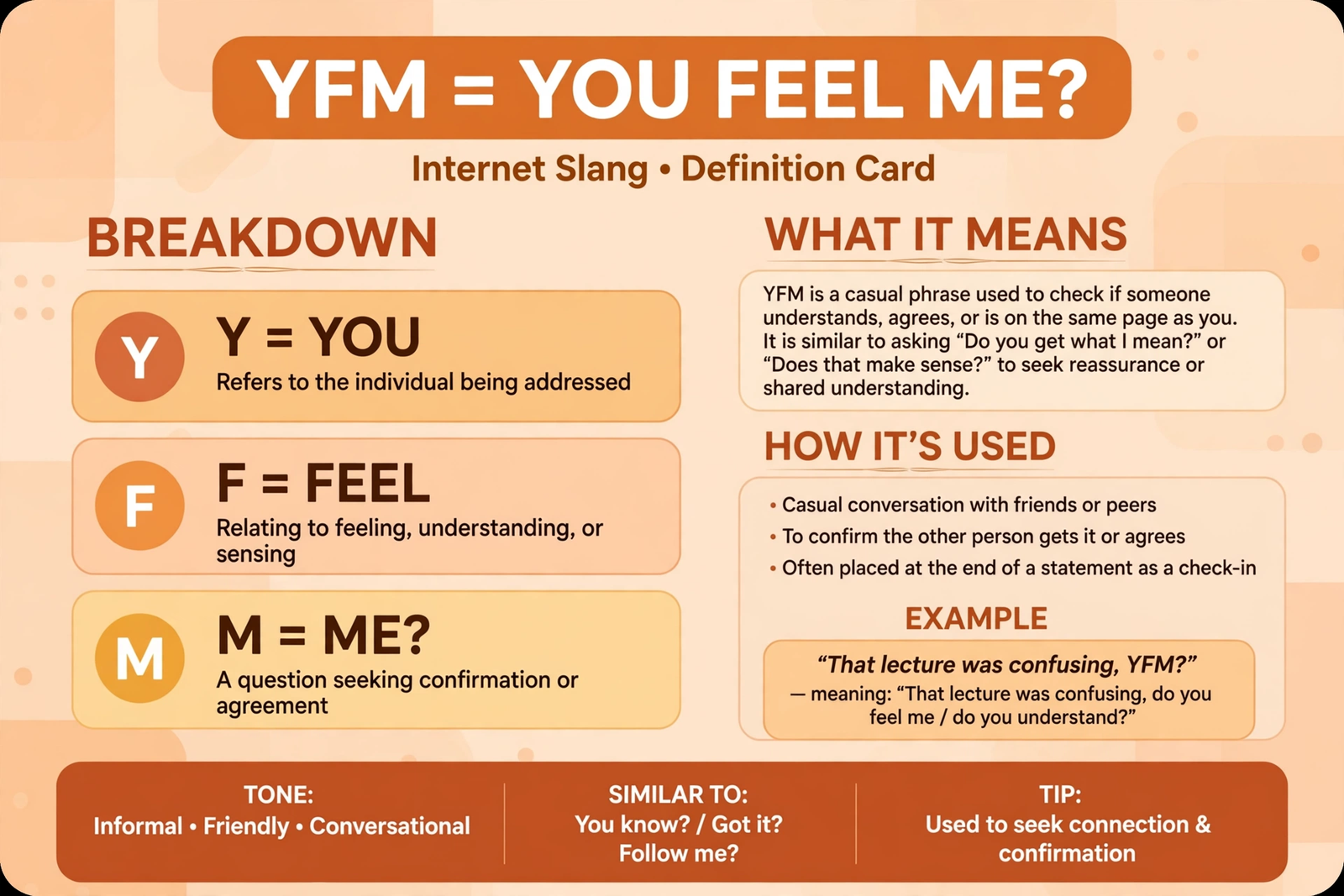
Quick definition: YFM stands for “you feel me?” — a casual way of asking whether someone understands, agrees with, or relates to what you just said. It usually appears at the end of a text, comment, or message, and it works just like “you know what I mean?”
yfm meaning slang & Definition
The yfm meaning slang is simple: YFM is short for “you feel me?” People add it after a thought to check that the other person gets the point — or feels the same way. Here, “feel” does not mean touching something. It means understanding it, relating to it, or agreeing with it on a gut level.
When someone writes “That meeting could have been an email, yfm,” they are not really asking a question. They are inviting you to nod along. The expected reply is usually something short, like “fr,” “exactly,” or “lol yeah.”
YFM is almost always written in lowercase in texts — “yfm” — because texting rarely follows grammar rules. Both forms mean the same thing. It is pronounced letter by letter, Y-F-M, when spoken aloud, though most people only ever type it.
Introduction
You are scrolling through TikTok comments or catching up on a group chat when you spot it: a sentence that ends with three little letters. “This week has been too long, yfm.” You understand the sentence, but those three letters stop you for a second. What does YFM actually mean, and why does everyone seem to drop it at the end of their messages?
YFM is one of those slang shortcuts that looks mysterious until someone explains it once — and then you start seeing it everywhere. It lives in Snapchat streaks, TikTok captions, Discord chats, Instagram DMs, and late-night texts between friends. It is friendly, informal, and expressive, and it does a surprising amount of social work for just three letters.
In this guide, you will learn the full yfm meaning slang, where it came from, how people use it in real conversations, and when to avoid it. You will see real examples from friendly chats, work messages, and funny situations, compare YFM with similar terms like YKWIM and FR, and get quick tips for using it without sounding awkward. By the end, you will know exactly what to say back the next time someone ends a message with “yfm.”
Origin
The phrase “you feel me?” existed long before smartphones. It comes from African American Vernacular English (AAVE), where it has been a common spoken expression for decades. In conversation, “you feel me?” asks the listener to confirm they understand — not just the words, but the feeling behind them. That sense of “feel” as understanding is even recorded in the dictionary: Merriam-Webster lists feel as meaning to be aware of or to understand something. It is a check for shared understanding, and it carries warmth that a plain “do you understand?” never could.
Hip-hop helped carry the phrase into the mainstream. Rappers and R&B artists used “you feel me?” in lyrics throughout the 1990s and 2000s, and the line became a familiar part of American pop culture. From there it spread into everyday speech, especially among young people, and eventually into texting — where long phrases get compressed into short ones.
That compression followed a pattern every texter knows. “Be right back” became BRB. “I don’t know” became IDK. “You feel me?” became YFM. Nobody can point to a single inventor, a founding platform, or a first use, and any article that claims otherwise is guessing. What is clear is that YFM grew out of spoken slang first and only later became a texting shortcut, which is why it still sounds natural when people say it out loud.
By the mid-2010s, YFM was showing up in Urban Dictionary entries, meme captions, and Twitter replies. Today it moves freely across Snapchat, TikTok comments, Instagram DMs, Discord servers, and group chats — anywhere people talk fast and casually.
Popularity
YFM is popular precisely because it is useful. Most slang abbreviations save time, but YFM also saves social effort. Ending a message with “yfm” turns a statement into a conversation. It tells the other person, “I just said something real — tell me you get it.” That tiny invitation is why it works so well in group chats, where a message can easily be ignored.
On TikTok, YFM appears in captions and comments under relatable videos — the kind about exhausting weeks, bad dates, or friendship drama. On Snapchat, it shows up in streaks and private snaps between close friends. On Discord and in gaming chats, it punctuates rants about a tough match or a funny fail. The meaning stays the same everywhere: “you feel me?”
YFM is most common among Gen Z and younger millennials in the United States, and it is understood across English-speaking social media worldwide. In the UK and Australia, people more often say “know what I mean” or “get me,” so YFM appears a little less often there — but it is still understood the same way when it does appear.
Unlike meme slang that explodes and fades within weeks, YFM has staying power. Because it comes from a real spoken phrase rather than a single viral video, it does not depend on one trend to survive. It is still widely used in 2026, and it shows no sign of disappearing.
yfm meaning slang in Everyday Texting
So how does YFM actually work in a conversation? The pattern is almost always the same: a person shares an opinion, a complaint, a joke, or a feeling — and then adds “yfm” at the end. The abbreviation turns the message into a soft question, and the other person usually answers with agreement, laughter, or a matching reaction.
Here is the basic structure:
- Statement + yfm: “I’m so done with Mondays, yfm.”
- Opinion + yfm: “That movie was way too long, yfm?”
- Feeling + yfm: “I miss summer already, yfm.”
Notice that YFM often comes with a question mark, but not always. With a question mark, it reads as a genuine check-in. Without one, it reads more like a verbal tic — a casual tag that softens the message. Both versions are correct.
YFM also changes slightly with tone. After a complaint, it asks for sympathy: “My phone died right before the concert, yfm.” After a joke, it asks for a laugh: “I walked in like I owned the place, yfm.” After a hot take, it asks for agreement: “Pineapple on pizza is actually elite, yfm.” In every case, the sender is really saying, “You get what I mean, right?”
People also pair YFM with other slang. “No cap, that was crazy, yfm” combines two check-ins into one message. “Fr, I’m tired, yfm” doubles down on agreement-seeking. These combinations are common in group chats, where tone is hard to read and extra signals help.
Examples
The fastest way to understand YFM is to see it in real conversations. The examples below show how the same three letters work in friendly chats, professional settings, and funny moments.
Friendly Examples
Example 1 — venting to a friend:
Alex: “I’ve been studying all day and I still feel behind, yfm.”
Sam: “Fr, same. Take a break, you’ve earned it.”
Example 2 — sharing an opinion:
Maya: “This song hits different at 2am, yfm.”
Jordan: “Exactly. It’s a whole vibe at night.”
Example 3 — making weekend plans:
Chris: “We should just stay in and watch movies this weekend, yfm? I’m exhausted.”
Taylor: “Yes please. I’m so down for that.”
In friendly chats, YFM builds connection. It tells your friend that you trust them to understand you — and friends usually respond with matching energy.
Professional Examples
YFM is casual, so it does not belong in formal work emails or messages to a boss. But in relaxed chats with close coworkers, it sometimes appears — and it usually still works, as long as the relationship is informal.
Example 4 — a coworker chat:
Priya: “That client call ran an hour over, yfm. I need coffee before the next one.”
Liam: “Lol, same. Grab me one too?”
Example 5 — a team group chat:
Dev: “We finally shipped the update, yfm? Feels good.”
Ana: “So good. Great work everyone.”
The rule is simple: if you would not say “you feel me?” out loud in that workplace, do not type YFM there either. Save it for friends and relaxed chats.
Funny Examples
Example 6 — dramatic overreaction:
“I dropped my phone face-down and my whole life flashed before my eyes, yfm.”
Example 7 — food opinions:
“Cereal is basically soup for breakfast, yfm? Don’t argue with me on this.”
Humour is where YFM shines. It invites the other person to laugh along, and it makes even a small joke feel like an inside joke between friends. If you want to sound natural with slang like this, learning how iykyk works in the same kind of chat will help you spot the pattern even faster.

Comparison with Similar Terms
YFM is not the only abbreviation that checks for understanding. Several slang terms do similar jobs, but each one carries a slightly different feeling. The table below makes the differences easy to spot.
| Term | Stands For | What It Really Asks | Best Used When |
|---|---|---|---|
| YFM | You feel me? | Do you understand and relate to me? | Sharing a feeling or opinion |
| YKWIM | You know what I mean? | Do you follow my point? | Explaining something complicated |
| FR | For real | Aren’t I right? / Seriously | Agreeing strongly with someone |
| IYKYK | If you know, you know | Only insiders will get this | Referencing an inside joke |
| WBU | What about you? | How do you feel about it? | Turning the question back |
| WYGG | What you got going on? | What are you up to? | Starting a casual conversation |
| NGL | Not gonna lie | Here’s my honest take | Sharing an honest opinion |
The key difference is focus. YKWIM asks whether someone followed your logic. FR shows strong agreement. IYKYK creates an in-group feeling. YFM is the warmest of the group — it asks for shared feeling, not just shared facts. That is why it works so well after emotional messages, complaints, and relatable jokes.
If someone says “that exam was brutal, yfm,” they want empathy. If they say “that exam was brutal, YKWIM,” they want confirmation that the exam was objectively hard. The two sentences look similar, but the feeling is different — and native texters pick up on it instantly. Terms like wygg sit in the same family of casual check-ins, but they open a conversation rather than closing a thought the way YFM does.

Alternate Meanings
Like most internet abbreviations, YFM does not have just one meaning. Context decides which one applies, and the texting meaning is by far the most common. Still, it helps to know the others so you are never confused.
1. You Feel Me? (texting and slang) — the dominant meaning. A casual check for understanding, agreement, or shared feeling. This is the meaning used in texts, Snapchat, TikTok, Discord, and Instagram DMs.
2. Your Favorite Martian (pop culture and music) — a viral animated music project created in 2011 by YouTuber Ray William Johnson, known for his show Equals Three. The virtual band featured characters like PuffPuff, DeeJay, Benatar, and Axel, and released comedy songs that racked up millions of views. If you see “YFM” in all caps next to music, animation, or YouTube nostalgia, this is probably the meaning.
3. You Follow Me? (instructions) — in some conversations, especially when someone is explaining steps or reasoning, YFM is occasionally read as “you follow me?” This use is much less common, and it depends heavily on context. If someone is walking you through directions and ends with “yfm,” they probably mean “are you following me so far?”
4. Y-FM (a radio station) — with a hyphen, Y-FM is the name of a real South African radio station based in Johannesburg. It sometimes confuses search results, but it has nothing to do with texting slang.
5. Niche initials — in small communities, YFM can stand for a username, a team, a song title, or a project name. These uses are rare and always depend on the group using them.
How do you tell them apart? Look at the setting. If YFM appears at the end of a sentence in a casual chat, it means “you feel me?” If it appears as a proper noun next to music or animation, it means Your Favorite Martian. In practice, the texting meaning wins almost every time.
Professional or Polite Alternatives
YFM is friendly and informal, which means it has no place in formal writing, job applications, or messages to people you do not know well. The good news is that the idea behind it translates easily into polite language. Here are alternatives for different situations:
- “Does that make sense?” — the safest all-purpose replacement, perfect for work and school.
- “Do you see what I mean?” — polite and conversational, good for meetings and emails.
- “I hope that’s clear.” — professional, good for instructions and explanations.
- “Let me know if that resonates.” — warm but professional, good for presentations.
- “Would you agree?” — direct and respectful, good for discussions and debates.
- “You know what I mean?” — casual but widely accepted, fine with acquaintances.
When you are texting friends, YFM is perfect. When you are writing to a teacher, a manager, or a client, pick one of the alternatives above. The message stays the same — only the packaging changes.
Common Mistakes
YFM is easy to use, but a few common mistakes can make you sound awkward or even rude. Avoid these and you will sound natural every time.
1. Using YFM in formal messages. Dropping “yfm” into a work email, a job application, or a message to a professor makes you look careless. Keep it in casual chats only.
2. Adding it after every single sentence. YFM works because it is occasional. If every message ends with “yfm,” it stops sounding friendly and starts sounding needy — like you are begging for agreement. Use it once per thought, not once per line.
3. Using it to end an argument. “I’m right and you know it, yfm” does not invite agreement — it pressures the other person. YFM is a check-in, not a weapon. In disagreements, ask a real question instead.
4. Assuming everyone knows it. Most young texters know YFM, but older relatives, new acquaintances, or people outside English-speaking social media may not. If someone replies with “?” or “what does that mean,” just explain it kindly instead of acting surprised.
5. Mixing it up with YF. YF is a shorter form that usually stands for “you feel” and only makes sense as part of a longer phrase. It is not a swap for YFM, so do not use them interchangeably.
6. Using it sarcastically with strangers. Among close friends, a sarcastic “yfm” after an obvious joke is funny. With strangers, the same message can read as rude or confusing, because they cannot hear your tone. Save the sarcasm for people who know you well.

Quick Tips
Want to use YFM like a native texter? These quick tips will keep you sounding natural:
- Put it at the end. YFM almost always closes a thought: “That was wild, yfm.” Starting a message with it sounds strange.
- Pair it with a real thought. YFM works best after something worth agreeing with — an opinion, a feeling, or a relatable complaint. “Hi, yfm” means nothing.
- Match the other person’s energy. If they text casually, YFM fits right in. If they text formally, skip it.
- Use lowercase in texts. “yfm” looks natural in a chat. “YFM” in all caps can look like shouting or like the band name.
- Reply with agreement. When someone sends you “yfm,” answer with “fr,” “exactly,” “lol yeah,” or “100%.” A short, warm reply keeps the conversation flowing.
- Don’t over-explain it. If someone asks what YFM means, just say “you feel me?” — one sentence is enough.
- Watch the platform. YFM fits Snapchat, TikTok, Discord, and Instagram perfectly. It is less common on LinkedIn or in professional Slack channels, so read the room.


FAQ
What does YFM mean in text?
YFM stands for “you feel me?” It is a casual way of asking whether someone understands, agrees with, or relates to what you just said. It usually appears at the end of a message, often with a question mark, and works like “you know what I mean?”
What does YFM mean in slang?
In slang, YFM means “you feel me?” — a friendly check-in used in texting and social media. It comes from African American Vernacular English and became popular through hip-hop and internet culture. It asks for shared understanding, not just a yes or no answer.
Is YFM rude or offensive?
No, YFM is not rude or offensive. It is casual and friendly. The only risk is using it in the wrong setting — like a formal email — or using it sarcastically with someone who does not know you well. With friends, it is completely fine.
What does YFM mean on Snapchat?
On Snapchat, YFM means the same thing as everywhere else: “you feel me?” It shows up in streaks, private snaps, and story replies between friends who want to check that the other person relates to what they shared.
What does YFM mean on TikTok?
On TikTok, YFM appears in captions and comments under relatable videos, usually meaning “you feel me?” Creators use it to connect with viewers over a shared experience, and commenters use it to agree with the video.
What does YFM mean from a guy?
YFM from a guy means the same thing as always: “you feel me?” It is a casual check for understanding or agreement. It is not a flirty term by itself — the tone depends on the rest of the conversation, not on the abbreviation.
What does YFM mean from a girl?
YFM from a girl also means “you feel me?” The meaning does not change based on who sends it. It is a friendly, informal way of asking whether you understand or relate to what she just said.
What is the difference between YFM and YKWIM?
Both ask for confirmation, but YFM asks whether you feel the same way — it is about shared emotion and relatability. YKWIM (“you know what I mean?”) asks whether you followed the point — it is about logic and clarity. YFM is warmer; YKWIM is more explanatory. If you are still building your slang vocabulary, our guide to wyb covers another everyday check-in abbreviation in the same style.
Conclusion
YFM is small, but it does a big job. In just three letters, it turns a statement into a conversation, a complaint into a shared laugh, and an opinion into a moment of connection. Now that you know the yfm meaning slang — “you feel me?” — you can spot it in texts, TikTok comments, Snapchat streaks, and Discord chats, and you can use it yourself without a second thought.
The key takeaways are simple. YFM means “you feel me?” and asks whether someone understands, agrees with, or relates to what you said. It comes from AAVE and hip-hop culture, it works best at the end of a casual message, and it fits friends, group chats, and social media perfectly. It does not belong in formal emails or professional messages, and it works best when you use it sparingly — once per thought, not once per line.
The next time a friend ends a message with “yfm,” you will know exactly what to do: answer with a quick “fr” or “exactly,” and keep the conversation going. And if you want to keep growing your texting vocabulary, start with another everyday abbreviation like ngl — once you understand one of these shortcuts, the rest start to make sense fast. Language keeps moving, and the people who understand slang are the people who never feel lost in the comments.
