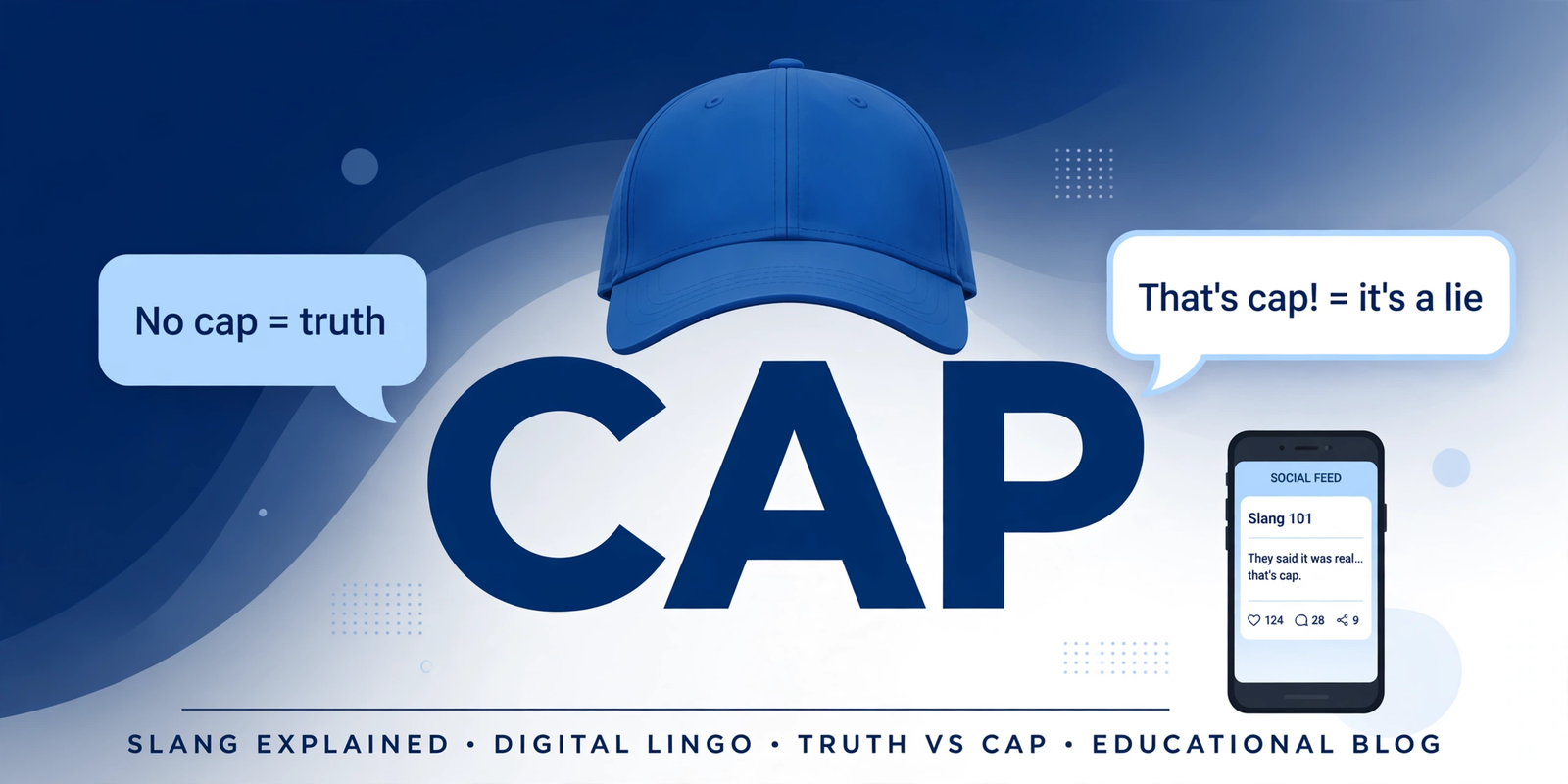
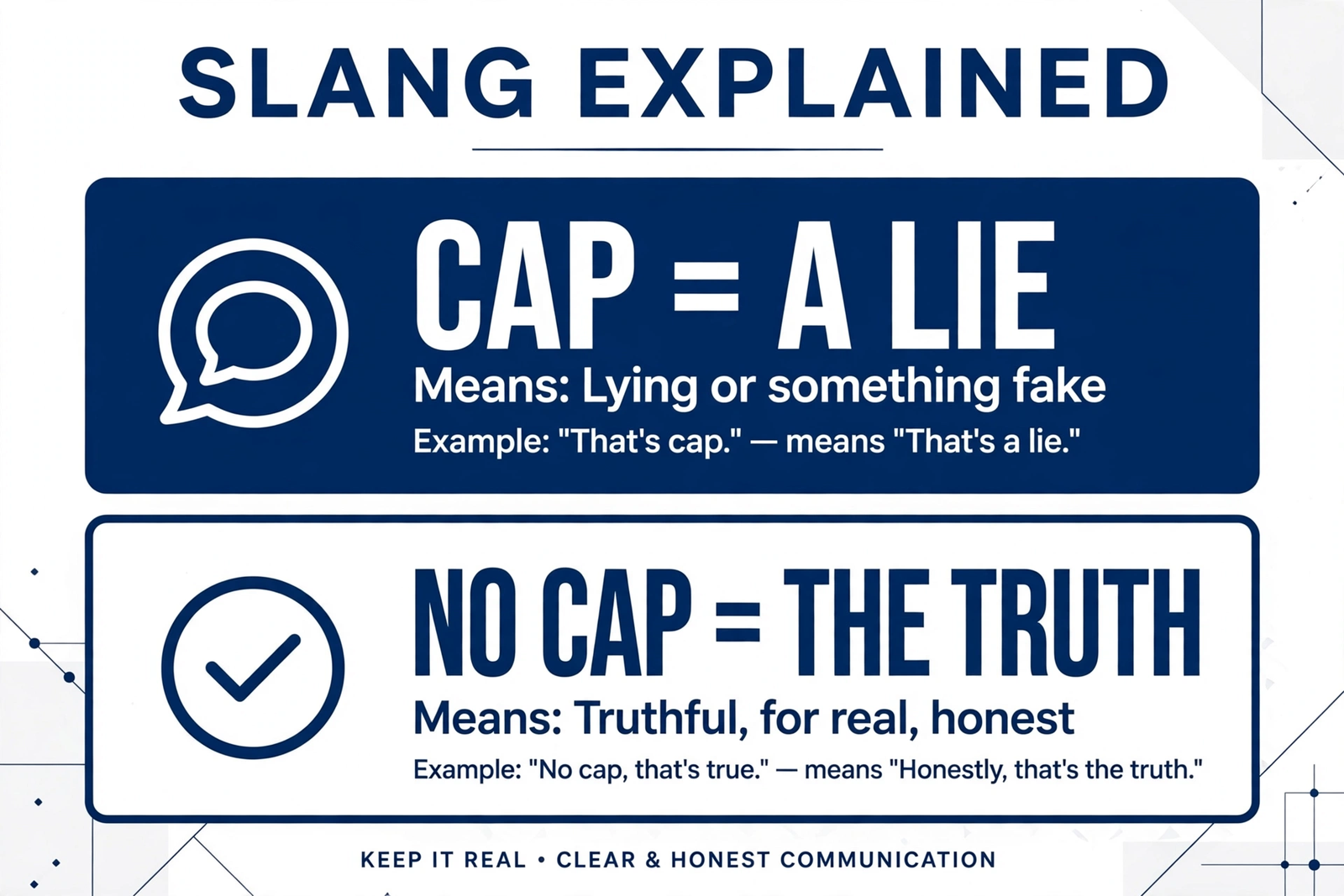
Quick Definition: In slang, “cap” means a lie — something false, exaggerated, or made up. When someone says “that’s cap,” they mean “that’s not true.” Its opposite, “no cap,” means “I’m telling the truth” or “for real.” The cap meaning slang origin goes back to African American hip-hop culture of the 1980s and 1990s, where “capping” meant boasting or talking big, and by the late 2010s the word had exploded on TikTok, Twitter, and in rap lyrics as the internet’s favourite way to call out a lie.
cap meaning slang origin Meaning & Definition
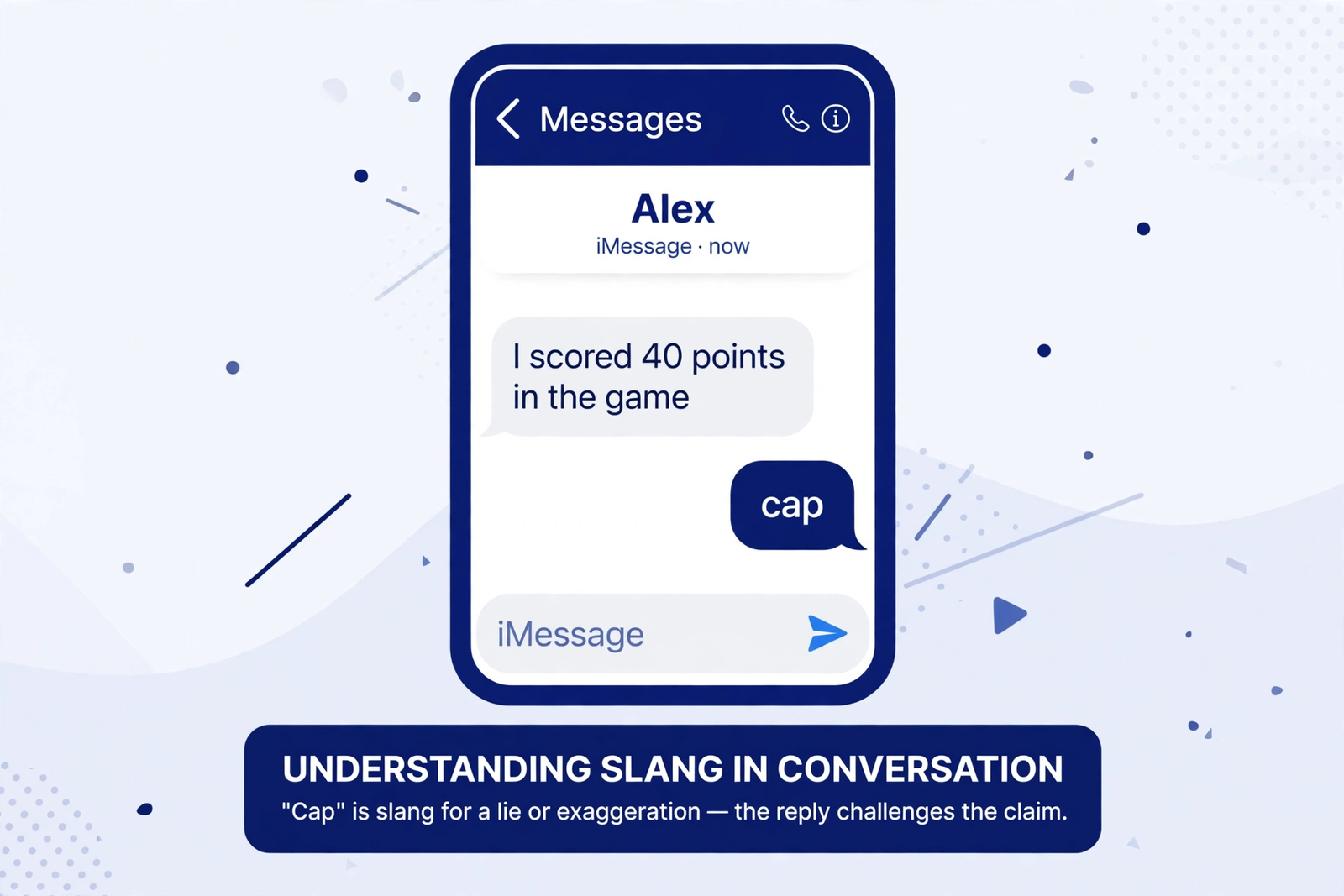
So, what is the cap meaning slang origin in plain English? At its simplest, “cap” is slang for a lie. If a friend claims he scored 40 points in a basketball game and you know he sat on the bench, you can reply “cap” — one word, and everyone understands: you’re calling it false. The phrase “no cap” flips the meaning completely. Say “no cap, that movie was amazing” and you are swearing that you genuinely mean it, no exaggeration, no joke.
The word works as a noun and a verb. As a noun, cap is the lie itself: “That whole story was cap.” As a verb, to cap is to lie or to exaggerate: “He’s capping about his salary again.” And as an exclamation, “Cap!” works like “Liar!” — short, sharp, and instantly understood by anyone who spends time online. The cap meaning slang origin matters because the word did not appear out of nowhere; it travelled from street slang to rap lyrics to mainstream group chats over roughly forty years, and each stop along the way added a new shade of meaning.
Today, cap is one of the most common slang words in American English. Teenagers use it in texts, streamers use it on Twitch, and rappers drop it in chart-topping songs. It is casual, a little playful, and much softer than calling someone a liar outright — which is exactly why it spread so fast.
Introduction
You have probably seen it in a comment section: someone posts a wild claim, and the first reply is a single word — “cap.” No explanation, no argument, just three letters. And somehow, everybody gets it. That is the power of modern slang. A tiny word carries a whole sentence of meaning, and if you are not in on it, a whole conversation can pass you by.
Cap is one of those words. It looks ordinary — it is also the thing you wear on your head and the lid on a bottle — but in slang it means something completely different. Understanding the cap meaning slang origin helps you read the room online: whether someone is joking, bragging, lying, or swearing they are telling the truth. In this guide, we will break down exactly what cap means, where it came from, how to use it in texts and on TikTok, how it compares with similar slang, and the mistakes to avoid so you never sound out of touch.
Whether you heard it in a song, saw it under a viral video, or got called out with it in your own group chat, this guide has you covered — from the 1980s streets where it started to the group chats where it lives today.
Origin
The cap meaning slang origin starts in African American Vernacular English (AAVE) and hip-hop culture. The most widely accepted explanation traces “cap” back to “high capping,” a phrase used in Black American communities in the early 1900s. To “cap” on someone meant to tease them, roast them, or talk big about yourself — playful boasting, usually in a battle of wits where each person tried to out-talk the other. The tradition was called “the dozens,” a verbal game of trading insults, and capping was a big part of it.
By the 1980s, rappers had picked the word up. In hip-hop, “capping” meant bragging or exaggerating to make yourself look good — the classic rap boast. Songs from that era used “cap” to describe someone talking big with nothing to back it up. Over time, the meaning narrowed: boasting that isn’t true is really just lying, so “cap” slid from “bragging” to “lying.” The Atlanta hip-hop scene in the 2010s pushed the word further into the mainstream. Rappers like Future and Young Thug used “cap” and “no cap” constantly in their lyrics, and their fans carried it onto social media.
The real explosion came around 2017–2019. “No cap” became a viral phrase on Twitter and TikTok, helped by the 2017 song “No Cap” by Future and the 2018 track “No Cap” by G-Eazy featuring Cardi B. Then in 2019, the “no cap” emoji combination — a blue cap emoji (🧢) — became a meme: people would reply to a lie with just the cap emoji, no words at all. That is how a word born in a century-old verbal game ended up as a single emoji in your group chat.
Some people also link the word to an older expression: to “cap” something can mean to top it or put a lid on it, and a lie “caps” the truth by covering it up. Linguists debate the exact path, but the hip-hop lineage — from “high capping” to rap lyrics to TikTok — is the one most experts agree on.
Popularity
Cap went from niche rap slang to mainstream internet vocabulary in just a few years, and the numbers tell the story. Google searches for “no cap meaning” and “what does cap mean” surged from 2018 onward, and the phrase has stayed in the top tier of slang searches ever since. On TikTok, videos tagged with “no cap” have been viewed billions of times, and the cap emoji (🧢) became one of the platform’s most-used reaction symbols — a silent way to call out a lie without typing a word.
Several things made cap stick while other slang faded. First, it is short: three letters that fit anywhere, from a tweet to a text to a comment. Second, it is versatile: it works as a noun, a verb, and an exclamation, and its opposite (“no cap”) is built right in, so you get two expressions for the price of one. Third, it fills a real gap — English did not have a casual, playful word for “that’s a lie” that wasn’t rude. “Liar” sounds harsh; “cap” sounds like a joke between friends.
The word has also crossed into mainstream media. Sports commentators use it, brands use it in ads, and politicians’ speeches have been fact-checked with the cap emoji. It has appeared in dictionaries: Merriam-Webster and Dictionary.com both now list “no cap” as a slang phrase meaning “without lying” or “for real.” When a slang word makes it into the dictionary, it has officially arrived.
Cap is also genuinely global now. It is used by English speakers in the UK, Canada, and Australia, and it pops up in the group chats of people who have never listened to a rap song in their lives. Like delulu and flex, it proves that a word born in one community can become everybody’s word if it is useful enough.
How It Is Used
Cap is mostly used in casual conversation — texts, group chats, comments, and social media captions. It almost never appears in formal writing, work emails, or serious situations, because it is fundamentally playful. Here are the main ways people use it:
- Calling out a lie: “You got an A? Cap.” — You do not believe them.
- Saying something is true: “No cap, that was the best concert ever.” — You really mean it.
- Describing a liar: “He’s always capping about his car.” — He keeps exaggerating.
- As a question: “Cap or no cap?” — Is that true or not?
- With the emoji: “I bench 300 lbs 🧢” — The emoji alone says “I don’t believe you.”
The word also shows up in compound phrases. “Stop the cap” means “stop lying.” “All cap” means “completely false.” “No cap, no lie” doubles down on honesty. And “capper” is a person who lies a lot — the noun form for someone who caps constantly. You will also see “cap” in rap lyrics and captions as a badge of authenticity: saying “no cap” in a lyric is the artist’s way of telling the listener “I’m being real with you.”
Tone matters a lot. Among friends, “cap” is light and funny — a joke, not an accusation. Said coldly to a stranger, it can feel like calling them a liar to their face, which is why most people save it for people they are comfortable with. The golden rule: use cap with friends, not with your boss.
Examples
Cap is easiest to understand in real conversations. Here are examples across different tones and situations, so you can see exactly how the word behaves in the wild.
Friendly Examples
- Friend 1: “I just ran a marathon in under 3 hours.”
Friend 2: “Cap. You get tired walking to the fridge.” - Text: “No cap, this pizza place is the best in the city. We have to go back.”
- Group chat: “Bro said he has a girlfriend in Canada 💀 that’s cap.”
- Reply: “You really think that movie was good? No cap, it was terrible.”
Professional Examples
Cap is informal, so it rarely belongs in a workplace — but it does appear in casual work chats and creative industries where the tone is relaxed:
- Coworker (casual Slack): “No cap, that client call went way better than I expected.”
- Team chat: “He said the report would take an hour. Cap — it’s been three.”
- Content creator: “No cap, this is the best product I’ve tested all year.” (Often used in reviews to sound genuine.)
Even in these settings, the word signals informality. If you would not say “for real” in the same sentence, do not use “cap” either.
Funny Examples
- “My alarm didn’t go off” — cap, you stayed up until 4 a.m. watching videos.
- “I’m not hungry,” he said, eating his third slice. Cap.
- “No cap, I was going to start my diet today… tomorrow.”
- When your friend says “I don’t even like her” while liking all her photos — that’s cap.
- “I studied all night.” The exam says otherwise. Cap. 🧢
Comparison with Similar Terms
Cap is part of a family of slang words for lying, truth, and exaggeration. They look similar, but each one has its own flavour. Here is how cap stacks up against its closest cousins:
| Term | Meaning | How It Differs from Cap |
|---|---|---|
| Cap | A lie or exaggeration | The standard word for calling out a lie; casual and playful |
| No cap | I’m telling the truth | The exact opposite of cap — a promise of honesty |
| Capper | A person who lies a lot | Describes the person, not the lie itself |
| Facts / Fax | That’s true, I agree | Confirms truth; cap denies it |
| For real / FR | Seriously, truly | Similar to “no cap,” but older and more general |
| Deadass | Seriously, I’m not joking | Stronger and more intense than “no cap”; New York slang |
| Sus | Suspicious, shady | Questions someone’s behaviour, not whether a statement is true |
| Bussin’ | Really good (usually food) | Unrelated meaning, but often appears in the same posts and captions |
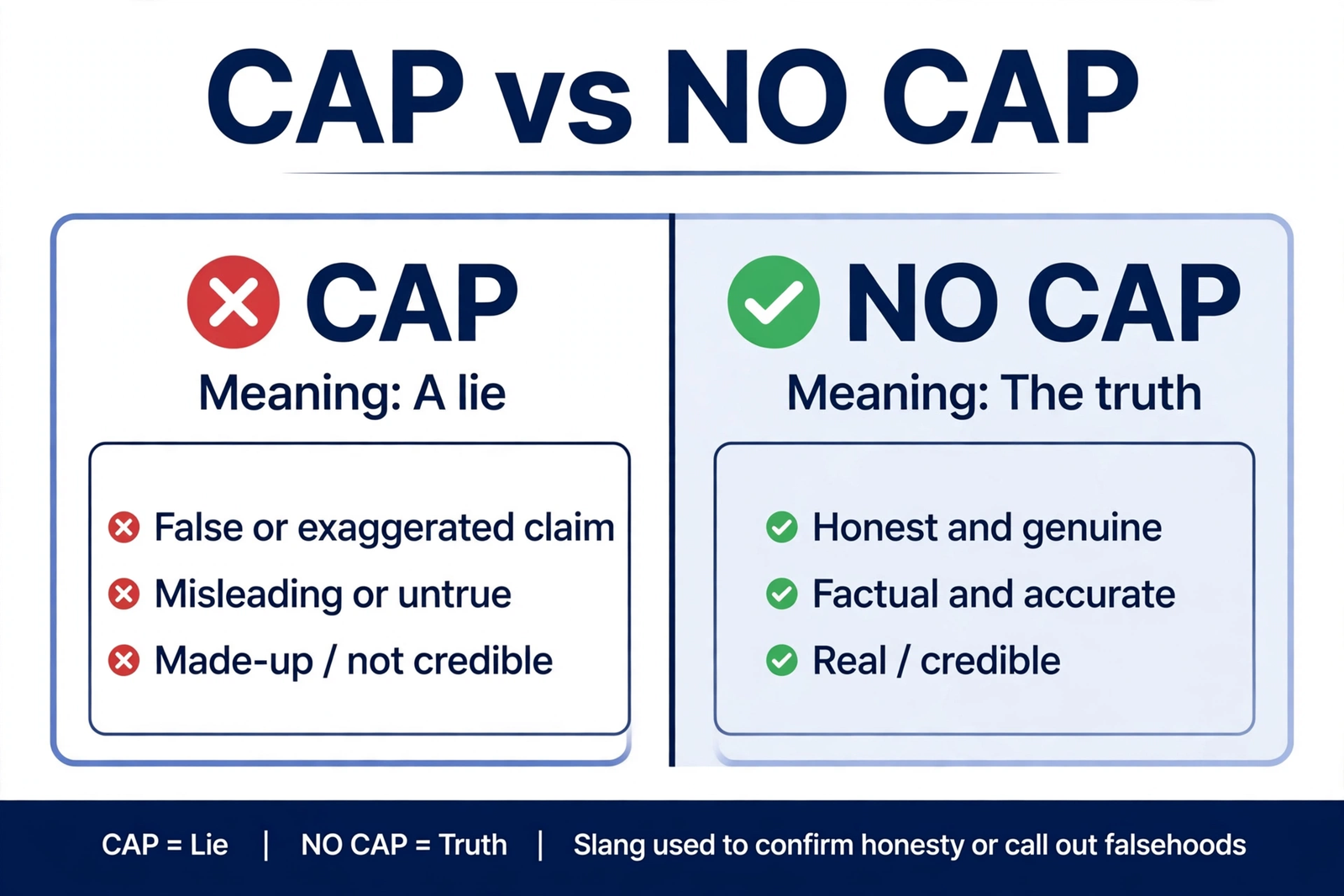
The most useful distinction is between “cap” and “no cap” — they are a matched pair, and mixing them up flips your meaning completely. Saying “cap” when you mean “no cap” tells your friends the exact opposite of what you intended, so double-check which one you mean before you hit send.
Alternate Meanings
Like most slang words, “cap” has other meanings outside of the lie sense — and context is everything. Here are the alternate meanings you are most likely to run into:
- A hat: The original meaning. A baseball cap is still a cap, and in hip-hop fashion, caps are a style staple — which may be part of why the slang caught on.
- A bottle lid: “Put the cap back on the bottle” — the everyday, literal meaning.
- A limit: “There’s a cap on how many people can enter” — a maximum amount, common in finance and gaming.
- To top or finish: “That goal capped off a perfect season” — to complete something, from the idea of putting a cap on top.
- To shoot (old slang): In older American slang, “to cap someone” could mean to shoot them. This meaning is dated and rarely used today, but you may still see it in old movies or rap lyrics.
- Capital letter: In texting, “cap” is sometimes short for capitalisation, as in “no caps” (typing in lowercase on purpose).
In practice, the slang meaning is now so dominant online that “cap” in a comment or text almost always means “lie.” If someone means a hat, they will usually say “hat” or “baseball cap” to avoid confusion.
Professional or Polite Alternatives
Cap is great with friends and terrible in a boardroom. If you need the same idea in a formal setting, here are polite alternatives that carry the meaning without the slang:
- Instead of “that’s cap”: “I’m not sure that’s accurate,” “That doesn’t quite add up,” or “I think that might be an exaggeration.”
- Instead of “no cap”: “Honestly,” “To be completely transparent,” “In all seriousness,” or “I genuinely mean that.”
- Instead of “he’s capping”: “He tends to exaggerate,” or “I would take that with a grain of salt.”
- Instead of “stop the cap”: “Let’s stick to the facts,” or “Can we be honest about this?”
The trick is keeping the honesty without the confrontation. “Cap” calls someone out directly; professional language questions the claim, not the person. In a work email, a job interview, or a conversation with someone you respect, the polite version always wins. Save “cap” for the group chat, where everyone knows you are joking.
Common Mistakes
Cap is simple, but people still get it wrong — especially if they are new to slang. Here are the mistakes to avoid:
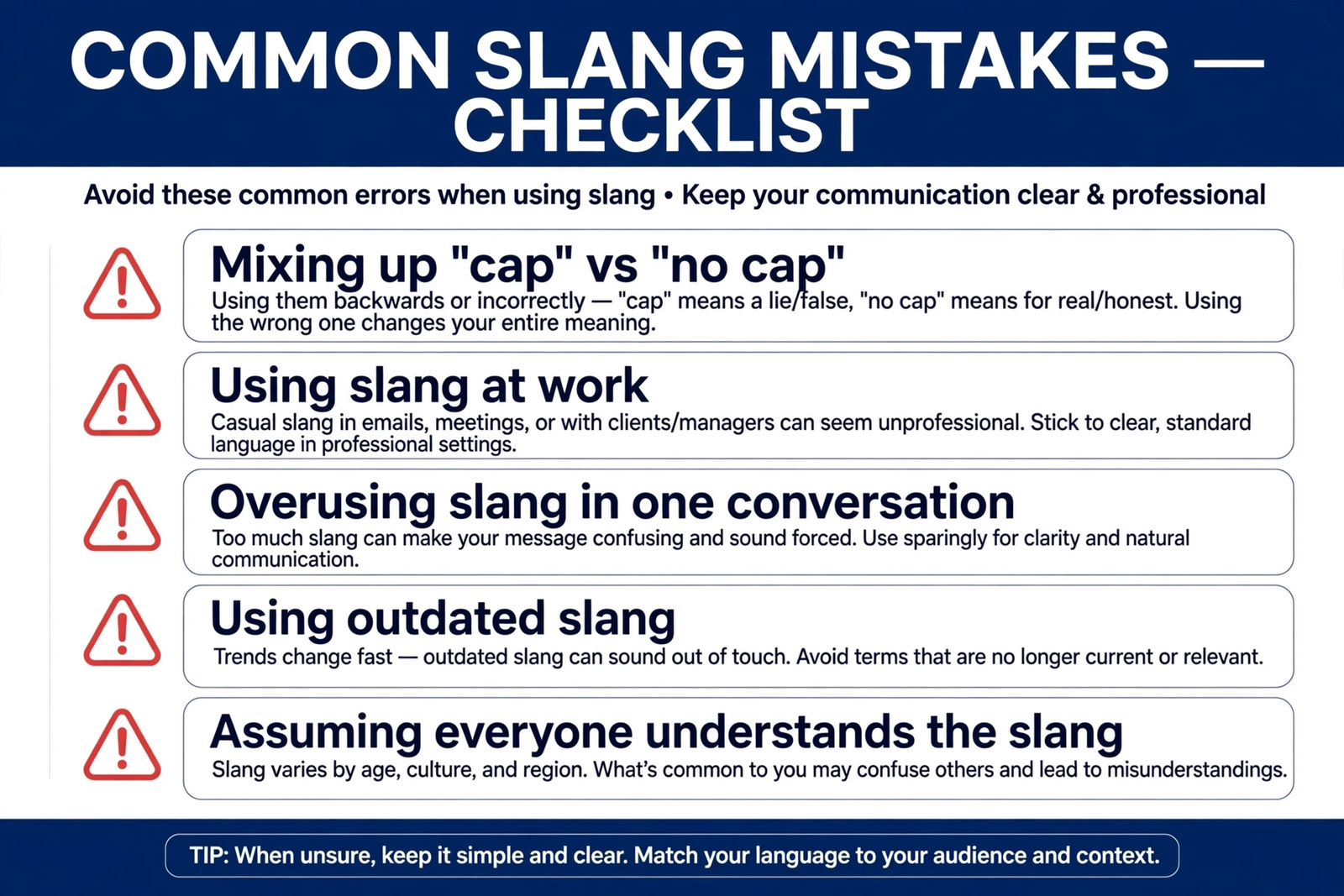
- Mixing up cap and no cap: This is the number one error. “Cap” means lie; “no cap” means truth. Swapping them says the opposite of what you mean.
- Using it in formal settings: Telling your manager “that’s cap” in a meeting will not land the way it does in a group chat. Keep it casual-only.
- Overusing it: Replying “cap” to everything makes you sound like a broken record. Save it for claims that are actually unbelievable.
- Calling someone a capper too soon: One exaggeration does not make someone a liar. “Capper” is a label — use it for repeat offenders, not a one-off joke.
- Using the cap emoji wrong: The 🧢 emoji means “that’s a lie.” Sending it after a true statement confuses everyone. Pair it with the claim you doubt, not with your own honest statement.
- Spelling it “capp” or “kapp”: The correct spelling is “cap.” Extra letters are a giveaway that you are guessing.
- Using it with older people who don’t know it: Your grandmother will think you are talking about a hat. Explain it — or just say “that’s not true.”
Quick Tips
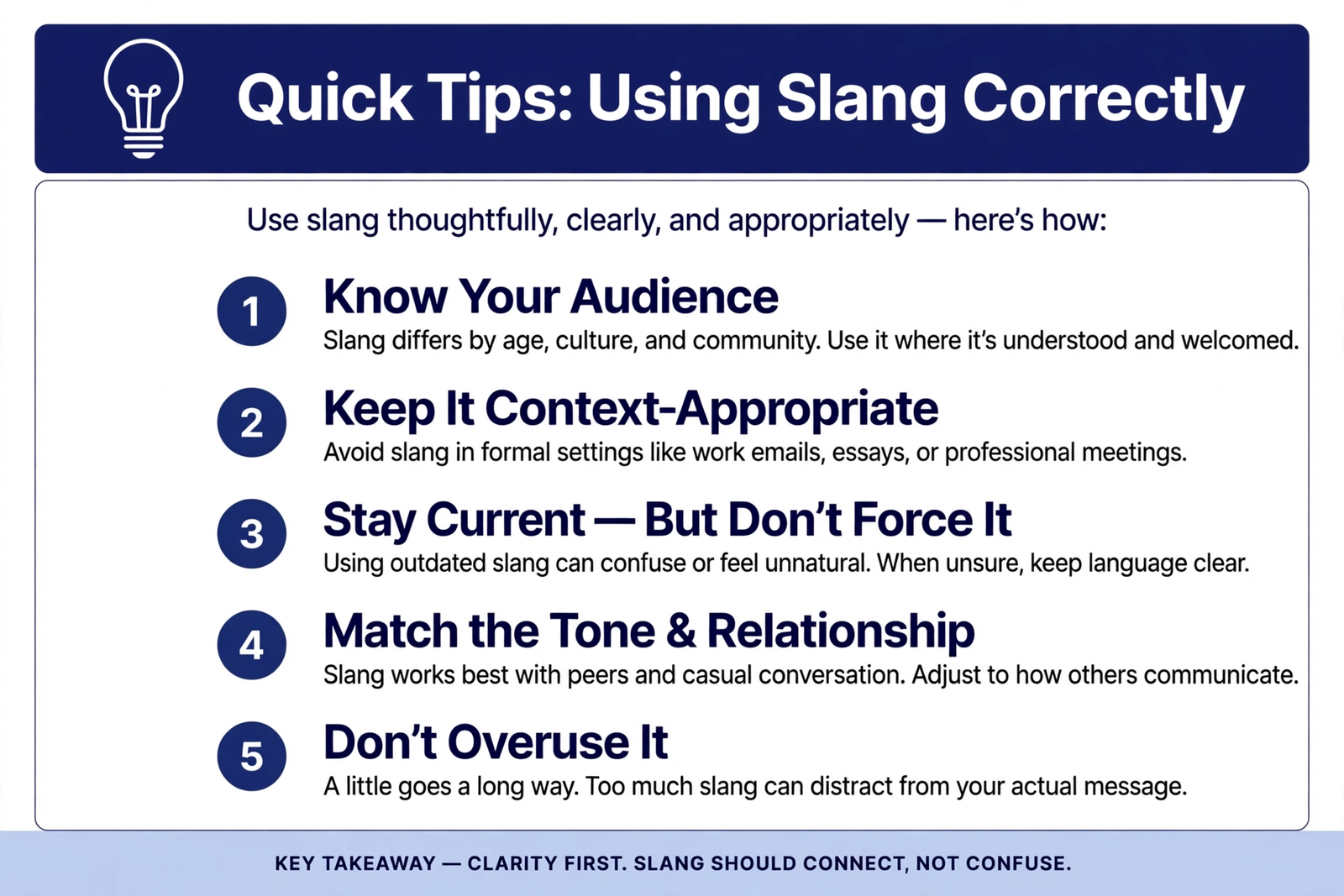
- Pair it with evidence: “Cap — the score was 2-0, not 5-0” hits harder than “cap” alone, and it is funnier too.
- Use “no cap” to add weight: Starting a sincere compliment with “no cap” tells people you really mean it, not just being polite.
- Read the room: In a hype, joking group chat, cap is perfect. In a serious conversation about something real, drop the slang and speak plainly.
- Combine it with “fr”: “No cap fr” (no cap, for real) is the double-strength version — use it when you really need people to believe you.
- Watch the reply: If someone says “cap” to you, laugh it off or prove them wrong with facts. Getting defensive just makes it funnier for everyone else.
- Learn the emoji: A single 🧢 in reply says everything. It is the fastest way to call out a lie on TikTok or Twitter.
- Don’t force it: Slang works when it sounds natural. If “cap” feels awkward coming out of your mouth, “that’s not true” works just as well.
FAQ
What does cap mean in slang?
Cap means a lie. If someone says “that’s cap,” they mean “that’s not true.” Its opposite, “no cap,” means “I’m telling the truth” or “for real.” The cap meaning slang origin traces back to African American hip-hop culture, where “capping” originally meant boasting or talking big.
What does “no cap” mean?
“No cap” means “I’m not lying” or “for real.” It is a way of swearing that what you just said is completely true, with no exaggeration. For example: “No cap, that was the best burger I’ve ever had.”
Where did “cap” come from?
Cap comes from African American Vernacular English and hip-hop culture. It traces back to “high capping,” a phrase from the early 1900s for playful boasting and roasting. Rappers in the 1980s and the Atlanta hip-hop scene of the 2010s popularised it, and TikTok and Twitter made it mainstream around 2017–2019.
Is “cap” rude?
Not usually. Among friends it is playful — a light way to call out an exaggeration. But it does accuse someone of lying, so with strangers or in formal settings it can come across as rude. Save it for people you are comfortable joking with.
What does the cap emoji 🧢 mean?
The blue cap emoji (🧢) means “that’s a lie” or “cap.” People reply with just the emoji to call out a false claim without typing a word. It became a meme in 2019 and is now one of the most common reaction emojis on TikTok and Twitter.
What is a “capper”?
A capper is a person who lies or exaggerates a lot. If someone is always capping — making up stories or inflating their achievements — their friends might call them a capper. It is usually teasing, not a serious insult.
Can I use “cap” at work?
It is best not to. Cap is casual slang, and using it with a manager or client can sound unprofessional. In relaxed creative workplaces it might appear in casual chats, but the safe choice is a polite alternative like “I’m not sure that’s accurate.”
Is “cap” still popular in 2026?
Yes. Unlike a lot of slang that burns out in months, cap has lasted for years because it is short, useful, and has a built-in opposite in “no cap.” It is still everywhere on TikTok, in rap lyrics, and in everyday group chats, and dictionaries now list it as standard slang.
Conclusion
So, what is the cap meaning slang origin in one sentence? It is a word for a lie that travelled from a century-old verbal game called “high capping” through hip-hop lyrics and onto TikTok, where it became the internet’s favourite way to call out a false claim — with its mirror image, “no cap,” swearing the exact opposite.
The key takeaways are simple. Cap means a lie, no cap means the truth, and a capper is someone who lies often. The word is casual, playful, and best used with friends — never in formal settings. Use the 🧢 emoji when you want to call out a lie with a single tap, and pair “cap” with evidence when you want your callout to land. Most importantly, never mix up cap and no cap, because that flips your meaning completely.
Slang moves fast, but cap has already survived for decades — from the streets to the charts to your group chat — and it is not going anywhere. Now that you know what it means and where it came from, you will spot it everywhere: in lyrics, in comments, and in your own chats. Just remember the rule: no cap means real, cap means fake, and if someone calls you out with a 🧢, the best reply is either a laugh or the receipts.
Want to keep decoding the internet’s language? Explore more guides — from what drip means in slang to the full Gen Z slang 2024 roundup — and you will never be lost in the comments again.

3 thoughts on “Cap Meaning Slang Origin: What Does Cap Mean in Text?”