
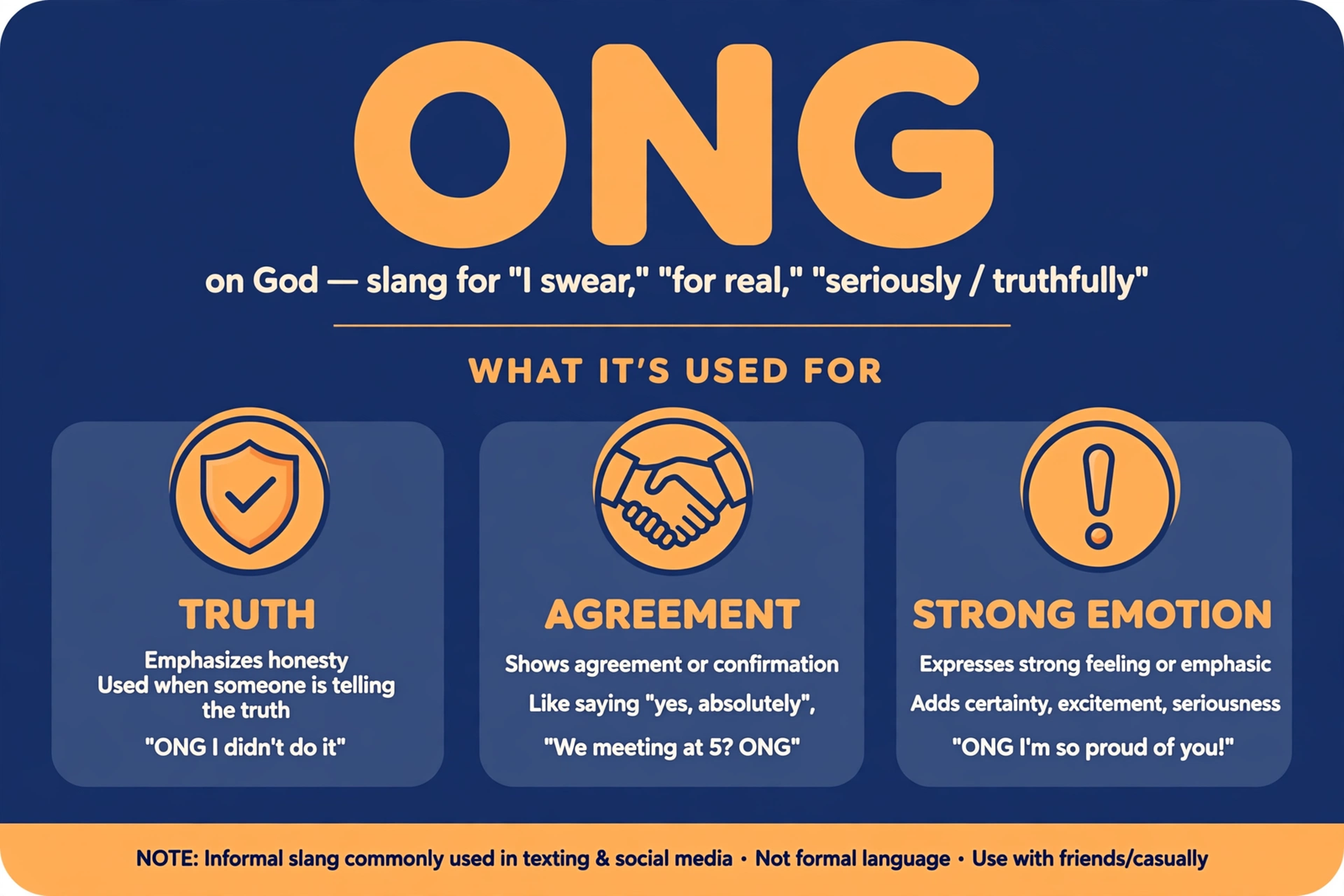
Quick definition: The ong meaning slang is simple — ONG stands for “on God.” It is a short way of saying “I swear to God” in a text message or social media post. People use it to show they are telling the truth, to strongly agree with someone, or to add serious emotion to what they just said.
Introduction
If you have spent any time on TikTok, Snapchat, or Instagram lately, you have probably seen three little letters pop up in comments and captions: ONG. At first glance, it looks like a typo. Did someone mean to type OMG and hit the wrong key? That is the most common first reaction — and it is also wrong. ONG is a real piece of internet slang with its own meaning, its own history, and its own rules for when to use it.
The ong meaning slang matters because this tiny acronym carries a lot of weight. When someone adds ONG to the end of a sentence, they are not just filling space. They are telling you, in the strongest way a texter can, that they mean every word. It is the digital version of putting your hand on your heart and swearing that something is true.
In this guide, we will break down exactly what ONG means, where it came from, how it spread from Twitter to TikTok, and how to use it without sounding awkward. You will see real examples from friendly chats, work messages, and funny conversations, plus a comparison with similar slang terms, the mistakes people make most often, and answers to the questions people search for most. By the end, you will know ONG as well as any Gen Z texter — and you will never confuse it with OMG again.
ong meaning slang Meaning & Definition
ONG is an abbreviation for “on God.” The phrase “on God” is a shortened form of “I swear on God” or “I swear to God,” and it is used to emphasize honesty, strong belief, or intense emotion. When someone types ONG, they are swearing that what they just said is the truth — the same way someone might say “I swear” or “cross my heart” out loud.
Here is the easiest way to think about it: if you can replace ONG with “I swear to God” and the sentence still makes sense, you have used it correctly. For example, “That movie was actually amazing, ONG” means “That movie was actually amazing, I swear to God.” The acronym adds emphasis, not new information. It tells the reader how strongly the writer feels.
ONG is used in three main ways, and understanding all three will keep you from misreading it:
- To swear something is true: “I did not eat your leftovers, ONG.” The writer is insisting they are innocent.
- To strongly agree: When a friend says something you completely agree with, replying “ONG” is a louder, more emphatic yes.
- To express strong emotion: Frustration, shock, excitement, or disbelief can all ride on those three letters. “This traffic is unreal, ONG” is not just a complaint — it is a complaint with feeling.
According to Dictionary.com, ONG is used similarly to phrases such as “I swear to God” or “as God is my witness,” and it is most often used in texting and on social media rather than spoken out loud. That matches how most slang works: it lives in the keyboard, not in conversation.
One important detail: ONG is almost never said out loud. You will not hear someone pronounce it “ong” in a real conversation. It is a written-only acronym, like LOL or BRB. People type it, they do not say it — and that is part of what makes it feel natural in a chat and strange anywhere else.
Origin of ONG
ONG did not appear overnight. Its roots go back to African American Vernacular English (AAVE), where the phrase “on God” has been used for years as a sincere oath — a way of swearing that something is true by invoking God as a witness. The full phrase “on God” was already common in spoken language long before anyone shortened it to three letters.
The abbreviation itself started showing up online in the mid-2010s. Urban Dictionary entries for ONG date back to around 2005 in some records, but the term only became widely known when it spread on Twitter around 2014, carried by teenagers and young creators who used it to agree with each other and emphasize their posts. From Twitter, it moved naturally to Instagram, Snapchat, and eventually TikTok, where short captions and fast comments reward abbreviations that pack meaning into very few characters.
Online personality Tana Mongeau is often credited with helping popularize ONG on social media, after which the term spread through TikTok trends, reaction videos, and comment sections. Like many slang terms, it did not need a marketing campaign — it needed a few viral moments and a generation of users who found it useful.
There is also a practical reason ONG took off when it did. As texting and social media became the default way young people communicate, every character started to count. “On God” is already short, but “ONG” is shorter — and in a world of character limits, quick replies, and fast-scrolling feeds, shorter usually wins. If you want to see how other short slang terms made the same jump from spoken phrase to typed acronym, our breakdown of glizzy meaning follows a very similar path.
Why ONG Became So Popular
ONG became popular for a simple reason: it solves a real communication problem. In a text message, the reader cannot hear your tone of voice or see your face. A plain statement like “That concert was amazing” can sound flat, bored, or even sarcastic. Add ONG to the end — “That concert was amazing, ONG” — and suddenly the reader knows you mean it. The acronym is a tone marker, and tone markers are gold in texting.
Several forces pushed ONG into the mainstream at the same time:
- TikTok and short-form video: Captions and comments on TikTok are short, fast, and emotional. ONG fits perfectly in that space, which is why the hashtag #ONG has millions of views.
- Gen Z texting culture: Younger users treat slang as a shared language. Using ONG correctly signals that you are part of the conversation, not an outsider guessing at it.
- Emotional honesty: Modern internet culture rewards direct, emotional expression. ONG lets someone be dramatic and sincere at the same time, which is exactly the tone that performs well online.
- The OMG confusion: Ironically, the fact that ONG looks like a typo of OMG helped it spread. People saw it, got curious, looked it up, and started using it themselves.
ONG also benefits from being genuinely useful across many situations. It works for agreement, for emphasis, for frustration, and for excitement. Most slang terms do one job; ONG does four. That versatility is why it has survived since the mid-2010s while hundreds of other abbreviations faded away within months.
How ONG Is Used in Texting and on TikTok
ONG is flexible, but it follows a few consistent patterns. In most messages, it appears at the end of a sentence, where it acts like an exclamation point with extra sincerity. “I am so tired, ONG” reads as a much stronger complaint than “I am so tired.” It can also appear at the start of a sentence, usually when the writer is about to make a bold claim: “ONG, I am never doing that again.”
Sometimes ONG stands alone as a complete reply. If a friend texts “This exam was impossible,” replying with just “ONG” says “I completely agree, it really was.” In group chats, a single ONG can do the work of a whole paragraph — it tells everyone you are on the same page without making you type a long response.
On TikTok, ONG shows up in three places: video captions, comments, and hashtags. A creator might caption a video “ONG this actually happened” to promise the story is real. In comments, viewers type ONG to agree with the creator or to react to something shocking. The hashtag #ONG collects all of this into one searchable stream, which is how many people first discover the term.
On Snapchat, ONG works the same way it does in texting, with one extra twist: because snaps disappear, people tend to be more casual and more emotional, and ONG fits that energy perfectly. A snap captioned “ONG look at this” is an invitation to believe something surprising is about to appear on screen.
One rule applies everywhere: ONG is casual. It belongs in chats with friends, in comment sections, and in social media captions. It does not belong in a work email, a school essay, or a message to someone you need to impress professionally — unless you know that person well and the conversation is already informal.
Examples of ONG in Real Conversations
Examples make slang click faster than definitions do. Here is how ONG sounds in real chats, broken down by tone — because the same three letters can feel friendly, professional, or funny depending on the words around them.
Friendly Examples
In friendly chats, ONG is usually warm and emphatic. It shows excitement, agreement, or honest surprise between people who already trust each other.
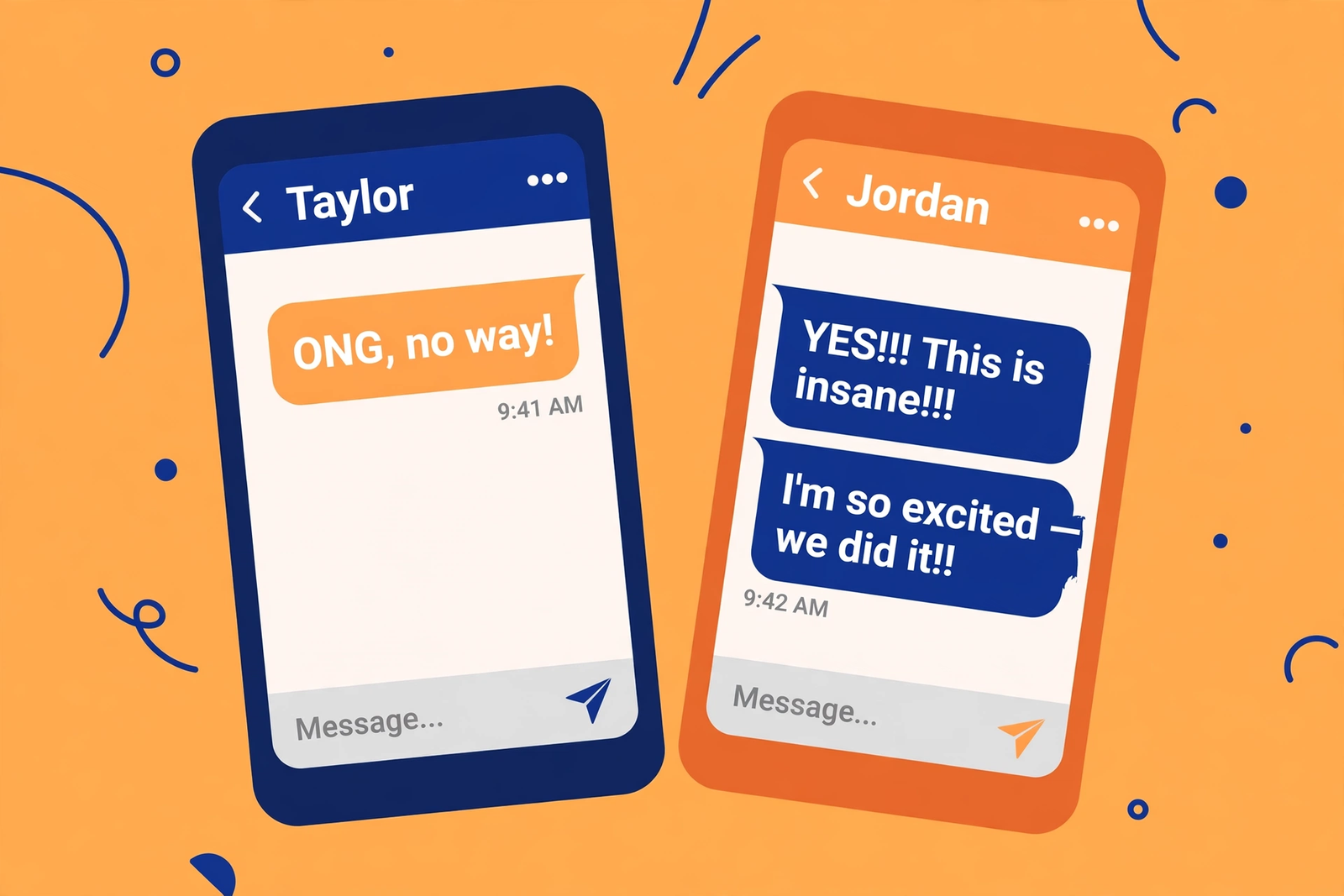
- Friend: “I just got tickets to the concert!”
You: “ONG, no way! I am so happy for you!” - You: “That pizza place was actually so good, ONG.”
- Friend: “I think she is the funniest person in our class.”
You: “ONG, she had me crying laughing yesterday.” - You: “I stayed up all night finishing that show, ONG it was worth it.”
Notice how ONG makes each message feel more genuine. Without it, “That pizza place was actually so good” is a simple opinion. With it, the reader knows you really mean it and you are not just being polite.
Professional Examples
ONG is casual slang, so it has a limited place in professional settings — but it does appear in informal work chats, especially among younger teams on Slack, WhatsApp, or group messages where the tone is already relaxed.
- Coworker: “The client loved the new design.”
You: “ONG, that is such a relief after all those revisions.” - You: “That meeting could have been an email, ONG.”
- Teammate: “We finally hit our target for the month.”
You: “ONG, great work everyone!”
Use it at work only when you are sure the culture allows it. If your manager writes formally, or the chat includes clients, skip ONG and say “I completely agree” or “That is great news” instead. When in doubt, the formal version is always the safer choice.
Funny Examples
ONG also works as a punchline. In funny contexts, it exaggerates a small complaint or a dramatic reaction until it becomes a joke.
- “My phone died right when I was about to win the game, ONG I am done.”
- Friend: “I tripped in front of the whole cafeteria.”
You: “ONG, I would have just stayed on the floor.” - “I opened the fridge and there was nothing to eat, ONG the struggle is real.”
- “He said the homework was easy. ONG, he is lying to all of us.”
The humor works because ONG is a serious oath applied to something silly. Swearing “on God” that your phone died at the worst moment is funny precisely because the situation does not deserve that level of drama — and everyone in the chat knows it.
ONG vs Similar Terms
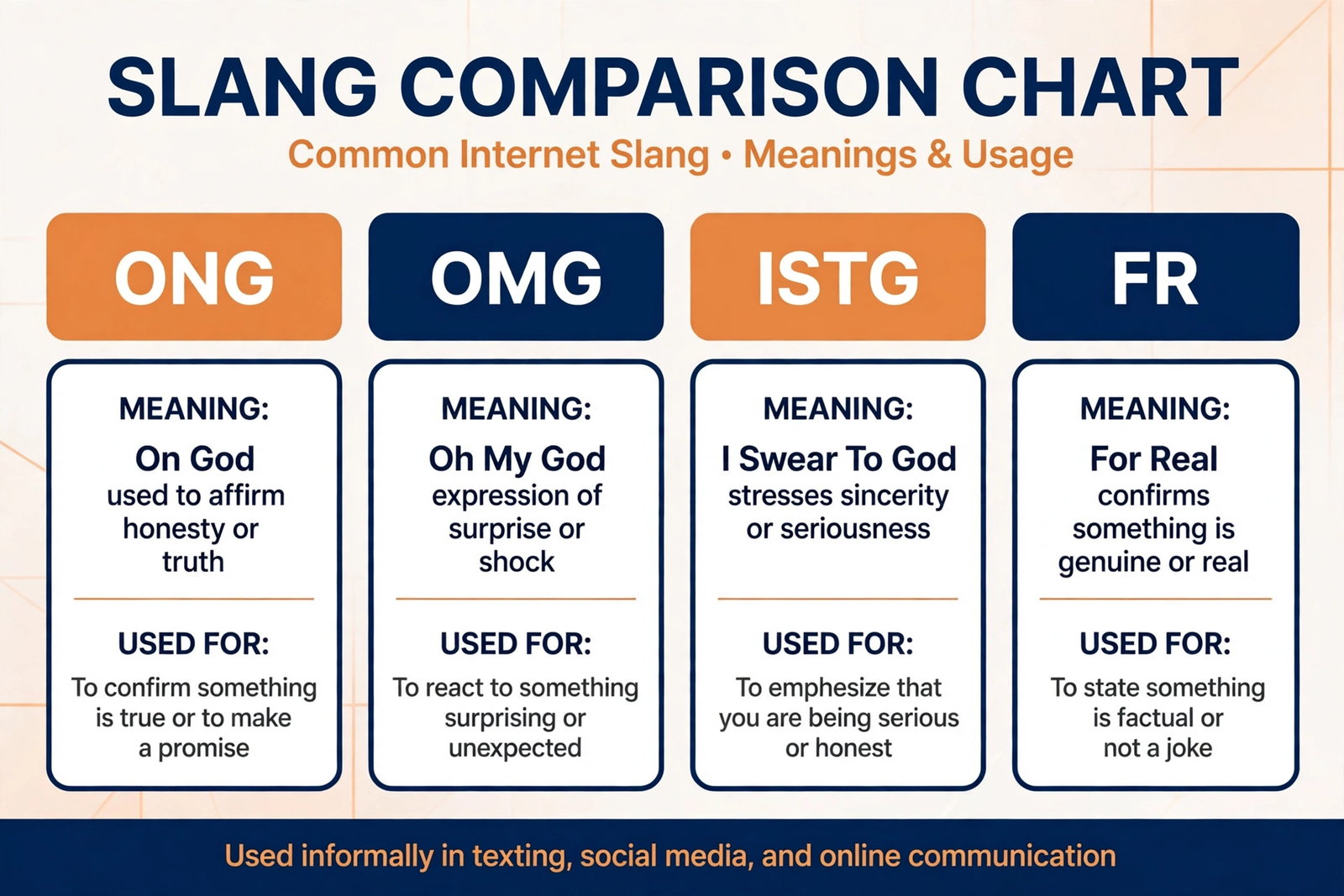
ONG is not the only acronym people use to show they are serious. Several similar terms do nearby jobs, but each one has a different flavor. Mixing them up is easy, so here is a side-by-side comparison.
| Term | Stands For | Meaning | Best Used When |
|---|---|---|---|
| ONG | On God | I swear this is true | Emphasizing honesty or agreeing strongly |
| OMG | Oh My God | Shock or surprise | Reacting to surprising news |
| ISTG | I Swear to God | A strong promise or oath | Making a serious promise or denying something |
| FR | For Real | Seriously, truly | Agreeing casually or confirming something |
| NGL | Not Gonna Lie | Honest opinion coming | Sharing an honest or unpopular opinion |
| TBH | To Be Honest | Honest opinion | Softening a truthful statement |
The closest cousins are ISTG and FR. ISTG is stronger and more formal than ONG — it is the full oath, and it sounds more serious. FR is lighter and more casual — it confirms something without the emotional weight. ONG sits in the middle: stronger than FR, softer than ISTG, and more emotional than both. OMG is the one people confuse it with most, but OMG expresses surprise, not honesty — “OMG, did that really happen?” is a question, while “ONG, that really happened” is a sworn statement.
If you are still learning internet abbreviations, our guide to the fn meaning in text covers another short acronym that people misread just as often, and it shows the same pattern: a tiny word with a very specific job.
Alternate Meanings of ONG
Like many three-letter abbreviations, ONG has other meanings outside of slang — but none of them are common in texting or on social media. If you see ONG in a chat, it almost always means “on God.” Still, it helps to know the alternates so you are not confused when one appears in a different context.
- Oklahoma Natural Gas: A utility company in the United States. You would only see this ONG on a bill or a business document.
- Ohio National Guard: A military organization. Again, a formal context, not a chat.
- Non-Governmental Organization: Sometimes written as NGO, but ONG is the French and Spanish form (Organisation Non Gouvernementale / Organización No Gubernamental). You may see it in international news.
- Overnight Guest: A rare, older usage in hospitality and travel contexts.
- Optical Networking Group: A technical term from the networking industry.
Context is everything. If a friend texts you “ONG” after you tell them gossip, they are not talking about a gas company. But if you see ONG on a utility bill, nobody is swearing to God — it is just the company name. The slang meaning wins in every casual conversation.
There is one more alternate reading worth mentioning: a typo. Because the N and M keys sit next to each other on a phone keyboard, some people type ONG when they mean OMG. If the sentence is about shock or surprise rather than honesty — “ONG, I cannot believe that happened” — the writer may have meant OMG. Reading the sentence as a whole, not just the acronym, tells you which one it is.
Professional or Polite Alternatives to ONG
ONG is honest and direct, but it is also informal and religious in origin, which means it is not right for every audience. Here are polite alternatives you can use when the situation calls for something more professional:
- “I completely agree.” — Clean, professional, and says the same thing as an agreeing ONG.
- “I assure you, that is true.” — Formal and confident, good for work messages and emails.
- “Honestly, I mean that.” — Casual but polite, works with acquaintances and coworkers.
- “I promise you.” — A sincere oath without any slang or religious wording.
- “That is absolutely correct.” — Best when you are confirming a fact rather than sharing a feeling.
- “No exaggeration — that really happened.” — Keeps the energy of ONG while sounding natural in any setting.
The key is matching the alternative to the moment. In a job interview, “I assure you” is the right choice. In a friendly chat with a coworker, “Honestly, I mean that” keeps things warm without sounding stiff. And in a text to your best friend, ONG is still the best tool for the job.
Common Mistakes When Using ONG
ONG is easy to use, but people still get it wrong. These are the mistakes that make a message confusing, awkward, or accidentally rude.
1. Using ONG to mean OMG. This is the number one mistake. ONG means “on God” — a statement of truth. OMG means “oh my God” — a reaction of surprise. “ONG, I cannot believe it!” sounds like you are swearing the disbelief is real, which is not what most people intend. If you are shocked, use OMG. If you are swearing something is true, use ONG.
2. Using it in formal messages. ONG in a work email, a message to a teacher, or a job application looks unprofessional. Slang has a place, and that place is casual conversation. Keep ONG out of anything that will be judged formally.
3. Overusing it. If every sentence ends with ONG, the word loses its power. It is an emphasis tool, and emphasis only works when it is rare. Use it once in a conversation where it counts, not five times in a row.
4. Saying it out loud. ONG is a written acronym. Saying “ong” in a spoken conversation will confuse most people, because the spoken phrase is “on God,” not “ong.” Type it, do not say it.
5. Using it when you are lying or joking. Because ONG is literally an oath, using it on a joke or a lie can backfire. If you swear something is true and it turns out to be false, people will remember that you used ONG. Save it for things you actually believe.
6. Using it with people who do not know slang. Older relatives, formal acquaintances, or anyone unfamiliar with internet culture may read ONG as a typo or not understand it at all. With those people, plain English works better.

Quick Tips for Using ONG Correctly
Keep these tips in mind and you will use ONG naturally every time:
- Place it at the end of a sentence for emphasis, or at the start when you are making a bold claim.
- Use it once per conversation — or once per point — so it keeps its impact.
- Pair it with something you genuinely believe, because it is an oath, not a filler word.
- Stick to casual chats with friends and peers; switch to formal language at work or school.
- Reply with a single ONG when you want to agree strongly without typing a long message.
- Read the whole sentence before replying to someone else’s ONG, so you know whether they are swearing, agreeing, or venting.
- Never use it sarcastically with strangers, because they may take the oath literally.

FAQ
What does ONG mean in texting?
In texting, ONG means “on God.” It is short for “I swear to God” and is used to emphasize that something is true, to strongly agree with someone, or to express strong emotion like frustration or excitement.
Is ONG the same as OMG?
No. ONG stands for “on God” and means “I swear this is true,” while OMG stands for “oh my God” and expresses shock or surprise. They look similar because the N and M keys are next to each other, but they mean different things.
Where did ONG come from?
ONG comes from the phrase “on God,” which has long been used in African American Vernacular English as a sincere oath. The abbreviation spread online in the mid-2010s, first on Twitter around 2014 and later on TikTok, Snapchat, and Instagram.
What does ONG mean on TikTok?
On TikTok, ONG means the same thing it means in texting: “on God.” Creators use it in captions to promise a story is real, and viewers use it in comments to agree with a video or react to something shocking. The hashtag #ONG collects these posts in one place.
What does ONG mean on Snapchat?
On Snapchat, ONG is used like it is in texting — to emphasize honesty or strong agreement in a snap caption or a chat reply. Because Snapchat messages are casual and disappear, ONG fits the relaxed, emotional tone of the app.
Can I use ONG in a professional setting?
It is best not to. ONG is casual slang, so save it for chats with friends. In professional messages, use alternatives like “I completely agree,” “I assure you,” or “I promise you” instead.
Is ONG rude or offensive?
ONG is not rude, but it does invoke God, so some people may find it too casual or inappropriate in formal or religious settings. It is fine among friends, but use a neutral alternative when you are unsure about your audience.
How do you reply when someone says ONG?
You can reply with “ONG” back to show you agree, or respond to the point they were making. For example, if a friend texts “This test was impossible, ONG,” a good reply is “ONG, I know, I definitely failed” — or simply “Same, honestly.”
Conclusion
The ong meaning slang is easy to remember once you know it: ONG stands for “on God,” a short way of swearing that something is true. It is the texting version of putting your hand on your heart and saying “I swear.” Whether you are agreeing with a friend, insisting you are telling the truth, or venting about a terrible day, ONG adds the weight of an oath to an ordinary sentence.
The key takeaways are simple. ONG goes at the end of a sentence for emphasis, or on its own as a strong agreement. It belongs in casual chats, captions, and comment sections — not in formal emails or professional messages. Do not confuse it with OMG, do not overuse it, and do not say it out loud. Used once, in the right moment, it tells the reader exactly how strongly you feel.
Now that you know what ONG means, you will start noticing it everywhere — in TikTok comments, group chats, and captions from friends who want you to know they are serious. And if you want to keep building your internet vocabulary, explore more guides like our breakdown of lbvs meaning slang and keep decoding the slang you see every day, one term at a time.
