
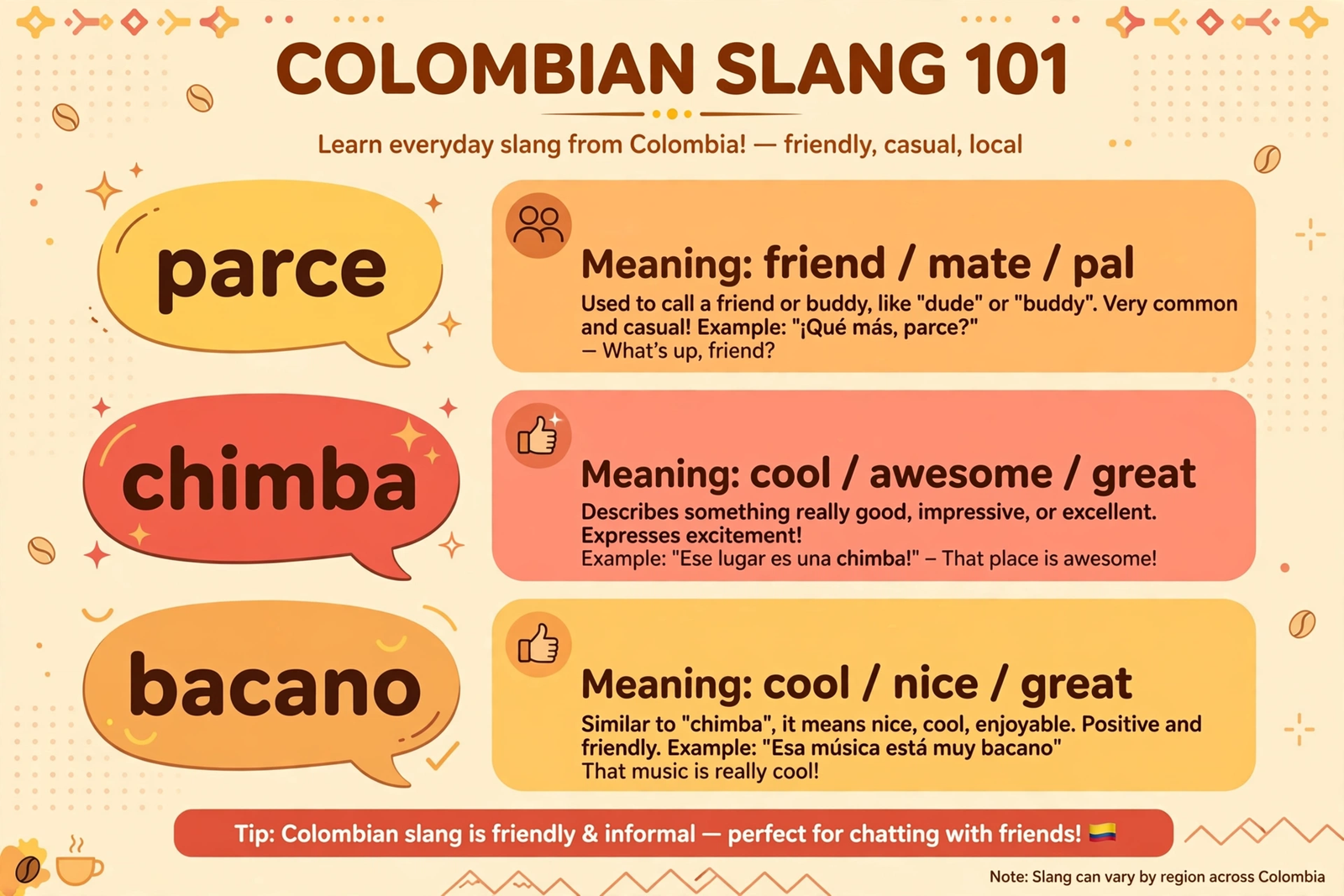
Quick definition: Colombian slang is the informal, everyday vocabulary of Colombian Spanish — words like parce (buddy), chimba (awesome), bacano (cool), and vaina (thing) that Colombians use constantly in casual conversation. It changes by region, from Medellín’s Paisa slang to Bogotá’s Rolo speech and the fast-paced Spanish of the Caribbean coast, and knowing even a dozen of these words instantly makes you sound less like a textbook and more like a friend.
Colombian Slang Meaning & Definition
Colombian slang — known locally as colombianismos — is the set of informal words, phrases, and expressions that Colombians use in everyday life but that you will rarely find in a Spanish textbook. It covers greetings, compliments, insults, money, work, parties, and hangovers. Some of it is warm and friendly, some of it is rough enough that you should only use it with close friends, and a lot of it only makes sense once you understand the region it comes from.
Unlike classroom Spanish, which aims for a neutral standard, Colombian slang is deeply local. A word that is perfectly normal in Medellín can sound strange in Bogotá, and a phrase that gets laughs on the Caribbean coast might confuse someone in Cali. That regional flavor is exactly what makes it so fun to learn — and so useful, whether you are traveling in Colombia, learning Spanish, watching a Colombian series, or chatting with Colombian friends online.
| Word or Phrase | English Meaning | Register |
|---|---|---|
| Parce / parcero | Buddy, mate, bro | Friendly, casual |
| ¡Qué chimba! | How awesome! | Very informal |
| Bacano / bacana | Cool, great, awesome | Casual, friendly |
| Chévere | Cool, nice, great | Casual, safe |
| Berraco / berraca | Tough, impressive, hardcore | Informal, strong |
| Vaina | Thing, stuff, situation | Casual, universal |
| ¿Qué más? | What’s up? | Friendly greeting |
| Plata | Money | Casual |
| Camello | Job, hard work | Casual |
| Guayabo | Hangover | Casual |
| Tinto | Small black coffee | Everyday |
| ¡De una! | Right away! Let’s do it! | Casual, enthusiastic |
In short, Colombian slang is not a separate language. It is Colombian Spanish spoken the way real people actually speak it — fast, warm, funny, and full of words that carry a whole attitude in a single syllable. Like every country’s street language, it rewards learners who go beyond the textbook — our guide to Australian slang shows how another country’s everyday words work the same way.
Introduction
Picture this: you land in Medellín, step into a taxi, and the driver turns around and says, “¿Qué más, parce? ¿Para dónde vamos?” You studied Spanish for two years, but nobody ever taught you qué más or parce. The driver is just asking where you’re headed, but for a few confused seconds, you are not sure whether he is greeting you, insulting you, or asking for directions.
That moment is why Colombian slang matters. Colombia is one of the most visited countries in South America, and its Spanish is often praised as one of the clearest in the Spanish-speaking world. But clear pronunciation does not mean simple vocabulary. The moment a conversation turns casual, textbook Spanish steps aside and the slang takes over. Friends call each other parce, good news is una chimba, a great party is una rumba, and the morning after is el guayabo.
This guide covers the most common words with real meanings and example sentences, the regional differences that trip people up, the polite-versus-vulgar line you should never cross by accident, and the mistakes that mark you as a beginner. Most existing guides fall into one of two traps: long lists of 100 words with one-line translations and no context, or polite-only lists that skip the rough words entirely — leaving you clueless the first time someone calls you huevón affectionately. This article does both jobs: the friendly words to start using today, and honest explanations of the vulgar ones so you understand them, even if you never say them yourself.
Origin
Colombian slang grew out of Colombia‘s geography, history, and famously regional culture. Colombia is a country of mountains, coasts, jungles, and valleys, and for much of its history those regions were cut off from each other by the Andes. People in Medellín, Bogotá, Cali, and the Caribbean coast developed their own accents, their own humor, and their own words — and they still have them today.
Many of the most famous words have surprising roots. Parcero, the word behind parce, comes from the Portuguese parceiro (partner, equal) and the old Spanish aparcero, a term for someone who shares land or work with you. Over time it shifted from “work partner” to “close friend,” then got shortened to the punchy parce that now opens half the conversations in Medellín. The Diccionario de americanismos lists parcero as a Colombian and Ecuadorian word for a close friend and a form of address among young people.
Other words come from everyday objects that got a second life. Camello literally means “camel,” but in Colombia it means a job — hard, heavy work, the way a camel carries a heavy load. Guayabo is literally a guava tree, yet it is the standard Colombian word for a hangover. Vaina originally meant a scabbard, and it slowly became the all-purpose word for “thing.” Plata means “silver,” which is why it became the casual word for money, just as English speakers say “cash” or “bucks.”
Music, television, and the streets of Medellín did the rest. Paisa culture spread words like parce, bacano, and chimba across the country through telenovelas, reggaeton, and social media. In early October 2026, members of BTS greeted crowds in Bogotá using parce, bacano, qué chimba, and hágale pues, giving Colombian slang a burst of global attention. Some slang has darker roots, too: words like gonorrea and malparido grew out of street culture and were popularized by narco dramas. They are real, common, and vulgar — which is exactly why you need to understand them rather than repeat them.
Popularity
Colombian slang is more popular — and more visible — than it has ever been. A decade ago, you mostly heard it if you lived in Colombia or had Colombian family. Today it shows up in reggaeton lyrics, Netflix series, TikTok videos, travel vlogs, and language-learning apps. Search interest in phrases like “Colombian slang words” and “what does parce mean” has climbed steadily as Colombia has become one of Latin America’s top tourist destinations, with Medellín in particular drawing digital nomads, language students, and backpackers by the thousands.
Inside Colombia, slang is not a youth-only thing. Teenagers and grandparents alike say qué más, chévere, and vaina. What changes with age and setting is the register: older or more formal speakers lean on the safe words, while younger speakers in Medellín or Cali throw around chimba, huevón, and gonorrea with friends. In business meetings and on the news, standard Spanish rules — but step outside the office and the slang returns within seconds.
Colombian slang has also become a badge of identity abroad. The large Colombian diaspora in the United States, Spain, and elsewhere keeps words like parce and bacano alive in Miami, New York, and Madrid. And for Spanish learners, Colombian slang has become a popular goal in itself. There is a reason for the hype: Colombian Spanish is widely considered one of the easiest Latin American varieties to understand — clear consonants, moderate pace, relatively neutral accent. Slang is the one part that still confuses learners, because it is the part that lives in the street rather than the classroom. Master it, and the whole country opens up.
How It Is Used
Colombian slang works on three levels, and knowing which level you are on matters more than knowing the words themselves. The same word can be friendly, neutral, or offensive depending on who says it, to whom, and with what tone.
1. Friendly and safe — use these freely. Words like parce, bacano, chévere, qué más, quiubo, vaina, plata, tinto, and ¡de una! are the everyday vocabulary of Colombian life. You can use them with friends, taxi drivers, shopkeepers, and coworkers your own age without anyone blinking. Chévere is the safest compliment in the language — it works for people, food, places, and ideas. Parce is warm and inclusive; calling someone parce is a small act of friendship.
2. Informal and strong — friends only. Words like chimba, berraco, huevón, and gonorrea are common, but they carry weight. Among close friends they can be affectionate, funny, or emphatic. With strangers, in formal settings, or with older people, they can land badly. ¡Qué chimba! means “how awesome!” between friends, but chimba has a vulgar second meaning, so keep it out of polite company. Huevón can mean “dude” among friends or “idiot” when said with anger — tone is everything.
3. Insults — understand, do not use. Malparido (roughly “bastard”) and gonorrea used as an insult are genuinely offensive. You will hear them in arguments, in music, and in crime dramas. Learn what they mean so you are not confused when you hear them, but do not repeat them unless you fully understand the relationship and the risk.
Region shapes usage just as much as register:
- Medellín and Antioquia (Paisa): the heartland of parce, bacano, chimba, berraco, and ¡hágale pues! (let’s do it). Paisa speech is warm and fast — strangers get called parce within minutes.
- Bogotá (Rolo / Cachaco): more formal on the surface, but the slang is still there: chévere, bacano, chino/china (kid, guy/girl), and usted used even with friends.
- Caribbean coast (Costeño): faster speech, dropped consonants, and its own vocabulary like ¡ajá! Coastal speakers swallow the final “s,” which makes their slang the hardest for learners to catch.
- Cali and the Valle del Cauca: salsa culture and Pacific influence: ¡ve! (look / hey) and vos instead of tú in many contexts.
- Coffee region (Eje Cafetero): close to Paisa speech, famous for politeness — lots of ¿me regalas…? (“can I have…?”) for everything from a coffee to directions.
One more thing that confuses learners: Colombians often use usted (the formal “you”) with friends, family, and even children in some regions. In Bogotá especially, a mother might call her own son usted. That does not mean the conversation is formal — it is just a regional habit, and the slang flows regardless of the pronoun.
Examples
Slang only clicks when you see it in real sentences. Notice how the same word can do different jobs — chimba can praise a concert, a meal, or a person, and berraco can praise someone’s courage or complain about a hard problem.
Friendly Examples
- ¿Qué más, parce? ¿Todo bien? — What’s up, buddy? Everything good? (The standard greeting between friends in Medellín.)
- ¡Quiubo, parcero! ¿Vamos a rumbear el viernes? — Hey, buddy! Are we going out partying on Friday?
- Ese suéter está bacano, parce. — That sweater is awesome, man.
- La comida estuvo muy bacana, gracias. — The food was really great, thanks. (Bacana is the feminine form.)
- ¡Qué chimba de concierto, parce! — What an awesome concert, buddy! (Pure excitement, friends only.)
- ¡De una! Nos vemos a las siete. — Absolutely! See you at seven.
- ¿Me regalas un tinto, por favor? — Can I get a small black coffee, please?
Professional Examples
Slang has a limited place at work, but the safe words fit naturally into a relaxed office or a chat with a Colombian colleague. The rule is simple: if the word would sound fine in a friendly email, it is fine.
- La reunión estuvo muy chévere, gracias por organizarla. — The meeting was really nice, thanks for organizing it.
- Este proyecto es un camello, pero vamos bien. — This project is tough work, but we’re doing well.
- ¿Cuánta plata necesitamos para el evento? — How much money do we need for the event?
- ¡Qué berraquera de equipo tenemos! — What an amazing team we have! (Berraquera means guts, courage, greatness.)
Funny Examples
- Anoche rumbiamos hasta las 4 y hoy tengo un guayabo ni el berraco. — Last night we partied until 4 a.m. and today I have a hangover like you wouldn’t believe.
- Me tomé tres tintos y todavía tengo sueño, ¡qué vaina! — I drank three coffees and I’m still sleepy, what a thing!
- Salió solo en la noche con el celular en la mano — dio papaya. — He went out alone at night with his phone in his hand — he was asking for it.
- La fiesta estuvo una chimba, pero el guayabo de hoy está chimbo. — The party was amazing, but today’s hangover is terrible. (Chimba for great, chimbo for bad.)

Comparison with Similar Terms
Every Spanish-speaking country has its own slang, and many words overlap in confusing ways. A word that means “cool” in Colombia can mean something completely different in Chile or Spain. English has the same regional quirks — see our guide to Ohio slang for a US example. This comparison shows how Colombian slang lines up against similar terms elsewhere — and where the false friends are hiding.
| Colombian Slang | Meaning | Equivalent Elsewhere | Watch Out |
|---|---|---|---|
| Parce / parcero | Buddy, bro | Mexico: güey; Argentina: boludo; Spain: tío | Boludo can be insulting; parce is almost always warm. |
| Bacano / chévere | Cool, great | Chile: bacán; Mexico: chido; Spain: guay | Bacán and bacano share a root. |
| ¡Qué chimba! | How awesome! | Mexico: ¡qué chido! | Chimba has a vulgar meaning; its equivalents do not carry that risk. |
| Huevón | Dude / idiot | Chile: huevón; Mexico: güey | In Chile it is milder; in Colombia, use only with close friends. |
| Vaina | Thing, stuff | Venezuela: vaina; Spain: cosa | Venezuelans use vaina the same way. |
| Tinto | Small black coffee | Elsewhere: café; in Spain tinto means red wine | Order a tinto in Madrid and you will get wine, not coffee. |
| Guayabo | Hangover | Mexico: cruda; Spain: resaca | Guayabo is almost uniquely Colombian. |
| Dar papaya | To make yourself vulnerable | No direct equivalent | A uniquely Colombian piece of street wisdom. |
The biggest practical lesson here is about tinto and chimba. Tinto will get you coffee in Bogotá and red wine in Madrid, so context is everything. And chimba is the only word on the list whose cheerful meaning sits right next to a vulgar one — the kind of double meaning also common in new internet terms, like the ones in our Gen Alpha slang guide — the kind of double meaning that makes Colombian slang both fun and risky for learners.

Alternate Meanings
Some Colombian slang words refuse to sit still. They change meaning with context, tone, and region, and those shifts are exactly where learners get tripped up.
Chimba / chimbo. ¡Qué chimba! means “how awesome!” — enthusiasm about a concert, a meal, or good news. But chimbo means bad, fake, or useless: ese celular es chimbo means “that phone is a fake.” And in a separate, literal sense, chimba is a vulgar word for female genitalia. Among friends, nobody is thinking about the vulgar sense when they say qué chimba — but it is the reason you should not say it to your Colombian grandmother, your boss, or a stranger.
Berraco. From verraco, a wild boar — tough, stubborn, hard to handle. So un berraco can be a compliment (a tough, capable, admirable person), an insult (a stubborn, angry person), or a description of a situation (está berraco — “this is really hard”). ¡Qué berraquera! is almost always positive: “how amazing!” Tone and context decide which one you are hearing.
Vaina. Vaina means “thing,” but it stretches to cover situations, problems, and complaints. ¿Qué es esta vaina? is “what is this thing?” ¡Qué vaina! is “what a mess!” ¿Cómo va la vaina? is “how’s it going?” It is the Swiss army knife of Colombian Spanish — the word you use when the right word will not come.
Gonorrea. Literally the disease gonorrhea, used as slang it means something or someone vile or despicable. But between very close male friends it can also be used as a rough term of affection, almost like “you rascal.” This is the most advanced and most dangerous word on this list. Learn it, recognize it, and do not use it until you have lived in Colombia for a while — if ever.
Tinto. In Colombia, tinto is a small cup of black coffee, usually sweetened, sold everywhere from street carts to offices. Outside Colombia, tinto usually means red wine. Order carefully.
Professional or Polite Alternatives
Colombian slang is wonderful with friends and risky at work, in a job interview, or when meeting your partner’s parents. The good news is that every slang word has a clean, polite equivalent that means the same thing without the edge.
| Slang Word | What It Means | Polite Alternative |
|---|---|---|
| Parce / parcero | Buddy, friend | Amigo / amiga — “friend” |
| ¡Qué chimba! | How awesome! | ¡Qué maravilla! — “how wonderful!” |
| Bacano / chévere | Cool, great | Excelente — “excellent” |
| Huevón | Dude / idiot | Amigo, or just use the person’s name |
| Berraco | Tough, impressive | Admirable — “admirable” |
| Vaina | Thing, situation | Cosa or asunto — “thing / matter” |
| Plata | Money | Dinero — “money” |
| Camello | Job | Trabajo — “work / job” |
| Guayabo | Hangover | Resaca — “hangover” |
| ¿Qué más? | What’s up? | ¿Cómo estás? — “how are you?” |
| Rumba | Party | Fiesta — “party” |
| Malparido | Bastard (insult) | No polite equivalent — just do not say it |
A useful rule of thumb: if you are not sure whether a word is safe, swap in the polite version. Nobody in Colombia will think less of you for saying amigo instead of parce or excelente instead of bacano. But saying huevón to the wrong person can end a conversation fast.
Common Mistakes
Learning slang is easy. Using it well is the hard part. These are the mistakes that almost every learner makes.
Using vulgar words too early. The classic beginner error is hearing chimba, huevón, or gonorrea in a TV show and repeating them the next day to a stranger. Those words are safe only inside an established friendship. Until you have that friendship, stick to parce, bacano, chévere, and qué más — 90 percent of the warmth with none of the risk.
Mixing up chimba and chimbo. ¡Qué chimba! is positive; qué chimbo is negative. They sound almost identical, and learners swap them constantly. Saying qué chimbo about your friend’s new restaurant is the opposite of a compliment — it means the place is fake, bad, or worthless. Learn the pair together and keep them straight.
Using Paisa slang in Bogotá as if it were universal. Parce is understood everywhere in Colombia, but in Bogotá it can sound like you are imitating Medellín. Bogotanos have their own flavor — chino for a kid or a guy, usted with friends, chévere as the default compliment. Match the city you are in and you will sound far more natural.
Overusing vaina. Vaina is addictive because it fills every gap. But if every sentence contains vaina, you sound like someone who does not know the real words. Use it as a spice, not a crutch — one or two times per conversation is plenty.
Calling everyone parce. Parce is friendly, but it still implies closeness. Using it with an older person, a police officer, or a formal business contact can come across as over-familiar. With strangers, a simple hola, ¿cómo estás? is safer; let them invite the parce first.
Assuming tinto means wine. If you learned Spanish in Spain, your instinct will tell you tinto is red wine. In Colombia it is coffee. This mistake is harmless — you will just get a small black coffee instead of a glass of wine — but it confuses waiters and marks you as a newcomer instantly.
Translating slang word for word. Dar papaya does not mean “to give papaya.” Slang is idiom, not vocabulary. Learn the phrase as a whole, with its situation attached, and you will use it correctly.

Quick Tips
- Start with five words. Learn parce, qué más, bacano, chévere, and vaina first. They cover greetings, compliments, and filler — the three things you need most in any conversation.
- Listen before you speak. Spend a day in any Colombian city just listening. Notice which words locals use with each other and which they never use with strangers. Your ear will teach you the register faster than any list.
- Watch Colombian shows with subtitles. Series and telenovelas are the fastest way to hear slang in context — the tone, the timing, and the reactions all come free with the dialogue. Try Spanish subtitles first so you can match the sound to the spelling.
- Learn phrases, not just words. ¿Qué más, parce? is more useful than parce alone. ¡Qué chimba! is more useful than chimba alone. Slang lives in fixed phrases, so memorize the whole phrase.
- Ask a local to correct you. Colombians are famously warm about foreigners learning their slang. If you say something wrong, they will usually laugh and fix it — that laugh is a lesson, not a judgment.
- Use slang to listen, not to show off. Dropping ten slang words into one sentence does not make you sound Colombian — it makes you sound like a tourist reading from a list. One natural parce beats five forced ones.
- Do not give papaya. The advice is real, not just slang. Keep your phone out of sight on the street, do not flash expensive things, and stay aware — no dé papaya is the single most useful safety phrase in the country.

FAQ
What does parce mean in Colombian slang?
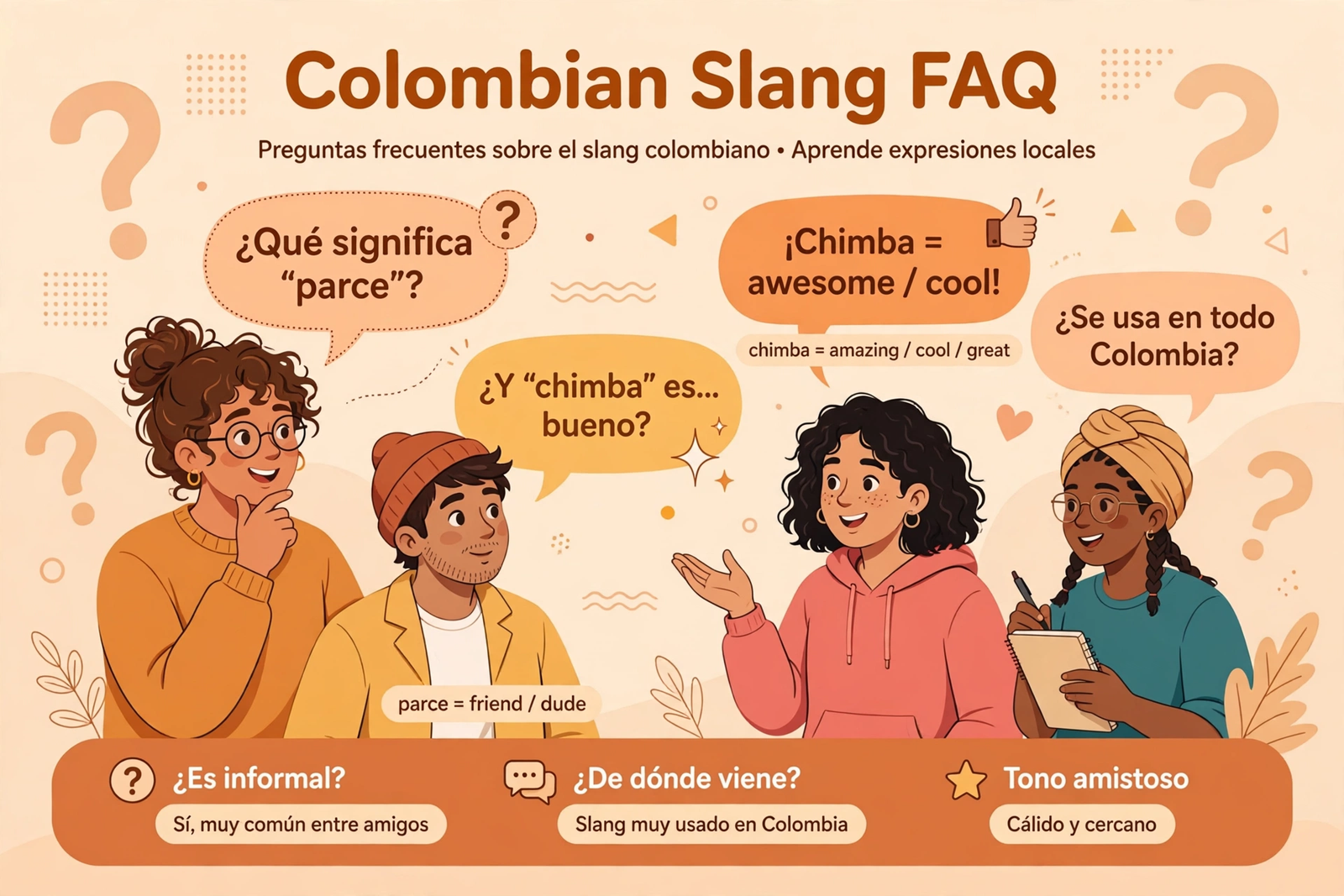
Parce is short for parcero and means “buddy,” “mate,” “bro,” or “dude.” It is the most common friendly term of address in Colombia, especially in Medellín and the Paisa region. You use it with friends and people your own age — for example, “¿Qué más, parce?” means “What’s up, buddy?”
What does chimba mean in Colombia?
¡Qué chimba! means “how awesome!” or “that’s great!” — an enthusiastic compliment about a person, event, or thing. But be careful: chimbo means bad or fake, and chimba also has a vulgar literal meaning. Among friends it is friendly and fun; in formal settings, use qué bueno instead.
What does bacano mean?
Bacano (feminine: bacana) means cool, great, or awesome. It can describe a person, a place, a meal, or a situation — “ese carro está bacano” means “that car is cool.” It is casual and friendly, and it is safe to use in most everyday conversations.
What is the difference between Paisa slang and Bogotá slang?
Paisa slang, from Medellín and Antioquia, is built around parce, bacano, chimba, berraco, and hágale pues. Bogotá (Rolo) slang is more formal on the surface, uses usted even with friends, and leans on words like chévere and chino/china for a kid or young person. The two overlap a lot, but the flavor — warm and fast in Medellín, drier and more formal in Bogotá — is easy to hear.
Is Colombian slang rude?
Most Colombian slang is not rude at all — words like parce, chévere, bacano, and vaina are warm and everyday. A smaller set is vulgar, including huevón, gonorrea, and malparido, and those should only be used — if ever — with very close friends. The polite words are the ones to learn first.
What does guayabo mean in Colombia?
Guayabo means a hangover. Literally it is a guava tree, but in Colombia it is the standard word for the morning after a night of drinking: “tengo un guayabo terrible” means “I have a terrible hangover.” The adjective form is enguayabado — hungover.
What does dar papaya mean?
Dar papaya literally means “to give papaya,” but as slang it means to make yourself an easy target — for example, by showing off an expensive phone on the street or leaving your bag unattended. The advice no dé papaya (“don’t make yourself a target”) is one of the most common safety warnings you will hear in Colombia.
How can I learn Colombian slang fast?
Start with five words — parce, qué más, bacano, chévere, and vaina — then listen to how Colombians use them in real conversations. Watch Colombian series with Spanish subtitles, follow Colombian creators on social media, and practice the fixed phrases out loud. Most importantly, use slang with real people: Colombians love it when foreigners try, and they will correct you kindly.
Conclusion
Colombian slang is more than a list of funny words. It is the sound of Colombia itself — warm, direct, funny, and a little bit cheeky. Words like parce, bacano, and chévere open doors: they turn a stranger into a friend, a transaction into a conversation, and a trip into a memory. Words like chimba and berraco carry the energy of the street, and words like dar papaya carry the wisdom of it.
The smart way to learn it is in layers. Start with the safe words — parce, qué más, bacano, chévere, vaina — and use them until they feel natural. Add the regional flavor once you know which city you are in: Paisa warmth in Medellín, Rolo polish in Bogotá, coastal rhythm in Cartagena. Learn the vulgar words so you understand them, but keep them in your pocket until a close friend invites them out. And remember the two that trip everyone up: chimba is great and chimbo is terrible, and a tinto is coffee, not wine. So go ahead — walk into a café, order a tinto, and say ¿qué más, parce? You already sound like you belong.

2 thoughts on “Colombian Slang: The Words That Make You Sound Like a Local”