
Quick Definition: In slang, “lear” is a playful, shortened form of “learner” — someone who is new at something and still learning. When a person calls themselves a “lear” in a text or gaming chat, they are saying “I’m still figuring this out” in a light, self-deprecating way. The word is also a homophone of “leer,” which means a sly or suggestive look, so context decides which meaning applies.
Lear Definition Slang Meaning & Definition
The lear definition slang meaning is simple: a “lear” is a beginner, a newbie, or someone in the process of learning something. It is the casual, internet-age spelling of “learner” with the final “n” dropped, the same way online slang often trims words to make them faster to type and more fun to say. If someone writes “I’m just a lear at this game,” they are not claiming to be bad at it forever — they are admitting they are new, still practising, and open to learning.
What makes “lear” interesting is that it carries a tone that the plain word “learner” does not. “Learner” sounds formal, like something from a classroom or a driving test. “Lear” sounds relaxed, funny, and self-aware. It is the kind of word people use when they want to lower expectations without sounding negative. Saying “I’m a lear” is a social shortcut: it tells the other person to be patient, to expect mistakes, and to laugh along with you instead of judging you.
The term shows up most often in casual texting, gaming chats, and social media comments. It is not standard dictionary slang yet, which is exactly why people search for the lear definition slang — they have seen it in a comment or a message and want to know whether it is a typo, a name, or a real word. It is a real word in the sense that people use it and understand it, even though it started as internet shorthand rather than formal English.
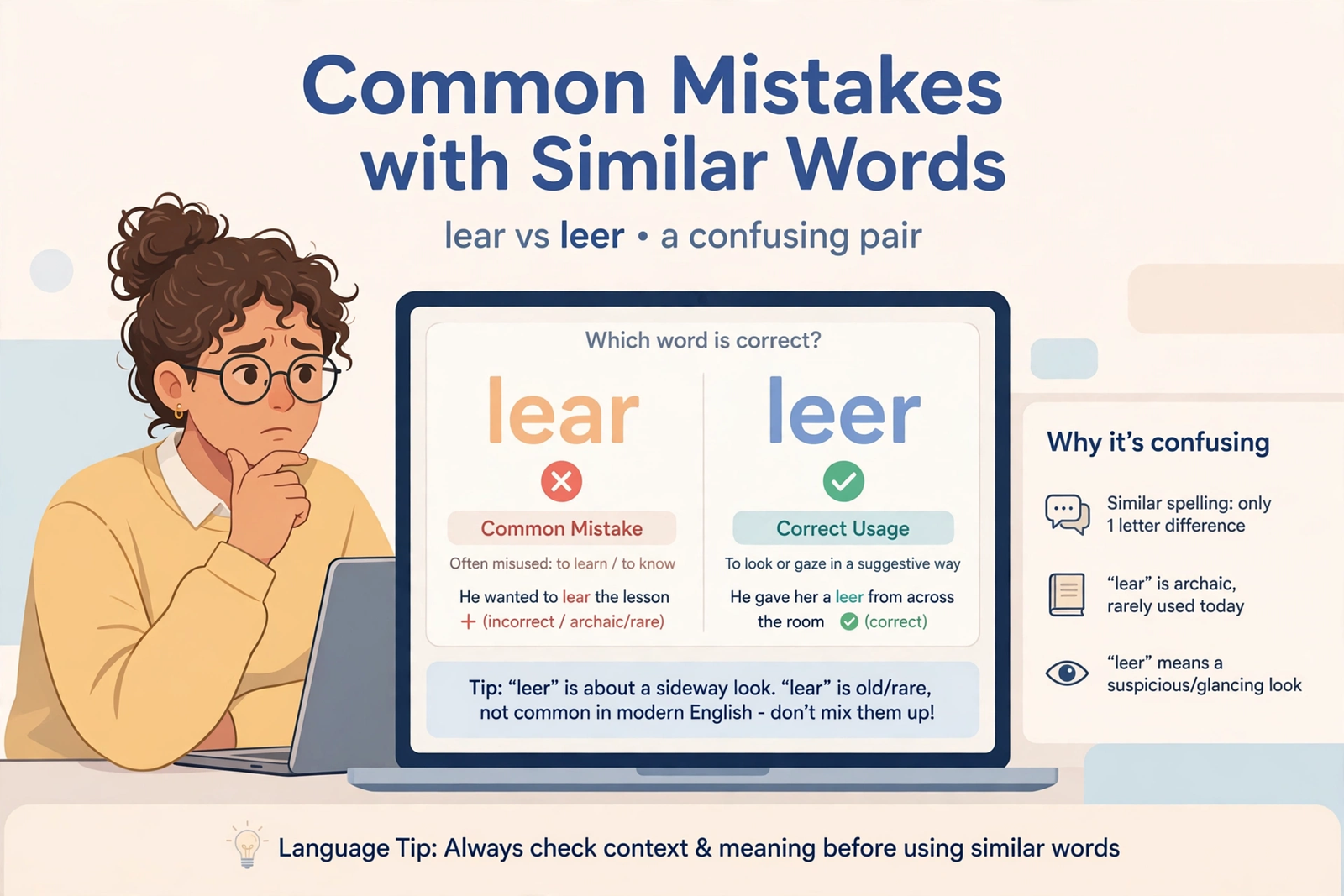
There is one important point of confusion to clear up early. “Lear” sounds exactly like “leer,” a much older English word that means to look at someone sideways, usually with a sly, suggestive, or unpleasant expression. The two words share a pronunciation but not a meaning. In a sentence like “stop learing at me,” the writer almost certainly means “leer” — the creepy look — not the beginner meaning. In a sentence like “I’m such a lear at cooking,” the writer means the beginner. The surrounding words always tell you which one it is, and this article explains how to tell them apart.
Introduction
Every year, the internet invents a new batch of words that leave everyone else playing catch-up. Some of them are abbreviations, some are inside jokes from a single viral video, and some are just old words spelled in a new way. “Lear” belongs to that last group. It looks like a typo at first glance — a word missing its final letter — but it has quietly become a handy little label for the experience of being new at something.
Think about the last time you tried something for the first time: a new video game, a new recipe, a new hobby, a new job. There is a gap between knowing nothing and knowing enough, and that gap needs a name. “Beginner” feels too formal. “Noob” feels too insulting. “Newbie” feels a little dated. “Lear” fills the space in between: it is honest, it is humble, and it has a sense of humour about itself. It says “I’m learning” without making a big deal out of it.
That is why understanding the lear definition slang matters even if you never plan to use the word yourself. You will run into it in gaming lobbies, in TikTok comments, in Discord servers, and in group chats where someone is trying a new skill. Knowing what it means saves you from a confused reply, and knowing how to use it gives you one more natural way to talk about learning in the casual, fast-moving language of the internet. This guide covers the full picture: what “lear” means, where it came from, how people actually use it, how it compares with similar words, and the mistakes to avoid.
If you enjoy decoding internet shorthand, you will find the same kind of breakdown in our guide to fn meaning in text, where another short abbreviation gets the full treatment — definition, origin, examples, and all.

Origin
The origin of “lear” as slang is not tied to a single viral moment, which makes it different from many slang terms that can be traced to one TikTok or one meme. Instead, it grew out of two separate streams that eventually met in the same spelling.
The first stream is the history of the word itself. “Lear” is an old word. In Middle English, forms like “lere” and “lear” were connected to learning and teaching — a “lear” could be a lesson, something learned, or in some uses a person who learns. The Old English root “lār” meant lore, teaching, or doctrine, and it is the same root that gives us “lore” and “learn.” In Scotland, “lear” survived for centuries as a noun meaning a lesson or something learned. Shakespeare gave the word its most famous outing as a name: King Lear, the ageing king who spends his play learning hard lessons about power, family, and pride. So the word has always lived near the idea of learning — it just took a long holiday from everyday speech.
The second stream is modern internet shorthand. Online, people shorten words constantly: “probably” becomes “prob,” “because” becomes “bc,” “definitely” becomes “def.” Dropping the final “n” from “learner” to make “lear” follows exactly the same pattern. Gaming communities were probably the biggest driver. In games, new players have always needed a quick way to say “I’m new, go easy on me.” Calling yourself a “lear” does that job in four letters, and it sounds more playful than “learner” and far kinder than “noob.” From gaming chats, the word drifted into general texting and social media, where people started using it for any new skill — cooking, coding, driving, dancing, or a new job.
The homophone connection with “leer” adds a third, accidental stream. Because “lear” and “leer” are pronounced the same way, some people first meet the spelling “lear” in a sentence about a look or a stare and assume it is a misspelling. Others meet it in a sentence about learning and assume it is a typo for “learn.” Both guesses are understandable, and both are wrong in the right context. The slang meaning of “lear” is its own thing: a casual noun for a learner.
Popularity
“Lear” is not a top-tier slang word like “rizz” or “slay,” and that is part of its charm. It has not been overused, memed into the ground, or adopted by brands trying to sound young. Instead, it has grown slowly and quietly, mostly in the places where people talk while doing something together — gaming lobbies, hobby Discords, study groups, and comment sections under tutorial videos.
Its popularity follows a familiar pattern for niche internet slang. A word starts in a small community, proves useful, and spreads by imitation. Someone sees a teammate write “I’m a lear, sorry for the mistakes” and borrows the word the next time they are the new person in a group. Because the word is short, friendly, and self-deprecating, it spreads easily: nobody feels embarrassed using it, and nobody feels attacked by it. That is a rare combination in slang, where many beginner-words are insults first and descriptions second.
Search interest in the lear definition slang has also grown because the word is genuinely confusing at first sight. A reader who sees “lear” in a sentence has at least three possible interpretations: the learner meaning, the “leer” look meaning, or the name King Lear. That confusion drives people to search for a definition, which is why clear guides to the word are useful. The word is also helped by its sound: it is short, it rhymes with familiar words like “clear” and “near,” and it is easy to remember once you know it.
It is worth being honest about the word’s status. “Lear” is still informal slang, not standard English, and you will not find the beginner meaning in most traditional dictionaries yet. That does not make it wrong — it makes it young. Many words that are now completely standard started the same way, as informal shortenings that people used in speech and writing long before dictionaries caught up. Whether “lear” becomes a permanent part of English or fades away, it is a useful word right now, and it captures a feeling that every learner recognises.
How It Is Used
“Lear” is used as a noun, and it almost always refers to a person. The most common pattern is “I’m a lear” or “I’m just a lear,” followed by the activity: “I’m a lear at chess,” “just a lear trying to bake,” “total lear here.” The word usually comes with a softener — “just,” “still,” “such a” — because the whole point is to sound humble rather than boastful. People rarely say “I’m a lear” with pride; they say it with a shrug and a laugh.
The word also works as a label for someone else, but only in a friendly way. Calling a friend “a lear” after they burn their first batch of cookies is teasing, not insulting. Calling a stranger or a colleague “a lear” can land differently, so it is best kept for casual conversations where the tone is already playful. In a work setting, “learner” or “new to this” is the safer choice.
Another common use is as a disclaimer before asking for help. “Lear question:” at the start of a message is a way of saying “this might be a basic question, please be kind.” It works like “dumb question” but without the self-insult, and like “ELI5” (explain like I’m five) but shorter. In gaming, “lear” often appears alongside an apology in advance: “lear here, sorry if I mess up the raid.” That single word manages expectations for the whole group in four letters.
The tone matters more than the spelling. “Lear” is warm, casual, and a little bit funny. It fits in texts, chats, comments, and social media captions. It does not fit in formal writing, academic essays, or professional emails, where “beginner” or “learner” is the right word. And it should never be used as a verb meaning “to look slyly” — that is “leer,” a different word that happens to sound the same.
Examples
Real examples make the lear definition slang click faster than any dictionary entry. The word changes its flavour depending on the situation, so here it is in friendly, professional-adjacent, and funny contexts.
Friendly Examples
- “I’m just a lear at this game lol, don’t expect much from me tonight.”
- “Day 3 of learning guitar — still a total lear but I can finally play one chord!”
- “She’s a lear at baking and her cookies still turned out better than mine.”
- “New to the gym, total lear energy, but everyone here has been so nice.”
- “I’m a lear when it comes to makeup, so any tips are welcome.”
Notice how each example pairs “lear” with honesty about being new. The word does the social work of lowering expectations while keeping the mood light. Nobody in these sentences sounds ashamed of learning — they sound open about it, which is exactly the tone the word is built for.
Professional Examples
- “I’m still a lear with this software, so I might ask a few basic questions this week.”
- “As a lear in this field, I really appreciate how patient the team has been.”
- “Lear question: is there a shortcut for this, or does everyone do it manually?”
- “I’m a lear at public speaking, so I’m practising one small talk at a time.”
In work or learning environments, “lear” works best in informal messages — a Slack chat, a team group message, a study group. It signals humility and a willingness to learn, which most colleagues and teachers respond to warmly. In a formal email or a job application, though, use “beginner” or “new to” instead.
Funny Examples
- “Lear status: I just tried to boil pasta and somehow set off the smoke alarm.”
- “Me, a lear, trying to assemble furniture without reading the instructions. Pray for me.”
- “I’m such a lear at parallel parking that my car now has its own fan club on the street.”
- “Certified lear moment: I waved back at someone who was waving at the person behind me.”
- “Lear driver energy — I signalled, checked, and still turned into the wrong lane.”
The funny examples show the word’s real strength: it lets people laugh at their own mistakes. Calling yourself a “lear” turns a failure into a story instead of an embarrassment, and that is why the word has stuck around in casual conversation.

Comparison with Similar Terms
“Lear” sits in a crowded family of words for beginners, and each one carries a different tone. Picking the right one is mostly about how kind you want to sound — to yourself or to someone else.
| Term | Meaning | Tone | Best Used When |
|---|---|---|---|
| Lear | A playful, casual learner; someone new and still learning | Warm, humble, funny | Texting, gaming, casual chats about a new skill |
| Learner | Someone who is learning something | Neutral, formal | School, work, official or polite contexts |
| Beginner | Someone starting something for the first time | Neutral, clear | Classes, tutorials, any formal setting |
| Newbie / Newb | A newcomer, often to a game or online community | Casual, sometimes teasing | Gaming and forums; can sound dismissive |
| Noob | An inexperienced player, often used as an insult | Mocking, negative | Trash talk in games; avoid in friendly chat |
| Rookie | A first-year player or a new member of a team | Playful, sporty | Sports, work teams, and friendly competition |
| Amateur | Someone who does something for love, not as a professional | Neutral to slightly negative | Hobbies, arts, and sports contexts |
| Leer | A sly, suggestive, or unpleasant sideways look | Negative, creepy | Describing a look — not a learner at all |
The key comparison is “lear” versus “noob.” Both are short internet words for someone new, but they point in opposite directions. “Noob” punches down — it is used to mock someone for not knowing something. “Lear” lifts up — it is usually something people call themselves, and it invites patience instead of ridicule. If you want to sound kind, choose “lear.” If you want to sound like a gamer from 2010 trying to trash-talk, choose “noob.”
The other comparison that matters is “lear” versus “leer.” These two are homophones: they sound identical but mean completely different things. A “lear” is learning. A “leer” is a look. Mixing them up is the most common mistake with this word, and it can change the meaning of a sentence completely — “I’m a lear” is charming, while “I’m a leer” is nonsense at best and creepy at worst. Keep them separate, and you will never go wrong.
For more short-form slang decoded the same way, our breakdown of cfs meaning in text shows how another tiny abbreviation carries a whole set of meanings depending on context.

Alternate Meanings
“Lear” has more meanings than just the slang one, and knowing them helps you avoid confusion when the word appears in a different context.
1. King Lear. The most famous “Lear” in English is the title character of Shakespeare’s tragedy “King Lear,” an ageing king who divides his kingdom between his daughters and learns, too late, which of them truly loves him. When someone writes “Lear” with a capital L, they almost always mean the play or the character, not the slang word.
2. An old word for learning or teaching. In Middle English and Scots, “lear” (also spelled “lere”) could mean a lesson, lore, or something learned, and as a verb it could mean to teach. This is the word’s deep history, and it is the reason the modern slang shortening feels so natural — the word has always lived close to learning.
3. A homophone of “leer.” As covered above, “leer” means to look sideways with sly, suggestive, or malicious intent. The Oxford English Dictionary traces “leer” to the 16th century, and you can see the full dictionary entry for the look-meaning on Oxford Learner’s Dictionaries. If a sentence is about eyes, glances, or staring, the word in play is “leer,” not “lear.”
4. Lear Corporation. In business news, “Lear” is also the name of a large American automotive supplier, Lear Corporation, which makes car seats and electrical systems. A headline about “Lear” in a finance or auto-industry article is about the company.
5. A surname and a place name. Lear is a family name — the writer and artist Edward Lear, famous for “The Owl and the Pussycat,” is the best-known example — and it appears in place names as well. Again, the capital letter is the clue: the slang word is almost always lowercase.
The practical rule is simple. Lowercase “lear” in a casual message about a skill or a game means the learner. Capitalised “Lear” means the play, the company, or a person’s name. And any sentence about looking or staring means “leer.”
Professional or Polite Alternatives
“Lear” is fun, but it is not the right word for every situation. Here are polished alternatives for the moments when slang would feel out of place.
- Beginner — the safest all-purpose choice: “I’m a beginner at photography.”
- Learner — slightly formal, great for school and work: “As a learner, I appreciate the extra guidance.”
- Newcomer — polite and neutral: “I’m a newcomer to this team.”
- Just starting out — natural and humble: “I’m just starting out with coding.”
- Still learning — honest and clear: “I’m still learning the ropes here.”
- New to this — casual but safe for work chats: “I’m new to this software.”
- In training — the professional option: “I’m currently in training on the new system.”
Think of it as a ladder. “Lear” is the bottom rung — the most casual and playful. “Beginner” and “learner” are the middle rungs — safe almost everywhere. “In training” and “newcomer” are the top rungs — the choices for formal and professional settings. You can climb the ladder depending on who you are talking to, and nobody will fault you for choosing a more polite word.
Common Mistakes
Most mistakes with “lear” come from its lookalikes and its informality. Here are the ones to watch for.
Mixing up “lear” and “leer.” This is the big one. “Lear” is a learner; “leer” is a sly look. Writing “stop learing at me” when you mean someone is staring is wrong — the verb you want is “leering.” Writing “I’m a leer at chess” when you mean you are new to chess is also wrong. If the sentence is about learning, use “lear.” If it is about looking, use “leer.”
Using it in formal writing. “Lear” is slang. It does not belong in a job application, an academic essay, a formal email, or a business report. In those places it reads as a typo, and the reader may think you meant “learn” or “learner.” Save it for texts, chats, and social media.
Using it to describe someone else unkindly. Calling yourself a “lear” is charming. Calling someone else a “lear” in a serious conversation can sound condescending, as if you are pointing out their inexperience. Keep it self-directed, or use it only with friends who will take it as a joke.
Spelling it “leer” in a learning sentence. Because the two words sound the same, spellcheckers will not always catch the swap, and autocorrect may even “fix” “lear” to “learn” or “leer.” Double-check the spelling before you send a message where the meaning depends on it.
Overusing it. Like any slang word, “lear” loses its charm if it appears in every sentence. Use it once to set the tone, then switch to plain language. “I’m a lear at this, so bear with me” is enough — you do not need to repeat it in every message.
Assuming everyone knows it. “Lear” is still niche slang. Older readers, non-native speakers, and people outside gaming and internet culture may not know it at all. If you are talking to someone who might not know the word, a quick explanation — “I’m a lear, still learning” — keeps the conversation smooth.
Quick Tips
- Use it on yourself first. “I’m a lear” is the safest and most natural use of the word — it signals humility and invites help.
- Pair it with the skill. Always say what you are a lear at: “lear at cooking” is clear, while “lear” on its own can confuse people.
- Keep it casual. Save “lear” for texts, chats, gaming, and social media — use “beginner” or “learner” at work and in formal writing.
- Check the spelling. “Lear” for learning, “leer” for looking — one letter changes the whole meaning.
- Add a softener. “Just a lear” or “still a lear” sounds friendlier than a bare “I’m a lear.”
- Use it as a question opener. “Lear question:” is a polite way to ask something basic without feeling embarrassed.
- Don’t force it. If “beginner” feels more natural in the sentence, use “beginner.” Slang works best when it sounds effortless.
- Read the room. In a friendly group chat, “lear” lands perfectly. In a formal meeting, it can sound out of place.


FAQ
What does lear mean in slang?
In slang, “lear” means a learner — someone who is new at something and still learning. It is a playful, shortened form of “learner” used in texts, gaming chats, and social media, usually by people describing themselves: “I’m just a lear at this game.”
Is lear a real word?
Yes, in two ways. Historically, “lear” is an old Middle English and Scots word connected to learning and teaching, and it is the name of Shakespeare’s King Lear. In modern slang, it is a real informal word for a beginner, even though most traditional dictionaries have not added the slang meaning yet.
What is the difference between lear and leer?
“Lear” and “leer” are homophones — they sound the same but mean different things. A “lear” is a learner, someone new at a skill. A “leer” is a sly, suggestive, or unpleasant sideways look. If the sentence is about learning, use “lear”; if it is about looking or staring, use “leer.”
How do you use lear in a sentence?
The most common pattern is “I’m a lear at [activity].” For example: “I’m a lear at baking, so don’t judge my first cake.” You can also use it as a disclaimer before a question: “Lear question: how do I save my progress?”
Is lear short for learner?
Yes. In modern slang, “lear” is a shortened, casual form of “learner” with the final “n” dropped, following the same pattern as other internet shortenings. The link is also historical: the old word “lear” was itself connected to learning and lessons.
Is it rude to call someone a lear?
Calling yourself a lear is friendly and self-deprecating, and it is the most common use. Calling someone else a lear is usually fine among friends as a joke, but it can sound condescending in a serious or work setting. When in doubt, use it about yourself, not about others.
Can I use lear in formal writing?
No. “Lear” is informal slang, so it does not belong in job applications, academic essays, formal emails, or business reports, where it may read as a typo. Use “beginner,” “learner,” or “newcomer” in formal contexts instead.
Where did the slang word lear come from?
It likely grew out of gaming and internet chat culture, where players shortened “learner” to “lear” as a quick, friendly way to say “I’m new here.” The spelling also draws on the word’s real history: Middle English “lear” was connected to learning, lessons, and teaching.
Conclusion
The lear definition slang is a small word with a big job: it gives people a kind, funny way to say “I’m still learning.” It is a playful shortening of “learner,” rooted in a word that has meant learning and lessons for centuries, and it has found a new home in gaming chats, texts, and social media. When you call yourself a “lear,” you are doing more than admitting you are new — you are inviting patience, help, and a laugh, and that is a social skill in itself.
The main thing to remember is the spelling trap. “Lear” is for learning; “leer” is for looking. Keep those two apart, keep the word in casual conversations where it belongs, and use it about yourself more than about others, and you will use it well. And the next time someone in a chat says “I’m just a lear,” you will know exactly what they mean — and you will know to go easy on them.
Learning internet slang is a skill of its own, and every term you decode makes the next one easier. If this guide helped, you might enjoy our take on glizzy meaning — another slang word with a surprising backstory — or the ever-useful tysm meaning for the abbreviation you see in almost every friendly text.
