Quick Answer: In texting, S2G means “swear to God” — a punchy little abbreviation people use to promise they’re telling the truth, back up a bold opinion, or react with dramatic disbelief. If a friend texts you “S2G, I did NOT eat your leftovers,” they’re basically putting a hand on their heart and swearing they’re innocent. It’s informal, emotional, and all over casual chats, social media captions, and gaming lobbies. But it can also come across as aggressive — or even disrespectful — depending on tone and context, so knowing exactly when (and when not) to drop an S2G genuinely matters. This guide covers the full s2g meaning in text: where it came from, how to use it naturally, real conversation examples, comparisons with similar slang, and the mistakes most people make.
S2G Meaning in Text — Meaning & Definition
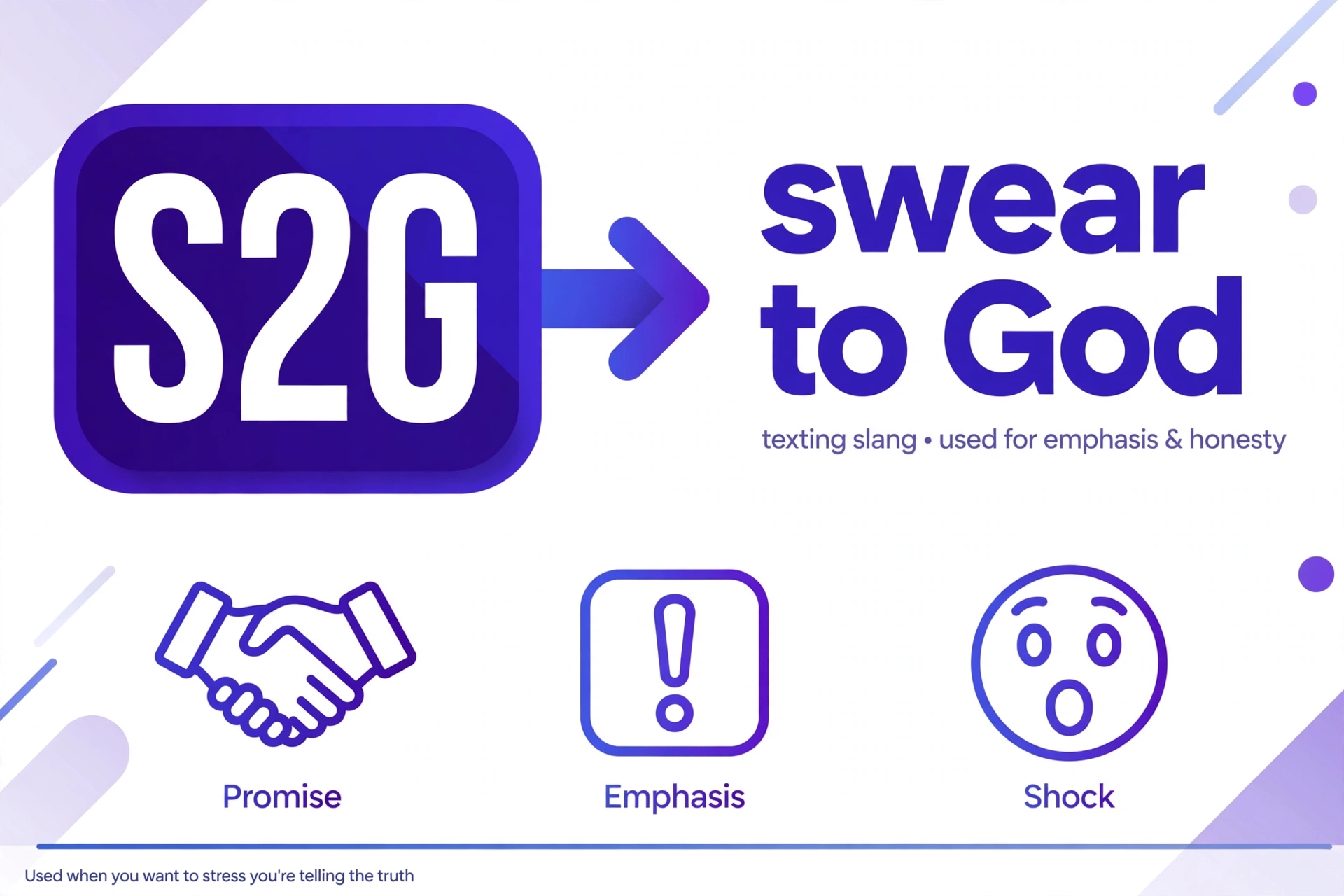
S2G stands for “swear to God.” It is internet shorthand for invoking a solemn oath — the digital version of raising your right hand and promising that you mean every word you just typed. When someone drops an S2G into a message, they are doing one of three things: making a promise, adding serious weight to a statement, or exploding with shock in the same way people use “OMG.”
| Detail | What it is |
|---|---|
| Term | S2G |
| Stands for | Swear to God |
| Type | Abbreviation / texting initialism (the “2” replaces “to”) |
| Tone | Informal, emotional, emphatic |
| Used by | Teens, young adults, gamers, social media users |
| Where you’ll see it | Text messages, Snapchat, TikTok captions, X (Twitter), Discord, gaming chat |
| In one line | “I promise this is true” / “I mean it with everything I’ve got” |
The core idea is simple: human beings have sworn oaths for thousands of years to prove sincerity, and S2G is just the 21st-century texting version of that instinct. The difference is speed — three characters do the work of an entire solemn vow.
It helps to think of S2G as having three distinct jobs:
- The Oath — a genuine promise. “S2G I’ll pay you back Friday.” The speaker is staking their credibility on the statement.
- The Emphasis — conviction behind an opinion. “That finale was the best episode ever, s2g.” Nothing is being promised; the claim is just being supercharged.
- The Exclamation — pure shock or disbelief, very close to “OMG.” “S2G?! He actually said that?” Here it functions as an emotional outburst, not a vow at all.
Which job it’s doing depends almost entirely on placement and punctuation — something we’ll break down with a full table later in this guide.
Introduction
Picture this: you’re mid-conversation with a friend, the messages are flying, and suddenly their reply is just three characters — “s2g.” Or maybe it’s louder: “I S2G I had nothing to do with it!” Do they sound angry? Are they joking? Are they making you a sacred promise or just being dramatic? If you’ve ever stared at those three letters and felt a tiny jolt of confusion, you’re not alone.
S2G is one of those slang terms that looks tiny but carries a surprising amount of emotional weight. Unlike neutral abbreviations, it borrows the gravity of a religious oath — which means it can sound deeply sincere in one chat and borderline aggressive in another. The same three letters can seal a promise between best friends or start an argument, all depending on context.
Modern texting is packed with these miniature emotion-bombs. You’ve probably already decoded internet favorites like IKTR (I know that’s right) and IDT (I don’t think so / I dreamt that) — S2G belongs to the same family of high-energy abbreviations, but it’s the one people reach for when feelings run hottest. By the end of this guide, you’ll know exactly what S2G signals, how to read its tone like a native, and how to use it without accidentally offending someone or sounding like you’re picking a fight.
Origin
The phrase behind the abbreviation is ancient. “Swear to God” — and its courtroom cousin “so help me God” — has been part of the English language for centuries, used in legal oaths, solemn promises, and everyday speech whenever someone needed their words to carry extra weight. Invoking God as a witness to your honesty is one of humanity’s oldest sincerity hacks.
The abbreviation itself was born in the early 2000s, during the golden age of SMS texting and instant messaging. Back then, text messages were capped at 160 characters, every keystroke cost effort on a numeric keypad, and teenagers were inventing a whole new compressed dialect in real time. “Swear to God” was simply too long for fast thumbs — so it got crushed down to S2G, following the same pattern as other number-swaps of the era (“talk 2 me,” “l8r,” “gr8”).
The earliest Urban Dictionary entries defining S2G appeared around 2006, which places it squarely in the AIM and MSN Messenger generation. From there it rode each new platform wave: it survived the migration to smartphones, thrived on Twitter where character limits rewarded brevity, and found a second life on TikTok and in gaming lobbies, where emotional outbursts are part of the culture. Nearly two decades later, it’s still going strong — a rare slang survivor in a world where most abbreviations flame out within a year or two.
Interestingly, the abbreviation also picked up a slightly darker reputation along the way. Because “swear to God” is such a strong claim, some people began using S2G to lend credibility to exaggerated or even false statements — the classic “s2g I saw a UFO last night” energy. That misuse is exactly why reading the context of an S2G matters more than the letters themselves.
Popularity
S2G never became a mainstream dictionary word, but inside digital culture it’s remarkably durable. Search interest for “s2g meaning” has stayed steady for years rather than spiking and dying like most viral slang — a sign that new generations keep discovering it organically in chats and comment sections.
Today you’ll encounter S2G most often in these places:
- TikTok & Instagram captions: “s2g this transition ate” or “S2G why is this so accurate” — used as hype and emphasis.
- Snapchat & iMessage: friend-to-friend promises and dramatic reactions.
- Gaming lobbies (Valorant, Fortnite, COD, Roblox): “s2g he was camping behind the box” — high-emotion, fast-paced callouts.
- X (Twitter) & Reddit: opinion posts where the writer wants their take to land harder.
- Discord servers: community chats full of inside jokes and exaggerated claims.
Why did S2G survive while hundreds of 2000s abbreviations died? Three reasons. First, it’s efficient — three characters replace an eleven-letter phrase. Second, it’s emotional — it does a job (oath-level emphasis) that no emoji quite replicates. And third, it’s flexible — the same letters work as a promise, an emphasis, or an exclamation, so it never gets boxed into one narrow use case.
Its core audience skews young — teens and twenty-somethings — but unlike hyper-niche Gen Alpha slang, S2G is widely understood across age groups online. Even millennials who grew up with AIM recognize it instantly.
How It Is Used
S2G is a chameleon — its meaning shifts with where it sits in a sentence and how it’s typed. Master this placement table and you’ll decode it correctly almost every time:
| Where it appears | What it usually means | Example |
|---|---|---|
| Start of a sentence | A promise or oath | “S2G I’ll be there at 8, no excuses.” |
| End of a sentence | Emphasis / strong conviction | “That plot twist broke me, s2g.” |
| Standing alone as a reply | Strong agreement (“I swear, you’re right”) | “s2g” |
| With ? or ?! after it | Shock / disbelief | “S2G?! There’s no way that’s real.” |
| ALL CAPS mid-argument | Anger / “don’t test me” energy | “I S2G don’t bring this up again.” |
| Lowercase, casual chat | Chill emphasis among friends | “that burrito was elite s2g” |
Beyond placement, formatting is tone:
- Lowercase “s2g” = relaxed, friendly, low-stakes. The default among close friends.
- Uppercase “S2G” = louder and more serious. Fine for hype, risky in disagreements.
- “S2G!” with an exclamation = excitement or outrage — check the surrounding words.
- “s2g…” with trailing dots = exhausted sincerity, like “I’m too tired to argue, just believe me.”
One more nuance: S2G is almost always reactive. People rarely open a conversation with it — it shows up as a response to doubt, surprise, or a bold claim that needs backing. If someone volunteers an S2G unprompted, they’re usually bracing for you not to believe them.
Examples
Nothing teaches slang like seeing it in the wild. Here are real-style conversations showing how S2G sounds across different moods.
Friendly Examples
1. The innocent promise
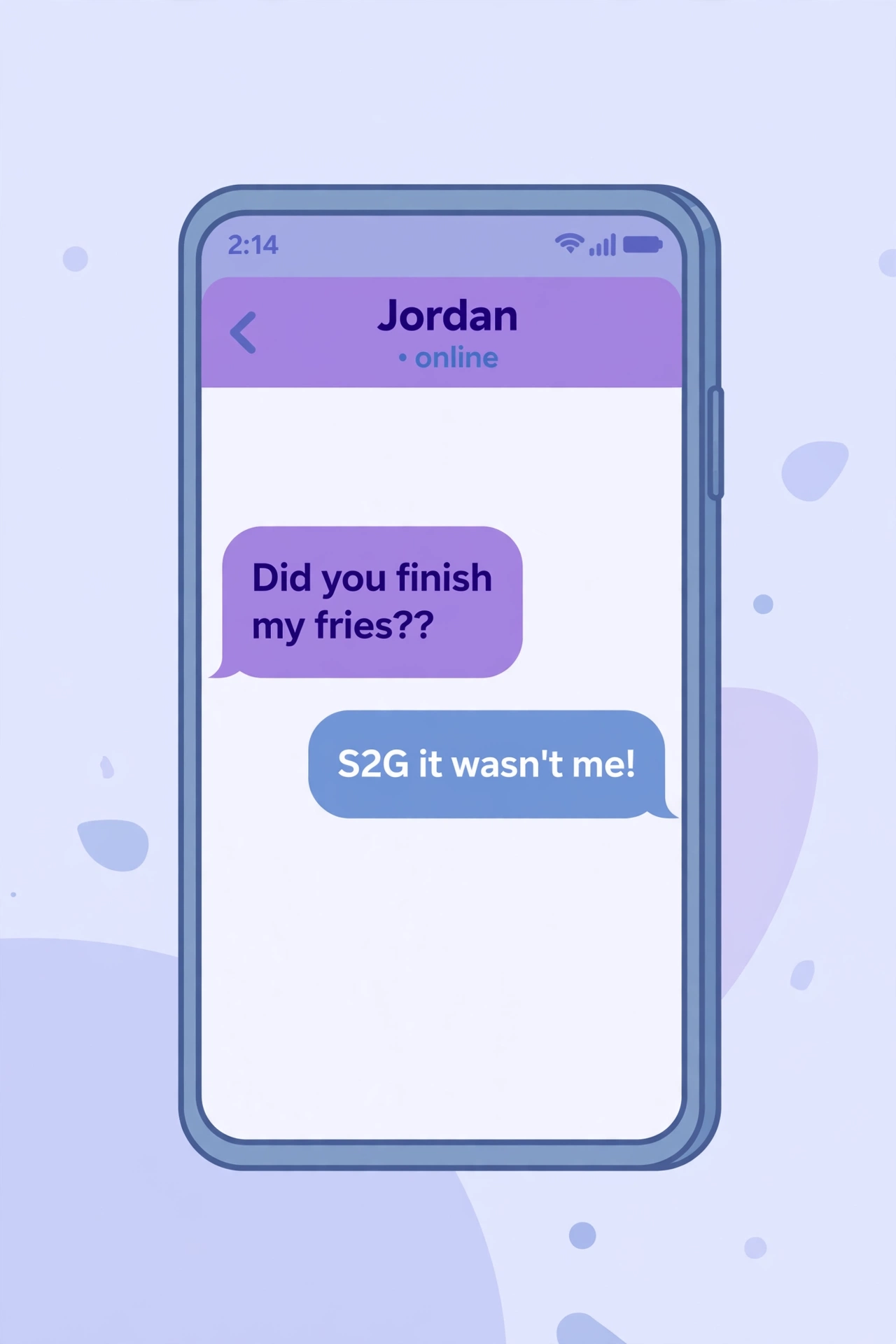
Maya: “Did you finish my fries?? 🍟”
Jordan: “S2G it wasn’t me, ask Luis, he was hovering over them the whole time.”
→ Jordan is making a playful oath of innocence. The S2G says “I’m putting my reputation on this.”
2. The hype agreement
Chris: “This new album is actually insane”
Sam: “s2g, I’ve had it on repeat since midnight”
→ No promise here — Sam is just supercharging his agreement. Lowercase keeps it chill.
3. The reassurance
Ava: “Are you sure the party is still on for Saturday?”
Noah: “S2G, I literally just talked to the host. We’re good.”
→ Noah is staking his credibility to calm Ava’s worry. This is S2G at its most sincere.
Professional Examples
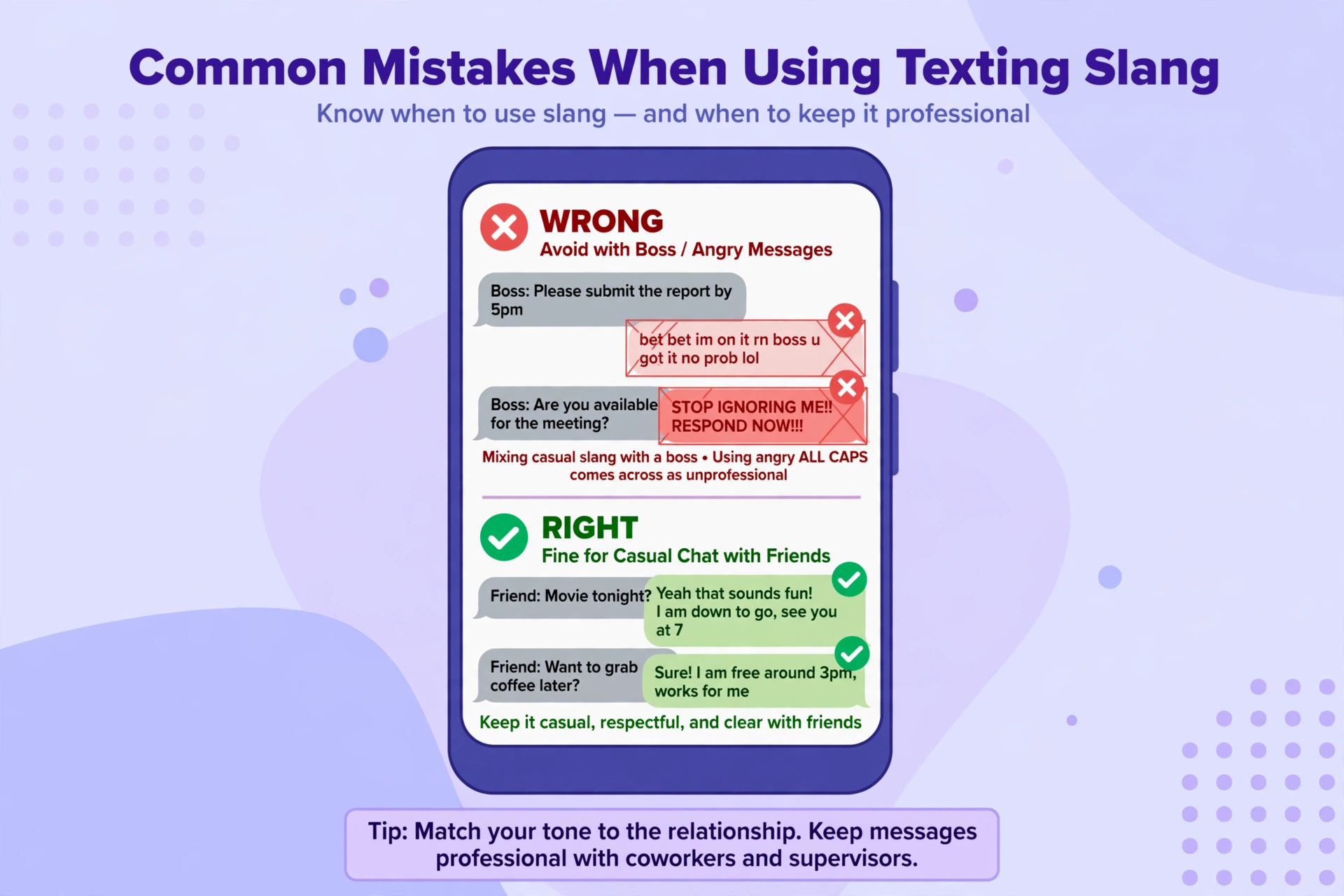
Let’s be honest: S2G has no real place in professional communication. You should never use it in emails, presentations, performance reviews, or messages to your manager — it reads as juvenile at best and disrespectful at worst. That said, it does occasionally surface in ultra-casual chats between close coworkers who are also friends. Treat these as the absolute outer limit:
1. The casual coworker chat (use with caution)
Priya: “Did the client actually approve the new deadline?”
Dev: “s2g, she said yes on the call this morning”
→ Only acceptable because Priya and Dev are peers and friends. With anyone senior, Dev should have written “Yes, she confirmed it on this morning’s call.”
2. The work group chat joke
Team chat: “Who ate the last donut?”
Marcus: “s2g it wasn’t me this time 😅”
→ Playful, low-stakes, and clearly a joke. Still, in a formal workplace culture, even this is a risk.
The rule is simple: if there’s any power dynamic, client relationship, or formal record involved, replace S2G with “I promise,” “I assure you,” or “I can confirm.” We’ll cover the full list of professional alternatives below.
Funny Examples
1. The dramatic overreaction
“S2G if my WiFi disconnects one more time during this ranked match I’m moving to the mountains”
→ Nobody is actually moving. The S2G is pure theater — and that’s the joke.
2. The meme caption
“s2g my bank account saw my cart and filed a restraining order 💀”
→ Classic TikTok-caption energy: S2G as hype punctuation for an exaggerated complaint.
3. The fake-solemn vow
Lena: “You said you’d start the diet Monday.”
Rob: “S2G this Monday is THE Monday. The prophecy is real.”
Lena: “You said that the last four Mondays.”
Rob: “And s2g I meant it all four times.”
→ Rob keeps swearing oaths he immediately breaks, which is exactly why his S2G carries zero weight — a perfect illustration of why overuse kills the term’s power.
Comparison with Similar Terms
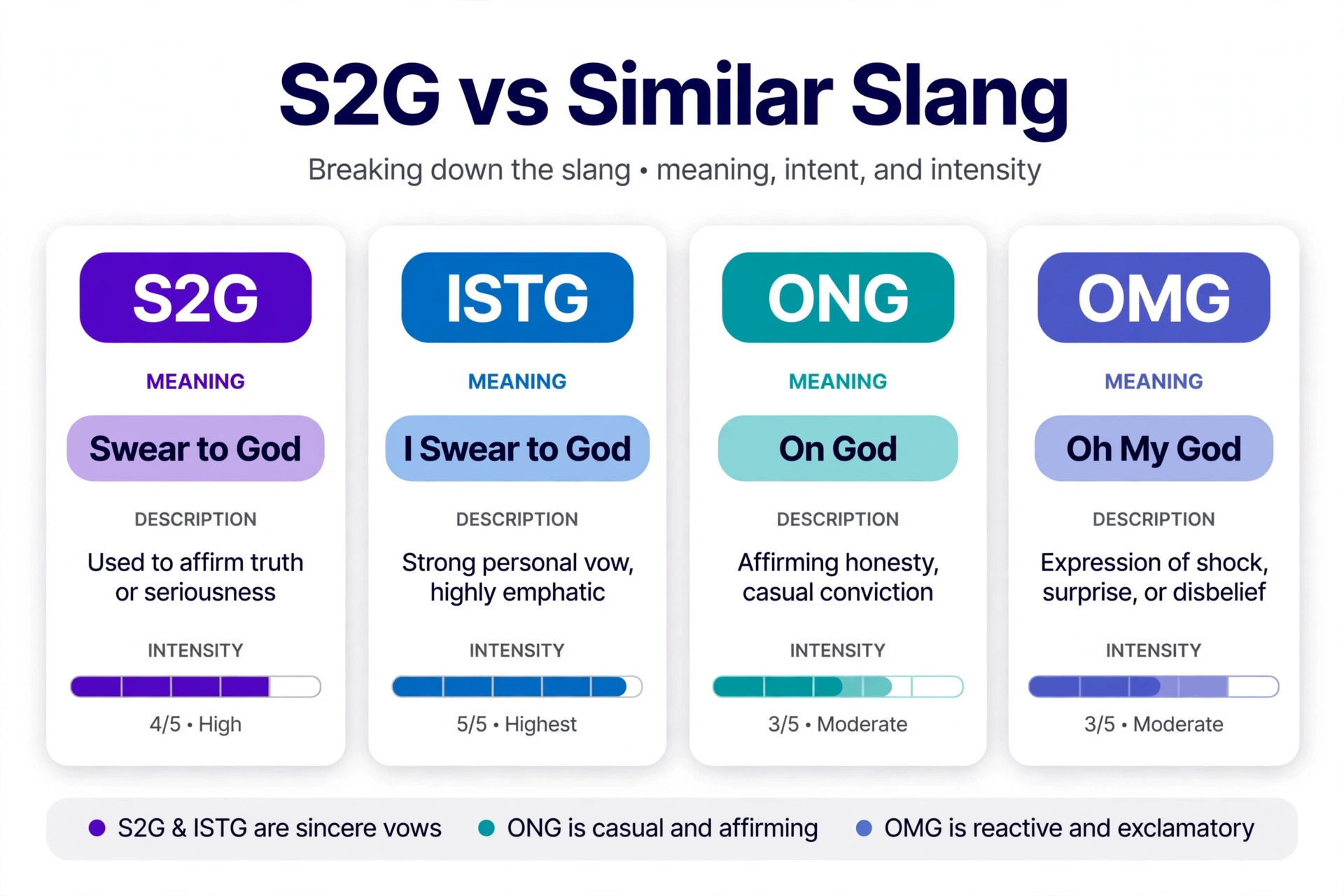
S2G lives in a crowded neighborhood of oath-and-emphasis slang. Here’s how it stacks up against its closest relatives:
| Term | Full form | Core meaning | Intensity (1–5) | Best used for |
|---|---|---|---|---|
| S2G | Swear to God | Oath / emphasis / shock | 4 | Promises, strong opinions, dramatic reactions |
| ISTG | I swear to God | Nearly identical, slightly more personal | 4 | Same as S2G; pick whichever you like |
| ONG | On God | Swearing on God; AAVE-origin | 4 | Emphasis and agreement, esp. in hip-hop-influenced slang |
| OMG | Oh my God | Surprise / excitement | 3 | Reactions, not promises — can’t replace S2G’s oath use |
| FR | For real | Sincere agreement | 2 | Casual agreement without the oath weight |
| NGL | Not gonna lie | Honest admission | 2 | Opinions and confessions, softer than S2G |
| I promise | — | Plain vow | 3 | Any context, including formal ones |
S2G vs ISTG is the comparison people ask about most, and the honest answer is: they’re functionally twins. ISTG (“I swear to God”) includes the “I,” making it a hair more personal, while S2G is a touch punchier to type. Nobody will misunderstand you either way — it’s pure stylistic preference, like choosing between “gonna” and “going to.”
S2G vs OMG matters more. OMG only expresses surprise — it can never make a promise. “OMG I’ll pay you back” sounds bizarre, while “S2G I’ll pay you back” sounds like a vow. If there’s an oath involved, S2G (or ISTG) is the right pick; if it’s pure reaction, OMG works.
S2G vs ONG: ONG (“on God”) comes from African American Vernacular English and carries cultural roots worth respecting — it’s not just a synonym to swap in randomly. In practice both signal strong conviction, but ONG leans slightly more toward emphatic agreement (“ong that’s facts”) while S2G leans toward oath-making.
Alternate Meanings
Here’s the refreshingly simple truth: S2G has no widely recognized alternate meaning. Unlike abbreviations such as “TM” (tomorrow, trademark, text me…) or “HY” (hell yes, hey you), S2G means “swear to God” essentially everywhere it appears. That consistency is part of why it’s so useful — there’s very little decoding ambiguity.
A few things people occasionally wonder about:
- Capitalization: “S2G,” “s2g,” and “S2g” all mean the same thing. Case changes the tone (loud vs. chill), never the definition.
- “S2” confusion: In gaming and TV fandoms, “S2” alone means “Season 2” — but the moment the G is attached, it’s “swear to God,” not “Season 2 G.” Context makes this obvious.
- Typos: On a phone keyboard, S2G is sometimes a mistype away from “S2H” or “A2G,” but these aren’t real slang terms — just fat-finger errors.
- Personal slang: Friend groups occasionally invent private meanings for common abbreviations, so if your circle uses S2G as an inside joke, that’s your group’s dialect — not the standard meaning.
Bottom line: if you see S2G in the wild, assume “swear to God” with near-total confidence. It’s one of the least ambiguous terms in all of texting slang.
Professional or Polite Alternatives
Because S2G invokes God and sounds inherently informal, there are plenty of situations where you need the same sincerity with better manners. Here’s your swap guide:
| Situation | Say this instead of S2G | Why it works |
|---|---|---|
| Work email / message to your boss | “I assure you” / “I can confirm” | Professional, no slang, no religious reference |
| Apologizing sincerely | “I promise” / “I give you my word” | Carries oath-weight without the slang |
| Around religious or sensitive people | “I mean it” / “On my honor” | Avoids invoking God casually |
| Formal writing / essays | “I solemnly swear” / “I attest” | Matches the register of formal prose |
| Casual but softer with friends | “No cap” / “Dead serious” / “For real” | Same energy, less intense |
| Texting your parents | “I promise, Mom/Dad” | Respectful and unambiguous |
The golden rule: match the weight of your words to the weight of the moment. S2G is a heavy word disguised as a light abbreviation — when the setting is serious, use serious language; when it’s casual, S2G is perfect.
Common Mistakes
S2G is easy to use and even easier to misuse. These are the six mistakes that trip people up most:
1. Using it with your boss, teacher, or clients.
Nothing torpedoes your credibility faster than typing “s2g” in a work chat. It’s slang built on a religious oath — in professional settings it reads as immature, and in some cultures as genuinely offensive. When stakes are real, use real words.
2. Swearing falsely — then getting caught.
The entire power of S2G comes from the implied oath. If you type “s2g I didn’t tell anyone” and the screenshots prove otherwise, you haven’t just lied — you’ve performed a fake oath, and people remember that far longer than an ordinary lie. Never attach S2G to something you aren’t sure about.
3. Overusing it until it means nothing.
If every third message contains an “s2g,” none of them carry weight. It’s the slang equivalent of crying wolf. Save it for moments that actually deserve emphasis and it’ll hit ten times harder when you do use it.
4. Ignoring religious sensitivity.
For many people, “swearing to God” casually — especially over trivial things like pizza toppings — feels disrespectful or even blasphemous. Read the room: with religious friends, family members, or anyone you don’t know well, default to “I promise” instead.
5. Typing it in ALL CAPS when you’re joking.
“S2G THAT’S SO FUNNY” doesn’t read as playful to most people — it reads as aggressive. Caps lock is the texting equivalent of shouting, and S2G already carries intensity. Keep jokes lowercase unless your friend group has an established all-caps humor style.
6. Replying “s2g” to genuinely serious news.
If someone shares something heavy — a breakup, a family emergency, bad health news — responding with a bare “s2g” can feel dismissive, like you’re treating their pain as gossip fodder. Serious moments deserve serious words: “I’m so sorry, are you okay?” will always beat slang.
Quick Tips
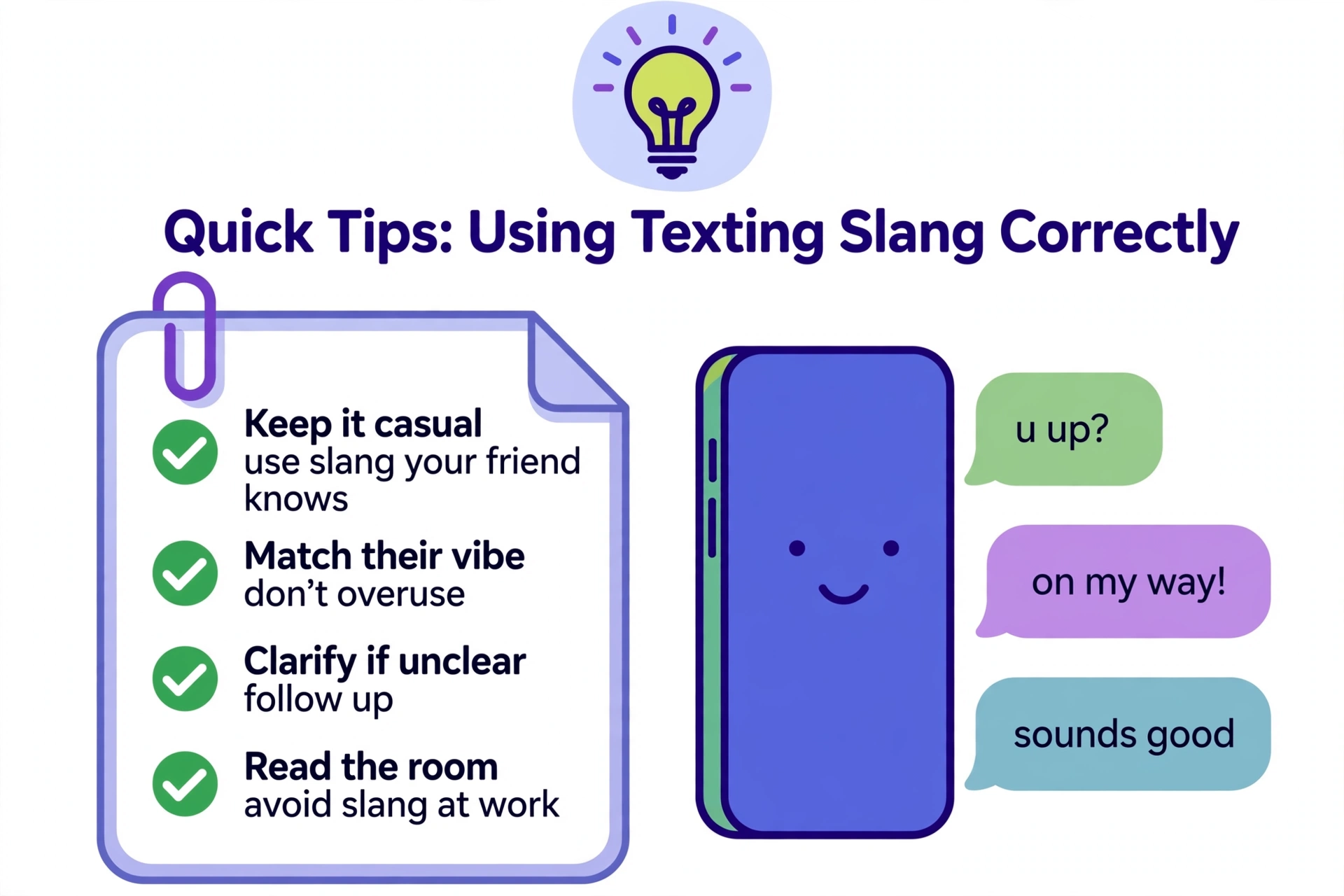
- Read the placement first. Start of sentence = promise, end of sentence = emphasis, alone = agreement, with ?! = shock. Position decodes meaning faster than anything else.
- Match the sender’s energy. If they sent a chill lowercase “s2g,” don’t reply with an aggressive all-caps “S2G!!” — mirroring tone keeps conversations smooth.
- When in doubt, ask. “S2g as in you promise, or s2g as in you’re shocked? 😄” takes five seconds and prevents real misunderstandings.
- Never use it at work or school. No exceptions for emails, assignments, or messages to authority figures. “I assure you” exists for a reason.
- Don’t stack it. “S2G ISTG ONG FR” in one message doesn’t make you more believable — it makes you sound like a parody. One oath per message is plenty.
- Pair it with specifics when promising. “S2G I’ll send the notes by 9pm” is ten times more convincing than a bare “s2g I’ll send them.” Details are what make oaths believable.
- Watch your audience. Around religious friends or family, swap to “I promise” — the respect costs you nothing.
- Good replies to “s2g”: “I believe you 👍” (accepting a promise), “s2g??” (playful shock back), “okay okay, no need to swear 😄” (defusing drama), or simply “fr” (matching the energy).

FAQ
1. What does S2G mean in texting?
S2G means “swear to God.” It’s used to make a promise, emphasize that you’re telling the truth, or react with strong surprise — similar to saying “I promise,” “I’m serious,” or “OMG” depending on context.
2. Is S2G rude or disrespectful toward God?
It can be, depending on who you’re talking to. Many religious people consider casually “swearing to God” — especially over trivial matters — disrespectful or blasphemous. Among secular friend groups it’s totally normal, but around religious friends, family, or strangers, it’s safer to say “I promise” instead.
3. What’s the difference between S2G and ISTG?
Almost nothing. ISTG stands for “I swear to God” — it’s the same phrase with the “I” included, making it a touch more personal. S2G is slightly punchier to type. They’re interchangeable in every real-world situation; it’s purely a style choice.
4. Can I use S2G at work or school?
No — not in any professional or academic context. S2G is informal slang built on a religious oath, so it reads as unprofessional in emails, meetings, assignments, and messages to bosses or teachers. Use “I assure you,” “I can confirm,” or “I promise” instead.
5. Why do people type “s2g” in lowercase?
Lowercase is the relaxed, friendly version. In texting culture, lowercase signals a chill tone while ALL CAPS signals shouting or intensity. A lowercase “s2g” usually means casual emphasis among friends; uppercase “S2G” means the person feels strongly — excited, angry, or dead serious.
6. What should I reply when someone says S2G to me?
Match the situation: if they’re making you a promise, try “I believe you 👍”; if they’re hyping something up, reply “s2g?? tell me more”; if they’re being dramatic, “okay okay, no need to swear 😄” defuses it playfully. A simple “fr” (for real) also works as easy agreement.
7. Is S2G the same as OMG?
Not quite. They overlap only in the “shock” use — “S2G?!” and “OMG?!” both express disbelief. But OMG can never make a promise (“OMG I’ll pay you back” sounds wrong), while S2G’s core job is oath-making. Think of OMG as pure reaction and S2G as reaction plus promise.
8. Is S2G still popular in 2026?
Yes. Unlike most slang that spikes and vanishes, S2G has shown steady, durable usage since the mid-2000s across texting, TikTok, gaming chats, and social media. Its flexibility — working as a promise, an emphasis, and an exclamation — keeps it relevant generation after generation.
Conclusion
Three letters, centuries of history, and a whole spectrum of emotion — that’s S2G in a nutshell. At its core, the s2g meaning in text is beautifully simple: “swear to God,” deployed as a promise, an emphasis, or an exclamation. The placement table (start = oath, end = emphasis, alone = agreement, with ?! = shock) will decode it correctly almost every time, and matching the sender’s tone — lowercase for chill, caps for intensity — will keep your own usage natural.
The two rules that matter most: only swear what you’d actually stand behind (a false S2G burns trust fast), and keep it out of professional settings where “I assure you” does the job better. Use it sparingly, mean it sincerely, and read the room on religious sensitivity — do that, and S2G becomes one of the most expressive tools in your texting arsenal.
Want to keep decoding the internet’s favorite abbreviations? Check out our guides to IMK meaning in text and WYA meaning in text next — and whenever you need a word’s formal definition, Merriam-Webster’s dictionary is the gold standard.

1 thought on “S2G Meaning in Text: What It Stands For, Real Examples & Tone Guide”