
Quick definition: Spanish slang words are informal, everyday expressions used by native speakers across Spain and Latin America that you will rarely find in a textbook. From güey in Mexico to tío in Spain, these words add color, humor, and real personality to everyday Spanish — and knowing them is the fastest way to sound like a native instead of a phrasebook.
Spanish Slang Words Meaning & Definition
Spanish slang words are the casual, unofficial vocabulary that native speakers use with friends, family, and on social media. Unlike formal Spanish, slang changes fast, varies wildly by country, and often carries a completely different meaning from the literal translation of its parts. A word like chido means “cool” in Mexico, while guay means the same thing in Spain — and neither one appears in a standard dictionary lesson.
Learning Spanish slang words is not just about sounding cool. It is about understanding real conversations. Movies, music, TikTok videos, and group chats are full of slang, and without it, even advanced learners miss jokes, tone, and sometimes the entire point of a sentence. Slang is where the culture lives: it shows how people greet each other, how they tease friends, how they express excitement, and how they complain when things go wrong.
This guide covers the most useful Spanish slang words from Mexico, Spain, Argentina, Colombia, and beyond — with clear meanings, real examples, and honest warnings about which words are friendly and which ones can get you in trouble. Whether you are texting a friend, traveling, or just trying to understand your favorite reggaeton lyrics, these are the terms that actually come up in real life.
Introduction
Imagine you have studied Spanish for two years. You know your verb conjugations, you can order food, and you can hold a polite conversation. Then a friend from Mexico texts you: “¡Qué onda, güey! ¿Vamos a echar desmadre o qué?” Suddenly, your textbook Spanish feels useless. That is the moment most learners discover slang — the living, breathing version of the language that no classroom fully teaches.
Spanish is spoken by more than 500 million people in over 20 countries, and every region has invented its own slang. Mexican slang is playful and full of creative insults-turned-terms-of-endearment. Spanish slang from Spain is fast, cheeky, and famous for words like vale and mola. Argentinian slang, called lunfardo, has its own rhythm and attitude. Colombian slang is warm and musical. The same word can be a compliment in one country and an insult in another, which is exactly why a good guide matters.
In this article, you will learn more than 50 Spanish slang words organized by how people actually use them: greetings, reactions, compliments, insults, and everyday filler words. You will see real example sentences, learn which words are safe for any situation, and find out which ones to avoid in formal settings. By the end, you will understand the slang you hear in songs, shows, and chats — and you will know how to use it without sounding forced.
Origin
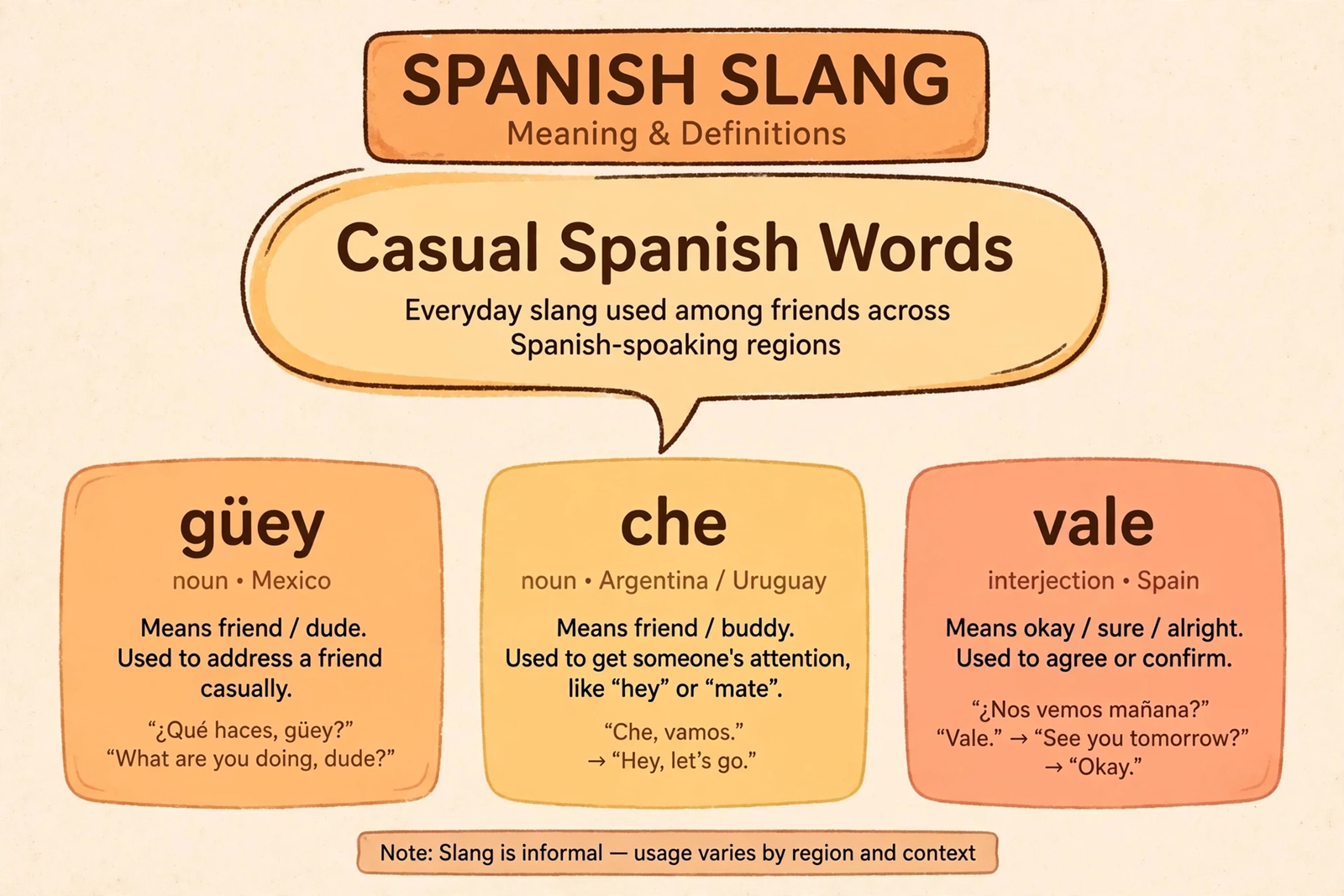
Spanish slang did not appear overnight. It grew out of centuries of regional history, migration, music, and street culture. Many slang words started as ordinary words that slowly changed meaning. The word güey, for example, comes from buey (ox). Over time, Mexican speakers softened the pronunciation, and the word shifted from an animal to a way of addressing a friend — similar to “dude” in English. Today, it is one of the most recognized Mexican slang words in the world.
Other slang comes from specific subcultures. Lunfardo, the slang of Buenos Aires, was born in the late 1800s in the city’s working-class neighborhoods and prisons. Words like che (hey) and boludo (dude, or idiot, depending on tone) spread through tango lyrics and eventually became part of everyday Argentine Spanish. In Spain, much modern slang grew from youth culture, television, and Madrid street life in the decades after the 1970s.
Today, the internet is the biggest engine of new Spanish slang. TikTok, WhatsApp, and reggaeton lyrics spread words across borders in days. A term that starts in Puerto Rico can be trending in Mexico City by the weekend. Social media has also mixed English into Spanish slang — words like crush, random, and spoiler now appear in everyday Spanish conversations, often with Spanish pronunciation and grammar wrapped around them.
Popularity
Spanish slang words are more popular than ever, and the numbers explain why. Spanish is the second most spoken native language in the world, and Spanish-language content dominates global music charts. When Bad Bunny, Karol G, or Peso Pluma release a song, millions of listeners around the world hear slang words like perreo, chimba, or plebe — and then search for what they mean.
Streaming platforms have made slang unavoidable. Shows like La Casa de Papel (Money Heist) introduced Spanish slang from Spain to global audiences, while Mexican and Colombian series on Netflix did the same for Latin American terms. Language-learning apps have noticed the trend too: many now include slang modules because learners keep asking for them. Google searches for phrases like “Spanish slang words” and “Mexican slang” have grown steadily as more people travel, date, work, or make friends across the Spanish-speaking world.
Slang is also popular because it signals belonging. Using the right slang word at the right moment tells native speakers that you understand their culture, not just their grammar. It turns a stiff conversation into a real one. That is why slang is often the first thing people ask about when they start learning Spanish seriously — and the last thing they fully master.
How It Is Used
Spanish slang words work like seasoning: a little goes a long way, and the right amount depends on the situation. With close friends, slang is constant — greetings, jokes, reactions, and insults all come in slang form. With strangers, coworkers, or older relatives, most native speakers switch back to neutral Spanish. The golden rule is simple: match the energy of the people around you.
Slang also changes meaning with tone. The Argentine word boludo can be a warm “dude” between friends or a sharp insult when said angrily. The Mexican word cabrón can mean “awesome” in one sentence and something far ruder in another. Context and tone do the heavy lifting, which is why listening matters more than memorizing lists.
Most slang words fall into a few practical groups. Greetings and address words (qué onda, che, tío) open conversations. Reaction words (órale, ¡qué padre!, joder) express surprise or excitement. Descriptive words (chido, guay, bacano) say something is cool. And filler words (vale, pues, o sea) keep conversations flowing naturally. The examples below cover all of these groups so you can use slang in real sentences, not just recite a list.
Examples
The best way to learn Spanish slang words is to see them in real sentences. The examples below show how native speakers actually use these terms — in friendly chats, at work, and in jokes. Notice how the same word can feel warm, funny, or rude depending on who says it and how.
Friendly Examples
- ¡Qué onda, güey! — “What’s up, dude!” (Mexico, greeting a close friend)
- Eres mi pata. — “You’re my buddy.” (Peru, warm and loyal)
- ¡Qué chévere! — “How cool!” (Colombia, Venezuela, and the Caribbean)
- Vamos a rumbear esta noche. — “Let’s go party tonight.” (Colombia, Venezuela)
- ¡Qué bacano! — “That’s awesome!” (Colombia)
- Me cae bien, es buena onda. — “I like him, he’s a good vibe.” (Mexico, describing a nice person)
Professional Examples
Slang has a place even in lighter professional settings, as long as you keep it mild. Words like vale (okay, in Spain) and che (hey, in Argentina) are soft enough for casual workplace talk. Here are examples that work without crossing a line:
- Vale, lo reviso esta tarde. — “Okay, I’ll check it this afternoon.” (Spain, office-friendly)
- Che, ¿me pasás el informe? — “Hey, can you send me the report?” (Argentina, casual office)
- ¡Qué padre quedó el proyecto! — “The project turned out great!” (Mexico, friendly praise)
- Estamos en las mismas. — “We’re in the same boat.” (General, empathetic and safe)
Funny Examples
- ¡No manches! — “No way!” (Mexico, playful disbelief — literally “don’t stain”)
- Estoy muerto de risa. — “I’m dying of laughter.” (General, after a great joke)
- ¡Qué oso! — “How embarrassing!” (Mexico, literally “what a bear”)
- Me da flojera. — “I’m too lazy / I can’t be bothered.” (Mexico, said with a dramatic sigh)
- ¡Estás en la luna! — “You’re totally spaced out!” (General, teasing a distracted friend)

Comparison with Similar Terms
One of the trickiest parts of Spanish slang is that different countries often have a different word for the exact same idea. “Cool” alone has at least six common versions. The table below compares the most common equivalents so you can pick the right word for the right country — and understand all of them when you hear them.
| Meaning | Mexico | Spain | Argentina | Colombia |
|---|---|---|---|---|
| Cool / awesome | Chido | Guay / Mola | Copado | Bacano / Chévere |
| Dude / mate | Güey | Tío / Tía | Che / Boludo | Parcero / Parce |
| What’s up? | ¿Qué onda? | ¿Qué pasa? | ¿Qué hacés? | ¿Qué más? |
| Okay / alright | Órale / Sale | Vale | Dale | Listo |
| Money | Lana / Varo | Pasta | Guita / Plata | Plata / Billete |
| Party / hang out | Echar desmadre | Ir de fiesta | Salir de joda | Rumbear |
| Friend | Cuate | Colega | Amigo / Pibe | Parcero |
| Embarrassing | ¡Qué oso! | ¡Qué vergüenza! | ¡Qué papelón! | ¡Qué pena! |
The takeaway is simple: learn the version from the country you talk to most, but recognize the others. If you travel from Mexico City to Madrid, switching from chido to guay and from güey to tío will instantly make you sound more local. And if you mix them up, nobody will mind — native speakers find it charming when learners try.

Alternate Meanings
Many Spanish slang words have more than one meaning, and some of them are wildly different from each other. Context is everything. Here are the most important ones to know before you use them:
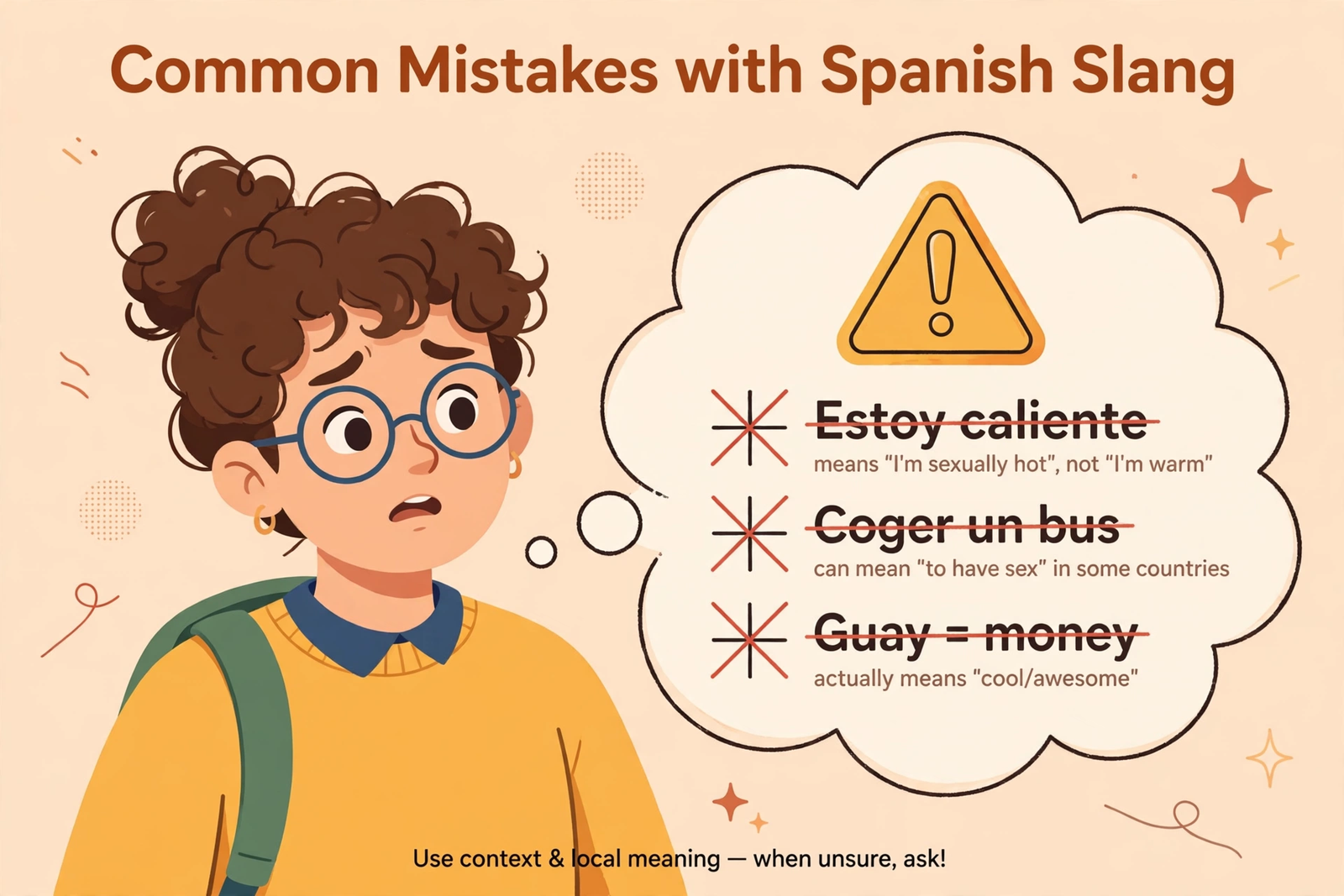
- Coger — In Spain, it means “to take” or “to grab” (coger el autobús = to catch the bus). In most of Latin America, it is a vulgar word for sex. This is the single most famous false friend in Spanish slang, and mixing it up can cause very awkward moments.
- Chingar — In Mexico, it can mean to mess up, to bother, or to have sex, depending on context. ¡No me chingues! means “Don’t mess with me!” while chingón means “awesome.” Use with care — it is strong language.
- Pendejo — In Mexico, it means “idiot” or “dumbass.” In Argentina and Uruguay, pendejo means a young kid or teenager, with no insult at all. Same word, opposite energy.
- Torta — A sandwich in Mexico, but slang for a slap in Spain (dar una torta), and a lesbian slur in some countries. Food words are surprisingly risky in slang.
- Curse words as praise — Words like cabrón, joder, and hostia can be insults, expressions of surprise, or even compliments depending on tone. Beginners should understand them before using them.
The lesson here is not to memorize every alternate meaning, but to slow down when a word sounds familiar. If a slang word seems out of place, it probably means something different in that country. When in doubt, ask a native speaker — they love explaining these differences, and it is a great conversation starter.
Professional or Polite Alternatives
Slang is fun, but it does not belong everywhere. In a job interview, a business email, or a conversation with someone much older, neutral Spanish is always the safe choice. Here are polite swaps for the most common slang words:
| Slang Word | Meaning | Polite Alternative |
|---|---|---|
| ¿Qué onda? | What’s up? | ¿Cómo estás? / ¿Qué tal? |
| Güey | Dude | Amigo / Compañero |
| ¡No manches! | No way! | ¡No me digas! / ¡Increíble! |
| Chido / Guay | Cool | Excelente / Genial / Muy bueno |
| Me da flojera | I’m lazy | No tengo ganas / Estoy cansado |
| ¡Qué padre! | How cool! | ¡Qué maravilloso! |
| Vale | Okay | De acuerdo / Perfecto |
| Estoy cansado de esto | I’m fed up | Estoy un poco harto de esto |
A good rule of thumb: if you would not say it to your boss or your grandmother, save it for friends. Neutral Spanish is never wrong, and switching between slang and formal Spanish is itself an impressive skill — it shows you understand register, which is something even many native speakers struggle to explain.
Common Mistakes
Learners make the same few mistakes with Spanish slang over and over. Avoid these and you will sound natural much faster:
- Using slang with everyone. Calling your teacher güey or your boss boludo is a fast way to look rude. Slang is for peers and friends, not authority figures.
- Mixing countries randomly. Saying qué onda, tío, che in one sentence mixes Mexican, Spanish, and Argentine slang. Pick one region per conversation and stay consistent.
- Overusing one word. Saying güey in every sentence sounds like a caricature. Native speakers use slang naturally — a few times per conversation, not every other word.
- Using strong words too early. Words like cabrón, chingar, and joder are powerful. Until you fully understand their weight, listen more than you speak.
- Translating word for word. ¡Qué oso! is not about bears, and no manches is not about stains. Slang almost never translates literally — learn the meaning, not the dictionary definition.
- Forgetting tone. The same word can be a joke or an insult. Boludo said with a smile is friendly; said with anger, it starts a fight. Watch faces, not just words.
Quick Tips
Want to actually remember and use Spanish slang words? These tips come from how native speakers and successful learners do it:
- Learn 5 words at a time. Master a small set — one greeting, one reaction, one compliment, one filler word, one joke — before adding more. Depth beats volume.
- Watch shows with subtitles. Spanish-language series and YouTube videos are the best slang teachers. Pause, repeat, and write down words you hear twice.
- Listen to reggaeton and Latin pop. Lyrics repeat slang constantly, and music makes words stick. Look up the lyrics after listening.
- Practice with native friends. Ask a friend to correct you. Most native speakers are happy to explain slang — and they will tell you instantly if a word sounds wrong.
- Keep a slang notebook. Write the word, the country, the meaning, and one example sentence. Review it weekly and try one new word per day.
- Learn the country first. Focus on the slang of one country — the one you visit, or where your friends are from. Add other regions later.
- Use slang sparingly at first. One well-placed ¡qué chévere! sounds more natural than ten forced slang words in a row. Confidence grows with practice.


FAQ
What are the most common Spanish slang words?
The most common Spanish slang words include güey (dude, Mexico), che (hey, Argentina), vale (okay, Spain), chido (cool, Mexico), guay (cool, Spain), qué onda (what’s up, Mexico), and órale (wow/come on, Mexico). These words appear in everyday conversation, music, and social media across the Spanish-speaking world.
What does güey mean in Spanish slang?
Güey means “dude” or “mate” in Mexican slang. It comes from the word buey (ox) and is used to address friends, get attention, or add emphasis. It is informal and friendly between peers, but it should not be used with teachers, bosses, or strangers in formal settings.
Is it rude to use Spanish slang?
Most Spanish slang is not rude — it is simply informal. Words like chido, vale, and qué onda are friendly and safe with peers. However, some slang words are strong or vulgar, such as cabrón or chingar, and those can be rude depending on context. The key is knowing your audience and the situation.
How do you say “cool” in Spanish slang?
“Cool” in Spanish slang depends on the country: chido in Mexico, guay or mola in Spain, copado in Argentina, bacano or chévere in Colombia, and piola in Chile. The neutral word genial works everywhere and is always a safe choice.
What is the difference between Mexican slang and Spain slang?
Mexican slang and Spain slang use different words for the same ideas and have different tones. Mexico uses güey, chido, órale, and qué onda, while Spain uses tío, guay, vale, and mola. Spain slang is often faster and more direct, while Mexican slang is playful and full of creative expressions. Both are correct — they are simply regional.
Can I learn Spanish slang from TikTok and music?
Yes, TikTok, YouTube, and reggaeton lyrics are excellent sources for Spanish slang because they show how native speakers actually use words in real life. However, always double-check meanings with a reliable source, since slang on social media can be exaggerated, regional, or used ironically. A good dictionary like SpanishDict helps confirm what you hear.
What does “qué onda” mean?
Qué onda means “what’s up?” or “what’s going on?” in Mexican slang. It is a casual greeting used between friends, similar to “hey, what’s happening?” You can answer it with nada, ¿y tú? (nothing, and you?) or todo bien (all good).
How many Spanish slang words should I learn first?
Start with 10 to 15 Spanish slang words from one country — a few greetings, reactions, and everyday expressions. Mastering a small set and using them naturally is far better than memorizing 100 words you never say. Once those feel comfortable, add words from other regions one country at a time.
Conclusion
Spanish slang words are the difference between speaking Spanish and sounding Spanish. They carry humor, warmth, and culture in a way that textbook vocabulary never can. From the Mexican güey to the Spanish vale to the Argentine che, each word opens a small window into how real people talk, joke, and connect.
The best approach is simple: pick one country, learn a handful of words deeply, and use them with real people. Watch shows, listen to music, and do not be afraid to make mistakes — native speakers appreciate the effort far more than they judge the errors. If you want to keep building your slang vocabulary, it also helps to understand how other online abbreviations work, like the FN meaning in text or the TYSM meaning — internet slang and Spanish slang share the same playful spirit. You can also check the HBU meaning in chat and the CFS meaning in text to see how short forms carry big meanings online, just like slang does in spoken Spanish.
Start with five words today. Use one in a real conversation this week. That is how slang becomes yours — not from a list, but from living the language one word at a time.

5 thoughts on “Spanish Slang Words: 50+ Terms You Need to Know in 2026”