Quick definition: Slang for penis refers to the huge collection of informal, humorous, and sometimes vulgar words and phrases people use instead of the clinical word “penis” — from everyday terms like dick and cock to playful euphemisms like willy, schlong, and trouser snake. These slang terms vary wildly in tone, from affectionate jokes between friends to crude insults, and knowing which one fits which situation is the whole point of this guide.
Slang for Penis Meaning & Definition
When someone searches for “slang for penis,” they usually want one of two things: a list of the words people actually use, or an explanation of what a specific term means in context. So let’s answer both, starting with the basics.
In plain English, slang for penis is any informal or non-clinical word used to refer to the male reproductive organ. The clinical word “penis” comes from Latin, where it originally meant “tail,” and it entered English in the late 1600s. But in everyday speech, almost nobody says “penis” outside a doctor’s office or a biology classroom. Instead, English speakers reach for slang — and they have been doing so for centuries.
Why does this one body part have so many nicknames? Linguists have a simple answer: taboo creates vocabulary. Words for things we feel awkward talking about directly tend to multiply. The penis is one of the most euphemized words in the entire English language — slang lexicographer Jonathan Green documented hundreds of terms across three volumes of his Dictionary of Slang, and researchers at the University of Pennsylvania’s Language Log once collected 40 euphemisms in a single blog post and were flooded with hundreds more from readers.
The terms fall into a few recognizable families:
- Animal metaphors: cock (rooster), snake, weasel, worm, anaconda, trouser snake
- Weapon and tool metaphors: rod, sword, pistol, hammer, joystick, love gun
- Food metaphors: sausage, banana, frankfurter, cucumber, tube steak
- Men’s names: Dick, Peter, Johnson, Willie, Percy, John Thomas
- Playful diminutives: willy, winkie, ding-dong, pee-wee, winky
- Clinical-sounding euphemisms: member, manhood, organ, private parts
Each family tells you something about how the speaker feels — boastful, joking, embarrassed, or crude. That emotional register matters more than the dictionary definition, because the same word can be a joke among friends and an insult in an argument.
Introduction
Let’s be honest: almost everyone has paused mid-sentence, searching for a less awkward way to say “penis.” Maybe you were joking with friends, writing a funny text, reading a novel, or trying to explain something to a teenager without sounding like a textbook. That pause is exactly why slang for penis exists — and why there is so much of it.
English has more slang words for this one body part than for almost any other topic. Some are centuries old, like cock and prick. Some were born in pop culture, like Lady Gaga’s “disco stick” or Sir Mix-a-Lot’s “anaconda.” Some are regional — todger and bellend belong mostly to British English, while schlong crossed over from Yiddish into American slang. And some live almost entirely online, in memes, group chats, and texting slang.
This guide is written as a language resource, not a joke list. You will find the most common terms organized by tone and register, the history behind the biggest ones, real usage examples for friendly, professional, and funny contexts, and — just as importantly — the polite alternatives to use when slang would be the wrong choice. Whether you are a writer looking for the right word, a language learner trying to understand American or British humor, or just curious about why English has forty words for the same thing, this article covers it.
If you enjoy decoding modern slang, you may also like our guide to the BBC meaning in slang, which explains another term that sits at the intersection of anatomy slang and internet culture.
Origin
The history of slang for penis is really a history of English itself — and it starts much earlier than most people expect.
The earliest terms: swords, tails, and roosters
The oldest pattern in penis slang is the weapon metaphor. As early as the 11th century, the sword became a stand-in for male anatomy — a symbol of power, strength, and protection. From that one image came a whole family: lance, dagger, pike, ramrod, bazooka, gun, and pistol. The logic was simple and boastful, and it never really went away.
The word “penis” itself is a euphemism. It is Latin for “tail,” and it entered English around 1676. Before that, people said “yard” (from the Old English word for a measuring rod or stick), “prick” (from the idea of a sharp point), and “cock.” The word cock is one of the most interesting cases in all of slang: it originally meant a rooster, and scholars believe it transferred to anatomy because of the rooster’s red, fleshy wattles, which swell and change color — much like the organ itself. By the late 18th century, “cock” had become so strongly associated with anatomy that polite speakers invented the word “rooster” just to talk about the bird without blushing.
Men’s names become slang
Starting around 1800, English developed a strange habit: naming the penis after men. “Roger” came first, followed by “Thomas” in 1811, then “Dick,” “Peter,” and “Willie.” “Dick” eventually became so dominant that it is now probably the single most common slang term in American English — and, as a side effect, it also became an insult for an unpleasant person. “Johnson” followed the same path in the 20th century, and “Percy” and “John Thomas” remain favorites in British humor.
Yiddish, the military, and pop culture
Schlong arrived from Yiddish (from the German word Schlange, meaning snake) and spread through American comedy in the mid-20th century. Dong was popularized around 1900, possibly after Edward Lear’s poem “The Dong with a Luminous Nose.” And in the modern era, pop culture keeps minting new terms: “disco stick” from Lady Gaga’s 2008 song “LoveGame,” “anaconda” from Sir Mix-a-Lot’s 1992 hit “Baby Got Back,” and “BBC” from internet culture — a term whose full meaning we break down in our BBC meaning in slang guide.
For an authoritative take on how dictionaries record these shifts, Merriam-Webster’s definition of penis traces the word’s Latin roots and its long history in English.
Popularity
So which slang terms for penis do people actually use in 2026 — and which ones have faded into history books?
The short answer: a small handful of terms does most of the work. In everyday American conversation, dick and cock dominate by a wide margin. They appear in movies, stand-up comedy, song lyrics, Reddit threads, and group chats constantly. Prick is close behind, though it doubles as an insult, which changes how people use it. Johnson, schlong, and wang are common in comedy and casual talk, while willy and todger rule in British English.
Search data and social media tell the same story. Terms like “slang for penis,” “dick meaning,” and “cock meaning” get steady search volume year after year, with spikes whenever a viral meme, a celebrity joke, or a hit song puts a term back in the spotlight. TikTok and X (formerly Twitter) have become major engines for this: a single viral clip can revive a half-forgotten word like schmeat or hog overnight, and texting slang keeps short forms like “D” alive among younger users who want a discreet abbreviation.
Meanwhile, the older, more elaborate euphemisms — “bald-pate friar,” “gospel-pipe,” “matrimonial peacemaker” — have almost entirely died out. They survive only in slang dictionaries and history articles. The pattern is clear: the terms that last are short, vivid, and easy to say. One or two syllables beats a clever phrase every time.
| Term | Popularity (US, 2026) | Main context |
|---|---|---|
| Dick | Very high | Everyday casual speech, comedy, insults |
| Cock | Very high | Casual speech, music, adult content |
| Prick | High | Insults, casual speech, British and US |
| Johnson | Medium-high | Jokes, lighthearted talk, US |
| Schlong | Medium-high | Comedy, casual speech, US |
| Willy | High (UK) | Children’s speech, British humor |
| Wang | Medium | Jokes, casual speech, US |
| Member | Medium | Polite euphemism, older writing |
| Trouser snake | Medium | Comedy, jokes, memes |
| Dong | Medium | Casual speech, older US slang |
How It Is Used
Slang for penis shows up in more places than most people realize — and the meaning shifts with the setting. Here is where you will actually encounter these terms:
- Casual conversation: Friends joking around use dick, schlong, or wang the way they would use any other slang. Tone is everything — the same word can be affectionate, teasing, or aggressive depending on delivery.
- Comedy and entertainment: Stand-up comedians, sitcoms, and song lyrics rely heavily on penis slang because it gets an instant reaction. Think of how many punchlines depend on the audience knowing exactly what Johnson or anaconda means.
- Texting and social media: Short forms thrive here. “D” is a discreet texting abbreviation, while memes recycle terms like trouser snake and one-eyed monster for comedic effect. Like much of modern tea meaning in slang and gossip culture, these terms spread fastest in group chats and comment sections.
- Insults: Several penis slang terms double as insults for people — dick, prick, bellend, and knob are all used to call someone rude, stupid, or unpleasant. In these cases the anatomical meaning is secondary; the insult is the point.
- Writing and fiction: Novelists and screenwriters choose terms to signal character and era. A Victorian character says “member”; a modern American teenager says “dick”; a British comedy character says “todger.” The word choice does characterization work.
- Medical and educational contexts: This is where slang does not belong. Doctors, teachers, and health educators use “penis” because clarity matters more than color. Using slang in a medical conversation can confuse the issue or make a patient uncomfortable.
One more important note: many of these terms also appear in compound slang. For example, BBBJ and other adult abbreviations build on the same vocabulary — if you come across one in a chat, our BBBJ meaning in slang guide explains it in the same plain, dictionary style.
Examples
Seeing terms in real sentences is the fastest way to learn them. Here are examples grouped by context — notice how the same word can feel friendly, formal, or funny depending on the sentence around it.
Friendly Examples
- “He pulled his pants down and his little willy was just hanging out — the kids thought it was hilarious.”
- “My buddy kept joking that his Johnson has its own zip code.”
- “Don’t be such a dick about it — just tell me what happened.” (Here “dick” means a rude person, not anatomy.)
- “He nicknamed it ‘the trouser snake’ and honestly, the name stuck for years.”
- “The baby’s diaper leaked and Dad just laughed and said, ‘Well, at least his wee-wee is working fine.'”
Professional Examples
- “The patient reported pain in the penile area following the procedure.” (Clinical language — slang would be inappropriate here.)
- “The urologist explained the anatomy using a diagram of the male reproductive organ.”
- “In the novel, the author uses the euphemism ‘member’ to keep the scene appropriate for a general audience.”
- “The slang dictionary entry lists ‘schlong’ as an informal American term of Yiddish origin.”
- “HR reminded staff that anatomical slang is not appropriate language in workplace conversations.”
Funny Examples
- “He calls it his ‘anaconda’ — and honestly, the confidence is the funniest part.”
- “My grandpa still calls it a ‘tallywhacker’ and nobody in the family can say it with a straight face.”
- “The meme said his ‘disco stick’ had two left feet. The group chat lost it.”
- “He introduced his ‘one-eyed monster’ to the conversation and immediately regretted it.”
- “She said his ‘pocket rocket’ was more of a bottle rocket. Savage, but fair.”

Comparison with Similar Terms
Not all slang for penis is interchangeable. The terms differ in vulgarity, region, age group, and whether they can also be used as insults. Picking the wrong one is the most common mistake people make — so here is a side-by-side comparison of the heavyweights.
| Term | Vulgarity level | Region | Also an insult? | Best used when… |
|---|---|---|---|---|
| Dick | High | US / worldwide | Yes — very common | Casual talk with friends; never at work |
| Cock | Very high | US / worldwide | Rarely | Adult contexts, comedy, music lyrics |
| Prick | High | US / UK | Yes — very common | Mostly as an insult; rarely anatomical |
| Johnson | Medium | US | No | Lighthearted jokes, safe-ish humor |
| Schlong | Medium-high | US | No | Comedy and casual conversation |
| Willy | Low | UK | No | Talking with children; British humor |
| Member | Low | Worldwide | No | Polite writing, older literature |
| Wang | Medium | US | No | Jokes between friends |
| Bellend | High | UK | Yes — very common | British insults; avoid in the US |
| Todger | Low-medium | UK | No | British comedy, informal chat |
A few patterns jump out from this table. First, the most popular terms — dick and cock — are also the most vulgar, which is why they dominate comedy but are banned from polite settings. Second, the terms that double as insults (dick, prick, bellend) are the riskiest to use, because listeners may hear the insult even when you meant the anatomy. Third, British and American slang only partly overlap: willy sounds childish in the US but is the default in the UK, while bellend means almost nothing to most Americans.
The same register problem shows up across slang generally — a word that is playful in one community can be crude or confusing in another. That is why guides like our pegging slang explainer spend as much time on context and tone as on the definition itself.
Alternate Meanings
Many slang terms for penis have second (or third) lives as completely different words. Context is the only way to tell them apart, and misunderstanding them is a classic source of embarrassment — especially for English learners.
- Dick: Besides anatomy, “dick” is one of the most common insults in American English (“Don’t be a dick”), and it is also a short form of the name Richard. A detective in old movies might be called a “private dick” — meaning a private investigator, not anatomy.
- Cock: Still means a male chicken (rooster) in farming and everyday British speech, and it appears in words like “cocktail,” “cockpit,” “peacock,” and “cocky” — none of which are anatomical.
- Prick: As a verb, it means to pierce something slightly (“prick your finger”), and as an insult it means an unpleasant person. The anatomical meaning is only one of several.
- Johnson: A very common surname — millions of people are named Johnson, and the name appears in “Johnson & Johnson,” the healthcare company. Only context reveals whether someone means the person or the slang.
- Peter: A common first name first, a slang term second. “Peter” as anatomy slang is mostly found in older British writing.
- Tool: In slang, “tool” can mean a foolish person as well as anatomy — and of course it is an ordinary word for a hammer or wrench.
- Rod: A fishing rod, a curtain rod, or a metal bar — the anatomical meaning depends entirely on context and usually a joke.
- Member: A member of a club, a team, or a parliament is the far more common meaning. The anatomical sense is old-fashioned and usually signaled by context.
- Weenie / wiener: A hot dog first, anatomy slang second — and in the US, calling something “weenie” usually means small or unimpressive rather than anatomical.
Professional or Polite Alternatives
Sometimes slang is the wrong tool entirely. In a doctor’s office, a classroom, a workplace, or a conversation with children, reach for one of these instead:
- Penis — the correct clinical term. Always safe in medical, educational, and scientific settings.
- Male reproductive organ — formal and precise, good for written reports and health content.
- Private parts / privates — the standard polite euphemism for talking with children or in mixed company.
- Genitals / genitalia — clinical and neutral; useful when precision matters but the specific organ does not.
- Manhood — old-fashioned and literary; works in fiction and formal writing, but can sound dated in conversation.
- Member — a soft, old-fashioned euphemism that still appears in polite writing.
- Down there — the most common vague euphemism in everyday speech (“He has pain down there”). Not precise, but socially safe.
A good rule of thumb: if you would not say it to a doctor, a teacher, or your grandmother, do not say it in a professional setting. Slang is for friends, comedy, and casual writing — not for the clinic, the classroom, or the office.
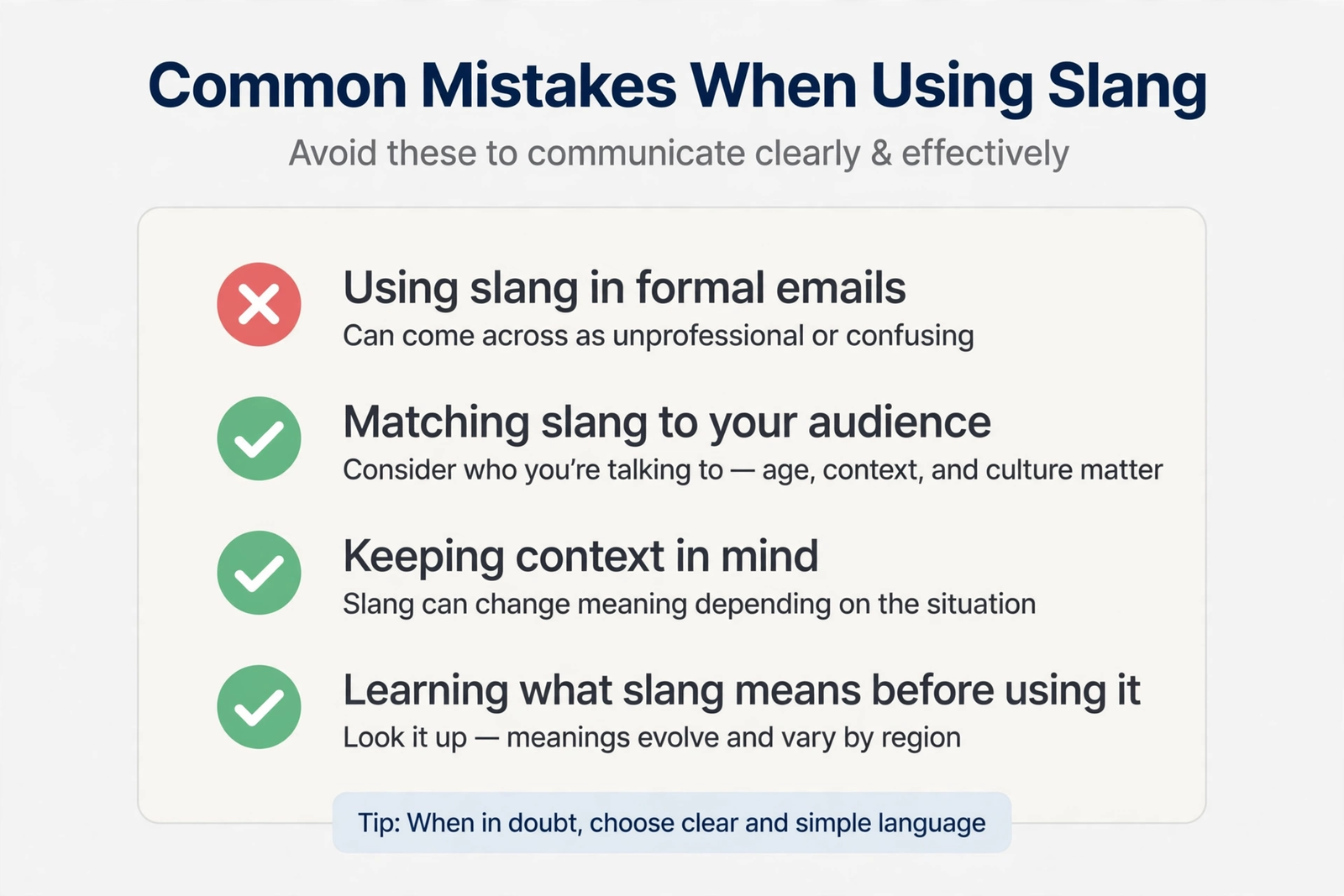
Common Mistakes
People get into trouble with penis slang in predictable ways. Here are the mistakes to avoid:
- Using a vulgar term in a formal setting. Saying “dick” or “cock” at work, at school, or in front of children can offend people and, in a workplace, can become an HR problem. Match the word to the room.
- Confusing the insult with the anatomy. Calling someone “a dick” or “a prick” is an insult, not a biology lesson. New English learners sometimes miss this and use the words far more freely than native speakers would.
- Using British terms in the US (and vice versa). “Bellend” will confuse most Americans, and “willy” sounds childish to American ears. Regional slang does not travel well.
- Assuming every term means the same thing. “Schlong” implies size; “weenie” implies smallness; “chub” usually refers to an erection, not the organ itself. Using the wrong term sends the wrong message — often a funny one.
- Overusing slang in writing. One well-chosen slang term in a joke or a story is funny. Five in one paragraph reads as trying too hard and distracts from whatever you are actually saying.
- Using slang with strangers. These terms assume a level of familiarity. With people you do not know well, neutral language is safer and more respectful.
- Forgetting the audience. What works in a group chat with friends can be wildly inappropriate in a family group chat, a work Slack channel, or a public comment section. Check the audience before you hit send.
Quick Tips
- When in doubt, say “penis.” The clinical word is never wrong, never offensive, and always understood.
- Match the register to the room. Friends get schlong and wang; doctors, teachers, and bosses get “penis.”
- Learn the insult meanings first. Before using dick, prick, or bellend, know that all three are also insults — context decides which meaning lands.
- Use British terms only with British audiences. Todger, willy, and bellend are UK words; Americans may misunderstand them.
- Keep it to one term per joke. Piling up synonyms kills the humor. Pick the best one and move on.
- Watch texting abbreviations. A single letter like “D” is discreet, but it is also ambiguous — make sure the other person knows what you mean.
- Read the room on social media. A term that is hilarious in a meme comment can look crude on a public post tied to your real name.
- Writers: let the character choose the word. A teenager, a doctor, and a British comedian would each pick a different term — use that to make dialogue feel real.

FAQ
What is the most common slang for penis?
The most common slang terms for penis in American English are “dick” and “cock,” followed by “prick,” “Johnson,” and “schlong.” In British English, “willy,” “todger,” and “bellend” are among the most used. “Dick” is probably the single most frequent term overall because it works in jokes, casual speech, and as an insult.
What is a polite slang word for penis?
The most polite options are “member,” “manhood,” and “private parts.” “Member” is the classic soft euphemism in writing, while “private parts” is the standard choice when talking with children or in mixed company. In medical or educational settings, the clinical word “penis” is always the best choice.
What does “schlong” mean in slang?
“Schlong” is American slang for penis, borrowed from Yiddish (from the German word Schlange, meaning snake). It is informal and mildly vulgar, often used humorously, and it usually implies a large penis. It became mainstream through American comedy in the 20th century.
What is the British slang for penis?
Common British slang for penis includes “willy,” “todger,” “bellend,” “knob,” “John Thomas,” and “Percy.” “Willy” is the most widely used and the least offensive — it is the word British parents typically teach children. “Bellend” and “knob” are much ruder and also work as insults.
Why are there so many slang words for penis?
Taboo topics generate the most slang. Because people often feel awkward saying “penis” directly, they invent euphemisms — and each generation adds new ones through comedy, music, and the internet. Linguists note that the penis may be the most euphemized word in English, with hundreds of recorded terms stretching back to the 1300s.
Is “dick” an insult or slang for penis?
Both. “Dick” is slang for penis and also one of the most common insults in American English, meaning a rude or unpleasant person. Which meaning applies depends entirely on context: “Don’t be a dick” is an insult, while a joke about someone’s “dick” is anatomical. This double meaning is why learners should use the word carefully.
What does “trouser snake” mean?
“Trouser snake” is humorous slang for penis, comparing it to a snake hiding in a pair of trousers. It is a lighthearted, cartoonish term mostly used in jokes, memes, and comedy. Related terms include “one-eyed trouser snake” and “one-eyed monster,” which play on the same snake metaphor.
What is the origin of the word “cock” as slang for penis?
“Cock” originally meant a rooster, and it transferred to anatomy centuries ago — most likely because of the rooster’s red, fleshy wattles, which swell and change color. The slang use dates back to at least the 1600s. By the late 18th century it was so strongly associated with anatomy that polite speakers invented the word “rooster” to talk about the bird without embarrassment.

Conclusion
Slang for penis is a perfect example of how English works: one ordinary body part, hundreds of nicknames, and a set of unwritten rules about when each one is funny, friendly, crude, or completely out of place. The terms themselves are not complicated — dick, cock, Johnson, schlong, willy, member — but the social judgment behind them is everything. Use the right word in the right room and you sound natural and funny; use the wrong one and you sound rude, confusing, or both.
The practical takeaway is simple. In casual conversation with friends, the everyday terms are fine. In comedy and writing, pick the term that fits the character and the joke. And in medical, educational, or professional settings, put the slang away and say “penis” — clarity always wins there. If you remember nothing else from this guide, remember this: the word matters less than the audience.
Language keeps moving, and this corner of it moves fast — new terms appear in memes and group chats every year while older ones fade. For now, the 40+ terms in this guide cover the words you are most likely to hear, read, or need yourself. And if you want to keep decoding the slang you see online, start with our guides to the BBC meaning in slang and pegging slang — the same plain-English, dictionary-style approach, applied to the next terms you are likely to look up.

1 thought on “Slang for Penis: 40+ Terms, Meanings & How People Actually Use Them (2026)”