Quick definition: In slang, NEET stands for “Not in Education, Employment, or Training.” The neet meaning slang most people look up online describes someone — usually a young person — who is not currently studying, working, or enrolled in any kind of training program. On the internet, it is used as a label, a joke, a self-description, and sometimes an insult, depending on who says it and where.
neet meaning slang & Definition
NEET is an acronym, and its full form is simple: Not in Education, Employment, or Training. If a person is not going to school, not holding a job, and not learning a trade or skill through a formal program, they fit the literal definition of a NEET.
But the neet meaning slang you see on TikTok, Reddit, Discord, and 4chan goes a little further than the dictionary-style definition. Online, the word carries a whole lifestyle stereotype with it: a young person living at home with their parents, staying up late, playing video games, watching anime, scrolling social media, and putting off the “real world” for as long as possible.
That stereotype is not always fair — and it is not always accurate — but it is the reason the word spread so far beyond government reports and became a piece of internet slang. Here is the short version:
- NEET (noun): A person who is not in education, employment, or training.
- NEET (adjective): Describing that lifestyle, e.g. “a NEET lifestyle” or “my NEET summer.”
- NEETing (verb, informal): Living like a NEET, e.g. “I spent the whole summer NEETing at home.”
- Tone: Self-deprecating and joking when used about yourself; teasing or insulting when used about someone else.
One important note: being a NEET is a temporary status, not a permanent identity. People take gap years, lose jobs, finish school and pause before the next step, or deal with health and family situations. The internet joke version of the word flattens all of that into a meme — and that is exactly why it is worth understanding properly before you use it.
Introduction
You have probably seen it in a comment section: someone jokes “bro is a full-time NEET 😭” under a video of a guy gaming at 3 a.m., or a friend texts “I’m just NEETing this summer, don’t judge me.” The word sounds funny, a little strange, and oddly specific — and that is because it started life as something completely different from slang.
NEET began as a piece of official government language. It was a boring, bureaucratic label invented to count young people who had slipped through the cracks of school and work. Then the internet found it, gave it a face (the basement-dwelling gamer stereotype), and turned it into a meme that refuses to die.
In this guide, we will break down the neet meaning slang in full: what it stands for, where it came from, how it is actually used in texts and on social media, how it differs from similar words like hikikomori and otaku, the common mistakes people make with it, and the polite alternatives you can use instead. By the end, you will know exactly when the word fits — and when it is better left unsaid.

Origin
The story of NEET starts in the United Kingdom. In July 1999, the British government’s Social Exclusion Unit published a report called “Bridging the Gap,” which investigated young people aged 16 to 24 who were unemployed and not in school. The report needed a neutral label for this group, and the phrase “Not in Education, Employment or Training” was born — soon shortened to the acronym NEET.
Japan picked up the term shortly after. There, it was applied to a wider age group, roughly 15 to 34, and it became closely associated with hikikomori — people who withdraw from social life for months or years at a time. Japanese media, anime, and online forums spread the word through the 2000s, and it crossed back into English-speaking internet culture with a new, heavier set of associations.
The internet did the rest:
- March 15, 2005: The first widely cited Urban Dictionary entry for NEET was submitted, defining it as a sociological term for young people outside work and school.
- 2012: Anonymous users on 4chan’s /r9k/ (robot9000) board turned the NEET into a recurring character in greentext stories — waking up at 3 p.m., arguing with mum, ordering takeout, going back to the computer.
- 2014 onwards: YouTube videos, Reddit threads, and anime memes cemented the stereotype: the NEET as a young man in his parents’ basement, surrounded by games and instant noodles.
- Today: TikTok and X (Twitter) use it both as a self-deprecating joke (“day 47 of being a NEET”) and as a teasing label for anyone who seems to be avoiding adult responsibilities.
So the neet meaning slang you see today is really two meanings layered on top of each other: the original, neutral government definition — and the internet’s jokey, exaggerated version of it.
Popularity
Why did a dry government acronym become a lasting piece of internet slang? A few reasons explain its staying power.
First, it names something real. Almost everyone knows someone who has been between school and work — a friend taking a gap year, a cousin who quit a job and never went back, a classmate who graduated and moved back home. NEET gives that in-between state a single, punchy name.
Second, it is perfect meme material. The NEET stereotype — waking up late, gaming all night, living off your parents’ cooking — is easy to joke about and easy to recognize. Greentext stories, wojak comics, and anime reaction images gave the word a visual language that kept it alive for over a decade.
Third, it works as a self-label. Unlike most insults, NEET is a word people happily apply to themselves. Saying “I’m a NEET right now” is a way of being honest about a rough patch while keeping it light. That self-deprecating use is what keeps the word circulating on TikTok, Reddit, and Discord, long after most slang from the 2000s has faded.
Fourth, anime made it global. Many anime and manga series feature NEET characters — from the shut-in heroes of isekai stories to the famously unemployed MADAO of Gintama. For anime fans, the word became part of the shared vocabulary, and from there it spread to gaming and streaming communities.
Today, the word is most common in:
- Reddit: r/NEET and greentext-style posts on 4chan’s /r9k/ board.
- TikTok: “NEET life” and “day in the life of a NEET” videos, usually played for laughs.
- Discord and gaming chats: teasing friends who are always online at odd hours.
- X (Twitter): jokes about unemployment, burnout, and “opting out” of the rat race.
- Anime and manga communities: discussions of NEET characters and the hikikomori connection.
How It Is Used
NEET shows up in a few distinct ways, and the meaning shifts with the context. Here is how to read it in the wild.
As a neutral label
In news articles, research papers, and policy discussions, NEET is a plain, factual category. “The NEET rate among 18-to-24-year-olds rose last year” is not slang at all — it is the original government usage.
As a self-description
This is the most common slang use. Someone says “I’m a NEET” the way they might say “I’m between jobs” — only funnier and more honest. It signals: I know my situation is not ideal, and I am laughing about it before you can.
As a joke or tease
Friends call each other NEETs when someone skips class, quits a job, or spends a whole weekend gaming. Among friends, it is usually light-hearted. From a stranger, it can sting.
As an insult
Used seriously, “NEET” can be a way of calling someone lazy, unmotivated, or a burden on their family. The stereotype does a lot of heavy lifting here — the insult is not just “you don’t work,” it is “you have chosen to do nothing with your life.” That is why context and relationship matter so much with this word.
As a lifestyle label
Some people use NEET as an identity: “the NEET lifestyle,” “NEETbux” (a joking term for living off benefits or family support), or “NEETmaxxing.” In these cases, the word describes a whole way of living, not just a job status.
Quick rule of thumb: if the person saying it is talking about themselves, it is almost always a joke. If they are talking about someone else, check the tone — it could be friendly teasing or a real dig.
Examples
Seeing the word in real conversations is the fastest way to understand the neet meaning slang. Here are realistic examples across different tones.
Friendly Examples
- Friend 1: “What are your plans for the summer?”
Friend 2: “Absolutely nothing! I’m going to chill at home and play video games. I’ll only come out for food.”
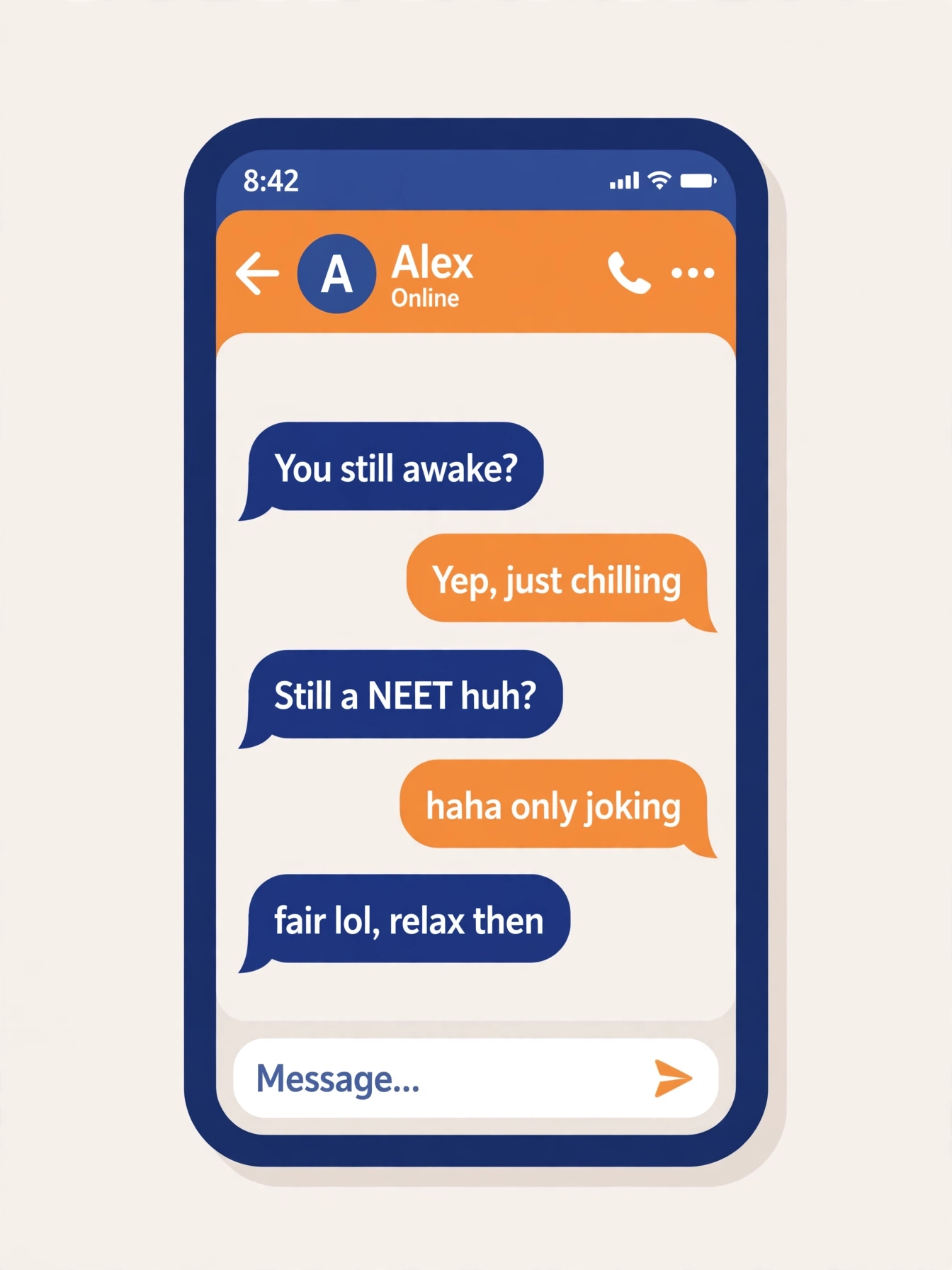
Friend 1: “Bro, you are such a NEET 😂” - Alex: “Day 47 of being a NEET: I have mastered the art of the 3 p.m. wake-up.”
- Maya: “Graduated in May, still a NEET in November. Living the dream (not really).”
- Sam: “My NEET arc continues. I applied to zero jobs today and I feel great about it.”
Professional Examples
In formal settings, people avoid the slang version of the word and use the full, neutral phrasing instead:
- “The report tracks young people not in education, employment, or training.”
- “Our program helps NEET youth aged 16–24 get back into work or study.”
- “She took a gap year after graduation, so she is technically counted as NEET in the statistics.”
Notice the difference: in a report or a job interview, nobody says “I’m a NEET.” They say “I’m currently between roles” or “I’m taking time to upskill.” The slang stays in casual spaces.
Funny Examples
- Jordan: “My alarm clock is broken.”
Chris: “You don’t have a job, school, or training. What do you need an alarm for? Classic NEET.” - TikTok caption: “POV: you’re a NEET and your mum just asked what you do all day.”
- Reddit post title: “NEET check: who else’s sleep schedule is completely destroyed?”
- Discord message: “He’s been online for 14 hours straight. Certified NEET behaviour.”
| Situation | Example message | Tone |
|---|---|---|
| Texting a friend | “I’m a full-time NEET now 😅” | Self-deprecating joke |
| Teasing a friend | “Bro, you are such a NEET 😂” | Friendly tease |
| TikTok caption | “Day 47 of being a NEET” | Humorous, relatable |
| News report | “The NEET rate rose among 18–24s” | Neutral, formal |
| Insult in an argument | “You’re just a NEET living off your parents” | Harsh, negative |
| Gaming chat | “He’s online 14 hours a day, certified NEET” | Playful mockery |
Comparison with Similar Terms
NEET gets mixed up with several nearby words. They overlap, but they are not the same thing — and using the wrong one can change what you are actually saying.
| Term | What it means | How it differs from NEET |
|---|---|---|
| NEET | Not in education, employment, or training | The broad, official category — about status, not behaviour |
| Hikikomori | A person who withdraws from social life for 6+ months | About extreme social isolation; many hikikomori are NEETs, but most NEETs are not hikikomori |
| Otaku | Someone deeply obsessed with anime, manga, or games | About hobbies, not job status — an otaku can have a full-time job |
| Freeloader | Someone who lives off others without contributing | A judgemental insult; NEET is a neutral status that can be temporary |
| Slacker | Someone who avoids work or effort | About attitude and effort; a NEET may be trying hard to find work |
| Stay-at-home parent | A parent who cares for children full-time | Technically counted as NEET in some statistics, but the term is almost never used this way in slang |
| Gap year student | Someone taking a planned break between school stages | A deliberate, temporary break; a NEET label usually implies no plan at all |
| Unemployed | Someone without a job who is looking for one | Unemployed people are usually seeking work; NEETs may or may not be looking |
The key distinction is this: NEET describes a status, not a personality. A hikikomori is defined by isolation, an otaku by obsession, and a slacker by attitude. A NEET is defined only by what they are not currently doing — studying, working, or training. That is why the word can apply to a gap-year traveller, a new graduate, a stay-at-home parent, and a basement gamer all at once, even though those people have almost nothing else in common.
It is also worth knowing that the stereotype is often wrong. In the United States, for example, more than half of NEETs are women, and many are caring for children or family members. The “male gamer in the basement” image that dominates the memes is only one slice of a much bigger group.

Alternate Meanings
NEET has a few other meanings that can cause confusion, especially in text messages where context is thin.
NEET exam (India)
In India, NEET is the National Eligibility cum Entrance Test — the exam every pre-medical student must pass to enter undergraduate medical courses. If an Indian friend texts “I’m preparing for NEET,” they mean the exam, not the lifestyle. Context is everything: “NEET 2026” is almost always the exam.
“Neet” as the opposite of “yeet”
In some meme circles, “neet” is jokingly treated as the antonym of “yeet.” Since “yeet” can mean “yes” (or to throw something with force), “neet” is used to mean “no.” This usage is rare and mostly a wordplay joke — you will not hear it in everyday conversation.
NEET as a surname or name
NEET is also an uncommon surname. If you see it capitalized in a formal document with no other context, it may simply be someone’s name.
How to tell which meaning is intended: check the topic. Exam talk, medical study, and Indian contexts point to the test. Talk about jobs, school, gaming, or staying home points to the slang meaning. And if someone says “neet” right after “yeet,” they are making a joke.
Professional or Polite Alternatives
Because NEET can sound judgemental, it is worth having softer ways to say the same thing — especially at work, in formal writing, or when talking about someone else’s situation.
- “Between jobs” — the most natural, everyday alternative. “He’s between jobs right now.”
- “Taking a career break” — sounds deliberate and positive.
- “On a gap year” — for a planned break between school and work.
- “Currently not in work or study” — the plain, factual version, close to the original definition.
- “Exploring their next step” — kind and forward-looking.
- “A young person outside education and employment” — the formal phrasing used in reports and policy.
- “Focusing on family responsibilities” — when caregiving is the real reason.
- “Upskilling / retraining” — when someone is learning new skills outside a formal program.
As a general rule: use “NEET” in casual chats with friends, in memes, and when describing yourself. Use one of the alternatives above in professional settings, in writing about other people, or whenever you are not sure how the word will land.
Common Mistakes
Here are the mistakes people make most often with the neet meaning slang — and how to avoid them.
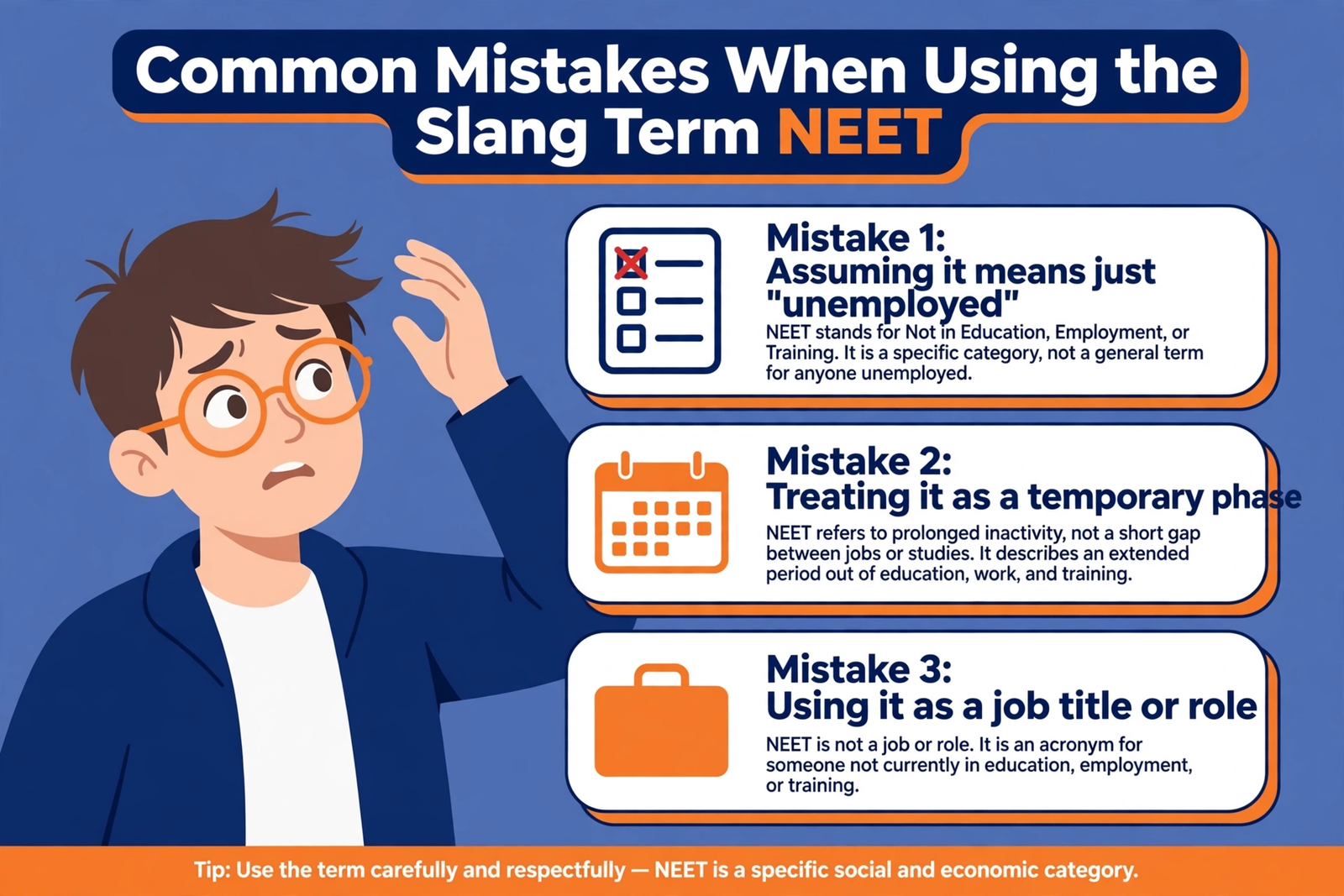
1. Assuming every NEET is lazy
Many NEETs are dealing with illness, disability, caregiving, a bad job market, or a lack of local opportunities. The meme version of the word erases all of that. Do not use it as a synonym for “lazy.”
2. Calling a stay-at-home parent a NEET
Technically, some statistics count stay-at-home parents as NEETs. In everyday language, though, calling a parent a NEET is rude and misleading — raising children is full-time work.
3. Confusing NEET with hikikomori
A hikikomori is someone who has withdrawn from social contact for months or years. Most NEETs still see friends, go out, and live normal social lives. The two words describe different things.
4. Using it in professional settings
NEET is slang in casual use and bureaucratic jargon in formal use — either way, it sounds wrong in a job interview or a work email. Use “between roles” or “career break” instead.
5. Mixing it up with the NEET exam
If you are talking to someone from India about “NEET,” ask which one they mean. Confusing the medical entrance exam with the slang term leads to very strange conversations.
6. Using it as an insult toward strangers
Among friends, “NEET” is a joke. Aimed at a stranger online, it is an insult about their life choices — and you know nothing about their circumstances. Keep the teasing for people who know you are joking.
7. Treating it as a permanent identity
Being a NEET is a phase for almost everyone who experiences it. People go back to school, find work, start training, or change direction. The word describes a moment in someone’s life, not who they are.
Quick Tips
- Know your audience: Use NEET with friends and in memes. Avoid it in professional or formal contexts.
- Self-label freely, label others carefully: Calling yourself a NEET is funny; calling someone else one can sting.
- Check the context: In India, NEET usually means the medical exam. In anime communities, it may come with hikikomori or otaku associations.
- Do not use it as a synonym for lazy: The word describes a status, not a character flaw.
- Pair it with humour, not cruelty: The best NEET jokes are self-deprecating ones.
- Remember the full form: Not in Education, Employment, or Training — if you remember that, you will never misuse the word.
- If someone calls themselves a NEET, listen first: Sometimes it is a joke. Sometimes it is someone telling you they are struggling. The right response depends on which one it is.

FAQ
What does NEET mean in slang?
NEET stands for “Not in Education, Employment, or Training.” In slang, it describes a young person who is not studying, working, or in training — often used jokingly online to describe someone living at home, gaming, and putting off adult responsibilities.
Is NEET an insult?
It depends on who says it. When people call themselves NEETs, it is usually a self-deprecating joke. When friends tease each other with it, it is usually friendly. But used seriously about someone else, it can be an insult implying laziness or failure — so use it carefully.
Where did the term NEET come from?
NEET was coined in July 1999 in a UK government report called “Bridging the Gap,” which studied 16-to-24-year-olds outside school and work. Japan adopted the term for ages 15–34, and the internet — especially 4chan, Reddit, and anime communities — turned it into slang in the 2000s.
What is the difference between a NEET and a hikikomori?
A NEET is anyone not in education, employment, or training — a status. A hikikomori is someone who has withdrawn from social life for six months or more — a behaviour. Many hikikomori are NEETs, but most NEETs are not hikikomori: they still have friends and a social life.
Can a NEET be a girl?
Yes — and in the United States, more than half of NEETs are actually women. The “male gamer in the basement” stereotype from memes is misleading; many NEETs are women caring for children or family members, or dealing with health or job-market challenges.
What does NEET mean in India?
In India, NEET usually means the National Eligibility cum Entrance Test — the exam pre-medical students must pass to enter medical college. If the conversation is about studying or medicine, that is almost certainly the meaning intended.
Is being a NEET bad?
Being a NEET is a status, not a moral judgement. Sometimes it is a deliberate break, like a gap year. Sometimes it reflects real difficulties — health, caregiving, or a tough job market. It only becomes a problem if it lasts a long time with no plan, and even then, support and small steps help more than shame.
How do you stop being a NEET?
There is no single path, but common first steps are: a part-time job or freelance gig, a short course or certification, volunteering, or a structured daily routine. The key is starting small — one application, one class, one routine change — and building from there.

Conclusion
The neet meaning slang is simple on the surface — Not in Education, Employment, or Training — but the word carries a lot more than its four letters suggest. It started as a neutral label in a 1999 UK government report, travelled through Japan and anime culture, and became one of the internet’s most durable jokes about modern life.
Used about yourself, it is a funny, honest way to talk about a between-stages moment in life. Used about a friend, it is a tease that usually lands. Used carelessly about a stranger, it can be an unfair judgement about a situation you know nothing about. The difference is all in the tone, the relationship, and the context.
So the next time you see someone joke “I’m a full-time NEET” in a comment section, you will know exactly what they mean — and you will know the history behind the joke, too. And if you are in a NEET phase yourself, remember: it is a status, not an identity. The next chapter is yours to write.
Curious about other internet slang? Check out our guides to fn meaning in text, cfs meaning in text, and tysm meaning for more everyday terms explained the same way.
