
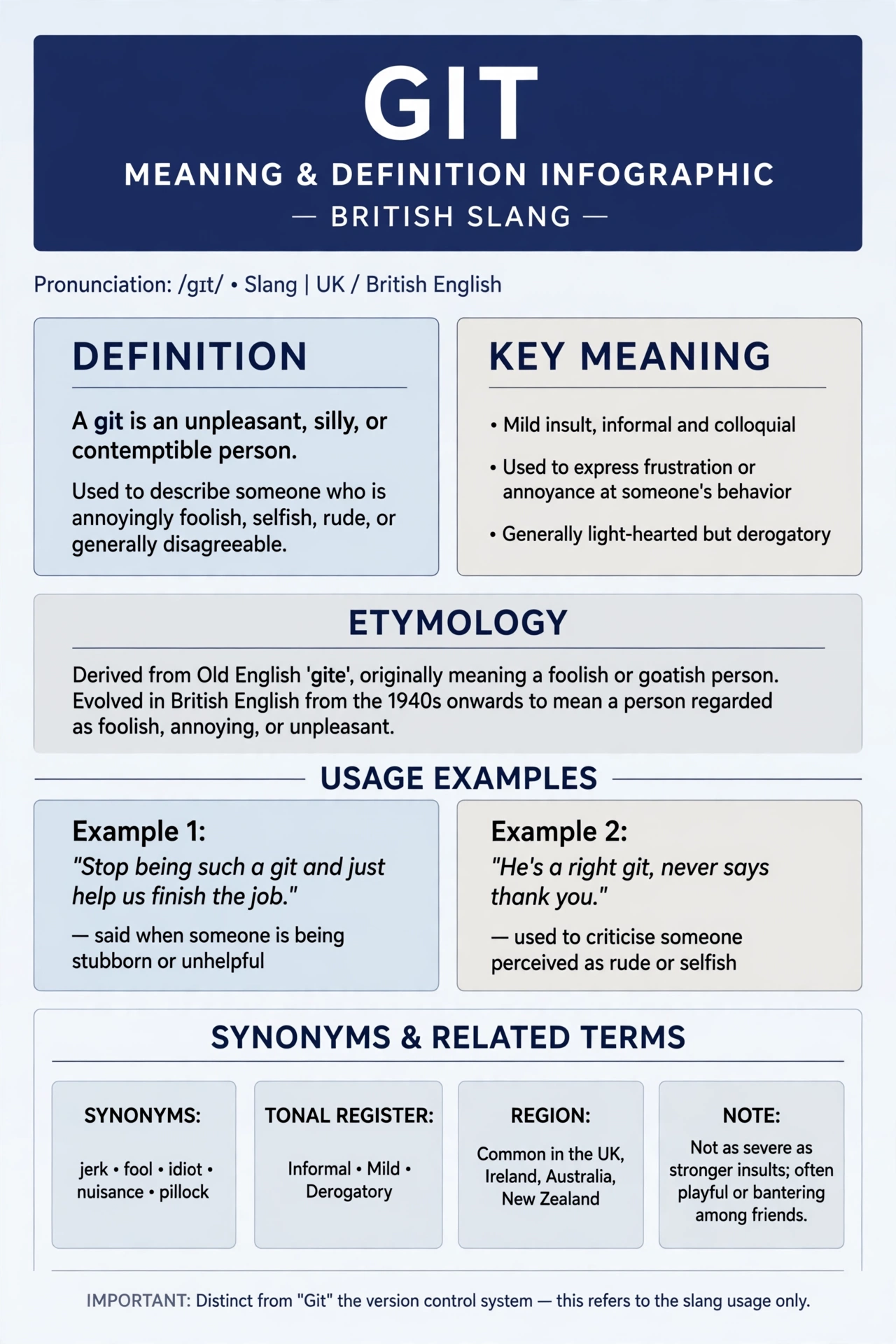
Quick Definition: In British slang, a git is an unpleasant, annoying, or contemptible person — a mild insult roughly meaning “jerk” or “idiot.” The phrase git slang most often refers to this insult, as in “Don’t be such a git” or “He’s a miserable old git.” It is informal, very British, and far softer than the swear words it is often grouped with, which is exactly why it survives in everyday conversation, comedy, and texts.
Git Slang Meaning & Definition
The term git is one of the most recognisably British words in the English language. When someone calls another person a git, they are saying that person is behaving badly, selfishly, stupidly, or just irritatingly. It sits in the same family as words like “twit,” “berk,” and “prat” — insults that sting a little without crossing into genuinely offensive territory.
Here is the simplest way to understand it:
- Git (noun): an unpleasant or contemptible person; a fool or a jerk.
- Tone: mildly insulting, often playful or affectionate between friends.
- Register: informal British English; rarely used in formal writing.
- US equivalent: “jerk,” “idiot,” or “tool” — depending on the context.
Importantly, the word changes colour with its company. “You lucky git” is almost a compliment — it means someone got away with something good and you envy them. “You silly git” is gentle teasing between friends. But “miserable old git” or “selfish git” carries real disapproval. The word itself is a vessel; the adjectives around it decide how harsh it is.
That flexibility is a big reason git slang has stayed alive for decades while trendier slang burns out in months. It works in a pub, in a sitcom, in a text message, and even in a newspaper column. The Cambridge Dictionary defines “git” as an unpleasant person, and that simple, official definition matches exactly how the word is used in everyday British speech. It is rude enough to feel satisfying and polite enough to use in front of your grandmother — most of the time.
Introduction
Picture this: you are watching a classic British comedy and a character sighs, “Oh, don’t be such a git.” Everyone laughs. If you grew up outside the UK, you might have nodded along without quite knowing what a git actually is — or why it sounded funny rather than furious. You are not alone. Millions of people encounter this word through British television, films, books, and memes, and many of them have no idea whether it is a joke, an insult, or something far ruder.
The truth is pleasantly simple. A git is a mildly insulting word for someone who is being unpleasant, foolish, or annoying. It is the kind of word a teacher might use in a staffroom, a grandparent might mutter at the television, and a friend might throw at you after you beat them at a game. It belongs to the great British tradition of the softened insult — words that let you express frustration without starting a fight.
In this guide, we will break down the full git slang meaning, trace where the word came from, show how it is used in real conversations and texts, compare it with similar British insults, and explain the one big alternate meaning that confuses everyone: the software. By the end, you will know exactly when to use it, when to avoid it, and why it has lasted so long.
If you enjoy decoding British expressions, you will also like our guide to Australian slang, where another set of playful insults works in much the same way — and if you want the wider picture of how young people talk online, our Gen Z slang 2024 roundup covers the words dominating TikTok and group chats right now.
Origin of Git
The origin of “git” is a small mystery that linguists still argue about, and the most likely story is more interesting than a simple dictionary definition. The word appears in British English in the early 20th century, and most etymologists trace it back to the word “get” — an old northern English and Scots insult meaning a bastard or an unpleasant person, itself probably a shortened form of “beget.”
Here is how the story usually goes:
- 1800s: In parts of northern England and Scotland, “get” was used as a term of contempt for someone considered low or illegitimate.
- Early 1900s: The spelling and pronunciation drifted from “get” to “git” in southern and general British usage.
- Mid-1900s: The word spread through everyday speech, music hall comedy, and later radio and television.
- 1960s–1980s: British sitcoms and films made “git” a household word, famous enough that even American audiences recognised it.
Some theories also connect “git” to the older word “giddy” or to regional dialect forms, but the “get” theory is the one most dictionaries favour. What is certain is that the word was once stronger than it is today. In the early 20th century it carried a sharper edge, close to calling someone a bastard in the insulting sense. Over the decades it softened, the way many insults do once they become common in comedy and family viewing.
A fun piece of cultural history: “git” became so familiar through British television that it eventually appeared in the Oxford English Dictionary with its modern sense firmly established, and it is now one of the words language learners meet first when they study British informal English. It is proof that an insult can become a cultural export.
Popularity of Git Slang
Unlike most slang, “git” has never really had a peak and a crash. It has been steadily popular for more than half a century, and that staying power is unusual. Words like “groovy” or “rad” rise and vanish; “git” simply stays in the background of British speech, ready whenever someone needs a quick, satisfying insult.
Several things keep it popular:
- Television and film: From classic sitcoms to modern streaming comedies, British writers use “git” because it is funny, safe for broadcast, and instantly characterful.
- Music and comedy: Stand-up comedians and songwriters reach for it when they want a very British flavour of mockery.
- Memes and social media: Clips of British characters calling someone a git circulate constantly on TikTok and X, introducing the word to new audiences.
- Generational hand-down: Parents and grandparents use it, so children absorb it early as part of everyday vocabulary.
- Low risk: Because it is mild, people feel comfortable using it at work, at school, and in mixed company — unlike stronger British insults.
In the United States, the word is understood far more than it is used. Americans encounter it through British media and often adopt it as a joke or a knowing reference — saying “git” marks you as someone who watches British comedy. In Australia and New Zealand, it is also recognised, though local insults like “drongo” or “galah” often take its place.
Online, the word enjoys a second life. People searching for the git slang meaning are usually doing one of two things: trying to understand something they heard in a show, or trying to work out whether it is safe to say. The answer to both is reassuring — it is one of the gentlest insults in British English, and it almost always lands as humour rather than hostility.
How Git Is Used in Slang
Using “git” correctly is mostly a matter of tone and context. The word is a noun, and it almost always appears with an adjective in front of it or as a direct address. Here are the most common patterns:
- “Don’t be a git.” — A light rebuke: stop being annoying or selfish.
- “You lucky git!” — Envious admiration: you got something good and I wish I had too.
- “Silly git.” — Affectionate teasing between friends or family.
- “Miserable old git.” — Genuine disapproval of a grumpy, unpleasant person.
- “Selfish git.” — Accusing someone of thinking only of themselves.
- “Jammy git.” — “Jammy” means lucky, so this is a playful way to call someone fortunate.
- “Cheeky git.” — Someone who is bold, rude, or audacious in a funny way.
The word also appears in set phrases. “Git” on its own can work as an exclamation — “Oh, git!” — though that is less common than the adjective-plus-git formula. In texts and chats, it often shows up in exactly the same forms, sometimes shortened in playful ways, but the full word is so short already that it rarely gets abbreviated.
One thing to remember: “git” is almost always about a person, not a thing or a situation. You would not call a broken laptop a git (though a frustrated Brit might, jokingly). The insult targets behaviour — someone is a git because of something they did or the way they are acting.
Examples of Git in Slang
The best way to learn a slang word is to see it in real sentences. These examples cover the main tones — friendly, professional, and funny — so you can feel how the meaning shifts with context.
Friendly Examples
- “You beat me by one point again, you lucky git!”
- “Come on, don’t be a git — share the last slice with me.”
- “He forgot my birthday and then showed up with cake. Silly git, I forgave him in five minutes.”
- “She’s a jammy git — she won the raffle twice in a row.”
- “Stop being such a git and help me carry these bags.”
In friendly use, the word is basically a term of endearment with an edge. Friends call each other gits the way they might call each other idiots — it only works because everyone knows it is not meant seriously. If a stranger said it, the same words could feel rude, so the relationship matters more than the word itself.
Professional Examples
In workplaces, “git” sometimes appears in informal, behind-the-scenes talk — but it is best kept out of formal emails and meetings. Here is how it sounds in professional contexts:
- “The client changed the deadline again at 5pm. The git didn’t even apologise.”
- “Our manager is a bit of a git about holiday requests, honestly.”
- “Don’t be a git about the rota — swap the shift and be done with it.”
- “He took credit for my idea in the meeting. What a git.”
Notice that even at work, the word expresses frustration without the aggression of a real swear word. That is its superpower: it lets people vent while staying within the bounds of office-acceptable language. Still, if you are speaking to someone senior or writing anything official, choose a neutral word like “difficult” or “unreasonable” instead. And if you are texting a colleague, remember that tone does not travel well in writing — a playful “git” can read as hostile without a friendly emoji or context, a risk shared by many informal abbreviations, as our guide to fn meaning in text also shows.
Funny Examples
- “My cat knocked my coffee over, looked me in the eye, and walked away. Little git.”
- “He ate the last biscuit and blamed the dog. Cheeky git.”
- “I told him the Wi-Fi password was ‘password’ and he believed me. Silly git.”
- “The satnav sent me into a field. Stupid git of a machine.”
- “He turned up to a fancy dinner in flip-flops. Absolute git — and somehow he pulled it off.”
The humour comes from the mismatch: “git” sounds old-fashioned and almost quaint, so using it about a cat, a satnav, or a friend’s terrible outfit makes the insult feel like a joke. British comedy has used exactly this trick for decades, and it is why the word still gets laughs.
Comparison with Similar Terms
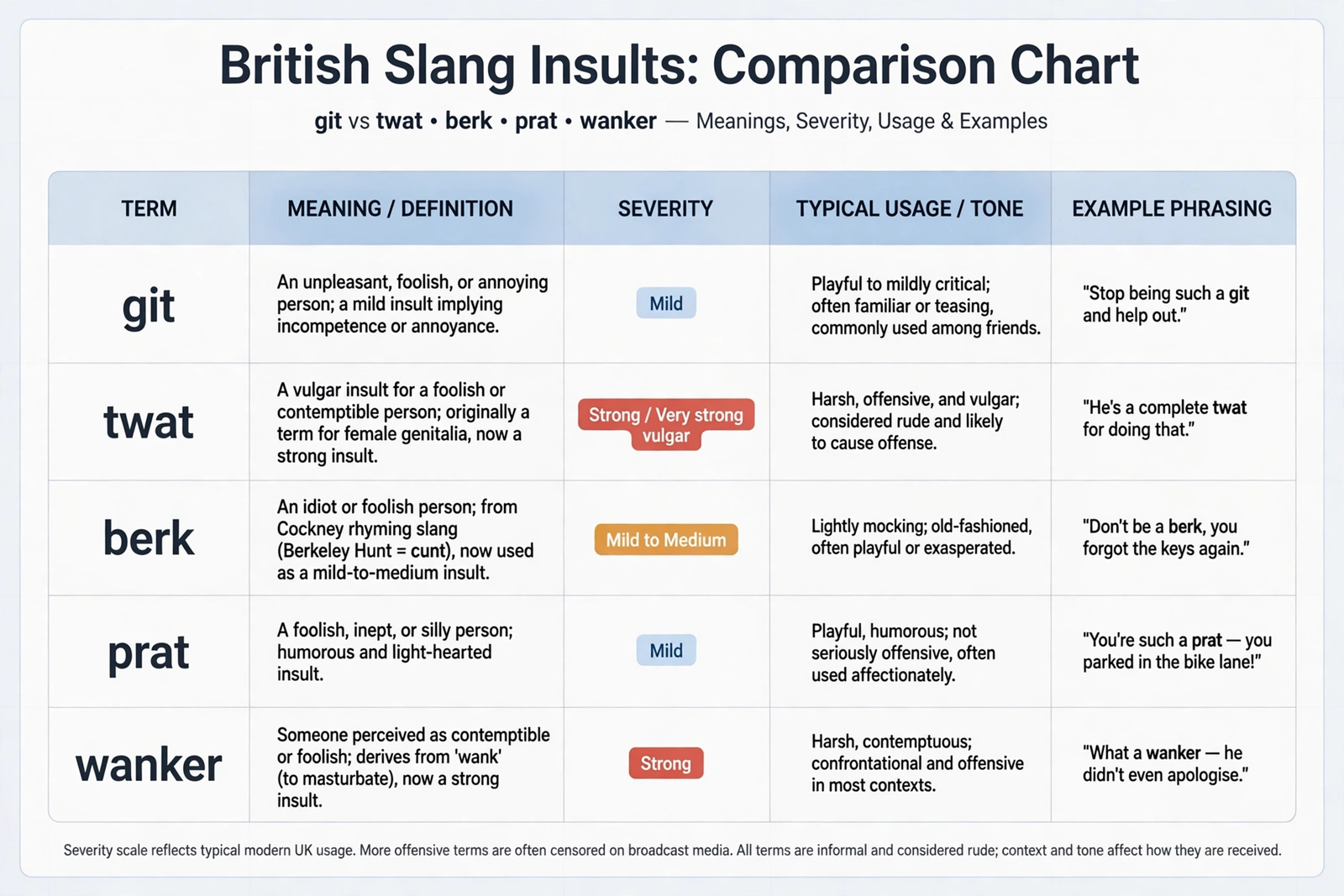
British English is rich in mild insults, and “git” is only one of them. Comparing it with its closest cousins shows exactly where it sits on the scale from affectionate to offensive.
| Term | Meaning | Strength | Typical Tone |
|---|---|---|---|
| Git | Unpleasant or annoying person | Mild | Teasing to annoyed |
| Twat | Foolish or obnoxious person | Medium | Insulting, sometimes vulgar |
| Berk | Fool or idiot (from rhyming slang) | Mild | Playful, old-fashioned |
| Prat | Stupid or incompetent person | Mild | Mocking, light-hearted |
| Wanker | Contemptible person (vulgar origin) | Strong | Angry, offensive |
| Plonker | Idiot or fool | Very mild | Affectionate, comedic |
| pillock | Stupid person | Mild | Mocking, informal |
A few things stand out from this comparison. First, “git” is one of the safest choices in the group — only “plonker” is clearly gentler. Second, “berk” and “prat” are its nearest neighbours: if you like the sound of “git,” you will feel at home with those too. Third, words like “twat” and “wanker” are a step up in rudeness, and using them in the wrong company can cause real offence, so “git” is the better default when you are unsure.
American readers often ask how “git” compares with US insults. The closest match is “jerk” — same mildness, same flexibility, same ability to be friendly or annoyed depending on tone. “Douchebag” or “asshole” are far stronger, while “goofball” is far softer. “Git” lives right in the middle, which is why it is so useful.
Alternate Meanings of Git
Here is where things get confusing — and where most internet searches for “git” actually lead. The word has a completely different, hugely important meaning in the world of technology, and it has nothing to do with insults.
Git the Software
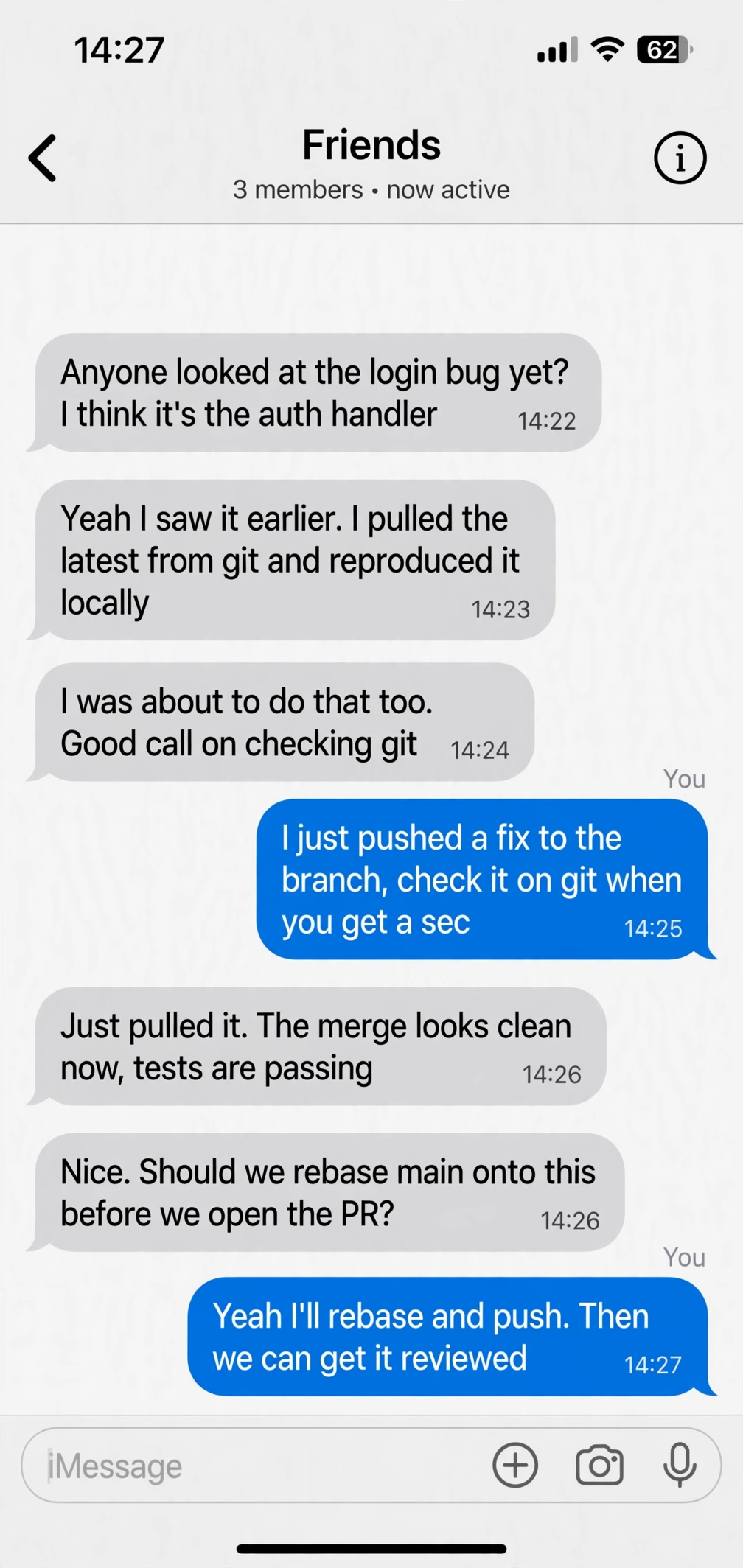
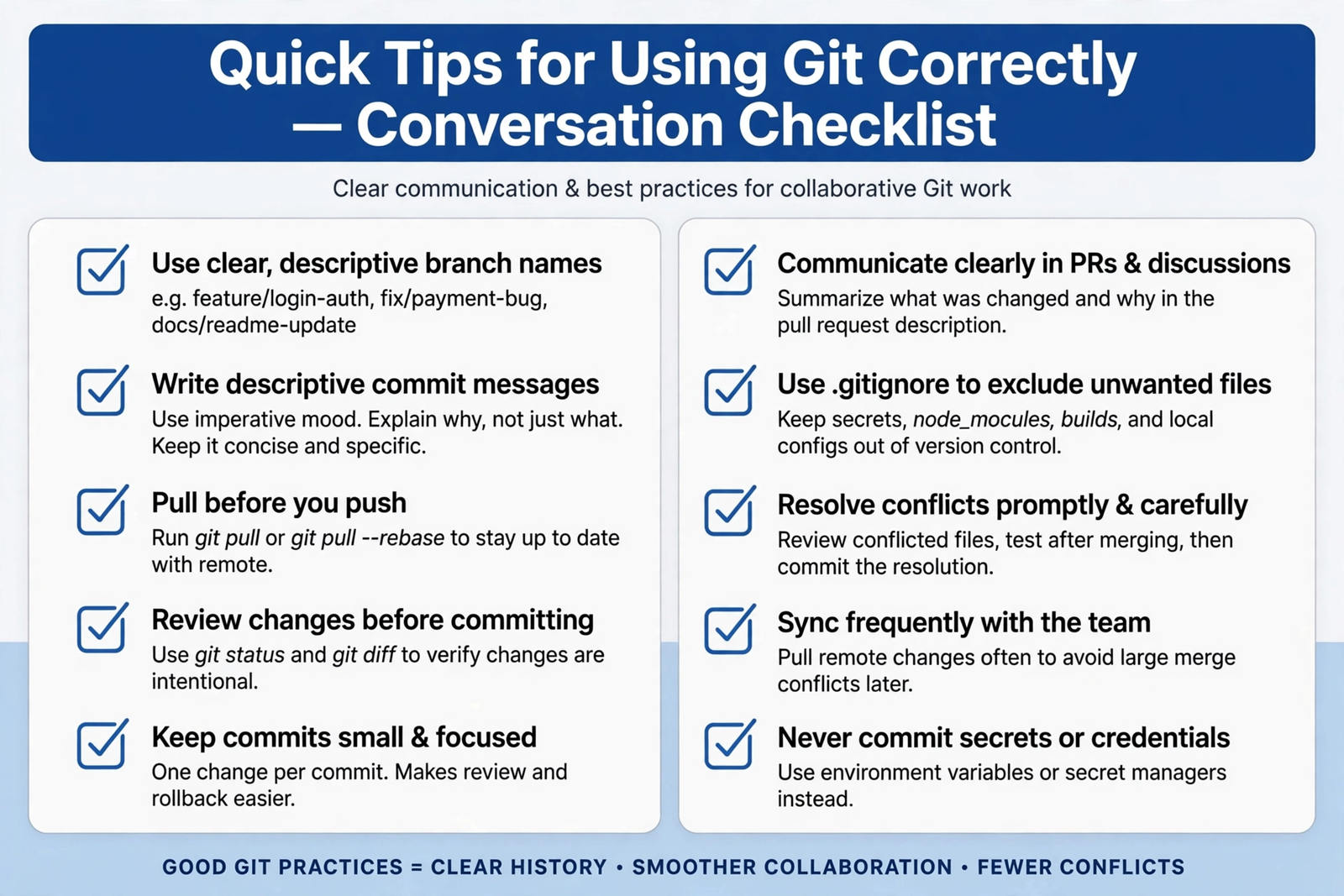
Git is a free, open-source version control system created by Linus Torvalds in 2005. It lets software developers track changes to code, work together on the same project, and undo mistakes. If you have ever heard a developer say “push it to Git” or “commit your changes,” they are talking about the software, not calling anyone a name. GitHub, GitLab, and Bitbucket are platforms built around Git, and millions of developers use them every day.
The name was chosen as a joke: Torvalds has said he names his projects after himself, and “git” in British slang means an unpleasant person — he described himself as an “egotistical bastard” and picked the word deliberately. So the two meanings are connected, but only as a piece of programmer humour.
GIT as an Acronym
In a few niche contexts, GIT is also used as an acronym — for example, in computing education it sometimes stands for “Global Information Tracker” in older course material, and in travel contexts it can mean “Group Inclusive Tour.” These uses are rare, and in everyday conversation you can safely ignore them.
How to Tell Them Apart
- British person, annoyed tone: almost certainly the insult.
- Developer, code, GitHub, repository: almost certainly the software.
- Capital “G” at the start of a sentence about code: software.
- Lowercase “git” with an adjective (“silly git”): the insult.
If you search “git” online, the software dominates the results because the tech world is enormous. That is exactly why people search for the phrase “git slang” — adding “slang” filters out the software and finds the insult meaning. It is a good reminder that context is everything with words that live in two worlds.
Professional or Polite Alternatives
Sometimes you need the meaning of “git” without the insult. Here are polite ways to say the same thing, depending on the situation:
| Instead of “git” | Try saying | Best for |
|---|---|---|
| “Don’t be a git.” | “That’s not very fair.” | Work, school, formal settings |
| “Selfish git.” | “He’s being a bit inconsiderate.” | Polite conversation |
| “Silly git.” | “Silly thing” or “you joker” | Friendly teasing |
| “Miserable old git.” | “He’s in a bad mood today.” | Describing someone neutrally |
| “Lucky git!” | “Lucky you!” | Any setting, including formal ones |
| “Cheeky git.” | “Cheeky monkey” or “you’re bold!” | Playful, family-friendly |
For a quick message of thanks or warmth, by contrast, you might reach for something positive entirely — our guide to tysm meaning covers one of the friendliest abbreviations in texting. The point is simple: “git” is a tool for informal moments, and every informal word has a formal cousin for the moments that matter.
Common Mistakes When Using Git
Because “git” is mild and funny, people sometimes assume it is harmless everywhere. It usually is — but these mistakes catch learners out:
- Using it with strangers: With friends, “git” is a joke. With someone you just met, it can sound genuinely rude. Save it for people who know your tone.
- Confusing it with the software: Telling a developer “you git” as a joke lands differently in a code review than in a pub. In tech settings, assume “git” means the software unless the context is clearly social.
- Thinking it is American slang: It is not. Americans will understand it from television, but they rarely use it themselves, so it can sound like an affectation if you force it.
- Overusing it: Like any catchphrase, “git” loses its charm if you say it ten times a day. Use it sparingly and it stays funny.
- Pairing it with the wrong adjective: “Lucky git” is friendly; “stupid git” is not. The adjective does the emotional work, so choose it carefully.
- Using it in formal writing: It has no place in essays, job applications, or official emails. It is a spoken, informal word.
- Assuming it is a swear word: It is not classed as profanity in the UK, and it appears in daytime television — but it is still an insult, so don’t use it to a teacher, a police officer, or your boss’s boss.

Quick Tips for Using Git Correctly
- Start with the friendly forms: “Lucky git” and “jammy git” are the safest ways to try the word out — they are almost always taken as compliments.
- Match your audience: Use it with British friends, family, and people who enjoy British comedy. Skip it with strangers and in formal settings.
- Let the adjective lead: The word before “git” sets the tone. “Silly” softens it; “selfish” sharpens it.
- Watch British shows: Sitcoms and panel shows are the best classroom for hearing how “git” sounds in real, natural speech.
- Keep it spoken: It works best out loud, where tone of voice makes the joke clear. In writing, add context or an emoji so it reads as playful.
- Don’t force it: If it does not come naturally, leave it. Forced slang always sounds worse than no slang.
- Know the software meaning: If someone mentions Git, GitHub, or repositories, they are talking about code — smile, nod, and save your insult for later.
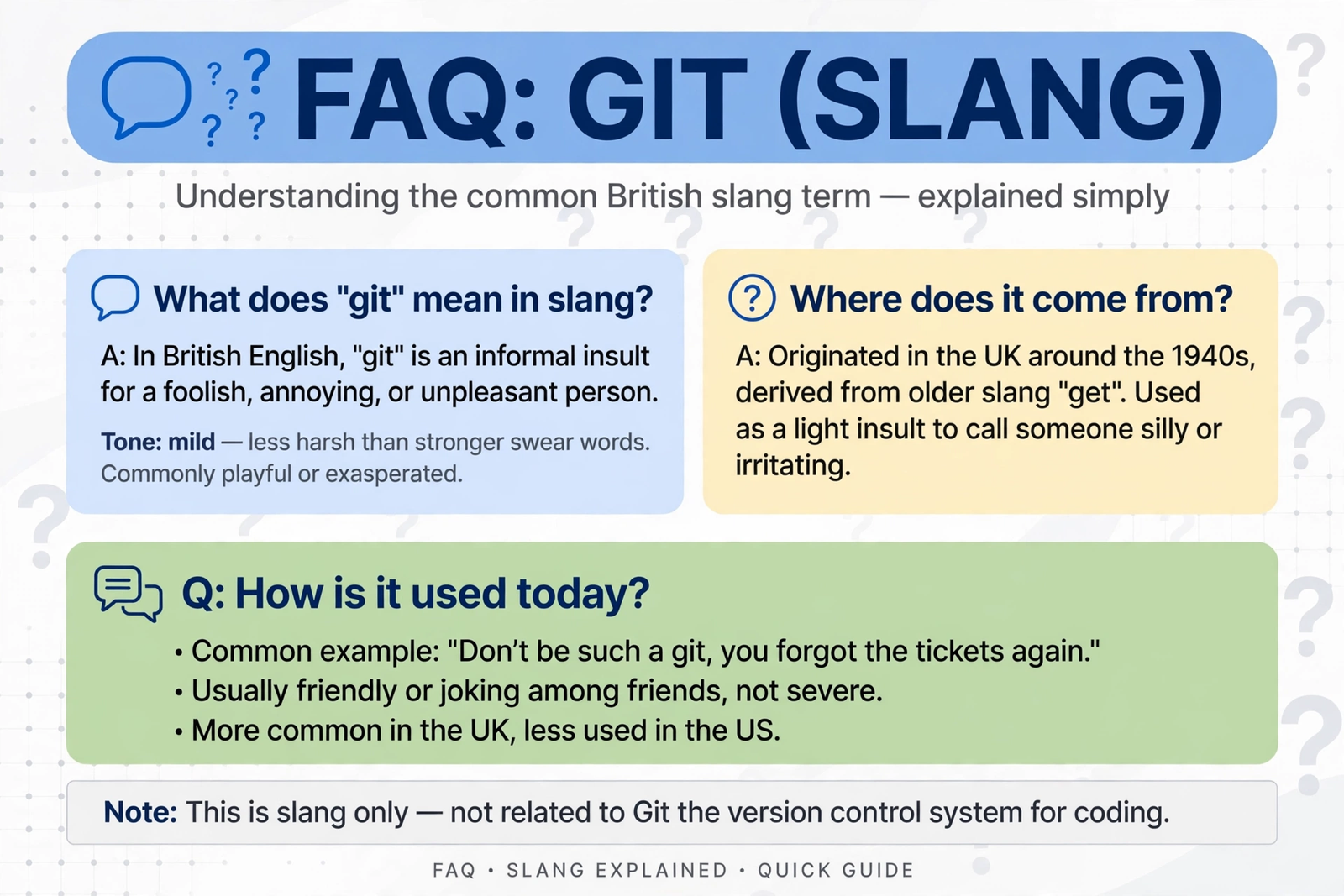
FAQ
What does git mean in slang?
In British slang, “git” means an unpleasant, annoying, or foolish person — similar to “jerk” in American English. It is a mild insult, often used playfully between friends, as in “Don’t be such a git” or “You lucky git.”
Is git a swear word?
No, “git” is not classed as a swear word in the UK. It is a mild insult that appears regularly on daytime television and in family-friendly comedy. It is rude enough to express frustration but polite enough for most everyday situations.
Is git rude or offensive?
It depends on context. Between friends it is usually affectionate teasing. Said angrily to a stranger, it is rude. The adjectives around it — “silly git” versus “selfish git” — decide how offensive it feels.
What does “you lucky git” mean?
“You lucky git” is a playful, envious compliment. It means someone got something good — a win, a bargain, a stroke of luck — and you wish it had happened to you. It is almost always friendly.
Where does the word git come from?
Most etymologists trace “git” to the older northern English and Scots insult “get,” meaning an unpleasant or contemptible person. The spelling shifted from “get” to “git” in the early 20th century, and the word softened over time as it became common in comedy and everyday speech.
Do Americans use the word git?
Americans understand “git” from British television and films, but they rarely use it in everyday speech. In the US, the closest equivalents are “jerk” and “idiot.” Using “git” in America usually marks you as a fan of British comedy.
What is the difference between git and Git the software?
They are two different words that happen to share a spelling. In slang, “git” is a British insult for an unpleasant person. In technology, Git is a version control system created by Linus Torvalds in 2005 for tracking changes in code. Context — a pub versus a code repository — makes the meaning clear.
Can I call someone a git at work?
It is best avoided in formal work settings. In casual chat with colleagues you know well, a light “don’t be a git” might pass, but in meetings, emails, or with senior staff, use a neutral word like “difficult” or “unreasonable” instead.
Conclusion
The git slang meaning is simple, but the word itself is a small piece of British cultural history: a mild insult that has survived for over a century because it is funny, flexible, and just rude enough. It can tease a friend, envy a lucky winner, or dismiss a selfish stranger — and it can do all of that without ever crossing into genuinely offensive language. That balance is rare, and it is why “git” is still going strong while countless trendier words have vanished.
The key things to remember are straightforward. Use it informally, with people who know your tone. Let the adjective in front of it do the emotional work — “lucky git” is a compliment, “selfish git” is not. And always check the context: in a room full of developers, “git” probably means the software, not the insult.
British slang is full of words like this — playful, layered, and very hard to learn from a dictionary alone. Keep exploring, keep listening to how native speakers actually use them, and the next time someone calls you a git, you will know exactly whether to laugh, apologise, or say, “Takes one to know one.” For a broader tour of how internet slang keeps evolving, our Gen Z slang 2024 guide is a great next stop — and for the classic texting abbreviations, the fn meaning in text article explains another word that changes completely with context.

2 thoughts on “Git Slang Meaning: What Does Git Mean in Slang? Origins, Examples & Usage”