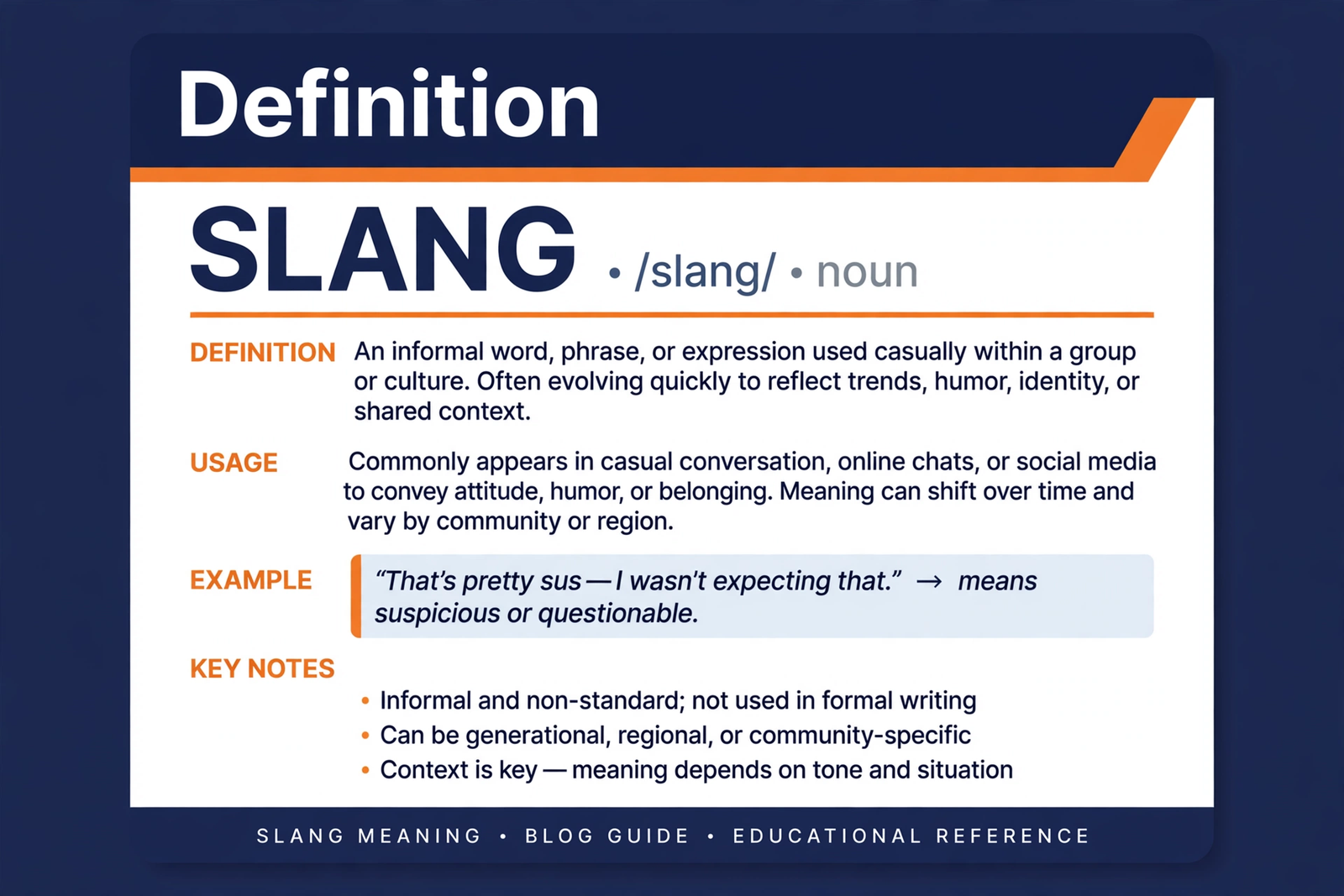
Quick definition: Kike is an offensive ethnic slur used against Jewish people. In slang and texting, the term “kike slang” usually refers to people searching for what the word means, where it came from, and why it is considered one of the most insulting words in the English language. It is not casual slang, it is not a compliment, and it is not a word to use in conversation.
Kike Slang Meaning & Definition
The word kike is a derogatory noun that targets Jewish people. When someone searches for “kike slang” or “kike meaning in text,” they are almost always trying to understand a word they saw online, in a meme, in a comment section, or in a text message. The short answer is simple: it is a slur, and it carries a long history of hate behind it.
Unlike playful internet slang such as “lol” or “tbh,” the word kike belongs to a different category entirely. It was created to insult and dehumanize. There is no friendly version of it, no joking version that makes it harmless, and no context in which calling someone a kike is polite. Understanding the word matters precisely because it is so hurtful — knowing what it means helps people recognize hate speech, avoid repeating it by accident, and respond to it correctly when they see it.
In modern texting and social media, the word appears in a few specific places. It shows up in heated arguments where someone reaches for the cruelest insult they can find. It appears in hateful memes and comment threads. It also appears in educational discussions, history lessons, and news reports about antisemitism. Occasionally, people encounter it in older books, movies, or song lyrics and search for its meaning because the context gives them no clue. In every case, the meaning is the same: a slur aimed at Jewish people.
| Term | Meaning | Tone | Safe to Use? |
|---|---|---|---|
| Kike | Offensive slur for a Jewish person | Hateful / derogatory | No |
| Jewish | A person of Jewish faith or heritage | Neutral / respectful | Yes |
| Hebrew | Language or ancient people of Israel | Neutral | Yes |
| Semitic | Relating to Semitic peoples or languages | Neutral / academic | Yes |
Introduction
Every day, thousands of people search for the meanings of slang words they encounter online. Most of the time, the word turns out to be harmless — a new abbreviation, a TikTok trend, or a piece of Gen Z humor. Every now and then, though, the search leads to a word with a much darker story. Kike is one of those words.
If you found this article because you saw the word in a text, a comment, or a video, you did the right thing by looking it up before using it. Many slang terms are confusing precisely because their real meaning is hidden behind a short, unfamiliar spelling. Kike looks like it could be a nickname, a typo, or a piece of internet humor. It is none of those things. It is a word with more than a hundred years of hateful history, and understanding that history is the best way to make sure you never use it by mistake.
This guide explains the kike slang meaning in plain language: what the word means, where it came from, how it is used today, how it compares to other terms, and what to say instead. It also answers the most common questions people ask about it, so you can leave with a complete and honest understanding. If you want to understand how slang spreads online in general, our middle school slang guide breaks down 40+ words teens use every day.

Origin
The origin of the word kike is tied to the history of Jewish immigration to the United States in the late 19th and early 20th centuries. Most historians and etymologists trace it to the Yiddish word “kikel,” which means “circle.” The most widely repeated explanation is connected to Ellis Island, the immigration station in New York Harbor where millions of newcomers arrived between 1892 and 1954.
According to this account, Jewish immigrants who could not write were asked to sign their names with an “X” on entry papers. Many refused to use an X because they associated it with the cross, a Christian symbol. Instead, they drew a small circle — a “kikel” in Yiddish. Immigration officials and other newcomers reportedly began calling these immigrants “kikels,” and over time the word was shortened to “kike” and turned into a slur.
Historians note that this story, while widely told, is difficult to prove in every detail. What is certain is the timeline: the word first appears in American English in the early 1900s, and by the 1910s and 1920s it was already established as a derogatory term for Jewish people. It spread quickly through American cities with large Jewish immigrant communities, such as New York, and from there into wider American English.
During the 20th century, the word was used openly in discriminatory contexts — in housing, employment, clubs, and schools that excluded Jewish people. It appeared in political propaganda and in the language of hate groups. After World War II and the Holocaust, the word became even more strongly associated with antisemitism, and its use in polite society collapsed. Today it survives mainly as a marker of hate speech, instantly recognizable as a slur.
Popularity
It is strange to talk about the “popularity” of a slur, because its spread is not like the spread of a fun internet trend. But search data shows that people look up the word kike regularly, and there are clear reasons for that pattern.
- Online arguments: The word still surfaces in comment sections, gaming chats, and social media arguments, where people use extreme insults to provoke a reaction.
- Memes and shock content: Some meme communities use slurs deliberately to shock, and viewers who do not recognize the word search for its meaning.
- Music and media: The word appears occasionally in older songs, films, and books. A viewer or listener who encounters it out of context looks it up.
- News and education: Reports about antisemitic incidents, hate-crime statistics, and history lessons all mention the word, prompting searches from readers and students.
- Curiosity and caution: Many searches come from people who saw the word and want to confirm whether it is offensive before repeating it.
Unlike viral slang that spikes for a week and disappears, searches for kike slang stay steady over time. That is because the word is not a trend. It is a permanent part of the English language’s history of prejudice, and every new generation of internet users eventually encounters it and needs to understand it. For a lighter example of how slang evolves online, see our guide to trifling slang — a word that picked up new meanings on TikTok and in chats. You can also read a fuller account of this word’s history on Wikipedia’s page on the term.
How It Is Used
In texting and online slang, the word kike is used in a very narrow set of ways, and almost all of them are hostile. Understanding these patterns helps you recognize the word when it appears and respond appropriately.
As a direct insult: The most common use is as a noun aimed at a Jewish person or at someone the speaker believes to be Jewish. Example: someone in an argument calls another user the word to attack their identity rather than their argument. This is hate speech, not banter.
As a general insult: Sometimes the word is thrown at people who are not Jewish at all, simply because the speaker wants the most offensive word available. This does not make it less of a slur — it shows the speaker is using a word rooted in hatred as a generic weapon.
In hateful jokes and memes: Some online communities use the word in memes that mock Jewish people, Jewish culture, or antisemitic conspiracy theories. The “joke” framing does not remove the hate; it is a way of spreading slurs while pretending it is humor.
In quotations and discussions: The word also appears in legitimate contexts — news reports quoting hate speech, history classes, documentaries, and articles like this one. In these cases it is being discussed or quoted, not used as an insult. There is an important difference between explaining a slur and aiming it at a person.
What it is never used as: The word has no affectionate meaning, no reclaimed casual use in mainstream culture, and no neutral sense. Unlike some other slurs that certain communities have reclaimed for in-group use, kike has no widely accepted reclaimed usage. Even within Jewish communities, it is generally avoided except when discussing the word itself.
Examples
Because the word is a slur, real-world examples of it in use are usually examples of harassment. The examples below are presented for recognition and education only — they show the contexts in which you are most likely to encounter the word so you can identify it and respond correctly.
Examples in Text Messages and Chats
- An argument in a group chat escalates, and one person replies with the slur instead of addressing the point being made. The message is meant to hurt, not to communicate.
- A stranger in a gaming lobby types the word at another player after losing a match. This is a common pattern: anonymous users reaching for identity-based insults when frustrated.
- Someone receives a message containing the word from an unknown number. In most cases this is harassment, and the right response is to block the sender and report the message.
Examples in Online Arguments
- A political debate in a comment section turns personal, and one commenter uses the word against a Jewish public figure or another commenter they assume is Jewish.
- A user posts an antisemitic conspiracy theory and uses the slur repeatedly throughout the post to describe Jewish people as a group.
- A troll account uses the word as a username, bio, or hashtag to provoke reactions and attract attention from hateful communities.
Examples in Media and Pop Culture
- The word appears in historical films and television shows set in the early 20th century, where it reflects the open prejudice of that era.
- It is quoted in documentaries about the Holocaust and the history of antisemitism in America.
- Some older comedy routines and songs used the word casually at a time when such language was more common in public entertainment. Modern audiences usually find those moments shocking, which is itself a sign of how much public attitudes have changed.
Comparison with Similar Terms
To understand the kike slang meaning fully, it helps to compare it with related words — both other slurs and the neutral terms people should use instead. The table below lays out the key differences.
| Word or Term | What It Means | Offensive? | When It Appears |
|---|---|---|---|
| Kike | Slur for a Jewish person | Yes — always | Insults, hate speech, historical quotes |
| Hebe | Shortened slur from “Hebrew” | Yes | Insults, older slang |
| Yid | From Yiddish; a slur in English, though used neutrally in Yiddish itself | Yes, in English | Insults, some reclaimed in-group use |
| Jewish | A person of Jewish faith or heritage | No | Everyday, respectful language |
| Antisemitism | Hatred of or prejudice against Jewish people | No — it describes the prejudice | News, education, discussion |
| Zionist | Supporter of Jewish national self-determination / Israel | No, though sometimes misused as an insult | Political discussion |
The most important comparison is between kike and the neutral word “Jewish.” There is never a situation where kike is the correct or necessary word when “Jewish” is available. The slur adds no information — it only adds hatred. The same is true of the other slurs in the table: each one exists only to insult, while neutral language already covers the meaning completely.
It is also worth noting how kike compares to other ethnic slurs in English. Like them, it began as an outsider’s label, was used to justify discrimination, and is now recognized as hate speech. The pattern is consistent across languages and cultures: a word invented to dehumanize a group, used by people outside that group, and rejected by the people it targets. For contrast, a harmless word with layered meanings is covered in our vanilla meaning slang guide.
Alternate Meanings
Does the word kike have any other meaning besides the slur? In practical terms, no. There is no harmless alternate definition in common use, and that is part of what makes the word so clear-cut.
- No alternate slang meaning: Unlike words such as “bad” or “sick,” which developed positive slang senses, kike never gained a second, neutral meaning.
- Similar spellings: The word is sometimes confused with “kik,” a messaging app, or with “kick” in fast typing. These are unrelated words, and context usually makes the difference obvious. If someone writes “kik me” they almost certainly mean the app, not the slur.
- Yiddish roots: The related Yiddish word “kikel” (circle) is a neutral word in Yiddish itself, but the English borrowing “kike” carries only the slur meaning. Knowing the etymology explains where the word came from; it does not make the English word acceptable.
- Historical quotations: The only other context in which the word appears is in historical documents, literature, and academic discussion of antisemitism. In those cases the word is being cited as evidence of prejudice, not used as a normal word.
If you see the word used in a context that seems friendly or neutral, look closer. It is almost always either a typo for another word, a quote from a historical source, or someone using a slur while pretending it is a joke.
Professional or Polite Alternatives
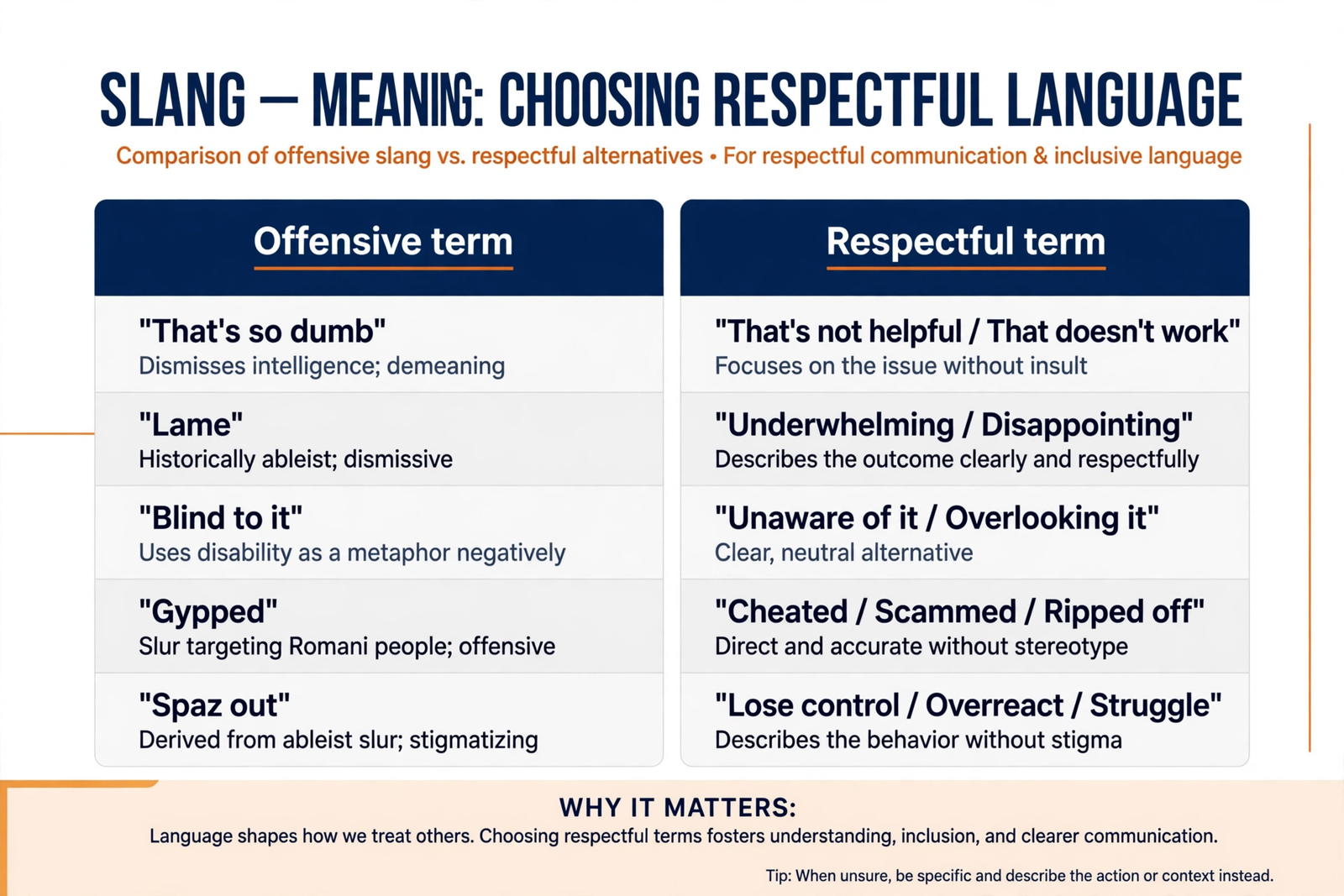
There is nothing the slur expresses that neutral language cannot express better. Here are the correct alternatives for every situation.
- Referring to a person: Say “Jewish person,” “Jewish man,” “Jewish woman,” or simply use the person’s name. “Jewish” is the respectful adjective and noun.
- Referring to the community: Say “the Jewish community,” “Jewish people,” or “Jews” — the last of these is a standard, neutral term when used respectfully in context.
- Referring to the religion: Say “Judaism” for the faith, and “Jewish” for things relating to it, such as “Jewish holidays” or “Jewish traditions.”
- Referring to the language: Say “Hebrew” or “Yiddish” as appropriate. Hebrew is the ancient and modern language of Israel; Yiddish is the historical language of Ashkenazi Jews.
- Discussing the word itself: If you need to talk about the slur — for example, in a classroom or when reporting harassment — you can say “the k-word” or “an antisemitic slur” instead of spelling it out. Many style guides recommend this approach in general writing.
- In formal or workplace writing: Use “Jewish” exclusively. There is no professional context in which the slur belongs in a document, email, or message.
Choosing the respectful term is not about political correctness. It is about accuracy and basic respect. “Jewish” describes the person; the slur only describes the speaker’s prejudice.
Common Mistakes
People make several mistakes with this word, and most of them come from not knowing what it means. Here are the most common ones — and how to avoid them.
Mistake 1: Assuming it is harmless slang. Because the word is short and unfamiliar to many people, some assume it is a new piece of internet slang like “yeet” or “slay.” It is not. It is a century-old slur, and using it causes real harm even when the speaker does not intend any.
Mistake 2: Repeating it to be funny. Some people repeat slurs they hear online because it gets a reaction. Shock value is not humor, and repeating a slur spreads it to more people. If a word’s only effect is to offend, it is not a joke.
Mistake 3: Using it as a generic insult. Throwing the word at someone who is not Jewish does not make it harmless. The word’s meaning does not change based on the target — it is still a slur aimed at Jewish people, and using it still spreads hate.
Mistake 4: Quoting it without context. Even when discussing the word, spelling it out repeatedly is unnecessary. In most writing, “the k-word” or “an antisemitic slur” communicates the same point without repeating the insult.
Mistake 5: Confusing it with similar words. Fast typing can turn “kick” into “kike,” and the messaging app “Kik” looks similar. If you meant one of those words, correct the typo quickly so nobody misunderstands you.
Mistake 6: Ignoring it when you see it. If someone uses the word to harass a person online, ignoring it is understandable — but reporting it helps. Most platforms have clear rules against slurs and hate speech, and a report takes seconds.

Quick Tips
- Do not use the word. There is no context in which you need it. “Jewish” covers every legitimate meaning.
- If you see it in a message, do not forward it. Forwarding spreads the slur further. Screenshot it for a report if needed, then delete it.
- If someone calls you the word, report and block. You do not owe the person a debate. Use the platform’s report tools and move on.
- If a friend uses it, tell them plainly. A short message works: “That word is an antisemitic slur — please don’t use it.” Many people genuinely do not know, and one clear correction is enough.
- Teach children the respectful term only. Kids who learn “Jewish” as the normal word have no reason to ever pick up the slur.
- When discussing the word, use “the k-word.” It keeps the conversation clear without repeating the insult.
- Check before you quote. In school or work writing, quote slurs only when the assignment or report genuinely requires it, and prefer a euphemism otherwise.
- Learn the history. Understanding where slurs come from makes it easier to recognize new ones and to explain to others why they matter.

FAQ
What does kike mean in slang?
In slang and texting, kike is an offensive ethnic slur for a Jewish person. It is not casual slang and has no friendly or neutral meaning. People usually search for “kike slang” after seeing the word in a comment, meme, or message and wanting to know whether it is insulting — it is.
Is kike a bad word?
Yes. It is considered one of the most offensive slurs in English. It is classified as hate speech by most social media platforms, and using it to target someone can lead to account suspensions, bans, or disciplinary action at school or work.
Where did the word kike come from?
The word most likely comes from the Yiddish word “kikel,” meaning “circle.” According to a widely told account, Jewish immigrants at Ellis Island signed entry papers with a circle instead of an X, and the word “kikel” was shortened to “kike” and turned into a slur in the early 1900s.
Can Jewish people use the word kike?
Unlike some slurs that have been reclaimed by the communities they target, kike has no widely accepted reclaimed use, even within Jewish communities. Most Jewish people consider it offensive regardless of who says it, and it is best avoided by everyone.
What should I say instead of kike?
Say “Jewish person” or “Jewish people.” If you are discussing the word itself, say “the k-word” or “an antisemitic slur.” There is no meaning the slur carries that the respectful term does not already cover.
Is it okay to use kike in a joke?
No. Using a slur as a joke still spreads it and still hurts the people it targets. The people hearing the “joke” cannot tell whether you mean it, and Jewish people who hear it experience it as hate speech, not humor.
What should I do if someone calls me kike online?
Do not engage with the person. Take a screenshot for evidence, report the message or account using the platform’s reporting tools, and block the sender. If the harassment continues or includes threats, save the evidence and contact local law enforcement or an organization that tracks hate incidents.
Why do people still search for kike slang?
People search for it because they encounter the word in arguments, memes, music, movies, or news reports and want to understand it. Searches stay steady over time because every new generation of internet users eventually comes across the word and needs an honest explanation of what it means and why it is offensive.

Conclusion
The kike slang meaning is straightforward, even if its history is painful: it is an ethnic slur aimed at Jewish people, with roots in early 20th-century immigration and a long record of use in discrimination and hate. It has no friendly sense, no neutral sense, and no reclaimed sense. It is a word that exists only to insult.
The good news is that avoiding it is easy. The respectful word — “Jewish” — is shorter, clearer, and accurate in every situation. If you saw this word online and looked it up, you have already done the right thing. Now you know what it means, where it came from, and why it matters. Share that knowledge when you see someone else use the word without understanding it, report it when it is used to harass, and keep your own language respectful. That is how a word like this loses its power — one person at a time, by choosing not to repeat it. Keep building your slang vocabulary the safe way with our guide to GTS meaning slang.
