
Quick definition: In slang, nerfed means something has been deliberately weakened or made less powerful — usually a weapon, character, or ability in a video game after a balance update. If your favourite gun suddenly deals less damage after a patch, it got nerfed. Outside gaming, people now use the word for anything that lost its strength, from a phone feature to a school lunch menu.
nerfed meaning slang & Definition
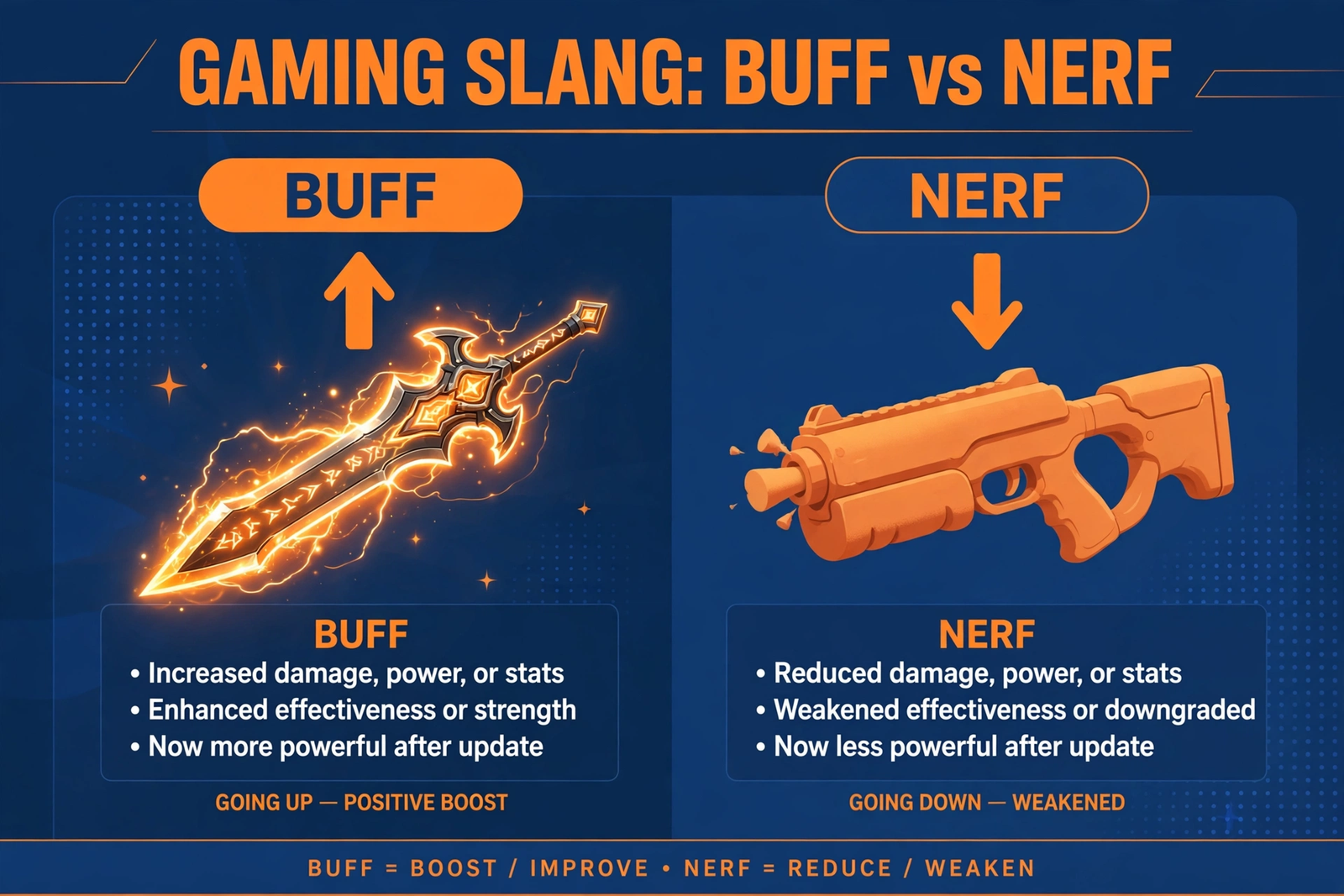
The nerfed meaning slang is simple once you know the picture behind it: imagine a powerful sword being swapped for a soft foam toy sword. That is exactly what happens when developers “nerf” something in a game. A nerfed weapon, character, spell, or strategy used to be strong — sometimes too strong — and a game update has reduced its power on purpose to keep the game fair.
Here is the definition in one line: nerfed (verb, past tense of “nerf”) means weakened, downgraded, or reduced in effectiveness by the people in charge, usually through a software patch or a rule change.
The word comes from Nerf, the famous brand of foam toys — foam dart guns, foam balls, and foam swords that look impressive but cannot hurt anyone. When gamers in the late 1990s complained that their swords felt like foam toys after a game update, the joke stuck, and “nerfed” became permanent gaming vocabulary. Today the term has escaped gaming completely. You will hear it on TikTok, in group chats, in sports talk, and even in offices — anywhere something that used to hit hard now hits soft.
So when someone asks “what does nerfed mean in slang?”, the short answer is: made weaker on purpose. Keep reading for the full story — the origin, real examples, comparisons with similar words like “buff” and “OP”, and the mistakes to avoid when you use it yourself.
Introduction
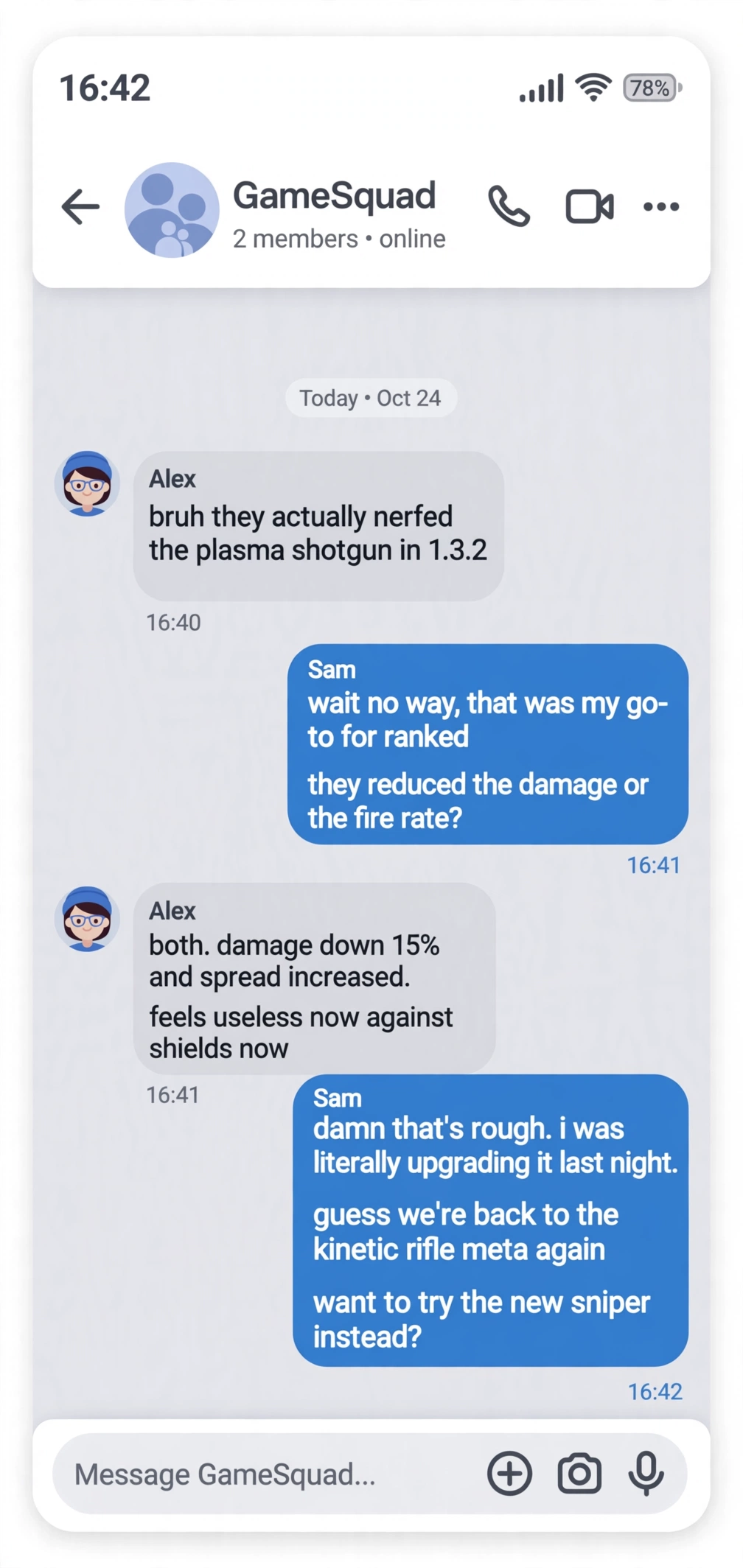
Picture this: you spend three weeks grinding to unlock the best rifle in your favourite shooter. It melts enemies, wins matches, and makes you feel unstoppable. Then one Tuesday morning a patch drops, and suddenly that same rifle takes twice as many bullets to finish a fight. Your group chat explodes. “Bro, they nerfed my gun!” “RIP, it’s nerfed now.” Nobody is talking about foam toys — but everybody understands exactly what happened.
That moment is why the nerfed meaning slang matters far beyond hardcore gamers. Gaming words have become the internet’s shared language. Just like dub travelled from gaming wins into everyday TikTok captions, “nerfed” travelled from patch notes into normal conversation. A creator whose reach drops after an algorithm change says their account got nerfed. A student whose favourite cafeteria meal shrank says the menu got nerfed. A phone update that removes a beloved feature? Nerfed.
In this guide, you will learn the exact nerfed meaning slang, where the word came from, how gamers and non-gamers use it differently, and how to use it naturally without sounding forced. We will compare it with its opposite — “buff” — and with lookalike terms such as “debuff”, “OP”, and “patched”. You will also get real example sentences for friendly chats, professional settings, and funny situations, plus a FAQ that answers the questions people actually search for. By the end, you will not only know what nerfed means — you will know exactly when to say it.

Origin of Nerfed
The story of “nerfed” starts in 1997 with a game most of today’s players have never touched: Ultima Online, one of the first massively multiplayer online role-playing games (MMORPGs). In the early days of the game, the developers reduced the power of swords in melee combat. Players were not happy, and they started joking that they were now “hitting each other with Nerf swords” — soft, harmless foam instead of deadly steel.
Lead developer Raph Koster later confirmed the story on his personal blog: “For the record, the term ‘nerfing’ entered online gaming vocabulary because of Ultima Online. At some point, we reduced the power of swords in melee combat, and players started complaining that they were hitting each other with Nerf swords.” The joke was so perfect that it spread from forum to forum, game to game, until “nerf” became the standard verb for weakening anything in a game.
A few facts make the origin even more interesting:
- The toy came first: The Nerf brand launched its famous foam ball in 1969, created by Parker Brothers and later owned by Hasbro. The toys were designed to be safe, soft versions of real sports equipment.
- The acronym is a myth: Some people claim NERF stands for “non-expanding recreational foam”. That is a backronym — a clever phrase invented after the fact. Nobody actually knows where the brand name came from.
- It reached the mainstream press early: The term appeared in The New York Times as early as 2002, in an interview with Gaute Godager, lead developer of the sci-fi MMORPG Anarchy Online.
- The opposite was born alongside it: While “nerf” means to weaken, “buff” means to strengthen — and both words grew out of the same balance debates in early online games.
For the full documented history of the term, including the original forum posts and memes, see the entry on Know Your Meme’s Nerf page, which tracks how the word spread from Ultima Online into every corner of gaming culture.
Why Nerfed Became So Popular
Why did one little gaming joke become a word that millions of people use every day? Three reasons explain the rise of the nerfed meaning slang.
1. Every game does it. Balancing is a permanent part of live games. Fortnite, Call of Duty, League of Legends, Valorant, Apex Legends, Clash Royale — every competitive game regularly weakens overpowered items in patches. That means players encounter a nerf every few weeks, and each time the word gets used thousands of times in chats, streams, and patch-note reactions.
2. It is the perfect complaint word. “They reduced the damage output of this weapon by 12% in version 4.2” is a patch note. “They nerfed my gun!” is a feeling. The word packs frustration, nostalgia for how strong something used to be, and a little humour into a single syllable. That is why it survives while the technical language around it changes.
3. It escaped gaming. Like “NPC”, “AFK”, “clutch”, and “grind”, “nerfed” jumped from game chat into real life. Social media made the jump easy: a short video about an app update, a school rule, or a fast-food recipe change can all be captioned “they nerfed it”. Once a word works outside its original world, it stops being jargon and becomes slang — and slang is exactly what this guide is about.
Today, “nerfed” shows up in places the Ultima Online players of 1997 could never have imagined: sports commentary (“the new ball nerfed home runs”), tech reviews (“the update nerfed the battery life”), cooking videos (“they nerfed the recipe”), and even workplace jokes (“management nerfed our lunch break”). The word is no longer only for gamers — it belongs to everyone who has ever watched something good get weaker.
How Nerfed Is Used
The nerfed meaning slang stays the same in every context — something got weaker — but the tone changes depending on where you hear it. Here are the four main ways people use it.
In Video Games
This is the original and still the most common use. A nerf happens when developers release a patch or update that reduces the power of a weapon, character, ability, map position, or strategy. Players say “they nerfed the shotgun”, “the new patch nerfed healing”, or “my main got nerfed again”. The word almost always carries a complaint, because nobody celebrates their favourite thing getting weaker — though players do celebrate when an opponent’s overpowered weapon gets nerfed.
On TikTok and Social Media
On TikTok, “nerfed” describes any downgrade, real or joking. A creator might say “TikTok nerfed my reach” after a video underperforms, or “they nerfed the school lunch” over a photo of a tiny portion. The gaming origin is part of the joke: treating everyday disappointments like a game patch makes them funnier and more shareable.
In Everyday Conversation
Outside the screen, people use “nerfed” for anything that lost power or quality. “The new update nerfed my phone’s camera.” “The gym nerfed the smoothie sizes.” “Rain nerfed our picnic plans.” In this casual use, it simply means “made worse or weaker”, and listeners understand it even if they have never played a video game.
In Sports and Pop Culture
Commentators and fans borrow the word too. A rule change that reduces scoring, a ball that flies less far, or a star player returning from injury at half strength — all of these can be described as “nerfed”. It is a vivid shortcut: everyone instantly pictures something powerful becoming soft and harmless.
| Context | What “nerfed” means there | Example |
|---|---|---|
| Gaming | Developers weakened an item or character in a patch | “They nerfed the sniper rifle again.” |
| TikTok / social media | An app, algorithm, or trend made something worse | “TikTok nerfed my reach this week.” |
| Everyday life | Something lost strength, size, or quality | “They nerfed the portion sizes here.” |
| Sports | A rule or change reduced performance | “The new ball nerfed home runs.” |
Examples of Nerfed in Sentences
Real examples are the fastest way to learn a slang word. Here are sentences grouped by tone, so you can see how “nerfed” sounds in a friendly chat, at work, and in a joke.
Friendly Examples
- “Bro, they nerfed my favourite character in the new update. I am actually so sad right now.”
- “Did you see the patch notes? They nerfed the shotgun and buffed the pistol.”
- “My phone battery got nerfed after that update. It barely lasts till lunch now.”
- “No way, they nerfed the cafeteria pizza. It used to be huge!”
- “I swear the Wi-Fi gets nerfed every time it rains.”
Professional Examples
- “The latest update nerfed the export speed, so our renders are taking twice as long now.”
- “After the policy change, our ad reach was effectively nerfed — impressions dropped by 30 percent.”
- “The new pricing tier nerfed several features we relied on, so we will need to upgrade the plan.”
- “The redesign nerfed the checkout flow; fewer users are completing their purchases.”
- “That patch nerfed the tool’s best feature, so the team is looking for a workaround.”
Funny Examples
- “Getting old is just life nerfing your knees one birthday at a time.”
- “Monday nerfed my whole weekend mood in five seconds.”
- “My alarm clock got nerfed — it lets me snooze forever now.”
- “They nerfed the office coffee. It tastes like warm water with confidence issues.”
- “Adulting nerfed my sleep schedule beyond repair.”
Notice the pattern: in every example, something that used to be strong, fast, big, or good is now weaker — and the speaker is at least a little annoyed about it. That feeling is part of the nerfed meaning slang, not just the dictionary definition.
Nerfed vs Similar Terms
“Nerfed” has several close cousins in gaming slang, and mixing them up is the most common mistake new players make. This comparison table clears it up in seconds.
| Term | Meaning | Direction | Example |
|---|---|---|---|
| Nerfed | Made weaker by developers in an update | Down | “They nerfed the rifle’s damage.” |
| Buffed | Made stronger by developers in an update | Up | “They buffed the pistol’s reload speed.” |
| Debuffed | Temporarily weakened by an enemy spell or effect | Down (temporary) | “The boss debuffed my armour.” |
| OP | Overpowered — too strong, needs a nerf | Too strong | “That weapon is so OP right now.” |
| Patched | Changed by an update (could be stronger or weaker) | Either way | “They patched the glitch yesterday.” |
| Weakened | General word for made less strong | Down | “The storm weakened the signal.” |
The key differences are worth remembering. Buff is the exact opposite of nerf — if one goes up, the other goes down, and patch notes usually do both at once. Debuff sounds similar but means something different: it is a temporary weakening caused inside the game (a curse, a poison, a spell), not a permanent change made by developers. OP describes the problem that causes a nerf — when players call something OP, they are usually asking developers to nerf it. And patched is neutral: a patch can buff, nerf, fix, or change anything, so saying “they patched it” tells you nothing about whether it got stronger or weaker.
There is one more pair people confuse: nerfed vs. weakened. “Weakened” is the plain English word and works anywhere. “Nerfed” adds the idea that someone in charge deliberately reduced the power — a developer, a company, a platform. Saying “the update nerfed my battery” implies the update is to blame; “my battery weakened” just states a fact. That blame is exactly why gamers reach for “nerfed” instead of “weakened”.
Alternate Meanings of Nerfed
Like most slang, “nerfed” has picked up a few extra meanings as it spread beyond gaming. None of them contradict the main definition — they are all variations on “made weaker”.
- In tech talk: A feature, app, or device that lost capability after an update is “nerfed”. Example: “The new iOS nerfed the old camera modes.”
- In sports: A player, team, or piece of equipment performing below its old level is “nerfed”. Example: “Injuries have nerfed their defence this season.”
- In school and work: A rule or policy that takes away a perk is described as a nerf. Example: “They nerfed our free snacks — now it is just water.”
- In memes: “Nerfed” is used as a joke label for anything disappointing. A meme might show a powerful movie character next to a weak one with the caption “how they nerfed him in the sequel”.
- As a noun — “a nerf”: Gamers also use “nerf” as a noun for the weakening itself. “That was a huge nerf” means the reduction in power was very large.
One meaning you should not confuse it with: “nerfed” has nothing to do with the toy brand in a literal sense anymore. Nobody who says “my gun got nerfed” is talking about foam darts — the toy is only the origin story, not the current meaning. Similarly, “nerfed” is never a compliment. If something is nerfed, it got worse from the user’s point of view, even if the change was fair or necessary for balance.
Professional or Polite Alternatives
“Nerfed” is casual slang, so it fits group chats, streams, and social media — but it can sound out of place in a formal email or a business meeting. Here are polite alternatives that carry the same meaning without the gaming flavour:
| Instead of “nerfed” | Use this in formal settings | Example sentence |
|---|---|---|
| “They nerfed the feature.” | reduced / scaled back | “The update reduced the feature’s capabilities.” |
| “The update nerfed performance.” | weakened / diminished | “The update diminished overall performance.” |
| “Our reach got nerfed.” | limited / restricted | “The algorithm change limited our reach.” |
| “They nerfed the pricing.” | downgraded | “The new plan downgraded several benefits.” |
| “The tool got nerfed.” | made less effective | “The change made the tool less effective.” |
A good rule: use “nerfed” with friends, teammates, and online audiences who know gaming culture. In a client email, a report, or a presentation, pick “reduced”, “scaled back”, or “diminished” instead. The meaning stays the same — only the register changes. And if you are writing for a mixed audience, like a blog post or a social caption, “nerfed” is usually fine as long as the context makes the meaning clear, exactly like the examples in this article.
Common Mistakes When Using Nerfed
Even native English speakers misuse this word. Avoid these five mistakes and you will sound like someone who actually plays games.
1. Using it for things that were never strong. A nerf only makes sense if something used to be powerful. Saying “my old phone got nerfed” is odd if the phone was always slow. Say instead that it “got slower” — unless an update actually removed a feature it used to have.
2. Confusing nerf with debuff. A debuff is temporary and happens inside the game — a spell that slows you for ten seconds. A nerf is a permanent change made by developers in a patch. “The enemy debuffed me” and “the developers nerfed my character” describe two different things.
3. Saying “nerfed up” or “nerfed down”. “Nerfed” already means “made weaker”, so adding “down” is redundant and “up” is a contradiction. The opposite of nerfed is “buffed”, not “nerfed up”. Just say “nerfed” on its own.
4. Using it as a compliment. “Nerfed” is always negative from the user’s side. Never say “they nerfed it, thank goodness” about your own favourite weapon — unless you are joking. If the change was good for the game, say “they finally balanced it” instead.
5. Overusing it for every small change. If a patch only changes a weapon’s colour or fixes a typo, that is not a nerf. Save the word for real reductions in power, or it loses its punch. The same goes for everyday use: if your coffee is slightly different today, it was not nerfed — it was just different.

Quick Tips for Using Nerfed Correctly
- Check the direction: Weaker = nerfed. Stronger = buffed. If you are not sure which way the change went, check the patch notes before you complain.
- Name what changed: “They nerfed the damage” is clearer than “they nerfed it”. Always say what got weaker — the weapon, the character, the feature, the portion size.
- Match your audience: Gamers will love it; your boss in a formal report will not. Switch to “reduced” or “scaled back” at work.
- Use the past tense for the event: “It got nerfed in the last patch” (the change already happened). Use the present for ongoing complaints: “They keep nerfing my main.”
- Pair it with “buff” for contrast: “They nerfed the rifle but buffed the shotgun” is the classic patch-note sentence, and it shows you understand game balance.
- Keep it playful outside gaming: In everyday talk, “nerfed” works best as a light joke — “they nerfed the office snacks” — not as a serious complaint. The humour is half the point.
- Do not force it: If the sentence works just as well with “weakened” or “reduced”, use the plain word. Slang lands best when it feels natural, not when it is squeezed in.

FAQ

What does nerfed mean in slang?
In slang, “nerfed” means deliberately weakened or made less powerful. It started in gaming, where developers reduce a weapon, character, or ability’s power in a patch. Now people also use it for anything that lost strength or quality, like a phone feature after an update or a smaller food portion.
Where did the word nerfed come from?
It comes from the Nerf brand of foam toys. In 1997, players of the game Ultima Online joked that their swords felt like foam Nerf swords after developers reduced their power. Lead developer Raph Koster confirmed the story, and the term spread through gaming forums into everyday slang.
What is the opposite of nerfed?
The opposite of nerfed is buffed, which means made stronger. When developers release a balance patch, they usually nerf overpowered items and buff underpowered ones at the same time to keep the game fair.
What does nerfed mean in TikTok slang?
On TikTok, “nerfed” means something got downgraded or made worse, usually as a joke. Creators say “TikTok nerfed my reach” when a video underperforms, or “they nerfed the school lunch” over a small portion. It borrows the gaming meaning and applies it to everyday disappointments.
Is nerfed the same as debuffed?
No. A nerf is a permanent weakening made by developers in a game update. A debuff is a temporary weakening that happens inside the game, like a curse or poison spell that wears off. Nerfs change the game; debuffs are part of playing it.
Can nerfed be used outside gaming?
Yes. People now use “nerfed” for anything that lost power or quality — a phone update that removes features, a recipe that gets smaller, a rule that takes away a perk. As long as something used to be stronger and is now weaker, “nerfed” works.
What does “they nerfed my main” mean?
“My main” is the character a player uses most. “They nerfed my main” means the developers weakened that character in the latest patch, so the player is upset because their favourite way to play just got worse.
Is nerfed a bad thing?
From a player’s point of view, yes — a nerf makes something you like weaker. But for the game as a whole, nerfs are usually good: they fix overpowered items, restore fairness, and keep matches competitive. That is why developers nerf things even though players complain every time.
Conclusion
The nerfed meaning slang is one of those rare words that tells a whole story in a single syllable. It started as a joke in 1997, when Ultima Online players compared their weakened swords to foam toys — and it grew into the universal word for anything that got deliberately weaker, from a rifle in a shooter to a feature in a phone update. Remember the core idea: if it used to be strong and now it is soft, it got nerfed. Its opposite is “buffed”, its cousin is “debuffed” (temporary, inside the game), and its cause is usually an “OP” item that needed balancing.
Use it in game chat, on TikTok, and with friends whenever something good gets weaker — just remember the tips: name what changed, do not confuse it with a debuff, and switch to “reduced” or “scaled back” in formal settings. And if you want to keep building your slang vocabulary, check out related gaming terms on this site, like what FT means in text and gaming, git slang, and cooking slang. The next time a patch drops and your favourite weapon feels like a foam sword, you will know exactly what to say: they nerfed it.
