
Quick definition: In short, como meaning slang is the borrowed Spanish word como / cómo used in English-language texts and social media to mean “how,” “as,” or “like.” On its own in a chat, “como?” usually works as a short form of “How?” or “What?” — a quick check-in, a request to repeat something, or a playful sign of confusion. In longer Spanglish sentences it keeps its Spanish grammar, so como quieras means “as you wish” and como siempre means “as always.” The spelling, the accent mark, and the sentence around it decide which meaning you are looking at.
Como Meaning Slang & Definition
At its simplest, como is not an invented internet word. It is Spanish. With an accent, cómo is the interrogative and exclamatory word for “how”: ¿Cómo estás? means “How are you?” and ¡Cómo llueve! means something like “How it is raining!” Without an accent, como is a relative adverb, conjunction, or preposition that usually translates as “as,” “like,” “in the way that,” “approximately,” or “for example.” Lo hice como me dijiste means “I did it as you told me,” and tardó como una hora means “it took about an hour.” The Real Academia Española, the authority on the Spanish language, lists both forms together and explains that the accent is what marks the question or exclamation sense, while the unaccented form does the quiet connecting work in the middle of a sentence.
That distinction matters in slang use because texting drops the accent most of the time. When someone types “como?” in an English-language group chat, they are almost always borrowing the accented ¿Cómo? sense: “How?” They are rarely asking a grammar question. They might mean “How are you?”, “How did that happen?”, “Say that again?”, or simply “What?” The word is short, it looks friendly and a little playful, and in the United States, where Spanish is the second most spoken language, it is familiar even to people who do not speak Spanish fluently. That familiarity is the whole reason it travelled from Spanish conversation into English texting in the first place.
There is also a second, separate Spanish job for como that shows up in slang-adjacent phrases. Como is the first-person present form of the verb comer, “to eat,” so yo como means “I eat.” You will almost never meet that meaning in a lone “como?” text, because the context is completely different, but it is worth knowing if you ever see como inside a sentence about food. The same four letters can be a question word, a comparison word, or a verb, and only the rest of the sentence tells you which one you have.
| Form | What it means | Typical text use |
|---|---|---|
| ¿Cómo? / como? | How? / What? / Huh? | Alone in a chat, asking for repetition or reacting with surprise |
| ¿Cómo estás? | How are you? | A greeting or check-in, often shortened to “como?” or “como stas?” |
| como (no accent) | As, like, in the way that | Inside a phrase: como quieras, como siempre, como sea |
| yo como | I eat | Verb form of comer; only in sentences about eating |
| como si | As if | Como si nada — “as if nothing happened” |
If you are learning the word from social media rather than from Spanish class, the easiest rule is this: a lone “como” with a question mark is a reaction. A “como” buried in the middle of a Spanish phrase is a connector. Both uses are correct Spanish, and both have become normal in the mixed-language chatting that many bilingual and bicultural friend groups use every day. For a wider tour of borrowed Spanish words in English slang, our Spanish slang guide covers the terms that travel together with como, from greetings to teasing insults.
Introduction
You do not need to speak Spanish to meet “como” online. It turns up in a TikTok comment under a confusing video, in a Discord chat when someone misses the joke, in an Instagram reply where a friend is checking in, and in group texts that slide back and forth between English and Spanish without warning. Sometimes it is one word and a question mark. Sometimes it is half a sentence you half understand. Either way, the feeling is the same: someone is asking something, reacting to something, or inviting you to explain, and the shortest possible word is doing all of that work.
This guide untangles como the way a bilingual friend would: the literal Spanish meaning first, then the slang meaning, then the phrases you will actually see, then the mistakes that make native speakers wince. You will get the accent rule that explains most of the confusion, the regional flavors from Mexico to Spain to the US, real examples for friendly chats, work messages, and funny meme replies, and a comparison with the Spanish question words people mix it up with. By the end, you will know when “como?” means “How are you?”, when it means “Excuse me, what?”, and when answering it in English is perfectly fine.

Origin
Como comes from Latin quomodo, meaning “in what way” or “how.” That is a long, unglamorous history for a word that now fits in a four-letter text, but it explains why the word is so flexible. A word that started out asking about manner — how something is done — naturally grew into a word for comparison — as, like, in the same way — because comparisons are really just statements about manner. “Do it like this” and “do it how I showed you” are the same idea from two angles, and Spanish kept one word for both.
The slang story is much newer, and it is really a story about the United States. Spanish is widely spoken across the US, in homes, schools, workplaces, and online communities, and English and Spanish have been mixing in everyday speech for generations. That mixing has a name, Spanglish, and it is not broken Spanish or broken English. It is a normal bilingual habit: you borrow the word that feels fastest, funniest, or warmest for the moment, and your friends, who share both languages, understand it. Como is a perfect borrowing candidate because it is short, it is instantly recognizable, and it carries a tone that “how?” on its own does not quite have. Typing “como?” feels a little more playful, a little more familiar, and a little more like an inside reference than typing “what?”
Memes and short-form video gave that borrowing a much bigger audience. A creator drops “como?” as a reaction in a comment or a caption, viewers who do not speak Spanish pick up the vibe from the context, and the word spreads as a reaction image in text form, much like “huh?” or “excuse me?” spread before it. Slang dictionaries and explainer sites then recorded the texting sense, usually with the same short summary: in texting, “como” is shorthand for “how,” often standing in for “How are you?” or “How?” That summary is accurate as far as it goes, but it leaves out the accent rule, the phrase uses, and the regional differences, which is where most of the real confusion lives. The Real Academia Española entry for como and cómo is the authoritative place to see the full range of senses, from the relative adverb uses to the “approximately” and “for example” senses that rarely make it into slang explainers.
Popularity
Como is popular in a quiet way. It is not a viral word of the year, and it does not have a dance or a hashtag challenge attached to it. Its popularity is the everyday kind: it is useful, so it gets used. Bilingual friend groups use it constantly, often without noticing they have switched languages at all. A text thread can run in English for twenty messages, switch to “como stas?” for a check-in, and switch straight back, and nobody in the thread thinks anything of it. That code-switching is the engine of its spread. Every time a non-Spanish speaker sees “como?” used that way and understands it from context, the word gains one more casual user.
Social media rewards short reactions, and “como?” is an ideal one. It is four letters, it reads as curious rather than rude, and it works under almost any confusing post: a plot twist, a surprising outfit, a claim that needs evidence, a joke that landed sideways. On TikTok and Instagram, you will see it in comments where English speakers are reacting to Spanish-language content, and in captions where creators are deliberately mixing languages for humor or identity. On Discord and in gaming chats, it does the same job as “huh?” or “wait, what?” but with a little more personality. The word also benefits from music and television. Spanish-language songs and shows routinely use ¿Cómo? as an exclamation, and English-speaking viewers absorb the sound and the meaning together, then bring the word into their own chats.
Search interest tells a similar story. People do not search for “como” because it is trending. They search for it because they saw it somewhere, did not quite get it, and want a fast answer before they reply. That is exactly the audience this guide is for. And because como is a real Spanish word with a long dictionary history, not a made-up slang coinage, the answer is stable: learn the two forms, learn the common phrases, and you will recognize it everywhere. Regional slang works the same way everywhere — the shared phrases travel, and the local flavor changes the details — which is why guides to southern slang and other regional vocabularies follow the same pattern: a core meaning everyone shares, plus local uses only insiders know.
How It Is Used
In practice, “como” shows up in three main patterns. The first is the lone reaction: “como?” or “como??” on its own, sometimes with laughing emojis or a skull emoji, meaning “How?”, “What?”, or “I did not expect that.” The second is the greeting shortcut: “como stas?”, “como estás?”, or just “como?” at the start of a conversation, meaning “How are you?” or “How is it going?” The third is the phrase use, where como is doing its normal Spanish connecting job inside a longer sentence: como quieras, como sea, como siempre, como si nada. The third pattern is the one that confuses English speakers most, because translating word by word does not work. Como sea is not “how sea.” It is “whatever” or “however it goes.”
Tone decides a lot. A friendly “como stas?? miss u” is a warm check-in. A flat “como?” after a long explanation is a polite “I did not follow that, say it again.” A drawn-out “comooo???” with caps or extra letters is disbelief or teasing, the text version of leaning in and saying “Excuse me?” The same four letters can be curious, confused, amused, or gently challenging, and the punctuation, the emojis, and the message before it are what tell you which one you got. That is normal for slang. Short words borrow their meaning from context, and como borrows more than most because it is doing two languages’ worth of work.
Spelling in texts is loose, and that is part of the slang. You will see “como,” “cómo,” “cmo,” “cm,” and “komo.” The shortenings cm and cmo come from Spanish texting shorthand, where cm stands for cómo or como and cmo stas? stands for ¿cómo estás? The komo spelling replaces C with K, a common stylistic swap in informal Spanish texting, so komo, kual for cuál, and kasa for casa all follow the same pattern. None of these spellings change the meaning. They just signal informality, youth, or a deliberately casual tone, the same way English texters write “u” for “you” or “wut” for “what.” In anything formal — an email, a school assignment, a message to someone you do not know well — use the full, accented form: ¿Cómo estás?
| What you see | What it usually means | How to read the tone |
|---|---|---|
| como? | How? / What? / Huh? | Curious or confused; neutral to friendly |
| como stas? | How are you? | Friendly check-in, informal spelling |
| como?? / comooo??? | Wait, what? / No way! | Surprised, teasing, or disbelieving |
| como quieras | As you wish / up to you | Agreeing, easygoing, sometimes resigned |
| como sea | Whatever / however | Dismissive, resigned, or go-with-the-flow |
| como siempre | As always / like usual | Familiar, routine, sometimes teasing |
| como si nada | As if nothing happened | Observational, often amused or annoyed |
| cm / cmo | Short for como / cómo | Very casual texting shorthand |
Examples
The best way to learn como is to see it in real messages, with the situation attached. The same word can be a greeting, a question, or a joke depending on where it lands. These examples cover the range: friendly chats, work and professional settings, and the funny, exaggerated reactions where como shines as a meme reply.
Friendly Examples
- “Como stas? Haven’t seen you in forever!” — A warm check-in. The informal spelling says this is a friend, not a formal message.
- “Como?? You got the job? Tell me everything!” — Surprised delight. The double question mark does the excited-tone work.
- “Como quieras, I’m easy. Pizza or tacos, you pick.” — “As you wish, you decide.” Easygoing agreement, not indifference.
- “Como siempre, she’s the first one on the dance floor.” — “As always.” Affectionate teasing about a reliable habit.
- “Como te digo, it was the best trip ever.” — “Like I tell you” or “as I was saying.” A storyteller warming up.
- “Como? I thought the party was Saturday?” — A polite “What? Say that again?” after unexpected news.
- “Como sea, we’ll figure it out together.” — “Whatever happens, however it goes.” Reassurance, not dismissal.
- “¡Cómo no! Of course I’ll come.” — “How could I not?” A warm, emphatic yes in Spanish.
Professional Examples
In professional settings, como is much rarer, and when it appears, it is usually in a bilingual workplace where switching languages is normal, or in a message to a colleague you already know well. The rule is the same as for any slang: if the relationship and the workplace culture support it, a light touch is fine. If they do not, keep it in full, standard form. A manager in a bilingual team might write “¿Cómo va el proyecto?” — “How is the project going?” — and nobody blinks. The same manager would not open a formal client email with “como?” and a shrug emoji.
- “¿Cómo estás? Hope you’re doing well — quick question about the report.” — A polite, bilingual opening before a work question.
- “Como quedamos, I’ll send the draft by Friday.” — “As we agreed.” A professional connector use, not slang at all.
- “¿Cómo prefieres que lo hagamos?” — “How would you prefer we do it?” A courteous, standard-Spanish question.
- “Como te comentaba en la reunión, the timeline moved up.” — “As I mentioned in the meeting.” Code-switching mid-sentence in a bilingual office.
- “Sorry, ¿cómo? I missed the last part on the call.” — “Sorry, how was that?” A natural bilingual repair when you did not hear something.
Funny Examples
Humor is where lone “como?” earns its keep. As a reaction, it is the text equivalent of a double-take: you read something unbelievable, and before you have a full sentence ready, “como?” is already out. Meme captions use it the same way, often under a photo or clip that needs no further explanation.
- “Como?? He said WHAT at the family dinner?” — The group-chat double-take. Everyone knows a full reaction is coming next.
- “Me: I’m going to bed early tonight. Also me at 3 a.m.: como stas everyone” — The late-night check-in joke. The greeting is the punchline.
- “Como si nada, she just walked past her ex like it was a normal Tuesday.” — “As if nothing happened.” The understatement is the joke.
- “Como sea, the group chat has already decided. Resistance is pointless.” — “Whatever, it’s decided.” Teasing surrender to the group.
- “Teacher: pop quiz. The whole class: como???” — The collective “wait, what?” Every student knows the feeling.
- “Como, I literally just explained this five minutes ago.” — The exasperated “how?” from someone repeating themselves. The comedy is in the patience wearing thin.
| Situation | What to say | What it really means |
|---|---|---|
| A friend greets you online | “Como stas?” | “How are you?” — friendly, informal |
| You missed what someone said | “¿Cómo? Sorry, say that again?” | “What? I didn’t catch that.” |
| Someone tells surprising news | “Como?? No way!” | “How? I can’t believe it.” |
| Letting someone else decide | “Como quieras.” | “As you wish — your call.” |
| Something happens as usual | “Como siempre.” | “As always, like usual.” |
| Someone acts unbothered | “Como si nada.” | “As if nothing happened.” |
| Agreeing warmly in Spanish | “¡Cómo no!” | “Of course! How could I not?” |

Comparison with Similar Terms
Como gets mixed up with other Spanish question words because English speakers tend to learn them as a set and then blur them together. The set is worth learning properly, because each word asks a different question, and swapping them changes the meaning completely. Qué asks “what,” por qué asks “why,” cuándo asks “when,” dónde asks “where,” and cómo asks “how.” If you want a thing, a reason, a time, a place, or a manner, you need a different word for each. “Como?” will not get you the answer to “what time is it?” and “qué?” will not get you “how are you?”
The closest cousin is qué. In fast, informal speech, both “¿Cómo?” and “¿Qué?” can mean “What did you say?” or “Huh?”, and bilingual speakers use them almost interchangeably as repair words. The difference is subtle: ¿Cómo? leans toward “How was that?” or “In what way?”, while ¿Qué? leans toward “What?” as a request for the words themselves. In a loud room, either one works. In a written question, the distinction sharpens: ¿Cómo te llamas? is “What is your name?” in the sense of “How are you called?”, while ¿Qué es eso? is “What is that?” You would not swap them without sounding odd.
Así is the other word people confuse with como. Así means “like this,” “so,” or “in this way,” and it points at a manner that is already on display: así es means “that’s right” or “that’s how it is.” Como sets up a comparison or a manner that is described in the rest of the sentence: como tú means “like you.” Think of así as pointing and como as comparing. The phrases tal como (“just as”) and igual que (“the same as”) sit nearby too, and they are useful precisely because they make the comparison explicit when plain como feels too vague.
| Term | Core meaning | Use it when you want to ask or say |
|---|---|---|
| cómo / como? | How / as, like | How something is done, or react with “How?” |
| qué | What | What something is: ¿Qué es eso? |
| por qué | Why | The reason: ¿Por qué llegaste tarde? |
| cuándo | When | The time: ¿Cuándo es la fiesta? |
| dónde | Where | The place: ¿Dónde vives? |
| así | Like this / so | Point at a manner: así es, así se hace |
| tal como | Just as | An exact comparison: tal como te dije |
| igual que | The same as | Equality: igual que siempre |
English comparisons help too. “How?” and “as” are different jobs in English, and Spanish happens to use related forms of one word for both. If you keep the English jobs separate in your head — question word versus comparison word — the Spanish accent rule starts to feel logical instead of arbitrary. The accent is just Spanish spelling out which job the word is doing in that sentence.

Alternate Meanings
Not every “como” you meet is the slang “como?” Most of the time the context makes the meaning obvious, but a few alternate uses are common enough to be worth naming, especially for searchers who land here from a different question entirely.
First, the grammar meanings. In formal Spanish, como without an accent covers a wide range: “as,” “like,” “in the way that,” “approximately,” “for example,” and “as if” when paired with si. A sentence like visitaremos museos famosos, como el Prado means “we will visit famous museums, such as the Prado.” That is not slang, and it is not a question. It is the everyday connecting work the word does in millions of ordinary sentences, and it is the reason dictionary entries for como are so long.
Second, the verb meaning. Como is the “I” form of comer, “to eat,” so yo como pan means “I eat bread,” and como en casa can mean “I eat at home.” The accent rule does not apply here, because this como is a verb, not a question word. You will recognize it by the subject and the food or eating context around it. It is a good reminder that Spanish, like English, reuses short words heavily, and that no four-letter word means only one thing.
Third, the Portuguese cognate. In Portuguese, como also means “how” and “as,” spelled the same way and pronounced a little differently. A Portuguese speaker writing “como estás?” is asking the same “How are you?” in their own language. The overlap is no accident: Spanish and Portuguese are close relatives, and como is one of the many words they share. If you see como in a Brazilian or Portuguese context, do not assume it is Spanish slang. It may simply be Portuguese.
Fourth, the place name. Como with a capital C is a city in northern Italy, on the shore of Lake Como, and the lake itself is one of Italy’s most famous beauty spots. Search results for “Como” alone are dominated by travel, hotels, and celebrity holiday photos, which is a useful warning: if your search does not include “meaning” or “slang,” you will get Italy, not Spanish. The same warning applies to song titles and lyrics. ¿Cómo? turns up as an exclamation in Spanish-language songs, where it usually means “How?” or “What a…” in an emotional sense, and it should be read in its lyric context, not as a texting abbreviation.
Professional or Polite Alternatives
Slang is for friends, family, and informal online spaces. In formal writing, in messages to strangers, and in professional settings, the polite move is to use the full form in the right language, and to say a little more than the bare minimum. A lone “como?” can read as abrupt or confused in a formal context, even when you meant it warmly. The alternatives below keep the meaning and remove the ambiguity.
- Instead of “como?” to a stranger: “Sorry, could you repeat that, please?” or, in Spanish, “Perdón, ¿cómo?” with the full accent and punctuation.
- Instead of “como stas?” in a formal message: “¿Cómo estás?” or “How are you doing?” spelled out, with a greeting attached.
- Instead of “como quieras” when you want to sound engaged: “Whatever you prefer — I’m happy either way.” It says the same thing, but it does not sound like you have checked out.
- Instead of “como sea” when you want to sound cooperative: “However it works out, we’ll make it work.” It keeps the flexibility without the shrug.
- Instead of “como?” as a reaction to surprising news at work: “Really? Tell me more — I want to make sure I understand.” Curiosity reads better than a bare question mark.
- Instead of “como si nada” in a formal report: “As if nothing had happened.” The English version is clearer for readers who do not share the Spanish reference.
The general principle is simple: the more formal the setting, the more words you should use. Slang earns its place by being short. Politeness earns its place by being explicit. Knowing both registers, and switching between them on purpose, is what fluent bilingual communication actually looks like. Nobody expects you to text your best friend like a business letter, and nobody expects you to email a client like a group chat. The skill is in the switch.
Common Mistakes
Most mistakes with como are small, and native speakers will usually understand you anyway. But a few of them change the meaning, or make a friendly message read as rude, so they are worth fixing on purpose.
- Using “como” for every “what.” If you mean “What is that?”, you usually want qué, not como. “Como?” as a repair word (“What did you say?”) is fine. “Como es eso?” for “What is that?” is not. Learn the question-word set and the confusion mostly disappears.
- Ignoring the accent in formal Spanish. In texts, nobody minds a missing accent. In school, work, or published writing, cómo with an accent is the question word, and como without one is the connector. Mixing them up in a formal sentence is a spelling error, even if the meaning is clear.
- Reading “como quieras” as enthusiasm. Como quieras can be easygoing agreement, but it can also be resigned or annoyed: “Fine, whatever you want.” Tone and context decide. If someone answers a real question with a flat “como quieras,” check whether they actually want to decide, or whether they have given up deciding.
- Using “como?” with someone you do not know. With friends, it is playful. With a stranger, a teacher, or a client, a bare “como?” can read as “What are you talking about?” Soften it: “Sorry, ¿cómo? I didn’t catch that.”
- Translating “como sea” word for word. It does not mean “how sea” or “how it is.” It means “whatever,” “however,” or “no matter how.” Word-for-word translation is the fastest way to misunderstand Spanish phrases, and this one is a classic example.
- Assuming “como” is always slang. In a Spanish sentence, como is usually just grammar. Do not force a slang reading onto a normal sentence like hazlo como quieras (“do it as you like”). The slang reading only wins when the context is an English-language chat or a lone reaction.
- Confusing “como” with “como” the verb. Yo como is “I eat,” not “I how.” If the sentence is about food, it is the verb. If it is a question or a comparison, it is the other como. Context, again, does all the work.

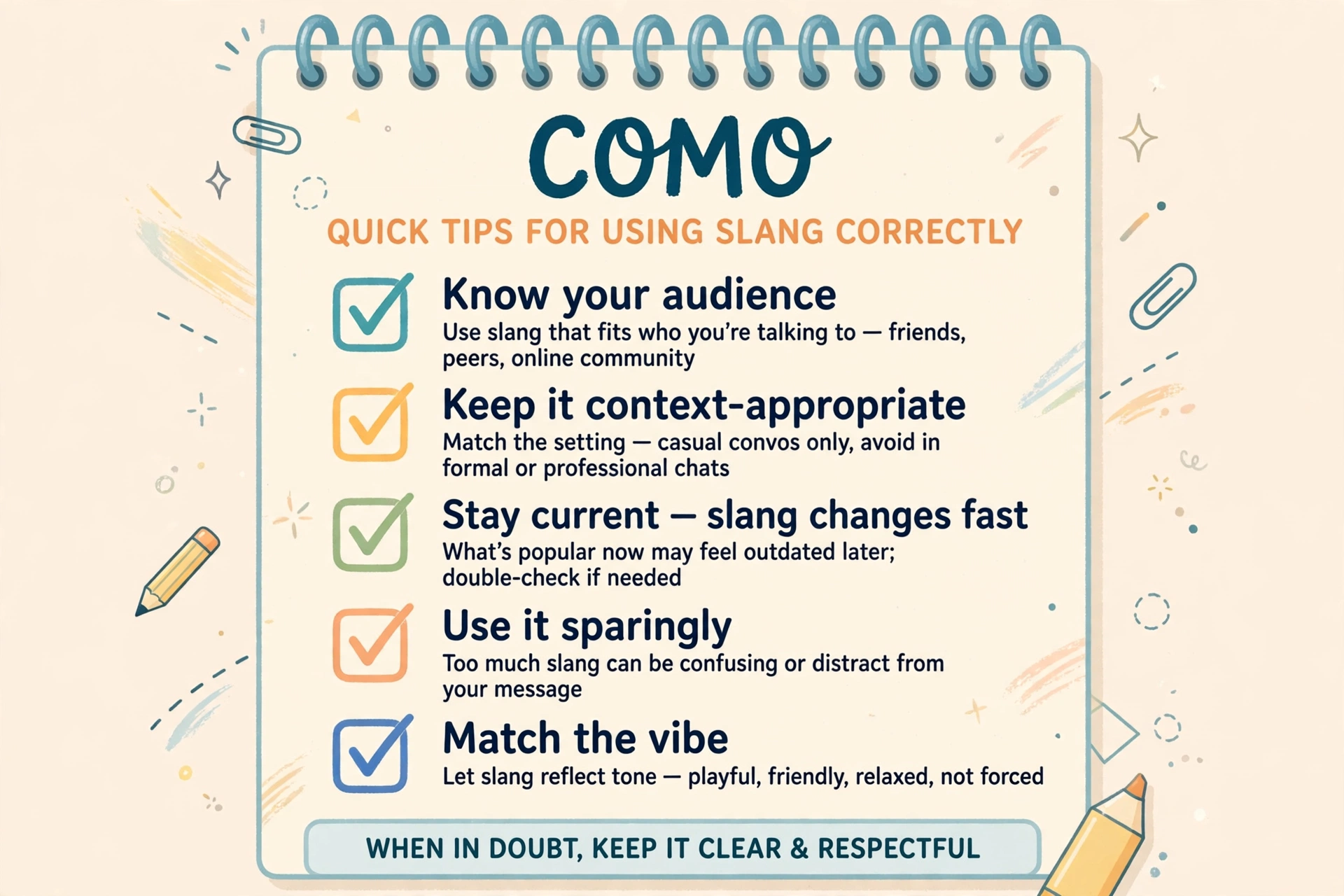
Quick Tips
- Start with the question mark. If “como” is alone and ends with “?”, read it as “How?” or “What?” first. That reading is right most of the time in chats.
- Check the sentence around it. If como sits in the middle of a Spanish phrase, translate the whole phrase, not the word. Como siempre and como sea only make sense as units.
- Answer in either language. If someone texts you “como stas?”, answering “I’m good, you?” is perfectly fine. You do not have to reply in Spanish to be understood, and most bilingual friends switch freely.
- Keep the accent for formal Spanish. Texts can drop it. Homework, emails, and anything published should keep cómo accented when it asks a question.
- Use “como quieras” carefully. Add warmth when you mean agreement: “Como quieras, I’m happy with either!” reads as generous. A bare “como quieras” can read as checked out.
- Learn the phrase set, not just the word. Como quieras, como sea, como siempre, como si nada, ¡cómo no! — five phrases cover most of what you will see, and they are easy to memorize as chunks.
- Listen before you borrow. If your friend group uses “como?” playfully, join in. If you are writing to someone you do not know well, use the full greeting first and let them set the tone.
- When in doubt, ask. “What does ‘como’ mean there?” is a better move than guessing wrong for a week. Bilingual friends usually love explaining their words, and the question itself is a friendly one.

FAQ
What does como mean in slang?
In slang and texting, como usually means “how” or “what.” On its own, “como?” works as a short form of “How?” or “What?” — a quick check-in, a request to repeat something, or a playful reaction to surprising news. In longer Spanglish phrases it keeps its Spanish meaning of “as” or “like,” so como quieras means “as you wish” and como siempre means “as always.”
What does “como?” mean in a text message?
In a text message, “como?” usually means “How?”, “What?”, or “Huh?” It can be a greeting shortened from ¿Cómo estás? (“How are you?”), a polite request to repeat something you missed, or a surprised reaction to unexpected news. The message before it, the punctuation, and the emojis tell you which one. A friendly “como stas?” is a check-in. A flat “como?” after a long explanation is “say that again?” A “como??” with extra question marks is disbelief or teasing.
Is como Spanish for “how” or “what”?
Strictly, cómo with an accent means “how” when it asks a question or exclaims something. Como without an accent means “as,” “like,” or “in the way that.” In informal texting the accent is usually dropped, so “como” covers both jobs, and English speakers also use it loosely for “what?” when they mean “What did you say?” The safest formal rule is: accent for the question, no accent for the connector.
What is the difference between como and cómo?
Cómo with a written accent is the stressed question and exclamation word: ¿Cómo estás? (“How are you?”), ¡Cómo llueve! (“How it rains!”). Como without an accent is unstressed and does connecting work: como quieras (“as you wish”), como siempre (“as always”). The Real Academia Española treats them as forms of one entry, distinguished by stress and function. In casual texts the difference is often ignored, but in formal Spanish it matters.
What does “como stas” mean?
“Como stas?” is informal texting shorthand for ¿Cómo estás?, “How are you?” The spelling drops the accent, the opening question mark, and the accented vowel in estás, which is normal in fast Spanish texting. It is a friendly, casual greeting, not a formal one. You can answer it in English (“I’m good, you?”) or in Spanish (“Bien, ¿y tú?”), and either answer will be understood.
What does “como quieras” mean?
Como quieras means “as you wish,” “however you want,” or “up to you.” It hands the decision to the other person. Said warmly, it is easygoing agreement. Said flatly, it can sound resigned or annoyed, like “fine, whatever you want.” The tone and the situation decide which version you heard, so read the rest of the conversation before you react to it.
Can non-Spanish speakers use “como” in texts?
Yes, if you use it the way the people around you use it. A lone “como?” as a friendly reaction or a “como stas?” check-in to a bilingual friend is welcome and widely understood in the US. Avoid it in formal messages, with strangers, or as a joke at someone’s expense. As with any borrowed word, listen first, copy the local use, and keep the full, standard form for anything formal.
What does “como” mean in Portuguese?
In Portuguese, como also means “how” and “as,” spelled the same way. Como estás? in Portuguese is the same “How are you?” question. Spanish and Portuguese are close relatives, so the shared word is expected, not a coincidence. If you see como in a Brazilian or Portuguese context, read it as Portuguese first. The slang borrowing described in this guide is the Spanish-to-English one, which is the one most US texters meet.
Conclusion
Como is a small word doing a large job. In Spanish it asks “how,” it compares with “as” and “like,” and it connects phrases that English speakers use every day without thinking about them. In English-language texting it has become a short, warm, slightly playful reaction: a greeting, a question, a double-take. Learn the accent rule, learn the five common phrases — como quieras, como sea, como siempre, como si nada, ¡cómo no! — and the word stops being confusing. You will read it correctly, answer it naturally, and know when to use the full formal form instead.
The best way to keep learning is to keep listening to how bilingual friends actually use it, in the same way you would learn any living slang. Notice when “como?” is a greeting and when it is a reaction. Try “como stas?” with a friend who uses it, and see how natural the reply feels. And if you enjoy decoding borrowed words and regional speech, keep going with our other guides — Philly slang and New York slang each show how one country can hold a dozen different ways of asking the same question, in a dozen different accents, with a dozen different jokes attached. Como rewards the same habit that unlocks every slang word: listen for the meaning underneath the spelling, and you will understand far more than four letters alone.
