WDYM Meaning in Text Meaning & Definition
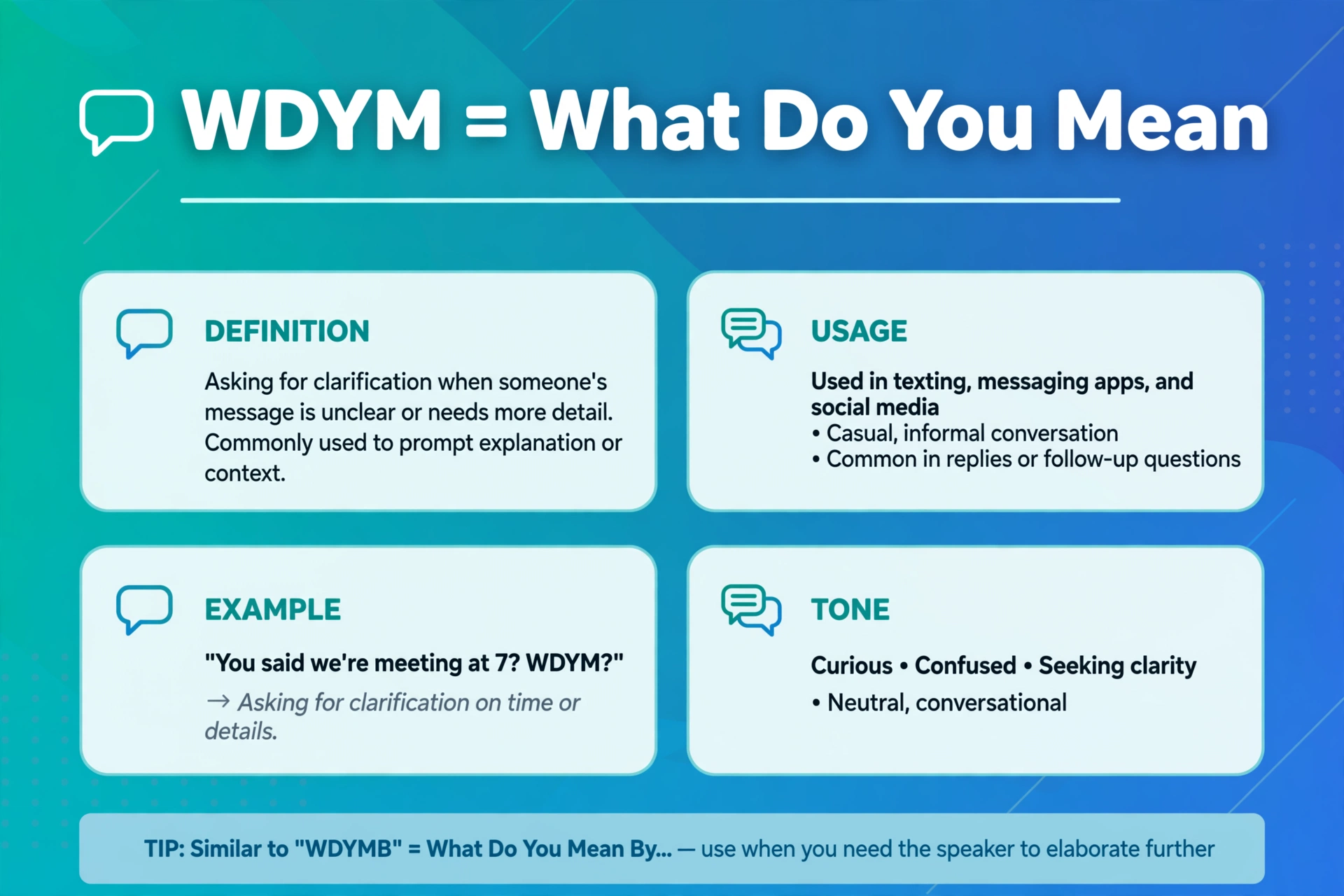
Quick definition: WDYM stands for “what do you mean” — a casual texting abbreviation people use to ask for clarification when something in a conversation is confusing, vague, or surprising. It is the digital equivalent of raising an eyebrow and asking someone to explain themselves.
Introduction
Scrolling through your messages, you have probably come across someone typing “wdym” mid-conversation, and if you stopped to figure out the wdym meaning in text, you are not alone. This tiny four-letter acronym carries a surprising amount of conversational weight. Whether it signals genuine confusion, playful teasing, or mild disbelief, understanding it helps you read the room in any chat.
Unlike some slang that fades within a season, WDYM has become a staple of casual digital communication because it does something every conversation eventually needs: it asks for clarity without sounding confrontational. Saying “what do you mean” in full can feel formal or even irritated in a quick text exchange. “Wdym” keeps things light while still getting the message across.
If you enjoy decoding texting slang, you may also want to look up the wtv meaning in text — another short acronym with a very different attitude — or check out the wya meaning in text for a question-style abbreviation people use every day.
Origin
WDYM grew out of the same wave of abbreviation culture that gave us LOL, BRB, and OMG in the early 2000s. As SMS messaging and instant messengers like AIM and MSN Messenger limited how much people wanted to type, full phrases compressed into initials. “What do you mean” was a natural candidate because it appears constantly in conversation — asking someone to clarify is one of the most repeated moves in any dialogue.
The abbreviation really took off with the rise of Twitter, where character limits rewarded brevity, and later with Instagram comments and Snapchat messages, where speed matters more than spelling. Unlike slang invented by one community, WDYM emerged organically across platforms because it filled a universal need: a fast, casual way to say “hold on, explain that.”
By the mid-2010s, WDYM had cemented itself in the everyday texting vocabulary of Gen Z and millennials, appearing in memes, reaction images, and comment threads. Its pronunciation rarely comes up — people read it as the full phrase — which helped it feel more like a word than a code, similar to how “idk” reads as “I don’t know” without anyone sounding out letters.
Popularity
WDYM remains one of the most searched texting abbreviations, consistently ranking alongside classics like IDK, TBH, and NGL in online slang dictionaries. Its popularity comes from its versatility: it works in almost any chat context, from group chats with friends to comments on TikTok videos.
One reason WDYM has staying power is that it adapts to tone. In a friendly conversation it reads as curious (“wdym you got the tickets??”). In a tense exchange it can read as challenged (“wdym I never said that”). That flexibility keeps it relevant across situations where more niche slang only fits one mood.
It also benefits from meme culture. Reaction memes captioned with “wdym” spread the acronym to people who might never have typed it themselves, and each wave of viral content refreshes its visibility. Search interest in “wdym meaning” spikes regularly, usually when younger users introduce it into new communities — gaming lobbies, Discord servers, or comment sections of trending videos.
For a similar high-frequency abbreviation with its own personality, see the ttm meaning in text, which serves the opposite conversational purpose — keeping contact rather than questioning it.
How It Is Used
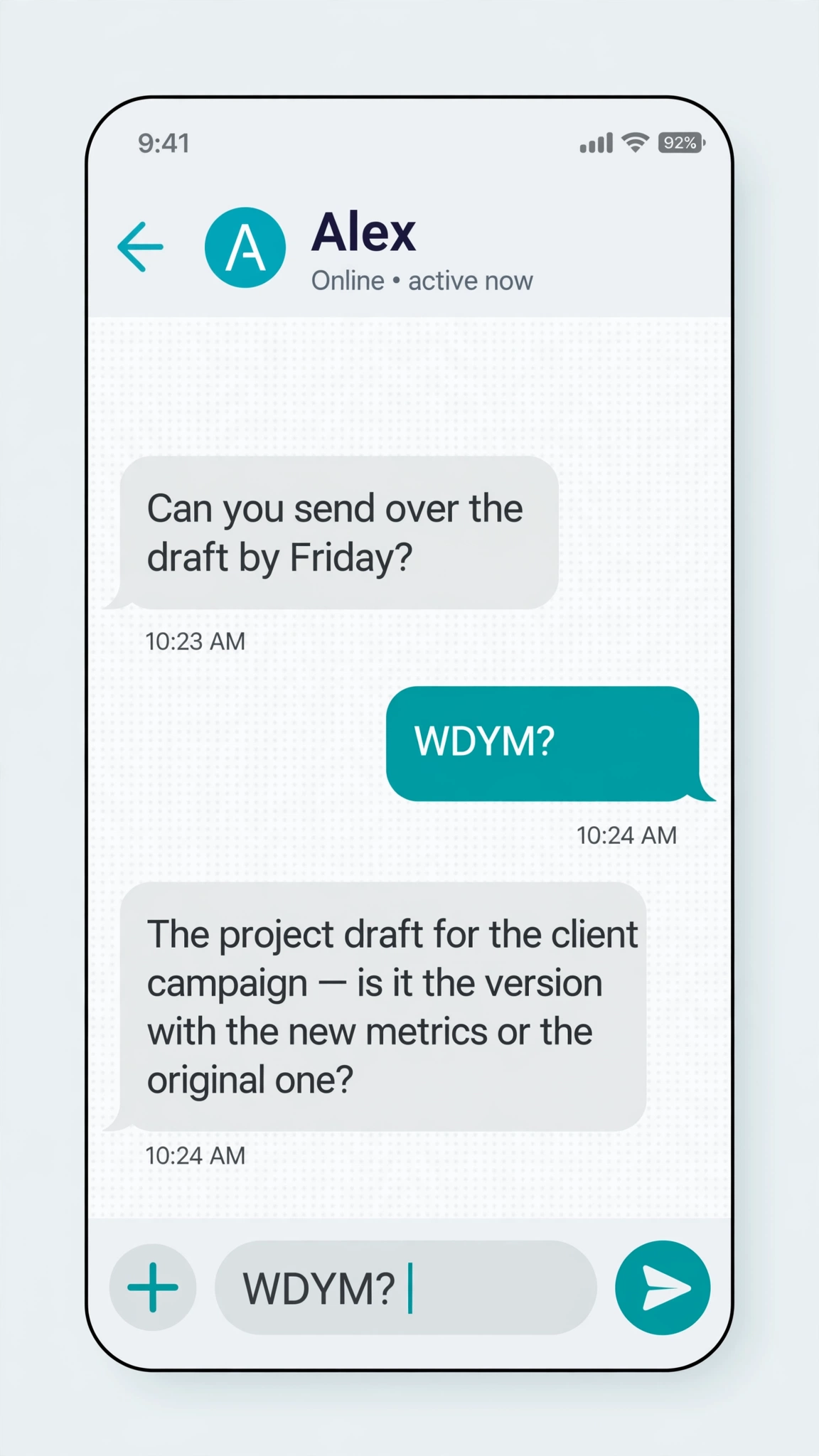
At its core, WDYM is a clarification request. You type it when someone says something unclear, unexpected, or incomplete, and you want them to expand. It replaces the full question “what do you mean?” in settings where speed and informality rule.
Typical usage falls into a few patterns:
- Genuine confusion: “My flight got rescheduled” — “wdym rescheduled??”
- Asking for elaboration: “We need to talk” — “wdym we need to talk”
- Playful teasing: “You’re the best cook ever” — “wdym you want me to cook for you”
- Mild disbelief: “I finished the whole series in one night” — “wdym one night”
- Defensive reaction: “That was kind of rude” — “wdym?? I was joking”
Capitalization barely matters — “wdym,” “Wdym,” and “WDYM” all read the same — though all caps can add emphasis, the way shouting a question changes its energy. It almost always appears with or without a question mark, and often with extra punctuation for tone (?? for disbelief, … for suspicion).
The acronym works best in casual and semi-casual settings: texts, DMs, group chats, social comments, gaming chat, and dating apps. It feels out of place in formal writing — emails to a boss, school essays, or official messages should use the full phrase.
Response etiquette matters too. When someone asks “wdym,” they are inviting an explanation, so replying with another “wdym” creates a confusion loop that quickly becomes a joke rather than a conversation. Answer the question, clarify what you meant, and the chat moves forward.
Examples
Context changes everything with WDYM. Here are realistic exchanges showing how tone and situation shape its meaning.
Friendly Examples
- “I got us reservations for Saturday” — “wdym US?? like all of us??”
- “You won’t believe what happened at work” — “wdym tell me everything”
- “Pack your bags” — “wdym where are we going??”
- “I finally beat that level” — “wdym finally, you’ve been trying for weeks 😂”
- “Guess who just called me” — “wdym WHO”
In friendly chats, WDYM is basically excitement wearing a question mark. It signals engagement — you are hooked and want the details.
Professional Examples
- “The client moved the deadline” — “wdym, to when exactly?”
- “Let’s circle back on the proposal” — “wdym by circle back — do you want a meeting?”
- “We might need to restructure the plan” — “wdym restructure? what’s changing?”
- “HR sent an update about the policy” — “wdym, which policy?”
In work chats, WDYM usually stays lowercase and brief, but many professionals still prefer the full “what do you mean” in writing to keep things polished. If your workplace culture is casual, wdym is fine in Slack or Teams; if not, spell it out.
Funny Examples
- “I’m on a diet starting Monday” — “wdym you’re eating pizza right now”
- “I’m a morning person” — “wdym you woke up at 2pm”
- “Money can’t buy happiness” — “wdym have you tried money”
- “I don’t have a favorite child” — “wdym mom we all know it’s me”
- “I’m leaving the group chat” — “wdym you’ll be back in 5 minutes”
Humor is where WDYM thrives. The format is almost a meme template: state something, then “wdym” plus the contradictory evidence. It is the texting equivalent of a reality-check punchline.
Examples at a Glance
| Tone | Example message | What it signals |
| Friendly | “wdym tell me everything” | Excitement and curiosity |
| Neutral | “wdym, to when exactly?” | Simple clarification |
| Professional | “wdym by circle back?” | Request for specifics |
| Funny | “wdym you’re eating pizza right now” | Playful contradiction |
| Skeptical | “wdym you ‘forgot'” | Disbelief, mild challenge |
| Defensive | “wdym?? I was joking” | Pushing back on criticism |
Comparison with Similar Terms
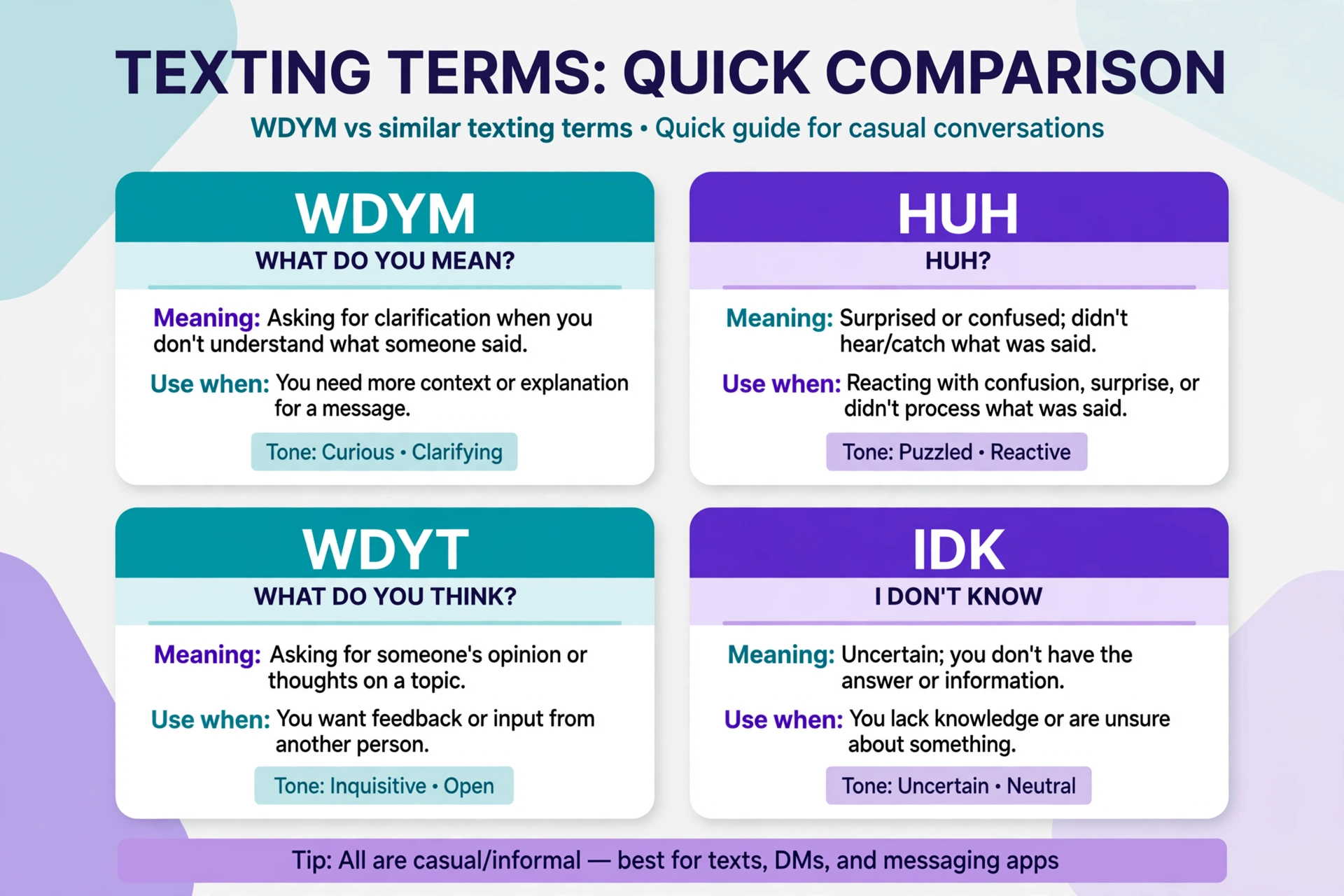
WDYM sits in a family of clarification and reaction abbreviations, but each has its own shade of meaning. Mixing them up can change the whole vibe of a message, so here is how WDYM stacks up against its closest relatives.
| Abbreviation | Stands for | How it differs from WDYM |
| WDYM | What do you mean | The baseline: asks someone to explain or clarify |
| HUH | — | Shorter and blunter; can sound annoyed or dismissive |
| WHAT | — | Expresses shock more than curiosity; stronger reaction |
| IDK | I don’t know | Opposite move: admits confusion instead of demanding answers |
| WYM | What you mean | A casual variant, often used in agreement (“wym fr”) |
| EXCUSE ME | — | More confrontational; implies offense taken |
| RUN THAT BY ME AGAIN | — | Warmer and more polite; invites re-explanation without edge |
| SAY WHAT | — | Playful surprise; lighter than WDYM’s skeptical edge |
The closest cousin is WYM (“what you mean”), which people use in hip-hop-influenced slang and casual chats, sometimes even as agreement rather than a question. WDYM is the clearer, more universally understood form — when in doubt, it is the safer pick.
Curious about another everyday abbreviation with multiple personalities? The tmp meaning in text guide breaks one down the same way.
Alternate Meanings
While “what do you mean” accounts for the vast majority of WDYM uses, a few alternate interpretations exist in specific corners of the internet:
- What did you mean — a past-tense flavor of the same idea, used when referring back to an earlier message (“wdym by that comment yesterday?”). Most people still intend “what do you mean” even in these cases.
- What do you mind — extremely rare, mostly a misreading; not standard usage.
- Band and brand names — a few music tracks and usernames use “WDYM” as a stylized title, always playing on the “what do you mean” phrase.
In practice, if you see WDYM in a chat, assume “what do you mean” — the alternatives are niche enough that treating them as default will mislead you far more often than it helps.
Professional or Polite Alternatives
WDYM is perfect for casual chats, but some situations call for the same question in a more polished package. Here are alternatives matched to context:
- Work messages: “Could you clarify what you mean?” or “Just to make sure I understand — are you saying…?”
- Formal emails: “I want to confirm my understanding of your point about…”
- Customer service: “Could you help me understand what you mean by that?”
- Polite conversation: “Sorry, I’m not sure I follow — could you explain?”
- Academic settings: “Could you elaborate on that point?”
- Diplomatic disagreement: “Interesting — what exactly do you mean by that?”
The pattern is simple: keep the curiosity, add a softener. Words like “could,” “sorry,” and “help me understand” turn a blunt question into a gracious one without changing what you are actually asking.
Common Mistakes
WDYM is simple, but people still trip over it. Watch out for these:
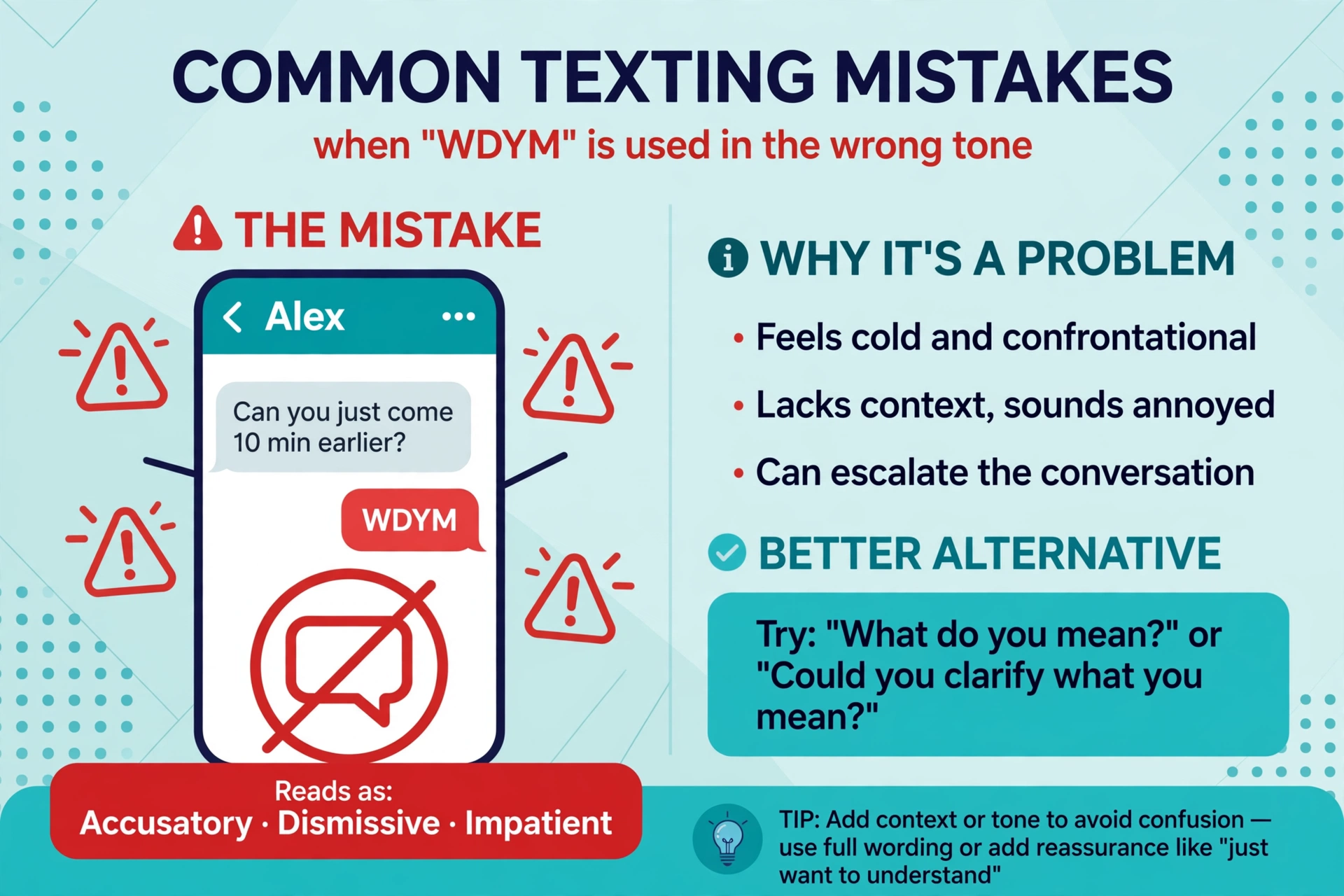
- Using it in formal writing. Resumes, cover letters, school papers, and professional emails should always spell out “what do you mean.” Acronyms read as careless in formal contexts.
- Replying “wdym” to “wdym.” Two people asking each other to clarify creates a loop. If someone asks you wdym, answer — don’t bounce the question back.
- Reading hostility that isn’t there. Text strips out tone of voice, so “wdym” can look colder than intended. Before assuming someone is annoyed, consider that they may just be confused.
- Overusing it. Typing wdym after every other message makes conversations stall. If you are lost, say what specifically confuses you instead of repeating the same prompt.
- Confusing it with WYM. In some slang contexts WYM means agreement (“you know wym”), while WDYM is always a question. Using one for the other confuses readers.
- Forgetting the question mark changes the tone. “wdym” alone can read flat or suspicious; “wdym??” reads surprised. Match your punctuation to your actual feeling.
Quick Tips
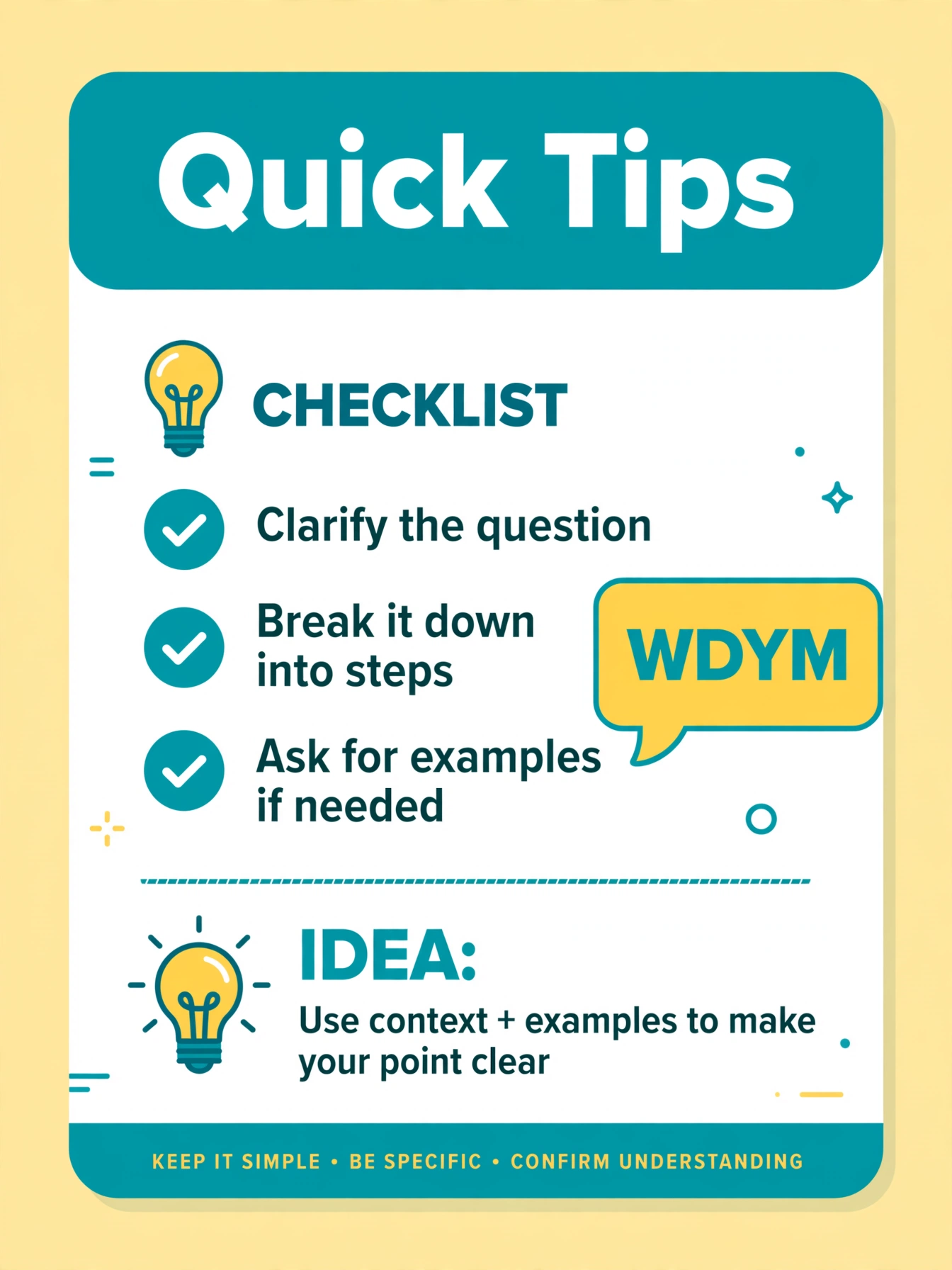
- Add context after it. “wdym by ‘later’ — tonight or tomorrow?” gets a useful answer; bare “wdym” sometimes gets a shrug.
- Match the energy. In a playful chat, lean into humor (“wdym you ate the last slice”). In a serious one, keep it neutral and direct.
- Use it sparingly at work. Fine in casual Slack channels; spell it out in client-facing messages.
- Pair it with an emoji when tone matters. A 😅 or 🤔 after “wdym” instantly softens it and signals you are confused, not confrontational.
- Don’t fear the full phrase. When something genuinely matters — a misunderstanding with a friend, an unclear instruction — “what do you mean by that?” carries more care than the acronym.
- Check before reacting. If a “wdym” moment makes you defensive, reread the original message first. Half of texting arguments start with a misread tone.
- Teach it forward. If someone older or newer to texting asks what wdym means, a quick “it means ‘what do you mean'” keeps the conversation flowing — just like this guide did for you.
FAQ
What does WDYM mean in texting?
WDYM means “what do you mean.” It is a casual texting abbreviation used to ask someone to clarify, explain, or elaborate on something they just said. People use it in texts, DMs, group chats, and social media comments when a message is confusing, surprising, or vague.
Is WDYM rude?
Not inherently. In most cases WDYM is neutral — a quick way to ask for clarification. However, because text messages lack tone of voice, it can read as confrontational or annoyed depending on context and punctuation. Adding a friendly emoji or extra context (“wdym, I’m curious!”) keeps it clearly polite.
What is the difference between WDYM and WYM?
WDYM always means “what do you mean” and functions as a question asking for clarification. WYM (“what you mean”) is a looser slang variant that sometimes works as agreement rather than a question — for example, “you know wym” roughly means “you know what I’m saying.” WDYM is clearer and more widely understood, so it is the safer choice.
Can I use WDYM in professional emails?
It is better not to. In professional emails, spell out the full phrase or use a polished alternative like “Could you clarify what you mean?” WDYM is fine in casual workplace chats (like a relaxed Slack channel) but reads as too informal for client emails, formal reports, or job applications.
How do you respond when someone says WDYM?
Explain what you meant. The person is asking for clarification, so rephrase your original message, add details, or give an example. Avoid replying with another “wdym,” which creates a confusing loop. A good pattern is: “Sorry, I meant [clearer version].”
Does WDYM have any other meanings?
The overwhelmingly standard meaning is “what do you mean.” Rare alternate readings include “what did you mean” (past-tense flavor of the same idea) and occasional stylized uses in song titles or usernames. In everyday texting, assume “what do you mean.”
When did WDYM become popular?
WDYM emerged from early-2000s abbreviation culture alongside LOL and BRB, then surged with Twitter’s character limits and the rise of Instagram, Snapchat, and TikTok. By the mid-2010s it was firmly established in everyday texting, and meme culture has kept it visible ever since.
What are polite alternatives to WDYM?
Polished alternatives include “Could you clarify?”, “I’m not sure I follow — could you explain?”, “What exactly do you mean by that?”, and “Could you elaborate?” These keep the same curious intent while sounding more considerate in formal or sensitive conversations.
Conclusion
Now that you know the wdym meaning in text, you can read it the way it was meant: as a quick, casual invitation to explain. Whether it shows up as genuine curiosity, playful teasing, or a meme-format punchline, WDYM is one of texting’s most useful little tools — a four-letter shortcut for one of conversation’s most important questions.
The key takeaways are simple. Use it in casual chats where brevity is welcome, add context or an emoji when tone could be misread, spell it out in formal settings, and always answer the question when someone aims it at you. Master those habits and WDYM becomes a conversation smoother, not a conversation starter for arguments.
Texting slang is a whole language of its own, and every abbreviation has its own story. If you found this guide useful, you might also enjoy the ngl meaning in text breakdown or the wyfd meaning in text guide — and for a deeper look at how abbreviations get cataloged, Dictionary.com is a solid reference for standard definitions behind the slang.
