Quick definition: 1970s slang is the casual, expressive vocabulary of the disco decade — words like groovy, far out, boogie, and right on that described cool things, good vibes, dancing, and everyday life in 1970s America. Many of these phrases, including dude, bummer, and chill out, are still used today.
1970s Slang Meaning & Definition
1970s slang refers to the informal words and catchphrases that were popular in the United States during the 1970s. Born from disco, funk, rock music, television, and the counterculture movement, 1970s slang gave people colorful new ways to say something was cool, to greet a friend, or to describe a wild night out. Words like groovy, far out, and outta sight were the decade’s way of saying “amazing,” while boogie meant dancing and right on meant total agreement.
Unlike the texting slang of today, 1970s slang was spoken out loud — on dance floors, in school hallways, on CB radios, and in living rooms in front of the TV. It was playful, musical, and full of personality. Some of it sounds dated now (jive turkey, anyone?), but plenty of 1970s slang survived and still shows up in everyday conversation, movies, and memes.
Introduction
Picture a 1970s dance floor: the disco ball is spinning, the funk is loud, and somebody in bell-bottoms just told you the band is outta sight. If you time-traveled back to 1976, you would need more than a polyester shirt to fit in — you would need the lingo. The 1970s produced some of the most fun and recognizable slang in American history, and decades later, people still reach for these words when they want to sound laid-back, retro, or just plain cool.
In this guide, we break down 45+ classic 1970s slang words and phrases, explain what each one means, show you how people actually used them, and reveal which ones are still alive today. Whether you are writing a retro-themed post, settling a trivia debate, or just curious about what your parents meant when they said “can you dig it,” this is the complete guide to 1970s slang.
Origin of 1970s Slang
1970s slang did not appear out of nowhere. It grew out of several powerful cultural forces that collided in the same decade. The late-1960s counterculture and hippie movement supplied words like groovy, far out, and peace out. The rise of funk and soul music gave the decade funky, boogie, and get down. Disco culture added its own dance-floor vocabulary, while Black American English contributed words like jive, right on, and soul brother that crossed into mainstream use.
Television and movies spread the lingo even further. Shows like “Soul Train” and “That ’70s Show” (much later, but set in the era) helped keep the words alive, and CB radio culture — popularized by truckers and the 1975 hit song “Convoy” — gave America 10-4, good buddy, and keep on truckin’. By the middle of the decade, 1970s slang was everywhere: in classrooms, on the radio, and in everyday conversation from coast to coast.
Popularity of 1970s Slang
At its peak, 1970s slang was the default way young Americans talked. Disco was the biggest music scene in the country, Saturday Night Fever (1977) turned the dance floor into a national obsession, and slang words from the era became part of the mainstream dictionary. Newspapers, magazines, and TV shows quoted the phrases, and advertisers borrowed them to sell everything from jeans to soft drinks.
Today, 1970s slang enjoys a second life. Retro parties, vintage fashion, and nostalgia-driven movies and shows keep words like groovy and far out in circulation. Some terms never left at all: dude, bummer, chill out, and peace out are still completely normal in 2026. Others, like jive turkey or shaggin’ wagon, survive mostly as jokes or trivia answers — which honestly makes them even more fun to know.
How 1970s Slang Is Used
1970s slang was mostly spoken, casual, and social. People used it to hype something up, agree with a friend, greet someone, or describe a person or situation in a more colorful way. The tone was usually positive and laid-back — the decade’s slang was about good vibes, not insults. Even its put-downs, like jive turkey or space cadet, were more playful than mean.
In modern usage, 1970s slang works best in three situations: joking around with friends, themed parties and retro events, and creative writing where a vintage flavor fits. Dropping a “far out!” or “right on!” into a conversation today usually gets a smile, because everyone recognizes the words even if nobody talks that way all day anymore. Just avoid using the dated insults seriously — calling someone a turkey in 2026 will confuse them more than it offends them.
The 45+ Most Popular 1970s Slang Words and Meanings
Here is the ultimate list of 1970s slang, grouped by what the words describe. Each entry includes its meaning and a real example so you can see exactly how it worked.
Ways to Say “Cool” in 1970s Slang
If there was one thing the 1970s loved, it was finding new ways to say something was cool. These were the most popular approval words of the decade.
| 1970s Slang Word | Meaning | Example |
|---|---|---|
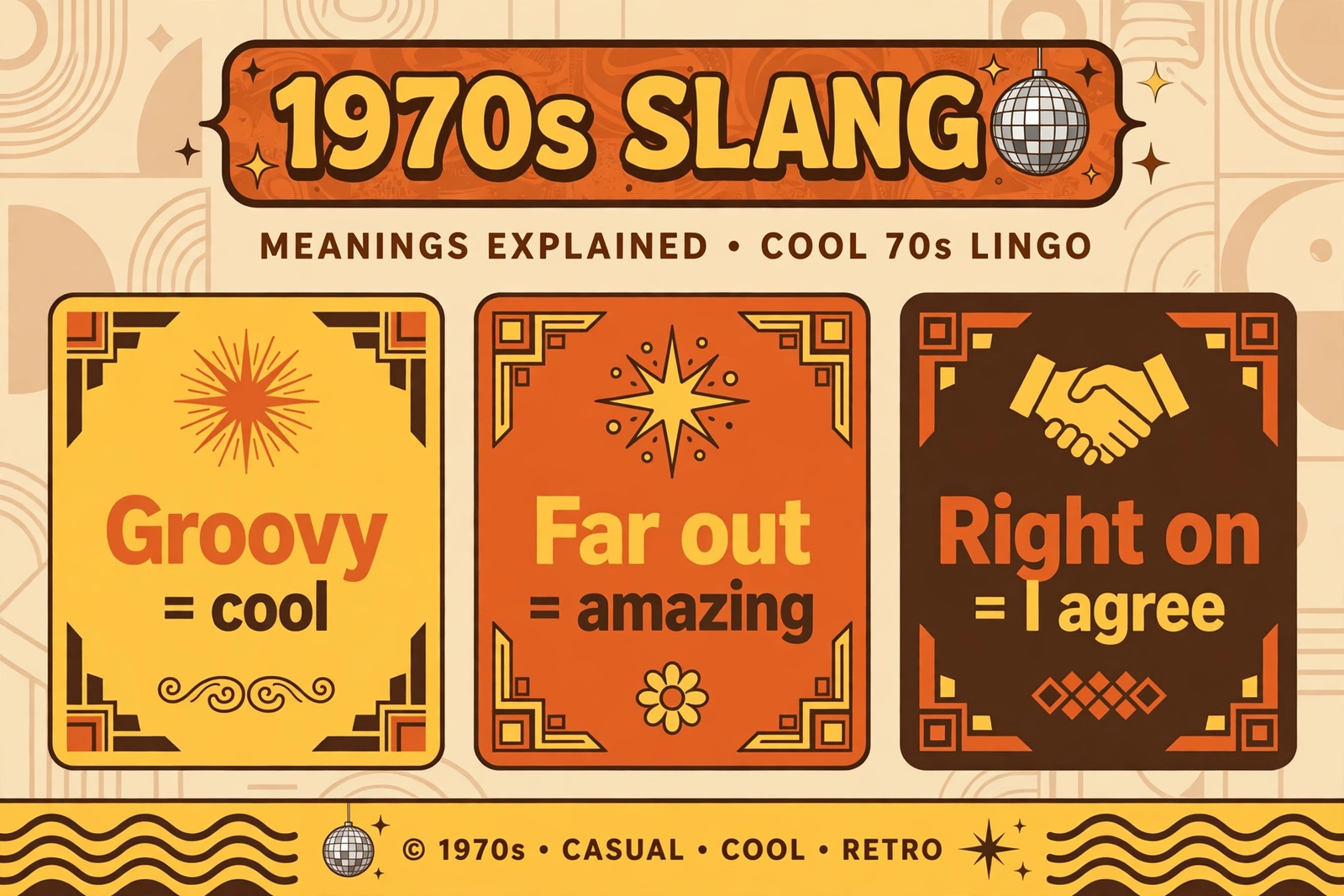
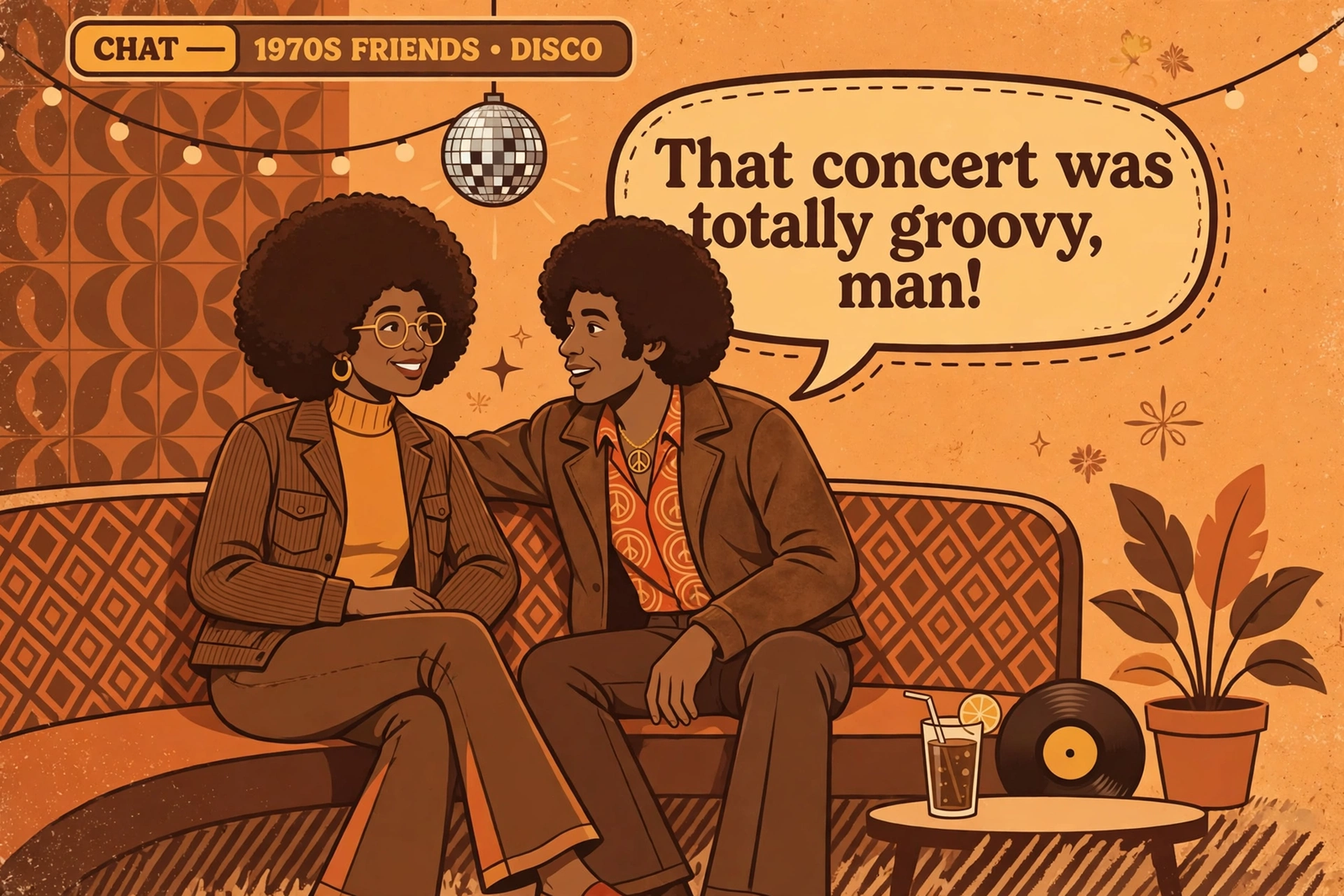
| Groovy | Cool, enjoyable, excellent | “That concert was totally groovy, man!” |
| Far out | Amazing, impressive, or unusual | “Far out! You got front-row tickets?” |
| Outta sight | Fantastic, beyond great | “Her new outfit is outta sight.” |
| Right on | Totally correct, or “I agree” | “Right on! Let’s hit the disco tonight.” |
| Funky | Cool in a weird, stylish, rhythmic way | “That funky bass line is stuck in my head.” |
| Dynamite | Fantastic, explosive in a good way | “The party was dynamite!” |
| Boss | Excellent, top-notch | “His new car is totally boss.” |
| Neat-o | Cool or awesome | “Neat-o! A new record player!” |
| Bad | Good or great (the opposite of its normal meaning) | “That guitar solo is bad — in the best way.” |
| Solid | Dependable, reliable, very good | “He’s a solid guy. You can trust him.” |
| Fab | Short for fabulous | “Your dress is totally fab.” |
| Heavy | Deep, serious, or profound | “Man, that’s heavy. I need to think about it.” |
| Stellar | Incredible, outstanding | “Stellar performance tonight!” |
People and Personality in 1970s Slang
The decade had a nickname for just about everyone — from the coolest cat in the room to the biggest goof.
| 1970s Slang Word | Meaning | Example |
|---|---|---|
| Dude | A guy, or a casual way to address anyone | “Hey, dude, check out this record.” |
| Foxy / Fox | Very attractive, usually a woman | “She’s one foxy mama.” |
| Stone fox | An extremely attractive woman | “Did you see that stone fox at the disco?” |
| Cool cat | Someone laid-back, stylish, and hip | “He’s a real cool cat.” |
| Dreamboat | A very attractive man | “The new lifeguard is a total dreamboat.” |
| Hunk | A handsome, muscular guy | “That hunk just asked me to dance.” |
| Space cadet | Someone spaced out or airheaded | “Stop being such a space cadet and focus.” |
| Airhead | A silly or foolish person | “Don’t be an airhead — bring the tickets.” |
| Jive turkey | A fake, dishonest, or uncool person | “Don’t trust him, he’s a real jive turkey.” |
| Turkey | A fool or idiot | “What a turkey — he forgot the keys again.” |
| Dork | A nerd or socially awkward person | “He’s a dork, but he’s our dork.” |
| Youngblood | A young man or boy | “Listen, youngblood, let me show you how it’s done.” |
| The man | Authority figures or the establishment | “Don’t let the man bring you down.” |
Greetings, Goodbyes, and Everyday Phrases
| 1970s Slang Phrase | Meaning | Example |
|---|---|---|
| Peace out | Goodbye, I’m leaving | “It’s getting late — peace out!” |
| Catch you on the flip side | See you later | “Catch you on the flip side, man!” |
| What’s crackin’? | What’s going on? | “Hey, what’s crackin’ tonight?” |
| Can you dig it? | Do you understand / agree? | “This band is the best. Can you dig it?” |
| Keep on truckin’ | Keep going, stay positive | “Tough week, but keep on truckin’.” |
| Chill out | Relax, calm down | “Chill out — the party starts in an hour.” |
| 10-4 | Understood, message received (CB radio code) | “Pick you up at eight? 10-4, good buddy.” |
| Later days | Goodbye | “Later days, everybody!” |
| Gimme some skin | Give me a low five | “Great game! Gimme some skin!” |
| Right on | Exactly, I agree completely | “Right on — that’s what I’m talking about.” |
Dancing, Music, and Nightlife
No guide to 1970s slang is complete without the disco vocabulary. The dance floor had its own language.
- Boogie — to dance energetically. “Let’s boogie — this is my song!”
- Get down — to start dancing or partying. “The DJ is on — let’s get down!”
- Groovin’ — enjoying the music and the moment. “We were groovin’ all night long.”
- Jam — a great song, or a dance party. “That jam is my favorite track.”
- Disco — the music, the scene, and the clubs themselves. “We’re going disco dancing tonight.”
- Shaggin’ wagon — a customized van, often with a bed in the back. “He picked us up in his shaggin’ wagon.”
- Freak out — to get wildly excited. “When the band came on, the whole crowd freaked out.”
Feelings and Reactions
- Bummer — a disappointment or a letdown. “Rain on prom night? Total bummer.”
- Copacetic — everything is fine, no problem. “Don’t worry, it’s all copacetic.”
- Down with — okay with something. “I’m down with going to the concert.”
- Good vibes — positive energy. “This place has such good vibes.”
- To the max — to the extreme. “Turn it up to the max!”
- Freaky deaky — strange or odd. “That movie was freaky deaky.”
- The lowdown — the truth, the full story. “Give me the lowdown on what happened.”
- The skinny — the real facts. “What’s the skinny on the new teacher?”
Examples of 1970s Slang in Sentences
Seeing 1970s slang in real sentences makes it much easier to understand how people actually talked. Here are examples across different tones and situations.
Friendly Examples
- “Hey man, that new record is groovy — can you dig it?”
- “Right on! I’ll pick you up at eight, and we’ll boogie all night.”
- “What’s crackin’, dude? Long time no see!”
- “Catch you on the flip side — peace out!”
Professional Examples
1970s slang rarely belonged in the office, but a few lighter terms crossed over into workplace talk, especially in creative industries:
- “Let’s keep on truckin’ — the launch is next week and we’re almost there.”
- “That’s a solid plan. I’m down with it.”
- “Give me the lowdown on the meeting before I head in.”
- “Don’t worry, the budget situation is copacetic.”
Funny Examples
- “My dad still says ‘far out’ every time he sees a new gadget. He’s a total space cadet about technology.”
- “She called him a jive turkey in front of everyone — the whole room went quiet.”
- “Grandpa’s shaggin’ wagon stories get funnier every Thanksgiving.”
- “I tried to say ‘groovy’ at a party and my teenager told me to never do that again. Bummer.”
Comparison with Similar Terms
Every decade reinvents “cool.” Comparing 1970s slang with the slang of other decades shows how the language of approval keeps changing while the feeling stays the same.
| Meaning | 1970s Slang | 1980s Slang | Today’s Slang |
|---|---|---|---|
| Something is cool | Groovy, far out | Radical, tubular | Slay, fire, lit |
| I agree | Right on | Totally, for sure | Facts, no cap |
| Let’s dance | Boogie, get down | Breakdance, rock out | Vibe, hit the dance floor |
| Goodbye | Peace out, later days | Later, catch you later | I’m out, deuces |
| Someone is attractive | Stone fox, foxy | Babe, hottie | Snack, fine |
| That’s disappointing | Bummer | That’s bogus | That’s rough, L |
| Calm down | Chill out | Take a chill pill | Chill, relax |
| A friend / a guy | Dude, cool cat | Homeboy, dude | Bro, bestie |
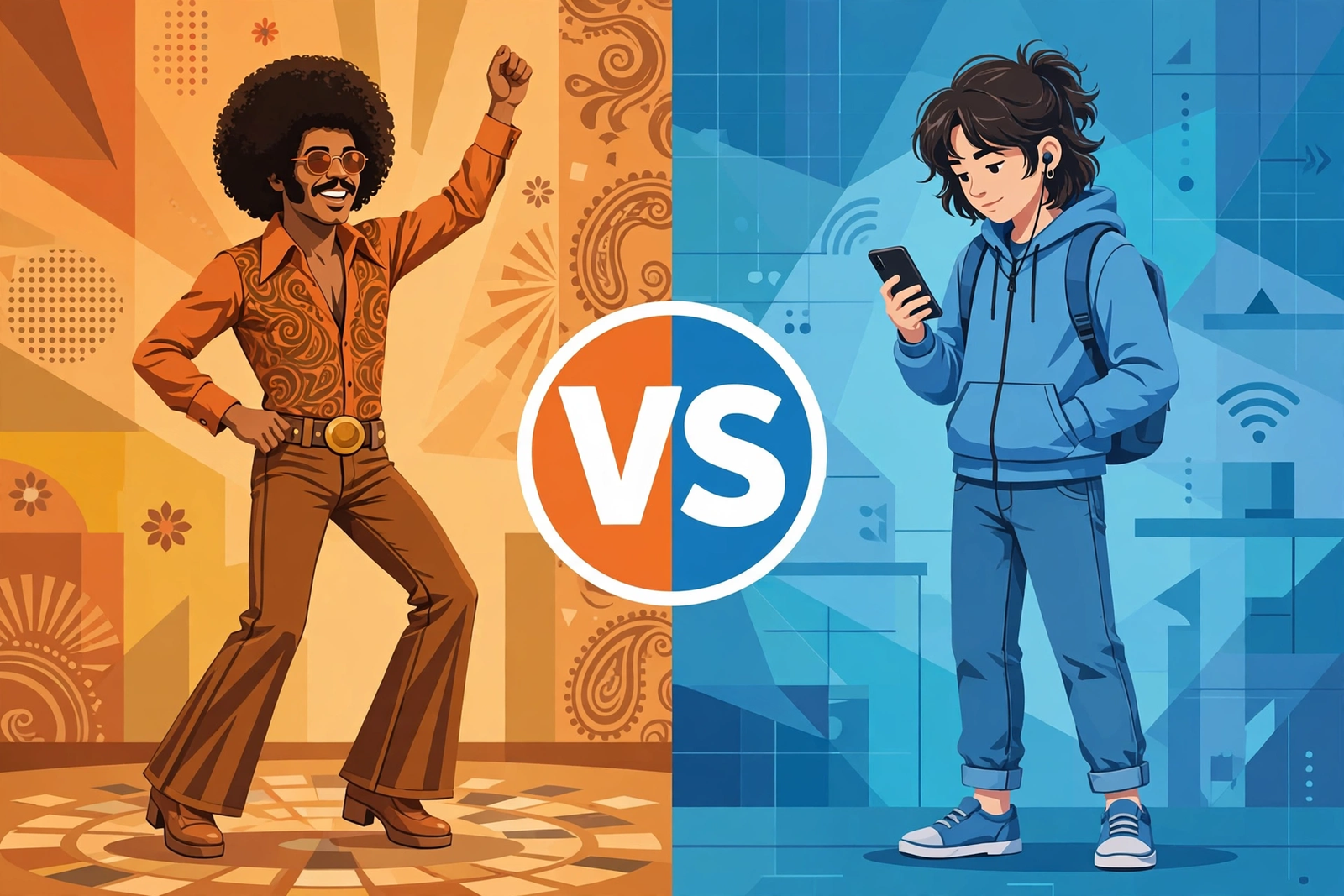
The big difference is tone. 1970s slang was warm, musical, and laid-back — it came from disco and funk culture. 1980s slang was louder and more extreme, and today’s slang is shorter, faster, and built for texting. If you want to explore how the next generations talked, check out our guide to late 90s and early 2000s slang, which covers 45+ words from the era of boy bands and dial-up internet.
Alternate Meanings of 1970s Slang Words
Many 1970s slang words had more than one meaning, and a few meant something completely different outside the decade:
- Bad — In 1970s slang, “bad” meant good or excellent, a usage borrowed from jazz culture. Outside slang, it still meant something negative, which is exactly why the slang version sounded so cool.
- Heavy — Could mean deep or serious (“that’s heavy”), but also referred to a large quantity or a big problem, depending on context.
- Boogie — Meant dancing, but “boogie” was also a style of music (boogie-woogie) and, in the military, a term for an unidentified aircraft.
- Funky — Originally described a strong smell or a style of music. In 1970s slang it became a compliment for anything stylish or rhythmic.
- Dude — Started as a term for a city slicker in the 1800s, became a casual word for a guy in the 1970s, and today is used for just about anyone.
- Boss — In slang, “boss” meant excellent. In everyday English, it was (and is) a supervisor at work — so “that’s boss” and “my boss” were two very different sentences.
Professional or Polite Alternatives to 1970s Slang
1970s slang is fun, but it does not belong in every setting. If you are writing an email, giving a presentation, or talking to someone in a formal situation, use these modern alternatives instead:
| 1970s Slang | Professional Alternative |
|---|---|
| Groovy / Far out | Excellent, impressive, outstanding |
| Right on | Absolutely, I completely agree |
| Chill out | Please relax, take a moment |
| Bummer | That’s unfortunate, what a shame |
| Give me the lowdown | Please brief me, bring me up to speed |
| Keep on truckin’ | Keep going, stay the course |
| Can you dig it? | Does that make sense to you? |
| Peace out | Goodbye, have a great day |
The rule is simple: use 1970s slang with friends, at retro parties, and in creative writing — and switch to plain, professional language at work or in formal writing.
Common Mistakes with 1970s Slang
People make a few predictable mistakes when they try to use 1970s slang today. Avoid these and you will sound retro-cool instead of confused:
- Mixing decades: “Groovy” is 1970s, but “tubular” is 1980s and “dope” is mostly 1990s. Mixing them in one sentence sounds off to anyone who knows the eras.
- Using insults seriously: Words like jive turkey, turkey, and space cadet were playful put-downs in the 1970s. Using them as real insults today just sounds strange, and some of them (like “spaz”) are now considered offensive.
- Overdoing it: One or two retro words per conversation is charming. A whole paragraph of “far out, groovy, right on, peace out” sounds like a costume, not a conversation.
- Getting “bad” backwards: Saying “that movie was bad” as a compliment only works if your audience knows the slang meaning. In most situations today, people will think you hated the movie.
- Forgetting the context: “Boogie” meant dancing, not just music. “The man” meant authority, not just any man. Always check the meaning before dropping a 1970s slang word into a sentence.
- Using dated terms with strangers: Some 1970s slang, including words tied to race and gender from that era, has not aged well. Stick to the fun, universal words — groovy, far out, boogie, right on — and skip the rest.
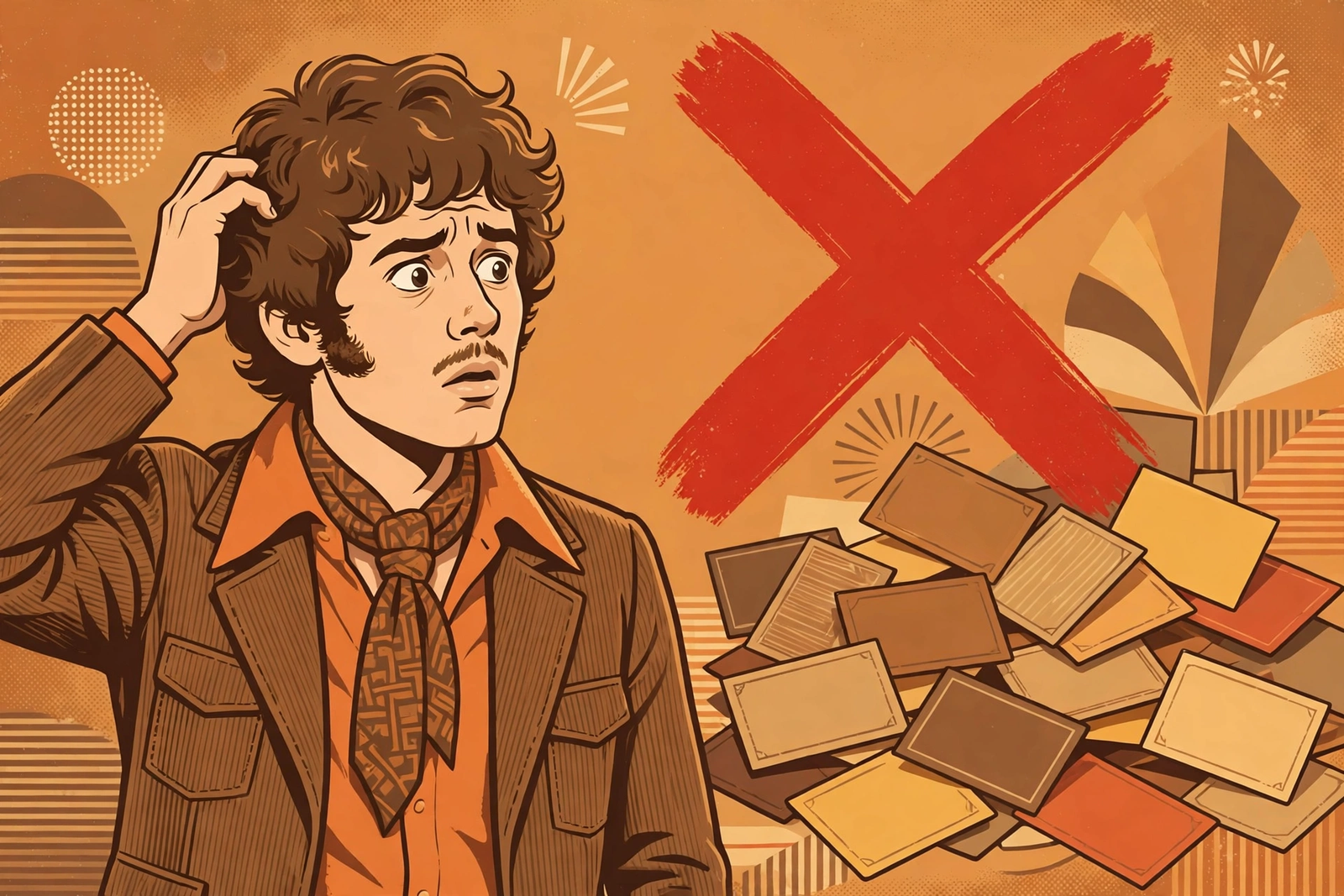
Quick Tips for Using 1970s Slang
- Start with the survivors: Dude, bummer, chill out, and peace out are still normal in 2026. They are the safest 1970s slang words to use anywhere.
- Save the rest for fun settings: Retro parties, themed trivia nights, and nostalgic social media posts are the perfect place for groovy, far out, and boogie.
- Pair slang with the era: 1970s slang sounds best alongside 1970s references — disco, vinyl records, bell-bottoms, and funk music.
- Learn the top ten first: Groovy, far out, right on, boogie, dude, bummer, peace out, chill out, outta sight, and keep on truckin’ cover most situations.
- Watch a movie for the vibe: Saturday Night Fever, Dazed and Confused, and That ’70s Show are great for hearing 1970s slang in natural conversation.
- Check before you use it at school or work: Teachers and coworkers may love the nostalgia, but a formal setting calls for modern language — see the alternatives table above.
- Have fun with it: The whole point of 1970s slang is good vibes. Use it playfully, and people will enjoy it with you.


FAQ About 1970s Slang
What is the most famous 1970s slang word?
Groovy is the most famous 1970s slang word. It meant cool, enjoyable, or excellent, and it became the signature word of the decade thanks to music, movies, and TV. Far out and right on are close behind.
What does “far out” mean in 1970s slang?
In 1970s slang, “far out” meant amazing, impressive, or unusual. People said it when they were excited or surprised by something great, like a new song, a cool outfit, or unexpected news. It came from the counterculture idea of going “far out” beyond normal experience.
What does “boogie” mean in the 1970s?
In the 1970s, “boogie” meant to dance energetically, especially to disco or funk music. Saying “let’s boogie” was an invitation to hit the dance floor. The word also described the dance music style itself.
Do people still use 1970s slang today?
Yes, some 1970s slang is still used every day. Dude, bummer, chill out, and peace out never really went away. Other words like groovy and far out survive mostly as jokes, retro references, or nostalgic throwbacks in movies, memes, and themed parties.
What did “right on” mean in the 1970s?
“Right on” meant “I completely agree” or “that’s exactly right.” It was one of the most common expressions of approval in 1970s slang, and it was often used with a raised fist or a nod. Today it sounds vintage, but everyone still understands it.
What is a “jive turkey”?
A “jive turkey” was 1970s slang for a fake, dishonest, or uncool person — someone who talked big but could not be trusted. It was a playful insult popularized by movies and TV shows of the era, and today it is mostly remembered as a funny piece of 1970s slang history.
What 1970s slang words do Gen Z still use?
Gen Z still uses dude, chill out, bummer, and peace out regularly. Words like vibe and funky also overlap with modern slang. On social media, 1970s slang shows up in retro memes, vintage fashion posts, and “70s aesthetic” content — often mixed with newer terms. If you like era-based slang guides, our middle school slang guide shows what younger generations are saying right now.
Where did 1970s slang come from?
1970s slang came from a mix of sources: the 1960s counterculture, funk and soul music, disco clubs, Black American English, television, and CB radio culture. Each scene added its own words, and the decade’s music and movies spread them across the whole country. For more era slang, see our guides to ghetto slang and slang for clothes.
Conclusion
1970s slang is more than a list of funny old words — it is a time capsule of one of the most colorful decades in American culture. From groovy and far out to boogie and right on, these words captured the music, the dancing, and the laid-back good vibes of the disco era. Some of them, like dude and chill out, never left our vocabulary at all, while others survive as joyful retro throwbacks.
The best way to enjoy 1970s slang is to use it playfully: drop a “far out!” at a retro party, say “peace out” when you leave, and keep on truckin’ through your week. Now that you know the meanings, the origins, and the common mistakes to avoid, you can talk like it’s 1976 — whenever you want. Right on!
