Quick Definition: bean dip slang is a playful way to change the subject when someone asks a question you do not want to answer. Instead of saying “I am not talking about that,” you smoothly steer the conversation somewhere lighter — as if you were simply asking someone to pass the bean dip at a party. It is polite deflection, not rudeness: a soft exit from an awkward topic.
Bean Dip Slang Meaning & Definition
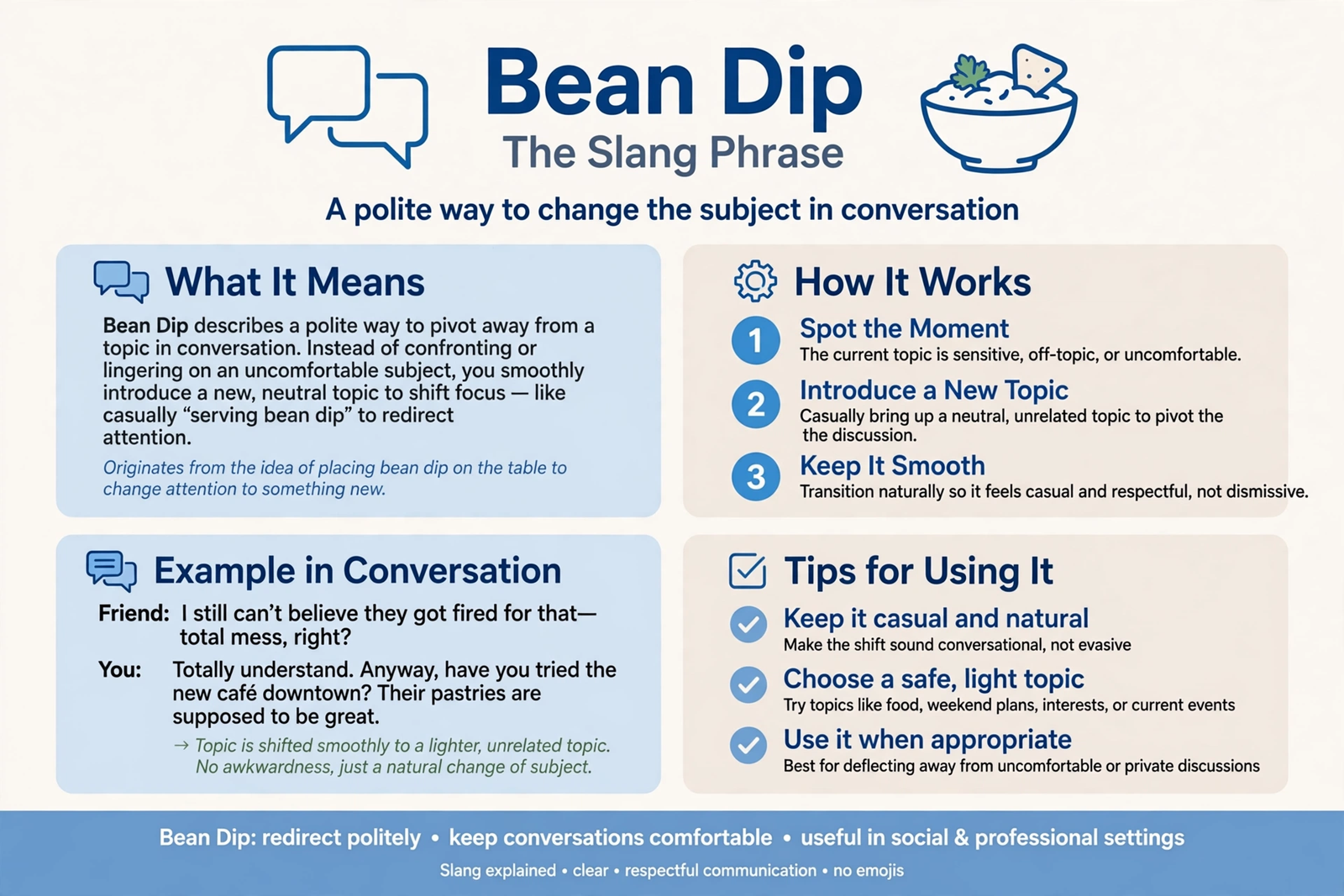
bean dip slang means using the phrase “bean dip” — or “pass the bean dip” — to dodge an uncomfortable question and redirect a conversation to something safer. The words themselves have nothing to do with food in this context. They are a code: a light, slightly funny signal that says “let’s not go there” without starting an argument.
Imagine you are at a family dinner and a relative asks when you are finally getting married, or how much money you make. Instead of freezing up or snapping back, you smile and say, “Anyway — have you tried this bean dip? It is amazing.” The question disappears, the mood stays friendly, and nobody loses face. That is bean dip slang in action.
The phrase works because it is deliberately boring and mundane. It replaces a charged topic with the most ordinary thing in the room: a snack. Psychologists call this kind of move a “redirect,” and it is one of the oldest social tools there is. What makes bean dip slang special is that it turned the redirect into a named, shareable piece of internet language — a shorthand that whole communities now recognise instantly.
On social media, the meaning has stretched a little further. Today, bean dip slang is also used to call out oversharing in the wrong place. When someone drops a heavy personal story into the comments of a light-hearted video, a reply like “Wow, okay. Anyway, pass the bean dip” tells them, politely but firmly, that this is not the place for it. The tone is blunt, funny, and very Gen Z — but the core idea is the same: change the channel, keep the peace.
Introduction
Every language has a way of saying “I would rather not answer that” without actually saying it. In English, one of the strangest and most charming versions of that dodge is bean dip slang — a phrase that sounds like a party snack and works like a social shield.
If you have seen “pass the bean dip” in a comment section, a group chat, or a reality TV recap and wondered what on earth a dip has to do with anything, you are not alone. The phrase has travelled a long way from its original home, picked up new meanings along the way, and recently went viral in a completely different context. This guide explains all of it: what bean dip slang means, where it came from, how people use it in texts and real life, and how to use it yourself without sounding rude.
Whether you want to escape nosy questions at a family gathering, keep a group chat light, or simply understand what your friends mean when they type “bean dip” mid-conversation, you will find the full answer here — with real examples, a comparison with similar phrases, and the mistakes to avoid.
Origin
The origin of bean dip slang is older — and sweeter — than most people expect. Long before it was a TikTok comment or a reality TV joke, “pass the bean dip” was a piece of folk wisdom shared in homeschooling communities in the United States.
The story goes like this: at a gathering, someone asks you a loaded or inappropriate question — about your parenting, your lifestyle, your choices. Instead of engaging, you change the subject with something harmless and physical: “Please pass the bean dip.” You are not lying, you are not arguing, and you are not giving the question the energy it wants. You are simply moving on, the way you would reach for a snack at a table.
The phrase was popularised in homeschooling forums in the 2000s, where parents swapped strategies for handling criticism from relatives and strangers. One well-known homeschooling writer, Joanne, is often credited with spreading the idea, and the expression became a beloved in-joke in those circles: a gentle, slightly funny way to set a boundary without a confrontation. The advice was always the same — change the topic, do not engage, and if the person pushes, calmly say the topic is not up for discussion.
From there, the phrase slowly leaked into the wider internet. Parenting blogs, forums, and social media carried it outward, and the image stuck because it is so vivid: a bowl of dip on a table, a room full of people, and one person quietly deciding that the conversation is moving on now. By the time short-form video and comment culture took over, “bean dip” was ready-made for its second life — a one-phrase summary of a whole social skill.
That second life arrived with a jolt in 2024, when the reality show Love Is Blind brought the phrase to millions of viewers in a very different sense — a story we will untangle in the alternate meanings section below. The show gave bean dip slang a huge burst of search interest, and from then on, the phrase belonged to the mainstream internet as well as to the homeschooling parents who coined its polite use.
Popularity
bean dip slang is popular today for a simple reason: everyone has been trapped in a conversation they wanted to escape. The phrase gives that universal feeling a name, a joke, and a tactic all at once.
Its popularity grew in three waves. The first wave was the homeschooling and parenting community, where “pass the bean dip” circulated as practical advice for years. The second wave came through social media, where the phrase was picked up as a funny, relatable way to describe dodging awkward questions — the kind of thing that performs well in memes, reaction videos, and comment threads. The third wave was television: Love Is Blind season 6 put “bean dip” in front of a mass audience, and searches for the phrase spiked as viewers tried to work out what the cast meant.
On TikTok and X, the phrase now appears most often in two settings. The first is storytelling: creators acting out the moment a relative asks an invasive question and they mentally reach for the bean dip. The second is comment-section boundary-setting, where “pass the bean dip” is the Gen Z way of saying “this is not the time or place for that story.” Both uses share the same energy: light, quick, and a little bit cheeky.
The phrase also benefits from being endlessly adaptable. It works in a text message, a tweet, a video caption, or a real-life dinner table. It works for small dodges (“So, are you two still together?”) and big ones (“Why haven’t you had kids yet?”). And because it sounds harmless, it lets the speaker set a boundary without sounding defensive — which is exactly why it keeps spreading.
How It Is Used
bean dip slang is used in three main ways, and the setting decides which one you are seeing.
1. As a spoken redirect. In a face-to-face conversation, you say it out loud — or just perform the move it describes. Someone asks something uncomfortable; you answer briefly, then pivot: “We are really happy as we are, thanks — please pass the bean dip, it is delicious.” The food does not need to be there. The point is the pivot.
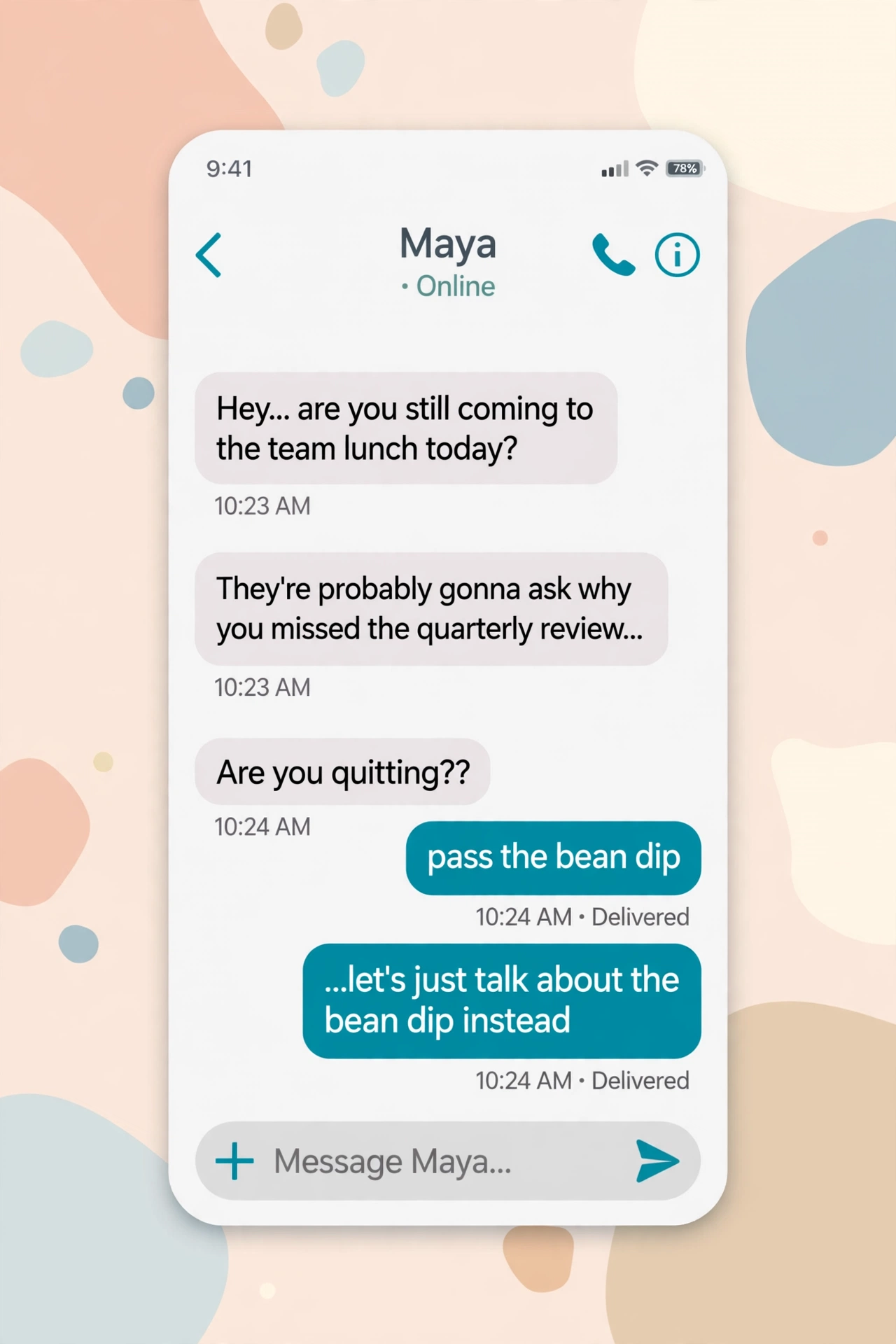
2. As a text or chat shorthand. In messages, “bean dip” or “pass the bean dip” can stand alone as a reply. A friend asks a question you do not want to answer in the group chat, and you reply “bean dip lol” or “anyway, pass the bean dip.” Everyone who knows the phrase understands instantly: topic closed, moving on. It is similar to how other slang terms work in texting — short, coded, and understood by the in-group, much like the shorthand explained in our guide to fn meaning in text.
3. As a comment-section callout. Online, the phrase is often aimed at someone else’s oversharing. A creator posts a fun video, a stranger replies with a heavy personal story, and another commenter writes “pass the bean dip” — a way of saying “wrong place for that” without a lecture. This use is blunter, and it is the one most likely to be called mean, so context matters a lot.
In all three cases, the grammar is flexible. You can “bean dip” a topic, “pass the bean dip,” or simply say “bean dip” and let the silence do the work. The phrase is almost always light in tone — even when the boundary behind it is firm.
Examples
Real examples make bean dip slang click instantly. Here is how it sounds in different situations, from family dinners to work chats.
Friendly Examples
At a reunion, an aunt leans in: “So, when are you two getting engaged?” You grin: “We are just enjoying things as they are — ooh, is that the seven-layer dip? Pass the bean dip, please!” The question is gone, the mood is warm, and nobody is offended. That is the classic friendly bean dip: a smile, a pivot, and a snack.
In a group chat, a friend asks about your ex out of nowhere: “Wait, are you still talking to Jake??” You reply: “lol bean dip — anyway, did anyone see the new episode last night?” The conversation moves on, and your friend takes the hint without any drama.
Professional Examples
At work, a colleague fishes for gossip in a meeting: “So, is it true the whole team is getting restructured?” You answer calmly: “I don’t have anything to share on that — but I did want to flag the timeline for Friday’s launch.” No bean dip is mentioned, but the move is identical: a brief non-answer, then a pivot to safe ground. In professional settings, people rarely say the phrase out loud; they simply perform it.
In a job interview, a recruiter asks a question that edges into personal territory. A polite bean dip sounds like: “I would rather focus on what I can bring to the role — for example, in my last position I…” The structure is the same every time: acknowledge, decline, redirect.
Funny Examples
Online, the funny version is the bluntest. Someone trauma-dumps in the comments of a makeup tutorial: “My boyfriend left me and I lost my job and my cat is sick.” A reply reads: “Girl, this is a GRWM. Pass the bean dip.” It is harsh, it is funny, and it is very much the internet’s sense of humour — which is why this version of the phrase divides opinion.
Another classic: a gamer’s teammate starts venting about their personal life over the headset mid-match. “Cool story, bro — pass the bean dip and let’s play.” The message is clear: wrong time, wrong place, let’s get back to the game.
| Situation | What someone says | Bean dip reply |
|---|---|---|
| Family dinner, nosy question | “When are you having kids?” | “We are happy as we are — pass the bean dip!” |
| Group chat, ex drama | “Are you still talking to Jake??” | “lol bean dip — did anyone see last night’s episode?” |
| Work meeting, gossip fishing | “Is the team getting restructured?” | “Nothing to share on that — let’s talk Friday’s launch.” |
| Video comments, oversharing | A long personal story under a fun video | “Anyway, pass the bean dip.” |
| Gaming, mid-match venting | Teammate vents about their breakup | “Cool story — pass the bean dip, let’s play.” |
Comparison with Similar Terms
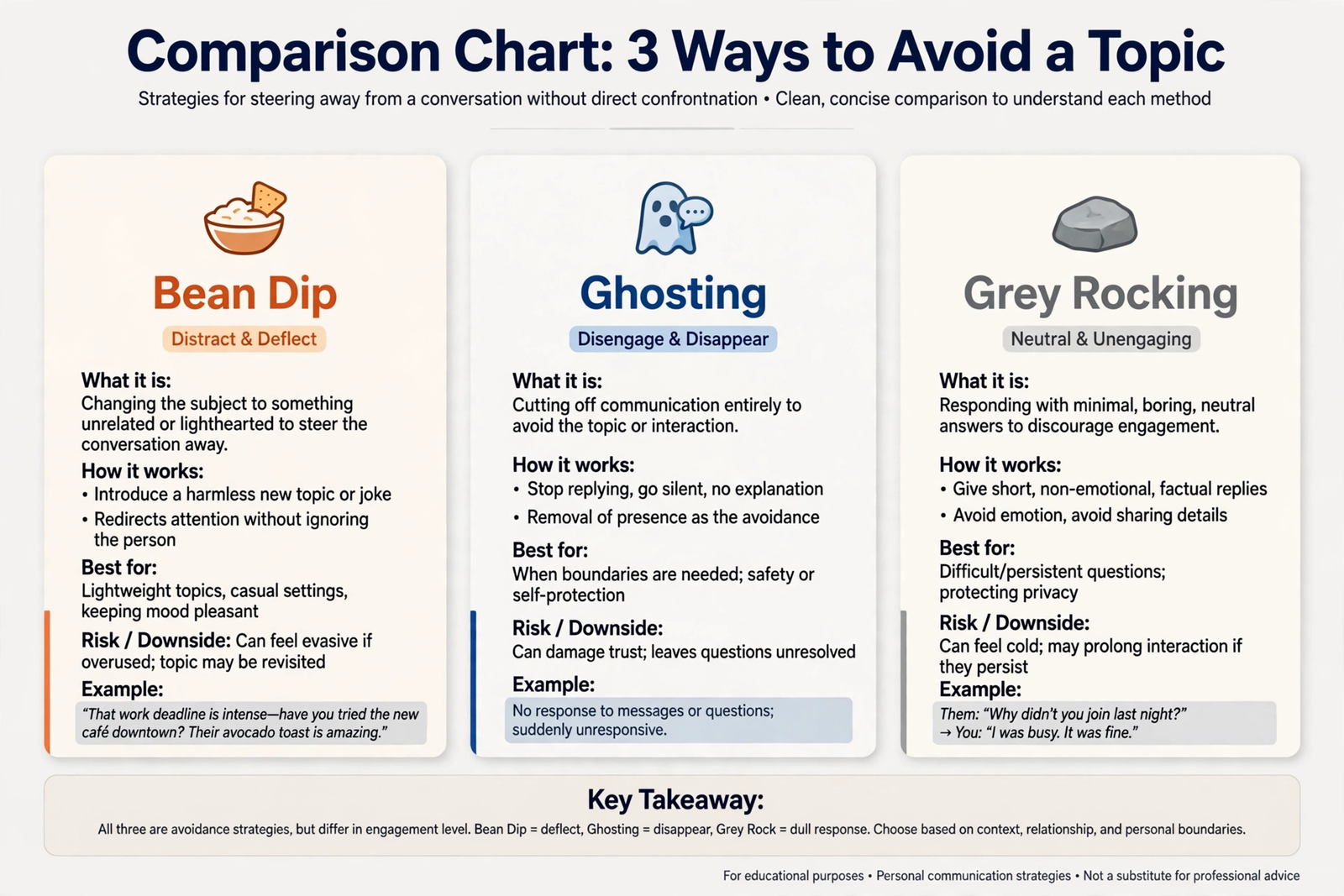
bean dip slang is often confused with other ways of avoiding a topic, but it is not the same as any of them. The differences matter, because each one sends a different social signal.
Ghosting is disappearing entirely — no reply, no explanation. Bean dipping is the opposite: you stay in the room, you stay friendly, you just change the channel. Ghosting ends the interaction; bean dipping saves it.
Grey rocking is going deliberately boring and unresponsive so that a difficult person loses interest. Bean dipping is its extroverted cousin: instead of going silent, you get aggressively mundane. You acknowledge the question with a smile and then talk about the dip. Both protect your boundaries, but bean dipping keeps the conversation alive.
Deflecting is the general term for dodging a question, and bean dipping is one specific, playful kind of deflection. All bean dipping is deflecting, but not all deflecting is bean dipping — a politician dodging a question is deflecting, but nobody would call it bean dipping.
“Anyway…” is the closest relative. Saying “anyway” and moving on is the same move without the joke. Bean dip slang just gives the move a name, a visual image, and a shared wink — which is why it works so well in group chats, where a single phrase can carry a whole paragraph of meaning. If you enjoy decoding chat shorthand, you will like our breakdown of hbu meaning in chat too.
| Term | What it does | How it differs from bean dip slang |
|---|---|---|
| Bean dip slang | Playfully changes the subject | Stays friendly and keeps talking |
| Ghosting | Disappears without replying | Ends the interaction completely |
| Grey rocking | Goes boring to end interest | Silent and dull, not playful |
| Deflecting | Dodges a question generally | Broader term, no humour built in |
| “Anyway…” pivot | Moves on to a new topic | Same move, without the shared joke |
| Stonewalling | Refuses to engage at all | Hostile; bean dipping stays warm |
Alternate Meanings
Like many slang terms, bean dip slang has more than one meaning — and one of them caused a lot of confusion when it hit television.
1. The literal food. Bean dip is, first and foremost, a real snack: a creamy dip made from refried beans, often layered with cheese, salsa, and sour cream, served with tortilla chips at parties. If someone at a barbecue asks you to pass the bean dip, they almost certainly just want the dip. Context is everything.
2. The polite redirect. This is the main slang meaning covered in this article — the homeschooling-forum expression for changing the subject when a question is uncomfortable or none of someone’s business.
3. The Love Is Blind meaning. On Love Is Blind season 6, cast member AD explained a very different, crude meaning of “bean dip” that had circulated as a joke among the cast — a physical gag that left the other cast members uncomfortable. The show’s recaps picked it up, and many viewers searching for the phrase that week found this meaning first. It is not the meaning most people use online, and it is worth knowing about only so you can tell the two apart: the polite redirect is the established slang sense, while the reality-TV sense was a one-off joke that went viral. You can read the show’s recap of the moment on Looper’s Love Is Blind lingo guide if you want the full context.
4. The online boundary callout. The newest sense: using “pass the bean dip” to shut down oversharing or trauma dumping in a comment section. This is a spin on the polite redirect, but aimed at strangers rather than relatives — and it is noticeably less polite.
When you see the phrase, check the setting first. At a dinner table, it is almost always the polite redirect. In a reality TV recap, it may be the crude joke. In a comment section, it is usually the boundary callout. The words are the same; the meaning depends on the room.
Professional or Polite Alternatives
Sometimes you need the bean dip move without the slang. Here are polished alternatives that do the same job in formal settings.
- “I would rather not get into that.” — Direct, calm, and hard to argue with. Best for work and formal events.
- “That is not something I am comfortable discussing.” — Clear boundary, polite tone. Good for personal questions from acquaintances.
- “Let’s focus on the task at hand.” — The professional bean dip. Redirects a meeting without any awkwardness.
- “I appreciate you asking, but I will keep that private.” — Warm and firm at the same time. Works with family and close friends.
- “Interesting question — anyway, about Friday’s deadline…” — The classic pivot, dressed up for the office.
- “I am not the right person to ask about that.” — Useful when the question is gossip or someone else’s business.
- A smile and a subject change. — The wordless version. “Speaking of which, did you see the new menu?” does the whole job with zero confrontation.
The trick in every case is the same as in bean dip slang: answer briefly, do not apologise for the boundary, and offer the conversation a better place to go. People almost always follow the redirect, because a new topic is easier than a standoff.
Common Mistakes
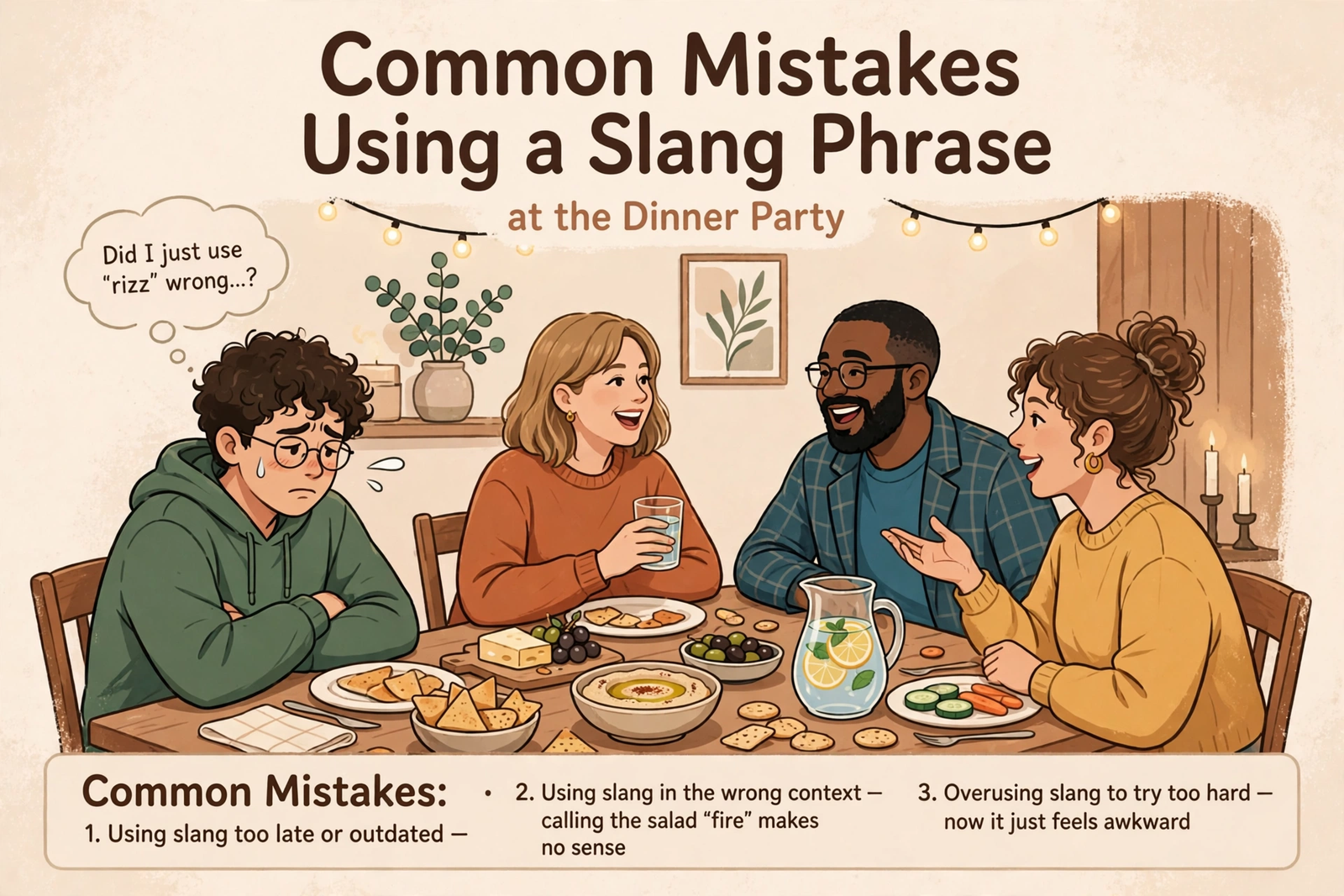
bean dip slang is easy to use and easy to misuse. These are the mistakes that turn a smooth redirect into an awkward moment.
Using it on someone who is genuinely upset. If a friend is crying and telling you something painful, replying “pass the bean dip” is not a boundary — it is cold. The phrase is for nosy questions and wrong-place oversharing, not for shutting down someone who trusts you. Save it for the aunt at dinner, not the friend in crisis.
Using it in a support group or serious setting. Context is everything. In a therapy group, a grief circle, or any space where people are invited to share, a bean dip is the wrong move. The whole point of those spaces is the conversation you would be dodging.
Repeating it after the person pushes back. A bean dip works once. If someone asks again, more directly, repeating the joke starts to look evasive or rude. The second time, be direct: “I have said I would rather not discuss it.” A boundary stated clearly beats a joke repeated awkwardly.
Confusing it with the Love Is Blind meaning. Because the crude reality-TV sense went viral, some people — especially younger viewers — may hear “bean dip” and think of the show first. Around people who only know that version, the polite redirect can land very strangely. When in doubt, use the full phrase “pass the bean dip” with a clear subject change, so the intent is obvious.
Using it as an excuse to never answer anything. If every question gets a bean dip, people stop asking — and stop trusting you. The phrase is a tool for occasional awkward moments, not a lifestyle. Answer the questions you can, and save the dip for the ones you truly should not.
Quick Tips
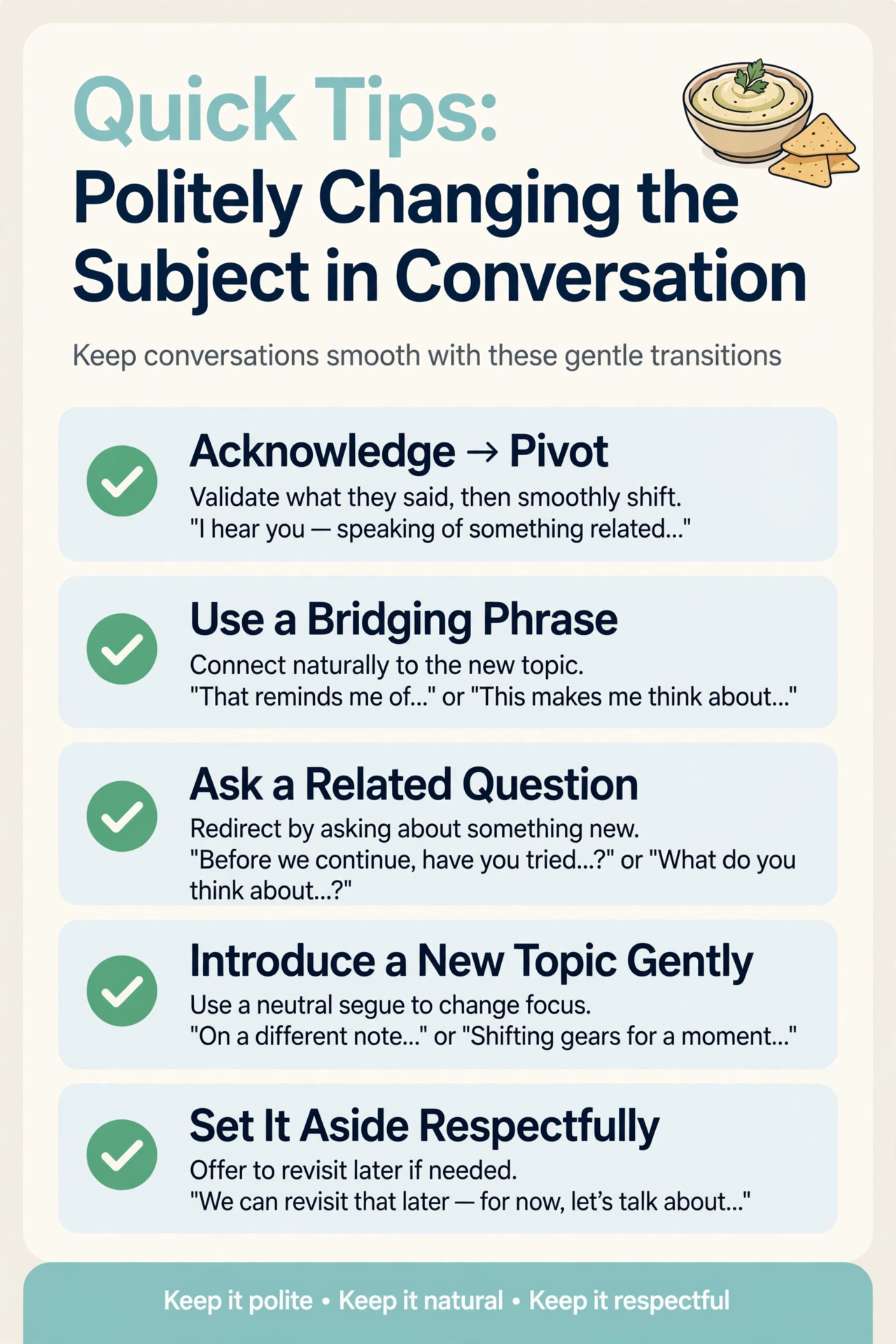
Want to use bean dip slang like a pro? Keep these tips in mind.
- Smile first, pivot second. The redirect lands softly when your face and tone are warm. A flat “bean dip” sounds dismissive; a smiling one sounds charming.
- Always offer a new topic. A pivot needs a destination. “Pass the bean dip — have you tried the new place downtown?” works far better than a bare dodge.
- Use it once per conversation. One redirect is smooth. Three in a row is a pattern, and people notice patterns.
- Match the setting. At a party, say it out loud. At work, perform it silently. Online, type it only when the oversharing is clearly misplaced.
- Read the room before the comment-section version. The blunt online use can read as mean. If the person sharing is vulnerable rather than attention-seeking, scroll past instead.
- Pair it with gratitude when family is involved. “I love that you care — and I would rather talk about your trip!” keeps the relationship warm while the topic changes.
- Do not explain the joke. If someone does not know the phrase, just let the subject change do the work. Explaining “it means I am avoiding your question” defeats the purpose.
FAQ
What does bean dip slang mean?
bean dip slang means using the phrase “bean dip” or “pass the bean dip” to politely change the subject when someone asks an uncomfortable question. It is a light, funny way to set a boundary without arguing.
Where did “pass the bean dip” come from?
The phrase comes from homeschooling communities in the United States, where parents used it as advice for handling nosy or critical questions: instead of engaging, change the subject — as if asking someone to pass the bean dip at a dinner table. It spread through forums and blogs before reaching mainstream social media.
Is bean dip slang rude?
Usually not. In its original sense it is deliberately polite — a way to avoid a confrontation. But the newer online use, where it is aimed at strangers oversharing in comment sections, can feel blunt or mean. The setting decides whether it reads as charming or cold.
What does bean dip mean on Love Is Blind?
On Love Is Blind season 6, the cast used “bean dip” as a crude joke with a very different meaning from the polite redirect. The show’s version went viral, but it is not the meaning most people use. The established slang sense is the polite subject change.
How do you use bean dip slang in a text?
You can reply with “bean dip lol” or “anyway, pass the bean dip” when someone asks something you do not want to answer in a group chat, then immediately introduce a new topic. It works best when everyone in the chat knows the phrase.
Is bean dip slang the same as ghosting?
No. Ghosting means disappearing without a reply. Bean dipping means staying in the conversation but changing the subject. One ends the interaction; the other saves it.
Can you use bean dip slang at work?
Yes, but say it with actions rather than words. In a meeting, a polite version sounds like “I don’t have anything to share on that — let’s talk about Friday’s launch.” The structure is the same: brief non-answer, then a redirect to safe ground.
What is the literal meaning of bean dip?
Literally, bean dip is a party snack made from refried beans, often layered with cheese, salsa, and sour cream, served with tortilla chips. The slang meaning borrows the snack’s image — something ordinary on a table — to describe an ordinary, low-drama subject change.
Conclusion
bean dip slang is one of the internet’s most useful little phrases: a snack, a joke, and a social skill in three words. It started as practical wisdom in homeschooling circles — a gentle way to handle questions that deserved no answer — and grew into a piece of mainstream slang for dodging awkward moments, in person and online.
The key takeaway is simple. A bean dip is not about the food and not about being rude. It is about choosing where a conversation goes. Used well, it protects your privacy, keeps the mood light, and lets everyone move on without a scene. Used badly — on someone hurting, or in a space meant for sharing — it can sting. So read the room, offer a better topic, and let the dip do the work.
Next time a relative asks the question you were dreading, or a group chat takes a turn you did not ask for, you will know exactly what to do: smile, pivot, and pass the bean dip. And if you enjoy decoding the coded language of texts and group chats, our guide to tysm meaning is a good next stop — or explore more everyday slang like glizzy meaning to keep building your vocabulary.
