
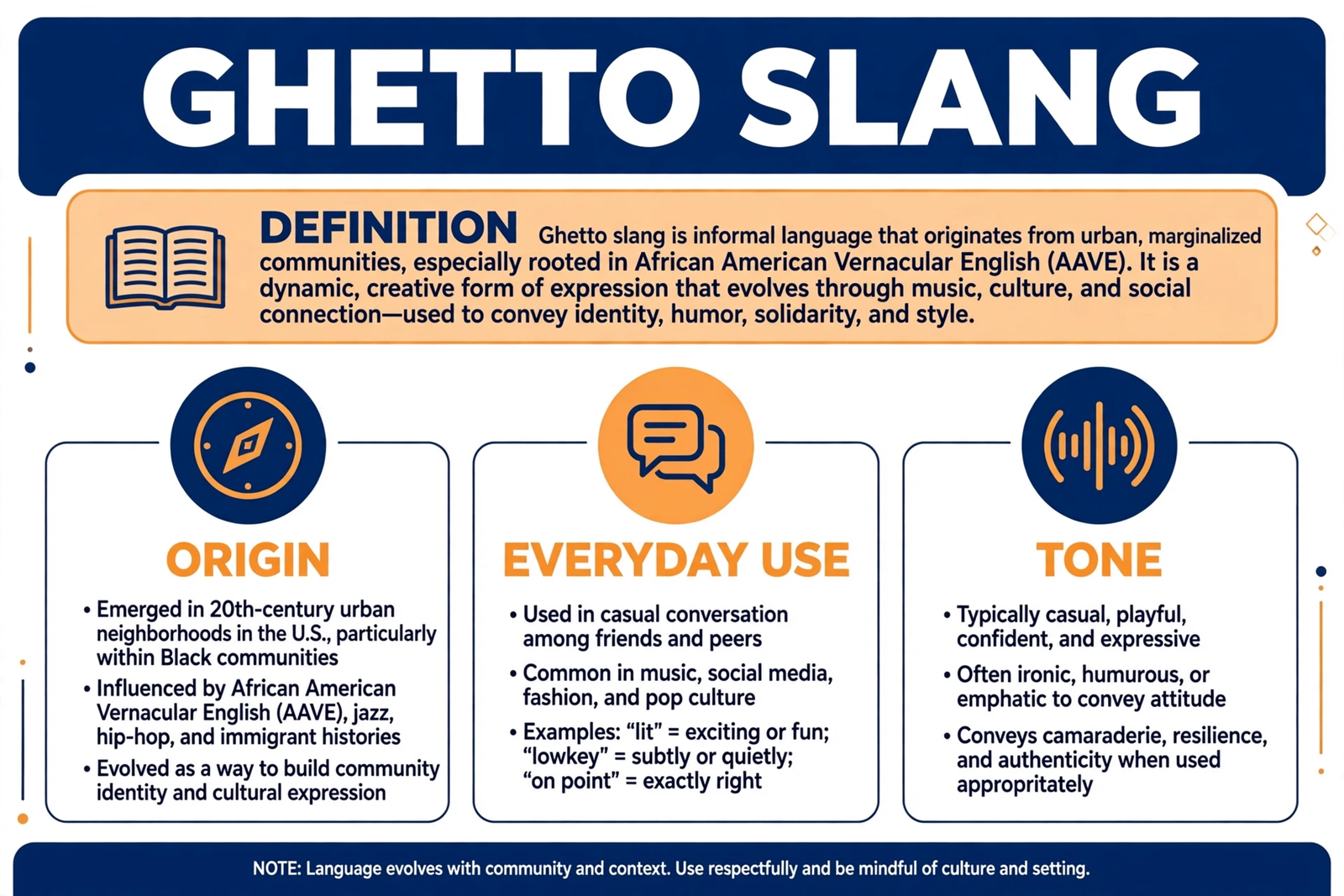
Quick definition: Ghetto slang is the informal language, words, and expressions that grew out of Black American urban communities — especially African American Vernacular English (AAVE) — and spread into hip-hop, social media, and everyday texting. Today people also use “ghetto” as slang itself, usually to describe something cheap, rough, or improvised — a usage many people find offensive, so context matters a lot.
Ghetto Slang Meaning & Definition
Ghetto slang means the street-level vocabulary and speech style that developed in predominantly Black inner-city neighbourhoods in the United States. It includes words, phrases, pronunciations, and grammar patterns from African American Vernacular English (AAVE), the dialect that has shaped American slang for generations — from jazz-era terms to today’s TikTok captions.
When someone says “ghetto slang,” they usually mean one of two things. First, the actual slang words that come from the hood: terms like lit, no cap, on fleek (older now), finna, homie, and tryna. Second, the adjective “ghetto” itself, used in sentences like “that phone case is so ghetto” — meaning cheap, tacky, or held together with duct tape and hope. That second use is where things get tricky, and we will come back to it.
Here is the short version in plain English:
- Ghetto slang (the language): informal words and phrases from Black urban culture, now used worldwide in music, memes, and texting.
- “Ghetto” as an adjective: slang for something low-quality, shabby, or makeshift — often considered disparaging and best avoided.
- “Ghetto” as a noun: a poor, densely populated urban area, historically a segregated neighbourhood.
Understanding all three meanings matters, because the word carries real history. It did not start as slang at all. It started as a place — and a painful one.
Introduction
You have probably heard the phrase “ghetto slang” in a comment section, a song lyric, or a friend’s text. Maybe someone called a word “ghetto slang” on TikTok. Maybe you saw it in a meme and wondered whether it was a compliment, an insult, or just a description. The honest answer is: it can be all three, depending on who says it and how.
Slang is how communities mark belonging. The words that come out of Black American neighbourhoods — from Harlem to South Central to the South Side of Chicago — have shaped the way the whole world talks. Hip-hop carried them across the planet. Social media sped them up. Today, a word born on a block in Atlanta can be trending in London, Lagos, and Lahore within a week.
But “ghetto” is not just another fun slang word. It has a heavy past, and the people it describes have strong feelings about how it is used. This guide explains the ghetto slang meaning in full: where the word came from, how the slang works, real examples from texts and songs, how it compares with similar terms like hood slang, and the polite alternatives you can use instead. By the end, you will know exactly what it means — and when not to say it.
Origin
The word “ghetto” is older than the slang by about 500 years. It first appeared in Venice, Italy, in 1516, when Jewish people were forced by law to live in a walled-off quarter of the city called the Ghetto Nuovo. The name probably came from the Venetian word ghèto, meaning “foundry,” because an iron foundry stood on the site — a history you can trace in detail in the Wiktionary entry for “ghetto.” Over the next centuries, Jewish ghettos spread across Europe, and the word came to mean any area where a minority group was forced to live apart.
The darkest chapter came during the Holocaust, when Nazi Germany created more than 1,000 ghettos across occupied Europe to imprison Jewish populations before deportation. After World War II, the word’s meaning shifted again in the United States. As Black families moved to northern cities during the Great Migration, segregation, redlining, and discriminatory housing policy packed them into poor, under-resourced neighbourhoods — and those neighbourhoods were called ghettos.
That is where ghetto slang was born. Cut off from mainstream opportunity but rich in culture, these communities built their own language. AAVE — sometimes called Black English or Ebonics — developed its own grammar, rhythm, and vocabulary. Words travelled from the street to the stage: jazz musicians in the 1920s and 30s, then blues and R&B singers, then hip-hop artists from the 1970s onward. Each generation added new words, and the mainstream borrowed them — often without credit.
By the 1990s and 2000s, “ghetto” itself had flipped into an adjective in pop culture. Movies, reality TV, and comedy used “so ghetto” to mean trashy or low-class. Hip-hop also reclaimed it proudly — “ghetto fabulous” meant flashy and proud of where you came from. The same word could be pride or insult, depending on the speaker. That tension has never gone away.
Popularity
Ghetto slang is everywhere in American pop culture, and it has been for decades. The reason is simple: Black American culture is the engine of American slang. Linguists have shown again and again that words start in Black communities, move into youth culture, then into advertising, TV, and everyday speech. Terms like cool, hip, dope, woke, lit, slay, and no cap all followed that path.
Hip-hop is the biggest amplifier. When a rapper drops a new word in a hit song, millions of listeners repeat it the same week. Social media made the cycle even faster. TikTok trends, Twitter (now X) memes, and Instagram captions now spread ghetto slang globally within hours. A teenager in a small town who has never visited a big city can still talk like the internet — because the internet talks like the hood.
Search interest in “ghetto slang” stays steady year after year, spiking whenever a viral video, a rap lyric, or a celebrity moment puts a word in the spotlight. Teachers, parents, and language learners search it to understand what their kids are saying. Writers and marketers search it to sound current. And many people search it because they heard “that’s so ghetto” and want to know whether it is rude. (Short answer: usually, yes — see the Common Mistakes section below.)
The popularity also raises a real debate about respect and credit. When a word moves from a Black neighbourhood to a corporate ad campaign, the community that created it rarely gets paid or even acknowledged. That is why many people now talk about “slang appropriation” alongside slang itself. Knowing the history behind the words is part of using them well.
How It Is Used
Ghetto slang works like any slang: short, expressive, and full of feeling. It shows up in texts, captions, song lyrics, stand-up comedy, and casual conversation. Here is how people actually use it.
As a noun phrase (“ghetto slang” itself): People use the phrase to label a style of speech. “He was talking in ghetto slang the whole time” usually means the speaker used AAVE words and street expressions. Sometimes it is said with admiration — the speaker sounded real, funny, or cool. Sometimes it is said dismissively, as a way of calling the speech uneducated. The same sentence can land very differently depending on tone and who is talking.
As an adjective (“that’s ghetto”): This is the most common everyday use. It describes something cheap, broken, improvised, or tacky. A chair held together with zip ties is “ghetto.” A phone with a cracked screen and a rubber band is “ghetto.” A party with plastic cups and no music is “ghetto.” The meaning is “low-quality or makeshift” — but it carries a judgement about poor Black neighbourhoods that many people find offensive.
In hip-hop and pride (“ghetto fabulous”): Artists also use “ghetto” as a badge of honour. “Ghetto fabulous” means flashy, confident, and proud of your roots. “Straight outta the ghetto” means you made it out and you are not hiding where you came from. In this use, the word is reclaimed — but reclamation works differently depending on who is speaking.
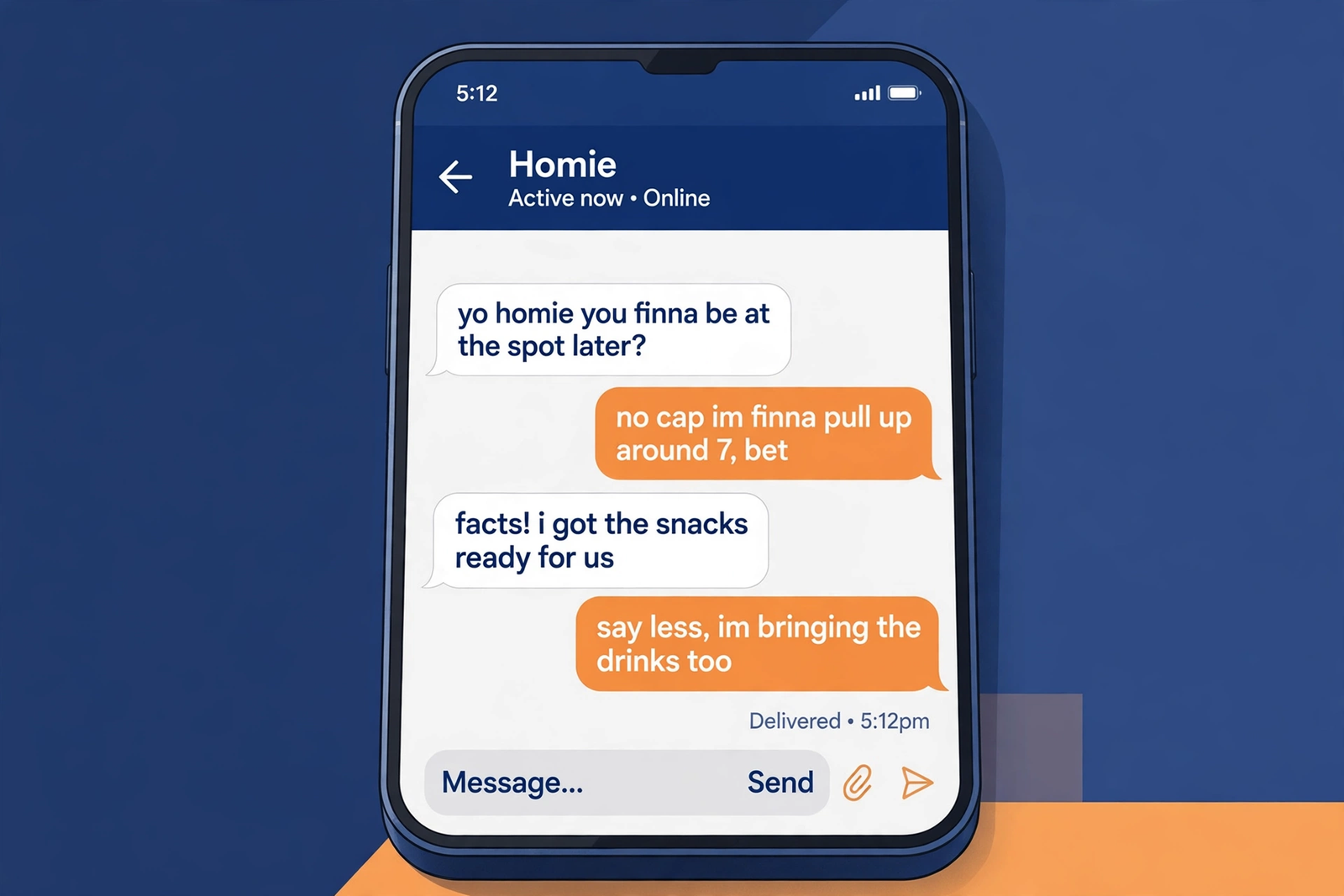
In texting and online chat: The slang words themselves — finna (fixing to), tryna (trying to), homie, fam, no cap, deadass, on God — appear in everyday messages without anyone thinking of them as “ghetto slang” at all. They have simply become internet English. That is how slang works: what starts in one community becomes everyone’s language.
Examples
Real examples make the meaning click. Here are everyday uses of ghetto slang, sorted by tone — so you can see how the same words shift with context.
Friendly Examples
- “Ayo, that party was lit, no cap — best night in ages.” (lit = amazing, no cap = no lie)
- “My homie from the block just got his degree. So proud of him, fam.”
- “Girl, your outfit is straight fire today. Ghetto fabulous and you know it.”
- “We finna hit the corner store, you coming?” (finna = going to)
- “Deadass, that food truck got the best tacos in the city.” (deadass = seriously)
Professional Examples
Ghetto slang rarely belongs in formal settings, but its words do cross over when the setting is casual and creative:
- “That marketing campaign was low-key genius — it felt real, not corporate.” (low-key = quietly, subtly)
- “Let’s keep it 100 with the client about the timeline.” (keep it 100 = be completely honest)
- “The new design is clean, no cap — the team killed it.”
- “We need a vibe check before we present this to the whole company.” (vibe check = quick sense of the mood)
The rule is simple: in professional settings, use the mild, widely adopted words (low-key, keep it 100) and skip the heavier street terms. When in doubt, default to standard English.
Funny Examples
- “My Wi-Fi is so ghetto it disconnects when someone microwaves popcorn.”
- “Bro fixed his car bumper with duct tape and zip ties. Certified ghetto engineering.”
- “She said ‘I ain’t got time for that’ and the whole group chat went silent. Iconic.”
- “My phone battery at 2% and I still won’t charge it. That’s the ghetto in me.”
Notice how the funny examples mostly use “ghetto” as an adjective for something broken or improvised. That is exactly the use that makes many people uncomfortable — it turns a word about real neighbourhoods and real poverty into a punchline. Funny to some, hurtful to others. Know your audience.
Comparison with Similar Terms
Ghetto slang overlaps with several related terms, but they are not the same thing. This table clears up the confusion.
| Term | What It Means | How It Differs from Ghetto Slang |
|---|---|---|
| Ghetto slang | Informal language from Black urban communities; also “ghetto” as an adjective for cheap or makeshift. | The broad umbrella term — covers the words and the attitude. |
| Hood slang | Slang from the neighbourhood (“the hood”) — street talk, local expressions, and rap vocabulary. | Almost a synonym, but “hood” sounds more local and proud; “ghetto” sounds heavier and more loaded. |
| AAVE | African American Vernacular English — a full, rule-governed dialect with its own grammar. | AAVE is a dialect, not just slang. Ghetto slang is the casual vocabulary that sits inside it. |
| Street slang | Any informal language from city streets, across all communities. | Broader and neutral — it is not tied to one community or history the way “ghetto” is. |
| Ratchet slang | Rowdy, unfiltered, over-the-top language and behaviour, often used playfully. | “Ratchet” is about attitude and messiness; “ghetto” is about place, class, and history. |
| Ebonics | An older name for AAVE, popular in the 1990s. | Mostly outdated now; linguists and speakers prefer AAVE or Black English. |
The key point: if you mean the language of Black urban communities, “AAVE” or “hood slang” is usually the safer, more accurate term. “Ghetto slang” is understood, but it drags the word’s painful history into every sentence.

Alternate Meanings
“Ghetto” wears several hats, and the meaning changes completely with context:
- A place: A poor urban neighbourhood, often segregated by race or class. “He grew up in the ghetto” is a statement about where someone lived, not how they talk.
- An adjective for cheap or tacky: “That setup is so ghetto” means improvised or low-quality. Slang, informal, and often offensive.
- A badge of pride: In hip-hop, “ghetto” can mean authentic, real, and unapologetic. “Ghetto superstar” is a compliment.
- A metaphor: Writers use it for any isolated, self-contained world — “the academic ghetto,” “a gay ghetto.” This use borrows the segregation meaning, not the slang one.
- A music and fashion label: “Ghetto house” is a style of Chicago house music. “Ghetto fabulous” is a fashion attitude — big, bold, and flashy.
Because the word has so many meanings, it is easy to be misunderstood. If you are writing or speaking for a wide audience, say what you actually mean — “street slang,” “AAVE,” “makeshift,” or “low-budget” — instead of reaching for “ghetto” as a shortcut.
Professional or Polite Alternatives
You almost never need the word “ghetto” to say what you mean. Here are cleaner swaps:
| Instead of | Say | When to Use It |
|---|---|---|
| “That’s so ghetto” | “That’s makeshift” / “That’s a quick fix” | Describing something improvised or DIY. |
| “Ghetto slang” | “Street slang” / “AAVE” / “urban slang” | Talking about the language itself. |
| “Ghetto neighbourhood” | “Under-resourced neighbourhood” / “low-income area” | Formal writing, news, or reports. |
| “Ghetto fabulous” | “Bold and flashy” / “extra in the best way” | Complimenting a big, confident style. |
| “Acting ghetto” | “Acting rowdy” / “being loud and unfiltered” | Describing behaviour without the class judgement. |
These alternatives are not about being “politically correct” for its own sake. They are about precision. “Makeshift” says exactly what you mean without insulting anyone’s neighbourhood. “AAVE” names the dialect accurately. Good language is specific language.
Common Mistakes
People get “ghetto slang” wrong in a few predictable ways. Avoid these:
- Using “ghetto” as a casual insult. Calling anything cheap or ugly “ghetto” links poverty and Blackness with low quality. Even if you mean no harm, many listeners will hear it as a slur. Use “makeshift” or “low-budget” instead.
- Treating AAVE as “broken English.” AAVE has consistent grammar rules — double negatives, habitual “be,” dropped copula — that linguists have documented for decades. It is a dialect, not a mistake. Mocking it as bad English is both wrong and rude.
- Forcing slang to sound cool. Dropping “no cap” and “deadass” into a work email to seem young usually backfires. Slang works when it is natural; forced slang reads as cringe.
- Using it to stereotype people. Not everyone from a poor neighbourhood talks the same way, and plenty of people who use ghetto slang never lived in one. The words travel far beyond their origin — do not assume someone’s background from their vocabulary.
- Confusing “ghetto” with “hood.” They overlap, but “the hood” is usually said with warmth and local pride, while “the ghetto” carries the weight of segregation and poverty. In lyrics and conversation, the difference matters.
- Quoting lyrics without context. A word that is fine in a rap song can land badly in a classroom or office. Songs have artistic licence; your group chat does not.

Quick Tips
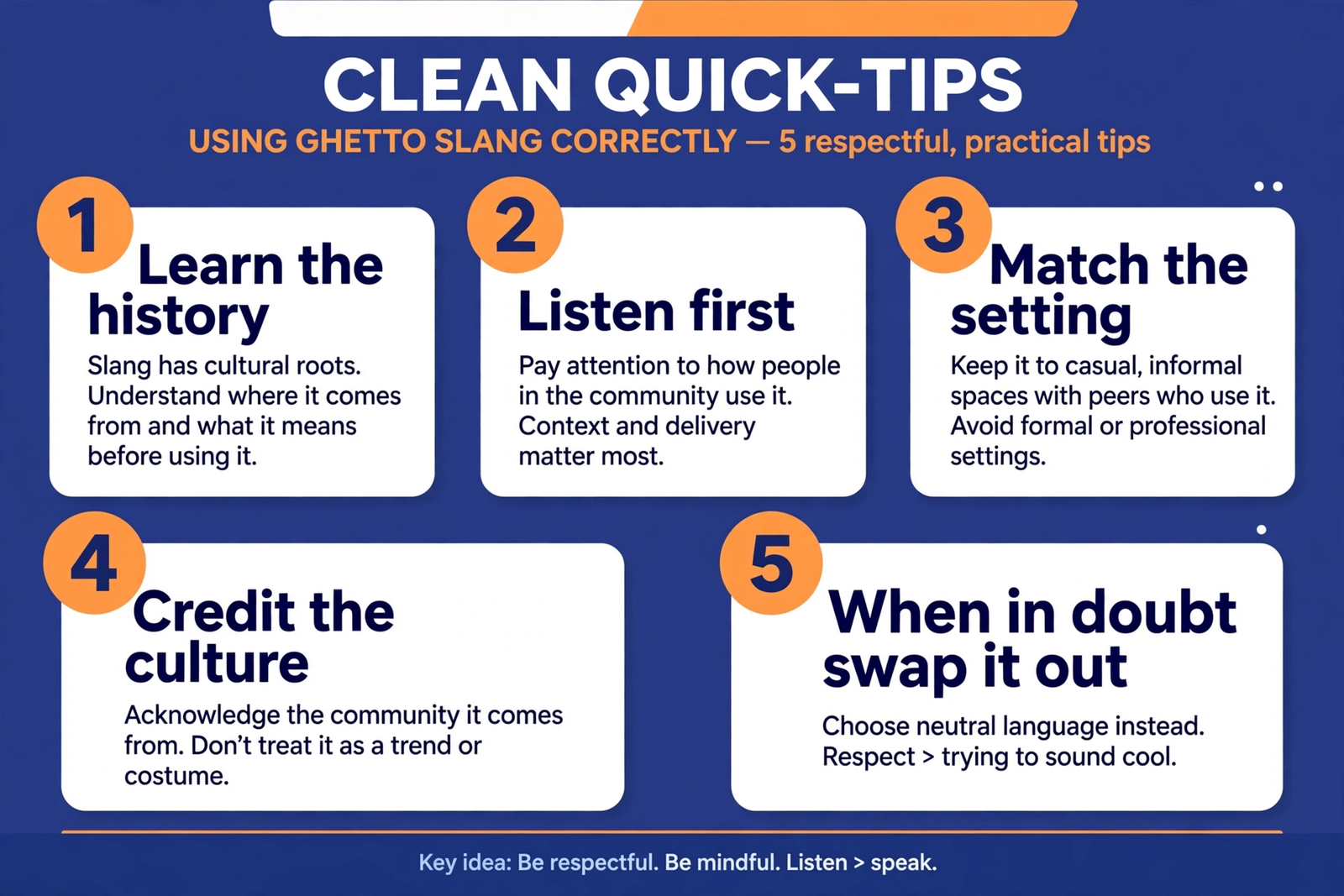
- Learn the history first. Knowing where “ghetto” comes from — Venice, the Holocaust, segregation — changes how you hear it. A word with that past deserves care.
- Listen before you repeat. Pay attention to how people from the community use these words, and in what settings. Imitation without understanding is where most mistakes happen.
- Match the setting. Slang belongs in casual chats, captions, and comedy — not in job applications, formal emails, or first meetings.
- Credit the culture. If you use AAVE words in content or marketing, say so. A quick nod to Black culture costs nothing and means a lot.
- When in doubt, swap it out. If you are unsure whether “ghetto” will offend, it probably will. “Makeshift,” “street slang,” or “AAVE” will say the same thing safely.
- Keep learning the new words. Slang moves fast. A term that was hot last year can sound dated today — check current usage on TikTok or Urban Dictionary before using a word in public content.

FAQ
What does ghetto slang mean?
Ghetto slang is the informal language that developed in Black American urban communities — words, phrases, and speech patterns from African American Vernacular English (AAVE). It also refers to the adjective “ghetto,” slang for something cheap, makeshift, or tacky.
Is it offensive to say “that’s so ghetto”?
Many people consider it offensive, yes. It uses a word tied to segregation and poverty as a synonym for “low-quality,” which can feel like an insult to the communities it describes. Safer options are “makeshift,” “low-budget,” or “DIY.”
What is the difference between ghetto slang and hood slang?
They overlap a lot. Hood slang refers to language from “the hood” — the neighbourhood — and usually sounds proud and local. Ghetto slang covers the same words but carries the heavier history of the word “ghetto.” In practice, “hood slang” is the warmer, more common term.
Is ghetto slang the same as AAVE?
Not exactly. AAVE is a complete dialect with its own grammar rules. Ghetto slang is the casual vocabulary and expressions that come out of AAVE-speaking communities. Think of AAVE as the language system and ghetto slang as the street-level words inside it.
Where did the word “ghetto” come from?
It comes from Venice, Italy, where Jewish people were forced to live in a walled quarter called the Ghetto Nuovo starting in 1516. The word later described segregated neighbourhoods in Europe and, in the United States, poor Black urban areas shaped by segregation and redlining.
What are some examples of ghetto slang words?
Common examples include homie (close friend), finna (going to), no cap (no lie), deadass (seriously), lit (amazing), fam (family or close friends), and keep it 100 (be totally honest). Many of these have spread into mainstream internet English.
Can I use ghetto slang in professional writing?
Mostly no. A few widely adopted terms like “low-key” or “keep it 100” work in casual professional settings, but heavier street terms and the word “ghetto” itself do not belong in formal writing, job applications, or client emails.
Why is ghetto slang so popular on TikTok and in music?
Hip-hop made it global, and social media made it instant. Black American culture drives most American slang, and TikTok spreads new words worldwide within days. The rhythm, humour, and expressiveness of the language make it perfect for songs, memes, and short videos.
Conclusion
Ghetto slang is more than a list of funny words. It is the voice of communities that turned hardship into culture — a language shaped in segregated neighbourhoods, carried by jazz and hip-hop, and now spoken (or at least quoted) around the world. Words like no cap, homie, and finna started on city blocks and ended up in everyday texts everywhere.
But the word “ghetto” itself carries a history that deserves respect. From a walled quarter in Venice to the segregated neighbourhoods of American cities, it has always described people pushed to the margins. Using it as a casual insult for anything cheap or broken ignores that history — and the people who lived it.
The smart move is simple: enjoy the language, learn where it comes from, use it naturally in the right settings, and choose precise words when the old ones carry a sting. Say “street slang” or “AAVE” when you mean the language. Say “makeshift” when you mean a quick fix. And when you want more slang explained the same way, explore related guides like 2010s slang or Australian slang — every era and every place has its own words worth knowing.

1 thought on “ghetto slang meaning: What It Means in Text (2026)”