
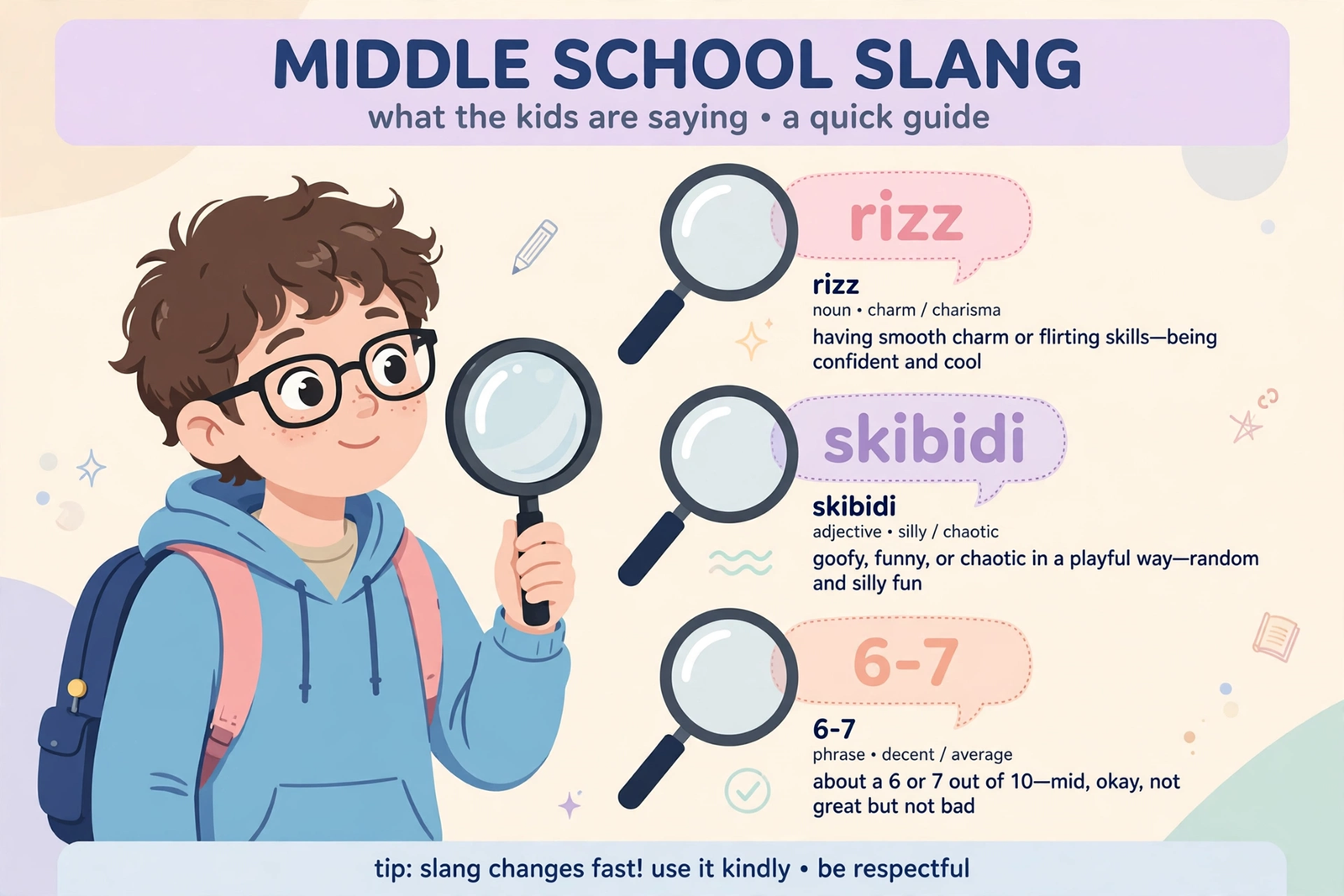
Quick definition: Middle school slang is the fast-changing set of words, phrases, and memes used by 11- to 14-year-olds in the United States — mostly Gen Alpha terms like rizz, skibidi, gyatt, 6-7, and sigma — picked up from TikTok, YouTube, Roblox, and gaming streams, and used in hallways, group chats, and classrooms to joke, compliment, tease, and belong.
Middle School Slang Meaning & Definition
Middle school slang means the informal vocabulary that kids aged roughly 11 to 14 use with each other every day. It is not a single word with one fixed definition — it is a whole dialect built from memes, streamer catchphrases, gaming lingo, and older teen slang, remixed at lightning speed. One week a word means “cool,” the next week the same word is a joke, an insult, or completely meaningless — and that is exactly the point.
If you have heard a sixth grader shout “six seven!” for no reason, call someone a “sigma,” or describe a lunch tray as “skibidi,” you have heard middle school slang in the wild. For kids, these words are social currency: knowing them signals that you are in on the joke. For parents and teachers, they can sound like a foreign language. This guide translates it — every major term, what it really means, where it came from, and when (if ever) to worry.
Most middle school slang is harmless nonsense. A small number of terms are rude or sexualized, and knowing the difference matters more than memorizing every word. We flag those clearly below so you can tell a joke from a red flag at a glance.
Introduction
Walk past any American middle school at lunchtime and you will hear a language that barely existed three years ago. “Bro has no rizz.” “That fit is so Ohio.” “Six seven!” — followed by laughter nobody over twenty understands. This is middle school slang in 2026: a mix of Gen Alpha meme words, Gen Z hand-me-downs, and gaming terms, all moving faster than any dictionary can track.
Why does it change so fast? Because the source is not the street anymore — it is the feed. A single TikTok sound, a YouTube series like Skibidi Toilet, or a streamer’s throwaway line can put a new word in a million group chats overnight. Kids adopt it, remix it, and drop it the moment adults start using it. That speed is a feature, not a bug: slang has always been how young people mark who belongs to their group and who does not.
This article does what most parent guides do not. Instead of a dry dictionary list, you get the full picture: the origin of each wave of middle school slang, a 40+ word glossary with real examples, friendly and funny usage, comparisons with similar terms, the mistakes adults make when they try to use it, and quick tips for keeping up without embarrassing yourself. Whether you are a parent decoding your kid’s texts, a teacher hearing it in class, or a student who wants to use it right, you will leave fluent.
Origin
Middle school slang has three main roots, and almost every word in this guide comes from at least one of them.
1. Streaming and gaming culture. Twitch streamer Kai Cenat popularized rizz (short for “charisma”) in his friend group around 2021, and it spread so far that Oxford University Press named it Word of the Year for 2023. Gaming gave us noob, GG (good game), OP (overpowered), and cooked (finished, done for). Roblox and Minecraft chats are still slang factories today.
2. TikTok and YouTube memes. The YouTube series Skibidi Toilet, created by Alexey Gerasimov, turned the nonsense word “skibidi” into the defining sound of Gen Alpha humor. The “6-7” meme — a basketball chant with no fixed meaning — became the most-searched Gen Alpha term of early 2026, and Dictionary.com named 67 its Word of the Year for 2025. TikTok sounds compress a joke into a single word, and middle schoolers carry it into real life.
3. Older slang, remixed. Much of today’s middle school slang has deep roots. Slay, shade, and tea come from LGBTQ+ ballroom culture; no cap, lit, and fire come from hip-hop and African American Vernacular English (AAVE). Gen Alpha did not invent these words — it inherited them, shortened them, and stacked them into absurd combinations like “skibidi Ohio rizz,” where the incomprehensibility itself is the joke.
Understanding the origin matters because it explains the tone. Most of these words started as jokes among friends, not as insults. When a kid says them, they are usually performing belonging, not being rude — even when the words sound strange to adult ears.
Popularity
Middle school slang is more visible in 2026 than any teen dialect before it, for one simple reason: kids carry the internet in their pockets. A meme born on Monday can be school-wide slang by Friday. Search data backs this up — 67 was the most-searched Gen Alpha term from January to August 2026, and rizz still draws heavy searches three years after its peak.
Teachers report hearing the same handful of words dozens of times a day: skibidi, 6-7, rizz, sigma, Ohio, aura, and gyatt. Some schools have even banned shouting “six seven” in class, which — predictably — only made it funnier to the kids. The words also cross over into family life: parents hear them at dinner, see them in texts, and find them in homework margins.
The popularity curve is short and steep. A term typically goes viral, peaks within months, then fades into “cringe” territory once adults and brands start using it. Rizz followed this arc exactly — crowned by Oxford in 2023, then gradually mocked as overused by 2026. Sigma went from a serious “lone wolf” compliment to an almost entirely ironic joke. If your kid suddenly stops saying a word, it probably did not disappear — it just became uncool.
How It Is Used
Middle school slang shows up in four main places, and the same word can work differently in each one:
- In person: hallway greetings, lunch-table jokes, and classroom whispers. Short bursts — “Bro, that’s so skibidi” — land as punchlines, not sentences.
- In group chats: rapid-fire replies on Snapchat, Discord, and iMessage. A single word (“Ohio 💀”) can be a whole reaction.
- In gaming: voice chat during Roblox, Fortnite, or Minecraft. Terms like cooked, clutch, and GG describe what just happened in the game.
- On TikTok and YouTube: captions, comments, and sounds. This is where new words are born and where old ones get remixed.
Tone is everything. “You have aura” is a compliment. “You lost aura” is a roast. “That’s so skibidi” can mean cool, weird, or dumb depending on the speaker’s face. Kids read these cues instantly because they share the context; adults who only read the words often miss the meaning entirely. That is why the examples in the next section include tone labels — friendly, professional, funny, and negative — so you can see how context changes everything.
One more thing to know: middle school slang is almost never written formally. You will not see it in essays (teachers hope), but you will see it in texts, comments, and captions, usually lowercase, often with emojis like 💀 (dead — “I’m dying laughing”), 😭 (crying laughing), and 🔥 (fire — amazing).
Examples
Here are the most-used middle school slang words of 2026, grouped by tone so you can see how kids actually deploy them.
Friendly Examples
- Rizz: “He talked to her for two minutes and got her number — the rizz is unreal.” (Charm, short for charisma.)
- Slay: “You slayed that presentation, not gonna lie.” (Did amazingly well.)
- W rizz / W: “W rizz, bro.” (A win — smooth move, good game.)
- Aura: “Walking in with the new shoes? Plus 1,000 aura.” (Coolness, presence, vibe.)
- Goated: “That goal was goated.” (Greatest of all time.)
- Fire / lit: “This song is fire.” (Excellent, exciting.)
- Bussin: “This pizza is bussin.” (Really good, usually about food.)
- Ate: “She ate that outfit.” (Looked amazing, nailed it.)
- Bet: “You coming to the game?” “Bet.” (Yes, agreed, for sure.)
- Fr / for real: “That test was hard, fr.” (Seriously, honestly.)
Professional Examples
Slang rarely belongs in schoolwork, but kids do use toned-down versions with teachers and in semi-formal settings:
- Clutch: “He made the free throw in the last second — so clutch.” (Performed under pressure.)
- Lowkey: “Lowkey, I think the new schedule is better.” (Quietly, honestly.)
- Highkey: “Highkey excited for the field trip.” (Openly, very much.)
- Hits different: “Pizza on Friday hits different.” (Feels special in this context.)
- Main character: “She walked in like the main character.” (Confident, center of attention — playful, not rude.)
- Locked in: “I’m locked in for finals week.” (Focused, serious.)
Teachers can use these as a bridge: acknowledging the word, then gently shifting to standard language, works far better than banning it outright.
Funny Examples
- Skibidi: “Bro, that haircut is so skibidi.” (Can mean cool, weird, or dumb — tone decides.)
- 6-7: “What’s the answer?” “Six seven!” (A meme with no fixed meaning, shouted for fun.)
- Ohio: “Only in Ohio would that happen.” (Weird, cursed, chaotic.)
- Sigma: “He ate lunch alone on purpose. Sigma grindset.” (Ironic “lone wolf” joke — almost never serious now.)
- Skibidi Ohio rizz: “That was so skibidi Ohio rizz.” (Absurd stacked meme — means roughly nothing, and that is the joke.)
- Fanum tax: “You took my fries? That’s fanum tax.” (Playfully “taxing” a friend’s food, from streamer Fanum.)
- Let him cook: “Wait, let him cook.” (Let him finish — he’s onto something.)
- 💀 (skull emoji): “He fell off the chair 💀” (“I’m dead” — dying laughing.)
- Chat, is this real? “Chat, is this real?” (Talking to an imaginary audience, from streaming culture.)
- Mewing / looksmaxxing: “He’s been mewing all week.” (Joking about jawline “techniques” — usually ironic among middle schoolers.)
Negative or Dismissive Examples
Not all middle school slang is friendly. These are used to tease or shut someone down:
- L rizz / L: “L rizz, bro.” (No game — a loss.)
- Cooked: “We are so cooked for this test.” (Done for, doomed.)
- Mid: “That movie was mid.” (Mediocre, average.)
- Cringe: “That dance was so cringe.” (Embarrassing, awkward.)
- Yapping: “Bro is yapping again.” (Talking too much, rambling.)
- Delulu: “You’re delulu if you think he’ll text back.” (Delusional, unrealistic.)
- Ratio: “Ratio + L.” (Your reply got more hate than the original post.)
- NPC: “He just stands there like an NPC.” (Acting like a background character — boring, no personality.)
- Gyatt / gyat: An exclamation about someone’s body, usually their backside. Often used in a sexualized way — the one term parents most often flag, and rightly so.
Comparison with Similar Terms
Many middle school slang words overlap, and mixing them up is the fastest way to sound out of touch. This table sorts the look-alikes:
| Term | Meaning | Closest Cousin | Difference |
|---|---|---|---|
| Rizz | Charm, flirting skill | Aura | Rizz is active (what you do); aura is passive (the vibe you give off). |
| Sigma | Lone-wolf cool | Alpha | Alpha leads the pack; sigma ignores the pack. In 2026 both are mostly ironic. |
| Skibidi | Cool / weird / nothing | Ohio | Skibidi is a flexible filler; Ohio specifically means weird or cursed. |
| 6-7 | Meme with no meaning | Skibidi | 6-7 is shouted as a chant; skibidi is used as an adjective. |
| Slay | Did amazingly | Ate | Slay covers performance; ate is usually about looks or style. |
| Fire | Excellent | Bussin | Fire is general praise; bussin is almost always about food. |
| No cap | Not lying | Fr (for real) | No cap emphasizes honesty; fr emphasizes agreement or emphasis. |
| Cooked | Done for, doomed | Mid | Cooked means finished; mid means mediocre but still standing. |
| Bet | Yes, agreed | Facts | Bet accepts a plan; facts agrees with a statement. |
| Gyatt | Exclamation about a body | Damn | Gyatt is slangier and often sexualized — not interchangeable in polite company. |
The generational shift is worth noting too. Millennials said “epic” and “on fleek”; Gen Z said “slay” and “fire”; Gen Alpha says “goated” and “skibidi.” The feelings are the same — only the labels rotate. If you already know one generation’s slang, you mostly need new words for old ideas, not a new way of thinking.
For a deeper look at how individual slang words evolve, see our guide to fn meaning in text — a classic texting abbreviation that went through the same viral-to-everyday journey years earlier. The pattern repeats with every generation.
Alternate Meanings
Almost every middle school slang word has more than one meaning, and context is the only reliable decoder:
- Skibidi: Positive (“that’s so skibidi” = cool), negative (“that’s skibidi” = dumb), or pure nonsense filler. The speaker’s tone and the situation decide — there is no dictionary-safe default.
- Ohio: Literally a U.S. state; in slang, an adjective for anything strange, cursed, or chaotic (“only in Ohio”). It is never about geography when a middle schooler says it.
- Sigma: Originally a serious term from internet “male hierarchy” memes (the lone wolf above the alpha). In middle school in 2026 it is almost always ironic — calling someone “sigma” is usually a joke, not a compliment.
- 6-7: A number, a basketball player’s jersey reference, and a meaningless chant — all at once. Kids shout it because everyone else does; asking what it means misses the point.
- Cooked: In a kitchen, it means food is ready. In school, it means you are finished — “we’re cooked for this test” means failure is coming, not dinner.
- Tea: A drink, or gossip (“spill the tea” = share the gossip). In middle school chats it is almost always the gossip meaning.
- Slay: Literally “to kill,” but in slang it means to perform brilliantly. “She slayed” is high praise, not violence.
- Ghost: A spirit, or suddenly ignoring someone’s messages completely. “He ghosted me” is about texts, not the paranormal.
- Cap: A hat, or a lie. “No cap” means “I’m not lying.” “That’s cap” means “that’s a lie.”
When a word confuses you, do not guess from the literal meaning — ask a kid what it meant in that sentence. The same word can flip meaning between classes.
Professional or Polite Alternatives
Middle school slang is for friends, not for formal settings. Here is how to translate the most common terms into language that works with teachers, coaches, and adults:
| Slang | Polite Alternative | When to Use It |
|---|---|---|
| Rizz | Confidence, charm, social skills | Talking about how someone communicates well |
| Slay / ate | Did an excellent job | Praising a performance or presentation |
| Cooked | In a difficult situation | Admitting you are unprepared for a test |
| Mid | Average, not my favorite | Giving honest feedback politely |
| No cap / fr | Honestly, seriously | Emphasizing that you mean what you said |
| Bet | Agreed, sounds good | Confirming plans with an adult |
| Lowkey | Quietly, to be honest | Sharing a mild opinion |
| Gyatt | (No polite version — avoid it) | Do not use with adults or about classmates |
| Skibidi / 6-7 | (No translation — just drop it) | These are jokes; they have no formal equivalent |
| Yapping | Talking a lot | Describing a long conversation neutrally |
A good rule for kids: slang with friends, standard English with teachers and in writing. Code-switching like this is a real skill — adults do it every day between work and home. Kids who can switch are not being fake; they are being fluent in two registers.
Common Mistakes
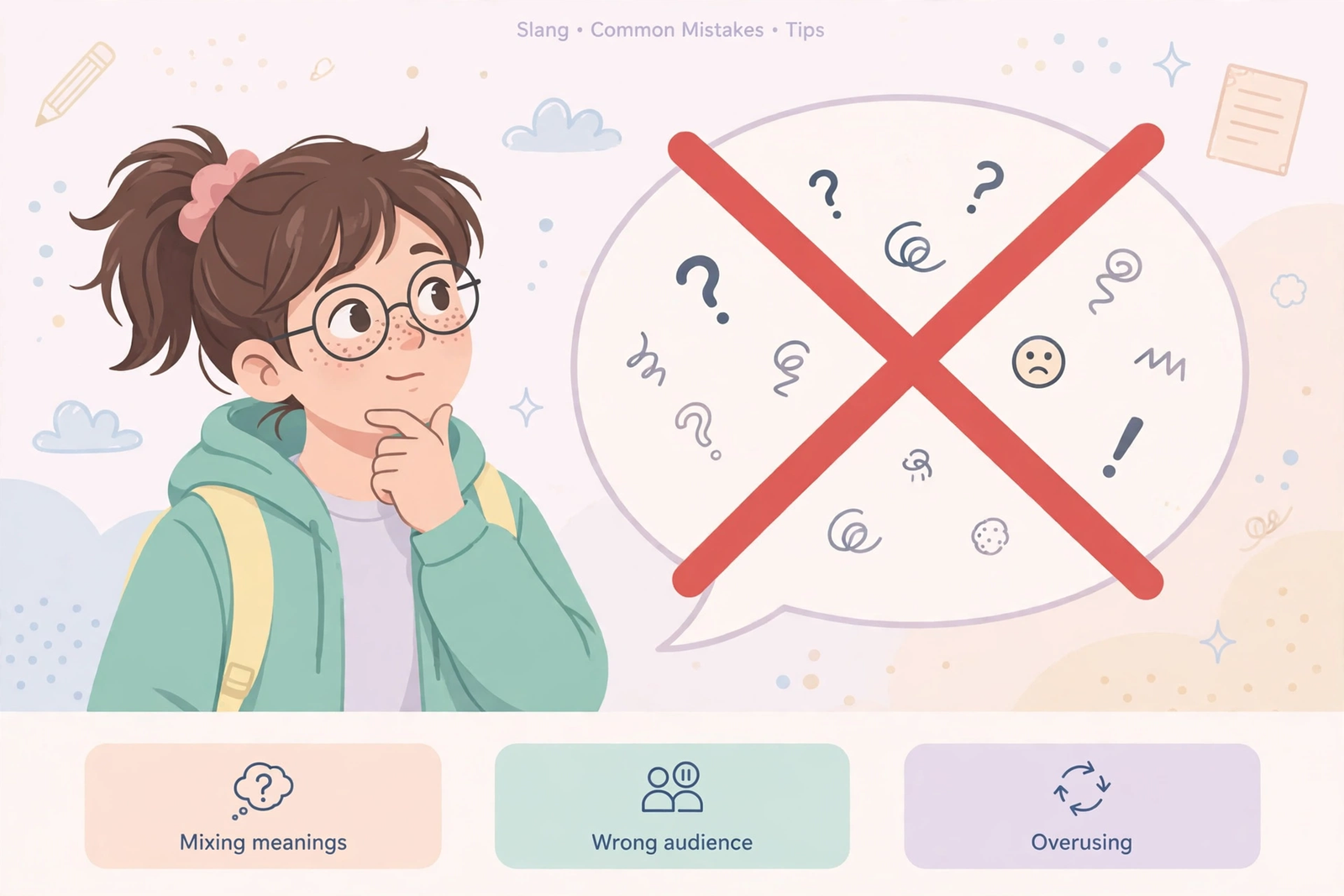
Adults trying to use middle school slang make the same handful of mistakes. Kids notice instantly — and the word becomes cringe the moment an adult forces it.
- Using it at the wrong time. Shouting “six seven!” in a staff meeting or writing “no cap” in a work email does not make you relatable — it makes the word uncool for the kids who liked it. Slang belongs in casual, peer-to-peer moments.
- Getting the tone wrong. “Skibidi” as praise and “skibidi” as an insult sound identical on paper. If you do not know the tone, do not use the word — you will say the opposite of what you mean.
- Stacking memes. “Skibidi Ohio rizz” is funny because a kid said it once, ironically. An adult repeating the stack sounds like a meme museum tour. One slang word per sentence is plenty.
- Using sexualized terms casually. Gyatt comments on someone’s body. Adults should never use it, and kids should be told plainly why it is different from harmless words like rizz or aura.
- Correcting kids publicly. Laughing at a child’s slang or mocking it in front of friends shuts down communication. If a word concerns you, ask about it privately and calmly.
- Assuming every word is an insult. Most middle school slang is neutral or positive. “Ohio” is not bullying, “6-7” is not a code for anything bad, and “sigma” is usually a joke. Save the concern for genuinely cruel or sexualized language.
- Forgetting words expire. If you learned “rizz” in 2023 and still use it constantly in 2026, kids have already moved on. Slang has a shelf life of months, not years.
If you are a parent, the biggest mistake is treating slang as a problem to solve instead of a conversation to have. Ask your kid to teach you one word a week. You will learn the language — and they will tell you which words actually matter, including the ones to worry about. For more on how slang words travel from chats into everyday speech, our bricked up meaning slang guide shows the same lifecycle in a single word.
Quick Tips
- Learn the top 10 first. Rizz, skibidi, 6-7, sigma, Ohio, aura, gyatt, slay, no cap, and cooked cover 90% of what you will hear. The glossary table below fills in the rest.
- Listen before you speak. Hear a word three times in context before you try using it. Context is the definition.
- Ask, don’t Google mid-conversation. “What does that mean?” asked with genuine curiosity works better than a secret search later. Kids love explaining their world.
- Watch the emojis. 💀 means “dying laughing,” 😭 means “crying laughing,” 🔥 means “amazing.” Emoji tone often carries the real meaning of the message.
- Keep a running list. Jot new words in your phone notes with the example sentence you heard. Review it monthly — half the words will already be dead, which is itself useful information.
- Know the red-flag words. Gyatt (sexualized), and any slang used to target a specific kid repeatedly, deserve a real conversation. Everything else is usually just play.
- Do not ban the harmless stuff. Banning “skibidi” makes it funnier. Save rules for language that is cruel, sexual, or disruptive in class.
- Use slang as a bridge, not a test. The goal is connection, not a vocabulary quiz. If your kid laughs when you try a word, laugh with them — that is the point.
40+ Middle School Slang Words at a Glance
| Word | Meaning | Example |
|---|---|---|
| Rizz | Charm, flirting skill | “He’s got rizz.” |
| Skibidi | Cool / weird / nonsense | “That’s so skibidi.” |
| 6-7 | Meme chant, no fixed meaning | “Six seven!” |
| Sigma | Lone-wolf cool (usually ironic) | “Sigma grindset.” |
| Ohio | Weird, cursed, chaotic | “Only in Ohio.” |
| Aura | Coolness, vibe, presence | “Plus 1,000 aura.” |
| Gyatt | Exclamation about a body | “Gyatt, look at that.” |
| Slay | Did amazingly | “She slayed it.” |
| No cap | Not lying, honestly | “No cap, that was great.” |
| Cooked | Done for, doomed | “We’re cooked.” |
| Bet | Yes, agreed | “Bet, see you there.” |
| Fr | For real, seriously | “Fr, that was hard.” |
| Mid | Mediocre | “That movie was mid.” |
| Bussin | Really good (food) | “This pizza is bussin.” |
| Ate | Nailed it, looked amazing | “She ate that outfit.” |
| Goated | Greatest of all time | “That goal was goated.” |
| Fire | Excellent | “This song is fire.” |
| Clutch | Great under pressure | “So clutch in the final.” |
| Lowkey | Quietly, honestly | “Lowkey, I agree.” |
| Highkey | Openly, very much | “Highkey excited.” |
| Delulu | Delusional | “You’re delulu.” |
| Yapping | Talking too much | “Stop yapping.” |
| Cringe | Embarrassing | “That was so cringe.” |
| NPC | Boring, background character | “He’s such an NPC.” |
| Ratio | Outvoted, embarrassed online | “Ratio + L.” |
| Fanum tax | Playfully taking food | “That’s fanum tax.” |
| Let him cook | Let him finish, he’s onto something | “Wait, let him cook.” |
| Hits different | Feels special here | “Pizza Friday hits different.” |
| Main character | Confident center of attention | “Main character energy.” |
| Locked in | Focused, serious | “I’m locked in for finals.” |
| Tea | Gossip | “Spill the tea.” |
| Ghost | Ignore messages suddenly | “He ghosted me.” |
| Cap | A lie | “That’s cap.” |
| W / L | Win / loss | “That’s a W.” |
| Slaps | Really good (music) | “This song slaps.” |
| Sus | Suspicious, sketchy | “That looks sus.” |
| Vibe check | Judging the mood | “Vibe check failed.” |
| Touch grass | Go outside, log off | “Bro needs to touch grass.” |
| It’s giving… | It feels like… | “It’s giving main character.” |
| Understood the assignment | Nailed the brief perfectly | “She understood the assignment.” |
| CEO of… | The best at something | “CEO of being late.” |
| Periodt | End of discussion, exactly | “And that’s periodt.” |


FAQ
1. What does middle school slang mean in simple words?
Middle school slang is the informal language used by kids aged 11 to 14 in the United States. It is a mix of meme words (skibidi, 6-7), streamer slang (rizz, fanum tax), gaming terms (cooked, clutch), and older teen words remixed for a new generation. Most of it is playful — a way for kids to joke and signal that they belong to the group.
2. What is the most popular middle school slang word in 2026?
Right now it is 6-7 (six seven), the most-searched Gen Alpha term of early 2026, followed closely by skibidi, rizz, sigma, and Ohio. Popularity shifts every few months, so the top word today may be “cringe” by next semester.
3. What does “skibidi” mean?
Skibidi comes from the YouTube series Skibidi Toilet. As slang it is deliberately flexible — it can mean cool, weird, dumb, or nothing at all, depending on tone and context. Kids use it as an adjective, a joke, and a filler word. There is no single fixed definition, which is exactly why kids love it.
4. What does “6-7” mean?
“6-7” (six seven) is a viral meme chant with no fixed meaning. It started as a basketball-related joke and became a shout kids use for fun, often with a hand gesture. Its value is participation, not definition — shouting it signals you are in on the joke.
5. Is middle school slang bad or inappropriate?
Most of it is harmless. Words like skibidi, 6-7, rizz, sigma, and Ohio are jokes, not insults. The main exception is gyatt, which comments on someone’s body and is often used in a sexualized way — that one deserves a real conversation. Slang becomes a problem only when it is used to bully, harass, or target a specific kid.
6. How is middle school slang different from Gen Z slang?
Gen Z slang (slay, no cap, lit, fire) grew out of social media and hip-hop culture and is now fairly mainstream. Middle school slang in 2026 is Gen Alpha’s version — louder, more absurd, more meme-driven, and designed to be hard for adults to decode. Many Gen Z words survive in middle school, but the newest layer (skibidi, 6-7, sigma jokes) belongs to Gen Alpha.
7. Should parents learn middle school slang?
Yes — but as listeners, not performers. Knowing the words helps you understand your kid’s texts, spot the rare red-flag term, and start conversations. Trying to use the slang yourself usually backfires and makes the words uncool. Ask your kid to teach you instead; it turns a confusing language barrier into a bonding moment.
8. How fast does middle school slang change?
Very fast. A word can go from viral to cringe within a single school year. Rizz peaked in 2023 and was already fading by 2026; sigma went from serious compliment to ironic joke in months. Expect the glossary in this article to need a refresh every semester — and treat any slang guide older than a year as history, not current events.
Conclusion
Middle school slang is not a problem to fix — it is a language to learn. Words like rizz, skibidi, 6-7, sigma, and Ohio are how 11- to 14-year-olds joke, compliment, tease, and belong. They come from TikTok sounds, YouTube series, gaming chats, and older slang remixed for a new generation, and they change faster than any dictionary can follow.
The key takeaways are simple. First, most middle school slang is harmless nonsense — save your concern for the few terms that are cruel or sexualized, like gyatt. Second, context is the definition: the same word can praise, roast, or mean nothing at all depending on tone. Third, the best way to keep up is to ask your kid, not to memorize lists — slang is a conversation, and kids are happy to translate when adults ask with genuine curiosity.
Bookmark this guide and revisit it each semester, because the words will change even if the pattern does not. And if you want to keep exploring how internet slang works, check out our Australian slang words guide and our corn slang breakdown — two more examples of how a single word can travel from a niche joke to everyday speech.

1 thought on “Middle School Slang: What It Means, 40+ Words, Examples & Parent Guide (2026)”