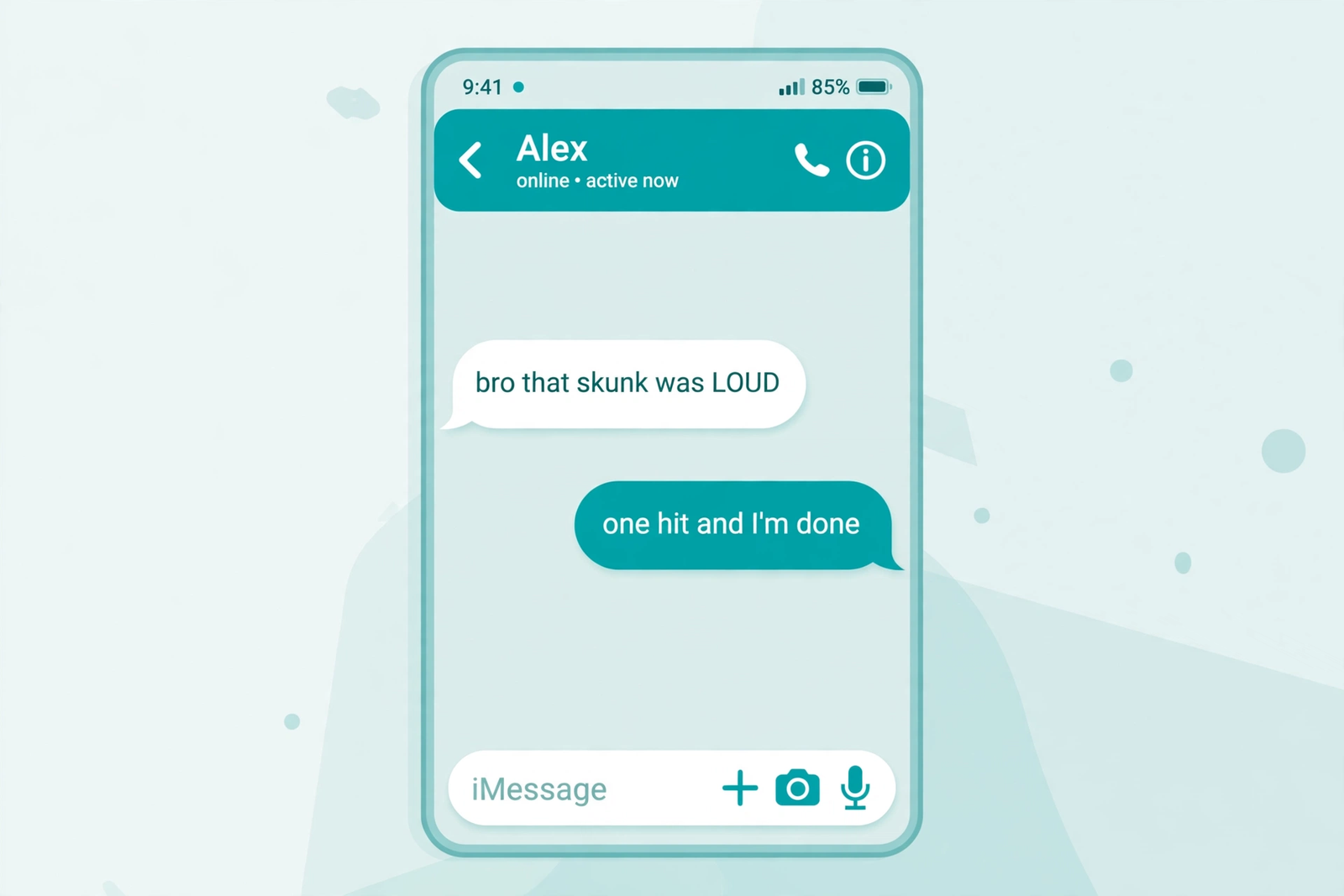
Quick definition: In slang, skunk most often means a strong-smelling strain of cannabis, or — as the verb “to skunk” — to defeat someone so badly they score nothing at all. When a friend texts “that skunk was loud,” they are talking about weed, not wildlife. When they say “we got skunked 10-0,” they are talking about a blowout loss. The skunk slang meaning depends entirely on context, and this guide covers every version of it.
skunk slang Meaning & Definition
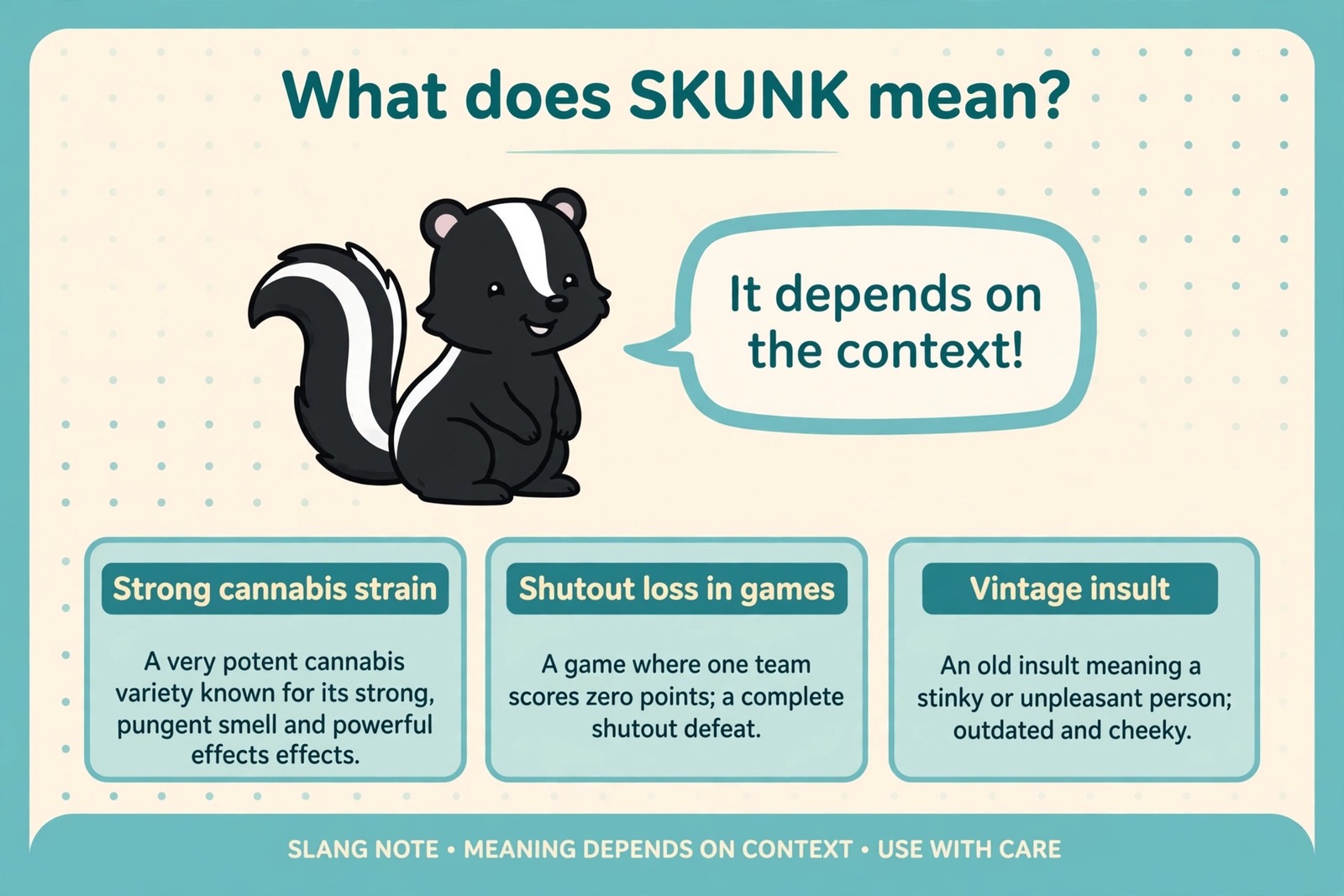
The skunk slang meaning starts with the animal itself. A skunk is famous for one thing: a smell so powerful it clears a room. That is exactly why the word jumped into slang. In cannabis culture, “skunk” is the name for a famously pungent, high-potency strain of marijuana — if you can smell it from down the hall, people call it skunk. In games and sports, “skunked” means shut out completely, beaten without scoring a single point. And as an old-fashioned insult, calling someone “a skunk” means calling them a low, contemptible person.
Three meanings, one root idea: something strong, unmistakable, and hard to ignore. The smell of the animal gave the word its power, and each slang sense borrows a different part of that reputation — the cannabis sense borrows the smell, the gaming sense borrows the idea of a total, humiliating defeat (like being sprayed and left with nothing), and the insult borrows the animal’s low reputation.
Here is the simplest way to keep them straight. If the sentence is about weed, smell, or a dispensary, skunk means cannabis. If the sentence is about a score — “skunked 7-0,” “skunked in cribbage” — it means a shutout loss. If the sentence is “you dirty skunk,” it is an insult, and a fairly old-fashioned one at that. Context does the work every time, and once you know the three senses, you will never mix them up.
It also helps to know the grammar. As a noun, skunk is the weed or the insult (“that skunk,” “a real skunk”). As a verb, “to skunk” means to shut someone out (“we skunked them”), and the past tense “skunked” is the form you will see most. You will also meet “skunky” as an adjective for anything with that sharp, dank smell — “a skunky bag,” “skunky beer.” Each form points at the same family of meanings.
Introduction
You are in a group chat when someone types “bro that skunk was LOUD 😤” and half the chat reacts with fire emojis while the other half is confused. Nobody is talking about an animal in the backyard. Welcome to one of slang’s most multi-purpose words — a term that can mean premium weed, a humiliating defeat, or a vintage insult depending on the room it lands in.
The skunk slang meaning confuses people precisely because the three senses live in completely different worlds. A gamer hears “skunked” and thinks of a 10-0 loss. A cannabis user hears “skunk” and thinks of a strain. A fan of old movies hears “you skunk” and thinks of a black-and-white insult. All three are correct, and all three are in active use today — which is why the word deserves a proper guide instead of a one-line definition.
This guide covers everything about the skunk slang meaning: where it came from, how the cannabis sense took over, what “skunked” means in games, the insult you probably should not use, real examples in every tone, the mistakes that get people into trouble, and the polite alternatives for every situation. By the end, you will know exactly which skunk someone means — and which one to use yourself.
Origin
The story starts in the 1970s, in the world of cannabis breeding. “Skunk #1” was a hybrid strain developed by the breeder Sam the Skunkman, crossing Afghani, Acapulco Gold, and Colombian Gold genetics. The result was a plant with two standout traits: it was far more potent than the weed most people were used to, and it smelled intensely — sweet, sharp, and unmistakably skunky. The name was a joke about the smell, and it stuck so hard that “skunk” became shorthand for any strong-smelling, high-quality cannabis, not just that one strain.
The name spread through the 1980s and 1990s as cannabis culture went global. In the UK, “skunk” became the default word for potent indoor-grown cannabis, and British newspapers spent the 2000s warning about “skunk” as if it were a separate drug entirely. In the US, the word traveled through hip-hop lyrics, stoner comedies, and dispensary menus. By the time legalization arrived in several states, “skunk” was already printed on product labels — a slang word that had become an industry term.
The gaming sense is older, and it comes from card games. In cribbage, losing by 31 points or more is called being “skunked,” and the loser traditionally paid a double stake — a humiliation the name captures perfectly. The term spread from cribbage to other games: “skunked” in beer pong means losing without sinking a cup, in hockey it means a shutout, and in casual gaming it means any loss where you never got on the board. The verb “to skunk” — to shut someone out — followed the same path from the card table to the group chat.
The insult is the oldest sense of all. Calling someone “a skunk” as a contemptible person dates back to the 19th century, when the animal’s reputation for stinking and sneaking around made it a ready-made metaphor for a low character. You will find it in old Westerns, gangster films, and mid-century novels — “you dirty skunk” is practically a period costume in a single phrase. It has faded from everyday use, but it survives in movies, books, and the occasional grandparent.
Popularity
Skunk is not a flash-in-the-pan TikTok word — it has been in steady slang use for about fifty years, and each of its senses has its own audience keeping it alive. The cannabis sense is the most popular by far. Dispensaries list skunk strains, growers breed new skunk crosses, and “skunky” is a standard tasting note in cannabis reviews, the same way wine reviewers talk about oak or tannin. In the UK especially, “skunk” is still the everyday word for strong weed, and it appears constantly in music, TV, and conversation.
The gaming sense lives wherever people keep score. Cribbage players still use “skunked” as a formal term, beer pong players shout it across the table, and online gamers use it in chats after a lopsided match. It is the kind of word that thrives in competitive settings, because a shutout loss needs a word with a sting to it — “we lost” is a fact, “we got skunked” is a story.
On social media, the cannabis sense dominates. Search “skunk” on TikTok or Instagram and you will find strain reviews, grow diaries, and jokes about the smell — usually with a skunk emoji or a cloud of smoke. The gaming sense shows up in clips of blowout wins and losses, and the insult shows up mostly as a joke or a quote from an old film. The word is not tied to one platform or one generation, which is why it has outlasted dozens of trendier slang terms.
What keeps skunk relevant is that it names things other words do not. There is no better single word for “weed so strong you can smell it through the bag,” and no better word for “lost so badly we never scored.” Slang survives when it does a job nothing else does, and skunk does two jobs at once.
How It Is Used
Using skunk correctly is all about picking the right sense for the room. The cannabis sense belongs in casual conversation among adults, in dispensary talk, and in music and meme culture — never in a formal setting, and never around people who would not appreciate the topic. The gaming sense is safe almost anywhere casual competition happens: game nights, sports chats, the office fantasy league. The insult is best left in old movies unless you are deliberately going for a retro, cartoonish tone.
The most common patterns are easy to copy. For the cannabis sense: “that skunk was loud,” “got some skunky stuff,” “this smells like straight skunk.” For the gaming sense: “we got skunked,” “don’t get skunked,” “a 10-0 skunking.” For the insult: “you low-down skunk,” “that dirty skunk stole my wallet” — said with a wink, because nobody uses this insult seriously anymore.
Tone matters. The cannabis sense is relaxed and knowing — it signals you are part of the culture. The gaming sense is competitive and teasing, usually aimed at friends. The insult, used straight, sounds either ancient or aggressive, so if you use it at all, use it as a joke. In text, an emoji or a laughing reaction usually marks which tone you mean.
Skunk also pairs naturally with other casual words. Cannabis talk brings “loud,” “dank,” “gas,” and “fire” — check our guide to gas meaning slang for the full family of praise words for strong weed. Gaming talk brings “swept,” “shut out,” “destroyed,” and “washed.” And if the conversation drifts toward the wider world of weed words, our guide to slang for weed covers more than forty terms, from “dank” to “loud” and back again.
Examples
Examples make the skunk slang meaning click instantly, because the same word behaves completely differently in each of its worlds. Notice how the sentence around it always gives the sense away — the topic is the decoder. The examples below are grouped by tone, so you can see the word at work in friendly chats, more polished settings, and jokes.
Friendly Examples
- “Bro, that skunk was so loud my whole car smells like it now.” — cannabis sense, the classic complaint-brag.
- “We got skunked 10-0 in beer pong, it was honestly embarrassing.” — gaming sense, a shutout loss.
- “This strain is pure skunk, one hit and I’m done.” — cannabis sense, praising potency.
- “Don’t let them skunk you again, play defense this time!” — gaming sense, as a warning before a rematch.
- “That bag is so skunky I could smell it before you even opened it.” — adjective form, about the smell.
- “We skunked them in the first game and they rage quit.” — verb form, the winners’ version of the story.
Professional Examples
Skunk is a casual word, so “professional” here means the more polished end of casual — a relaxed creative workplace, a dispensary or cannabis-industry setting, or a work game night. In a formal office, use the alternatives below instead.
- “The new batch has a strong skunk profile — customers are asking for it by name.” — dispensary or cannabis-industry talk, matter-of-fact.
- “We got skunked in the first round of the office trivia league, so we need a better strategy.” — work game night, friendly competition.
- “That skunk strain is one of our best sellers this quarter.” — retail or industry context, professional tone.
- “The client loved the campaign — total opposite of getting skunked, thankfully.” — playful use in a creative team chat.
Funny Examples
- “I told my grandma I had some skunk and she asked if an animal got into the house.” — the generation-gap joke that never gets old.
- “We didn’t just lose, we got skunked so bad the scoreboard filed for unemployment.” — exaggerating a blowout loss.
- “My roommate said the apartment smells like skunk. I said, ‘yeah, that’s the point.'” — leaning into the smell joke.
- “He called me a dirty skunk like we’re in a 1940s gangster movie. I almost tipped my hat.” — the vintage insult, used as a joke.
- “That skunk was so loud the neighbors knew my weekend plans before I did.” — the smell as a punchline.
One pattern to steal from these examples: the cannabis sense is almost always about the smell or the strength, and the gaming sense is almost always about the score. If your sentence is about either of those two things, skunk fits naturally. If it is about neither, you are probably reaching for a different word.
Comparison with Similar Terms
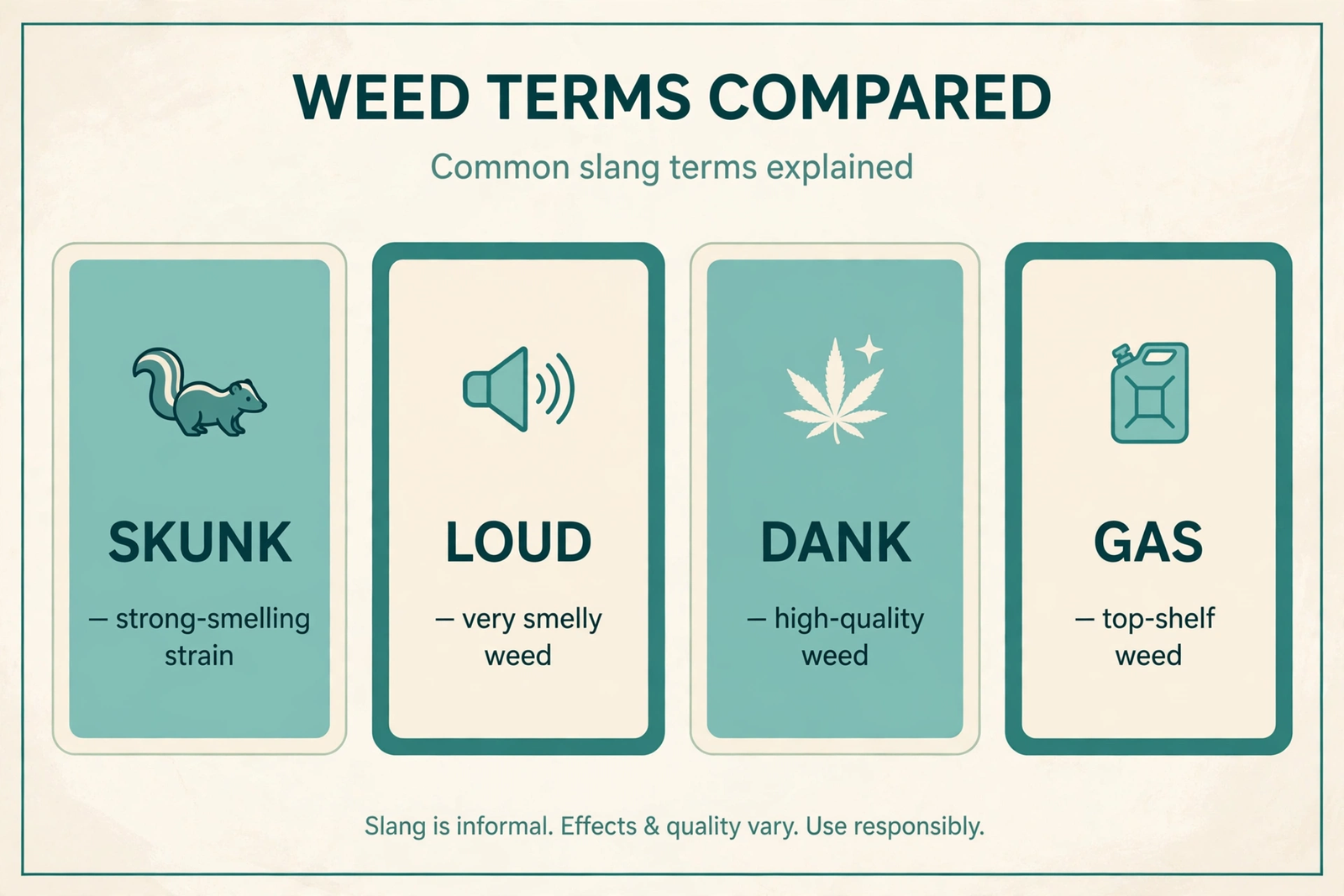
Skunk shares territory with several other slang words, and picking the wrong one changes what your sentence says. The table below compares the cannabis sense with its closest relatives, and the gaming sense with its own cousins, so you can choose the right word for the moment.
| Word | What It Means | Main Use | Best Used For |
|---|---|---|---|
| Skunk | Strong-smelling potent cannabis | Cannabis | Strains famous for smell and strength |
| Loud | Very strong, very smelly weed | Cannabis | Praising potency, especially the smell |
| Dank | High-quality, sticky, potent weed | Cannabis | Praising quality in general |
| Gas | Top-shelf, excellent weed | Cannabis | Praising quality and hype |
| Skunked | Shut out, lost without scoring | Games & sports | Blowout losses, card games, beer pong |
| Swept | Lost every game in a series | Sports | Playoff series and match series |
| Shut out | Opponent scored zero | Sports | The formal version of getting skunked |
| Washed | Past your prime, no longer good | Gaming & sports | Teasing a player, not a single score |
The key difference in the cannabis family is specificity. Skunk points at the smell and the strain family — it is the most descriptive of the four. Loud points at the smell alone. Dank points at quality and stickiness. Gas points at hype and top-shelf status. They overlap heavily, and people often stack them — “loud skunk gas” is a real phrase — but skunk is the only one that names a strain lineage as well as a smell.
In the gaming family, the difference is scope. Skunked means zero points in a single game or match. Swept means zero wins in a whole series. Shut out is the neutral, broadcast-friendly version of skunked. Washed is not about the score at all — it is about the player being finished. Choose skunked when the scoreboard says zero and you want the sting in the word to match.
Alternate Meanings
Skunk is a busy word, and the slang senses are only part of the picture. Knowing the other meanings is what keeps you from misreading a message — and from sending one that gets misread.
- The animal: The original meaning — a small black-and-white mammal famous for its defensive spray. “A skunk got into the garden” is about wildlife, not slang, and the spray is the reason every slang sense exists.
- Skunk cannabis: A potent, strong-smelling strain family, descended from Skunk #1. The most common slang sense today, especially in the UK and in dispensary culture.
- Skunked (games): Losing without scoring — in cribbage, beer pong, hockey, or any casual game. The score is zero, and the word makes sure everyone knows it.
- Skunk as an insult: A low, contemptible person — “you dirty skunk.” Vintage, mostly found in old films and books now, and usually a joke when used today.
- Skunked beer: Beer that has gone stale or lightstruck and tastes off. “This beer tastes skunked” is a real complaint in bars, and it borrows the same smell idea.
- Drunk as a skunk: A classic idiom meaning very drunk. It has nothing to do with the animal’s habits — it is just a rhyme that stuck around for over a century.
- Skunk ape: A Bigfoot-like cryptid said to roam the Florida Everglades, named for its terrible smell. A fun piece of folklore, not everyday slang.
The golden rule: weed = smell and strength, games = a zero on the scoreboard, insult = a vintage put-down. If the sentence is about a bag, a strain, or a smell, it is cannabis. If it is about a score, it is a shutout. If it sounds like a line from an old Western, it is the insult. And if someone says “drunk as a skunk,” they are just very drunk — no animals involved.
Professional or Polite Alternatives
Skunk is casual in every one of its senses, and casual is not always appropriate. In a work email, a formal message, or a conversation with someone you do not know well, reach for one of these instead. They carry the same meaning without the slang.
| Instead of | Say | When |
|---|---|---|
| “That skunk was loud” | “That was a very potent strain” | Cannabis-industry or medical settings |
| “Skunky weed” | “Strong-smelling cannabis” | Formal or clinical conversation |
| “We got skunked” | “We lost without scoring” | Formal sports reporting, work chats |
| “Don’t get skunked” | “Don’t let them shut us out” | Polite team encouragement |
| “You dirty skunk” | “You’re being dishonest” | Any serious confrontation |
| “Drunk as a skunk” | “Completely drunk” / “Very intoxicated” | Formal or medical settings |
None of these loses the meaning — “potent strain” says exactly what “skunk” says about the weed, and “lost without scoring” says exactly what “skunked” says about the game. What they lose is the casual energy, which is exactly what you want to lose in a formal setting. Save skunk for friends, fans, and group chats, and use its polished cousins everywhere else.
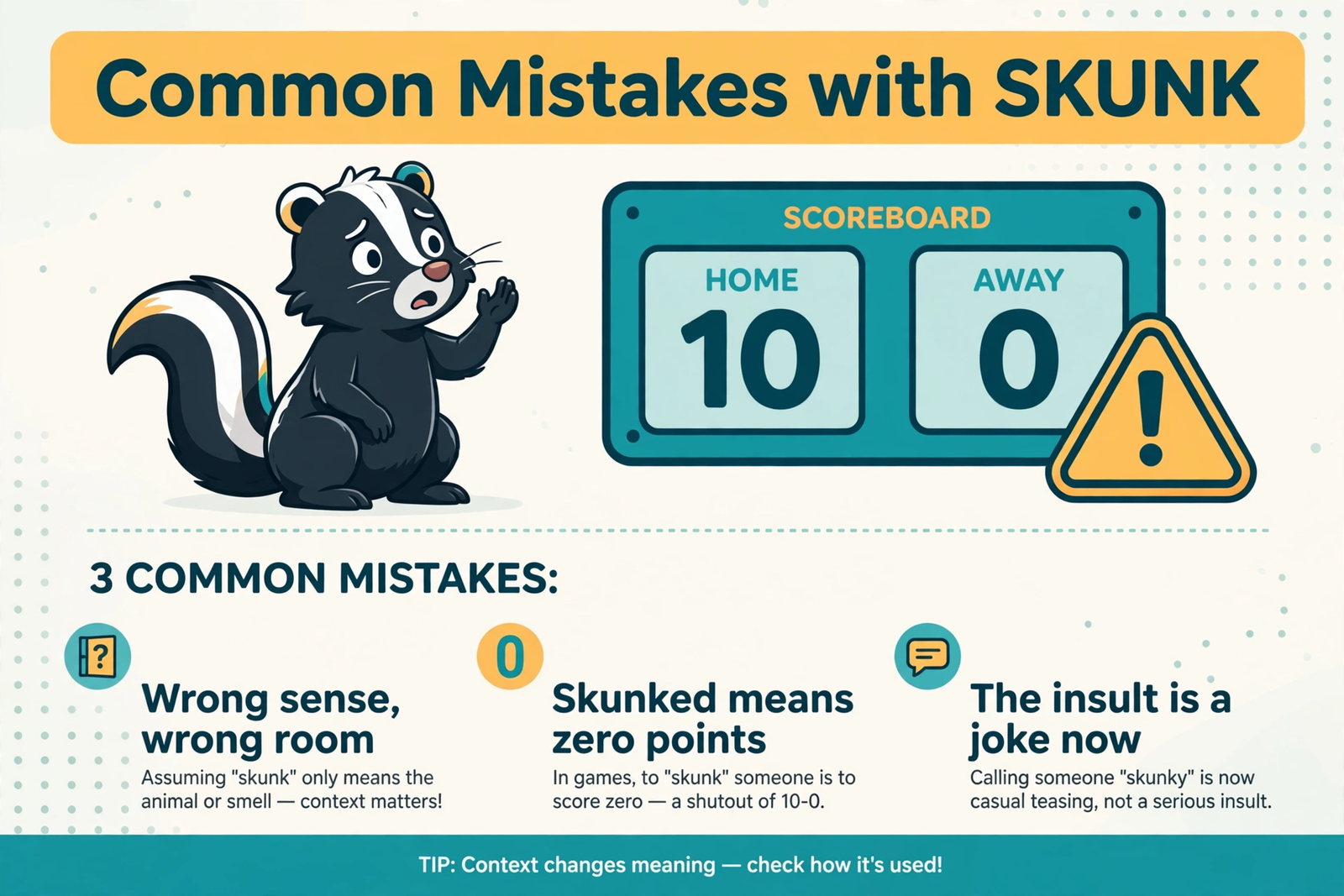
Common Mistakes
Most mistakes with skunk come from using the wrong sense in the wrong room, or from forgetting how loaded the cannabis sense is. Here are the ones people actually make.
1. Using the cannabis sense where it does not belong. Talking about “skunk” at work, at school, or around family who would not appreciate it is a fast way to make a conversation awkward. Cannabis may be legal where you live, but the word still carries a casual, counterculture charge — save it for the right audience.
2. Confusing skunked with swept. Getting skunked means scoring zero in one game. Getting swept means losing every game in a series while still scoring points. Saying “we got swept 10-0” mixes two different humiliations — pick the one that matches the scoreboard.
3. Using the insult seriously. “You skunk” as a genuine insult sounds either ancient or unhinged in 2026. It works as a joke or a movie quote, and almost nowhere else. If you actually want to confront someone, use plain language instead.
4. Saying “skunked” about a close loss. Losing 10-9 is not getting skunked — it is a close game. Skunked is reserved for zero. Using it for any loss drains the word of its sting and makes you sound like you are exaggerating.
5. Mixing up skunk and skunked beer. “Skunked” describes stale beer in a bar, and a shutout in a game. Both are correct, but they are different conversations — do not order a beer by saying you hope you do not get skunked and then act surprised when the bartender laughs.
6. Assuming everyone knows the cannabis sense. Older listeners often only know the animal or the insult. Telling your uncle you “picked up some skunk” might get you a lecture about wildlife control. Know your audience before you use the word.
Quick Tips
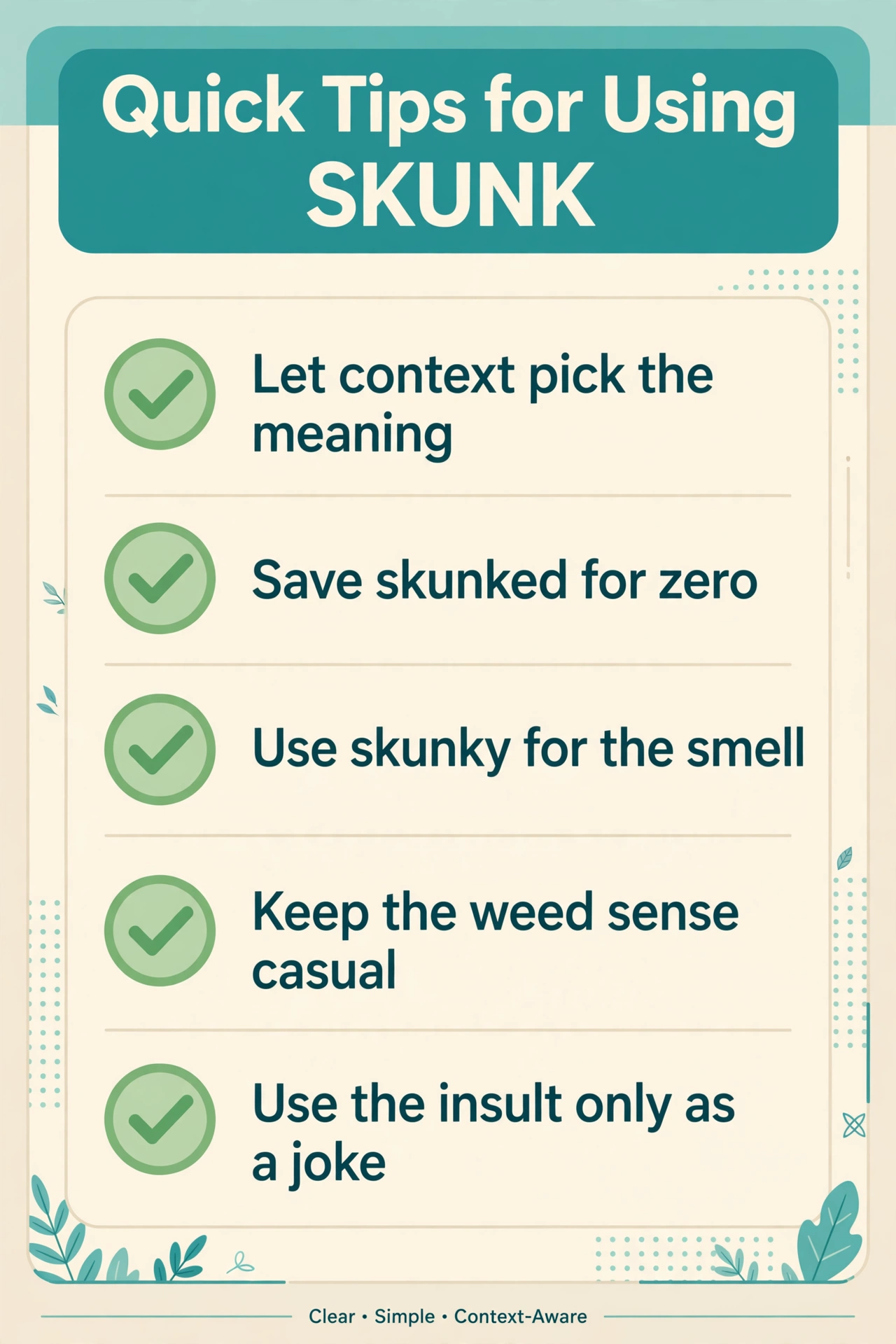
- Let the topic pick the meaning. Weed, smell, or strains means cannabis; a score means a shutout; an old movie line means the insult. The sentence around skunk always gives it away.
- Save skunked for zero. The word only works when the losing side never scored. A close loss is not a skunking, and calling it one makes you sound dramatic.
- Use “skunky” for the smell. It is the most useful form of the word — “skunky” describes any sharp, dank smell, from weed to stale beer, without committing you to a whole story.
- Keep the cannabis sense casual. Friends, dispensaries, and meme culture are the right rooms. Work, school, and formal settings are not.
- Use the insult only as a joke. “You dirty skunk” is funny precisely because nobody says it seriously anymore. Play it as a vintage gag and it lands; play it straight and it confuses people.
- Pair it with the right words. “Loud skunk” and “skunked 10-0” are natural pairings. One intensifier or one score is enough — “absolutely insanely loud skunk gas” is trying too hard.
- Know the UK difference. In British English, “skunk” is the default word for strong weed, far more common than in American English. If a British friend mentions skunk, they almost certainly mean cannabis.
- Do not force it. If you would not naturally say skunk out loud, do not force it into a text to sound current. A sincere “we lost badly” always beats a performed “we got skunked.”
FAQ
What does skunk mean in slang?
In slang, skunk most often means a strong-smelling, potent strain of cannabis, named Skunk #1. It can also mean a shutout loss in games — “we got skunked” means we lost without scoring. As an insult, “a skunk” is a vintage word for a contemptible person. The topic of the sentence tells you which meaning applies.
What does “skunked” mean?
Skunked means beaten so badly you scored nothing at all — a 10-0 loss, a cribbage game lost by 31 points, a beer pong game without a single cup. It comes from card games, where being skunked traditionally meant paying a double stake. It can also describe stale, lightstruck beer that tastes off.
Is skunk a compliment or an insult?
It depends on the sense. As cannabis slang, skunk is usually a compliment — it means the weed is strong and high quality. As “skunked” in games, it is a teasing insult aimed at the loser. As “you skunk,” it is a vintage insult meaning a low, dishonest person, though today it is almost always used as a joke.
Why is strong weed called skunk?
Because of the smell. The strain Skunk #1, bred in the 1970s, was famous for a sharp, sweet, unmistakable odor that reminded people of the animal’s spray. The name stuck, and “skunk” became shorthand for any potent cannabis with that strong smell — which is why people also describe weed as “skunky” or “loud.”
What does “drunk as a skunk” mean?
It means very drunk. The phrase is a rhyming idiom that has been around for over a century, and it has nothing to do with the animal’s actual behavior — skunks are not known for drinking. It is just a colorful way of saying someone is completely intoxicated.
Is skunk slang still used today?
Yes. The cannabis sense is in active use in dispensaries, grow culture, and music, especially in the UK where “skunk” is the everyday word for strong weed. The gaming sense survives in cribbage, beer pong, and online gaming chats. The insult has mostly faded, surviving in old films and as a deliberate joke.
What is the difference between skunk and loud?
They overlap a lot, but skunk names a strain family and a smell, while loud only describes the smell and strength. All skunk is loud, but not all loud weed is skunk — loud can describe any potent strain. Skunk is the more specific word, and the one with a real breeding history behind it.
Can I say skunk at work?
The gaming sense is usually fine in a casual workplace — “we got skunked in trivia” is harmless. The cannabis sense is not appropriate in most workplaces, even where cannabis is legal, so use “potent strain” or “strong-smelling cannabis” instead. And the insult should stay in old movies. If you want more slang that is safe for work chats, start with smh meaning in text — it is the word you will need for everything that is not skunk at all.
Conclusion
The skunk slang meaning is really three meanings wearing one word: strong weed, a shutout loss, and a vintage insult. The cannabis sense comes from Skunk #1, a 1970s strain so pungent it was named after the animal famous for clearing rooms with its smell. The gaming sense comes from cribbage, where losing by 31 points earned you the humiliating title of “skunked.” The insult comes from the 19th century, when the animal’s low reputation made it a ready-made put-down. Merriam-Webster lists the slang senses right alongside the animal, which tells you how established this word has become.
The trick to using it well is context. If the sentence is about a bag, a strain, or a smell, skunk is cannabis — strong, pungent, and high quality. If it is about a score, skunked is a shutout, and it only counts when the losing side scored zero. If it sounds like a line from a gangster film, it is the insult, and it is a joke now, not a weapon. And remember the golden rule: weed means smell and strength, games mean zero on the scoreboard, and the insult belongs in the past.
So the next time a friend texts “that skunk was loud,” you will know exactly what they mean — and the next time your team loses 10-0, you will know exactly what to call it. One word, three worlds, fifty years of staying power. And if you want to keep building your slang vocabulary, start with dope meaning slang — it is the word people reach for when skunk is not quite the right kind of praise.
