
OPS Slang Meaning: What It Really Means in Texts, Rap, and TikTok
Quick definition: In slang, “ops” means the opposition — your enemies, rivals, or anyone working against you. It is short for “opposition” or “opponent,” and it comes from Chicago drill music and hip-hop culture. When someone says “watch out for the ops,” they mean “watch out for the people who are against us.”
OPS Slang Meaning & Definition
The term ops slang describes one of the most widely used words in modern hip-hop vocabulary. At its core, “ops” is simply a shortened form of “opposition.” It names the people on the other side of a conflict — rivals, enemies, or an opposing group. The singular form is “op,” and the plural “ops” (also spelled “opps”) is far more common in everyday use.
Unlike many slang words that stay inside one community, ops has traveled from street corners and rap lyrics into group chats, TikTok captions, gaming lobbies, and comment sections. A teenager in a group chat might joke that the teacher is “the ops,” a gamer might warn teammates that “the ops are pushing mid,” and a rapper might use the word to name real-life rivals. The meaning stays the same in every setting: the people who are not on your side.
It is worth noting that “ops” is a context word. In a rap song, it usually carries serious weight — real rivals and real conflict. In a joke between friends, it is playful exaggeration. In gaming or business, it can mean something else entirely, which is why the rest of this guide breaks down every meaning, so you never guess wrong.
| Term | Meaning | Where you will hear it |
|---|---|---|
| Ops | The opposition; enemies or rivals | Rap lyrics, texts, TikTok, gaming |
| Opps | Same meaning, alternate spelling | Social media captions and comments |
| Op | One opponent (singular) | Rap lyrics and casual speech |
| OPP (1991) | “Other People’s Property” | Naughty by Nature’s classic song |
Introduction
If you have spent any time on TikTok, in a rap comment section, or in a group chat with Gen Z friends, you have probably seen the word “ops” and wondered what it actually means. It shows up in lyrics, memes, captions, and everyday conversation — and it always sounds a little serious, even when it is meant as a joke. That is because the word comes from a serious place.
Ops slang started in Chicago’s drill music scene in the early 2010s, where it described rival crews and real neighborhood conflict. From there it spread through hip-hop, then through social media, and finally into mainstream slang. Today, millions of people use it casually, often without knowing its history. Understanding where it came from matters, because the word still carries the weight of its origins even when it is used lightly.
This guide explains everything: the exact ops slang meaning, where it came from, how it is used in texts, rap, gaming, and TikTok, how it differs from similar words like “hater” and “enemy,” the alternate meanings that can trip you up, and the polite alternatives you should use in formal settings. By the end, you will know exactly when to use it — and when to leave it alone.

Origin
The story of ops slang begins in Chicago, Illinois, in the early 2010s, during the rise of drill music. Drill was a raw, aggressive offshoot of hip-hop built around the realities of street life in Chicago’s South Side, and its lyrics named those realities directly. Rappers needed a short, punchy word for the rival crews and opposing neighborhoods they were talking about, and “ops” — clipped from “opposition” — was the answer.
The earliest known use of the abbreviated form traces to Chicago drill pioneer Chief Keef. In his 2011 track “John Madden,” he rapped, “Better stop, fuck nigga we don’t fuck with opps.” That line put the word on record, and as Chief Keef’s fame exploded, the vocabulary of drill traveled with him. Other Chicago artists — Lil Durk, King Louie, G Herbo, and later King Von — used “opp” and “opps” constantly in their lyrics, and each song pushed the word further into the mainstream.
The longer word “opposition” had appeared in rap much earlier. LL Cool J used it in his 1985 track “Rock the Bells,” rapping “opposition will halt.” But the short form “opp” belongs to the drill era. It grew slowly at first, then surged around 2016 as drill went global, and by 2018 stars like Cardi B and Lil Durk were using the word in tweets that went viral. What started as neighborhood shorthand had become international slang.
There is also an older, completely different “O.P.P.” that causes confusion. In 1991, Naughty by Nature released the hit song “O.P.P.,” where the letters stood for “Other People’s Property” — a playful euphemism for being involved with someone else’s partner. That meaning belongs to the 1990s. The modern ops slang meaning — opponents and enemies — is a separate development, and today’s usage refers almost exclusively to rivals.
Popularity
Ops slang is now everywhere. It appears in rap lyrics across genres, in TikTok videos and comments, in Instagram captions, in gaming voice chat, and in everyday texting among teenagers and young adults. Merriam-Webster now lists “opps” as a slang entry, noting that the plural form is more common than the singular — a sign that the word has fully entered mainstream English.
Several things explain its staying power. First, it is short. Three letters say what would otherwise take a sentence: “the people who are against us.” Second, it sounds tough. It carries a hint of street credibility, which is exactly why people use it even in situations that are not serious at all. Saying “the ops are watching” is more dramatic — and more fun — than saying “people are watching.” Third, it is flexible. It works as a noun (“he’s an op”), in phrases (“no love for the ops”), and as a joke (“my alarm clock is the ops”).
TikTok has been the biggest engine of its recent popularity. Creators use “ops” in skits, storytimes, and captions, often ironically — the “ops” might be a strict parent, a teacher, a coworker, or even a pet. The joke works because everyone knows the word’s serious roots, and applying it to something harmless creates instant comedy. That ironic use has introduced the word to people who have never listened to drill music at all.
The word also shows up constantly in gaming culture. In competitive games, “the ops” is a natural label for the enemy team, and players warn each other about “ops pushing” or “ops camping.” Because gaming and hip-hop audiences overlap heavily, the word moved between the two worlds easily, and each one reinforced the other.
How It Is Used
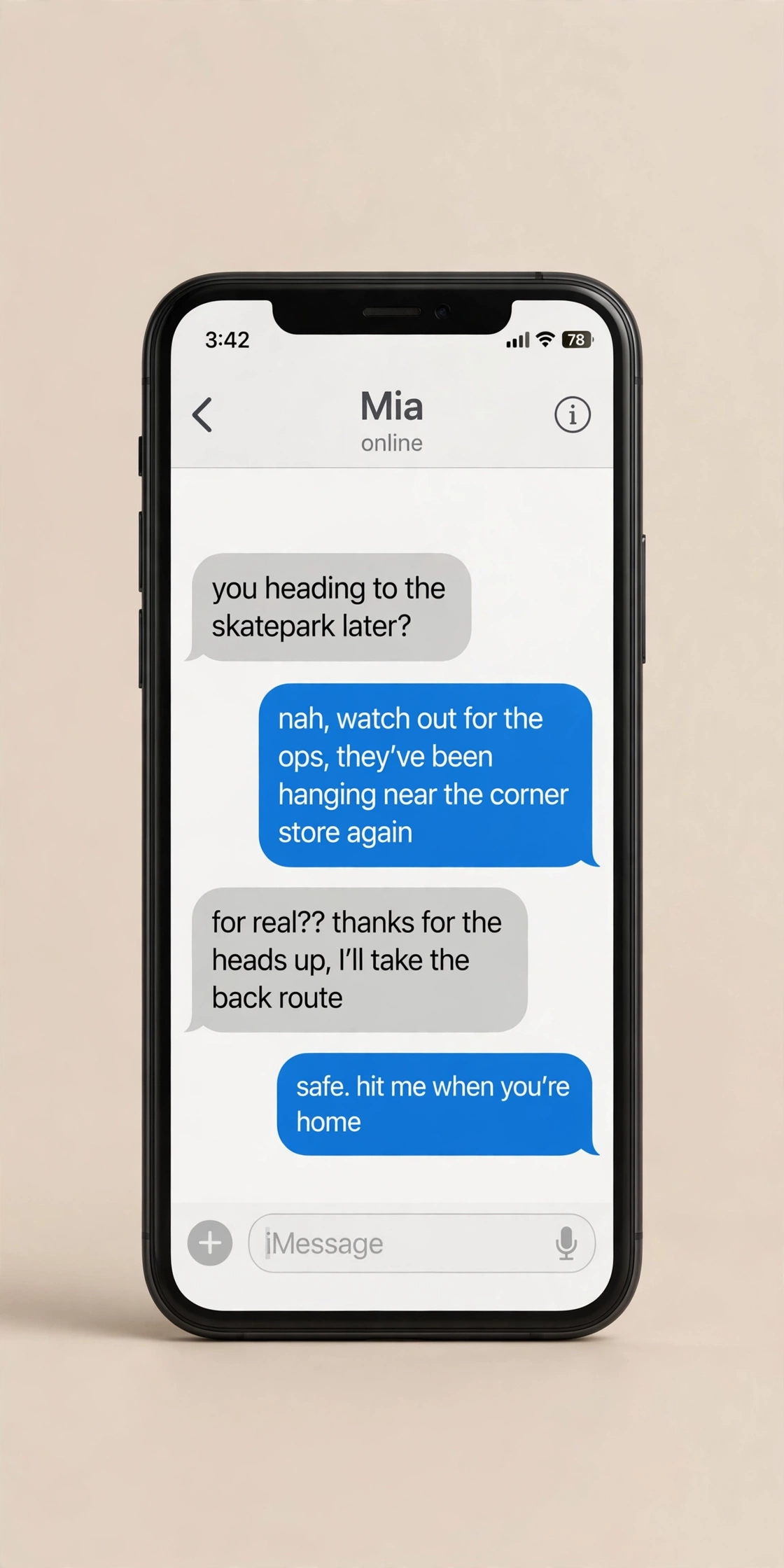
Ops slang is almost always used as a noun, and it almost always refers to a group rather than one person. “The ops” is the standard form. You will hear it in sentences like “Don’t post our location, the ops are watching,” or “We can’t go to that side of town, that’s where the ops stay.” In these sentences, “the ops” means a specific set of rivals the speaker has in mind.
The singular “op” names one person: “He’s an op, don’t trust him.” The plural “opps” with two p’s is simply a spelling variation of the same word, and both spellings are used interchangeably online. You will also see the phrase “no love for the ops,” which means the speaker has zero sympathy for their rivals, and “opp hunting” or “watching for the ops,” which describe looking out for enemies.
Tone changes everything. In a rap song or a serious conversation, “ops” is a warning about real conflict. In a joke, it is an exaggeration — the “ops” might be the group project members who never reply, or the gym trainer who scheduled a 6 a.m. session. The rule is simple: the more casual the setting, the more likely the word is playful. The more serious the setting, the more literal it is.
The word also works as an adjective in some phrases. “Opp activity” means behavior associated with rivals, and “opp block” refers to a rival’s neighborhood. These uses are less common in everyday texting, but you will see them in lyrics and social media posts from people deep in hip-hop culture.
- Warning: “Stay low, the ops are outside.”
- Identifying someone: “I don’t talk to him — he’s an op.”
- Joking: “My diet starts Monday, the ops (donuts) are everywhere.”
- Gaming: “Ops are rushing B, fall back and regroup.”
- Caption: “Me avoiding the ops (my responsibilities) all weekend.”
Examples
The best way to understand ops slang is to see it in real conversations. The word changes its flavor depending on who is talking and where, so here are examples from the three settings where you will meet it most often.
Friendly Examples
Between friends, “ops” is usually a joke. It turns an ordinary annoyance into a dramatic enemy, and that exaggeration is the whole point.
- “Bro, the ops (our group project members) still haven’t replied to a single message.”
- “I can’t believe the ops — my little brother — ate the last slice of pizza.”
- “Hide me, the ops are coming. (My mom just got home and the house is a mess.)”
- “We move in silence. The ops (our teachers) can’t know about the surprise party.”
- “Day 3 of avoiding the ops. My gym membership is judging me.”
In these examples nobody is in danger. The word borrows the drama of its street origins and applies it to everyday life, which is exactly why friends find it funny.
Professional Examples
In professional or formal writing, “ops” almost never means enemies. When it appears at work, it usually means “operations,” as in “ops team” or “ops meeting.” That is a different word wearing the same letters, and confusing the two can be embarrassing — so keep the slang version out of the office entirely.
- “The ops team will handle the server migration on Friday.” (Operations — not slang.)
- “Please loop in Ops before we change the deployment schedule.” (Operations — not slang.)
- “Our competitors launched a similar feature today.” (Say this instead of calling rivals “the ops” at work.)
If a coworker uses “the ops” to mean competitors in a casual chat, it is usually understood as a joke. In an email, a meeting, or anything a client might read, use “competitors” or “rival companies” instead.
Funny Examples
Some of the funniest uses of ops slang come from TikTok and meme culture, where the “ops” are never who you expect.
- “POV: The ops (your own alarm clock) caught you slipping at 6 a.m.”
- “Me: I’m going to bed early tonight. The ops: a 3-hour YouTube rabbit hole.”
- “Nobody: … Me at 2 a.m.: the ops (my fridge) are calling my name.”
- “When the ops — your Wi-Fi router — disconnects right before the final round.”
- “The ops pulled up. It was just my bank app reminding me I’m broke.”
The pattern is always the same: build tension with the word “ops,” then reveal that the “enemy” is something completely harmless. The bigger the gap between the serious word and the silly reveal, the funnier the joke lands.
Comparison with Similar Terms
Ops slang sits close to several other words, and people often mix them up. The differences are small but real, and using the wrong one can change what your sentence means.
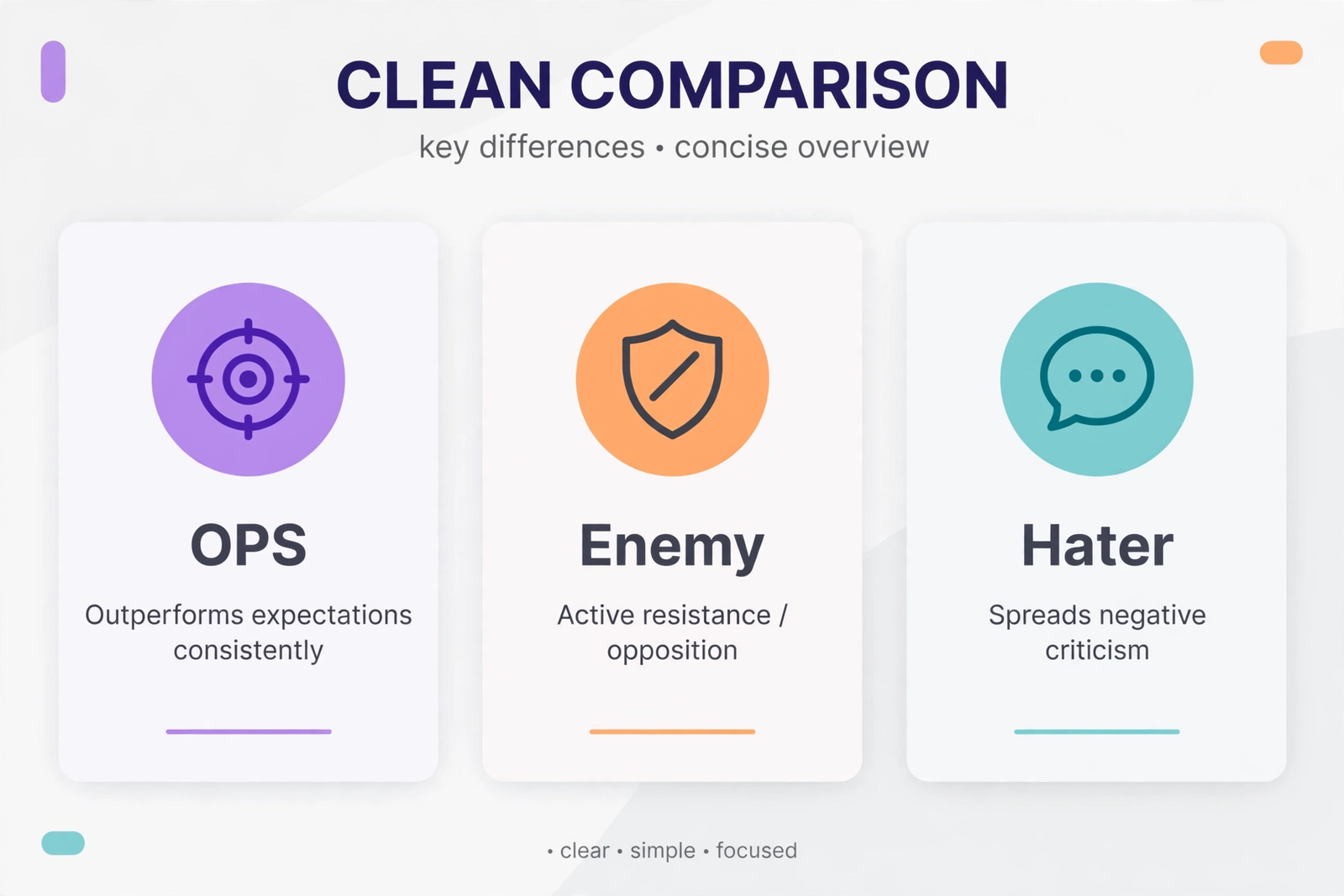
| Term | Meaning | How it differs from “ops” |
|---|---|---|
| Ops / Opps | The opposition; rivals or enemies | The base word — a group on the other side of a conflict |
| Enemy | Someone who hates you or wishes you harm | Broader and more formal; an enemy can be a stranger, while an op is usually someone in your orbit |
| Rival | Someone competing with you | Softer and often non-violent; rivals compete, ops oppose |
| Hater | Someone who dislikes you out of jealousy | Passive — a hater talks behind your back; an op actively works against you |
| Snitch | Someone who reports you to authorities | A specific kind of betrayal, not a general rival |
| Op (Reddit/forums) | Original poster of a thread | Completely different meaning — the person who started the post |
| Opposition (formal) | The side against you in a debate or conflict | The full, formal version of the same idea |
The most important distinction is between “ops” and “hater.” A hater is annoyed by your success and talks about it. An op is on the other side of a real divide — a rival crew, an opposing group, or someone actively working against you. Calling someone a hater is an insult about their character. Calling someone an op is a statement about which side they are on.
The second distinction worth remembering is the Reddit meaning. On Reddit and many forums, “OP” means “original poster” — the person who started a thread. If someone writes “OP deleted the post,” they are not calling anyone an enemy. Context tells you which meaning applies: in a rap lyric or a TikTok caption, it is almost always the slang meaning; in a forum thread, it is almost always “original poster.”
Alternate Meanings
Like many short slang words, “ops” has more than one meaning, and the setting decides which one you are hearing. Here are the alternate meanings you are most likely to meet.
1. Operations (Military, Business, and Gaming)
“Ops” is short for “operations” in the military, in business, and in gaming. A company’s “ops team” handles day-to-day operations. In video games, “ops” can mean missions or operations, and games like Call of Duty have built entire modes around the word. This is the oldest use of the abbreviation, and it predates the slang meaning by decades.
2. Opinions (Social Media Polls)
On Instagram, Snapchat, and TikTok, some users post “ops?” or “send ops” to ask followers for their opinions. In this setting, “ops” is short for “opinions” — as in, “give me your opinion on this outfit” or “drop your ops on my new song.” It is a niche use, but if you see “ops” under a selfie or a poll sticker, opinions is almost certainly the meaning.
3. Other People’s Property (1991)
Naughty by Nature’s 1991 hit “O.P.P.” made the letters stand for “Other People’s Property” (or “Other People’s Partner”), meaning someone else’s boyfriend or girlfriend. This meaning is now mostly historical. You will still hear the song at parties and throwback playlists, but nobody under thirty uses “OPP” this way in conversation.
4. Oops (Typo or Playful Spelling)
Occasionally, “ops” is just a typo or a playful spelling of “oops.” If someone drops a glass and texts “ops,” they almost certainly mean “oops.” The spelling is close enough that autocorrect and fast typing create this confusion regularly.
5. Original Poster (Forums)
As noted above, “OP” on Reddit and forums means “original poster.” The plural “OPs” is rare, but you may see it in threads discussing several posters at once. This meaning lives only in forum culture and never appears in rap lyrics or TikTok captions.
Professional or Polite Alternatives
Ops slang belongs in casual conversation, lyrics, and jokes. In formal settings — work, school, or anything public — it sounds out of place, and in serious contexts it can sound threatening. These alternatives say the same thing without the street edge.
| Instead of | Say this | When to use it |
|---|---|---|
| “The ops are watching” | “Our competitors are paying attention” | Work or business |
| “He’s an op” | “He’s on the opposing side” | Formal discussion |
| “No love for the ops” | “I have no sympathy for our rivals” | Professional writing |
| “Watch out for the ops” | “Be careful — there are people working against us” | Serious warning |
| “The ops (my teacher)” | Just name the person plainly | School or family settings |
The general rule is simple: if a teacher, boss, client, or stranger might read it, use the plain version. Save “ops” for friends, lyrics, memes, and group chats where everyone understands the joke.
Common Mistakes
Ops slang is easy to use and easy to misuse. These are the mistakes people make most often, and how to avoid them.
Mistake 1: Using it in formal settings. Calling a coworker, teacher, or client “the ops” is not funny at work — it sounds hostile. Keep the word in casual spaces. If you are writing something professional, competitors and rivals are the right words.
Mistake 2: Confusing it with “op” the forum term. On Reddit, “OP” means the original poster. If someone says “thanks, OP,” they are thanking the person who started the thread, not naming an enemy. Reading forum slang with a rap dictionary causes instant confusion.
Mistake 3: Thinking it just means “enemy.” An enemy can be anyone who dislikes you. An op is more specific: someone on the opposing side of a known conflict, usually someone in your orbit — a rival crew, an opposing group, or a person you are actually in tension with. Like other slang terms that sound simple but carry a specific history — for example, our guides to bwc meaning slang and zesty meaning slang — the real meaning lives in the culture behind the word, not just the dictionary definition.
Mistake 4: Using it about real conflict lightly. The word comes from a world where “ops” meant real danger. Using it as a joke is fine, but using it to describe a genuine dispute can escalate a situation. If a conflict is real, plain language is safer than slang.
Mistake 5: Spelling it “OOPs” or “opz.” The standard spellings are “ops” and “opps.” Other spellings look like typos and confuse readers. Stick to the two accepted forms.
Mistake 6: Assuming it always means enemies. Remember the alternate meanings: operations at work, opinions in a poll, original poster on a forum. If the sentence does not make sense with “enemies,” try one of the other meanings before assuming the writer made a mistake.

Quick Tips
- Check the setting first. Rap lyric, TikTok caption, or gaming chat? It means enemies. Work email? It means operations. Forum thread? It means original poster.
- Use “the ops” for groups and “an op” for one person. The plural is the default — most of the time, you will be talking about a group.
- Both spellings work. “Ops” and “opps” mean the same thing. Pick one and stay consistent inside a single post or message.
- Keep it casual. The word is slang. It fits texts, captions, lyrics, and jokes — not essays, emails, or job applications.
- Let tone do the work. The same sentence can be a warning or a joke depending on context. Make sure your audience can tell which one you mean.
- Do not use it to threaten anyone. Even as a joke, calling a real person “the ops” in a heated moment can be read as a threat. When feelings are involved, use plain words.
- Pair it with other slang carefully. “Ops” mixes naturally with drill and hip-hop vocabulary, but dropping it into formal writing next to business language just looks confused.
FAQ
1. What does “ops” mean in slang?
In slang, “ops” means the opposition — your enemies, rivals, or anyone working against you. It is short for “opposition” or “opponent,” and it comes from Chicago drill music and hip-hop culture. The full documented history of the term is tracked in Know Your Meme’s entry on “opp”.
2. What is the difference between “ops” and “opps”?
There is no difference in meaning. “Opps” is simply an alternate spelling of “ops,” with a doubled “p.” Both refer to opponents or rivals, and both are used widely online. The plural form is more common than the singular “op” in either spelling.
3. Where did “ops” slang come from?
It comes from Chicago’s drill music scene in the early 2010s. Chief Keef’s 2011 track “John Madden” contains the earliest known use of the shortened form, and other drill artists like Lil Durk, G Herbo, and King Von spread it through their lyrics. It grew through hip-hop, then social media, and by 2018 it was mainstream slang.
4. Is “ops” the same as “enemy”?
Not exactly. An enemy is anyone who wishes you harm, including a stranger. An op is more specific — someone on the opposing side of a known conflict, usually a rival person or group within your orbit. In casual use the two overlap, but “ops” always implies sides: your side and theirs.
5. What does “ops” mean on TikTok?
On TikTok, “ops” usually means enemies or rivals, often used as a joke. Creators call strict parents, teachers, alarm clocks, or responsibilities “the ops” for comedic effect. In some polls and question stickers, “ops” can also mean “opinions” — as in, “send me your ops on this.”
6. What does “ops” mean in gaming?
In gaming, “the ops” usually means the enemy team or opposing players — for example, “the ops are rushing B.” In some games it can also mean “operations” or missions. The surrounding words make the meaning clear: if players are warning each other, it means enemies.
7. Is it rude or offensive to say “ops”?
The word itself is not a swear word, and it is not offensive in casual conversation. But it carries the weight of its origins in street conflict, so using it about a real person in a tense situation can sound threatening. It is best kept playful and casual, never aimed at someone during a real argument. If you enjoy decoding slang with serious roots, you may also like our guides to niche meaning slang and glazing slang explained.
8. What does “OPP” mean in the 1991 song?
In Naughty by Nature’s 1991 hit “O.P.P.,” the letters stood for “Other People’s Property” — a playful way of talking about being involved with someone else’s partner. That meaning is historical. The modern slang meaning of “ops” (opponents) is a separate development from Chicago drill music, and the two should not be confused.
Conclusion
OPS slang meaning is simple on the surface and rich underneath: “ops” means the opposition — the rivals, enemies, or people on the other side. It is short for “opposition,” born in Chicago’s drill scene, carried into the mainstream by Chief Keef and the generation of rappers who followed him, and now used everywhere from TikTok captions to gaming lobbies.
The practical advice is straightforward. Use “ops” when you are joking with friends, writing a caption, or talking about rap and gaming culture — that is where it belongs. Remember that the word carries real history, so keep it away from formal settings and real conflicts, where plain words like “competitors,” “rivals,” or “opponents” do the job better. And when you see it in a message, check the setting before you decide what it means: enemies in a lyric, operations at work, opinions in a poll, or the original poster on a forum.
Slang moves fast, but the words that last are the ones that say something no other word says quite as well. “Ops” packs a whole side of a conflict into three letters, and that is why it is still here more than a decade after a Chief Keef track introduced it to the world. Now that you know exactly what it means, you will spot it everywhere — and you will know exactly how to use it.
