Quick definition: Italian American slang is the colorful mix of English and Southern Italian dialect words — like gabagool, goombah, and fuggedaboutit — used by Italian American families and communities, especially in New York and New Jersey, to talk about food, family, friendship, and everyday life.
Italian American Slang Meaning & Definition
Italian American slang is not quite Italian, and it is not quite standard English. It is the living language that grew up in Italian immigrant neighborhoods in the United States — a blend of Neapolitan and Sicilian dialect, old-country words reshaped by American English, and brand-new expressions invented on the streets of Brooklyn, the Bronx, and Newark. When someone says gabagool instead of capicola, or calls their best friend a goombah, they are speaking Italian American slang.
At its heart, Italian American slang is about belonging. These words carry the sound of Sunday dinners, crowded kitchens, and tight-knit neighborhoods. They are playful, warm, and often funny — and they instantly signal that you are part of the family, or at least that you grew up around one. Shows like The Sopranos and movies like Goodfellas took this slang global, so today people all over the world drop a fuggedaboutit even if they have never set foot in New Jersey.
It is worth knowing from the start that Italian American slang is a family of expressions, not one fixed dialect. A word that is everyday language in Staten Island might sound old-fashioned in Chicago, and a phrase your grandmother used in the 1970s might now live mostly in memes. That variety is part of the fun — and part of what makes the slang so rich to explore.
Introduction
Picture a Sunday afternoon in an Italian American home. The sauce — never call it gravy unless you want a debate — has been simmering since morning. Someone’s uncle is holding court at the table, telling a story that gets bigger every time he tells it. And the whole conversation is peppered with words that sound Italian but would confuse a tourist in Rome: mutzadell for mozzarella, manigot for manicotti, stunad for someone acting foolish.
That is Italian American slang in its natural habitat. It grew out of the great wave of immigration from Southern Italy between the 1880s and the 1920s, when millions of Italians settled in American cities. Their children and grandchildren spoke English at school and dialect at home, and the two languages melted together into something new. Final vowels fell away, consonants doubled, and English words got an Italian twist — and vice versa.
Today, Italian American slang lives in two worlds at once. In real Italian American families, it is a living, affectionate shorthand. On TikTok, in memes, and in mob movies, it is a pop-culture signature. This guide covers both: the real meanings, the real origins, and the real examples — plus the mistakes to avoid, because a few of these words can land very differently depending on who says them and where. If you have ever wondered what gabagool actually is, why everyone says fuggedaboutit, or whether it is okay to call someone a goombah, you are in the right place.

Origin
The story of Italian American slang begins with immigration. Between 1880 and 1920, more than four million Italians arrived in the United States, most of them from the poor south — Naples, Sicily, Calabria, and the surrounding regions. They did not speak standard Italian, which was still a new, mostly literary language back home. They spoke local dialects: Neapolitan, Sicilian, Calabrese. When these dialects hit American English, the result was a linguistic mash-up that linguists now recognize as a distinct variety of English with Italian roots.
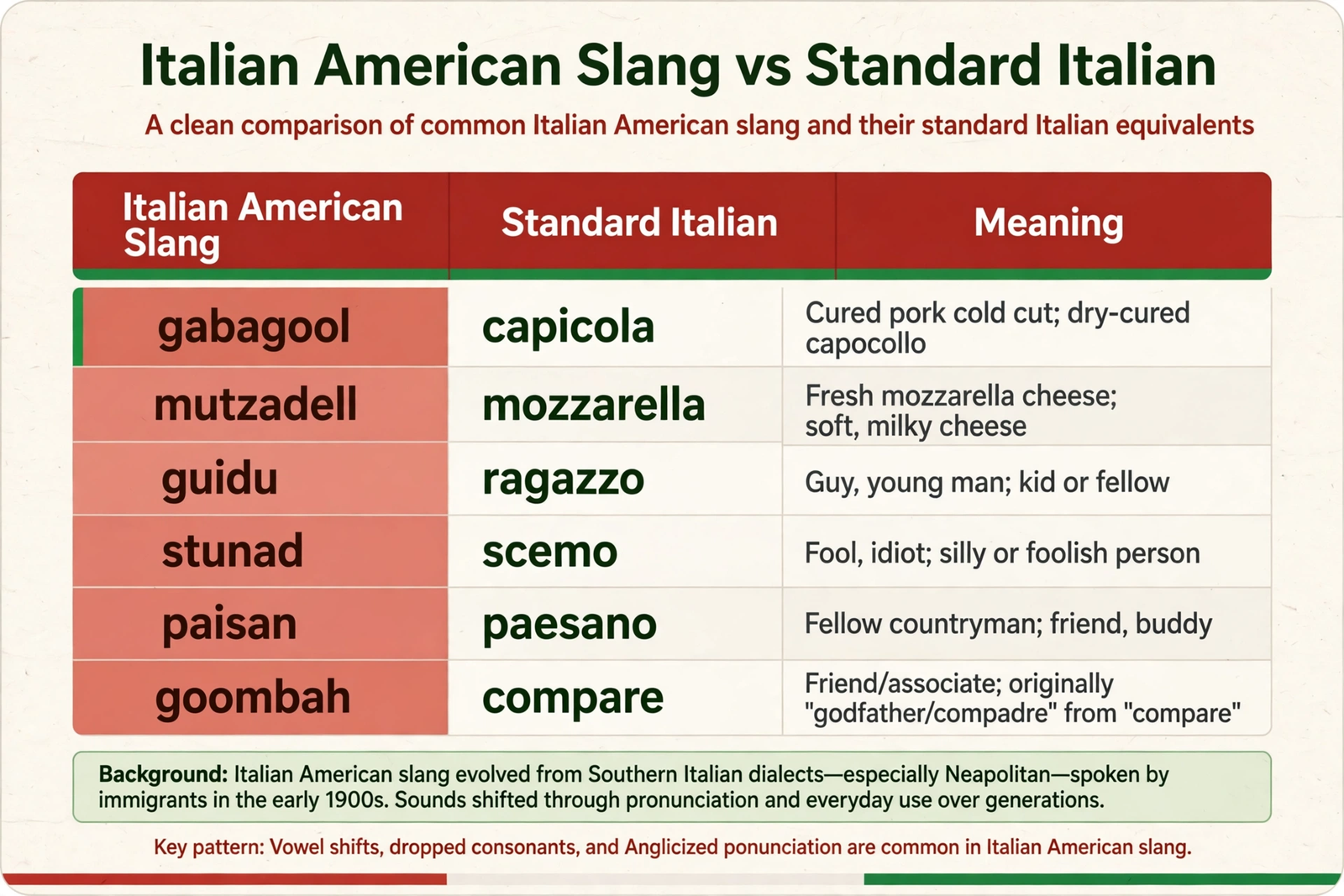
The most famous feature of this slang is what happened to the ends of words. In Neapolitan and Sicilian dialect, final vowels are often dropped or swallowed, so capicola became gabagool, mozzarella became mutzadell, and ricotta became rigot. The hard c sound in these words softened into a g sound, which is why the spellings look so different from the original Italian. These were not mistakes — they were the natural sound rules of the dialects, carried across the Atlantic and passed down through generations.
Other words came straight from dialect with their meanings intact. Stunad comes from the Neapolitan stunato, meaning stunned or stupid. Goombah comes from compare, a term for a close male friend or godfather, and its feminine counterpart goomah comes from comare. Agita comes from the Italian verb agitare, to agitate — in Italian American slang it means an upset stomach, or the anxiety that causes one. These words were everyday vocabulary in immigrant homes long before Hollywood ever heard them.
Hollywood then did what Hollywood does: it amplified everything. The Godfather (1972), Goodfellas (1990), and The Sopranos (1999–2007) turned Italian American slang into a global export. Suddenly, fuggedaboutit was something everyone knew, and bada bing was a punchline on every late-night show. Italian Americans themselves have mixed feelings about this — proud of the culture, less thrilled that the loudest version of it on screen is often the mob version. The slang is much bigger than the mafia stereotype, and the food, family, and friendship words are where its real heart lives.
Popularity
Italian American slang has never really gone away, but it has had several waves of popularity. The first wave was in the neighborhoods themselves, from the 1920s through the 1960s, when it was simply how people talked. The second wave came with the mob movies of the 1970s and 1990s, which made the slang famous worldwide. The third wave is happening right now, on TikTok and Instagram, where creators use Italian American slang for comedy sketches, cooking videos, and “things my nonna says” content that racks up millions of views.
Food content has been a huge driver. Italian American cooking videos — Sunday sauce, meatballs, baked ziti — almost always come with the slang attached. When a creator says gabagool while layering a sandwich, the comments fill up with people repeating it, asking what it means, and sharing their own family’s version of the word. The slang has become a gateway into the food, and the food has become a gateway into the slang.
There is also a nostalgia factor. For many Italian Americans, especially third- and fourth-generation families, the slang is a link to grandparents and great-grandparents who have passed away. Using the old words is a way of keeping them close. That emotional pull is why the slang survives even as the original dialects fade — the words carry memory, identity, and love in a way that plain English often does not.
How It Is Used
Italian American slang is used in three main ways: as food vocabulary, as family and friendship talk, and as expressive filler — the colorful words and phrases that add flavor to a sentence. Most of the food words are simply the dialect names for things: gabagool is capicola (a cured pork), mutzadell is mozzarella, manigot is manicotti. You will hear them in delis, at dinner tables, and in recipes passed down on stained index cards.
The family and friendship words do social work. Calling someone your goombah says they are more than a friend — they are like family. Calling someone a paisan (from paesano, fellow countryman) says you share roots. Madone — short for Madonna mia, “my Madonna” — is the classic exclamation of shock, delight, or disbelief, the Italian American equivalent of “oh my God.”
Then there is the expressive layer: fuggedaboutit (forget about it) can mean “don’t worry about it,” “it’s not important,” or “absolutely not,” depending on tone. Bada bing means “and just like that” — the punchline to a story. Stunad and chooch are gentle insults for someone acting foolish, the kind of thing you say to a friend, not an enemy. Context and tone decide almost everything with these words, which is why the examples below matter so much.
One important note: Italian American slang is mostly spoken, not written. Spellings vary wildly — fuggedaboutit, fuhgeddaboudit, forgetaboutit — because people spell the words the way they hear them. There is no official dictionary for most of these terms, so do not worry about getting the spelling perfect. The sound and the meaning are what count.
Examples
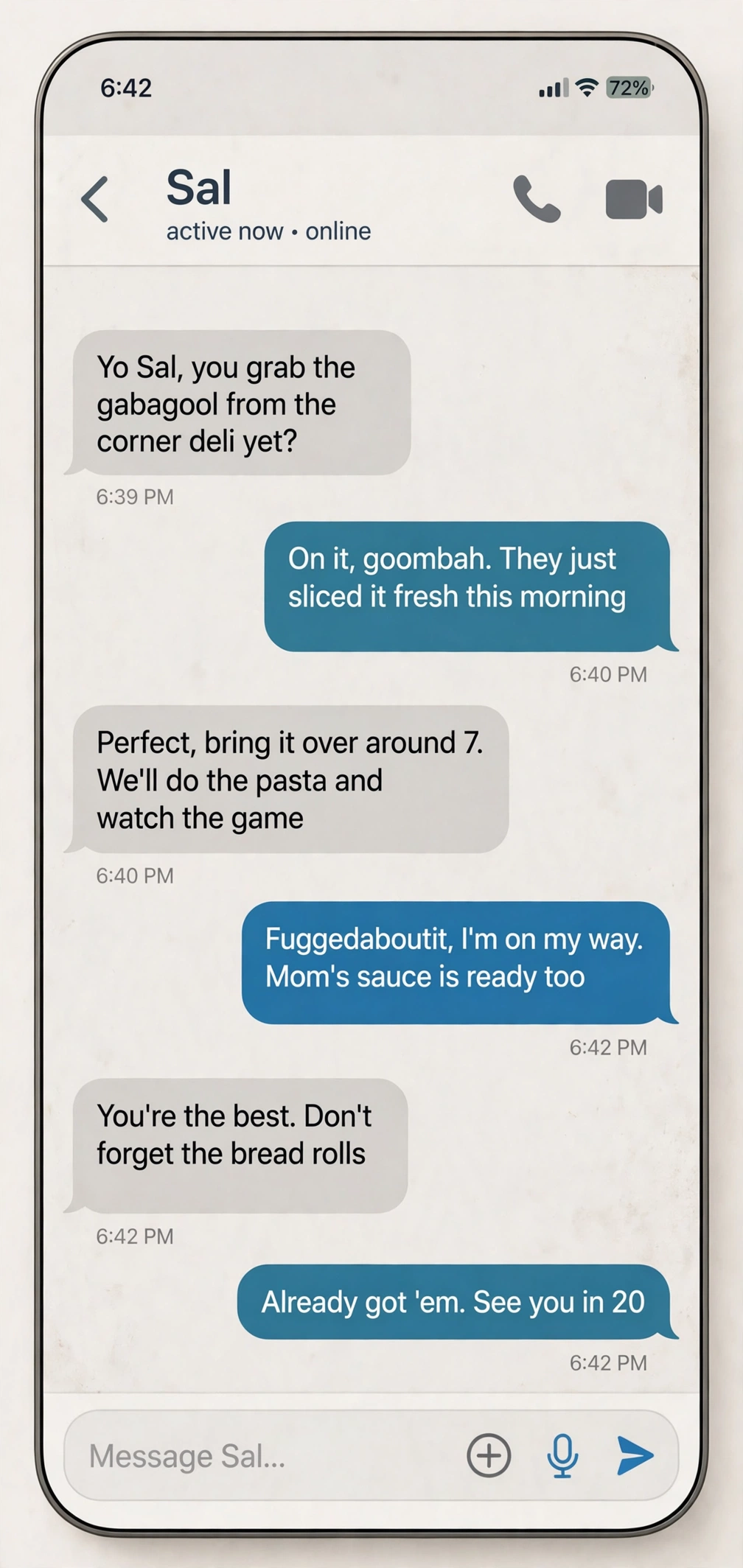
The best way to learn Italian American slang is to see it in action. Here are real-world examples in different tones, so you can feel how the same words shift with context.
Friendly Examples
- “Hey goombah, come over Sunday — Ma’s making the sauce.” — A warm invitation. Goombah here means best friend, practically family.
- “Grab some gabagool and mutzadell from the deli on your way home.” — Everyday food shopping talk in an Italian American household.
- “Madone, look at this spread! You outdid yourself, Auntie.” — Madone as delighted surprise at a big family dinner.
- “My paisan from the old neighborhood just opened a bakery.” — Paisan as a proud marker of shared roots.
- “Don’t give me agita, just tell me what happened.” — Playful: “don’t stress me out.”
Professional Examples
- “The caterer asked if we wanted gabagool on the sandwich platter.” — In a deli or catering context, the dialect food terms are standard professional vocabulary.
- “Our Sunday sauce simmers for six hours — that is the family recipe.” — A restaurant owner describing their menu with pride, using the community’s own word for tomato sauce.
- “He’s a stand-up guy, a real goombah — you can trust him with the business.” — Used carefully in business, goombah signals loyalty and trust.
Funny Examples
- “Fuggedaboutit — I already ate the last meatball.” — The classic shrug: it is done, move on.
- “Bada bing, bada boom — and suddenly I’m the one doing the dishes.” — Bada bing as the comic punchline to a story.
- “Don’t be a stunad, the sauce goes on the pasta, not the tablecloth.” — Teasing a friend for a silly mistake. Funny between friends, rude to a stranger.
- “He tried to impress Nonna with his cooking. Madone, the look on her face.” — Madone as the setup for a family comedy moment.
Comparison with Similar Terms
Italian American slang is often confused with standard Italian, and with the slang of other immigrant communities. The table below clears up the differences.
| Term / Concept | What It Means | How It Differs |
|---|---|---|
| Italian American slang | Dialect words reshaped by English (gabagool, goombah, fuggedaboutit) | Spoken by Italian American families; sounds different from standard Italian |
| Standard Italian | The official language of Italy (capicola, mozzarella, compare) | Formal, written, taught in schools; an Italian in Rome would not say gabagool |
| Italian slang | Modern slang used in Italy today (che figata, boh, dai) | Comes from Italy itself; mostly younger speakers, different vocabulary entirely |
| New York slang | General NYC expressions (fuggedaboutit overlaps here) | Broader city slang shared by many groups; Italian American slang is one ingredient |
| Sicilian / Neapolitan dialect | The original regional languages of Southern Italy | The source material; Italian American slang is what happened to them in America |
The key takeaway: if you say gabagool in Naples, people will understand you — but they will know instantly that you learned the word in America. And if you say capicola in a New Jersey deli, people will understand you too — but they might smile, because the “real” word around there has always been gabagool.
Alternate Meanings
Most Italian American slang words have one main meaning, but a few shift depending on context — and a few soundalikes cause genuine confusion.
- Goombah vs. goomah: Goombah (from compare) is a close male friend or godfather. Goomah (from comare) traditionally means a godmother — but in mob-movie usage it also means a mistress. Same root, very different meanings. In family settings, use goomah only for the godmother sense.
- Agita: Literally an upset stomach, but just as often it means stress or anxiety in general. “You’re giving me agita” usually means “you’re stressing me out,” not “you’re hurting my stomach.”
- Fuggedaboutit: Three meanings in one phrase: “don’t worry about it,” “it’s not important,” and “absolutely not.” Tone is everything — said warmly it is reassuring, said flatly it is a dismissal.
- Stunad: Means foolish or stunned, but it can be affectionate (“you lovable stunad”) or genuinely insulting, depending on who says it and how.
- Sauce vs. gravy: In many Italian American families, tomato sauce is called “gravy” — and in others, calling it gravy is a serious offense. Both sides are convinced they are right. This is the most famous friendly argument in Italian American culture, and there is no winning it.
- Words to avoid: A few old terms, like guinea and wop, began as slurs against Italian immigrants and are still offensive today. They are part of the history, but they are not slang to use — ever.
Professional or Polite Alternatives
Italian American slang is warm and expressive, but it is casual by nature. In formal settings, or when you are talking to people outside the community, the standard terms work better. Here is how to translate:
| Slang Term | Polite / Standard Alternative | When to Switch |
|---|---|---|
| Gabagool | Capicola | Menus, formal recipes, talking to non-Italian speakers |
| Mutzadell | Mozzarella | Written recipes, restaurants outside Italian neighborhoods |
| Fuggedaboutit | “Don’t worry about it” / “No problem” | Work emails, formal conversations, strangers |
| Stunad / chooch | “Silly” / “being foolish” | Any professional setting — the slang versions are insults |
| Goombah | “Close friend” / “old friend” | Formal introductions, business settings |
| Madone | “Oh my goodness” / “Wow” | Polite company, mixed audiences |
The rule of thumb is simple: slang belongs where warmth and familiarity belong. At the family table, in the neighborhood deli, or joking with old friends, it is perfect. In a job interview, a formal email, or a first meeting, use the standard words — you can always switch to the slang later, once everyone is comfortable.
Common Mistakes
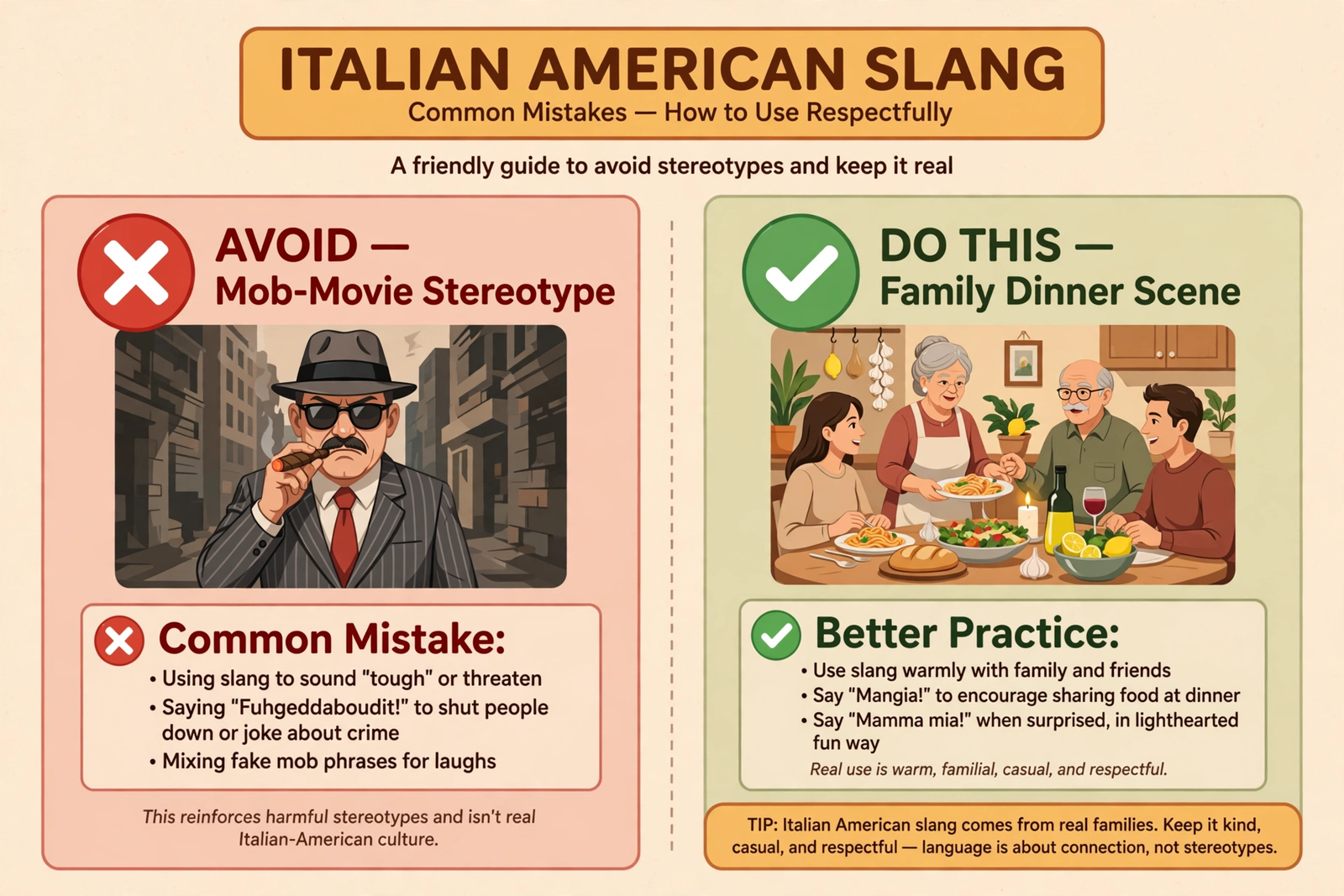
Italian American slang is easy to love and easy to get wrong. These are the mistakes people make most often:
- Using mob-movie slang as if it were the whole culture. The mafia stereotype is a tiny, loud slice of Italian American life. Leading with bada bing and wiseguy talk to an Italian American stranger can come across as a caricature, not a compliment.
- Calling tomato sauce “gravy” in the wrong house. Some families say gravy, others consider it a crime. If you are a guest, follow the host’s lead — and never correct them either way.
- Using goomah to mean “girlfriend.” In traditional usage it means godmother; in mob movies it means mistress. Either way, it is not a casual word for a girlfriend, and using it that way will raise eyebrows.
- Saying the food words with a fake accent. The charm of gabagool is that it is how real families actually say it. An exaggerated accent turns a real word into a parody.
- Repeating slurs you heard in old movies. Words like guinea and wop are slurs, not slang. Quoting them, even innocently, can genuinely hurt people.
- Assuming every Italian American uses this slang. Many Italian American families never used these words at all, especially families from Northern Italy or later generations. Do not assume someone’s background from a last name.
- Overusing it. One fuggedaboutit in a story is charming. Five in one sentence is a parody. Like any strong flavor, a little goes a long way.
Quick Tips
- Learn the food words first. Gabagool, mutzadell, manigot, and rigot are the safest and most useful words to know — everyone loves talking about food, and these words open doors.
- Listen before you use it. Spend time around Italian American speakers — in person, in cooking videos, in family comedies — and notice which words come up naturally before you try them yourself.
- Start with fuggedaboutit. It is the most famous phrase, it is hard to misuse badly, and it works in a dozen situations. Just keep the tone warm.
- Use it with warmth, not as a joke. The slang is beloved because it carries family feeling. If you use it affectionately, people will respond affectionately.
- Pair the words with the culture. The slang makes more sense when you know the food and the family traditions behind it. Cook a Sunday sauce, watch a classic film, or visit an Italian deli — the words will stick much faster.
- Respect the boundaries. Some words are in-group words. If an Italian American friend uses a term with you, that is an invitation; if they do not, enjoy the slang as a listener and a learner.
- Explore related slang. Italian American slang sits alongside other regional and immigrant slangs — from Spanish slang words to French slang and Mexican slang — and comparing them shows how every community seasons English in its own way.

FAQ

What does gabagool mean?
Gabagool is the Italian American pronunciation of capicola, a cured Italian pork cold cut. It comes from the Neapolitan dialect, where the hard “c” softened to a “g” and the final vowel dropped away. You will hear it in delis and at family tables across New York and New Jersey.
What does fuggedaboutit mean?
Fuggedaboutit is the Italian American way of saying “forget about it.” Depending on tone, it can mean “don’t worry about it,” “it’s not important,” or “absolutely not.” It is one of the most famous phrases in Italian American slang, popularized by mob movies and The Sopranos.
What does goombah mean?
Goombah comes from the Italian compare and means a close male friend — someone so close they are practically family — or a godfather. Its feminine counterpart is goomah, from comare, which traditionally means godmother.
Is Italian American slang the same as Italian?
No. Italian American slang comes from Southern Italian dialects like Neapolitan and Sicilian, reshaped by a century of American English. A person in Rome would say capicola and mozzarella, not gabagool and mutzadell. Standard Italian and Italian American slang are cousins, not twins.
What does madone mean?
Madone is short for Madonna mia, “my Madonna.” It is an exclamation of surprise, shock, or delight — the Italian American equivalent of “oh my God.” You will hear it at family gatherings, usually right before a big reaction to some news.
What does stunad mean?
Stunad comes from the Neapolitan stunato and means foolish, stunned, or acting silly. It is usually a gentle, teasing insult between friends and family — but it can sting if said seriously, so save it for people you know well.
Why do Italian Americans call tomato sauce “gravy”?
In many Italian American families, especially those with roots in Southern Italy, the long-simmered Sunday tomato sauce is called “gravy” — a habit that likely came from the English word for meat sauce being applied to the family’s meat-based ragù. Other Italian American families insist it is “sauce” and consider “gravy” wrong. Both traditions are real, and the debate is famously friendly and never-ending.
Is it okay for non-Italians to use Italian American slang?
Yes, in most cases — especially the food words and friendly phrases like fuggedaboutit and goombah. Use them warmly and in the right context, avoid the slurs and the mob caricature, and remember that the slang belongs to real families. Used with respect, it is a compliment to the culture, not an imitation of it.
Conclusion
Italian American slang is far more than a collection of funny words from mob movies. It is a century-old blend of Neapolitan and Sicilian dialect and American English, built in immigrant kitchens and neighborhood streets, and kept alive by families who still gather around a pot of Sunday sauce. Words like gabagool, goombah, madone, and fuggedaboutit carry history, humor, and belonging in a handful of syllables.
The key takeaways are simple. Start with the food words — they are the friendliest way in. Learn the family words, and use them with warmth. Understand that tone decides meaning, that the slang is spoken more than written, and that a few words are best left alone entirely. And remember that behind every funny pronunciation is a real story of immigration, adaptation, and love.
So the next time someone offers you a sandwich with gabagool and mutzadell, or tells you to fuggedaboutit with a smile, you will know exactly what they mean — and exactly how to answer. Keep exploring the world of slang, from regional favorites like Italian slang to the newest terms taking over TikTok, and you will never be lost in the conversation again.
