
Quick Definition: Cool in spanish slang is expressed with words like chévere, guay, chido, bacán, and piola — informal words that mean “cool,” “awesome,” or “great.” Which word you hear depends on the country: Mexicans say chido, Spaniards say guay, and Venezuelans and Colombians say chévere. There is no single Spanish word for “cool” — there are at least fifteen, and using the wrong one in the wrong country instantly marks you as a tourist.
Cool in Spanish Slang Meaning & Definition
Cool in spanish slang means the casual, everyday words Spanish speakers use instead of the textbook word genial when they want to say something is cool, awesome, fun, or impressive. English has one word — “cool” — that covers everything from a great song to a nice person to a fun party. Spanish splits that job across dozens of regional slang words, and each one carries its own flavour, country, and attitude.
At its simplest, cool in spanish slang works like this: chévere is the all-purpose “cool” of the Caribbean and northern South America, guay is Spain’s version, chido belongs to Mexico, bacán rules Chile, Peru, and Colombia, and piola is the quiet-cool word of Argentina and Uruguay. They all translate to “cool” in English, but they are not interchangeable — a Mexican will understand guay, but nobody in Mexico City actually says it.
That is the first thing to understand about cool in spanish slang: it is a map, not a dictionary entry. The word you choose tells people where you learned Spanish, who you hang out with, and how plugged in you are. Get it right and you sound like a local. Get it wrong and you sound like a textbook with a passport.
Introduction
Picture this: you are in a bar in Madrid, a friend shows you a photo of his new motorbike, and you say “¡Qué chido!” Everyone smiles — politely. You used the right idea and the wrong country. In Spain, that bike is guay, or molón, or even brutal. Chido is perfect in Mexico City and sounds out of place in Madrid. One word, one border, completely different reaction.
That is why so many people search for cool in spanish slang. Spanish is spoken in more than twenty countries, and slang is the part of the language that changes fastest and travels least. The classroom teaches genial and fantástico, which are correct everywhere and exciting nowhere. Real people in real conversations say chévere, bacán, piola, padre, and a dozen other words — and each one opens a small window into a country’s culture.
This guide covers the fifteen most useful ways to say cool in spanish slang, with the country where each word lives, real examples of how people use it, and the mistakes that give learners away. Whether you are texting a friend in Bogotá, watching a Mexican YouTuber, planning a trip to Buenos Aires, or just trying to understand the lyrics of a reggaeton song, you will leave here knowing exactly which “cool” to use — and where. If you want the bigger picture first, start with our full list of Spanish slang words and then come back for the deep dive on “cool.”

Origin
Most words for cool in spanish slang were born from local history, not from a dictionary. Chévere probably comes from the African roots of Caribbean Spanish, carried through Cuba and Venezuela, and it spread across the Caribbean coast until it became the default “cool” from Caracas to San Juan. Guay has a murkier past — some linguists link it to the Arabic influence on Spanish, others to old Romani slang — but by the 1980s it was the unmistakable voice of young Spain.
Chido is a Mexican classic with indigenous and working-class roots in Mexico City, popularised through films, music, and television until it became one of the most recognised Mexican slang words in the world. Bacán travelled from lunfardo, the old street slang of Buenos Aires, up the Pacific coast to Chile and Peru, where it settled in as the everyday word for something excellent. Piola also comes from lunfardo, where it originally meant something clever or cunning before softening into “cool” and “chill.”
Then there is the English effect. In the last twenty years, the English word “cool” itself has marched into Spanish, especially among young people and in cities. You will hear “¡Qué cool!” in Madrid, Mexico City, and Miami alike. It is real, it is common, and it is also the easy way out — the Spanish equivalents carry far more local colour, and using them is what separates a fluent speaker from a natural one.
Popularity
Why did cool in spanish slang become such a searched topic? Three reasons explain it.
First, Spanish-language music went global. Reggaeton, Latin trap, and regional Mexican music dominate streaming charts, and their lyrics are packed with slang. When Bad Bunny or Peso Pluma calls something chévere or chido, millions of listeners look the word up the same day.
Second, streaming television made regional Spanish impossible to ignore. A viewer who watches a Colombian narco-drama, a Spanish teen series, and a Mexican comedy in the same week hears three different words for “cool” — and naturally wants to know which is which. Shows like La Casa de Papel turned guay and molón into words English speakers recognise, while Mexican series exported chido and padre worldwide.
Third, travel and texting made slang practical. Millions of people now chat daily with Spanish-speaking friends, date across borders, or travel through Latin America and Spain. Knowing the local word for “cool” is the fastest way to sound friendly instead of formal — and in Spanish-speaking cultures, sounding friendly matters more than sounding correct.
How It Is Used
Cool in spanish slang is used in very specific ways, and country and context decide everything. The same idea — “that’s cool” — comes out differently depending on where you are and who you are talking to.
- As a reaction: The most common use. Someone shows you something good and you answer with one word: “¡Chévere!” “¡Qué guay!” “¡Qué chido!” It works exactly like “Cool!” or “Awesome!” in English.
- To describe a person: “Es un tipo bacán” (He’s a cool guy) in Chile, or “Es una chica muy piola” (She’s a really cool girl) in Argentina. Note that most of these words change form with gender — chido/chida, bacán/bacana, piola stays the same.
- To describe a thing or place: “Un restaurante bien chévere” (a really cool restaurant), “una fiesta copada” (a cool party) in Argentina.
- To agree to a plan: “¿Vamos a la playa? — ¡Chévere!” works like “Sounds good!” or “Cool, let’s go!”
- Ironically: Like English, Spanish slang can be sarcastic. A flat “qué guay…” after bad news means the opposite. Tone does the work.
- In texts and chats: Short and punchy. “q chido”, “chevere!!”, “re piola” — slang gets even shorter online, and accents often disappear in fast typing.
The golden rule of cool in spanish slang is simple: use the word that belongs to the country you are in. One local word beats five impressive ones from five different countries. If you are not sure which country your listener is from, genial or qué bueno are safe everywhere — but the moment you know, switch to the local word and watch their face change.
Examples
Real examples show how cool in spanish slang actually sounds in conversation. Here are the same kinds of moments — friendly chats, work messages, and jokes — in different countries.
Friendly Examples
- Venezuela / Colombia: “¿Viste el nuevo video de Shakira? ¡Está chévere!” — Did you see Shakira’s new video? It’s so cool!
- Mexico: “¡Qué chido está tu carro nuevo!” — Your new car is so cool!
- Spain: “¡Qué guay es este sitio! Tenemos que volver.” — This place is so cool! We have to come back.
- Chile: “El concierto estuvo bacán, ¿cierto?” — The concert was awesome, right?
- Argentina: “Tu remera está re piola.” — Your T-shirt is really cool.
- Costa Rica: “¡Qué tuanis la fiesta de anoche!” — Last night’s party was so cool!
Professional Examples
Slang and work do mix — carefully. With colleagues you know well, a light slang word builds warmth; with a client or a boss, stick to neutral Spanish.
- “La presentación quedó genial, ¡muy buen trabajo!” — The presentation turned out great, very good work! (Genial is the safe professional choice everywhere.)
- “¡Qué chévere que el proyecto salió bien!” — How great that the project went well! (Warm, fine with a Colombian or Venezuelan team.)
- “¡Qué guay, lo conseguimos!” — How cool, we did it! (Natural with a Spanish team after a win.)
- “Está padre la idea, vamos a desarrollarla.” — The idea is cool, let’s develop it. (Common in Mexican offices.)
Funny Examples
- “Mi abuela tiene más flow que yo, ¡qué chévere es ella!” — My grandma has more style than me, she’s so cool!
- “El perro aprendió a abrir la puerta. ¡Qué crack, es lo más guay del mundo!” — The dog learned to open the door. What a legend, he’s the coolest thing ever!
- “Intenté bailar salsa y terminé en el suelo. Muy bacán yo, ¿no?” — I tried to dance salsa and ended up on the floor. Very cool of me, right? (Sarcastic — the opposite of cool.)
- “Me compré unos zapatos que brillan en la oscuridad. Soy el más piola del barrio.” — I bought shoes that glow in the dark. I’m the coolest guy in the neighbourhood.

Comparison with Similar Terms
Not every word for cool in spanish slang means exactly the same thing. Some are warmer, some are stronger, and some describe people better than things. This table sorts out the most important ones — and if you want the English side of the same idea, our guide to slang for cool shows how English speakers do the same job.
| Word | Main Countries | Closest English | Best Used For |
|---|---|---|---|
| Chévere | Venezuela, Colombia, Caribbean, Central America | Cool, great, nice | Almost anything — the most versatile |
| Guay | Spain | Cool, neat | Things, places, plans |
| Chido | Mexico | Cool, awesome | Things, experiences, reactions |
| Bacán / Bacano | Chile, Peru, Colombia, Ecuador | Awesome, cool | People, parties, experiences |
| Piola | Argentina, Uruguay, Chile | Cool, chill | People, relaxed situations |
| Padre | Mexico | Cool, great | Things and ideas (“¡qué padre!”) |
| Copado | Argentina | Cool, awesome | Parties, places, plans |
| Molón | Spain | Cool, groovy | People and style |
| Genial | Everywhere (standard Spanish) | Great, brilliant | Anywhere — the safe universal word |
| Brutal | Spain, Latin America | Brutal, insane (good) | Something impressively intense |
| La raja | Chile | The best, awesome | Strong praise (“¡está la raja!”) |
| Chilero | Guatemala | Cool, nice | Everyday Guatemalan praise |
| Tuanis | Costa Rica, Nicaragua | Cool, great | Almost anything in Costa Rica |
| Cool | Everywhere (borrowed) | Cool | Young, urban, informal speech |
The pattern is clear: chévere and genial are the two most flexible words on the list, guay and chido are the two most tied to one country, and the rest add local colour. If you only memorise three, make them chévere, chido, and guay — between them they cover the Caribbean, Mexico, and Spain, which is where most learners will use Spanish first.

Alternate Meanings
Like all slang, the words for cool in spanish slang carry extra meanings that can surprise learners. Padre literally means “father” in standard Spanish — so “¡qué padre!” is literally “how fatherly!” even though every Mexican hears it as “how cool!” Context is everything, and nobody in Mexico is confused. Brutal literally means “brutal,” but as slang it is pure praise: “¡qué brutal!” means “that’s insanely good!”
Piola is the trickiest. In Argentina it can mean “cool” or “chill,” but it can also mean “clever” or “sly,” and in some contexts it means staying quiet and out of trouble — “quedate piola” means “keep a low profile.” Bacán can also describe a wealthy, flashy person in older lunfardo usage, not just something cool. And guay has a famous false friend: in some parts of Latin America, guay sounds like the word for a type of fruit or a rural person, which is one more reason it stays in Spain.
Then there is the word “cool” itself. Young Spanish speakers borrow it constantly — “¡qué cool!”, “eres muy cool” — and it is understood everywhere. But it is also the least impressive choice: it tells people you know English, not that you know Spanish. Use the local word when you can, and save “cool” for when you genuinely cannot remember the local one.
Professional or Polite Alternatives
Slang is for friends, not for boardrooms. When the situation is formal, these alternatives carry the same positive meaning without the street flavour:
- Genial — Great, brilliant. The universal safe word: “¡Qué genial!”
- Excelente — Excellent. Perfect for work emails and formal praise.
- Maravilloso / Maravillosa — Wonderful. Warm and polite, good for complimenting people and experiences.
- Fantástico — Fantastic. Slightly enthusiastic but always appropriate.
- Estupendo — Wonderful, stupendous. Common in Spain, understood everywhere.
- Increíble — Incredible. Works for things that genuinely impress you.
- Qué bueno — How good. The simplest polite reaction, and it works in every country.
A useful rule: if you would not say “awesome!” to your boss in English, do not say chido or bacán to your boss in Spanish. Genial and excelente are your professional equivalents, and they never sound out of place.
Common Mistakes
Learners make the same four mistakes with cool in spanish slang. Avoid them and you will already sound better than most students.
1. Using the wrong country’s word. Saying guay in Mexico or chido in Madrid is understandable but instantly foreign. Match the word to the country. If you are chatting online, check where the person is from before you pick your word.
2. Forgetting gender agreement. Many of these words are adjectives, so they change with gender: chido becomes chida for a woman, bacán becomes bacana, copado becomes copada, molón becomes molona. “Una fiesta chida” is right; “una fiesta chido” is not. Chévere, guay, and piola do not change — one less thing to worry about.
3. Overusing one word for everything. Repeating chévere five times in one conversation sounds like a tourist who learned one word. Native speakers rotate: chévere, qué bueno, genial, brutal — variety is what makes slang sound natural.
4. Using slang in formal settings. Dropping ¡qué chido! in a job interview or a business email reads as careless, not friendly. In formal Spanish, genial and excelente do the same job with zero risk. Save the slang for the people you would joke with in English.

Quick Tips
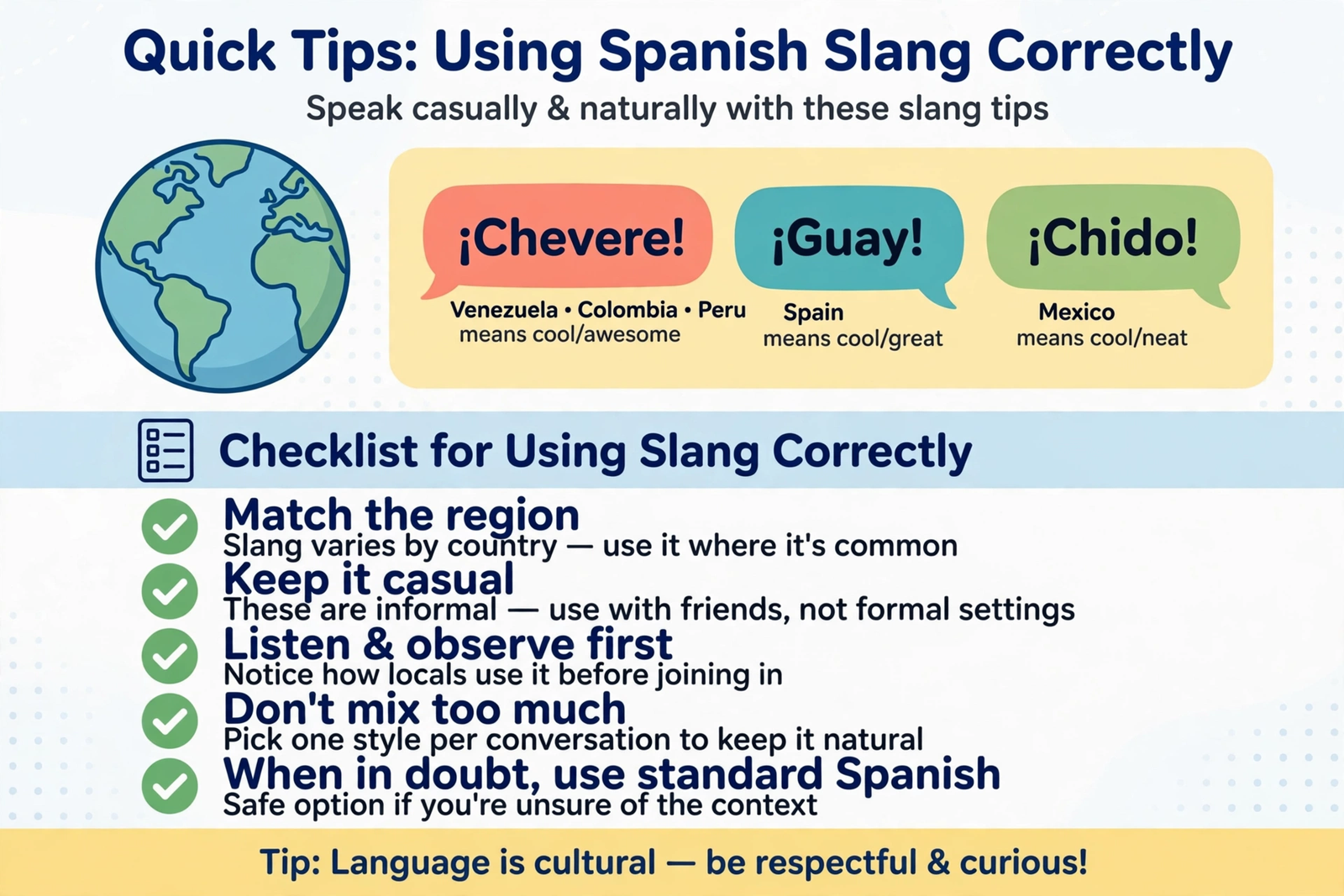
- Learn one word per country you care about. Mexico: chido. Spain: guay. Colombia/Venezuela: chévere. Chile: bacán. Argentina: piola. Five words cover most of the Spanish-speaking world.
- Listen before you speak. In any new group, wait until you hear which word the locals use, then copy it. That is how natives learn slang too.
- Use genial as your default. When you do not know the local word, genial is correct, warm, and understood from Madrid to Mexico City.
- Add qué for emphasis. “¡Qué chévere!” and “¡Qué guay!” hit harder than the bare word — it is the Spanish equivalent of “so cool!”
- Watch reggaeton lyrics and Spanish series with subtitles. You will hear chévere, bacán, and guay in their natural habitat, with tone and context included free of charge.
- Check the dictionary when in doubt. For exact definitions and conjugations, SpanishDict’s guide to translating “cool” is a reliable place to confirm what each word means before you use it.
- Do not force it. One natural chido beats ten awkward ones. Slang works when it slips out, not when it is performed.
FAQ
What is the most common way to say cool in spanish slang?
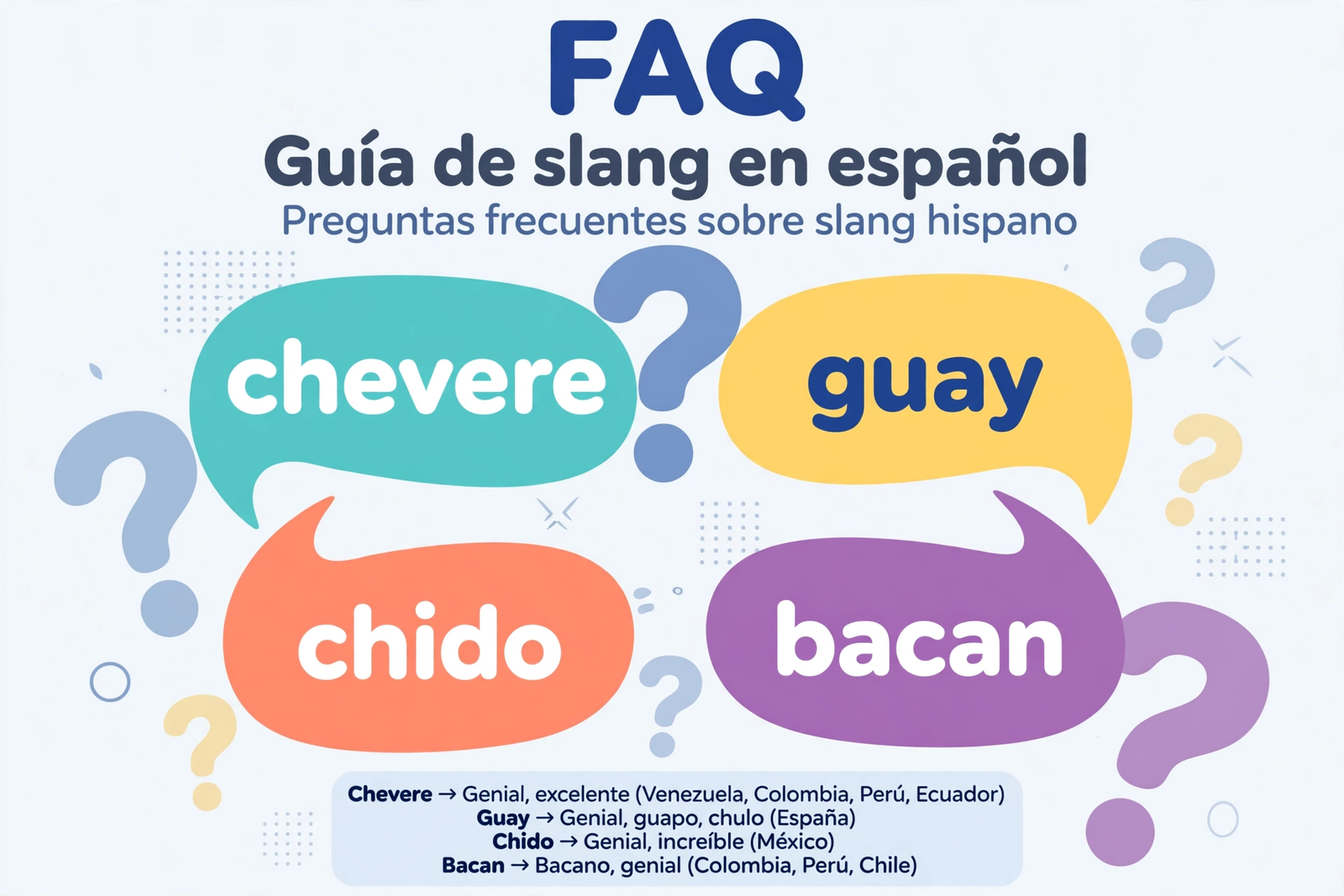
Chévere is the most widely used, understood across Venezuela, Colombia, the Caribbean, and much of Central America. In Spain the answer is guay, and in Mexico it is chido. If you need one word that works almost anywhere in Latin America, pick chévere.
How do you say cool in Spanish in Mexico?
In Mexico, say chido (for masculine things) or chida (for feminine things): “¡Qué chido!” Mexicans also say padre — “¡qué padre!” — and genial works everywhere. For more Mexican expressions, see our guide to Mexican slang.
How do you say cool in Spanish in Spain?
In Spain, say guay: “¡Qué guay!” Spaniards also use molón for people with style, brutal for something impressively good, and genial as the safe all-purpose word.
What does chévere mean in Spanish slang?
Chévere means “cool,” “great,” or “nice” in Spanish slang. It is used in Venezuela, Colombia, Cuba, Puerto Rico, the Dominican Republic, and parts of Central America. It can describe people, things, plans, and experiences, and it works as a reaction (“¡Chévere!”), an adjective (“una persona chévere”), or an agreement (“¿Vamos? — ¡Chévere!”).
Is guay or chido more common?
Neither — they belong to different countries. Guay is the everyday word in Spain, and chido is the everyday word in Mexico. Both are extremely common inside their own country and rarely used outside it, so the right choice depends entirely on where you are.
Can I just say “cool” in Spanish?
Yes — young Spanish speakers borrow the English word “cool” all the time, and it is understood everywhere. But it is the least local choice. Using chévere, guay, or chido shows you actually know Spanish slang, while “cool” only shows you know English.
What is the difference between chévere and bacán?
Both mean “cool,” but they live in different regions and carry a slightly different feel. Chévere is warm and versatile, used across the Caribbean and northern South America for almost anything good. Bacán is stronger and more enthusiastic, used in Chile, Peru, and Colombia, and it often describes people and experiences rather than objects.
Is it rude to use Spanish slang as a learner?
No — Spanish speakers generally love it when learners use local slang, because it shows genuine interest in their culture. Just match the word to the country, keep it out of formal situations, and do not overuse a single word. One natural chévere will earn you more smiles than a perfect textbook sentence.
Conclusion
Cool in spanish slang is not one word — it is a whole map of the Spanish-speaking world. Chévere opens doors in Caracas and Bogotá, guay makes you sound at home in Madrid, chido and padre belong to Mexico, bacán rules the Pacific coast, piola and copado are pure Buenos Aires, and tuanis and chilero carry the flavour of Central America. Learn the word that belongs to the people you actually talk to, and you will sound less like a student and more like a friend.
The key takeaways are simple. Start with the big three — chévere, chido, and guay — then add the local word for wherever you travel or whoever you text. Remember gender agreement (chida, bacana, copada), keep slang out of formal settings, and let genial be your safety net when you are unsure. Slang is at its best when it builds connection — a shared laugh, a quick compliment, a word that tells someone you get their world.
Language keeps moving, and new words for “cool” will keep appearing in songs, series, and group chats. But if you know the fifteen words in this guide, you already speak the Spanish that real people use every day. Keep exploring — from expressions like the ones in our guide to gay in Spanish slang to the newest terms crossing your feed — and you will never be stuck for the right word again.

1 thought on “Cool in Spanish Slang: 15 Ways to Say Cool Like a Native Speaker”